
人教版新目标英语九年级上册(新)unit8 It must belong to Carla 说课稿
It must belong to CarlaI am honored to stand here! Thank you for giving me such a good opportunity to learn from you .Today I’ll talk about The first Period section A(from 1a to1C)of Unit8. It’s from Grade9 in Go For It! The title of this unit is “It must belong to Carla”. Here my speech mainly contains six parts I’ll introduce them one by one with your great help..一、Analysis of teaching material 二、Analysis of the students三、Teaching procedures 四、Black board design /z/五、Teaching process display 六、Teaching reflectionPart One: Teaching materialⅠ. Analysis of the teaching materialThis lesson is the first period of Unit8. With the help of Guessing Game, Listening practice and dialogue, modal verbs are used to develop the Ss’language skills of speculation. Therefore the lesson will lay a foundation for the future .Ⅱ. Analysis of the studentsStudents of Grade nine have learned English for 3 years. They have a good foundation in words and sentences. They have mastered some skills of listening, speaking, reading, and writing. Most students have taken a great interest in English now, they enjoy learning English. But Ss can’t learn English well. Especially Ss are afraid of speaking English in front of people. So I always encourage them to take an active part in each class and help them speak bravely and confidently.Ⅲ. Teaching aims and demandsKnowledge objectives:Students can master vocabularies and languages structures.Ability objectives:Learn to use modal verbs to show their own speculations.Moral objective:Combined with the surrounding scenes and things, make correct judgement. Emotional objective:To make the students be interested in good co-operation and competition. Ⅳ. Important pointsA. Key vocabularies:whose , truck , rabbit, picnicB. Key structuresThe key point of the lesson is using modal verbs to show your speculations. Ⅴ. Difficult pointHow to use belong to , must, might, could , can'tⅥ. Teaching aids:Tape recorder, Power-point CAIPart Two: Teaching & Learning methodsTeaching methodsIn this lesson, I’ll mainly use the “task-based” teaching method, and it will be used in the whole lesson. I think it’s helpful to develop the Ss’ thoughts. I’ll also use “situation communication”method. It can provide enoughlistening and speaking situations for Ss. I think good teaching methods are the keys to success.Learning methodsIn this lesson, I use different ways to guide the Ss better and develop the Ss’ abilities, such as pairwork,groupwork and reports. The Ss will learn how to be a good language learner , and how to communicate with others. It will be very helpful for their learning in the future. I think good studying ways can help the Ss to be good language learners.Part Three: Teaching proceduresStep1 Warming up and Lead-in1.Greetings and ask two students do a short sport about the last unit.2. Take out my moblie phone, ask and answer like this:T:What’s this? Ss: It’s a moblie phoneT:Whose moblie phone is this? Ss: It’s Ms Luo’sT: So we can say “It must belong to Ms Luo”Today we are going to unit8 It must belong to carlaPurpose: It’s necessary for the Ss to provide a situation to review knowledge and it’s important to form a better English surrounding for Ss. Step2 Presentation1.Show three groups of pictrues, ask and answer,then teach them to read these new words one by one.2. Play a memory gamePresent these pictures once again and ask them to speak out loudly what this is/what they are doingPurpose: To get the feedback of the words-learning.3. Ask the Ss to complete 1a, and then check the answers with them.Purpose: To check if the students have really mastered these words Step3: Pairwork(1c)1. Show some pictures to the Ss, and guide them to make conversations like this:Whose notebook is this?The notebook must be Mary’s= The notebook must belong to Mary .2. Invite two groups of students to come to the platform, use their own things to make conversations like this, then ask all the Ss to practice the conversation .---Whose ….. is this?---It must/might/could/can’t belong to sb.be sb’s .Purposes:1. To learn to use.2. To train the students’ cooperation ability as well as improve their spoken English.Step4: Listening Practice. (1bPurpose: To train the students’listening ability, listening can make the Ss consolidate the knowledge step by step.Step5: GroupworkInvite six students to take their own things to the platform, and play a guessing game , then ask the Ss to practice the conversation(6 students with a group)--Whose …… is this/that?---It must/might/could/can’t belong to sb. because…..=It must/might/could/can’t be sb’s.---Is this yours?/ Does it belong to you?---Yes/No…..Purpose: This activity can improve Ss comprehensive ability of using English. The Ss at this age enjoy showing themselves, so it can also improve their studying interests; I think it’s most important during studying, because interest is a best teacher.Step6: ExercisePurpose: To check the outcome of this class, including words and sentence patternsStep7 Homework1. Review the new words & target language.2. Make a dialogue according to sample and write it inthe exercise book.Part Four: Blackboard designNew Words: whose,truck,rabbit,picnicSentence structures:---Whose …… is this/that?---It must/might/could/can’t belong to sb.=It must/might/could/can’t be sb’s.---Is this yours?/ Does it belong to you?---Yes/No…..Part Five:Teaching processPart Six: Teaching reflectionIn this lesson, I mainly adopt the Task-Based Learning Method. I design many various activities that close to students’life, I also arrange individual work, pair work, and group work for students to practice English。
人教新目标英语九年级全册 Unit 8 It must belong to Carla. Section A (3a-3c) 课件
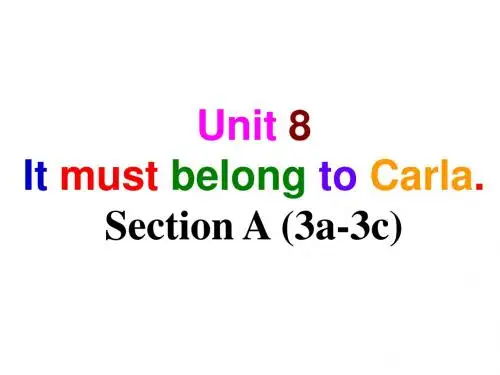
feeling uneasy
Victor's family
wife: could be an
animal
Victor and his fridens:must be
other persons
teenagers
policeman: might be the wind
Helen: a dog-can't be a dog
Unit 8 It must belong to Carla.
Section A (3a-3c)
Keoliceman, wolf, uneasy, nothing much, at first, go
away ,in the neighborhood.
Key sentences:
n. 事件,发生的事 n. 声音; 噪音 n. 男 警察 n. 狼 adj. 担心的,不安的
Check the previewsion
3b Read the article and find words to match the
meanings.
uneasy neighbor teenagers neighborhood wolf noise-maker
The policemen
They think it might be the wind.
2019/6/24
Read the para2-3 and fill in the chart.
Helen
She guesses/thinks it can’t be a dog.
She thinks it was too big to
nervous or worried _u__n_e_a__s_y_ young people _t_e_e_n__a_g_e_rs person in the next house _n_e__ig__h_b_o__r area where people live n__e_ig__h_b__o_r_h_o_ od animal like a very large dog __w__o_l_f_ person who makes noise _n_o__is_e__-m___aker
2020秋九年级英语全册Unit8ItmustbelongtoCarla词汇和短语素材新版人教新目标版
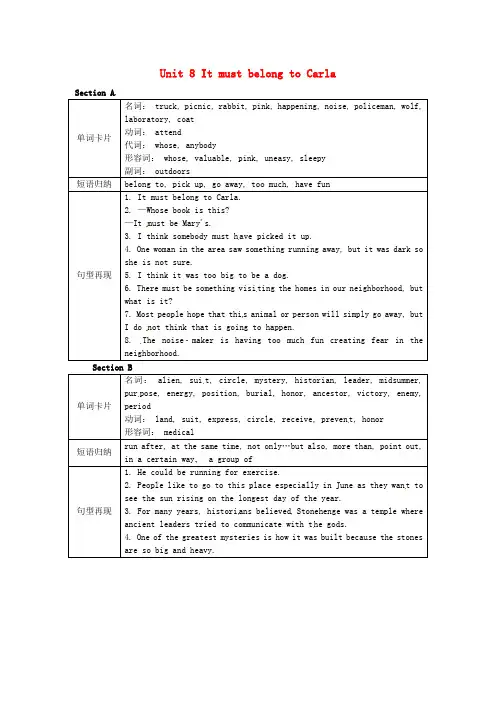
Unit 8 It must belong to Carla Section A单词卡片名词: truck, picnic, rabbit, pink, happening, noise, policeman, wolf, laboratory, coat动词: attend代词: whose, anybody形容词: whose, valuable, pink, uneasy, sleepy副词: outdoors短语归纳belong to, pick up, go away, too much, have fun句型再现1. It must belong to Carla.2. —Whose book is this?—It must be Mary's.3. I think somebody must h ave picked it up.4. One woman in the area saw something running away, but it was dark so she is not sure.5. I think it was too big to be a dog.6. There must be something visi ting the homes in our neighborhood, but what is it?7. Most people hope that thi s animal or person will simply go away, butI do not think that is going to happen.8. The noisemaker is having too much fun creating fear in the neighborhood.Section B单词卡片名词: alien, sui t, circle, mystery, historian, leader, midsummer, pur pose, energy, position, burial, honor, ancestor, victory, enemy, period动词: land, suit, express, circle, receive, preven t, honor形容词: medical短语归纳run after, at the same time, not only…but also, more than, point out, in a certain way, a group of句型再现1. He could be running for exercise.2. People like to go to this place especially in June as they wan t to see the sun rising on the longest day of the year.3. For many years, histori ans believed Stonehenge was a temple where ancient leaders tried to communicate with t he gods.4. One of the greatest mysteries is how it was built because the stones are so big and heavy.。
人教版英语九年级全册Unit8ItmustbelongtoCarla
(三)情感态度与价值观
1.积极参与课堂活动,乐于与同学分享和交流,培养合作精神。
2.增强对英语学习的兴趣和自信心,养成良好的学习习惯。
3.尊重他人,善于倾听他人意见,培养公平、公正、公开的人际交往态度。
4.学会关爱他人,关心社会,培养责任感和集体荣誉感。
4.能够运用所学知识进行小组讨论,描将采用以下方法帮助学生达成学习目标:
1.创设情境:通过展示物品,让学生在真实语境中感知、理解和运用英语进行交流。
2.任务型教学:设计小组活动,让学生在完成任务的过程中,运用所学知识进行讨论和推测。
3.互动交流:鼓励学生积极参与课堂活动,与同学和老师进行有效互动,提高英语口语表达能力。
-鼓励学生积极参与课堂活动,树立自信心,全面发展英语素养。
四、教学内容与过程
(一)导入新课
1.教师出示一张失物招领的照片,上面有各种物品,如钱包、钥匙、相机等,引导学生关注图片内容,并提出问题:“What do you see in this picture? Do you know whose things are these?”
-设计不同难度的练习,让学生逐步掌握语法知识,从简单到复杂,提高他们的推测能力。
3.小组合作,互动交流:
-将学生分成小组,进行小组讨论和活动,促使他们相互交流、分享观点,提高合作能力。
-鼓励学生积极发言,为同学提供帮助,培养他们的责任感和团队精神。
4.多元化教学,关注个体差异:
-针对不同学生的英语水平,设计难易程度不同的任务,使每个学生都能在课堂上获得成就感。
3.每个小组展示自己的讨论成果,其他小组进行评价,教师给予反馈和指导。
人教版英语九年级Unit8《ItmustbelongtoCarla.》全单元说课稿

人教版英语九年级Unit 8《It must belong to Carla.》全单元说课稿一. 教材分析人教版英语九年级Unit 8《It must belong to Carla.》全单元主要围绕“推理判断”这一主题展开。
通过本单元的学习,学生能够掌握一般现在时、一般过去时和一般将来时的被动语态,以及情态动词must的用法。
教材通过丰富的情境和真实的例子,帮助学生学会如何根据线索进行推理判断,并能在实际情境中运用所学知识进行交际。
二. 学情分析九年级的学生已经具备了一定的英语基础,能够理解和运用一般现在时、一般过去时和一般将来时的被动语态。
然而,学生在情态动词must的用法上可能还存在一定的困惑。
因此,在教学过程中,教师需要关注学生的实际情况,针对性地进行讲解和练习。
三. 说教学目标1.知识目标:学生能够掌握一般现在时、一般过去时和一般将来时的被动语态,理解情态动词must的用法。
2.能力目标:学生能够在实际情境中运用所学知识进行交际,提高推理判断能力。
3.情感目标:培养学生热爱生活,关心他人的品质。
四. 说教学重难点1.重点:一般现在时、一般过去时和一般将来时的被动语态,情态动词must的用法。
2.难点:情态动词must在实际情境中的运用。
五. 说教学方法与手段1.教学方法:采用情境教学法、交际法、任务型教学法等。
2.教学手段:多媒体课件、实物、图片、卡片等。
六. 说教学过程1.引入:通过展示一张照片,让学生猜测照片中的人是谁,引出本课主题。
2.呈现:展示教材图片,引导学生观察并找出图片中的线索,推理判断出物品的主人。
3.讲解:讲解一般现在时、一般过去时和一般将来时的被动语态,情态动词must的用法。
4.练习:学生分组进行角色扮演,运用所学知识进行交际。
5.巩固:学生完成教材练习题,检测所学知识。
6.拓展:引导学生运用所学知识,谈论现实生活中的人和事。
七. 说板书设计板书设计需突出本课重点内容,包括一般现在时、一般过去时和一般将来时的被动语态,以及情态动词must的用法。
人教新目标九年级英语全册教案:unit8 It must belong教案

Unit8 It must belong to CarlaThe 1st PeriodⅠ.Teaching Aims and Demands1.Knowledge Objects(1)Key V ocabularybelong, belong to, plate, author, toy, picnic(2)Target LanguageWhose book is this?It must be Mary’s.J.K.Rowling is her favorite author.2.Ability Objects(1)Train students’ listening skill.(2)Train students’communicative competence using the target language.3.Moral ObjectsWhen you are on a picnic, remember to bring litter back to keep our environment clean and tidy.Ⅱ.Teaching Key Points1.Key vocabulary2.Target languageⅢ.Teaching Difficult Points1.Listen for the target language2.Oral practice using the target languageⅣ.Teaching Methods1.Scene teaching method2.Listening method3.Pair workⅤ.Teaching Aids1.Blackboard drawings2.A tape recorder3.A projectorⅥ.Teaching ProceduresStep I RevisionCheck homework.Step Ⅱ1aThis activity introduces the key vocabulary.Write the key vocabulary words on the blackboard.Say the words one by one and have students repeat several times until they can read them fluently and accurately.Ask different students to explain in their own words the meanings of the words belong to, attend and picnic.Belong means to be owned by somebody.Attend means to take part in one invent.A picnic is a meal eaten out of doors.Then invite two students to draw a rabbit next to the word rabbit and a toy truck next to the word truck.Focus attention on the picture.Have students point to each item and say its name.Call students attention to the chart with the headlines clothing.Fun things and kitchen things at the top.Invite different students to explain the meanings of the column heads.Say, Please look at the picture and write the things you see in the correct columns in the chart.Point out the sample answers.Get students to complete the task on their own.As they work, move around the room checking their progress and answering any questions they may have.Show the correct answers on the screen by a projector.Clothing Fun thingsKitchenThingshat volleyballplatejacket CDcupsT-shirt toy carmagazinebookStep ⅢlbThis activity gives students practice in understanding the target language in spoken conversation.Call students’attention to the chart.Set a time limit of two minutes.Students read the persons, the things and the reasons.Say, You will hear a conversation.As you listen, draw lines to connect the person in the first column with the thing in the second column.Then draw another line to connect the thing in the second line with the reason in the third column.Point out the sample answer.Say, The name Carla in the first column connects to volleyball in the second column because that’s the thing they are talking about.And the word volleyball in the second column connects with the sentence she loves volleyball in the third column.Play the recording the first time.Students only listen.Play the recording again.This time students listen and match each person with a thing and a reason.Check the answers.Girl 1:Whose volleyball is this?Boy 1:It must be Carla’s.She loves volleyball.Girl 1: How about this toy truck?Girl 2: Oh, that toy truck must belong to Jane’s little brother.He was the only little kid at the picnic.And the magazine must belong to Deng Wen.He loves cats.Boy 1: Oh, and look, someone left a book.Girl 2: Oh, yeah…This book must be Mary’s.J.K Rowing is her favorite writer.Girl 1: OK…and how about this CD?Girl 2: Hmm…The CD must belong to Grace.She always listens topop music.Step Ⅳ1cThis activity provides oral practice using the target language.Point to the picture in Activity lb.Invite pair of students to say the conversation in the speech bubbles.S A: Whose volleyball is this?S B: It must be Carla’s.She loves volleyball.Point out the conversation in the box.Invite another pair of students to say it to the class.S A : Whose book is this?S B: It must be Mary’s.J.K.Rowing is her favorite writer.Write the conversation on the blackboard.Point out the chart in Activity 1b.Say.Now work with a partner.Start by reading the conversations in the picture and in the box: Then make conversations using the information in the chart in Activity 1b.Talk about who each thing might belong to and give a reason.Get students to practice in pairs.As they work, move around the classroom listening in on various pairs and offering help with language and pronunciation as needed.After all the students have had an opportunity to ask and answer questions, stop the activity.Get different pairs of students to say their conversations to the class.Listen to 2a Fist listen, then write the answers. Check the answers. Listen again. Finish 2b.Make conversations using the information in 2a and 2b.Step ⅤSummarySay, In this class, we’ve learned the key vocabulary words belong to, plate, author, toy and picnic and done much listening and oral practice using the target language.Step ⅥHomework(1)Say and remember the spelling of the vocabulary words.(2)Say the conversations in Activity 1c to get a further understanding of the target language.Step ⅦBlackboard DesignUnit 8 It must belong to Carla.Section AThe First Period1.Key vocabulary: belong v.belong toplate n.author n.toy n.picnic n.2.Target language:Whose book is this?It must be Mary’s.J.K.Jowing is her favorite author.。
初三英语上册(人教新目标)Unit 8 It must belong to Carla 知识点总结
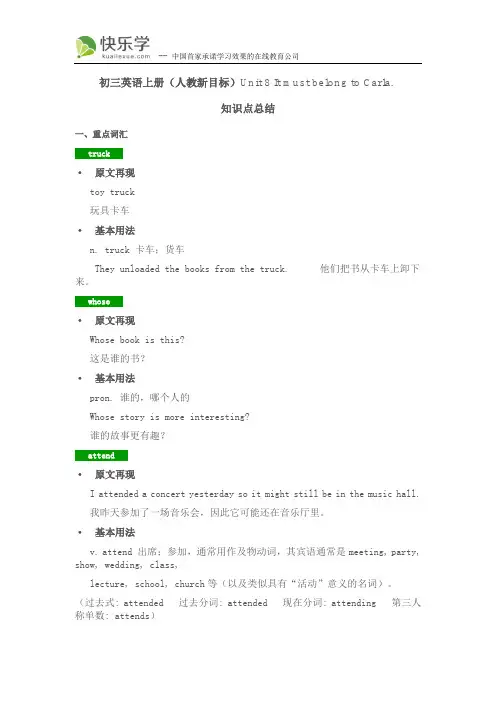
初三英语上册(人教新目标)Unit 8 It must belong to Carla.知识点总结一、重点词汇truck·原文再现toy truck玩具卡车·基本用法n. truck 卡车;货车They unloaded the books from the truck. 他们把书从卡车上卸下来。
whose·原文再现Whose book is this?这是谁的书?·基本用法pron. 谁的,哪个人的Whose story is more interesting?谁的故事更有趣?attend·原文再现I attended a concert yesterday so it might still be in the music hall.我昨天参加了一场音乐会,因此它可能还在音乐厅里。
·基本用法v. attend 出席;参加,通常用作及物动词,其宾语通常是meeting, party, show, wedding, class,lecture, school, church等(以及类似具有“活动”意义的名词)。
(过去式: attended 过去分词: attended 现在分词: attending 第三人称单数: attends)Did you attend the meeting yesterday?你昨天去开会了吗?He was ill and didn’t attend sc hool.他有病,没有去上学。
·知识拓展相关短语attend to 注意;专心于;照料。
如:If you don’t attend to your teacher, you will never learn anything.你要是不注意听老师讲,你就会什么也学不到。
If you go out, who will attend to the baby?你要是出去,谁来照顾婴儿?词义辨析:attend/join/join in/take part in这些动词或词组均含“参加,加入”之意。
人教版九年级英语全册Unit8ItmustbelongtoCarla整单元优秀教学案例
2.通过设计有趣的角色扮演活动,让学生在实际交流中运用所学知识。例如,学生分组扮演不同角色,运用物主代词和情态动词must进行对话。
3.利用多媒体手段,如视频、音频等,为学生提供丰富的语言输入,提高他们的听力理解能力。例如,播放一段关于物品归属的短视频,让学生听后回答相关问题。
4.创设互动式的课堂氛围,让学生在课堂上敢于表达、乐于交流。例如,组织学生进行小组讨论,分享自己对物主代词和情态动词must用法的理解。
2.组织学生进行同伴评价,互相反馈意见,共同进步。例如,学生可以评价同伴在对话中的表现,给出改进建议。
3.教师对学生的学习成果进行评价,关注学生的全面发展清晰,非常好!”
4.鼓励学生树立正确的评价观,正视自己的优点和不足,调整学习策略。例如,学生可以认为:“我在课堂上表现不错,但还需要在发音和语法上多加练习。”
(五)作业小结
在课堂的最后,我会布置一个相关的作业,让学生回家后进行练习。这个作业会包括填写物主代词和运用情态动词must的句子。通过这个作业,我可以让学生在课后巩固所学知识,并提高他们的实际运用能力。同时,我会在下一次课堂上对学生的作业进行反馈,帮助他们发现和纠正错误,提高他们的学习效果。
五、案例亮点
3.教师巡回指导,关注每个小组的学习情况,提供有针对性的帮助。例如,针对某个小组在运用物主代词和情态动词must时出现的问题,给予指导和建议。
4.利用小组合作机会,培养学生的团队精神,提高他们的沟通能力。例如,在小组活动中,学生需要协调分工,共同完成任务。
(四)反思与评价
新目标人教版九年级全一册英语《Unit 8 It must belong to Carla.》Section B 2a-2b教学设计
教学设计Unit 8 It must belong to Carla.Section B 2b Stonehenge—Can Anyone Explain Why It Is There? Ⅰ.Teaching Aims:◆ Knowledge aims1. Students can master the following words and language chunks:express, circle, mystery, historian, leader, medical, directl y…into…, not only… but also…2. Students can use the linking words or phrases.◆Ability aims1.Improve students’ reading skills by recognizing the idioms and phrases.2.Students can get the general idea of the passage and retell it.3.Students can write an introduction of a new place.◆Emotion and attitude aims1.Encourage students to discover the world and keep their imagination.2. Through enjoying the historic sites excite students to love the world and our country.Ⅱ.Teaching key points and difficult points1.Master the linking words or phrases.2.Students can rewrite the passage.III. Teaching Procedures:Step 1.Warming upA.Talk about : What do you love?B. Enjoy a video about discovery before the class. Answer the question what they love.C. Lead in the new words and phrases by the introduction of the miracles and mysteriesD. Read the article and circle the linking words and phrases.E.Match each linking word or phrase with its purpose.Step 2 Pre-reading1.Look at a picture and predict the answer, then check the answer by watching a video. Which famous place is it?A.Stonehenge(巨石阵)B.Stone Forest(石林)2.Read the title of the article and predict the answer of the article.Step 3 While reading1.Fast readingA.Scanning the article and underline the linking words and phrases.B.Read the passage and divide the story into 3 parts, then match the main idea of each part.Part 1 : The history of Stonehenge.Part 2: The popularity of Stonehenge.Part 3: The inferences of Stonehenge.C.Check the answers.2.Intensive readingA.Read part 1 carefully and finishing the task.Retell part 1 according to the mind-map.B.Read part 2 carefully and answer the following questions.●How many inferences about Stonehenge are mentioned in Part. 2?1.① What did ancient leaders do there?② Did historian Paul Stoker think so? Why or why not?2. Why were the large stones put together in a certain way?3. ①What was Stonehenge used for?②What did one visitor say?4. ①Some think it might be…②Others think it might be…Retell part 2 according to the mind-map.C.Read part 3 carefully and complete the article.Most historians believe the Stonehenge must be almost _______years old. We don’t know how it was built because the stones are so ________. And we don’t really know who built it. But we do know they must have been hard-working and________.Thinking about if you were the great planners, how did you do it? D. Retell the whole article according to the mind-map.Step 4.SummaryStep 5.Post-readingA.Writing:Last week, you got an E-mail from your friend Linda. She said she would go on a trip to Britain. Please introduce Stonehenge to her.B. Learn more about the historic sites.C. Watch the video The World Is Just Awesome. Excite students to keep their imagination.Step 6. HomeworkSurf the Internet something about the other famous places in the map. Introduce one of them to us.。
2024九年级英语上册Unit8必背知识点
2024九年级英语上册Unit8 It must belong to Carla.必背知识点针对2024年九年级英语上册Unit 8 "It must belong to Carla"这一单元,以下是必背的知识点归纳:一、词汇与短语(1)必背单词1. whose (adj.&pron.) 谁的用法:whose + 名词,表示所属关系。
示例:Whose book is this? 这是谁的书?2. truck (n.) 卡车;货车3. picnic (n.) 野餐常用短语:have a picnic/go for a picnic 去野餐4. rabbit (n.) 兔;野兔5. attend (v.) 出席;参加常用短语:attend the meeting 参加会议6. valuable (adj.) 贵重的;很有用的;宝贵的相关词汇:value (n.) 价值;v. 重视,珍视7. pink (adj.&n.) 粉红色的8. anybody (pron.) 任何人示例:anybody else 别的任何人9. noise (n.) 声音;噪音相关词汇:noisy (adj.) 吵闹的;make noise 制造噪音10. policeman (n.) 男警察复数形式:policemen11. wolf (n.) 狼复数形式:wolves12. happening (n.) 事件;发生的事情13. uneasy (adj.) 担心的;不安的14. laboratory (n.) 实验室15. coat (n.) 外套;外衣16. sleepy (adj.) 困倦的;瞌睡的相关短语:feel sleepy 感到困倦;asleep (adj.) 睡着的;fall asleep 入睡;sleeping (adj.) 熟睡的17. outdoors (adv.) 在户外18. suit (n.) 西服;套装v. 适合;suit sb. fine = fit sb. well 非常适合某人19. alien (n.) 外星人20. express (v.) 表示;表达n. expression 表情,表达21. circle (n.) 圆圈v. 圈出22. Britain (=Great Britain) 大不列颠23. receive (v.) 接待;接受;收到注意:与accept区分,receive仅表示客观上收到,主观上接受用accept24. leader (n.) 领导者;领袖v. lead 领导;导致25. medical (adj.) 医疗的;医学的n. medicine 药;medical research 医学研究26. purpose (n.) 目的;目标常用短语:the purpose of ……的目的;on purpose 故意地(2)必背短语1. belong to 属于2. pick up 捡起;拾起3. used to 过去常常4. nothing much 没什么事5. at first 起初6. in the neighborhood 在街区里7. go away 离开8. listen to classical music 听古典音乐9. at school 上学;求学10. go to the concert 去听音乐会11. have any/some idea 知道12. a math test on algebra 有关代数的数学考试13. the final exam 期末考试14. because of 因为15. a present for his mother 送给他妈妈的礼物16. run for exercise 跑步锻炼17. milk shake 奶昔18. turn on/off 打开/关上19. pour…into…将…...倒入…...20. a cup of yogurt 一杯酸奶21. on Saturday morning 在星期六早上22. cut up 切碎23. put…into…将…...放入...…24. one more thing 还有一件事25. a piece of 一片/一张/一块26. at this time 在此时27. a few 几个28. fill…with…用…装满29. cover…with…用......覆盖30. mix up 混淆;混合31. take turns 轮流32. try one's best 尽某人最大的努力33. make a difference 有影响;起作用34. in a hurry 匆忙地35. on one's way 在某人去……的路上二、语法结构1. 情态动词must, might, could, can't表示推测must 表示肯定的推测,意为“一定,肯定”。
人教版新目标九年级英语Unit8 It_must_belong_to_Carla_Section_B 2a-2e
orstones we’ll must be late for most agree that the Come positionon, of the be for a school special purpose. Some n. 位置,地方 一定是(推测) 否则 think it might be a burial place or a place to honor ancestors. Others think it was n. 埋葬,安葬 一定是(推测) v. 表示敬意 n. 祖宗,祖先 被建造 built to celebrate a victory over an enemy. n. 胜利,成功 n. 敌人,仇人 为了纪念胜利打败敌人
被建造 =during在…期间 Stonehenge was built slowly over a long period of time. Most historians believe it n. 一段时间;时期 一定是(推测) must be almost 5,000 years old. One of the greatest mysteries is how it was built =as/since because the stones are so big and heavy. In 2001, a group of English volunteers tried to build another Stonehenge, but they couldn’t . “We don’t really know who built Stonehenge,” says Paul Stoker. “And perhaps we might never “的确”加强语气 know, but we do know they must have been must have done 一定 做过(推测) hard-working--and great planncle below and underline the sentences with linking words or phrases. Do you think you have made correct matches in 2a?