
九年级英语总复习第十二单元
学习目标: 学习目标:
Task 1
要点回顾 语法要点 高频考题 中考聚焦
Task 2
Task 3
Task 4
一.英汉短语互译:
be supposed to do sth 1.应该 1.应该 shake hands 2.握手 2.握手 3.第一次会见某人 3.第一次会见某人 meet sb for the first time 4.邀请某人做某事 4.邀请某人做某事 invite sb to do sth make mistakes 5.犯错误 5.犯错误 6.对某事随意 对某事随意, 6.对某事随意,不严格 be relaxed about sth drop by 7.顺便拜访 7.顺便拜访 after all 8.毕竟 8.毕竟 pike up 9.捡起 9.捡起 10.特地做某事 10.特地做某事 go out of one’s way to do sth 11.使某人感到宾至如归 11.使某人感到宾至如归 make sb feel at home 12.敬酒 make a toast 12.敬酒 Task
Task 1
6. We often just drop by our friends’ homes. 我们通常只是顺便去朋友家。 drop by “顺便拜访,访问” drop in on sb. 顺便拜访某人 drop in at sth. 顺便拜访某地 I dropped in on my teacher on my way home. 回家的路上我顺便拜访了我的老师。 She often drops in at her primary school. 她经常到她的小学转转。
Task 1
3. make plans to do == plan to do. 打算做某事 如: She has made plans to go to Beijing.==She has planed to go to Beijing. 4. 我发现要记住每一样事是困难的。 I find it difficult to remember everything. 形式宾语 真正宾语 常见的形式宾语有:find / think + it/them +形容词 to do sth. 如:I think it hard to study English. 5. can’t stop doing 忍不住做某事 laughing. 我忍不住笑 I can’t stop
Task 1
三.词语辨析
• 1.arrive, reach,get to
(1) arrive 是不及物动词,如果后面需要跟宾语时,要加上 介词, at 表示到达较小的地方,in 表示到达较大的地方 They arrived in Beijing at eight. When did you arrive at the bus stop? (2) reach 是及物动词,后面直接跟表示地点的名词。 When you reach Beijing, call me, please. (3)Get to 后面跟表示地点的名词,如果后面是表示地 点的副词 home, here,there等时,要去掉介词to. When he got home, his father was repairing the bike for him. How do you usually get to school?
Task 1
2.except, besides, but
(1)except “除…之外“,指同一类事物的排除,不能用于句首。 All came back except Kate. I don’t want anything except this. (2)besides “除…之外,还有…”指包括本身在内。 Five other boys were late besides me. Mary went to the zoo besides peter.They had a good time. (3)but 相当于except ,常和nothing,nobody,nowhere,who, all等词连用,but后还可以接不定式,当其前有动词do的任 何形式时,动词不定式符号to要省略。 There is nothing but a table in the room. She does nothing but watch TV.
• 1.He wants to know where Nina _____(live). lives • 2. Can you tell me how long it _____(take) to get to takes school. got • 3. I wanted to know how she _____(get) to school. • 4. I don’t know if he will go ____(go) there. is doing • 5. Do you know what his father _____(do)now. living • 6. Danny told me he was used to _____(live)in the city. to bow • 7. Japanese and Koreans are supposed _______(bow) when they meet people. feel • 8. They go out of their way to make me _____(feel) at home. to get • 9. He found it difficult _____(get) used to the food there. Spending • 10._____(spend) time with my parents during the Spring is Festival ___(be) important.
• 肯定句:主语+be supposed to+ v. • 否定句:主语+be not supposed to+ v. • 一般疑问句: be+主语+ supposed to+ v.? • 特殊问文句: 特殊疑问词+be 主语+ supposed to+ v.?
Task 2
Unit 12
1. be (not) supposed to do sth. 不被)期望 被(不被 期望 (不)应该做某事 不被 期望/ 不 应该做某事 e.g. You are supposed to clean the classroom every day. e.g. You are not supposed to smoke here. 2. 情态动词 情态动词should的用法 的用法 should + have done表示本应做某事,而实际上未做, 表示本应做某事, 表示本应做某事 而实际上未做, 暗示说话人对自己或他人的责备、 暗示说话人对自己或他人的责备、抱怨或遗憾的意 思。 e.g. We should have come to school earlier.
1.Did you find _ D very interesting to play Yo Yo? A. this B. it’s C. that D. it 年兰州市中考试题) (2006年兰州市中考试题) 年兰州市中考试题 2. Some of my girl students find _____ difficult to B learn physics. Can you help them? A. that B. it C. them D. themselves 年无锡市中考试题) (2006年无锡市中考试题) 年无锡市中考试题
Task 4
Task 3
1. —Which sweater do you prefer, the yellow one or the pink one? D —______. I like a light blue one. A. Either B. Both C. Any D. Neither C 2. The war was over about three months ago, ______ the American soldiers in Iraq are still having a lot of trouble to deal with. A. or B. and C. but D. so B 3. The mountain was ______ steep ______ few people in our city reached the top. A. so; as B. so; that C. as; as D. too; to 4. —What is a writing brush, do you know? C —It’s used ______ writing and drawing. A. with B. to C. for D. by A 5. I really don’t know ______ about it. A. what to do B. how to do C. to do what D. how can I do
Task 1
In your country,What are you couhen you meet someone for the first time?
We are supposed to say,“吃了吗?” , 吃了吗?
刨根问底
We are supposed to shake hands.
Watch and Think
• We are supposed to study hard. • She is not supposed to smoke. • Are you supposed to study hard? • be (not) supposed to v. 原形 • 被(不被)期望 (不)应该做某事;理应 不被)期望/( 应该做某事; • 用来表示根据规定,人们不得不做的事或期待 用来表示根据规定, 发生的事。时态,人称和句式的变化在be动词 发生的事。时态,人称和句式的变化在 动词 上体现。 为不定式符号 后接动词原形。 为不定式符号, 上体现。to为不定式符号,后接动词原形。
人教版九年级全册英语第十二单元Unit12《单词+短语+句子》默写专项练习(含答案)
UNIT 12 Life is full of the unexpected.
Section A(1a-4c)
[限时:15分钟]
重点单词
1. adj. 出乎意料的;始料不及的
2. v. 睡过头;睡得太久
3. n. 街区
4. v. 着火;燃烧
5. adj. 活着;有生气的
6. n. 市场;集市
7. n. 背包;旅行包8. n. 工作者;工人
9. v. 盯着看;凝视
10. prep. 在……上面adv. 在上面
11. n. 机场
12. prep. & conj. 到;直到
13. adv. 向西;朝西adj. 向西的;西部的n. 西;西方
14. n. 豆;豆荚15. n. 奶油;乳脂
16. adj. 死的;失去生命的
词形变换
1. expect —(形容词)—(反义词)
2. oversleep—(过去式/过去分词)
3. burn—(过去式)—(过去分词)—(形容词)
4. fool—(形容词)
5. belief—(反义词)
重点短语
1. 在……以前
2. 捎……一程
3. 与……成一排
4. 盯着看;凝视
5. 突然响起;发出声音
6. 冲出;奔出
7. 洗淋浴8. 从……跳起来
9. 充满
10. 排队等候
1/ 6。
九年级英语第十二单元知识点总结
Unit 12: Making a Difference1. Vocabulary:- Philanthropy: the desire to promote the welfare of others, expressed especially by the generous donation of money to good causes.- Volunteer: a person who freely offers to take part in an enterprise or undertake a task.- Fundraising: the process of gathering voluntary contributions of money or other resources, by requesting donations from individuals, businesses, charitable foundations, or governmental agencies.- Charity: an organization set up to provide help and raise money for those in need.- Non-profit: not established for the purpose of making a profit.- Initiative: the power or opportunity to act or take charge before others do.- Campaign: a series of planned activities designed to achieve a particular aim.2. Grammar:- Infinitives: "to" + base form of the verb, used as a noun, adjective, or adverb.- Gerunds: verb forms ending in "-ing", used as nouns.- Passive voice: the subject receives the action of the verb, rather than performing it.- Modals: auxiliary verbs that express ability, necessity, possibility, permission, or prohibition.- Connectives: words or phrases used to join words, phrases, or clauses.3. Language Functions:- Expressing opinions and beliefs.- Giving reasons and justifications.- Supporting and opposing ideas.- Taking part in discussions and debates.- Asking for and giving advice.4. Reading Skills:- Skimming: quickly going through a text to get a general idea of the main points.- Scanning: rapidly searching for specific information in a text.- Identifying the main idea and supporting details.- Understanding vocabulary in context.- Making inferences and drawing conclusions.- Analyzing the author's purpose and tone.5. Writing Skills:- Writing a persuasive essay: using logical arguments and evidence to convince the reader of a particular viewpoint.- Organizing ideas effectively with clear paragraphs and logical transitions.- Using formal language and appropriate tone.- Editing and revising for coherence, clarity, and grammatical accuracy.6. Speaking Skills:- Initiating and sustaining conversations on familiar topics.- Expressing opinions clearly and confidently.- Supporting arguments with relevant examples and evidence.- Active listening and responding appropriately to others.- Participating in group discussions and making meaningful contributions.7. Cultural Awareness:- Understanding and appreciating the importance of volunteer work in different cultures.- Recognizing the impact of philanthropy on society.- Learning about charitable organizations and their activities.。
人教版九年级英语单元复习Unit12PPT课件
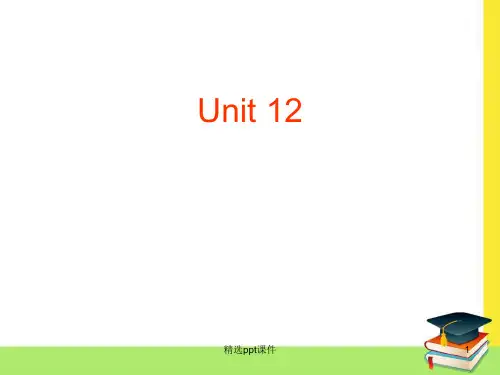
He _g_a_v__e __m__e__a__ _l_i_ft_ to the station.
精选ppt课件
19
4. 有时,坏事可以变成好事。 A bad thing can be _t_u_r_n_e_d _i_n_to__ a good
one sometimes. 5. 你知道飞机什么时间起飞吗?
• 同学们以说英语开始, 却以说汉语结束。
精选ppt课件
16
11. above,on, over的用法 above
精选ppt课件
over on
17
a. above的意思是“在…之上;高于……”, 表
示相对高度,不一定是在正上方,它的反
义词是below. 例:The plane flew above the clouds.
精选ppt课件
3
Grammar Focus
• 过去完成时
• 一、概念 • 过去完成时表示一个动作或状态在过去某一 • 时间或动作之前已经完成或结束,也可能是 • 早已完成或结束,即“过去的过去”;也可以 • 指过去的动作延续到过去的某个时刻。 • 二、结构 • “had +动词的过去分词”
精选ppt课件
clouds.
5. The river goes through the city from _w_e_s_t__
(西) to east.
精选ppt课件
21
中考链接
• 1. By the end of last month, he _______ in the club for two years.(2013年诸暨 )
• be about to 忙于;即将做某事。侧重于表 示动作马上就要发生,常与when引导的从 句连用,但不与具体的时间状语连用。
人教版九年级英语unit12知识点归纳
人教版九年级英语unit12知识点归纳人教版九年级英语Unit 12 知识点归纳Unit 12是人教版九年级英语教材中的一单元,本单元主要涉及到动词的时态、主谓一致等语法知识,同时也包括了一些关于旅行和海洋生物的话题。
下面将对本单元的知识点进行归纳总结。
一、动词的时态在本单元中,我们学习了一些动词的过去时、现在完成时和将来时的用法。
1. 过去时:表示过去发生的动作或状态。
单数形式动词在后面加了-ed,而复数形式动词则加了-d或-ed。
例如:- We lived in a small village before we moved to the city.- They played basketball yesterday afternoon.2. 现在完成时:表示过去发生的动作对现在造成的影响或仍然存在。
由have/has + 过去分词构成。
例如:- I have visited the Great Wall twice.- She has already read that book.3. 将来时:表示将来要发生的动作或存在的状态。
由will + 动词原形构成。
例如:- We will go to the beach tomorrow.- They will have a party next week.二、主谓一致主谓一致是指主语和谓语在人称和数上保持一致。
在本单元中,我们需要特别注意以下几点:1. 主语为第三人称单数时,谓语动词需要加-s或-es。
例如:- He often goes to the cinema on weekends.2. 表示时间、距离、金钱等的量词作主语时,谓语动词的单复数形式与它们代表的数量有关。
例如:- Ten yuan is enough to buy a drink.三、旅行话题在本单元中,我们学习了一些与旅行相关的词汇和句型,并通过对话的形式来进行实际应用。
新目标九年级英语unit12知识点汇总
新目标九年级英语unit12知识点汇总九年级英语Unit 12知识点汇总Unit 12是九年级英语的最后一个单元,内容涵盖了阅读理解、语法、词汇以及写作等多个方面。
本文将对这些知识点进行汇总,总结归纳,以帮助同学们更好地复习和掌握。
一、阅读理解本单元的阅读理解主要围绕旅游主题展开,包括观光旅游和生态旅游等。
文章的难度适中,同学们应注重理解文章的主旨和细节,并学会运用阅读技巧来解答问题。
二、语法1. 宾语从句:宾语从句是指出现在一个句子中作宾语的从句。
宾语从句通常以连接词that, if, whether等开头。
如:I know that he is a good student.2. 将来进行时:将来进行时表示将来某个时间正在进行的动作或某个未来的事件。
构成:will be + 动词ing。
如:They will be watching a movie at this time tomorrow.3. 动词不定式的被动语态:动词不定式的被动语态由to be + 过去分词构成。
如:The problem needs to be solved.4. 特殊疑问句:特殊疑问句用来询问某个具体的信息,常见的特殊疑问词有:what, who, when, where, why, how等。
如:What time is it?三、词汇1. 旅游相关词汇:tourist, travel, destination, attraction, guide, sightseeing等。
2. 计量词:本单元涉及了一些计量词,如:a pair of, a group of,a piece of等。
在使用时要注意与名词的搭配。
3. 形容词和副词:学习一些形容词和副词可以丰富语言表达,如:breathtaking, fascinating, slightly等。
四、写作本单元的写作任务是写一篇关于英国旅游的文章。
写作时可以运用所学的词汇和语法知识,通过添加细节和论述观点来丰富文章。
人教版九年级英语Unit12单元知识点梳理

一、短语:1.make me sleepy使我困倦2.drive sb.crazy使……发疯3.yes and no好坏参半4.feel left out感觉被忽视5.sleep badly睡眠很差6.don’t feel like eating不想吃东西7.for no reason毫无理由8.neither…nor…既不……也不……9.let…down使…失望10.take one’s position替代我的职位11.to start with起初12.get the exam result back取考试成绩单13.remain unhappy forever永远不幸福14.a shirt of a happy person一件快乐人的衬衫二、知识点:1.by the time作连词引导时间状语从句,当从句用一般过去时,主句用过去完成时;当从句用一般现在时,主句用一般将来时或将来完成时。
如:(1)By the time I got outside,the bus had already left.当我出来的时候,公共汽车已经走了。
(2)I’ll be in bed by the time you get home.你到家时,我已经上床睡觉了。
2.表示“把某物忘在某处”要用词组leave sth in a place。
如:I've left my umbrella at home.我把伞忘在家里了。
forget意为“遗忘某物”,指忘记一件具体的东西,但不能有具体的地点。
如:I forgot my umbrella yesterday.我昨天忘了带伞。
3.above的用法:(1)作介词:在……上面,如:The moon is above the trees now.月亮现在正位于树梢上。
‚在…之上,超过,如:They are children above six years old.他们是六岁以上的孩子。
九年级英语12单元知识点
九年级英语12单元知识点九年级英语第12单元知识点包括词汇、语法和阅读理解等内容。
以下是对这些知识点的详细介绍:一、词汇1. 单词本单元重点单词包括celebrate, festival, tradition, custom, parade 等。
可以通过词汇卡片、词义记忆法和例句运用等方式来巩固记忆。
2. 短语本单元常用短语有take part in, dress up, set off, have fun等。
通过词组归纳和造句练习,可以提高短语运用的能力。
3. 同义词本单元的同义词有celebration和party,habit和custom等。
通过比较两词的用法和概念,可以提高同义词辨析的能力。
二、语法1. 形容词比较级和最高级本单元涉及形容词比较级和最高级的构成和用法。
学生可以通过掌握常用的形容词比较级和最高级形式,来描述人、事和物的特征。
2. 条件句本单元包括零条件句、一般条件句和虚拟条件句的用法。
学生可以通过练习条件句的句型转换和句子翻译,来提高条件句的灵活运用。
3. 定语从句本单元的定语从句主要是关系代词who, which, that引导的定语从句。
学生可以通过句子改写和短文填空的练习,来提高辨认和运用定语从句的能力。
三、阅读理解1. 阅读策略本单元的阅读理解主要包括扫读、略读、细读和推理等策略。
学生可以通过练习不同类型的阅读材料,来提高阅读技巧和理解能力。
2. 短文理解本单元的短文理解包括填词、判断和选择等题型。
学生可以通过阅读短文和解答相关问题,来培养阅读材料的理解和答题技巧。
3. 段落标题本单元的段落标题是通过阅读理解短文,为每个段落选择合适的标题。
学生可以通过概括段落大意和理解关键信息,来选择恰当的段落标题。
总结:九年级英语第12单元的知识点包括词汇、语法和阅读理解等内容。
通过有效的学习方法和练习,学生可以提高对这些知识点的理解和应用能力,从而在英语学习中取得更好的成绩。
九年级英语第十二单元知识点
九年级英语第十二单元知识点九年级英语第十二单元知识点和练习一. 重要词汇1. for the first time 第一次for the last time 最后一次She visited the Great Wall for the first time last week .He took the plane for the first time, of course he was a little nervous .I’m telling you for the last time --- don’t be late again .与time有关的词组:all the time ==always总是, 一直at the same time 同时at times 有时==sometimes by the time …到……的时候time after time \ time and time again 一次又一次; 屡次, 反复once upon a time 从前kill time 消磨时间in no time 立刻,马上==at once have a good time 过得愉快, 玩得开心from time to time 有时, 时常2. shake hands 握手shake hands with sb. 和某人握手shake sb. by the hand == shake one’s hand 握住某人的手3. arrive ( at\ in) 到达I arrived in Beijing yesterday evening .get ( to ) 到达I got to Beijing yesterday evening .reach到达I reached Beijing yesterday evening .当宾语是副词时,要省略上面短语中的at\ in和to,如arrive home\ here \ thereget home\ here \ there4. suppose (1) 动词, “认定, 猜想”后接that引导的宾语从句, that可以省略.I suppose ( that ) we’ll go there next week .I suppose ( that ) he is still in town .(2) 动词, “假设, 假如”Suppose he be here on time , what shall we do ?(3 ) be supposed to do sth.=== should 应该做某事其否定结构为be not supposed to do sth 不应该做某事Everyone is supposed to wear a seat-belt (安全带) in the car .Teachers are supposed to treat all the students alike .老师应该对所有学生一视同仁.You are not supposed to smoke on the bus .We are not supposed to play football on Sunday .It’s a secret , I’m not supposed to tell you.5.relax 动词, “使轻松, 使休息”Let’s relax ourselves by listening to music .relaxed 形容词, 某人“感到松懈的, 感到放松的”I felt relaxed after the competition .relaxing 形容词, 某物“令人松懈的, 令人轻松的”I like those relaxing country songs .6.drop by 顺便来访He dropped by to see what happened here yesterday .7. make plans to do sth \ plan to do sth. \ make plans for sth. 计划做某事We made plans for the next meeting yesterday .She often makes plans to improve her English .8. without 介词, “无, 没有”(1) without sth. 没有某物A man without a friend is only half a man .She went to work without breakfast this morning .Without air or water , we couldn’t live .(2) without doing sth. 没有做某事She spoke without thinking .He left without saying goodbye .(3) without短语常可转换成状语从句或并列句.Without your help I can’t work out the problem .== If you don’t help me I can’t work out the problem .He went out without saying a word .=== he went out and didn’t say a word .(4) without 短语作定语时, 可以转换为定语从句.Have you seen a man without friends ?== have you seen a man who has no friends ?9. pick up (1) 捡起,拾起It’s a good habit to pick up the little( 2 ) (车辆等) 中途搭人\ 带货The car stopped and picked me up . 10. every time , next time , last time 等表示时间的短语后跟一个从句, 用来作主句的时间状语.Every time I come , I always find he is busy playing computer games .Last time you left the house , you forgot to lock the door .11. point at 指向较近的人或物The teacher is pointing at the map on the wall .point to 指向较远的人或物He pointed to the house on the other side of the river and said, “That’s my home .”point out 指出(方向,要点,错误等)The teacher pointed out many mistakes in my homework .12. go out of one’s way to do sth. 特意(花心血、时间)做某事, 故意做某事He went out of his way to help me .We go out of our way to build our country .13. make sb \ oneself feel at home 使某人感觉在家里, 很随意, 无拘束Sit down and make yourself feel at home .14. first 首先强调动作的先后角度Before I go, I must first change my clothes .at first == at the beginning 起初; 含有“后来不这样了”的意思At first I didn’t like her , but now I do .first of all 首先, 第一; 指按时间顺序处于第一First of all , we must check the number .First of all , let me say how glad I am to be here .above all 首先,最重要的是== the most important of all 强调重要性We must work hard, and above all we must believe thateach of us is able to do something well .after all 毕竟---- I’m sorry. I didn’t do it well .---- Never mind . A fter all, it’s the first time for you to do it .15. 含有up 的词组:stand up 站起来grow up 长大send up 发射climb up 爬上get up 起床pick up 捡起put up 张贴,搭建look up 查找set up 建立eat up 吃关use up 用完cut up切开give up 放弃clean up 清理fix up 修理16.begin with== start off with 以……开始The concert begin with the National Anthem (国歌)Begin with this one and do the others afterwards .We will begin with \ start off with music .end with 以……结尾In his speech, he began with a proverb and ended with a joke .17. 可以充当句子主语的结构:(1) 名词作主语: This picture is beautiful .(2) 代词作主语: I love you .(3) 形容词作主语: The old must be taken good care of .(4) 基数词作主语: Two and three is five .(5) 动名词作主语: Seeing is believing .(6) 动词不定式作主语: To study hard is our duty .(7) 并列结构作主语: Reading and writing are very important .(8) 主语从句作主语: What she did is not yet known .What she says isn’t always true .18. search 指对某处、某地进行搜查或搜索,对人时为搜身。
英语九年级12单元知识点
英语九年级12单元知识点英语九年级的第12单元是一个重要的阶段,它涵盖了许多重要的知识点和语法结构。
在本篇文章中,我们将探讨这些知识点,并尝试以一种有趣而有深度的方式呈现它们。
首先,让我们来看看本单元中的必备词汇。
在这个单元中,学生们需要学习有关环境和保护的词汇。
这些词汇包括"pollution"(污染), "recycle"(回收利用)和 "renewable energy"(可再生能源)等。
通过运用这些词汇,我们可以更好地了解环境问题,并为保护地球做出自己的努力。
接下来,我们要学习一些有关语法的知识点。
一个重要的语法结构是过去完成时。
过去完成时用于描述过去某个时间之前已经发生或完成的动作。
例如,"She had already finished her homework before her friend came over"(她朋友来之前,她已经完成了作业)。
这种语法结构对于描述过去发生的事件的顺序非常有用。
此外,我们还需要了解被动语态。
被动语态用于描述动作的接受者,而不是动作的执行者。
例如,"The book was written by Mark Twain"(这本书是马克·吐温写的)。
被动语态在正式的写作和口语表达中经常被使用,我们需要掌握它以增强我们的表达能力。
另一个重要的知识点是形容词和副词的比较级和最高级。
比较级用于比较两个事物的大小或程度,而最高级用于比较三个或以上的事物的大小或程度。
例如,"This book is more interesting than that one"(这本书比那本书更有趣)和"He is the tallest boy in the class"(他是班上最高的男生)。
这些语法结构是我们在日常交流和写作中经常使用的。
最新人教版九年级英语第12单元重要知识点总结大全
最新人教版九年级英语第12单元重要知识点总结大全1. 单词和短语- 否定副词:never, hardly, seldom, rarely- 名词短语:a bunch of, a series of, a variety of, a source of- 形容词短语:fed up with, worried about, interested in, tired of2. 语法2.1 过去完成时- 表示在过去某一时间或事件之前已经完成的动作或状态。
- 构成:had + 过去分词。
2.2 宾语从句- 宾语从句用来充当动词或介词的宾语,说明它所作的动作或动作的对象。
- 引导宾语从句的连词:that, whether, if, when, where, why, how 等。
2.3 名词性从句- 名词性从句可以充当主语、宾语、表语或同位语。
- 引导名词性从句的连词:that, whether, if, what, who, whom, which, whose, when, where, why, how等。
2.4 定语从句- 定语从句用来修饰一个名词或代词,并且不能独立存在。
- 引导定语从句的关系代词:that, which, who, whom, whose。
3. 文化知识- 英国文化:英国人最喜欢的体育运动是足球,也称为英式足球。
英国还有伦敦塔、巨石阵等许多著名的文化和历史遗迹。
- 美国文化:美国四个最受欢迎的体育运动是足球、篮球、棒球和冰球。
美国有百老汇和好莱坞等著名的文化产业。
4. 阅读技巧- 阅读理解题:先通读全文,找出文章主旨,然后仔细阅读每一段,根据段落大意进行答题。
- 完型填空题:通读全文,理解上下文的意思,根据句子结构和语法规律进行填空。
- 词汇题:通过上下文的句子理解和推断词义,选择正确的词汇填空。
以上是最新人教版九年级英语第12单元的重要知识点总结。
希望对你有帮助!。