
ReverseString_堆栈操作示例
2005
CS2731 Lab2
12
Registers Usage Conventions
Register Number $0 $1 $2, $3 $4-$7 $8-$15 $16-$23 $24, $25 $26, $27 $28 $29 $30 $31
2005
Mnemonic Name zero $at $v0, $v1 $a0-$a3 $t0-$t7 $s0-$s7 $t8, $t9 $k0, $k1 $gp $sp $fp $ra
CS2731 Lab2 13
System Calls
Service print integer print float print double print string read integer read float read double read string Code in $v0 1 2 3 4 5 6 7 8 $a0 == buffer address $a1 == buffer length $a0 == number of bytes $v0 <-- address Arguments $a0 == integer $f12 == float $f12 == double $a0 == address of string $v0 <-- integer $f0 <-- float $f0 <-- double Returned Value
CS2731 Lab2 5
2005
Example : Reverse String
Program Outline
Print the reversed string Push each character onto the stack ---------------(2) Input the string into a buffer -----------------------(1) Pop chars from stack back into the buffer
2005 CS2731 Lab2 9
Second section : Push
# push each character onto the stack pushl: lbu $t0,str($t1) # get current char into # a full word beqz $t0,stend # null byte: end of string subu sw addu b stend: $sp,$sp,4 $t0,($sp) $t1,1 pushl # push the full word # holding the char # increment the index # loop
allocate memory 9 exit
2005
10
CS2731 Lab2 14
CS2731 Lab2 7
2005
Example : Reverse String
Program Outline
Print the reversed string -----------------------------(4) Push each character onto the stack --------------ቤተ መጻሕፍቲ ባይዱ(2) Input the string into a buffer -----------------------(1) Pop chars from stack back into the buffer --------(3)
2005
CS2731 Lab2
11
Fourth section : Output
# print the reversed string done: li $v0,4 # service code la $a1,str # address of string syscall li $v0,10 syscall # exit
MIPS Stack
Upside down Stack of words (LIFO) $sp($29): Stack Pointer register (top item) Initially $sp = 0x7FFFEFFC
2005
CS2731 Lab2
1
Push Operation
3
2005
CS2731 Lab2
Example : Reverse String
Program Outline
Print the reversed string Push each character onto the stack Input the string into a buffer Pop chars from stack back into the buffer
CS2731 Lab2 4
2005
Example : Reverse String
Program Outline
Print the reversed string Push each character onto the stack Input the string into a buffer -----------------------(1) Pop chars from stack back into the buffer
2005
CS2731 Lab2
10
Third section : Pop
# pop chars from stack back into the buffer stend: li $t1,0 # index of first byte of str buffer popl: lw $t0,($sp) # pop a char off the stack addu $sp,$sp,4 beqz $t0,done # null means empty stack sb addu b done: $t0,str($t1) # store at string[$t1] $t1,1 # inc the index popl # loop
# PUSH the item in $t0 subu $sp,$sp,4 # point to the new place sw $t0,($sp) # store $t0 at the new top
2
2005
CS2731 Lab2
Pop Operation
# POP the item into $t0 lw $t0,($sp) # copy the top item into $t0 addu $sp,$sp,4 # point to the new place
CS2731 Lab2 8
2005
First section : Input
.data str: .space 128 # character buffer .text .globl main main: #input the string li $v0,8 # service code la $a0,str # address of buffer li $a1,128 # buffer length syscall li $t0,0 # push a null subu $sp,$sp,4 # onto the stack sw $t0,($sp) # to signal its bottom li $t1,0 # index of first char in str buffer
CS2731 Lab2 6
2005
Example : Reverse String
Program Outline
Print the reversed string Push each character onto the stack ---------------(2) Input the string into a buffer -----------------------(1) Pop chars from stack back into the buffer --------(3)
Conventional Use Permanently 0 Assembler Temporary (reserved) Value returned by a subroutine Arguments to a subroutine Temporary (not preserved across a function call) Saved registers (preserved across a function call) Temporary Kernel (reserved for OS) Global Pointer Stack Pointer Frame Pointer Return Address (Automatically used in some instructions)
java string字符串反转方法

java string字符串反转方法Java provides a built-in function to reverse a string, which is the String class's reverse() method. This method takes no parametersand returns the reversed string. It is a simple and convenient way to reverse a string in Java.Java提供了一个内置函数来反转字符串,就是String类的reverse()方法。
这个方法不带任何参数,并返回被反转后的字符串。
这是一个在Java中反转字符串的简单便捷的方法。
Another way to reverse a string in Java is by using a StringBuilder ora StringBuffer. Both of these classes provide a reverse() method that can be used to reverse the characters in a string. This method offers more flexibility and control over the reversal process, making it a popular choice for developers.另一种在Java中反转字符串的方法是使用StringBuilder或StringBuffer。
这两个类都提供了一个reverse()方法,可以用来反转字符串中的字符。
这种方法提供了更多的灵活性和对反转过程的控制,因此成为开发者们的首选。
In addition to using built-in methods and classes, developers can also reverse a string manually by iterating through the characters and building a new string in reverse order. This approach allows for a deeper understanding of string manipulation and is a good exercise for practicing fundamental programming skills.除了使用内置方法和类之外,开发者们还可以通过手动遍历字符并按照相反的顺序构建一个新的字符串来实现字符串的反转。
c++字符串反转函数

c++字符串反转函数
string reverse(string str)
{
int i = 0;
int j = str.length() - 1;
while (i < j) {
char temp = str[i];
str[i] = str[j];
str[j] = temp;
i++;
j--;
}
return str;
}
在C++中,字符串反转函数可以用来将一个字符串反转过来,以达到某种特定的效果。
很多时候,字符串反转也会被单独使用来让字符串以不同的方式排序、输出或处理。
一般
来讲,想要将一个字符串反转,可以采用以下几种方式:
(1)使用C++标准库中的reverse()函数;
(2)使用库stringstream(stringstream )内的reverse()方法;
(4)使用自定义的指针反转函数。
由此可见,使用C++语言来反转字符串,很容易实现。
只要用一点小小的技巧,就可
以实现字符串反转功能,取出被反转的字符串,以便实现某些特定的功能,十分方便快捷。
倒序输出实验报告
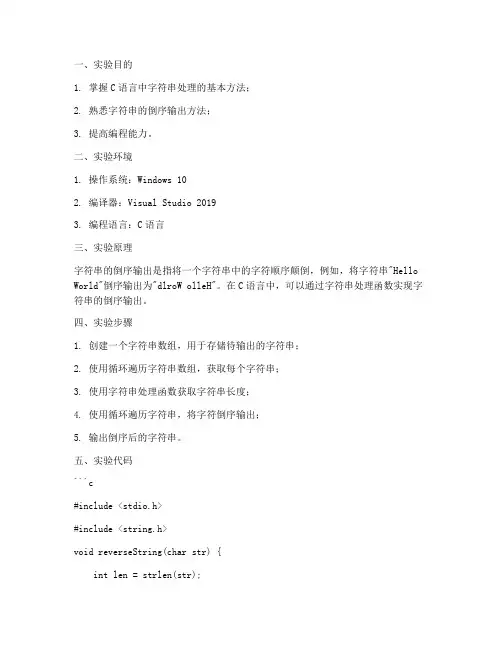
一、实验目的1. 掌握C语言中字符串处理的基本方法;2. 熟悉字符串的倒序输出方法;3. 提高编程能力。
二、实验环境1. 操作系统:Windows 102. 编译器:Visual Studio 20193. 编程语言:C语言三、实验原理字符串的倒序输出是指将一个字符串中的字符顺序颠倒,例如,将字符串"Hello World"倒序输出为"dlroW olleH"。
在C语言中,可以通过字符串处理函数实现字符串的倒序输出。
四、实验步骤1. 创建一个字符串数组,用于存储待输出的字符串;2. 使用循环遍历字符串数组,获取每个字符串;3. 使用字符串处理函数获取字符串长度;4. 使用循环遍历字符串,将字符倒序输出;5. 输出倒序后的字符串。
五、实验代码```c#include <stdio.h>#include <string.h>void reverseString(char str) {int len = strlen(str);for (int i = 0; i < len / 2; i++) {char temp = str[i];str[i] = str[len - 1 - i];str[len - 1 - i] = temp;}}int main() {char str[] = "Hello World";printf("Original string: %s\n", str);reverseString(str);printf("Reversed string: %s\n", str);return 0;}```六、实验结果1. 输出原始字符串:"Hello World"2. 输出倒序后的字符串:"dlroW olleH"七、实验总结本次实验通过C语言实现了字符串的倒序输出,掌握了字符串处理的基本方法。
c++reverse用法

c++reverse用法(原创版)目录1.C++中 reverse 用法概述2.reverse 函数的基本语法3.reverse 函数的实例分析4.reverse 函数的注意事项正文【1.C++中 reverse 用法概述】C++中的 reverse 函数是用于翻转字符串或字符数组的一种常用方法。
它可以将输入的字符串或字符数组中的元素进行反转,并将结果存储在输出的字符串或字符数组中。
reverse 函数的使用可以简化代码结构,提高程序的运行效率。
【2.reverse 函数的基本语法】C++中的 reverse 函数的基本语法如下:```cpp#include <iostream>#include <string>#include <algorithm>int main() {std::string str = "hello, world!";std::reverse(str.begin(), str.end());std::cout << str << std::endl;return 0;}```在这个示例中,我们首先引入了必要的头文件,然后定义了一个字符串变量 str,并使用 reverse 函数对其进行翻转。
最后,我们输出翻转后的字符串。
【3.reverse 函数的实例分析】我们通过一个具体的例子来分析 reverse 函数的使用方法。
假设我们有一个字符串"hello, world!",我们希望将其中的字符进行翻转,得到一个新的字符串"world! hello,"。
我们可以使用以下代码实现这一功能:```cpp#include <iostream>#include <string>#include <algorithm>int main() {std::string str = "hello, world!";std::reverse(str.begin(), str.end());std::cout << str << std::endl;return 0;}```在这个示例中,我们首先定义了一个字符串变量 str,并调用reverse 函数,将字符串的头尾字符进行翻转。
字符串反转java算法
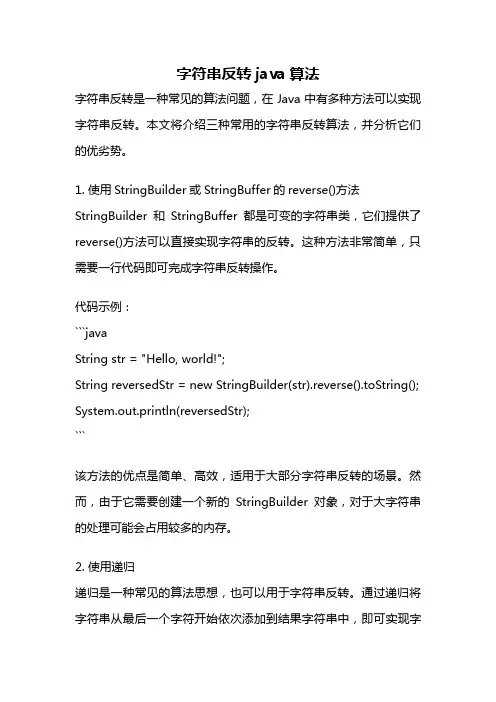
字符串反转java算法字符串反转是一种常见的算法问题,在Java中有多种方法可以实现字符串反转。
本文将介绍三种常用的字符串反转算法,并分析它们的优劣势。
1. 使用StringBuilder或StringBuffer的reverse()方法StringBuilder和StringBuffer都是可变的字符串类,它们提供了reverse()方法可以直接实现字符串的反转。
这种方法非常简单,只需要一行代码即可完成字符串反转操作。
代码示例:```javaString str = "Hello, world!";String reversedStr = new StringBuilder(str).reverse().toString(); System.out.println(reversedStr);```该方法的优点是简单、高效,适用于大部分字符串反转的场景。
然而,由于它需要创建一个新的StringBuilder对象,对于大字符串的处理可能会占用较多的内存。
2. 使用递归递归是一种常见的算法思想,也可以用于字符串反转。
通过递归将字符串从最后一个字符开始依次添加到结果字符串中,即可实现字符串反转。
代码示例:```javapublic static String reverseString(String str) {if (str.isEmpty()) {return str;} else {return reverseString(str.substring(1)) + str.charAt(0);}}public static void main(String[] args) {String str = "Hello, world!";String reversedStr = reverseString(str);System.out.println(reversedStr);}```该方法的优点是简洁、易于理解。
reverse函数的用法
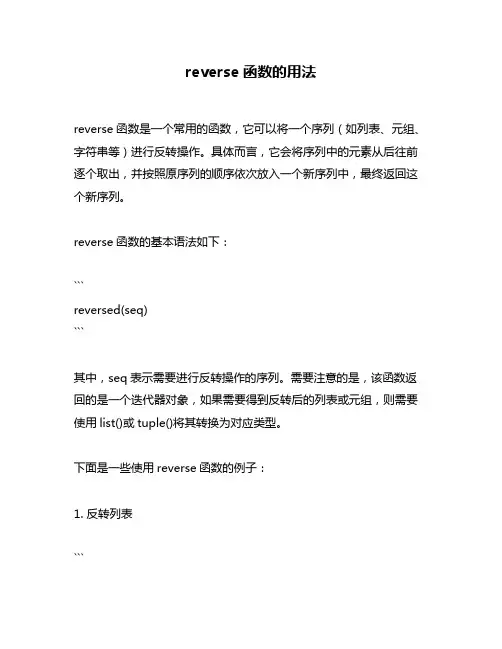
reverse函数的用法reverse函数是一个常用的函数,它可以将一个序列(如列表、元组、字符串等)进行反转操作。
具体而言,它会将序列中的元素从后往前逐个取出,并按照原序列的顺序依次放入一个新序列中,最终返回这个新序列。
reverse函数的基本语法如下:```reversed(seq)```其中,seq表示需要进行反转操作的序列。
需要注意的是,该函数返回的是一个迭代器对象,如果需要得到反转后的列表或元组,则需要使用list()或tuple()将其转换为对应类型。
下面是一些使用reverse函数的例子:1. 反转列表```lst = [1, 2, 3, 4]reversed_lst = list(reversed(lst))print(reversed_lst) # [4, 3, 2, 1]```2. 反转字符串```s = "hello world"reversed_s = ''.join(reversed(s))print(reversed_s) # "dlrow olleh"```3. 反转元组```tup = (1, 2, 3, 4)reversed_tup = tuple(reversed(tup))print(reversed_tup) # (4, 3, 2, 1)```需要注意的是,由于reverse函数返回的是迭代器对象,因此在对其进行遍历时只能进行一次遍历操作。
如果需要多次遍历,则需要先将其转换为列表或元组。
另外,需要注意的是,reverse函数并不会改变原序列的顺序,而是返回一个新的反转后的序列。
如果需要改变原序列,则可以使用列表、元组等自带的反转方法(如list.reverse())。
sv 队列 reverse方法
sv 队列 reverse方法
对于SV队列的reverse方法,它通常用于将队列中的元素顺序
颠倒,即将队列中的第一个元素变为最后一个,第二个元素变为倒
数第二个,依此类推。
这样的操作可以在队列中实现元素的逆序排列。
在实际编程中,实现SV队列的reverse方法可以通过以下步骤
进行:
1. 首先,创建一个临时的栈数据结构,用于暂存队列中的元素。
2. 然后,依次将队列中的元素出队,并压入临时栈中,直到队
列为空。
3. 接着,再将临时栈中的元素逐个出栈,并再次入队到原始队
列中,这样就完成了队列中元素的逆序排列。
以下是一个简单的伪代码示例,演示了如何在SV队列中实现reverse方法:
function reverse(queue) {。
var stack = new Stack(); // 创建一个临时栈。
while (!queue.isEmpty()) {。
stack.push(queue.dequeue()); // 将队列中的元素出队并压入栈中。
}。
while (!stack.isEmpty()) {。
queue.enqueue(stack.pop()); // 将栈中的元素出栈并重新入队到原始队列中。
}。
}。
需要注意的是,实际编程中需要根据具体的编程语言和SV队列的实现方式来进行相应的调整,但基本思路是类似的。
另外,对于
SV队列的reverse方法,还需要考虑边界情况和异常处理等问题,以确保代码的健壮性和稳定性。
举例说明堆栈的操作
举例说明堆栈的操作堆栈(Stack)是一种线性数据结构,其中元素的加入和删除都在同一端进行,这个端被称为栈顶。
堆栈遵循LIFO(Last In First Out)的原则,即最后加入的元素最先被删除。
下面举例说明堆栈的常见操作:1. 入栈(Push):将一个元素加入到栈顶。
比如,我们有一个空栈,然后按照顺序依次入栈5、8和3,栈的状态会变为[5, 8, 3]。
入栈操作可以用以下伪代码表示:```push(stack, element):top = top + 1 // 增加栈顶指针stack[top] = element // 将元素放入栈顶位置```2. 出栈(Pop):将栈顶元素删除,并返回其值。
从上面的例子继续,如果我们执行一次出栈操作,那么元素3会被删除,栈的状态变为[5, 8]。
出栈操作可以用以下伪代码表示:```pop(stack):if top < 0:error "栈为空"else:element = stack[top] // 获取栈顶元素的值top = top - 1 // 减少栈顶指针return element // 返回栈顶元素的值```3. 获取栈顶元素(Top):返回栈顶元素的值,但不删除栈顶元素。
在上述的例子中,栈顶元素是8、获取栈顶元素操作可以用以下伪代码表示:```top(stack):if top < 0:error "栈为空"else:return stack[top] // 返回栈顶元素的值```4. 判空(isEmpty):检查栈是否为空。
在入栈和出栈操作之后,我们可以使用isEmpty操作来判断栈是否为空。
如果栈为空,返回True;否则,返回False。
判空操作可以用以下伪代码表示:```isEmpty(stack):if top < 0:return Trueelse:return False```5. 获取栈的大小(Size):返回栈中元素的个数。
C语言反转字符串函数reverse()
C语⾔反转字符串函数reverse()The behavior of this function template is equivalent to:template <class BidirectionalIterator>void reverse (BidirectionalIterator first, BidirectionalIterator last){while ((first!=last)&&(first!=--last)) {std::iter_swap (first,last);++first;}}Attention:to the initial and final positions of the sequence to be reversed. The range used is [first,last), which contains all the elements between first and last, including the element pointed by first but not the element pointed by last.BidirectionalIterator shall point to a type for which is properly defined.Example:// reverse algorithm example#include <iostream> // std::cout#include <algorithm> // std::reverse#include <vector> // std::vectorint main () {std::vector<int> myvector;// set some values:for (int i=1; i<10; ++i) myvector.push_back(i); // 1 2 3 4 5 6 7 8 9std::reverse(myvector.begin(),myvector.end()); // 9 8 7 6 5 4 3 2 1// print out content:std::cout << "myvector contains:";for (std::vector<int>::iterator it=myvector.begin(); it!=myvector.end(); ++it)std::cout << '' << *it;std::cout << '\n';return0;}Output:myvector contains: 987654321实例:PAT⼄级1008 数组元素循环右移问题 (20 分)⼀个数组A中存有N(>0)个整数,在不允许使⽤另外数组的前提下,将每个整数循环向右移M(≥0)个位置,即将A中的数据由(A0A1⋯A N−1)变换为(A N−M⋯A N−1A0A1⋯A N−M−1)(最后M个数循环移⾄最前⾯的M个位置)。
反转字符串中的字符顺序(C++)
反转字符串中的字符顺序(C++)在C++中,要实现反转字符串中的字符顺序,首先需要了解字符串的基本操作和C++中提供的相关函数。
然后根据需求选择合适的方法来实现字符串的反转。
C++中,字符串的表示是通过字符数组来实现的。
我们可以使用char数组或者string对象来表达字符串。
对于char数组,C++提供了一些字符串处理的函数,比如strlen、strcpy、strcat等;对于string对象,C++也提供了丰富的成员函数来处理字符串,比如size、append、substr等。
如果我们选择使用char数组来反转字符串,可以通过交换数组元素的方式来实现。
具体来说,我们可以将字符串的第一个字符和最后一个字符进行交换,然后将第二个字符和倒数第二个字符进行交换,以此类推,直到整个字符串都被反转。
这种方法相对简单直接,但需要注意处理边界情况,比如空字符串或者长度为1的字符串。
```cpp#include <iostream>#include <cstring>//反转字符串的函数void reverseString(char* s) {int len = strlen(s);for (int i = 0; i < len / 2; i++) {char tmp = s[i];s[i] = s[len - i - 1];s[len - i - 1] = tmp;}}int main() {char str[] = "Hello, World!";reverseString(str);std::cout << str << std::endl; //输出!dlroW ,olleHreturn 0;}```如果我们选择使用string对象来反转字符串,可以通过string 对象提供的成员函数来实现。
比如,我们可以使用string的rbegin 和rend函数来遍历字符,并将字符逐个添加到新的string对象中,从而实现字符串的反转。