
七年级英语下册Module6-P4课件(新版外研版)优秀版
如:There is a lamp over the desk. 2) above指在上方,属于斜上方。
如:Raise your arms above your head. 3) on指在上面,表示两物体接触。
如:There is a cup on the table. 2:under / below的用法: 1) under在……下面/正下方.
—One hundred and thirty-five_m__e_t_r_e_s_.
4. — What can you see from the London Eye?
—On a _c_l_e_a_r_ day, most of London.
5. — where is the Tower of London?
7.It takes you 135 metres above the River Thames. 它能把你带到离泰晤士河面135米的高空。
8.As you go along the river , the London Eye is on your right. 沿河进行时,伦敦眼就在你的右边。 as 这里引导的是时间状语从句。
Module
6
Around town
Unit 2 The London Eye is on your
right.
Language points
1. clear adj. 晴朗的,清晰的 如:It’s a clear day today.
1) 派生词:clearly adv. 清晰地 如:An actor has to enunciate clearly .
5. Opposite is the National Gallery , a museum with lots of famous paintings. a museum 是the National Gallery 的同位语,with引 导的介词短语修饰museum.
6.When you are tired , the best way to see London is by boat. 译文:当你累了,游览伦敦最好的方式ridge is the Tower of London.
这是一个倒装句,主语是“the Tower of London” 正常语序为:The Tower of London is next to the bridge next to 在……的旁边,紧靠 The post office is next to our school. 1) next to是介词短语,后接名词或代词; 2)同义词:beside prep.在……旁边
He is famous as a football player.
3. get off 下车
Get off the bus on Oak Street. 1) 反义词组:get on上车;此处的on/off是介词,宾 语要跟在后面,不能置于中间. 2)v.+off构成的短语: take off 脱掉,起飞; turn off 关上; keep off 不让……进入; fall off 从……摔下来; have...off 休息……; set off 出发,动身。
9.You’re now back where you started. 你现在回到了出发的地方。 Where you started 是地点状语从句。
4. Complete the sentences.
above bridge clear famous metre square tour
1. — Where does the __t_o_u_r_ start? —From the _S_q_u__a_r_e_ opposite the National Gallery.
Let’s have a try……
5. Work in pairs
Student A: Show the map to student B and read
your directions.
Student B: Mark StudentA’s home on the map.
方位介词 用法总结
1:over, above和on的用法 1)over指在…的正上方,表示垂直在上。
2. — What’s the National Gallery?
—It’s a _f_a_m__o_u_s_ museum with lots of paintings. 3. — How high does the London Eye take you_a_b_o_v__e the River Thames.
—It’s next to a famous_b__r_id__g_e_.
5. Draw a map of your journey from school to home. Mark the streets and other places on the map in English. Don’t mark your home.
2) 用作形容词, 如:The river has clear water.
3) 用作动词,意思是“清理干净”, 如:clear the table(收拾桌子)。
2. famous 著名的 be famous for “以……出名或著称”
France is famous for its wine. 法国以其葡萄酒出名 be famous as “作为……出名或著称”
如: What's under your desk? 2) below 在……斜下方.
如: Her skirt came below her knees.
3:in 和on表示“在……上” 1.门一类——镶嵌在墙里的,用in, 字画一类——挂在墙面上的,用on. 2.鸟一类落在树上的,用in;
苹果一类长在树上的,用on. 4:in /on/ to表示方位 in表示在某范围之内; to表示在某范围之外; on表示“邻”、“接壤”。 Shanghai lies in the east of China. 上海位于中国东部。 Japan lies to the east of China. 日本在中国东部。 Mongolia(蒙古国)lies on the north of China. 蒙古人民共和国位于中国北部。
如:Raise your arms above your head. 3) on指在上面,表示两物体接触。
如:There is a cup on the table. 2:under / below的用法: 1) under在……下面/正下方.
—One hundred and thirty-five_m__e_t_r_e_s_.
4. — What can you see from the London Eye?
—On a _c_l_e_a_r_ day, most of London.
5. — where is the Tower of London?
7.It takes you 135 metres above the River Thames. 它能把你带到离泰晤士河面135米的高空。
8.As you go along the river , the London Eye is on your right. 沿河进行时,伦敦眼就在你的右边。 as 这里引导的是时间状语从句。
Module
6
Around town
Unit 2 The London Eye is on your
right.
Language points
1. clear adj. 晴朗的,清晰的 如:It’s a clear day today.
1) 派生词:clearly adv. 清晰地 如:An actor has to enunciate clearly .
5. Opposite is the National Gallery , a museum with lots of famous paintings. a museum 是the National Gallery 的同位语,with引 导的介词短语修饰museum.
6.When you are tired , the best way to see London is by boat. 译文:当你累了,游览伦敦最好的方式ridge is the Tower of London.
这是一个倒装句,主语是“the Tower of London” 正常语序为:The Tower of London is next to the bridge next to 在……的旁边,紧靠 The post office is next to our school. 1) next to是介词短语,后接名词或代词; 2)同义词:beside prep.在……旁边
He is famous as a football player.
3. get off 下车
Get off the bus on Oak Street. 1) 反义词组:get on上车;此处的on/off是介词,宾 语要跟在后面,不能置于中间. 2)v.+off构成的短语: take off 脱掉,起飞; turn off 关上; keep off 不让……进入; fall off 从……摔下来; have...off 休息……; set off 出发,动身。
9.You’re now back where you started. 你现在回到了出发的地方。 Where you started 是地点状语从句。
4. Complete the sentences.
above bridge clear famous metre square tour
1. — Where does the __t_o_u_r_ start? —From the _S_q_u__a_r_e_ opposite the National Gallery.
Let’s have a try……
5. Work in pairs
Student A: Show the map to student B and read
your directions.
Student B: Mark StudentA’s home on the map.
方位介词 用法总结
1:over, above和on的用法 1)over指在…的正上方,表示垂直在上。
2. — What’s the National Gallery?
—It’s a _f_a_m__o_u_s_ museum with lots of paintings. 3. — How high does the London Eye take you_a_b_o_v__e the River Thames.
—It’s next to a famous_b__r_id__g_e_.
5. Draw a map of your journey from school to home. Mark the streets and other places on the map in English. Don’t mark your home.
2) 用作形容词, 如:The river has clear water.
3) 用作动词,意思是“清理干净”, 如:clear the table(收拾桌子)。
2. famous 著名的 be famous for “以……出名或著称”
France is famous for its wine. 法国以其葡萄酒出名 be famous as “作为……出名或著称”
如: What's under your desk? 2) below 在……斜下方.
如: Her skirt came below her knees.
3:in 和on表示“在……上” 1.门一类——镶嵌在墙里的,用in, 字画一类——挂在墙面上的,用on. 2.鸟一类落在树上的,用in;
苹果一类长在树上的,用on. 4:in /on/ to表示方位 in表示在某范围之内; to表示在某范围之外; on表示“邻”、“接壤”。 Shanghai lies in the east of China. 上海位于中国东部。 Japan lies to the east of China. 日本在中国东部。 Mongolia(蒙古国)lies on the north of China. 蒙古人民共和国位于中国北部。
合集下载
外研版英语七年级下册课件module4单元课件
03
Grammar and Sentence Analysis
Explanation of key grammar rules
01 02
Present Perfect Tense of Verbs
Explain the definition, composition, and usage of the present perfect tense, and compare the differences between the past tense and the present perfect tense.
Teaching strategy
Adopting multimedia teaching, utilizing various means such as pictures, audio, and video to help students better understand and master the content they have learned. At the same time, pay attention to student participation and interaction, and encourage students to actively speak and communicate.
• Key content: The reading section introduces famous tourist attractions such as the Great Wall of China, the Eiffel Tower in France, and the Statue of Liberty in the United States; The listening section discusses travel plans and experiences; I practiced how to introduce my travel plans and experiences to others in the oral section; The writing section requires writing an article about travel plans; The vocabulary section includes vocabulary and expressions related to tourism.
外研版七年级英语下册Module6 Around town Unit1优质课课件(35张)

Summary
How to ask the way?
1.Where is the…? 2. Is there a …near hear? 3. How can I get to the…? 4. Can you tell me the way to…? 5. Could you tell me how to get
neighborhood. 邻近居街区
Follow me,
please!
The map of our neighborhood.
Lingling’s
South Lake Park
The map of our neighborhood.
Lingling’s
supermarket 超市
South Lake Park
Bookshop: There is a big bookshop __o_v_e_r_ t_h_e_r_e___, just _a_l_o_n_g____ Xi Chang’an jie, on the _r_i_g_h_t____, ___o_p__p_o_s_i_t_e__ the bank.
train bank
station
bookshop
hospital
Lingling’s
supermarket
post office
Aixin Road
museum
South Lake Park
The map of our neighborhood.
school
bank
train station book-
to…?
Summary
How to show the way?
1. Go along/ across… 2. Turn left/ right at the… street(大街)/ crossing
外研版英语七年级下册课件Module4单元课件
Tony: Yes. Teachers won’t use chalk on a blackboard and students won’t use pens and paper, or erasers any more!
Lingling: Great! Will students have a lot of homework to do?
Betty: Well, I’m not sure. Yes, students will use computers, but school is good fun, and you can make friends there. And teachers can check the students’ level and will help them. Computers won’t be able to do that.
1 Work in pairs. Look at the picture and describe it. Use the words in the box to help you.
blackboard chalk
computer email
eraser
Internet
paper
pen
pencil
一般疑问句: Will + 主语 + 动词原形? 肯定回答:Yes, 主语+ will . 否定回答:No,主语+ will not/won’t. 1、-将来的学校会不一样吗? -是的。
- __W__i_llschools __b__e_ different in the future? - Yes, they _w__i_ll__ .
ask v. 询问;问
新外研版七年级下英语课件Module6Unit

定义
合作学习法是一种通过小组合作、互动学习的方 式,促进学生学习效果的教学方法。
实施方式
教师将学生分成小组,每个小组有共同的学习目 标,通过组内合作、讨论、交流等方式完成学习 任务。
目的
合作学习法旨在培养学生的团队协作能力、沟通 能力和自主学习能力,同时提高学习效果。
案例
在教授“节日”这一主题时,教师可以让学生分 组收集不同国家的节日资料并进行展示,通过小 组内部的分工合作和讨论交流,让学生全面了解 不同国家的节日文化。
Ability goals
培养学生的阅读理解 能力,能够理解关于 节日和庆祝活动的文 章。
培养学生的口语表达 能力,能够用英语流 利地谈论节日和庆祝 活动。
提高学生的写作技巧 ,能够运用所学词汇 和语法点描述节日和 庆祝活动。
Emotional goals
激发学生对英语学习的兴趣和 热情,让他们感受到英语的魅 力和实用性。
06 Teaching Reflection
Evaluation of teaching effectiveness
Student engagement
Did students actively participate in class activities?
Language output
Did students demonstrate effective language use in speaking and writing tasks?
Reflection on teaching methods
Lesson structure
Technology integration
Was the lesson well-organized and did it flow logically?
外研版七年级英语下册 精品课件 Module 6 Around town(共90张PPT)
e
c
b
d
a
When you read English, there may be new words or phrases. Some of them may be names which you often can’t translate. Look at words which begin with capital letters and decide if they are names.
3. Who does the tourist ask for the way to the National Stadium? A policeman.
could street
excuse tourist
policeman underground
Excuse me, is Wangfujing Dajie far 1. _______ from Tian’anmen Square? 2. There’s a bookshop near here. What’s the name of the _______? street policeman the way 3. Can a _______ tourist ask a _________ to get to places in Beijing?
could street
excuse tourist
policeman underground
4. ______ Could you tell me how to get to the
National Stadium?
5. Where’s the ____________ underground station?
Unit 1 Could you tell me how to get to the National Stadium?
外研版七年级英语下册Module6 Around town Unit1 精品课件(35张课件)
“Why not +动词原形?”意为“为什么 不……呢?”,相当于“Why don’t you+ 动词原形?”。如:
Why not go to the zoo with us? = Why don’t you go to the zoo with us?
Practise 选择填空。
Why not _______ an English club to practise your English? A. to join B. join C. joins D. joining
Module 6 Around town6
Around town
Unit 1
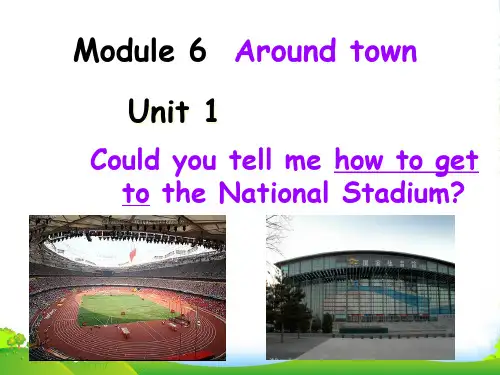
Could you tell me how to get to the National Stadium?
Free talk
The capital(首都) of China is Beijing. Well,do you know any important places in Beijing?
go along the street and turn left at the third street on the left.
2. Is there a bookshop near here?
2. Yes, there is a big bookshop over there.
3. How can I get there? =How can I get to the
P32
Task 1
Watch and answer the questions.
P32
Task 1
Watch and answer the questions.
1. How will the tourist get to Wangfujing Dajie from Tian’anmen Square?
Why not go to the zoo with us? = Why don’t you go to the zoo with us?
Practise 选择填空。
Why not _______ an English club to practise your English? A. to join B. join C. joins D. joining
Module 6 Around town6
Around town
Unit 1
Could you tell me how to get to the National Stadium?
Free talk
The capital(首都) of China is Beijing. Well,do you know any important places in Beijing?
go along the street and turn left at the third street on the left.
2. Is there a bookshop near here?
2. Yes, there is a big bookshop over there.
3. How can I get there? =How can I get to the
P32
Task 1
Watch and answer the questions.
P32
Task 1
Watch and answer the questions.
1. How will the tourist get to Wangfujing Dajie from Tian’anmen Square?
新版外研版七年级英语下册Module6P2课件
短语
1. 在...前面 in front of 2. 打扰一下 excuse me 3. ... 的路线 the wayt to... 4. 沿着这条街走 go/walk along the street 5. 往左转 turn left 6. 往右转 turn right 7. 在左边/右边 on the left/ right 8. 在第三大街 at the third street 9. 在附近 near here 10. 在银行对面 opposite the bank 11. 到达 get to 12. 到那儿 get there 13. 我不确定 I'm not sure.
4 Could you tell me how to get to the National Stadium?
5 Go along the street and you'll see an underground station.
Read activity 3 again and complete the table.
4. turn left/right 向左/ e.g.: Turn left,and you’ll find the hospital. 【拓展】 常见left/right搭配:turn left/turn right向左/右转; on the left/on the right of...在……的左边/右边; 2)常见turn搭配: turn to... 翻到……(页); at the third street 在第三大街 turn over 翻身; at the first crossing turn on 打开; 在第一个十字路口 turn off 关上; at the second turning turn up 调高; 在第二个转弯处 turn down 关小,调低
外研版七年级下册英语课件Module-6Unit
Meaning and usage
01
It is essential for students to understand the meaning of new words and how to use them correctly in context.
Synonyms and antonyms
Questioning and Discussion
Encourage students to ask questions and participate in discussions, promoting active learning and critical thinking.
Activities
01
Teaching objectives
理解关于全球变暖和气候变化的基本概念和科学原理。
了解全球变暖对地球环境和人类生活的影响。
掌握本单元的核心词汇和短语,如“climate change”、“global warming”、“carbon emissions”等。
培养学生对全球变暖和气候变化问题的关注和意识,激发环保意识。
The latest foreign research version of the seventh
目录
contents
Teaching objectivesTeaching contentteaching methodteaching processTeaching evaluationTeaching Reflection
Feedback
Provide constructive feedback to students on their performance during the practice session, pointing out areas for improvement and encouraging positive progress.
外研版英语七年级下册module6 (共19张ppt)
• 7.---These shoes look cool. _____are they? • -----They are on sale, only 10 dollars. • A.How much B.How many C.How long • 8.---_____T-shirt is this? • -----I think it’s Tom’s. • A.Whose B.Which C.What • 9.---_____is your favourite day? • ------Monday. Because we have PE and music. • A.How B.What C.Why
• A. eat the meal with teacher B. celebrate the special days
• C. learn 2-3 recipDes each lesson D. have a hands-on experience
• 7. You will pay______ for five lessons.
• 1.Look! The kites in the sky are different in ____. Some are big and some are small. • A. colour B.shape C.size • 2.---Excuse me, what’s the _____ of the apples? • ---It’s 10 yuan a kilo. • A.price B.size C.weight • 3.---What do you think of the cake? • ---It ___ delicious. Is it made by your mother? • A.sounds B.tastes C.smells
初中英语外研版七年级下册《Module 6 》课件PPT
Unit 2 The London Eye is on your right.
Around town
外研版初中英语七年级下册课件
教学目标
目
教学过程
录
教学重点
拓展练习
PART 01
教学目标
Some famous places in London
e
c b
a
Nationalaph 4-5
1. Where is the Tower of London?
Next to Tower Bridge.
2. How do you come back to the Square?
Get off the boat, go past the station and walk along the street, turn left into King’s Street, and go past a church.
C. Houses of Paliament
E. Tower of London
D. London Eye
Try to retell the tour of London.
The Trafalgar square → National Gallery → Buckingham Palace → Houses of Parliament,
Tower Bridge伦敦塔桥 It’s on the River Thames.
Tower of London伦敦塔
It’s the city’s oldest palace and it’s 900 years old.
PART 02
教学过程
Open your exercise book and turn to p87 • A1, Listen and answer the three
Around town
外研版初中英语七年级下册课件
教学目标
目
教学过程
录
教学重点
拓展练习
PART 01
教学目标
Some famous places in London
e
c b
a
Nationalaph 4-5
1. Where is the Tower of London?
Next to Tower Bridge.
2. How do you come back to the Square?
Get off the boat, go past the station and walk along the street, turn left into King’s Street, and go past a church.
C. Houses of Paliament
E. Tower of London
D. London Eye
Try to retell the tour of London.
The Trafalgar square → National Gallery → Buckingham Palace → Houses of Parliament,
Tower Bridge伦敦塔桥 It’s on the River Thames.
Tower of London伦敦塔
It’s the city’s oldest palace and it’s 900 years old.
PART 02
教学过程
Open your exercise book and turn to p87 • A1, Listen and answer the three