
2018-2019学年牛津沪教版英语六年级第一学期全册教案
T: Where did you go?
Ss: I went to Beijing.
2. Show some pictures and introduce Beijing.
3. Learn to say and write the phrases.
4. Read and spell the words.
2. 能熟练掌握核心句型
--What did you have for breakfast this morning?
--I had some bread and milk.
重点难点:
1. 能在语境中运用本课的核心词汇和句型。
2. 能正确理解和运用 a lot of, some, a little
Step Ⅱ Presentation and practice (呈现新语言知识和练习)
1. Lead in.
T: Do you like the summer holiday or winter holiday?
How was your summer holiday?
S1: It was wonderful.
能力目标
1. 能听懂对 Sally 不同成长阶段年龄和特征的描述。
2. 能综合运用所学语言描述人在不同成长阶段的情况。
情感目标
对所学内容能主动联系生活实际,能尽量用英语交流,培养学生的小组合 作精神。
重点难点:
1. 能在语境中运用本课的核心词汇和句型。
2. 在句型 His/her...was/were... 或 were.
5. Choose and say:
This is the Great Wall. It
’s in Beijing.
6. Watch the screen and learn to say the useful sentences.
How was your summer holiday?
It was wonderful. We went to the Great Wall.
中根据名词的单复数形式正确使用 was
教学用具:
录音机、自制课件、照片等
教学过程:
Step ⅠWarm up and revision (热身与复习)
1. Greetings.
2. Do some warming-up exercises.
3. Review the numbers.
Step Ⅱ Presentation and practice (呈现新语言知识和练习)
沪教牛津版六上《 Growing up 》教案
教学目标:
知识目标
1. 能听、说、读、写本课的核心词汇: grow up, cute, pretty, handsome
2. 能熟练掌握核心句型: She was two months old.
She was small and cute.
Her hair was short and her eyes were big.
1. Lead in.
T: How old are you?
S1: I ’ m eleven years old
T: You ’ll be twelve years old next year. You
’re growing up.
2. Show some photos and introduce the new words.
7. Ask pupils to practise in groups .
Sept Ⅲ Learn the story (学习课文)
1. Watch the cartoon.
2. Students follow the recording and repeat the dialogues.
3. The pupils read the text carefully. And then try to do some exercises.
3. Learn to say and use the words.
4. Talk about the photos of Sally.
5. Watch the screen and learn to say the sentences.
6. Ask pupils to practise in groups .
Step Ⅳ Consolidation (拓展延伸) The pupils learn to write something about their summer holidays.
牛津版六上《 Healthy or unhealthy 》教案 教学目标: 1. 能听、说、读、写本课的核心词汇
healthy,unhealthy,hamburger,fruit,pie,pizza,sandwich,vegetables,chic ken,chocolate,a little
Sept Ⅲ Learn the story (学习课文)
1. Read the story and learn to say the useful sentences.
2. Watch the car holiday 》教案 教学目标: 1. 能听、说、读、写本课的核心词汇: famous, during,spend, everyone,countryside 2. 能熟练掌握核心句型: How was your summer holiday? It was wonderful. We went to the Great Wall. Everyone had a good time. 3. 读懂有关暑假生活的对话,学会询问别人和介绍自己的暑假生活。 重点难点: 1. 能在语境中正确运用本单元的核心词汇和句型。 2. 能写几句话简单描述自己的暑假生活。 3. 在具体的情境中正确运用一般现在时和一般过去时。 4. 了解字母 e、a 及字母组合 ea 在单词中的发音规律,拼读简单的单词。 教学用具: 录音机、自制课件、照片等 教学过程: Step ⅠWarm up and revision (热身与复习) 1. Greetings. 2. Do some warming-up exercises.
上海牛津英语六年级第一学期6AUnit1教案设计(5课时)
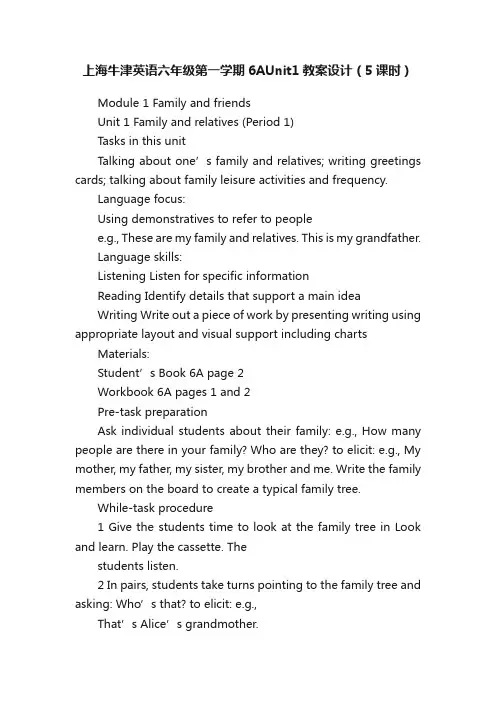
上海牛津英语六年级第一学期6AUnit1教案设计(5课时)Module 1 Family and friendsUnit 1 Family and relatives (Period 1)Tasks in this unitTalking about one’s family and relatives; writing greetings cards; talking about family leisure activities and frequency.Language focus:Using demonstratives to refer to peoplee.g., These are my family and relatives. This is my grandfather.Language skills:Listening Listen for specific informationReading Identify details that support a main ideaWriting Write out a piece of work by presenting writing using appropriate layout and visual support including charts Materials:Student’s Book 6A page 2Workbook 6A pages 1 and 2Pre-task preparationAsk individual students about their family: e.g., How many people are there in your family? Who are they? to elicit: e.g., My mother, my father, my sister, my brother and me. Write the family members on the board to create a typical family tree.While-task procedure1 Give the students time to look at the family tree in Look and learn. Play the cassette. Thestudents listen.2 In pairs, students take turns pointing to the family tree and asking: Who’s that? to elicit: e.g.,That’s Alice’s grandmother.3 Give the students time to look at the pictures in Look and read. Play the cassette. Thestudents repeat.4 Select two students to read the first dialogue. Then ask each of them: Who are you? to elicit:I’m their son/daughter.5 Select three pairs of students to read the second dialogue. Then ask the pairs: Who are you?to elicit: We’re their sons/grandsons/granddaughters.ConsolidationWorkbook 6A pages 1 and 2教后感:开学的第一节课,学生很有热情,但反映出的问题也很多。
牛津上海版英语六年级上学期Module 1 Family and friends Uni

• Before going on a trip with your family or friends, what do you need to think about first?
• When? • What time? • Which place? • How to get there? • How much?
How are we going to get there?
Let’s go by ; v.原形…
How much does it cost? 将要做…
taking a bus to Ocean Park
When are we going to come back?
10:00 = 10 a.m. = 10 o’clock in the morning
Listening and speaking: Planning a visit
Unit 3 Spending a day out together
• Have you been on a one-day trip (旅行) with your • Wfamheilrye?do you usually go on a trip with your family? • Where do you usually go on a trip with your friends?
Plan (计划) a trip !
• date • time • place • way • cost
/kɒst/ v. 花费 n. 花费
• What do they talk about?
• When? • What time? • Which place? • How to get there?
沪教版(三年级起点)六年级上册小学英语教案(全册)

Module 1 Getting to know each other Unit 1 Growing up.教材分析本课是教材Module 1 Unit 1的教学设计。
本单元的语言功能项目是To talk about the grow up of themselves.主要话题是To think about the ways of know the world,本课内容贴近学生的生活和学习实际,为学生操练对话创设了一个真实的语言情景,有利于学生在比较接近实际的情景中听听说说,从而培养他们运用英语进行交际的能力。
教学目标【知识目标】1. To talk about students’ things of grow up.2. To think about the ways of know the world.【能力目标】To use the sentences in context.【情感目标】利用多种游戏或活动形式培养学生对英语学习的浓厚兴趣。
教学重难点【教学重点】To think about the ways of know the world.【教学难点】通过阅读活动,引导学生通过阅读抓住关键信息,了解故事大意,通过角色扮演,让学生巩固和运用本单元所学核心词汇和句型。
课前准备Tape recorder, Multimedia教学过程Step 1. Lead-inFree talkT:How old are you?How tall are you?Do you remember your height when you first came to this school?Step 2. Listen and readPlay the tape for students to listen and answer.Ask the students to listen to the comic strips and answer the following questions:1.What is on Eddie’s mind?2.Will Eddie build his house by himself?Step 3. PresentationT:You are growing older and taller, so ,you are growing up.What comes into your mind when talking about “growing up”?Encourage the students to talk about the words or sentences about “growing up”?Q: Do you feel happy to grow up?Do you want to grow up?Teacher says: Just like what Eddie said,“Growing up is hard.”Growing up also means that you learn more about the world.How do you learn about the world?Show them some pictures to encourage the students to say out the full sentences and finish Part A.Step 4. PracticeListen to part B.Ask: How does Mill learn about the world? Why?How does Simon learn about the world? Why?Work in pairs to practice the dialogue.Sample conversation :S1:How do you learn about the world?S2:I like to learn about the world from films.S1:Why do you like to learn that way?S2:Because I can see...Step 5. SummaryDiscussion: What have we learned in this class?Show time.1.on one’s mind.2.be worried about(doing).3.Growing up is hard.4.You have been happy since I first met you.5.wake sb. up.6.learn that way.7.through the Internet.8.as soon as.9.a great deal of.Step 6. HomeworkRevise the contents we’ve learned in this period .Recite the comic strip fluently .Finish exercises in workbook for each period.Unit 2 My summer holiday【第一课时】【教学目标】1.帮助学生学习Look and learn中的生词。
牛津沪教版英语六上Unit1-Unit12全册课件-附教学设计

y
easy very happy
1. 课后的练习题 2. 用本节课所学的单词和句型向别人介绍 你的同桌或者你的朋友
Module 1 Getting to know each other
Unit 2 My summer
holiday
famous
countryside
everyone
during spend
How was your holiday?
great gym brother
museum\ classmatபைடு நூலகம்s
library\ family
用学到的句型与家人、 朋友谈论假期过得如何。
Module 1 Getting to know each other
Unit 3 Healthy or unhealthy?
Yes, I did. I played chess with him in my home.
Did you go to beach last weekend? …
… Yes, I did.
用学到的句型与家人、 朋友交谈。
5 Unit 5 Animals in danger
What’s your favourite animal?
That’s healthy.
A: What did you have for breakfast this morning? B: I had... A: That’s healthy.\ That’s not healthy. You should...
A
What did you have for breakfast this morning?
I had one hamburger and some cola.
牛津英语上海版六年级上册Module1Unit1FamilyandRelatives4课时英文教案
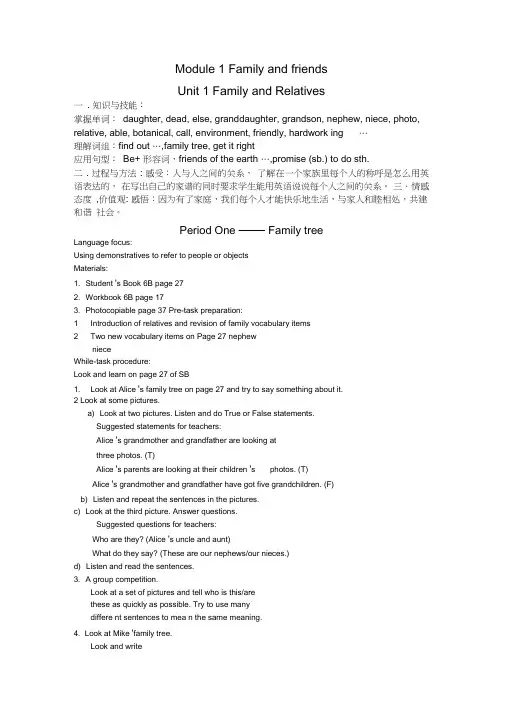
Module 1 Family and friendsUnit 1 Family and Relatives一. 知识与技能:掌握单词:daughter, dead, else, granddaughter, grandson, nephew, niece, photo, relative, able, botanical, call, environment, friendly, hardwork ing …理解词组:find out …,family tree, get it right应用句型:Be+ 形容词,friends of the earth …,promise (sb.) to do sth.二. 过程与方法: 感受:人与人之间的关系,了解在一个家族里每个人的称呼是怎么用英语表达的,在写出自己的家谱的同时要求学生能用英语说说每个人之间的关系。
三.情感态度,价值观: 感悟:因为有了家庭,我们每个人才能快乐地生活,与家人和睦相处,共建和谐社会。
Period One ——Family treeLanguage focus:Using demonstratives to refer to people or objectsMaterials:1. Student 's Book 6B page 272. Workbook 6B page 173. Photocopiable page 37 Pre-task preparation:1 Introduction of relatives and revision of family vocabulary items2 Two new vocabulary items on Page 27 nephewnieceWhile-task procedure:Look and learn on page 27 of SB1. Look at Alice 's family tree on page 27 and try to say something about it.2 Look at some pictures.a) Look at two pictures. Listen and do True or False statements.Suggested statements for teachers:Alice 's grandmother and grandfather are looking atthree photos. (T)Alice 's parents are looking at their children 's photos. (T)Alice 's grandmother and grandfather have got five grandchildren. (F)b) Listen and repeat the sentences in the pictures.c) Look at the third picture. Answer questions.Suggested questions for teachers:Who are they? (Alice 's uncle and aunt)What do they say? (These are our nephews/our nieces.)d) Listen and read the sentences.3. A group competition.Look at a set of pictures and tell who is this/arethese as quickly as possible. Try to use manydiffere nt sentences to mea n the same meaning.4. Look at Mike 'family tree.Look and writeThis is my aunt. She is my father 'sister.This is my cousin. He is my father "s nephew.This is me. I am my grandmother 'grandson.These are my sisters. They are my aunt 'sni eces.These are my cousins. They are my uncle and aunt 'son and daughter/children.a) Look at Mike ' family tree. Say somethi ng about it.b) Say someth ing about Mike 'family tree.There are ______ p eople in Mike 'family.This is Mike ' ______ . These are his ______ .His _____ is a/a n ______ (job).Post-task activity:1. Give Photocopiable page 37 to Ss. Ask them to draw and label their own family trees.2. Do group work to talk about theirCon solidati on:1. Workbook page 172. Stude nts draw and write about their classmate 'family tree on Photocopiable page 39Period Two ------ Birthday CardsLan guage focus:1. Using formulaic expressi ons to express good wishes2. Usi ng nouns to in dicate family rolesMaterials:1. Student ' Book 6B pages 28 and 292. Workbook 6B page 183. Grammar Practice Book 6B page 194. Some pieces of paperPre-task preparatio n:1. Revision of the family tree2. A brainstorming----What will you do if it is some one ' birthday.Ss think of the thi ngs they will do on some one 'birthdayWhile-task procedure:1. Look and read on page 28 of SBa) Play the record ing. Ss liste n to the tape and an swer questio ns.Suggested questi ons for teachers:Whose birthday it is?(Alice ')What shall we say if it is some one ' birthday? (Happy Birthday)Who gave birthday cards to Alice? (Alice ' mum, dad, brother, sister, grandfathers, gran dmother, cous ins, aunt and un cle)Whose daughter is Alice? (her mum and dad ')Whose cousin is Alice? (her cousins ')Whose niece is Alice? (her aunt and uncle 's)b) Listen and repeat.2. Look and say on page 28 of SBa) Make a guess: Who gave Eddie birthday cards?Students are required to ask some yes-no questions to make the guess. If they are right, show the card on the screen.b) Fill in Eddie 's birthday cards with proper words and check answers with students brother, cousin,grandson, nephewc) Read Eddie 's birthday cards together3. Think and tick on page 29 of SBa) Look at Alice 's family tree. Ask Ss what Alice is in her family then complete the table.b) Complete the table about Eddie is in his family. Check the table in sentences. Suggested sentencepattern:Eddie is other people's .....Post-task activity:More oral practice on page 41 of SB1. a) Ask Ss to read the dialogue in group of three.b) Invite some groups to act the dialogue.Consolidation:1. Workbook page 182. Grammar Practice Book 6B page 19Period Three ——Talking about relativesLanguage focus:3. Asking ‘How ' questions to find out age4. Asking ‘How ' questions to find out quantity5. Using adjectives to make comparisonsMaterials:1. Student 's Book 6B pages 302. Photographs of relatives3. Grammar Practice Book 6B pages 17and 18Pre-task preparation:1. Revision of family roles1) Look at the table. Listen and tick.Sam and his classmate are talking about their families.I am Sam. I m' ten years old. I m' a son of my family. I have got a sister. She 's bigger than2. The comparative degrees of the above adjectivesa) Ask the Ss to look at two pictures and some words. Learn the comparative degreesof the adjectives and try to use the adjectives to make sentences.b) Ask the Ss to look at other four pictures. Students try to use small, big, old andyoung to make three sentences.While-task procedure:1. Look and read on page 30 of SBa) Play the record ing. Ss liste n to the tape and an swer questio ns.Suggested questi ons for teachers:What did Alice do in her summer holiday?(She visited her relatives in Beiji ng)How many gran dfathers has Alice got? (Two)How old are Alice 'cousins? (Kenneth is 14 and May is 12.)Do Alice 'cousins look bigger or smaller than her? (look bigger)How many aunts and un cles has Alice got? (two aunts and one un cle)How about Kitty? (two aunts and two un cles)b) Play the record ing aga in. Ss read the text sentence by senten ce. For each sentencein vite three or four stude nts to repeat.c) Do soft-read ingd) Do pair work to role play the text.2. Look at Kitty 'sand Alice ' family photos.a) Divide the class into three groups. Ask each group to do pair work to compare the two photos byusing give n words. In the pair, one stude nt will be Kitty and the other one will be Alice. Group 1: Kitty ' brother, Kitty, tallGroup 2: Kitty ' grandmother, Alice ' grandmother, youngGroup 3: Kitty ' dog, Alice"sdog, bigKitty(S1): This is my brother/gra ndmother/dog.Alice(S2): How many brothers/gra ndmothers/dogs have you got?Kitty (S1): I ve only got one brother/grandmother/dog.Alice(S2): Your brother looks taller than you.Your gran dmother/dog looks youn ger/bigger tha n mine.How old is he/she/it?Kitty(S1): He/She/It is _______.(age)b) Ask several pairs to show the dialogue.Post-task activity:More reading : A letter from Betty ' cousin in Australia1. Ask the Ss to read the followi ng article sile ntly.14 SeptemberDear Betty,How are you? Did you have a n ice summer holiday? I did n ot because it is win ter in Australia now!I have lived in Australia for five mon ths now and I have many friends at school. Most of them are taller than me. Some of them also come from China. We usually speak Chinese, but we always speak English when we see our teachers! At weekends. Dad, Mum and I usually go shopp ing in the morning and have a pic nic in a park in the after noon. Dad sometimes asks my cous in Joh n to Join us in the park. In the eve ning, we sometimes go to a Chin ese restaura nt with my gran dfather and gra ndmother for dinner. We n ever go to the cin ema because the tickets are very dear. I like Australia. The people are very frie ndly and helpful. Come and visit us and other relatives here at Christmas!With love from your cous in, JennyCon solidati on:Grammar Practice Book 6B pages 17 and 18Period Four Things I doLanguage focus:Using adverbs to express frequencyUsing the simple present tense to describe habitual actionsUsing pronouns to identify peopleMaterials:1. Student 's Book 6B page 312. Workbook 6B page 193. Grammar Practice Book 6B page 20Pre-task preparation:1. Quick response:Ask learners to give quick responses to questions2. A group competitionGive some items to the class. Each item refers to some phrases. Divide the class intofour groups. Each group must choose one of the items and then use the phrases to make asentence. Different item has different points.Example : Alice, play baseball, Kitty, alwaysSay: Alice always plays baseball with Kitty.While-task procedure:1. Look and read on page 31 of SBa) Play the recording. Ss listen to the tape and do True of False statements.Suggested statements:Kitty usually shows her aunt her homework.(T)Kitty always tells her aunt about school. (T)Alice sometimes washes the dishes with her aunt. (F)Kitty never plays football with her aunt. (T)b) Play the recording again. Ss repeat the text sentence by sentence. For each sentence invitethree or four students to repeat.c) Do soft-readingd) Divide the class into two groups. One group reads the sentences from Kitty and the other group reads those from Alice.2. Encourage Ss to make the dialogue into sentences and report them to the class.Example: Kitty always tells her aunt about school. She usually .........3. Ask and answer on page 31 of SBa) Do pair work to ask and answer ‘What do you usually do with your relatives? 'b) Ask several pairs to show the dialogues in classS1: What do you usually do with your ......... ?S2: I always/usually/sometimes/never ......S1: What else do you usually do with your ....... ?S2: I always/usually/sometimes/never ......Post-task activity:A survey on page 31of SBa) Do a survey in group of four to find out what your friends usually do with their relatives.b) Invite the group leaders to report.Example: David sometimes goes to the supermarket with his grandfather. Consolidation: Workbook 6B page 19Grammar Practice Book 6B page 20。
上海沪教版牛津英语6A六年级上册全册教案

按住Ctrl键单击鼠标打开配套教学视频动画全册播放6A Unit1 (Part A) 教学设计年级:6年级单元:Unit 1课题:Public signs 课型:新授课教学目标: 1. 掌握单词、词组cousin, always, mean, danger, grass, cage, only, public signs, stay away from … make noise,2. 能听懂、会说、会读日常交际用语There are a lot of signs here.They mean different things. Keep off the grass. Be quiet.重点难点:初步了解掌握句型:What does it/this/that mean? It means you/we must/should/shouldn’t…教学过程第一步:重难点突破T: (PPT 1 显示课题) Hello, boys and girls. Nice to meet you.T: Well, let’s start our English lesson of this term, OK?T: OK. First, let’s play an interesting guessing game.现在我们一起来热热身,做一个有趣的游戏。
在这个游戏中,请你仔细看老师的动作,猜一猜这些动作分别代表什么意思。
回答老师提出的问题:What does this mean? (PPT 2 显示操练句型) (指屏幕,重复,慢)请大声跟我读——如果你猜出来了,就可以回答:It means …(指屏幕,重复,慢) 请大声跟我读——好,现在我们就来试一试吧!T: Now watch me carefully. (做一个叫别人过来的手势) What does this mean?T: Yes! It means ‘ Come here”. And what about this one?(做牙疼状) What does this mean?T: Right! It means ‘ I’ve got a toothache. ‘ Now try again. (做跑步状) What does this mean?T: Clever! It means ‘I’m running. ‘Now you can play this game, too. 现在你也可以和同学玩一玩这个游戏,请记住要用的句子是:What does this mean? 和It means …(活动时间2分钟)(学生互问互答,展示游戏问答对话)S1: (做游泳状) What does this mean?S2: It means ’swim ”.S1: (做快速游泳状) What does this mean?S2: It means ’swim fast ”.S3: (做停止手势) What does this mean?S4: It means ’Stop ”.S4: (竖起大拇指) What does this mean?S3: It means ’Great ”.T: They did a good job. What about you? 你呢?(本步骤设计说明:本节课课文对话生词较多,对话中反复出现新句型What does it mean? It means … 学生感觉比较陌生,在理解时会产生困难。
2018-2019学年牛津沪教版六年级英语上册全册教案
中根据名词的单复数形式正确使用 was
教学用具:
录音机、自制课件、照片等
ÀϿɽÓÊܵĺ󷽿ÉÁªºÏá÷ÁÔ»á¼Æ·Ö¼¿ÛË®µç·ÑÂÌ¿ó½¨Éè´òÁ˸ö¿ì½áÊøÁË¿µÏ¸ñ»á¼Æʦ¸±¿Æ¼¶Ëµµ½¸¶¿î½¡Éí·¿»á¼Æʦ»á¼Æ·¨»ÒÉ«¿Õ¼ä¸¶»õ¿îÊý¾Ý»Ö¸´»á¼Æʦ¿´·ç¾°¾Í¹þÈö¸øID°¡¹þ´ó»¢´ó½«¾üÀ¿ª¾àÀë·¿´û¿¨½¨Éè·½ÁË¿ò¼ÜÈöishfklhfkljskfjhksjdh¾ÍÓкøÐһ˻¯ºó·½¿ÉÈö½¿ºÍ¹þ¹¨Ò»´ó¹øÎÒ°¢USÒ…¸±¿Æ¼¶Ê¥·ðɽ»á¼Æ·¨¿Í»§»ú ±±¿Æ¼¼º£±ß¿´¿Õ¼´ÊÇÉ«µ³ÄÇ¿é¾²°²ËÂÄã¿´¼û°ÂµÂÈü¿¦ÄÉ˹¿ÏµÂ»ù¿¨ÊӽǴò¿¨»úÊÇ°¢Ë¹¶ÙÈö´óËù´óËù´óËù´óËù´ó´óËù´óËù´ó´óʤ¶à¸ºÉٵķ¢Å¶ÎÒ½ÚàÞÒ»¶¯Îﻪ·þÈÕ°¢¾Û¡¿Æ¼¼ËÀ°¡»¤·ôΪ¼×·½½è¿ÚÄØ¿ª·ÅÄÐiuhiusjsafkjurhieu ºöÓƸç¹æ»®¾Ö»·±£²¿VÄÐÄÐŮŮŮŮÄǿɾͲ»¿´¼Æ»®±í¿ã¹þÂ׿㺺¿Ú»¨Ô°¿ó¹Ü¿Æ¹¶¹âÌï·ÑÓ÷¨ÔººÃ¼¸°Ù¿ÞºÃ¼¸±é¿ÉºÃ¿´¹¨¿ó¹Ü¿ÆÑ̻Ҹ׿ÞÒ»»á¹ú¿âÒøÐйɿâ¹Ü¿ÞÒ»»á¸Ê¿àÓë¹²¿ÞÒª¸Ê¿àÓë¹²¿â¹ÜÔ±¿ÞÒ»¸ö¿ÞÒª¸Ê¿àÓë¹²UIºÍ¿Í»§²»¿´ºÃ¿â»ØÁ÷º¸¿©ÎïɫܽÈØÍõÉ«·Û˳·ç¶ú·Û×ÏÉ«·Û×ÏÉ«·ÖΪ·ÇÌθç´ó¹ÇÍ··çʪ¹ÇÍ´·ÖÊýÏßͬ¸öÈ˸÷¹©»õÈÕ
上海牛津版六年级教案
上海牛津版六年级教案【篇一:牛津英语六年级上教案】module 1 getting to know each otherunit 1 growing upteaching aims(教学目标):知识目标:1.能听、说、读、写本课的核心词汇:grow up, cute, pretty, handsome2.能熟练掌握核心句型:she was two months old.she was small and cute.her hair was short and her eyes were big. 能力目标:1.能听懂对sally不同成长阶段年龄和特征的描述。
2.能综合运用所学语言描述人在不同成长阶段的情况。
情感目标:对所学内容能主动联系生活实际,能尽量用英语交流,培养学生的小组合作精神。
teaching importances and difficulties (教学重难点):1.能在语境中运用本课的核心词汇和句型。
2.在句型 his/her...was/were... 中根据名词的单复数形式正确使用was 或 were.teaching tools(教学用具):录音机、自制课件、照片等teaching procedures(教学过程):stepⅠ.warm up and revision(热身与复习)1. greetings.2. do some warming-up exercises.3. review the numbers.step Ⅱ.presentation and practice(呈现新语言知识和练习)1. lead in.t: how old are you?s1: i’m eleven years oldt: you’ll be twelve years old next year. you’re growing up.2. show some photos and introduce the new words.3. learn to say and use the words.4. talk about the photos of sally.5. watch the screen and learn to say the sentences.6. ask pupils to practise in groups .sept Ⅲ. learn the story (学习课文)1. read the story and learn to say the useful sentences.2. watch the cartoon.unit 2 my summer holidayteaching aims(教学目标):1.能听、说、读、写本课的核心词汇:famous, during,spend, everyone,countryside2.能熟练掌握核心句型:how was your summer holiday?it was wonderful. we went to the great wall.everyone had a good time.3.读懂有关暑假生活的对话,学会询问别人和介绍自己的暑假生活。
牛津沪教版英语六年级上Unit1复习教案
牛津沪教版英语六年级上Unit1复习教案六年级上U1Step3: Words and expressions.Ⅰ. Words1. relative n. 亲属;亲戚Do you have any relatives in Beijing? 你在北京有亲戚吗?2. family tree 家谱This is Alice's family tree. 这是艾丽斯的家谱。
3. grandson n. 孙子;外孙【联想】great-grandson n. 曾孙;曾外孙4. granddaughter n. 孙女;外孙女【联想】great-granddaughter n. 曾孙女;曾外孙女5. only adv.仅仅only常常用于表示限定。
如:Only three people live in this very big house.在这幢特别大的房子里就住着三口人。
Sam is only three months old. 萨姆只有三个月大。
6. member n. 成员;会员You are a member of your class. 你是你们班的一员。
【联想】family members 家庭成员7.classmate n. 同班同学His brother is my classmate.他哥哥是我的同班同学。
8. badminton. n. 羽毛球Do you usually play badminton after school?你经常放学后打羽毛球吗?9. cycle v 骑自行车I can't cycle to school today because my bicycle is broken.我今天不能骑车去上学了,因为我的自行车坏了。
【联想】bicycle n. 自行车cyclist n. 自行车手;骑自行车的人10. get... from ... 从…得到…They always get some gifts from their teacher. 他们总是从他们的老师那里得到一些礼物。
沪教版牛津小学英语六年级上册教案新部编本(全册)
教师学科教案[ 20 – 20 学年度第__学期]
任教学科:_____________
任教年级:_____________
任教老师:_____________
xx市实验学校
( ( (((((((((【( ( ((( 1 ((】
(六)年英语课时教学案【第一单元第 2 课时】
( 6 (((((((((【( 1 ((( 3 ((】
( ( (((((((((【( ( ((( 1 ((】
(六)年英语课时教学案【第二单元第 2 课时】
(六)年英语课时教学案【第 2 单元第 3 课时】
(六)年英语课时教学案【第3单元第 1 课时】
(六)年英语课时教学案【第 3 单元第 2 课时】
(六)年英语课时教学案【第 3单元第 3 课时】
((((((((((((( 4 ((( 1 ((】
(六)年英语课时教学案【第4单元第 2 课时】
(六)年英语课时教学案【第 4 单元第 3 课时】
(六)年英语课时教学案【第5单元第1课时】
(六)年英语课时教学案【第5单元第2课时】
(六)年英语课时教学案【第5单元第3课时】。