
高考英语语法精讲精练专题 13虚拟语气与情态动词
语法专题十三:虚拟语气与情态动词情态动词和虚拟语气是高考重要考点,《2017年普通高等学校招生全国统一考试大纲》附录语法项目表中列出了虚拟语气以及情态动词。
2015年高考全国卷Ⅰ第79题(短文改错)考查了情态动词must后面接动词原形。
2016年高考全国卷Ⅰ没有考查情态动词与虚拟语气。
2017年高考全国卷Ⅰ没有考查情态动词与虚拟语气。
知识框架一. 含有条件状语从句的复合句(以do为例;S=主语)例如:①If I were you, I would apply for the job.②If I had the money, I would buy it.③If I were given another chance,I would do it better.④If I had taken your advice, I would have made great progress.⑤If it had not been for your help, I wouldn’t have finished the work so easily.⑥If it should rain tomorrow,I would stay at home all day.⑦If you were to come tomorrow,I could wait for you at home.注意:在书面语中,条件从句可以不用连词if,而将谓语中的were,had或 should 等移至主语之前构成倒装句。
例如:①Were I you, I would apply for the job.②Had I taken your advice, I would have made great progress.③Should it rain tomorrow,I would stay at home all day.二、错综时间的条件句虚拟条件句中的主句和从句涉及的动作发生的时间不一致,这时主句和从句的谓语形式应按照各自动作发生的实际时间来表达。
例如:①If you hadn't watched TV yesterday, you wouldn't be so sleepy now. (从句yesterday说明过去,主句now说明现在)②If they had left home early this morning, they would arrive in half an hour. (从句说明过去,主句说明将来。
)③If you hesitated this moment, you might suffer in the future. (从句说明现在,主句说明将来)三、含蓄条件句非真实条件句中的条件从句有时不表达出来,只暗含在上下文中,这种句子叫做含蓄条件句。
含蓄条件句有三种情况:1.条件暗含在单词短语中:常见介词有with假如有, without假如没有, but for要不是因为;连词有or/ otherwise (前句用陈述语气,后句用虚拟);but(前句为虚拟,后句陈述)例如:①He would not get such a result without your help. (条件暗含在介词短语without your help= if you hadn’t helped him中)②But for you, I could not be recovered so soon. (条件暗含在But for you= If you hadn’t helped me中)③He must have been there, or he never could know the place so well.(暗含条件是连词or;后句为虚拟)④I would have been to your place, but I was really too busy.=I was really too busy, or/ otherwise I would have been to your place.⑤She was ill, otherwise she would have been present at the meeting. (条件通过连词otherwise/ or表示出来 If she had not been ill...)2.条件可根据上下文推理出①They could have won.(条件可能是if they had been patient )②Such mistakes could have been avoided.(条件可能是if you had been more careful )③Why didn't you tell me about it I should have helped you.(条件可能是if you had told me about it)④-- Did you go to see him yesterday?-- I would have, but someone come to visit me.(条件是if no one had come to visit me)3.条件用其他形式来表示①Suppose you were in my shoes, what would you do? (用suppose/ supposing/ providing等词表示if)②To talk with her, you would know she could not hear well.(不定式有假设的意思,相当于If you should talk with her...)③Left to himself, he could not have finished the work.(动词的-ed形式表示条件 If he had been left to himself...)二. 虚拟语气用在宾语从句中sb. did(were)…(表现在)1. wish+that sb. had done… (表过去)sb. would/could do…(表将来)例如:①I wish I knew his address.②I wish he hadn’t been rude to his parents.③He wishes we would go with him.2.would rather后的从句要用虚拟语气。
例如:①I’d rather you posted the letter right away. (现在)②I’d rather I hadn’t said such unkind things to you.(过去)③I'd rather you came here for the answer tomorrow .(将来)3. 表示“坚持、建议、决定、要求、命令”(“坚决要命”)等主观意向的动词之后的宾语从句,谓语用should +do,should可省略(注意:被动语态用should+be+done)。
这类词有:insist,suggest,advise,recommend,propose,decide,determine,demand,request,require,desire,order,command等。
例如:①The expert proposed that TV should be turned off at least one hour every day.②Experiments demand that accurate measurements be made.③She insisted that we should take up the matter at the meeting.注意:1. suggest 表示“暗示、表明”时,用陈述语气。
2. insist 表示“坚持说、坚持认为(某个事实)”时,用陈述语气。
例如:①Your pale face suggests that you are ill.②He insisted that he hadn’t stolen the money.三. 虚拟语气用在主语从句中It is demanded / necessary / a pity + that…等结构的主语从句,谓语动词用should do,should 可省略。
(注意:被动语态用should+be+done)。
例如:①It is required that the students should not use mobile phones in their school.②It’s necessary that college students should master at least one foreign language.四.虚拟语气用在同位语从句中。
表示“坚持、建议、决定、要求、命令”(“坚决要命”)等主观意向的名词后同位语从句需用虚拟语气,其表达形式为should +do,should可以省略(注意:被动语态用should+be+done)。
这类名词常见的有:advice,suggestion,proposal,order, demand,desire,request,requirement,recommendation等。
例如:①He gave orders that the work (should) be started at once.②We are all for your proposal that the discussion ( should ) be put off.五.虚拟语气用在表语从句中。
表示“坚持、建议、决定、要求、命令”(“坚决要命”)等主观意向的的名词作主语时,表语从句需用虚拟语气,其表达形式为should +do,should可省略(注意:被动语态用should+be+done)这类名词主要有:advice, suggestion, order, proposal,demand,desire, request, requirement, recommendation等。
例如:①My suggestion is that the mayor (should) present the prizes.②His plan is that he should pass the exam first.六.虚拟语气用在定语从句中It is(about/high)time+that sb.did sth/should do sth. (注意:本句型中should不可省略)例如:①It's about time that we went home.②It’s high time that we should go home.注:在It/This/That +be+ the first time/second time that...句型中,从句中谓语动词用完成时态。
高中英语语法情态动词与虚拟语气讲解

高中英语语法情态动词与虚拟语气讲解情态动词的基本用法情态动词具有一定的词义,没有人称和数的变化,必须和其他动词一起构成谓语,用来表示愿望、态度或推测等。
1.表示能力(2)表示将来的能力:will be able to(3)表示过去的能力I can't promise anything, but I'll do what I can.我不能许诺什么,但我会尽力而为。
(表示现在的能力)The fire spread through the hotel very quickly but everyone was able to get out.尽管这场大火迅速蔓延到了这个宾馆,但是每个人都逃了出去。
(表示过去有能力做并且成功地做了)I could have worked out the problem, but I was too nervous.我本来可以解出这道题,但我太紧张了。
(表示本来有能力做但未做)2.表示推测(可能性)可能性可分为客观的可能性和具体事情实际发生的可能性两种。
(1)客观的可能性并不表示具体某事是否会发生,而用来说明人或事物的特征。
情态动词can可用于肯定句中表示客观的(或理论的)可能性,而表示具体事情实际发生的可能性时, can 一般不用于肯定句。
Accidents can happen on such rainy days.在这样的多雨天气里可能会发生事故。
(表示客观的可能性)We may go to the cinema tonight, but we are not sure yet.今晚我们可能去看电影,但还没确定。
(表示实际可能性,不用can)(2)表示具体事情实际发生的可能性表示具体事情实际发生的可能性的层次(由强及弱)比较:①在肯定句中表示推测(must/have to, should/ought to, may, might, could)a.当说话者表达怀疑或犹豫之意时,需用may, might或could, 其中might, could比may所表达的怀疑或犹豫之意更强。
高三英语高考语法知识点归纳总结情态动词和虚拟语气情态动词

八、情态动词和虚拟语气情态动词I.情态动词基本用法情态动词用法否定式疑问式简答式can 能力(体力,智力,技能)允许或许可(口语中常用)可能性(表猜测,用于否定句或疑问句中)can not / cannot /can’tdoCan…do…?Yes,…can.No,…can’t.could couldn’t domay 可以(问句中表示请求)可能,或许(表推测)祝愿(用于倒装句中)may not doMay…do…?Yes,…may.No,…mustn’t/can’t.might might not do Might…do…?Yes,…might No,…might not.must 必须,应该(表主观要求)肯定,想必(肯定句中表推测)must not/mustn’t do Must…do…? to.Yes,…must.No,…needn’t/don’t havehave to 只好,不得不(客观的必须,有时态和人称的变化)don’t have to do Do…have to do…?Yes,…do.No,…don’t.ought to 应当(表示义务责任,口语中多用should)ought not to/oughtn’t todoOught…to do…?Yes,…ought.No,…oughtn’t.shall 用于一三人称征求对方意见用于二三人称表示许诺、命令、警告、威胁等shall not/shan’t do Shall…do…?Yes,…shall.No,…shan’t.should 应当,应该(表义务责任)本该(含有责备意味)should not/sh ouldn’t do Should…do…?will 意愿,决心请求,建议,用在问句中would比较委婉will not/won’t doWill/Would…do…?Yes,…will.No,…won’t.would would not/wouldn’t dodare 敢(常用于否定句和疑问句中)dare not/daren’t do Dare…do…?Yes,…dare. No,…daren’t.need 需要,必须(常用于否定句和疑问句中)need not/needn’t do Need…do…?Yes,…must. No,…needn’t.used to 过去常常(现在已不再)used not/usedn’t/usen’tto dodidn’t use to doUsed…to do…?Did…use to do…?Yes,…used.No,…use(d)n’t.Yes,…did.No,…didn’t. II.情态动词的重点知识表示“能力、许可”的can和may 表示能力的情态动词用can/couldA computer_____think for itself; it must be told what to do.A.can’tB.must n’tC.may notD.might not表示许可时用may/might ,can/could 都可以,但在问句中用could…?或might…?以使口气委婉客气,其回答一定要用can或may,以使回答口气明确(must表示一定,必须,mustn’t表示禁止,不许可)。
高考情态动词与虚拟语气考点
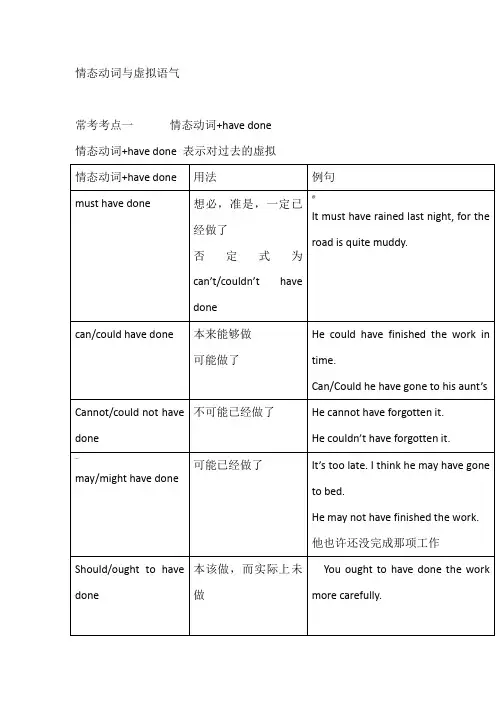
情态动词与虚拟语气常考考点一情态动词+have done 情态动词+have done 表示对过去的虚拟1.I have watched that movie it’ll give me horribledreams.A.Shouldn’t ’t ’t ’t2.Mark have hurried. After driving at top speed, he arrived halfan hour early.’t ’t ’t ’t, Professor Smith. I didn’t finish the assignment yesterday.-----Oh, you have done it as yesterday was the deadline.、’t ’thave been Tom that parked the car here, as he is the only one with a car.5. He didn’t regret saying what he did but felt that he it differently.express B. would express have expressed have expressed6. -----I’m sorry. I at you the other day.------Forget it, I was a bit out of control myself.’t shout ’t have shoutedis my dictionary I remember I put it here yesterday.#-------You it in the wrong place.A.must putB. should have put put have put8. The weather turned out to be fine yesterday, I the trouble to carry my umbrella with me.have taken have taken ’t have takenD. mustn’t have taken9. As you worked late yesterday, you have come this morning.’t ’t ’t ’tdid you do on the driving test---------Not so well. I much better, but I was too nervous.do have done ’t have done D. should do[have broken your promise; You painting the house long ago. A. could have finished B. had better finishC. must have finished have finishedI didn’t go fishing last Sunday because my car broke down.---------- you mine. I wasn’t using it.borrow B. could have borrowedborrow have borrowed13. My newly-purchased magazine is nowhere to be found. I have left it on the trainB. Should14. You the meeting to tell me that .you could have come up to me afterwards.(have come to ’t have interruptedto attend ’t go to15. -----What are you doing, dear-------I’m watching the football game.-------What You your homework first.A.would have done have donehave done D. may have done二.情态动词常考情况表客观存在的可能如:Accidents can happen on such rainy days.;Driving on the highway can be dangerous可以表示命令,警告,威胁,许诺,宣布法律规定时也要用shall.You shall leave the room at once.It has been announced that candidates shall remain in their seats until all the papers have been collected.He asked me for this book many times. Please tell him he shall have it tomorrow.My father told me, “You shall have a computer on your 18th birthday.”3.May well 与may as wellmay well + 动词原形,表示很可能He may well be proud of his son.Her appearance has changed so much that you may well not recognize her.(may as well+动词原形,表示“最好,满可以,倒不如”You may as well do it at once.We may as well stay where we are.4.must 表示偏要,硬要Must you make so much noiseIf you must smoke, please go out.情态动词基本用法|练习is usually warm in my hometown in march, but it be rather cold sometimesA. mustbe really difficult at times even though he’s a nice person in general.A. shall’t let your head out of a moving bus, which lead to a terrible disaster.4. -----Can I pay the bill by check--------Sorry,sir. But it is the management rules of our hotel that payment be made in cash."cationWhat does the sign over there read-------- “No person smoke or carry a cigarette, cigar or pipe in this area.”A.WillB. mayC. shallD. musthaven’t got the reference book yet, but I’ll have a test on the subject next month.-------Don’t worry, you have it by Friday.A.Could7. Being examed twice a year, whether it is a car or a bus or a truck, is the rule that every driver obey in this city.to, would you please buy me an MP5 player…----If you can help do some housework the whole vacation,you have one as a reward.A.mustB. need D . shall9. It is a set rule that all payment be made by the end of themonth.B. shallC. canD. maywell not want to go on the trip. She hates travelling.B. can11. ------The work will take me another week. I’m really tired.-------I think you as well consult an experienced worker.A.may12. If you talk about it with me, please wait till I finish mywork at hand.《A. canB. mayC. mustD. should13. Nick, stop screaming like crasy! Why you watch thatstupid football match at one in the morningA. shallB. wouldC. shouldD. must14. If you go, at least wait until the storm is over.A. canB. mayC. mustD. willI smoke here-------If you , choose a seat in the smoking section.A.ShouldB. could16. -------Why didn’t you come to Simon’s party last night-------I wanted to, but my mum simply not let me out so late at night.A./B.couldC. wouldD. should17. ------Are you going to the lecture tomorrow afternoon-------I’m not sure now. I go to Professor Black’s class instead.A.mightB. wouldC. shouldD. must18. ----- I book a table for dinner a few dsays ahead of time------- Yes, you . The restaurant is always full, especially during the holidays.A.Must; willB. Must; canC. shall; shallD. shall; must19. You can’t imagine that a well-behaved gentleman be sorude to a lady.A. might C. should D. would20. My MP4 isn’t in my bag. Where I have put it-A. canB. must D. would三. 虚拟语气主从句时态练习|1------John went to the hospital alone.-------If he me about it, I would have gone with him.A.should tellB. tellsC. toldD. had toldweather has been very hot and dry.-------Yes. If it had rained even a drop, things would be much better now! And my vegetables .A.wouldn’t dieB. didn’t dieC. hadn’t diedD. wouldn’thave diedwe the other road, might have arrived here in time for the meeting.A. takeB. had takenC. tookD. have taken4. Had I known about this computer program, a huge amount of time and energy .》A. would have been savedB. had been savedC. will be savedD. was saved5. If he my advice, he wouldn’t have lost his job.B. should followC. had followedD. would follow6. be fired, your health care and other benefits wouldn’t be immediately cut off.A would you be B. Should you be C. Could you be D. Might you be7. If English included in the examinations, few students would choose it.A. weren’tB. isn’tC. hasn’t beenD. hadn’t been8. ----Mike , It’s a pity you didn’t come to last night’s concert. It was really great!-------Really If I so busy, I would have gone with you.A.hadn’t beenB. weren’tC. shouldn’t beD. wouldn’tbe《9. it to rain tomorrow, the sports meeting would be put offuntil the same time next week.A.Should ; /B. If ; shouldC. Were; /D. If; weregoing10. for the fact that she got hit by a car and broke her leg on her way to school, she might have passed the exam.A. Had it not beenB. Hadn’t it beenC. Was it notD. Were it not把下列句子变成省略if 的形式1.If he had told me about it, I would have gone with him.2.If it had rained even a drop, things would be much better.3.If we had taken the other road, we might have arrived here intime.4.,5.If it should rain tomorrow, I wouldn’t go hiking.6.If he were a bird, he would fly in the sky happily四. 介词短语中的虚拟语气用介词短语代替条件句,常见的介词有:,without, but foreg:Without your help, we couldn’t have finished the work ahead of time.=But for your help, we couldn’t have finished the work ahead of time.=Had it not been for your help, I couldn’t have finished the work ahead of time.练习1./2.Thank you for all your hard work last week, I don’t think weIt without you.A.can manage have managedmanage have managedfor our help ,we the program in time.A. can not finishB. will not finishC. had not finishedD. could not have finishedfor the help of my Eglish teacher, I the first prize in the English writing competition.A. would not winB. would not have wonwin have won}4. the English examination I would have gone to the concert last Sunday.spite of B. But for C. Because of forelectronic computers, much of today’s advanced technologyA. will not have been achievedB. have not been achievedC. would not have been achieved not been achieved四.错综时间条件句, 动词形式根据它所表示的时间做出相应的调整eg: If you had followed my advice just now, you would be better now.If you had studied hard before, you would be a college student now.1.、2.If you had caught the early bus, you late now.A.Wouldn’t beB. won’t be’t have been D. aren’t2. If you had found a good job then, you trouble buying thehouse now.A. won’t haveB. wouldn’t haveC. wouldn’t hadD. didn’t have3. Maybe if I science, and not literature then, I would be able to give you more help.A. studiedB. would studyC. had studiedD. was studying4. “ If you to my party yesterday, you the reason why I am wearing the clothes now.” Helen said to me.; had known come ; would know`C. had come; would have knownD. came; would know五. 含蓄条件句例如I would have come, but I was ill that day.I was ill that day, or I would have come.练习1.I you more help, but I was too busy.have given B. gave give D. should give2. I went on business that day. Otherwise, I you solve the problem.A. would helpB. helpedC. would have helpedD. was helping~3. I didn’t know you were ill, or I to the hospital to see you.A. would goB. would have goneC. have goneD. went4. I sooner but I didn’t know that they were waiting for you. come B. was coming C. would come D. would have comehad to look after my mother in the ,I part in your birthday party.A. would takeB. did takeC. had takenD. would have taken六.表示建议,要求,命令等词(如suggest,propose,advice,require,request,demand, recommend, order,command,insist)后的从句中,虚拟语气结构为should+ 动词原形,should可以省略.当suggest 表示“表明”, insist 表示“坚持说过去发生过某事”时不属于这种用法.eg: He suggested that we (should ) start off early the next day.It’s suggestesd that the meeting (should ) be put off till next week.·We all agreed to his suggestion that we (should ) go to DaLian for sightseeing.My suggestion is that we (should ) put off the meeting.练习recommend parents their children under 12 to ride bicycles to school for safety.A. not allowB. do not allowC. mustn’t allowD. couldn’t allow2. The doctor recommended that you swim after eating alarge meal.A. wouldn’t ’t ’t D. shouldn’tboss required that the plans before April.A. turn in B turned in C. be turned in D. turning ingeneral ordered that the soldiers toward the mountain.`A. marchedB. be marchedC. marchhad a proposal that the meetingoff B. be put off C. putting off D. would be put off七.as if, as though,would rather, if only,wish 后面常接虚拟语气. It’s necessary/important/strange/natural/essential后面从句动词常用(should)+do. It’s (high) time that sb. Did sth./ do sth.eg: He looks as if he were an artist.I would rather I were a bird.If only I were a bird.I wish I were a bird.It’s (high time) that you went to school.It’s (high) time that we should start out.1.Gorge is going to talk about the geography of his country, but I’drather he more on its culture.A.Focus focus D. had focused2.------Where are the children The dinner is going to be completelyruined.-------I wish they always late.A.Weren’tB. hadn’t beenC. wouldn’t be ’t have been’s strange that they nothing about this matter.know know knownI wish I to my parent’s advice.B. listenC. am listeningD. had listenedat the terrible situation I am in! If only I your advice.A. followB. would follow followed D. followed6. He speaks Chinese as fluently as if he a Chinese.A. were been C. is D. has been7. Looking round the town, he felt as though he away for ages.A. has beenB. wasC. isD. had been。
高考英语情态动词和虚拟语气考点总结及真题解析

考点13 情态动词和虚拟语气【命题解读】英语中常用的情态动词主要有can,could,may,might,must,will,would,shall,should,ought to,dare,need,used to,had better等。
在学习情态动词时应注意以下几点:同一情态动词表示不同的意义的情况;情态动词后跟各种形式的用法;尤其要注意"情态动词+完成式"是高考中的重点所在。
对虚拟语气的考查重点在于根据句子的语境灵活多样地运用虚拟语气,宾语从句中虚拟语气的应用,交际用语中为表示委婉而使用的虚拟语气,含蓄条件句中的虚拟语气,以及特殊句型中的虚拟语气等。
【命题预测】情态动词是2021年各地高考试题中的必考项目,每年高考单独命题区的单项填空必有一道考查情态动词的项目。
新课标卷主要在语法填空和短文改错中考查。
考点依次是:推测(可能性)→请求/允许→必要性→特殊用法。
试题的立意不偏不怪,但有效信息越来越隐蔽,语境越来越真实,考查角度越来越细致,这些因素在很大程度上增加了试题的难度。
情态动词和虚拟语气与动词的时态和语态相结合的考查是近年来高考的趋势。
【复习建议】情态动词:1. 掌握情态动词的基本用法;2. 掌握情态动词表达"情感、态度、语气等"方面的用法。
虚拟语气:1. 掌握虚拟语气的基本用法;2. 掌握含蓄虚拟条件句的用法;3. 掌握主从句时间不一致的虚拟条件句的用法;情态动词考向一情态动词的基本用法1)can,could与be able to1.表示能力,意为"能,会"。
☞Many people can use the computer.许多人会用电脑。
☞If you have a good sleep,you will be able to work out this problem.如果你好好睡一觉,你将能够解出这道题。
☞I could have worked out the problem,but I was too nervous.我本来可以解决这个问题,但我太紧张了。
2013年高考英语语法复习之情态动词和虚拟语气
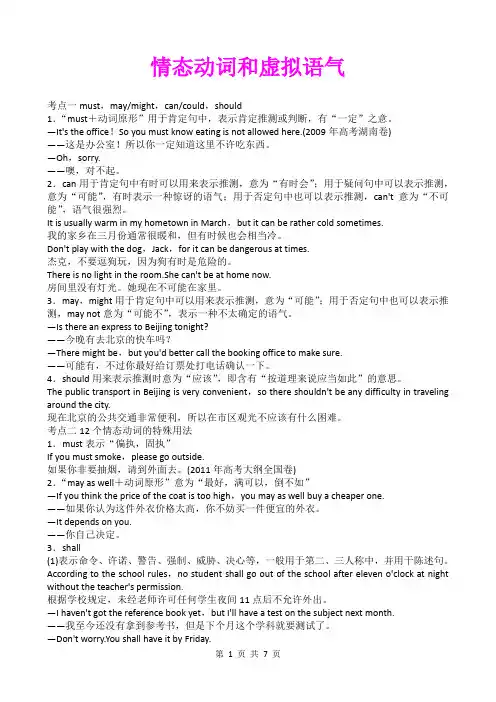
情态动词和虚拟语气考点一must,may/might,can/could,should1.“must+动词原形”用于肯定句中,表示肯定推测或判断,有“一定”之意。
—It's the office!So you must know eating is not allowed here.(2009年高考湖南卷)——这是办公室!所以你一定知道这里不许吃东西。
—Oh,sorry.——噢,对不起。
2.can用于肯定句中有时可以用来表示推测,意为“有时会”;用于疑问句中可以表示推测,意为“可能”,有时表示一种惊讶的语气;用于否定句中也可以表示推测,can't意为“不可能”,语气很强烈。
It is usually warm in my hometown in March,but it can be rather cold sometimes.我的家乡在三月份通常很暖和,但有时候也会相当冷。
Don't play with the dog,Jack,for it can be dangerous at times.杰克,不要逗狗玩,因为狗有时是危险的。
There is no light in the room.She can't be at home now.房间里没有灯光。
她现在不可能在家里。
3.may,might用于肯定句中可以用来表示推测,意为“可能”;用于否定句中也可以表示推测,may not意为“可能不”,表示一种不太确定的语气。
—Is there an express to Beijing tonight?——今晚有去北京的快车吗?—There might be,but you'd better call the booking office to make sure.——可能有,不过你最好给订票处打电话确认一下。
4.should用来表示推测时意为“应该”,即含有“按道理来说应当如此”的意思。
高中英语:情态动词与虚拟语气语法知识点
高中英语:情态动词与虚拟语气语法知识点情态动词的基本用法情态动词具有一定的词义,没有人称和数的变化,必须和其他动词一起构成谓语,用来表示愿望、态度或推测等。
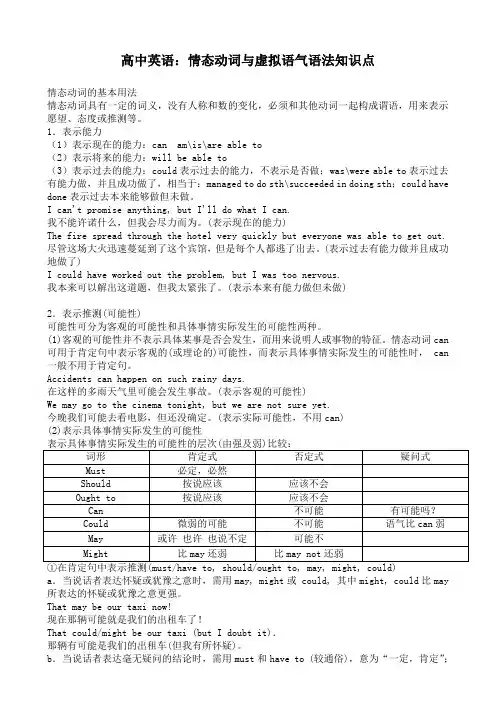
1.表示能力(1)表示现在的能力:can am\is\are able to(2)表示将来的能力:will be able to(3)表示过去的能力:could表示过去的能力,不表示是否做;was\were able to表示过去有能力做,并且成功做了,相当于:managed to do sth\succeeded in doing sth;could have done表示过去本来能够做但未做。
I can't promise anything, but I'll do what I can.我不能许诺什么,但我会尽力而为。
(表示现在的能力)The fire spread through the hotel very quickly but everyone was able to get out. 尽管这场大火迅速蔓延到了这个宾馆,但是每个人都逃了出去。
(表示过去有能力做并且成功地做了)I could have worked out the problem, but I was too nervous.我本来可以解出这道题,但我太紧张了。
(表示本来有能力做但未做)2.表示推测(可能性)可能性可分为客观的可能性和具体事情实际发生的可能性两种。
(1)客观的可能性并不表示具体某事是否会发生,而用来说明人或事物的特征。
情态动词can 可用于肯定句中表示客观的(或理论的)可能性,而表示具体事情实际发生的可能性时, can 一般不用于肯定句。
Accidents can happen on such rainy days.在这样的多雨天气里可能会发生事故。
(表示客观的可能性)We may go to the cinema tonight, but we are not sure yet.今晚我们可能去看电影,但还没确定。
高中英语语法总结:情态动词和虚拟语气
高中英语语法总结:情态动词和虚拟语气考向1 情态动词一、 can, could与be able to1. 表示能力(体力、知识、技能)。
☞Can you lift this heavy box?(体力)☞Mary can speak three languages.(知识)☞Can you skate?(技能)此时可用be able to代替。
can只有一般现在时和一般过去式;而be able to则有更多的时态。
☞I’ll not be able to come this afternoon.当表示"经过努力才得以做成功某事"时应用be able to,不能用can。
如:☞He was able to go to the party yesterday evening in spite of the heavy rain.2. 表示请求和允许。
☞—Can I go now?—Yes, you can. / No, you can’t. 此时可与may互换。
在疑问句中还可用could, might代替,不是过去式,只是语气更委婉,不能用于肯定句和答语中。
☞—Could I come to see you tomorrow?—Yes, you can. (No, I’m afraid not.)3. 表示客观可能性(客观原因形成的能力)。
☞They’ve changed the timetable, so we can go by bus instead. This hall can hold 500 people at least.4. 表示推测(惊讶、怀疑、不相信的态度),用于疑问句、否定句和感叹句中。
☞Can this be true?☞This can’t be done by him. How can this be true?二、 may, might1. 表示请求和允许。
might比 may语气更委婉,而不是过去式。
高考英语练习 情态动词和虚拟语气(讲解部分)
与将来事 实相反
①过去式 ②should+动词原形 ③were to+动词原形
would/should/could/ might+动词原形
If he shouldn't come tomorrow, we would put off the meeting.如果他明天不 来,我们就推迟这个会议。
周末给她打电话。
may,might 表示推测,用于肯定句,意为 “可能”,may not意为“可能不”, 如表 达“不可能”则用can't
This coat may be Peter's.这件大衣可能是彼得的。 This coat may not be Peter's.这件大衣可能不是彼得的。
may表示祝愿
表示理论上的可能时可用于肯定句。could表 Accidents can happen in this weather. 这种天气可
示推测时比can可能性小,可用于肯定句、否定 能会发生事故。(理论上的可能性)
句和疑问句
It could be weeks before we get a reply. 我们可能
2.用于“(should+)动词原形”结构的虚拟语气 (1)用于宾语从句中 以下动词后的宾语从句常常使用虚拟语气,即谓语为“(should+)动词原 形”。
6.will,would
用法
例句
用于各种人称,表示主语的意愿和意志
He will/would take you home.他愿意送你回家。
与第二人称的一般疑问句连用,表示请求、建议 Will/Would you go with me?你愿意和我一起去 吗?
语法篇专题情态动词和虚拟语气
用法
例句
can和could
表示能力
He can speak English better than you.
表示请求 或允诺?
You can have the book when I have finished it. Could you come again tomorrow?
表示客观可能性
should have done
过去本来应该……,而实际上没有……
The plant is dead. Maybe I should have given it more water.
ought to have done
过去本该……,而未……
You ought to have given him more help.
专题八 情态动词和虚拟语气
情态动词
一、情态动词 定义:情态动词是一种本身具有一定词义,但要与动词原形及其被动语态一起使用的词。它给谓语动词增添情态色彩,表示说话人对有关行为或事物的态度和看法,认为其可能、应该或必要等。 二、情态动词的特点 情态动词无人称和数的变化, 情态动词后面跟的动词需用原形,否定式构成是在情态动词后面加“not”。 个别情态动词有现在式和过去式两种形式, 过去式用来表达更加客气, 委婉的语气, 时态性不强, 可用于过去,现在或将来。情态动词属于非及物动词,故没有被动语态。
三、情态动词的语法特征 (1) 情态动词不能表示正在发生或已经发生的事情,只表示期待或估计某事的发生。 (2) 情态动词除ought 和have 外,后面只能接不带to 的不定式。 (3) 情态动词没有人称和数的变化,即其第三人称单数不加s。 (4) 情态动词没有非限定形式,即没有不定式,分词形式,也没有相应的动名词。 四、情态动词的基本用法
2013高考英语语法复习——情态动词和虚拟语气
1
除了 can,would以外,英语中还有很多情态动 词 。 常 见 情 态 动 词 有 : must , can(could) , may(might) , ought to , need , dare shall(should) , will(would) have (had) to,used to, had better,would rather。 注意:need,dare也可用作实义动词。
6. I heard you could speak several languages.
我听说你会讲几种语言。
2
7. Could I use your bike this afternoon when you don't use it? 今天下午你不用自行车时我可以用一下吗? 8. It could be very cold in winter in some southern cities of China.
4. 在从句中,表虚拟语气;
5. should也可表惋惜、忧虑、欢乐、惊讶等感 情色彩; 6. 在间接引语中,表达shall的过去式。
5
will/would有哪些用法?
翻译下列句子,体会情态动词will/would的用法 1. We will fight on until final victory is won. 我们要一直战斗到胜利为止。
——是的,你可以。/不行,你不可以。/不, 你决不能借用我的毛巾。
6
2. She may come to your birthday party tomorrow. 或许她明天会来参加你的生日宴会。 3. He studies hard in order that he may pass the exam. 为了通过考试他学习很用功。