
IBM产品差异化模型概述
A v a ila b ility wt: .031
Perform ance wt: .252
$ Price
H ow m uch do custom ers expect to pay for the value they seek?
$ P ric e wt: .172
$ Price
Value
Social Acceptance
Life C ycle
Ease of Use Assurances
Warrantee
$APPEALS
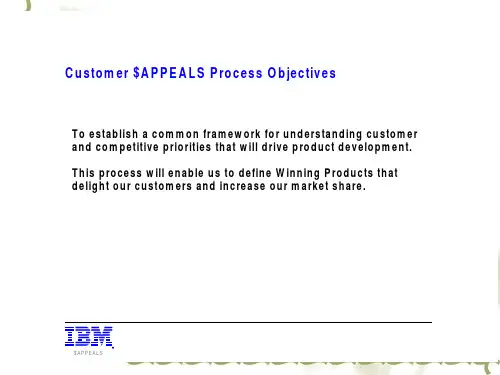
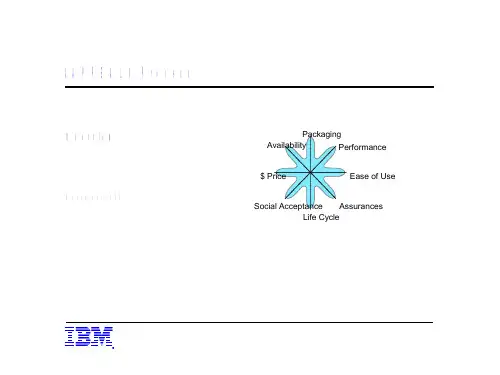
Custom er $APPEALS is an acronym that describes the eight basic criteria in the custom ers' com petitive buying decisions
Social acceptance
W hat "im age" w ill facilitate a purchase decision and how do custom ers acquire
this inform ation?
Social acceptance wt: .053
Life C ycle Costs w t: .030
PERFORMANCE
PACKAG ING
EASE OF USE A V A IL A B IL IT Y LIFE CYCLE CO ST
SO CIAL ACCEPTANCE
Custom er $APPEALS Factor Description
This factor represents the price custom ers expect to pay for a satisfactory product/offering. W hen rating vendors against this criterion, consider the actual or perceived value that the custom er is receiving for the price p aid . T h is w o u ld in clu d e th e valu e p erceived fo r tech n o lo g y, lo w -co st p ro d u cer, m aterials, lab o r co sts, o verh e ad , e x p e rie n c e , a u to m a tio n , s im p lic ity, p ro d u c a b ility e tc .
Assurances w t: .289
Life Cycle Costs
W hat lifecycle cost considerations influence the purchase decision?
Assurances
Provided by the whole product/ service
$APPEALS
Custom er $APPEALS is a business process that focuses on the custom ers' com petitive buying decisions
A vailability
P a c k a g in g
Perform ance
Each Custom er $APPEALS Factor m ust be considered from the perspective of custom ers in a m arket segm ent
Custom er $APPEALS Factor
$ PRICE ASSURANCES
P a c k a g in g
Availability
C ustom ers com plete buying experience - including the channels
through w hich they buy
Visual evaluation / B u n d lin g
Custom er $APPEALS
A v g
Perform ance
$ Price
Ease of Use
Social Acceptance
Life C ycle
Assurances
$APPEALS
Custom er $APPEALS categories are exam ined from a custom er perspective
IBM产品差异化模型概述
Custom er $APPEALS Process O bjectives
To establish a com m on fram ew ork for understanding custom er and com petitive priorities that w ill drive product developm ent. This process w ill enable us to define W inning Products that delight our custom ers and increase our m arket share.
Availab ility
P a c k a g in g
Perform ance
$ Price
Ease of Use
Social Accep tance
Life C ycle
Assurances
$ Price A vailability P ackaging P erform ance Ease of use A ssurances L ife cycle costs S ocial influences
Ease of Use w t: .079
Perform ance W hat functionality & perform ance characteristics
are wanted?
Ease of Use W hat constitutes ease of
use, installation, adm inistration, etc. ?
产品差异化理论研究综述
产品差异化理论研究综述摘要:企业采用产品差异化策略的动机源于缓解市场上激烈的价格竞争和追求最大利润的需要,并且企业的产品差异化程度越大,市场势力也越大,文章基于该视角对产品差异化重要的两种形式:横向差异化与纵向差异化的国内外研究现状进行梳理和总结。
尤其对现实经济与“产品质量最大差异化”原则相矛盾这一现象进行阐述。
最后指出该领域的研究不足并提出未来的研究方向。
关键词:产品横向差异化;产品纵向差异化;市场势力;研究综述一、引言产品差异化问题是现代产业组织理论关于市场结构的重要内容。
一方面企业可以通过产品差异化策略形成市场力量和取得非价格竞争优势,增强企业的核心竞争力;另一方面,企业可以通过产品差异化形成细分市场,进行有效的市场定位,集中优势资源,获取最大利润。
有关产品差异化的研究最初起始于20世纪30年代关于垄断竞争的讨论,之后随着博弈理论在经济学中广泛应用,产品差异化理论逐步发展成为热门的研究课题。
产品差异化是指同一产业内部不同企业提供同类的产品和品牌不能完全替代。
构成产品差别化的因素很多,很多学者都认为产品差异化源于产品相关“特征”的改变。
这些特征包括物理差异、心理差异、服务差异、空间差异。
物理差异是指企业的产品在设计、质量、结构功能方面存在一定程度的差别;心理差异是指企业的广告宣传和其他促销手段而造成消费者主观上认识的差异;服务差异是指企业在售前和售后提供的服务内容和服务质量方面存在差异;生产或销售产品的企业分布在不同的地点,导致了产品空间差异。
除了上述因素以外,产品差异化还源于消费者对产品认知的不同,无论同类产品之间是否存在客观差异,只要消费者认为产品不同,那么该类产品就存在差异。
可以发现下文关于产品差异化的研究都围绕产品差别化的构成因素而展开,得到了产品差异化程度越高,市场势力越大的结论。
产品差异的划分方式很多,比较重要的划分方式是按照产品差异化的方向来划分,可分为横向产品差异化和纵向产品差异化。
IBM的产品差异化模型

O v e r v ie w
N ovem ber 1999
Packaging
Availability
Performance
$ Price
Ease oห้องสมุดไป่ตู้ Use
Social Acceptance Assurances Life Cycle
$A P P E A LS
C u s to m e r $ A P P E A L S P r o c e s s O b je c tiv e s
T o e s ta b lis h a c o m m o n fr a m e w o r k fo r u n d e r s ta n d in g c u s to m e r a n d c o m p e titiv e p r io r itie s th a t w ill d r iv e p r o d u c t d e v e lo p m e n t. T h is p r o c e s s w ill e n a b le u s to d e fin e W in n in g P r o d u c ts th a t d e lig h t o u r c u s to m e r s a n d in c r e a s e o u r m a r k e t s h a r e .
W h a t " im a g e " w ill fa c ilita te a p u r c h a s e d e c is io n a n d h o w d o c u s to m e r s a c q u ir e
th is in fo r m a tio n ?
IBM(中国)公司产品销售渠道分析与设计

学位论文作者w7/}7
河北工业大学工商管理硕士(MBA)学位论文
第一章 绪论
§1-1 研究背景及意义
在成为地道的软件和服务提供商后,IBM(中国)公司已经部分抛弃了传统的分销, 并通过渠道新政以求建立共赢的生态圈。过去三年,厂商们已经陷入深度的渠道变革中。 2002 年,微软通过“春耕计划”梳理销售渠道,并且在经历了中国区高管更迭后,对销售 渠道进行地震式的重建;2003 年,SAP 高举“灯塔计划”照亮重点行业的重点客户后,在 全国范围内实施“燎原行动”,以覆盖更多的中小企业用户;甲骨文则是通过“金色中国” 计划,增加渠道的亲和力。
河北工业大学工商管理硕士(MBA)学位论文
arrangement of ideas chaos , channel policy do not perfect, correct the marketing channel support and insufficient science checking means, reward the system design being short of elasticity , knowing lack to the channel need and so on. Marketing channel scheme for this purpose, having designed that a set of IBM company sustained development suitable requires that operas ability is strong out: Marketing channel passage significance, Channel original channel flat-rization, correctly treating expanding distributing business , adjusting. At the same time investigation and discussion design plan be put into effect operating mechanism.
IBM的产品差异化模型英文
A vailab ility
Packag ing
Perform ance
$ P rice
Ease of Use
Social Acceptance
Life C ycle
Assurances
$ Price A vailability P ackaging P erform ance Ease of use A ssurances L ife cycle costs S ocial influences
Assurances w t: .289
Life Cycle Costs
W hat lifecycle cost considerations influence the purchase decision?
Assurances
Provided by the whole product/ service
PERFORMANCE
PACKAG ING
EASE OF USE A V A IL A B IL IT Y LIFE CYCLE CO ST
SO CIAL ACCEPTANCE
Custom er $APPEALS Factor Description
This factor represents the price custom ers expect to pay for a satisfactory product/offering. W hen rating vendors against this criterion, consider the actual or perceived value that the custom er is receiving for the price p a id . T h is w o u ld in c lu d e th e va lu e p e rc e ive d fo r te c h n o lo g y, lo w -c o s t p ro d u ce r, m a te ria ls , la b o r c o s ts , o verh e ad , e x p e rie n c e , a u to m a tio n , s im p lic ity, p ro d u c a b ility e tc .
IBM新的产品差异化模型英文(ppt 22页)

Life Cycle
Ease of Use
Assurances
Warrantee
$APPEALS
Customer $APPEALS is an acronym that describes the eight basic criteria in the customers' competitive buying decisions
Packaging
Availability
Customers complete buying experience - including the channels
through which they buy
Visual evaluation / Bundling
Customer $APPEALS
Packaging wt: .094
this information?
Social acceptance wt: .053
Life Cycle Costs wt: .030
Assurances wt: .289
Life Cycle Costs
What lifecycle cost considerations influence the purchase decision?
IBM产品差异化模型$appeals
$ P r ic e
H o w m u c h d o c u s to m e rs e x p e c t to p a y fo r th e v a lu e th e y s e e k ?
$ P r ic e w t: .1 7 2
E ase ofU se w t: .0 7 9
P e rfo rm a n c e W h a t fu n c tio n a lity & p e r fo r m a n c e c h a r a c te r is tic s
V is u a l e v a lu a tio n / B u n d lin g
C u s to m e r $ A P P E A L S
P a c k a g in g w t: .0 9 4
A v a ila b ility w t: .0 3 1
P e rfo rm a n c e w t: .2 5 2
W h a t " im a g e " w ill fa c ilita te a p u r c h a s e d e c is io n a n d h o w d o c u s to m e r s a c q u ir e
th is in fo r m a tio n ?
a re w a n te d ?
E ase ofU se W h a t c o n s titu te s e a s e o f
u s e , in s ta lla tio n , a d m in is tr a tio n , e tc . ?
S o c ia l a c c e p ta n c e
$A P P E A LS
IBM的产品差异化模型教材英文
P a c k a g in g
Availability
C ustom ers com plete buying experience - including the channels
through w hich they buy
Visual evaluation / B u n d lin g
Custom er $APPEALS
Assurances w t: .289
Life Cycle Costs
W hat lifecycle cost considerations influence the purchase decision?
Assurances
Provided by the whole product/ service
P a c k a g in g w t: .094
A v a ila b ility wt: .031
Perform ance wt: .252
$ Price
H ow m uch do custom ers expect to pay for the value they seek?
$ P ric e wt: .172
$ Price
Value
Social Acceptance
Life C ycle
Ease of Use Assurances
Warrantee
$APPEALS
Custom er $APPEALS is an acronym that describes the eight basic criteria in the custom ers' com petitive buying decisions
BLM(含样例)
1.没有营销部,没有市场洞察的体系平台; 2.根据同期定目标,不管市场容量; 3.有什么产品卖什么产品,卖多少无所谓; 4.没有组织营销和企划产品 ;
1.本部长不会市场洞察,也不请一 流人洞察市场;
2.本部长没咬死第一目标,所有人 丧失目标;
3.本部长用胡乱开发的人,产品就 没有经竞争力
4.本部长不会营销,也没有请一流 的营销人员组建一流的团队
业绩差距是现有经营结果和期望值之间差距的一种量化的陈述。 机会差距是现有经营结果和新的业务设计所能带来的经营结果之间差距
的一种量化的评估。 业绩差距常常可以通过高效的执行填补,并且不需要改变业务设计 填补一个机会差距却需要有新的业务设计。
业绩差距和机会差距的例子
业绩差距:“我们在2001年前半年减少50%客户投诉的目 标没有达到。”
•如果没有XXX高能效 产品,我们还将失去 参与XX亿市场竞争的 机会; •如果不能开发以XX系 列的全球产品,就会 失去走出去的能力
•如果08年我们完不成 预算目标,我们将被 对手远远抛在背后; 生存就成为问题
社会
(S)
•节约型社会:节能——据建设部的数据,建筑能 耗占全国终端能源总消费量27.5%。 •和谐社会建设,可持续发展,科学发展观成基本 理念 •节能减排成了全球峰会的最重要议题
机会差距:“我们正在失去在每年以15%速度增长的行业 相关的业务流程外包领域与客户合作的机会。”
2007年经营业绩总揽:现在业绩(1-9月)——收入、利润与母本对比分析
A、 集团 1-9月份收入、利润一览表:
1~9月份收入
内销
06年市场收入实际 外销
合计
内销
07年市场收入预算 外销
合计
内销
IBM_ESB_产品之间的比较及应用场景_第_2_部分,实际应用场景
/developerworks/cn/websph ere/zones/esb/faq/常见问题及解答IBM ESB 产品之间的比较及应用场景: 第 1 部分,IBM ESB 产品之间的比较企业服务总线ESB 的介绍企业应用的发展概述在介绍企业服务总线之前,有必要花一些笔墨来介绍企业应用架构的发展和变迁。
企业级应用架构的发展经历了以下几个阶段:独立应用系统EAI 阶段SOA 阶段独立应用阶段20 世纪60 到70 年代,企业应用处于独立应用系统阶段,当时的企业应用是一种用来替代重复性劳动的简单设计,其目的是用计算机代替孤立的,体力性质的工作环节,将相关联的企业信息或数据管理起来。
这些系统大部分是独立的系统——有独立的数据库、应用服务器、用户界面。
因此有时候这类应用也叫“竖井型”的应用。
但是,随着业务和信息的不断扩展,独立应用系统渐渐不能满足企业对IT 的需求,表现在大量的信息冗余,因为在建立一个新的应用的时候需要重新建立一套数据库;功能的重新设计,相似的功能存在于多个系统中;例如,客户信息在一个公司中可能有多个拷贝分别存在于多个数据库中,不同时期建立的应用系统所使用的技术也会不同。
对于获取客户资料这样的功能,必然存在于多个系统中,而且在不同的系统中其实现方式可能是Java/J2EE、Delphi、C/C++。
EAI 阶段20 世纪80 到90 年代,一些公司或集成商意识到应用集成的价值和必要性。
EAI 是一种将多个不同平台、用不同方案建立的异构的应用集成的一种技术和方法。
它的目标包括以下几个方面:各个分离的系统间的相互通讯,消除信息孤岛,实现信息的共享。
从功能的角度来看,EAI 包括信息接收、转换、翻译、路由、传播和业务流程管理。
从架构上看有两种方式:Hub/Spoke 方式和Bus 方式。
图 1 所示的Hub/Spoke 结构使用一个中心代理(Hub)和多个适配器(Spoke)将Hub 和应用连接起来。
产品差异化模型(英文)
Availability
Packaging
Performance
$ Price
Ease of Cycle
Assurances
$ Price Availability Packaging Performance Ease of use Assurances Life cycle costs Social influences
This factor represents ease-of-use attributes of the offering. When rating vendors against these criteria, consider the customer's opinion of the product with respect to comfort, learning, documentation, support, ergonomics, displays, sensory inputs/outputs, interfaces, "intuitiveness," etc.