
人教版高中英语必修二Unit1Listeningandspeaking
At the She heard _so_m__et_h_in_g__ex_p_l_od_e__, and she saw end of _th_e_c_a_s_tl_e_w_a_s_o_n__fi_re_.She found some melted August, pieces of something that looked like_h_o_n_e_y_____. 1944 The soldiers told her that the melted pieces
2.Listen to Part B and write down how the Amber Room was lost.
5
Name Hans Job a sailor Braun
Place Konigsberg
One night during the war
He was told to _h_e_lp__G_e_r_m_a_n_s_o_ld_i_er_s___put some__b_ig__w_o_o_d_en__b_o_xe_s___onto the ship.
1. Summarize the ideas for the debate. 2. Prepare for the next class.
Bye Bye
could have come from__t_h_e_A_m_b_e_r_R_o_o_m_______.
Which person gave the best evidence.
After the students tell something about some cultural relics, let them have a debate on the following topic: Do you think China should save all of its cultural relics?
Part B
Name Anna Job a maid Petrov
Place Konigsberg
One M__a_n_y_tr_u_c_k_s came to the castle with__la_r_g_e_b_o_x_es__. night in _T_h_e_G_e_r_m_a_n_s_o_ld_i_e_rs_took the boxes into the 1941 castle.
高中英语课件
(金戈铁骑 整理制作)
Unit 1 Cultural relics
4
Now you are going to hear anothertwo people talk about what happened to the Amber Room.
1.Listen to Part A and write down where the Amber Room was lost.
ship_____W_a_s_a_t_ta_c_k_ed__________________and sank. Almost __ev_e_r_yo_n_e_d_i_e_d_______. He had to swim three kilometres before_h_e_w__as__sa_v_e_d_b_y_a__G_e_rm__a_n_s_h_ip_.__.
The soldiers said that the heavy boxes
__W__e_re__fu_l_l_o_f_t_r_ea__su_r_e_________t_to__s_e_a____ . On the voyage, the
( Divide the class into two groups, first collect ideas, then one side will agree, saying “ Yes, we should save all our cultural relics.” The other side will not agree, saying “No, we should not save all our cultural relics, only save the best ones.” Both sides should give enough reasons.)
2021_2022学年新教材高中英语Unit1TeenageLifeListeningandSpea
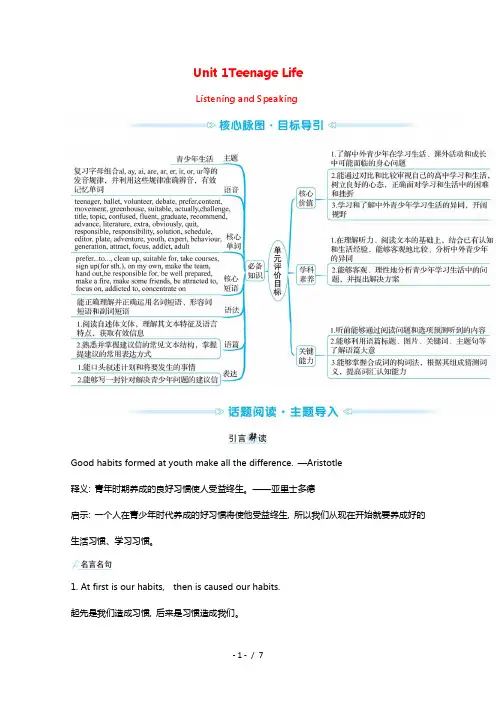
Unit 1Teenage LifeListening and SpeakingGood habits formed at youth make all the difference. —Aristotle释义: 青年时期养成的良好习惯使人受益终生。
——亚里士多德启示: 一个人在青少年时代养成的好习惯将使他受益终生, 所以我们从现在开始就要养成好的生活习惯、学习习惯。
1. At first is our habits, then is caused our habits.起先是我们造成习惯, 后来是习惯造成我们。
2. Habit is a human thought and behavior of the leader.习惯是一个人思想与行为的领导者。
3. Habit forms character, character determines destiny.习惯形成性格, 性格决定命运。
We don’t always get our hopes and dreams, and we don’t always get our own way. But don’t give up hope, because you can make a difference one situation and one person at a time.Look for the beauty around you: in nature, in others, in yourself, and believe in the love of friends, family, and humankind.You can find love in a smile or a helping hand. It is all around, if you just look for it.Give love, for in giving it you will find the power in life along with the joy, happiness, patience, and understanding. Believe in the goodness of others and remember that anger and depression can be countered by love and hope.Even when you feel as if there isn’t a lot you can do to change unhappiness or problems, you can always do a little, and a little at a time finally makes a big difference.[词海拾贝]1. humankind n. 人类2. patience n. 耐心3. depression n. 抑郁; 沮丧4. counter vt. 反驳; 抵制[我学我思]1. give up放弃2. along with连同……一起; 除了……3. make a big difference有很大影响; 产生很大不同4. What will you do when you are facing difficulties in high school?I will be brave to face challenges and ask my friends or my parents to help me.Choose a school clubⅠ. 主题词汇听写①Science②Basketball③Photography④BalletClub Club Club Club⑤Chess⑥Nature⑦Volunteer⑧DebateClub Club Club ClubⅡ. 教材听力填空Conversation 1(Listen and fill in the blanks)Teacher: Shh! Listen carefully!Teacher: Did you hear that? No? How about this?Teacher: If you couldn’t hear the first one, it means you’re ①not a dog! [Laugh]. Dogs can hear very high frequency ②sounds, but people can’t. And if you could hear the second one, you’re ③younger than 25.Student: Wow! Why is that?Teacher: Our ears change when we ④get older. Children and young people can hear the second one, but most people older than 25 can’t.Conversation 2(Listen and choose the best sentences)Teacher: ⑤__________ Team A, please begin.Team A: We say no, they shouldn’t. ⑥__________ They should think about schoolwork and spend more time studying.Team B: We don’t agree with Team A. ⑦__________ Teenagers can date if they want. It is quite natural for a teenager at that age to feel he or she likes somebody. ⑧__________Teacher: Team A?A. Our answer is “Yes”.B. We think it’s possible for teenagers to date and study at the same time.C. One reason is that teenagers are too young.D. Today’s topic is “Should teenagers date? ”答案: ⑤~⑧DCABⅢ. 话题听力体验听下面一段对话, 回答以下小题。
人教版高中英语必修第一册UNIT2 Section Ⅰ练习含答案

SectionⅠListening and Speaking课后·训练提升一、根据句意及首字母提示写出单词.We should a what we’ve learned to practice.m really a to hear that he was late for such an important meeting..The assistant has a a hotel for you..Nowadays,a mobile phone is e useful in our daily life..The father decided to p a few things and took the sick baby to hospital..The lady r her spare rooms to some university students last year.1.这些游客正在申请签证。
visas.2.别制造噪声,请集中精力工作。
your work.3.令我们惊讶的是,他竟然没通过驾驶考试。
,he should fail the driving test.4.我期望再次见到你。
5.别担心,我已经把每样东西都打包好了。
.6.建议你要提前做好旅行安排。
.7.去中国九寨沟的最佳时间是什么时候?What is8.她到达后打算怎么出游?after she arrives?三、同义句转换1.He is going to Beijing by plane..2.The girl focused on the homework she was doing.the homework she was doing.3.It was amazing for us to know that Kate refused our help.to know that Kate refused our help.4.The tourists hired a car to travel around the city.a car to travel around the city.Travelling can be a fun way to gain life experiences,but what if you’re a student and don’t have enough money for a trip?Don’t worry.Here are some useful tips.Save:This probably is the most important preparation for travelling.Cut expenses(花费)to fatten your wallet so you’ll have more choices about where to go and how to get there.Plan ahead:Don’t wait until the last minute to plan your trip.Giving yourself several months to get ready can mean security and savings.Do your homework:No matter where you go,research the places you will visit.Decide what to see.Travel books will provide information on the cheapest hotels and restaurants.Plan sensibly:Write down how much you expect to spend on food and hotels.Stick to(坚持)your plan,or you may not have enough money to cover everything.Travel in groups:Find someone who is interested in visiting the same places.By travelling with others you can share costs and experiences.Work as you go:Need more money to support your trip?Look for work in the places you visit.Go off the beaten path:Tourist cities may be expensive.You may want to rethink about your trip and go to a less known area.Smaller towns can have many interesting activities(活动) and sights.Pack necessary things:The most important things to take are not always clothes.Remember to take along medicine in case you get sick and snacks in case you cannot find a cheap restaurant.By planning sensibly,even students can enjoy their travel.Your travel experiences will be remembered for a lifetime.1.Before your trip,the first thing you should do is.A.to make a plan of the routeB.to get information on the InternetC.to save money by spending less,选C项。
【高一英语新教材必修二】Unit 1 Listening and Speaking P2-3
√
I know the general meaning of the word.
The speaker gives an example of the word.
After-listening
Youth Project
Who
What
(create an app)
Why
take photos of ... write texts ...
Unit 1 Cultural Heritage
Listening&Speaking P2-3
The Forbidden City
Mogo Caves of Dunhuang
Potala Palace
The Great Pyramid
Taj Mahal
The Great Wall is not only China's heritage, it is also the world's heritage.
News report
Title Body
news lead: where, who, what
details: why, how, what
Would you like take part in a project like this? Why or why not?
Could you think of more ways to protect the cultural heritage?
Help the reporter to complete the news report based on what you hear and the interview notes.
International Youth Camp Members Create Mount Tai App
Unit1CulturalHeritageListeningandspeaking课件高中英语人教版
This game is about the six cypresses that were planted on Mount Tai during the Han Dynasty. You learn about the trees and also the life in China over 2,000 years ago.
language
music
dance
There are a lot of world heritages in China. Can you give some examples?
The Temple of Confucius
The Temple of Heaven
The Forbidden City
Notre Dame Байду номын сангаасe Paris
The Leaning Tower of Pisa
The Great Pyramid
Mount Tai
Man is born dead, either heavier than Mount Tai, or lighter than a feather.
Unit 1 Cultural Heritage
Listening and Speaking
What is cultural heritage?
a. something existing from the past. b. It continues to be important for the present and future
2020年新人教版高中英语必修二教案全套
2020年新人教版高中英语必修二教案全套《Unit 1 Cultural Heritage》单元教案Period 1 Listening and Speaking & Listening and Talking【教材分析】Listening and Speaking introduces the topic of “Take part in a youth project”.The listening text is an interview about an international youth cultural heritage protection project. More than 20 high school students from seven countries participated in the project. The reporter interviewed two participants Stephanie and Liu Bin. By listening to the text, students can understand the significance of cultural heritage protection, and teenagers can use their knowledge, combine their own interests and advantages, etc. to participate in the action of cultural heritage protection.Listening and Talking introduces the theme of “Talk about history and culture”.The listening text is a dialogue between two tourists and tour guides when they visit the Kremlin, Red Square and surrounding buildings. The dialogue focuses on the functional items of “starting a conversation”, which is used to politely and appropriately attract the attention of the others, so as to smoothly start a conversation or start a new topic. The purpose of this section is to guide students to understand the history and current situation of Chinese and foreign cultural heritage in their own tourism experiences or from other people’s tourism experiences, explore the historical and cultural values, and be able to express accurately and appropriately in oral communication.【教学目标】1. Guide students to understand the content of listening texts in terms of the whole and key details;2. Cultivate students’ ability to guess the meaning of words in listening; discusswith their peers how to participate in cultural heritage protection activities.3. Instruct students to use functional sentences of the dialogue such as “I beg your pardon, but…” “Forgive me for asking, but…” and so on to start the conversation more politely and appropriately.【教学重难点】1. Guide students to understand the content of listening texts in terms of the whole and key details;2. Cultivate students’ ability to guess the meaning of words in listening; discuss with their peers how to participate in cultural heritage protection activities.3. Enable students to use the functional items of “starting a conversation”, which is used to smoothly start a conversation or start a new topic.【教学过程】Part 1: Listening and SpeakingStep 1: Lead inThe teacher is advised to talk about the meaning of the word “Heritage”.Boys and girls, before our listening, let’s work in pairs and discuss the meaning of the word “Heritage”.What does the word “heritage” mean? Share your ideas about your understanding of it and you can use examples to illustrate your meaning.Heritage means the traditional beliefs, values, customs, etc. of a family, country or society.For example, the Great Wall is the heritage of China.Step 2: PredictionAfter their small talk, the teacher can ask students to predict what the listening text is about by looking at the pictures.The listening text is probably about how to protect a famous heritage site by some students.Step 3: Summary of the main ideaThen play the radio which is about an interview about an international youth cultural heritage protection project. And after finishing listening for the first time, the students need to solve the following tasks.1. Listen to the conversation and sum up the main idea.Youths from seven countries are working together to protect cultural relics on Mount Tai.2. Listen again and help the reporter to complete the interview notes.International youth project, 23 high school students from 7 countriesMount Tai, one of the most famous mountains in ChinaIt has been protected for more than 3,000 years.22 temples, around 1,800 stones with writing on themDai Temple on Mount Tai; over 6,000 stepsStep 4: Guessing the meaning of the unknown wordsListen to the conversation again and use the context to guess the meaning of the words below. Tell the reasons why you guess so.Preserve: to protectReason: the word means the same of a word I knowPromote: to help sth to happen or developReason: The word is explained by the speakerStep 5: Speaking ProjectWork in pairs or groups and role play a conversation.Suppose you are a reporter and interviewing the students who devote their timeto protecting the heritage.Reporter: It is said that you are one of the volunteers to preserve the pine trees on Mount Huang. What are you guys doing?V olunteer: We are making some signs which are designed to educate people to protect the pine trees.V olunteer: Besides, we took a lot of pictures of pine trees and create an app which aims to promote people’s awareness of protecting the precious trees.Reporter: Sounds great and anything else?V olunteer: We often wear volunteer clothes and send some brochures in the park to call on more people to protect the trees.Reporter: Does your hard work pay off?V olunteer: Definitely. More and more tourists are now stopping carving names on the trees or climbing the trees.Part 2: Listening and TalkingStep1: Listen to the tape, which is about a dialogue between two tourists and a tour guide when they visit the Kremlin, Red Square and surrounding buildings for the first time, and then ask the students to solve the following tasks.1. Listen to the conversation and answer(1).Where are the speakers?On a street.(2).What are they doing?Sightseeing.2. What do you know about the Kremlin and Red Square? Listen again and complete the fact sheet.Step 2: Speaking ProjectActivity 3 on page 7.Work in groups. Choose a cultural site that you like and role-play a conversation between some tourists and their tour guide. Take turns to play the different roles.Step 3 HomeworkAccording to Activity 3, write down a conversation between the tourist and his/her guide.Unit 1 Cultural HeritagePeriod 2 Reading and Thinking:From Problems to Solutions【教材分析】1. This section focuses on “Understanding how a problem was solved”, which is aimed to guide students to analyze and discuss the challenges and problems faced by cultural heritage protection during the construction of Aswan Dam, as well as the solutions. On the basis of understanding, students should pay attention to the key role of international cooperation in solving problems, and attach importance to the balance and coordination between cultural heritage protection and social and economic development. Students are encouraged to face challenges actively, be good at cooperation, and make continuous efforts to find reasonable ways and means to solve problems.【教学目标】1. Enable students to understand the main information and text structure of the reading text;2. Motivate students to use the reading strategy “make a timeline” according to the appropriate text genre;3. Enable students to understand how a problem was solved;4. Enable students to understand the value of protecting cultural heritage by teamwork and global community;【教学重难点】1. Guide students to pay attention to reading strategies, such as prediction, self-questioning and scanning.2. Help students sort out the topic language about protecting cultural relics and understand the narrative characteristics of “time-event” in illustrative style3. Lead students to understand the value of protecting cultural heritage by teamwork and global community;【教学过程】1. PredictionStep 1 Predicting the main idea of the passageLook at the title and the pictures, and then predict what the passage will be about.Q: What will be talked about?Step 2: Fast reading tasksTask of the first fast reading:Read quickly and figure out the key words of each paragraph.•Paragraph 1: challenge•Paragraph 2: proposal led to protests•Paragraph 3: committee established•Paragraph 4: brought together•Paragraph 5: success•Paragraph 6: spiritTask of the second fast reading:1. Why did the Egyptian government want to build a new dam in the 1950s?2. Why did the building of the dam lead to protests?3. How did the government save the cultural relics?4. Which one can describe the project?A. Successful.B. Negative.C. Useless.D. Doubtful.5. What can be learned from the Aswan Dam project?Step 3: Careful reading tasksRead more carefully and answer the following questions.1. What do “problems” refer to and what do “solutions” refer to?2. Find out the numbers in paragraph four and explain why the author used exact numbers instead of expressions like many?3. What can you infer from “Over the next 20 years, thousands of engineers and workers rescued 22 temples and countless cultural relics”?4. What can you infer from “Fifty countries donated nearly 80 million to the project”?The project cost a lot of money.5. Before the building of the dam, what problems did the Nile River bring to the Egyptian?6. What words can you think of to describe the working process of the project?Step 4: ConsolidationDivide the passage into three parts and get the main idea of each part.Part 1 (Paragraph 1)The introduction of the topicKeeping the right balance between progress and the protection of cultural sites is a big challenge.Part 2 (Paragraphs 2-5)The process of saving cultural relics•Big challenges can someti mes lead to great solutions.•The Egyptian government wanted to build a new dam, which would damage many cultural relics.•The government turned to the UN for help.•Experts made a proposal for how to save cultural relics after a lot of efforts and the work began.•Cultural relics were taken down and moved to a safe place.•Countless cultural relics were rescued.Step 7 Homework:Review what we have learned and find out the key language points in the text.Unit 1 Cultural HeritagePeriod 3 Discovering Useful StructureRestrictive relative clauses【教材分析】This teaching period mainly deals with grammar “restrictive relative clauses.” To begin with, teachers should lead students to revise what they have learned about the relative pronouns and relative adverbs. And then, teachers move on to stress more special cases concerning this grammar, such as the “preposition+relative pronouns which and whom” and cases where we can omit the relative pronouns. This period carries considerable significance to the cultivation of students’ writing competence and lays a solid foundation for the basic appreciation of language beauty. The teacher is expected to enable students to master this period thoroughly and consolidate the knowledge by doing some exercises.【教学目标】1. Guide students to review the basic usages of relative pronouns and adverbs of attributive clauses.2. Lead students to learn to use some special cases concerning restrictive relative clauses flexibly.2. Enable students to use the basic phrases structures flexibly.3. Strengthen students’ great interest in gram mar learning.【教学重难点】1. Help students to appreciate the function of relative pronouns and adverbs of attributive clauses in a sentence2. Instruct students to write essays using the proper relative pronouns and adverbs of attributive clauses.【教学过程】本节语法思考:定语从句在复合句中的作用是什么?关系词有哪些?定语从句在复合句中的作用相当于形容词,它在句中作定语修饰名词或代词。
Unit 1 Cultural Heritage(教学设计)高一英语(人教版2019必修第二册)
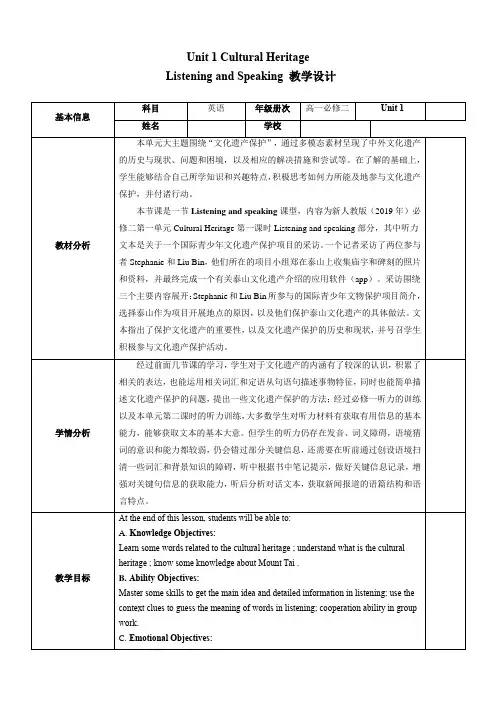
Unit 1 Cultural Heritage Listening and Speaking 教学设计Activity 1 Pre-listening1. look at the pictures below. What are the students doing?Suggested answers:1.The two girls are looking for information about Mount Tai in books and on the Internet. The two boys are taking pictures of the rock carving at Mount Tai and taking notes.2.In the classroom, the students are discussing Mount Tai. The girl is working on her computer.Activity 2 While-listening3.Listen to the conversation and choose the main idea.A.Students from different countries are working creatively to protect a temple in China.B.Youths from seven countries are working together to protect cultural relics on Mount Tai.C.Doing a project on cultural heritage protection in China is interesting and exciting.Suggested answers:B3.Listen again and help the reporter to complete the interview notes. International youth project, high school students from 7 countriesMount Tai, one of the most mountains in ChinaIt has been for more than 3,000 years22 temples, around 1,800 with writing on themDai Temple on ; over 6,000 .4.Listen again and use the context to guess the meaning of the words below. Tick the reason why you were able to guess the words.听力材料:Reporter: Hello. What are you guys doing?Stephanie: We’re creating an app about Mount Tai. We’re part of an international youth project.Reporter: That's interesting. How many students are taking part in the project?Stephanie: There are 23 senior high school students from seven countries. Reporter: Why is the project here at Mount Tai?Liu Bin: Well, as you know, Mount Tai is one of the most famous mountains in China. The mountain and the temples have been protected for over 3,000 years, so it's a great example of how people preserve their cultural heritage.We feel so proud to have chance to do something.Reporter: Tell me about the app you're making.Make a report of a cultural heritage.Choose a cultural heritage which you are familiar with and discuss with your partner how to introduce it.Example:Today, I will introduce you to the Great Wall located in Beijing. It's one of our cultural heritage, which is very magnificent(雄伟的)... But now it is facing some problems. There is too much rubbish left on the steps. We should ...板书设计Homework:Search for more information about the Kremlin and Red Square and the Forbidden City through the library, Internet or other sources. Talk about their history and culture with your classmates.课后反思通过学习:1,学生学习英语的信心增强;2,学生学会抓住听力中的答案;3,锻炼学生的口语能力!通过本节内容学习,理解并讨论主题图,预测单元的主题和内容,通过问题链引导学生谈论单元内容,该板块以听为本,学生通过听取信息和选择依据来学习语言知识,同时内化所学关于本单元的内容。
人教版(2019)高中英语必修二Unit1Period5Listening and Speaking
Background knowledge
泰山,被视为 “五岳之首”。1987年 12月由NESCO(联合国教科文组织)世界遗 产委员会第11届全体会议正式列为自然文 化遗产,也是世界文化与自然双重遗产。
五岳独尊Mount Tai
●东岳 ●西岳 ●南岳 ●北岳 ●中岳
• Mount Tai (Shandong) • Mount Hua (Shaanxi) • Hengshan (Hunan) • Mount Heng (Shanxi) • Mount Song (Henan)
2. Who do the the international students protect the Mount Tai for? 3. Why do the international students protect Mount Tai?
4. What are protected?
5. How do the the international students protect the Mount Tai?
Who are in the pictures?
Boys and girls/teenagers/youth
Where are they? How do you know?
They are in the classroom. I know it because of the desk,screen and blackboard.
also the life in China over 2,000 years ago.
7. There are 22__t_e_m__p_le_s_ and some 1,800 _s_to__n_e_swith writing on them.
Unit 1 Listening and Speaking(教学课件)-高中英语人教版
1. __D___
2. __C___ 3. __E___
4. __B___
5. __A___
light games a hall of mirrors
a blue screen
an area for sound a piano keyboard
tiny bright lights
a giant dish
Europe. The goal of the City is to spread scientific
and technical knowledge among the public,
particularly the youth, and to promote public
interest in science, research and industry.
cast shadows
speak in a whisper
colours of rainbow
While-listening 2. Listen again and complete the descriptions of the photos. (P.6 Ex.4)
Photo A: A giant dish; when you speak into it, it ___r_e_fl_e_c_ts__ the sound back and __m_a_k_e_s__it_l_o_u_d_e_r_. You can use it to speak in a __w_h_i_s_p_e_r_ to someone 17 meters away.
immerse(沉浸) yourself in a world of wonder(奇妙世界)
新人教版英语必修1-Unit 2-Listening and Speaking
Q:If you have the chance to travel anywhere in the world, where will you go?
What do you need to do to prepare for the trip?
(Word bank about preparing for the trip)
Listen and check
LISTENING PART 1 Paul: Hey, Meilin! So what are you doing for the coming holiday? Meilin: I’m travelling around Europe for two weeks with my aunt and uncle. Paul: Europe? Oh, I’ve always wanted to go there! Meilin: Yes, me, too. I’m so excited. I’m planning to visit France and Germany. Paul: That’s wonderful! Do you have your passport and visa already?
Listen and check
LISTENING PART 1 Meilin: I already have my passport, and I am applying for my visa tomorrow. Once I get the visa,we’ll book flight tickets online. Paul: So how do you plan to travel around? Meilin: We’re renting a car and driving! My uncle has always wanted to drive around Europe!
最新人教版高中英语必修二Unit 2 Period 1 Listening and Speaking
Task 4: Post-listening activities
1. According to the example on Page 15, make a dialogue with your partner about the blue whales. A: I’m concerned about the blue whales. What do you know about them? B: Well, I know that they’re being hunted and the number of them is decreasing fast, so they are in danger of extinction. Blue whales are the largest species living on the Earth. They are balancing the sea life and if they are extinct, the sea life will be seriously damaged. A: That’s terrible. What measures are being taken to help them? B: The blue whale is being protected from extinction through several conservation methods, such as being listed and protected under the laws which make it illegal to kill them.The authorities are strengthening monitoring to stop people hunting them. Besides, they also tell people not to buy whale products.