
牛津译林版七年级英语下册 Unit6 知识梳理
7 B Unit 6 知识梳理一.单词四会:pet rabbit hold feed catch wide hunt hide build camp bitefight end trouble anywhere middle drawer empty fit care doorbellmight feather tail wing knock repeat herself sun cage full pullbrush tank fur necessary once clean bottom talk speaker shy basketslowly三会parrot lap chase stick edge frighten owner fantail pea noisystring lead sign shell理解以下单词:bubble hutch window ledge cardboard frock rhyme fin paw重难点单词及拓展1. feed vt. ( 及物动词) 喂;喂养(feed-fed-fed )2. hold vt. ( 及物动词) 托住,握住,拿着; 举行(hold-held-held )3. catch vt. ( 及物动词)捉住;赶上;染上(catch-caught-caught )catch a mouse 捉住一只老鼠catch the thief 抓住小偷catch the early bus 赶上早班车catch up with sb 赶上某人catch a cold 得感冒4. wide 作副词:张大地e.g. Open your mouth wide, please.He looks around with eyes open wide作形容词:宽的;广阔的e.g. This river is very wide.5. build vt. (及物动词) 建筑,建造名词: building 建筑物,大楼(build-built- built )6. camp 作名词:帐篷;营地作动词:露营,野营go camping 去野营7. bite 动词:咬过去式bit、过去分词bitten8. fight 作动词:vi. ( 不及物动词)打仗(架)vt. ( 及物动词)与---打仗(架)过去式、过去分词fought-fought fight with sb 与---打仗(架)9.end 作名词:最后,最终, - 2 -in the end=at last= finally 最后,最终at the end of----在-----最后、末尾、尽头by the end of---到----末、为止by the end of last week 到上学期末10.trouble 名词:麻烦have trouble with sth --有困难have trouble doing sth 做某事有困难What’s your trouble ?= What’s the trouble /matter with you? = What’s wrong? 你怎么了?11. anywhere 副词:任何地方somewhere某地12. empty 形容词:空的an empty box 一个空盒子反义词:full13. care 作动词:vi. ( 不及物动词)介意,在乎care about sth/sb 在意/在乎---- care for sb 关心/照顾某人作名词:take care of sb 关心/照顾某人其形容词:careful 副词carefully14. might 情态动词may的过去式但有时不表过去15. knock 动词:敲,撞,碰knock at /on the door 敲门16. full 形容词:吃饱了的;满的反义词:empty空的hungry 饥饿的e.g. I ’m full. 我饱了。
The basket is full of apples. 篮子里装满了苹果。
17. brush作名词:刷子复数brushes作动词:vt. ( 及物动词) 刷三单brushesShe brushes her dog ’s fur once a day. 她一天刷一次狗毛。
18.necessary 形容词:必要的It’s necessar y for you to plan your time carefully.19. once 副词:一次两次:twice 三次:three timesonce a year twice a week three times a day请注意:------How many times do you go shopping every week?------- Only once-------How often does your sister play basketball? ----------Twice a week. 20. clean作形容词:干净的, - 3 -a clean room keep the classroom clean作动词:打扫,使---干净clean the classroom clean the window1.bottom 名词:底,底部at the bottom of-----在-----底部2.speaker 名词:讲话者动词speak3. frighten 动词:吓唬,使惊恐形容词:frightened 害怕的,恐惧的4. owner 名词:所有者,拥有者动词:own 拥有the owner of------的主人own a car 拥有一辆汽车5.noisy 形容词:嘈杂的,喧闹的The street is so noisy that I can ’t hear your words.How noisy it is!Don’t be noisy. The baby is sleeping.名词:noise make a lot of noise 发出很多噪音二.重点词组1. sleep a lot 多睡2. bark at sb (狗)向某人叫3.look like 看上去像—e.g. What does your sister look like? She is tall and slim.4. my favourite pet 我最喜爱的宠物e.g. What’s your favourite pet? I like dogs best.5. pull its tail 拉它的尾巴6.pull one ’s ear 拉某人的耳朵6. lie on the bed 躺在床上7.sleep on my lap 睡在我的膝上8. look after= take care of 照顾,照料9. belong to 属于e.g. This cat belongs to my brother.=This cat is my brother ’s.10. be crazy about (doing) sth 着迷于---e.g. Lucy is crazy about listening to music.11. eat fish for dinner 晚餐吃鱼, - 4 -12. walk the dog=take the dog for a walk 遛狗13.the cleverest animal 最聪明的动物14. spend lots of time / money on / doing sthe.g. I spend an hour reading every day.She spent lots of money buying / on clothes.15. keep the classroom clean 保持教室干净keep the fish tank clean 保持鱼缸干净16. play a trick/ tricks on sb 捉弄某人e.g. Jack likes playing tricks on others. It ’s not polite, I think.17. look the same 看上去相同e.g. Twins look thesame.look the same as--看上去与---相同e.g. Your pen is the same as mine.18. weigh 4 kilograms 重4千克19. make sure 确保e.g. Make sure that you can arrive on time. 确保你能按时到达。
20. not too cold or too hot 不太冷也不太热21. be different from 与---不同e.g. This shirt is different from from that one.22. at the bottom of---在---的底部e.g. There is a lot of sand at the bottom of the river.23. be easy to look after 容易照料e.g. Cats are easy to look after.24. too much food 太多的食物eat too much 吃太多25. take enough exercise 做足够的锻炼26. once a day 一天一次twice a week 一周两次three times a month 一月三次27. make too much noise 发出太多噪音be noisy 嘈杂a noisy place 一个嘈杂的地方28. have enough time to do sth 有足够的时间做某事29. at least 至少little-less- leaste.g. There are at least 500 students in the school hall., - 5 -30. be busy at work 忙着工作be busy with sth 忙于做某事be busy doing sth忙于做某事e.g. My father is busy at work all day. Tom is busy doing his homework.31. have long fur 长着长长的毛brush its fur 刷它的毛32. keep her warm 使她暖和33. feed sb sth= feed sth to sb 喂---给某人e.g. She feeds her rabbit some carrots every day.34. chase the cat=run after the cat 追赶猫35.open your mouth wide 张大你的嘴36. look around with eyes open wide 眼睛睁得大大的四处张望37. frighten sb/ sth 吓唬某人、某物frighten the cat38. be frightened of doing sth =be afraid of (doing) sth 害怕做某事39. give her a shower 给她洗澡take/have a shower 洗澡40. get/ be tired 累41. knock at the door 敲门42. want them to be healthy 想要他们健康43.all over 遍及all over the world 全世界44. in the middle (of) 在(----)中间45. until the end 直到最后46. in the end= at last= finally 最后,最终47. at the end of the road 在路的尽头48. on the edge of--在---的边缘49. an empty box 一个空盒子50. be full 饱了;满的be full of books 装满了书51. look around 四处张望/看look around for me52. don’t care 不介意care about 在意/在乎---- care for sb 关心/照顾某人53. rhyme with---与---押韵54. bring sb sth bring sth to sb 拿来某物给某人55. watch the fish swim around 看鱼儿游来游去56. hold it in my hand 把它捧在手里, - 6 -57. play with sb/ sth 和某人/某物玩58. teach sb to do sth 教某人做某事teach sb how to do sth 教某人怎样做某事59. take sb out for a walk 带某人出去散步60. repeat the teacher ’s words 重复老师的话61.the owner of ------的主人62.listen to a talk on the pet 听一个关于宠物的报告63. look a little different from other goldfish 看上去与别的金鱼有点不同64.move slowly 缓慢的移动65. have trouble with sth ----有困难have trouble doing sth 做某事有困难66. go camping 去野营67. fight with sb 与---打仗(架)68. catch the early bus 赶上早班车catch up with sb 赶上某人catch a cold 得感冒69. live in a tank /cage 生活在鱼缸/笼子里70. like sleeping in a basket 喜欢睡在篮子里71. give the goldfish some more food 再给金鱼一些食物72. the speaker ’s own pet 讲话者自己的宠物73. the right way to look after birds 照看鸟的正确方法三.句型.1.It’s very important not to take the goldfish out of the wat er 不把金鱼拿出水很重要2. Put your goldfish in the sun 把你的金鱼放到阳光下3. Make sure the water is not too cold or too hot. 确保水不太冷也不太热4.Fantail goldfish are easy to look after. 扇尾金鱼很容易照料5.What is your favorite pet? 你最喜爱的宠物是什么?6.You should take her out to the park at least once a day. 你应该至少一天一次带她去公园散步7. Don’t frighten the cat. 别吓唬那只猫。
牛津译林英语(深圳沈阳)版七年级下册Unit6 Electricity 重点词汇短语句型讲解

【考题链接】
Even though he was disabled (残疾的), he can do many things ____
swimming, writing and reading.
A. as
B. for example C. that is
D. like
Words
9. She can’t buy electricity in packets like sweets! She’ll look foolish. look: _v_. _看_起__来__…__;(感官系动词)
e.g.: She doesn’t trust anyone. e.g.: Does anyone have any questions?
anyone/anybody,常用于否定句和疑问句;不可与 of 连用
【拓展】
e.g.: Someone wants to see you at the school gate. any one “任何一个…”;可以
A. looks, looks B. looks, looks like C. looks like, looks D. looks like, looks like
Words
10. She can’t buy electricity in packets like sweets! She’ll look foolish. foolish: _a_d_j.__愚_蠢__的__; ( fool v. 愚弄)
for the moment 暂时;一会儿(指一段时间)
in a moment 立刻,马上
Words
13. rice cooker. cooker: _n_.__厨_炤__;__炉__具__;
牛津译林版初中英语七年级下册重要内容总结

牛津译林版初中英语七年级下册重要内容
总结
本文档总结了牛津译林版初中英语七年级下册的重要内容。
以
下是各个单元的主要内容:
Unit 1: Classroom language
- 介绍了一些教室用语,如问候、请教、赞扬等。
Unit 2: School life
- 着重介绍了各科目的研究内容,如数学、科学、历史等。
Unit 3: My weekends
- 描述了学生们的周末活动,如打篮球、唱歌、看电视等。
Unit 4: Food and drinks
- 教授了一些食物和饮料的词汇,如苹果、面包、茶、咖啡等。
Unit 5: At the snack bar
- 研究了在小吃店点餐的常用句型,如“What would you like?”、“Here you are.”等。
Unit 6: Festivals and celebrations
- 介绍了一些重要的节日和庆祝活动,如春节、圣诞节、生日等。
Unit 7: Hobbies
- 研究了各种爱好和运动,如阅读、游泳、踢足球等。
Unit 8: At the zoo
- 通过描述动物的外貌和生活性,使学生了解不同的动物种类。
Unit 9: My body and health
- 关注了身体部位和健康问题,如头、肚子、感冒、发烧等。
Unit 10: My family
- 描述了家庭成员的关系和工作,如爸爸、妈妈、姐姐、弟弟等。
这些是牛津译林版初中英语七年级下册的重要内容总结。
希望能对您有所帮助!。
Unit 6 语法一般过去时的肯定,否定和疑问句式(解析版) (牛津译林版)七年级英语下册
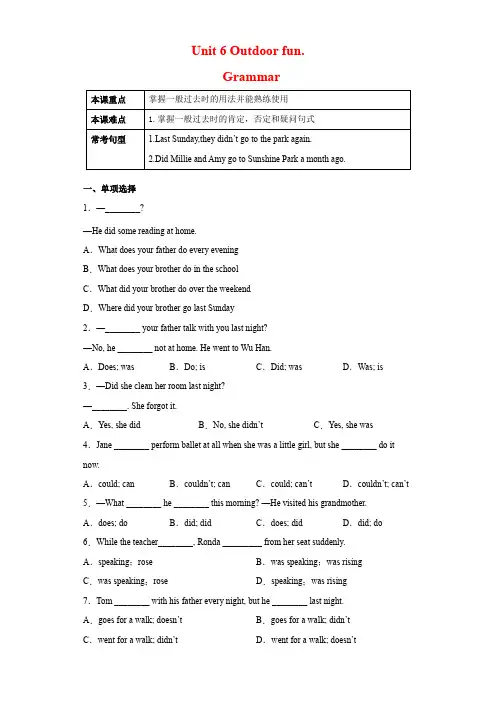
Unit 6 Outdoor fun.Grammar一、单项选择1.—________?—He did some reading at home.A.What does your father do every eveningB.What does your brother do in the schoolC.What did your brother do over the weekendD.Where did your brother go last Sunday2.—________ your father talk with you last night?—No, he ________ not at home. He went to Wu Han.A.Does; was B.Do; is C.Did; was D.Was; is 3.—Did she clean her room last night?—________. She forgot it.A.Yes, she did B.No, she didn’t C.Yes, she was 4.Jane ________ perform ballet at all when she was a little girl, but she ________ do it now.A.could; can B.couldn’t; can C.could; can’t D.couldn’t; can’t 5.—What ________ he ________ this morning? —He visited his grandmother. A.does; do B.did; did C.does; did D.did; do 6.While the teacher________, Ronda _________ from her seat suddenly. A.speaking;rose B.was speaking;was risingC.was speaking;rose D.speaking;was rising7.Tom ________ with his father every night, but he ________ last night.A.goes for a walk; doesn’t B.goes for a walk; didn’tC.went for a walk; didn’t D.went for a walk; doesn’t8.— ________ Carol ________ any photos in the park?—Yes, she did.A.Does; take B.Did; took C.Did; take 9.—Look at my new smart phone.—Wow. it’s so cool! When and where _________ you _________ it?A.do; buy B.have; bought C.did; buy 10.—You can’t swim in the river. It’s dangerous.—Sorry, I ________ see the sigh “No swimming”.A.don’t B.didn’t C.doesn’t D.won’t 11.— When ________ your father at work?— The day before yesterday.A.is B.did C.was12.________ your mother ________ a meeting last Friday?A.Does; have B.Did; have C.Did; has 13.—Did you visit the Great Wall last year?—________. But we visited the Palace Museum.A.Yes, we do B.No, we didn’t C.Yes, we did D.No, we don’t 14.—Where ________ you yesterday?—I was in the library.A.are B.were C.was D.be15.I ________ play in the park ________ I was a little girl. I really miss my happy days there.A.used to; after B.didn’t use to; when C.didn’t use to; after D.used to; when 16.—________ you study for the test last night?—Yes, and I studied very hard to get good grades this time.A.Do B.Did C.Are D.Does 17.—You can’t park your car here. Can’t you see the sign?—I am sorry. I _______ see it just now.A.won’t B.don’t C.didn’t D.wasn’t 18.—I ________ a good breakfast this morning.—Neither ________ I. Let’s go and buy some snacks.A.hadn’t; had B.didn’t have; had C.didn’t have; did D.hadn’t; did19.My sister _________ sing any English songs two years ago, but now she ________ do it very well.A.can’t; can B.couldn’t; can C.can’t; could D.couldn’t; could 20.—_______?—I camped by the lake with friends.A.How was your summer vacationB.Where do you goC.What did you do last weekend21.— Look at the sign , “No Photos”.— Sorry, I ________ see it.A.don’t B.didn’t C.can’t22.The People’s Park is ___________ I __________ her for the first time.A.where, meet B.when, met C.where, met D.when, meet 23.—Excuse me, what time ________ the concert ________?—Well, in fact you’re twenty minutes late. It ________ at eight o’clock sharp. A.did…begin; began B.does…begin; began C.did…begin; has begun D.does...begin; begins24.— ________ you ________ any better today, young lady?— Yes, thank you, Doctor Mason. It ________ as much as it ________ yesterday. A.Are...feeling; doesn’t hurt; did B.Are…feeling; hurts; hurt C.Do...feel; wasn’t hurt; hurt D.Do...feel; hurts; did25.—Mr. Green, ________ you ________ the Happy Valley last Sunday?—No, but I’ll visit it next week.A.will; go to B.did; went to C.did; go to D.did; gone to 26.—Did your friends and you hear what the guide said in the museum?—________. We were busy talking with each other at that time.A.Yes, we were B.No, we weren’t C.Yes, we did D.No, we didn’t 27.—________ you go to your grandparents’ home every weekend, Lucy?—Yes, and I ________ chickens there last weekend.A.Do; feed B.Do; fed C.Did; feed D.Did; fed 28.—My mother said you went on a Silk Road trip last year.—Yes, it ________ a wonderful trip.A.weren’t B.was C.will be D.were 29.—________ you stay at home last Sunday afternoon?—No, I ________ a kite with my friends in the park.A.Do; fly B.Were; flew C.Did; flew D.Did; fly 30.you to the park six hours ago?A.Did; went B.Did; go C.Will; go二、句型转换31.Mr. Wang went to Canada two years ago. (对画线部分提问)________ ________ Mr. Wang go to Canada ?32.Jim read a newspaper just now.(对划线处提问)________________ Jim read just now?33.My father had a fever last week. (对划线部分提问)________________________ last week?34.Their friend played on the playground the day before yesterday.(变为一般疑问句)________ their friend _______ on the playground the day before yesterday?35.The little boy often buys some flowers for his mother. (用上last Sunday,把句子改写为否定句)The little boy _________________ any flowers for his mother last Sunday.36.They went to Shanghai this morning. (改为一般疑问句)________ they ________ to Shanghai this morning?37.He went to the park last year. (改为否定句)He ________ ________ to the park last year?38.He did his homework at home last weekend.(改为否定句)He ________________ his homework at home last weekend.39.Lucy read English yesterday morning. (改为否定句)Lucy ________ ________ English yesterday morning.40.Mary went to London for a study trip last summer. (改为一般疑问句)________ Mary ________ to London for a study trip last summer?41.Bob did some exercise this morning. (改为一般疑问句)_______ Bob _______ any exercise this morning?42.The book cost him seven dollars. (改为一般疑问句)________ the book ________ him seven dollars?43.Nacy did her homework last night. (改为否定句)Nacy ____________ ____________ her homework last night.44.The new house cost Mr. Smith a lot of money.(改为否定句)The new house ________ ________ Mr. Smith much money.45.I felt tired after working for more than 10 hours yesterday. (改为否定句)I ___________ ___________ tired after working for more than 10 hours yesterday.参考答案:1.C【解析】句意:——你哥哥周末做了什么?——他在家看书。
Unit6单词讲解牛津译林英语七年级下册

1.outdoor adj. 户外的•固定搭配:outdoor activities 户外活动;outdoor sports 户外运动•例句:I enjoy doing outdoor activities like hiking and cycling. 我喜欢户外活动,如徒步和骑自行车。
2.hurry vi. 急忙,匆忙•固定搭配:hurry up 快点,赶快;in a hurry 匆忙地•例句:Hurry up, we don't have much time left. 快点,我们剩下的时间不多了。
3.plain vi. & vt. 抱怨•固定搭配:plain about 抱怨……;plain of 抱怨……•例句:She always plains about the noise outside her window. 她总是抱怨窗外有噪音。
4.camping n. 野营•固定搭配:go camping 去野营;camping trip 野营之旅•例句:We had a great camping trip last weekend. 上周末我们有一次很棒的野营之旅。
5.cycling n. 骑自行车运动•固定搭配:go cycling 骑自行车;cycling race 自行车比赛•例句:I enjoy cycling as a form of exercise. 我喜欢骑自行车作为一种锻炼方式。
6.riding n. (=horse riding)骑马•固定搭配:horse riding 马术;go riding 去骑马•例句:Riding a horse is one of my favorite hobbies. 骑马是我最喜欢的爱好之一。
7.skating n. 溜冰•固定搭配:go skating 去溜冰;ice skating 滑冰•例句:In winter, I love to go skating on the frozen lake. 冬天我喜欢在结冰的湖上溜冰。
英语知识点春牛津译林版英语七下Unit 6《Outdoor Fun》word单元知识总结-总结
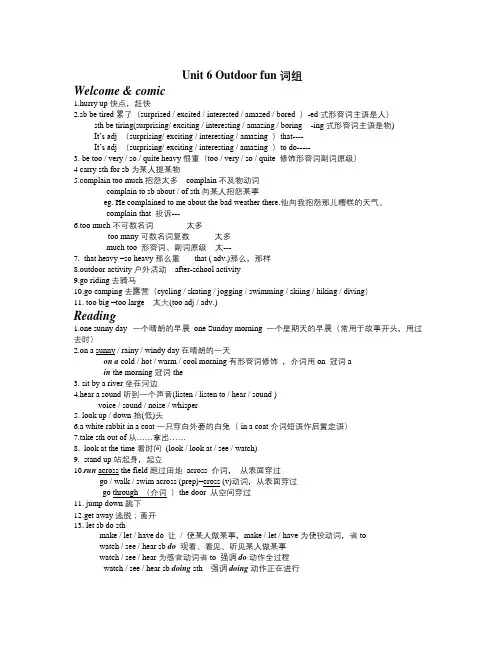
Unit 6 Outdoor fun词组Welcome & comic1.hurry up 快点,赶快2.sb be tired 累了(surprised / excited / interested / amazed / bored )-ed式形容词主语是人)sth be tiring(surprising/ exciting / interesting / amazing / boring -ing式形容词主语是物)It’s adj (surprising/ exciting / interesting / amazing )that----It’s adj (surprising/ exciting / interesting / amazing )to do-----3. be too / very / so / quite heavy 很重(too / very / so / quite 修饰形容词副词原级)4 carry sth for sb 为某人提某物plain too much 抱怨太多complain不及物动词complain to sb about / of sth向某人抱怨某事eg. He complained to me about the bad weather there.他向我抱怨那儿糟糕的天气。
complain that 投诉---6.too much 不可数名词太多too many可数名词复数太多much too 形容词、副词原级太---7. that heavy =so heavy那么重 that ( adv.)那么,那样8.outdoor activity 户外活动after-school activity9.go riding 去骑马10.go camping 去露营(cycling / skating / jogging / swimming / skiing / hiking / diving)11. too big =too large 太大(too adj / adv.)Reading1.one sunny day 一个晴朗的早晨one Sunday morning 一个星期天的早晨(常用于故事开头,用过去时)2.on a sunny / rainy / windy day 在晴朗的一天on a cold / hot / warm / cool morning有形容词修饰,介词用on 冠词ain the morning冠词the3. sit by a river 坐在河边4.hear a sound 听到一个声音(listen / listen to / hear / sound )voice / sound / noise / whisper5. look up / down抬(低)头6.a white rabbit in a coat一只穿白外套的白兔( in a coat介词短语作后置定语)7.take sth out of 从……拿出……8. look at the time 看时间(look / look at / see / watch)9. stand up 站起身,起立10.run across the field 跑过田地across 介词,从表面穿过go / walk / swim across (prep)=cross (v)动词,从表面穿过go through (介词)the door 从空间穿过11. jump down 跳下12.get away 逃脱;离开13. let sb do sthmake / let / have do 让/ 使某人做某事,make / let / have为使役动词,省towatch / see / hear sb do观看、看见、听见某人做某事watch / see / hear为感官动词省to 强调do动作全过程watch / see / hear sb doing sth 强调doing动作正在进行14.for a long time 好长一段时间15. find herself alone in …发现他自己单独在…alone = on one’s own = by oneself adj 独自的adv 独自lonely adj 孤独的16. all around 周围17.on the other side 在…另一边one ---the othersome---- the othersone -----anothersome----- others18.try to do sth 努力做某事19.go through 通过;浏览through / across / cross20.open the door with the key=use the key to open the door 用钥匙打开了门21.surprise sb使某人措手不及surprise v使惊奇;使措手不及surprised adj 吃惊的,惊讶的surprising adj令人惊讶的22.visit the park 参观公园23. have a good time =have fun=enjoy oneself (doing sth)玩得高兴24. go out 出去go out of----从-----出去25. put up our tent 搭起帐篷put up张贴;挂起;举起put ---in 把---放在---里put---into把---放到---里put off脱下;延迟,推迟Integrated skillsst weekend 上周末plete her article 完成她的文章3.people in the west = Western people西方人4.tell sb all (nothing / a little / little ) about sth 告诉某人全部()关于某事5.find a new way to make paper 发现了造纸的新方法find sb to do sth to do sth不定式作目的状语find sb doing sth doing sth 现在分词作补语find sb alone / clever / lazy---形容词作补语find sb to be (n, adj., prep) to be 可省find it adj. to do sth to do sth作宾语it 为形式宾语find that clausefind / find out / look fore bamboo to make kites 用竹子做风筝=make kites with bamboo7.make a bird out of wood 用木头做了一只鸟be made of / from 由----制造,常用被动be made into 被制成---- 常用被动8. have a long history 具有悠久的历史9.in the Warring States period 在战国时期10. in history 在历史上11. in the Eastern Han dynasty在东汉12.begin to use paper to make kites= begin to make kites with paper开始用只做风筝begin to do = start todo sth 开始做某事13.become famous for making kites因做风筝而出名become famous as因----出名become famous as 以----闻名14.from then on 从那时起have / has done from then on15.a great day 精彩的一天16. fly kites 放风筝17.I’m afraid not.I’m afraid so.18.It’s dangerous to swim in the lake.It’s dangerous to do sth 做某事很危险19.remember to take your mobile phone 记着带上手机remember (not) to do sth 记着(别)要做某事remember doing sth 记得做过某事20. the history of kites 风筝的历史Study skills1.in alphabetical order 按字母表的顺序2.start / begin with 以……开始3. look up 查阅4. in the top corner 在顶部的角落Task1.know what to do 知道做什么(tell sb / worry about / )know how / when / where to do sth2. feel a little ill 感到有点不舒服eat little 几乎不吃drink a little喝了一点点have a little(一点儿)time / food / waterhave a little(小的)cat / fisha little(有点儿)ill / different (原级)a little (有点儿)better (比较级)less than不足,少于at least至少3.It tasted sweet.taste sth taste行为动词,品尝taste sweet / good / nice taste系动词,尝起来have a good taste taste 名词,味道用法同smell4.have a good taste5.drink some (much) more又喝了一点6.look down / up向下看7.become smaller and smaller 变得越来越小run faster and fasterbecome more and more important8.decide to enter the garden 决定进到花园里decide to决定做某事enter=go into9. small enough 足够小be adj enough to do sthdo A adv enough to do B10.be too small to reach the key太小而够不着钥匙too … to …太……而不能eg.walk too slow to follow the othersreach 伸手(脚)够得着;到达(同get to或arrive in / at)Unit 6 Outdoor fun1.hurry up快点,赶快161拓展2.too much太多much too 太3.outdoor activities户外活动4.go riding骑马1645.do some shopping购物173 拓展6.look up向上看,查询167 补充look短语7.in a coat穿着一件外套1688.get away逃离,离开168 补充get短语9.stand up站起10.go through穿过,通过11.put up搭建,张贴,挂起,举起17312.Western people西方人175 拓展13.make...out of...由......制成 (175)14.from then on从那时起15.have a picnic去野餐16.after a while不久过一会18017. complain to sb. about/of/sth./sb.向某人抱怨某事/某人16218.on,in,at区别16719.by的用法16720.see sb. doing sth.看见某人正在做某事16821.how+形容词/副词+主语+谓语!What+a/an+形容词+单数名词+主语+其他!What+形容词+可数名词复数或不可数名字+主语+其他!16822. on one’s own by oneself alone与lonely区别16923.try to do 努力做某事try doing 尝试做某事16924.through ,cross ,across 区别16925.take spend pay cost用法17026.practise / like/stop/finish/enjoy doing 练习做某事27.become famous for/as…因为/作为……而著名17628.excited、exciting;surprised、surprising17629.it +be+形容词+to do sth某人做某事是怎样的17630.start with从……开始17831.what to do 17932.数词+more+名词再 (179)33forget to do 忘记去做forget doing忘记做过18034.enough+名词或名词+enough 形容词+enough enough to do35.decide to do 决定做某事want,would like,plan36.too...to...太......而不能......so...that...如此......以至于 (181)37.fail to do sth.失败做某事181Unit6 Outdoor fun单元测试一、根据句意,首字母或汉语提示完成单词。
Unit 6知识点讲解 2021-2022学年牛津译林版七年级下册英语
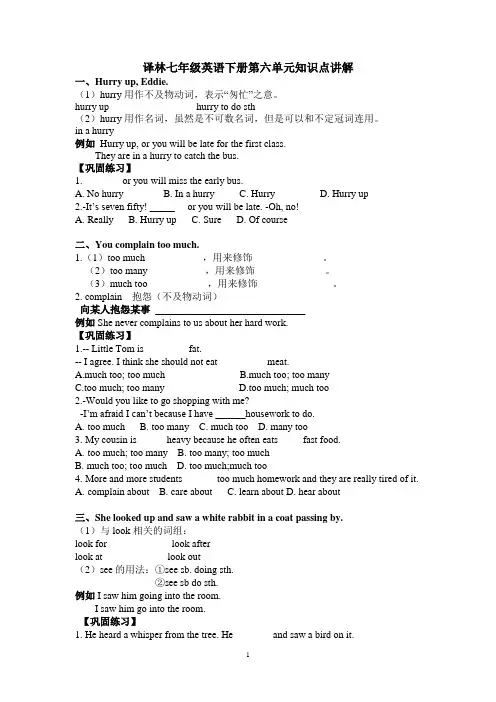
译林七年级英语下册第六单元知识点讲解一、Hurry up, Eddie.(1)hurry用作不及物动词,表示“匆忙”之意。
hurry up_________________ hurry to do sth_________________(2)hurry用作名词,虽然是不可数名词,但是可以和不定冠词连用。
in a hurry_______________例如Hurry up, or you will be late for the first class.They are in a hurry to catch the bus.【巩固练习】1.________or you will miss the early bus.A. No hurryB. In a hurryC. HurryD. Hurry up2.-It’s seven fifty! _______ or you will be late. -Oh, no!A.ReallyB. Hurry upC. SureD. Of course二、You complain too much.1.(1)too much ___________,用来修饰______________。
(2)too many ___________,用来修饰______________。
(3)much too____________,用来修饰_______________。
2. complain 抱怨(不及物动词)向某人抱怨某事______________________________例如She never complains to us about her hard work.【巩固练习】1.-- Little Tom is ________ fat.-- I agree. I think she should not eat _________ meat.A.much too; too muchB.much too; too manyC.too much; too manyD.too much; much too2.-Would you like to go shopping with me?-I’m afraid I can’t because I have ______housework to do.A.too muchB. too manyC. much tooD. many too3.My cousin is _____ heavy because he often eats ____ fast food.A.too much; too manyB. too many; too muchB.much too; too much D. too much;much too4.More and more students ______ too much homework and they are really tired of it.plain aboutB. care aboutC. learn aboutD. hear about三、She looked up and saw a white rabbit in a coat passing by.(1)与look相关的词组:look for___________ look after ____________look at___________ look out_____________(2)see的用法:①see sb. doing sth. _____________________②see sb do sth._________________________例如I saw him going into the room.I saw him go into the room.【巩固练习】1. He heard a whisper from the tree. He _______ and saw a bird on it.A. looked aroundB. looked downC. looked backD. looked up2. When I came into the room, I saw him ________ TV.A. watchingB. watchC. to watchD. watched四、Alice fell for a long time, and then she hit the ground.fell是fall的过去式,意为____________________和fall有关的短语有:fall asleep_______________ fall off _______________fall behind ______________【巩固练习】1.Yesterday he _________ the bike, but he wasn’t hurt badly.A. fell downB. felt offC. felt downD. fell off2.-What happened to Mare?-He fell ____ the bike ____a snowy morning.A.off; inB. down;atC. off;on五、She found herself alone in a long, low hall.(1)alone______________,相当于__________________。
译林牛津七年级英语下册 Unit 5-6单元词句梳理
译林牛津七年级英语下册Unit 5 Amazing thingsPeriod 1 Comic strip & Welcome to the unit必背单词1. same adj. 同一的, 相同的2. birth n. 出生, 诞生→ birthday n. 生日3. earth n. 地球; 大地4. back n. 后部; 背部5. fat n. 脂肪6. fact n. 事实必背短语7. the same size 一样的尺寸8. from birth 从出生时9. stop doing sth. 停止做某事10. in the back of 在……后面必背句子11. Come on, Eddie. It’s just a plane.得了吧, 埃迪。
那只是一架飞机。
12. Fish sleep with their eyes open.鱼睁着眼睛睡觉。
13. Our eyes are the same size from birth, but our nose and ears never stopgrowing.我们的眼睛与出生时大小相同, 但是我们的鼻子和耳朵从未停止生长。
14. Is n’t that amazing? 难道那不令人吃惊吗?Period 2 Reading必背单词1. as adv. 和……一样2. usual adj. 通常的, 平常的3. suddenly adv. 突然→ sudden adj. 突然的; 出乎意料的4. anybody pron. 任何人5. nobody pron.(=no one) 没有人, 无人6. reply vi.答复, 回答7. strange adj. 奇怪的; 陌生的8. leave vt. 离开9. quickly adv. 迅速地, 飞快地→ quick adj. 快的10. happen vi. 发生11. everything pron. 每件事, 每样事物, 一切12. wonder vi. & vt.琢磨, 想知道; 感到诧异13. carefully adv. 仔细地, 认真地; 小心地→ careful adj. 仔细的, 小心的→ care n. 关怀, 照料14. search vt. & vi. 搜查, 搜寻, 搜索15. himself pron. 他自己16. weak adj. 虚弱的, 无力的17. pick vt. 拾起18. surprised adj. 吃惊的, 惊讶的→ surprise n. 惊奇, 诧异; 突然袭击vt.使惊奇; 奇袭19. later adv. 随后, 后来20. somebody pron. 某人, 有人必背短语21. as usual 照例; 像往常一样22. sit down 坐下23. turn around 转身, (使) 翻转24. on one’s/the way 在路上25. say to oneself 自言自语26. pick up 拿起, 举起27. take ... to ... 把……带到……28. the animal centre 动物中心29. run away 逃离, 跑开必背句子30. As usual, they sat down under a big tree.她们和平时一样坐在一棵大树下。
Unit6 知识讲义-牛津译林版英语七年级下册
1、You complain too much.(P68)(1)complain 为动词,意为抱怨。
complain to sb. about sth/of sth. 向某人抱怨某事。
He complained to his mother about his old schoolbag.(2)too much放在动词或动词词组的后面,不可数名词的前面。
too many 后面跟可数名词的复数much too 后面跟形容词1、She looked up and saw a white rabbit in a coat passing by.(P70)(1)look up 此处意为抬头向上看;look up 还意为查阅,指在字典里查找。
You can look up this word in a dictionary.(2)in a coat意为穿着外套in+颜色表示穿着什么颜色的衣服She is always in black.(3)see sb. doing sth.看见某人正在做某事,强调所看到的动作正在进行。
I saw her dancing in the park at six yesterday.see sb do sth 看到某人做了或经常做某事。
I often see her dance in the park.2、How amazing!(P70)由how引起的感叹句How +形容词/副词(+主语+谓语)!How beautiful the girl is!How fast he runs!由what引起的感叹句:(1)what+a/an+形容词+单数名词(+主语+谓语)!What a nice girl!(2) what+形容词+可数名词的复数或不可数名词What cheap clothes!What delicious food!3、She found herself alone in a long, low hall.(P 70)(1)find oneself+形容词/介词短语意为发现自己处于某种状态。
Unit6Reading知识清单牛津译林版英语七年级下册
牛津译林版七年级下册 Unit 6 知识清单(二)Reading【知识精讲】1.by:prep.“在……旁边”(by the window)。
→by + 时间“到……时”(by the end of the month)。
→by + 地点“在……旁”(by the river)。
→by + 交通工具“乘……”(by train)。
→by用于被动语态“被……,由……”。
→by the way“顺便问一下”;by oneself“独自”。
2.look相关短语:look up“向上看;查阅,查找”(跟代词作宾语,代词放在中间)。
look at“看”;look after“照顾”;look like“看起来像……”;look through“浏览”;look around/about“环顾”;look for“寻找”;look forward to (doing sth.)“期待”。
3.see sb. doing sth.“看见某人正在做某事”(强调动作正在进行)。
see sb. do sth.“看到某人做某事”(看到整个过程,也可以指看到某人经常做某事)。
4.“in + 颜色”表示穿着什么颜色的衣服。
5.pass by = walk/go past“经过”。
6.感叹句:How + 形容词/副词(+ 主语+ 谓语)!What + a/an + 形容词+ 单数名词(+ 主语+ 谓语)!What + 形容词+ 可数名词复数/不可数名词(+ 主语+ 谓语)!7.take...out of“把……从……拿出来”。
→get out of...“从……里面出来”。
→jump out of...“从……里面跳出来”。
→look out of...“从……朝外看”。
→push sb./sth. out of...“把某人/某物从……推出来”。
→run out of...“从……跑出来”。
8.run across“跑过;偶然遇见”。
牛津译林英语7B Unit6 Outdoor fun知识点
(2)alone形容词,意为“独自,单独”,习惯上只用作表语,指客观上独自一人,相当于by oneself或on one's own
Eg. Some parents sometimes have to leave their children alone at home.
Eg. He woke up and found himself in a hospital bed.他醒来发觉自己躺在医院的床上。
[拓展]类似的结构有:“keep/make/think...+宾语+形容词”
Eg:We must keep our classroom clean.我们必须保持教室干净。
4. cycling
cycling名词,意为“骑自行车运动”,动词为cycle(骑自行车)
Eg. Beijing is a good place for cycling.北京是一个骑自行车运动的好地方。
Eg. They cycled 100 miles around the lake.他们围着湖骑行了100英里。
(2)put...into...动词短语,意为“把...放进...”,into介词,意为“到...里面”
fall over跌翻,摔倒
Eg. Babies often fall when they are learning to walk.婴儿学走路时时常会跌倒。
Please climb down the tree, or you will fall down.
请从树上下来,不然你会摔下来的。
[拓展]fall作名词,表示“秋天”,相当于英式英语中的autumn