
2021高考英语译林版模块7 Unit 2 Fit for life 夯基固本案
-7-
『语用规律归纳』
1.常见“人体部位及器官”名词荟萃
cheek脸颊
tongue舌头
chest胸部
shoulder肩膀
throat喉咙
lung肺
liver肝脏
wrist腕关节
finger手指
eye眼睛
2.-er后缀指物的名词小结
cooker炊具
speaker扬声器
receiver听筒;话筒
typewriter打字机
Observation is the best
-15-
13.代替in place of 14.放出,发出let out 15.环顾look around 16.填写fill in 17.分开,分离split up 18.执行,进行carry out 19.逐渐消失fade away 20.提出come up with 21.肿胀,膨胀swell up 22.打开;开拍open up 23.同意,赞成subscribe to 24.分辨出;弄明白make out
-11-
『构织连脉词族』 1.beneficial adj.有益的,有用的→benefit vt.对……有益 2.abnormal adj.不正常的,反常的→normal adj.正常的 3.astonish vt.使十分惊讶,使吃惊→astonishing adj.令人吃惊的 →astonished adj.感到吃惊的→astonishment n.惊奇 4.application n.应用,运用;申请表,申请;涂抹,外敷 →apply vt.申请;应用 5.unable adj.不能,无法→able adj.能够的→enable vt.使能够 →ability n.能力 6.effective adj.有效的;实际的,事实上的;生效的→effect n.效果 →effectively adv.有效地;有力地 7.approval n.批准,通过;赞成,同意→approve vt.批准;赞成 8.sickness n.疾病;恶心,呕吐→sick adj.恶心的
-5-
识记阅读单词——读文理解通畅 1.chemist n.药剂师,药商;化学家 2.needle n.针,针头;指针 3.surgeon n.外科医师 4.operating theatre n.手术室 5.life-saving adj.救命的,救生的 6.cupboard n.橱柜;食物柜;衣柜 7.counter n.柜台;计数器;反驳 vt.反驳;抵制,抵消 8.acid n.酸,酸性物质 adj.酸的,酸性的;酸味的;尖酸的 9.tablet n.药片;丸;牌,匾,碑 10.heart attack n.心脏病发作 11.circulate vi.& vt.循环;传播,散布;传递,传阅 12.blood sugar n.血糖
『语境活用』 1.Several customers were waiting when I arrived to open up the shop. 2.To work out how brave or anxious the baboons were,Dr.Carter presented them either h a novel food or a threat in the form of a model of a poisonous snake. 3.Why don’t you try out for the basketball team?You have nothing to lose. 4.People are learning how to organize information in large quantities so that they are able to access it at a later date. 5.When she saw him,she let out a cry of horror.
-14-
从表面理解到深层延伸 从拓展中抓其规律
teacher. 1.in large quantities大量地 2.try out测试,试验;参加选拔 3.be addicted to对……上瘾,痴迷 4.take measures采取措施 5.burst out laughing突然大笑起来 6.turn up出现,到场,开大(声音) 7.be beneficial to对……有益 8.in the form of以……形式 9.a handful of 少数的,少量的 10.manage to do sth设法做成某件事 11.be cautious about对……小心谨慎 12.wear sb out 使筋疲力尽;使厌烦
-10-
7.arrangement联想篇 make arrangements for为……作安排 come to an arrangement达成协议 arrange sth整理/布置/排列……;安排/筹备…… arrange sth for sb为某人安排某事 arrange for sb/sth to do sth安排……做某事
-4-
22.sharp adj.锋利的;急剧的;灵敏的;尖锐的,严厉的 plex adj.复杂的,难懂的 n.建筑群;相关联的一组事物;情结 24.addicted adj.上瘾;入迷 25.theory n.理论,学说 26.relate vt.&vi.联系,把……联系起来;叙述,讲述 27.subscribe vi.定期订购或订阅
counter柜台
drawer抽屉
poster海报
-8-
3.outcome联想篇 income收入 outcome结果;后果 output产品;产量 overcome克服 4.“able”家族 able adj.能;能够;有才能的 ability n.能力 disability n.伤残;无能力 disabled adj.伤残的 unable adj.未能;无法
-9-
5.如何表示“赞成” be for be in favour of agree with/to/on/that approve of be in support of 6.astonish用法归纳 be astonished at/by sth对某事感到惊讶 be astonished to do sth因做某事感到惊讶 in astonishment 吃惊地(常做方式状语) to one’s astonishment 使人吃惊的是(常放在句首,做结果状语)
-16-
『语用规律归纳』 表示“数量多”的短语荟萃 a number of many a a great deal of a large amount of large amounts of a large quantity of large quantities of plenty of
-17-
-12-
9.bleed vi.流血,失血→blood n.鲜血 10.reasonable adj.合理的,有理由的;公道的;明智的→reason n.理由 11.arrangement n.排列,布置;安排;约定,协议 →arrange vt.安排,约定 12.sharp adj.锋利的;急剧的;灵敏的;尖锐的,严厉的 →sharpen vt.使锋利 13.addicted adj.上瘾;入迷→addict vt.沉溺,使上瘾 →addiction n.沉溺,上瘾 14.relate vt.& vi.联系,把……联系起来;叙述,讲述 →related adj.有联系的→relation n.联系
-13-
『语境活用』 1.I wish you would approve (赞成) of taking aspirin, which is a simple but highly effective (有效的) treatment. 2.Although she’s completely addicted (有瘾的) , she makes up her mind to give up smoking, which is related (有关) to the rise in prices. 3.It’s astonishing how beautiful things sound when you can really listen in astonishment.(astonish) 4.Health is the best treasure which a man can possess.If a person takes possession of it,he will be wealthy.(possess) 5.It’s fortunate to have such a reasonable father. He doesn’t scold his children without reason.(reason)
-3-
12.effective adj.有效的;实际的,事实上的;生效的 13.approval n.批准,通过;赞成,同意 14.sickness n.疾病;恶心,呕吐 15.symptom n.症状;征兆 16.bleed(bled,bled) vi. 流血,失血 17.reasonable adj.合理的,有理由的;公道的;明智的 18.outcome n.结果,后果 19.applaud vi.& vt. 鼓掌;称赞,赞许 20.arrangement n.排列,布置;安排;约定,协议 21.dull adj.钝的,不锋利的;迟钝的;枯燥的;灰暗的,昏暗的
Unit 2 Fit for life (主题语境:人与自我——生活与学习)
-2-
在记忆中求准确 在语境中求熟练 Practice makes perfect. 必背表达单词——写作信手拈来 1.revolution n.巨变,大变革;革命;旋转,天体运行 2.beneficial adj.有益的,有用的 3.chew vi.& vt.咀嚼,嚼碎;咬,啃 4.possess vt.拥有,具有 5.best-selling adj.畅销的 6.vital adj.对……极重要的,必不可少的 7.potential n.可能性,潜在性;潜力,潜能 adj.潜在的,可能的 8.abnormal adj.不正常的,反常的 9.astonish vt.使十分惊讶,使吃惊 10.application n.应用,运用;申请,申请表;涂抹,外敷 11.unable adj.不能,无法
译林牛津版选修7:Unit 2 Fit for Life reading and langu
Because Fleming discovered penicillin and the others turned it into the great drug which saved millions of lives.
1950 1977
Discovered by Alexander Fleming
Found new chemical techniques to purify it
All the scientists shared the Nobel Prize
Fill in the boxes.
Proved to be a blood-thinning medicine
In 1897
3. What other things can ASA help with besides reducing fever and pain?
It can also help reduce the risk of heart attacks by thinning blood, prevent a stroke, reduce the risk of colon cancer, increase the length of people’s lives and help with diabetes.
a. modern, of present time
b. happening in a lot of places c. a medical doctor who does not
高中英语牛津译林版模块7Unit2 FitforlifeWelcometotheunit课件

v. [I or T] to (cause to) work, be in action or have an effect:
药立刻开始见效.
The medicine began to operate at once.
operation
What happens to the person?
The person is receiving an acupuncture treatment on an ear. Traditional acupuncture always requires doctors to insert such needles into various body areas.
Have you ever had such an experience?
What are the doctors and nurses busy doing?
They are performing an operation.
What do you call the doctors who perform an operation on patients?
(2) the fact of operating or being active: 这工厂已开工几个星期了. The plant has been in operation for several weeks. come into operation: 实施,生效
operator n. [C] 2. ever : adv.
What is the girl doing? She is having her eyesight examined to detect short sightedness. What do you call the man testing the girl’s eyes? An eye doctor.
高考英语一轮复习模块7.2Fitforlife(讲)(含解析)牛津译林版
Unit 2 Fit for life一、重点词汇alcoholics and people who are addicted to drugs. (P31) 有些人也用针刺疗法来治疗吸烟者、酗酒者以及对毒品上瘾的人。
11.【教材原句】Another theory relates acupuncture to the production ofchemicals in the body which reduce pain.(P33)另一种理论则将针灸和人体内减少疼痛的化学物质的生成联系起来。
12.【教材原句】Fleming tried this mould out on another bacterium and foundthat it killed the bacterium too. (P19)弗莱明将这种霉用在另外一种细菌上做试验,发现它同样杀死了那种细菌。
13.【教材原句】Due to the widespread use of penicillin, many lives weresaved during the war. (P19)正因为青霉素的广泛应用,战争期间的很多生命得以挽救。
14.【教材原句】Today I feel worn out.(P25)今天我感到筋疲力尽。
15.【教材原句】...and a needle like a small sword,used for letting liquidout of body parts which had swollen up...(P30)形似小剑的针,用于将液体从身体的肿胀部位导出……16.【教材原句】A lot of people now subscribe to these theories. (P31)很多人现在都认同这些理论。
二、经典句型考点-1.if省略句【教材原句】Have you ever seen a doctor?If so, what happened?(P17)你曾经看过医生吗?如果看过的话,发生了什么事?考点-3. prove用作连系动词时的句型【教材原句】Both of these medicines have saved millions of people’s lives and have proved beneficial to mankind since they were invented.(P18)自这两种药被发明以来,它们已挽救了数百万人的性命,并已证实对人类有益。
牛津译林版英语高二下册Module7Unit2Fitforlife
Unit 2 Fit for lifeWelcome to the UnitTeaching a ims:After this class, the students will be able to:1. learn more words about doctors;2. have general idea of the history of acupuncture;3. practise their spoken English.Teaching procedures:Step 1 Lead-in1. H ow can we keep fit?2. W hat will people do when they fell ill?3. Guessing game: What are the doctor s?Step 2 P ictures talking.In what way do doctors give patients treatment?S tep 3 Discussion1. Do you know any person related to invention or discovery of medicine?2. Can you imagine a day without any medicine in this world?S tep4 HomeworkS earch for more information about the history of medicine.ReadingP eriod oneTeaching a ims:After this class, the students will be able to:1. gain the gist through first and second reading;2. practice students’listening ability;3. improve students’ thinking ability through discussion;4. understand some medical terms.Teaching procedures:Step 1 lead-in1. Fill in the blanksA good _________ tastes bitter.Laugh is the best ____ in the worldThere is no ______ against death.2. QuestionsWhat medicines have you ever taken? And what do you know about them?How much do you know about the two medicines?Who invented the two medicines?What illnesses can the two medicines be used to treat?Step 2 First readingWhen was aspirin first sold as a tablet?What did Fleming, Florey and Chain share?Step 3 ListeningListen to the article and try to answer the questions in C1 on page 20.S tep4 Second readingDevelopment of aspirin:Development of Penicillin:Effects of aspirin:Effects of penicillin:S tep5 DiscussionDo you believe that “wonder drugs”will be invented to treat diseases like AIDS in the future?S tep 6 Reading strategyHow can we understand medical terms?Words coming from the same stem:Words that are compound words:Words with irregular plural forms:S tep7 ConsolidationFill in the blanks with proper words according to the reading material.S tep8 HomeworkReview the w hole article, underline the phrases and words you don’t know.ReadingP eriod twoTeaching a ims:After this class, the students will be able to:1. consolidate the gist of the article;2. learn some phrases such as focus on, open up, take place, etc;3. learn some words such as trial, thin(vt), note, etc.Teaching procedures:Step 1 ConsolidationFill in the blanks with correct the words.S tep 2 Useful phrasesfocus on, open up, take place, save one’s life, be made from, in powder form, carry out a study, be considered to be, manage to do, due to, dream come true, heart attack.Step 3 Difficult language pointsW ords:trial, thin(vt), risk, note, application, massS entence structure:1. However, it was not until World War II that two other scientists managed to use new chemical techniques to purify it.2. I t was over a decade before someone else turned penicillin into the great drug of the 20th century.S tep 4 Group discussionL et students discuss with partners about making up a story with the words and phrase we have just learned.S tep5 PresentationAsk students to present their story in front of the class.S tep6 HomeworkWord powerTeaching a ims:After this class, the students will be able to:1. Learn more words about common diseases such as chicken pots, influenza, cancer, etc.2. Learn some words about the ways we use medicine such as powders, liquid, cream and so on.3. Learn some words about the hospital department such as reception, ward, X-ray room, etc.Teaching procedures:Step1 Lead-inCan you tell the names of the diseases?Step2 Word gameWhat are the names of diseases according to the definition?S tep3 Diary entry readingTake notes down about the diseases mentioned in the entry.S tep4 Match gameM atch the words with pictures, learn some words about different ways we use medicine.S earch information about the history of medicine.S tep5 H ospital departmentI dentify the functions of each department in hospitalWord powerTeaching a ims:After this class, the students will be able to:1. Learn more words about common diseases such as chicken pots, influenza, cancer, etc.2. Learn some words about the ways we use medicine such as powders, liquid, cream and so on.3. Learn some words about the hospital department such as reception, ward, X-ray room, etc.Teaching procedures:Step1 Lead-inCan you tell the names of the diseases?Step2 Word gameWhat are the names of diseases according to the definition?S tep3 Diary entry readingTake notes down about the diseases mentioned in the entry.S tep4 Match gameM atch the words with pictures, learn some words about different ways we use medicine.S earch information about the history of medicine.S tep5 H ospital departmentI dentify the functions of each department in hospitalProjectTeaching aims:After learning this period, the students will be able to1. learn about two search services and what should be taken into consideration whileresearching on the Internet;2. use the Internet to do research on a topic by using the information andinstructions in the text;3. make a poster explaining how they have searched and what they have found.Step 1 Lead-in(PPT)Begin the class by asking students in what ways they get information. After the discussion, arouse students’ thinking by asking them, “What is the fastest growing source of information in the world today?”(PPT)Step 2 Skimming (PPT)Allow the students two or three minutes to go through the text quickly to find the answers to the questions on the screen: “When using the Internet to do research, you should keep some steps in mind…”(PPT)Answer:Step one: choosing a search serviceStep two: how to searchStep three: using your informationStep 3 Careful reading for detailed information (PPT)1. Step One: choosing a search service1)Ask the students the following questions:What are the two search services mentioned in the guide?What do they both give us?Can you set some examples of search engines?Answers:Search engines and subject directories.They both give us direct links.Google, Yahoo, Lycos and Excite.(2)True or false questions:Search engines are a type of computer program.Search engines present evaluated contents because the information has been checked by a person.You need to be patient when using subject directories because the links go to the full articles or pages.The links of the search engines are not classified by subject.Subject directories not only present correct information, but also are up to date.Answers:T F F T F2. Step two: how to search1)There are several things to take into consideration when you are searching…Answer:Information gets old.People put information on the Internet.The way you type your key words makes a difference.2)Find the right answer:(1)Where will many sites state the date?A. In the middle of the page.B. At the bottom of the page.C. At the front of the page.D. Usually on the right side.(2)According to the passage, why do we usually need to check the source of the information we find?A. Because the date is too old.B. Because we can’t surf on personal web pages.C. Because not everyone will proofread their own writing and correct errors thatthey made.D. Because we are afraid of virus.(3)Which of the following web pages is much better for doing research on the Internet?A. Personal web pages.B. Pages managed by organizations and companies you trust.C. Government pages.D. B,C and D.(4)According to the passage, if you want to learn about swimming but you don’t want any information about swimming, you should type______.A. sports swimmingB. “sports”- “swimming”C. “sports”+ “swimming”D. sports-swimming(5)If you are not sure about the information, you can consult other web pages to confirm the information, which is called______.A. cross-checkingB. proofreadingC. reviewD. careful readingAnswers:BCDBA3)Step three: using your informationFill in the blanks:To copy the words just as you found them is not only cheating, but also not legal.So remember to:Write an _______of the information you have found.Use your own _______and making your own __________about what it means.________a list of the ______ you got your information from.Answers:outline; words; decisions; Attach; sitesStep 4 Language points (PPT)A. Important phrases:1. do research on2. keep in mind3. be classified by4. be related to5. make a decision6. be divided into7. a bunch of8. up to dateinto considerationa general rule11. be careful about12. make a difference13. search for14. belong to15. make a list of16. follow these tipsB. Key words:1. keep ... in mind (= remember sth firmly). It’s a good idea. I will keep it in mind.Translation:你要牢记,你是否努力会影响你的成绩。
牛津译林版高中英语模块7 Unit 2 Fit for life Words 教学设计 4
Unit 2 Fit for life Words 教学设计4Step 1: Brainstorming1. Search the Internet or turn to reference books for information about common disease. Focus on the names of diseases.2. Report your findings to the class. Try to find words related to the symptoms of the diseases as well.Step 2: Vocabulary learning1. Read the entry about diseases. Find out and underline the diseases mentioned in the text.2. Read the entry again and try to fill in the chart.travelling cholera travelling yellow fever travelling typhoid travelling Step 3: Vocabulary extension1. As we all know,there are different ways we use medicines. Can you match the words with the following pictures?tablets/pills C.capsules E.liquid medicines F. injections B.sprays D.creams G.powders A.Answers□F tablets/pills □B capsules □G liquid medicines □D injections□A sprays □C creams □E powders2. Complete Part C. You may refer to Parts A and B for reference.AnswersC 1. measles;chickenpox 2. Influenza/Flu 3. Cancer 4. Diabetes5. heart diseases;heart attack;stroke6. malaria;cholera;yellow fever;typhoid7. tablets;pills;capsules;liquid medicine;powders;injections;creams;sprays 3. Complete Part D. You may consult with each other or check your dictionary.AnswersD 1a 2d 3f 4b 5c 6e 7h 8g4. Reading:Traditional Chinese MedicineTraditional Chinese medicine has a long history of 5000 thousand years. It is a summary of the experience of the laboring people over many centuries of struggle against disease. For thousands of years it has played an important part in curing disease and protecting the health of the Chinese people,thus contributing greatly to the growth and prosperity of China,as well as to the world-wide medical knowledge.Traditional Chinese medicine is based on its own theories and contains a unique system in itself. It holds that man and his natural environment form an organic whole;many diseases are linked with the environment. It also holds that the various parts of the human body form an organic whole. When one is ill,the whole body is affected,so that treatment should emphasize the physical condition of the individual as a whole. It is still today widely used by the Chinese people and the whole world people in treating diseases. It is an integral part of world civilization and a common benefit for all mankind.Since the founding of New China,Chinese Government have attached great importance to traditional Chinese medicine and laid down a series of principles,policies and measures,aiming to develop traditional Chinese medicine,integrate it with Western medicine and modernize the traditional Chinese medicine. It has progressed greatly over the past thirty years and more. Quite a number of Chinese medical workers have carried out studies on traditional Chinese medicine with modern scientific knowledge and methods. They have also used combined Chinese and western medical means in the treatment of a number of difficult and complicated cases,which have all shown satisfactory results. At the same time many researchers have studied the basic theories of traditional Chinese medicine such as yin and yang,theory of zang-fu,channels and collaterals,Qi and blood,the four diagnostic methods,the principles of qigong etc,with experimental research methods resulting in considerable progress.In recent years,more and more people are interested in traditional Chinese medicine. They would like to accept its treatment. They are interested in learning its knowledge and technique to treat patients and studying why it works. Traditional Chinese medicine as a subject has been added into teaching plan in different famous medical colleges. Traditional Chinese medicine clinics and schools are everywhere in the world and increased continuously every year. With the present development of traditional Chinese medicine,its integration with modern science and technology will surely enhance its contribution to human health.Step 4: Homework:Complete the related exercises in Workbook.ResourcesMeaslesMeasles occurs primarily in children. It is a disease caused by a viral infection. When infected,children may have red spots on the skin and may have a fever. More often,they may be sensitive to light and have reddish eyes.ChickenpoxChickenpox is a common disease among children. The signs of a chickenpox infection often start with cold-like symptoms,sometimes accompanied by a fever and a stomach ache. In addition to the itchy,red spots,other symptoms include a runny nose and a bad cough. The spots can cause the infected child much discomfort and normally become visible on the chest and stomach first.CholeraCholera is a seriously infectious disease caused by drinking water. It may break out after flooding. Patients usually have diarrhoea,vomit and even die. It is reported that this disease is more frequently found in poor areas,mostly because people do not have access to clean drinking water.Yellow feverYellow fever is a viral disease mainly spread by mosquitoes. Patients usually have jaundice,muscle pain,high fever or bleeding. It is reported that this disease is frequently found in Africa and Latin America.TyphoidTyphoid is an infectious disease caused by bacteria. It is transmitted by food or water and very common in some parts of the world. After infection,patients usually have a high fever and rose-coloured spots on the skin. Now people may have a vaccination to prevent this disease.。
牛津译林版高中英语模块7 Unit 2 Fit for life Background 教学设计
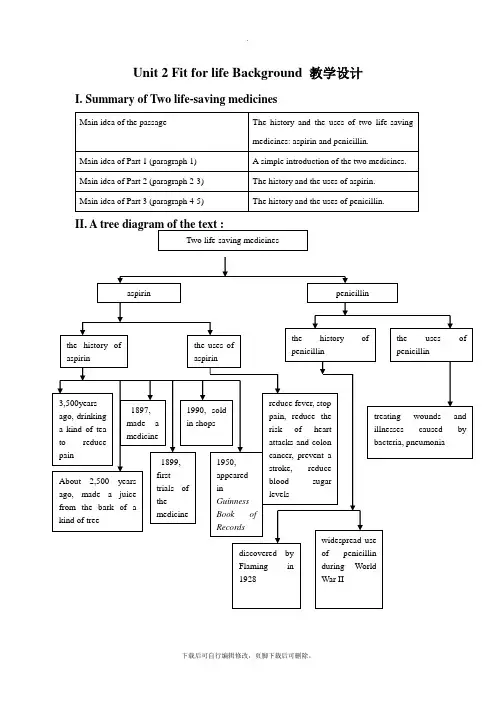
Unit 2 Fit for life Background 教学设计I. Summary of Two life-saving medicinesIII.A retold version of the text Two life-saving medicines: Aspirin and penicillin are two important medicines that have changed people’s lives.Medical historians think that aspirin was invented in 1897. But it has a long history. That is to say,its history can date back to about 2,500 years ago and even 3,500 years ago. The first trials of the medicine took place in 1899 and in 1900 it was sold in shops. Aspirin has many uses. For example,it can reduce fever and help stop pain. It can also reduce the risk of heart attacks,prevent a stroke and reduce the risk of colon cancer and blood sugar levels.Penicillin was discovered by a Scottish scientist Fleming in 1928. But its widespread use was during World War II. It helped save many lives. It was the great drug of the 20th century. Three scientists shared the Nobel Prize for their work on the medicine.●Section 2 Background informationI. A vocabulary about diseasesanemia 贫血iron deficiency anemia 缺铁性贫血angina pectoris 心绞痛arteriosclerosis 动脉硬化apoplexy 中风bronchitis 支气管炎cirrhosis 肝硬化diabetes 糖尿病dysentery 痢疾gastric ulcer 胃溃疡hepatitis 肝炎hypertension 高血压hypoglycemia 低血糖influenza 流感leukemia 白血病myocardial infarction 心肌梗死nephritis 肾炎pneumonia 肺炎rheumatic fever 风湿病rheumatoid arthritis 类风湿性关节炎tumour 肿瘤cerebral infarction 脑梗死cerebral thrombosis 脑血栓concussion of brain 脑震荡epilepsy 癫痫meningitis 脑膜炎migraine 偏头痛neurasthenia 神经衰弱schizophrenia 精神分裂症appendicitis 阑尾炎cancer of breast 乳腺癌carcinoma of esophagus 食管癌carcinoma of stomach 胃癌cervical spondylosis 颈椎病fracture 骨折protrusion of intervertebral disc 椎间盘突出rheumatoid arthritis 类风湿性关节炎abortion 流产irregular menstruation 月经失调amygdalitis,tonsillitis 扁桃体炎cataract 白内障tinnitus 耳鸣colour blindness 色盲deafness 聋keratitis 角膜炎pharyngitis 咽炎rhinitis 鼻炎acne 痤疮eczema 湿疹psoriasis 牛皮癣II. The Tibetan medicineIn light of the Central Government's decision to energetically(积极地) develop Tibetan medicine,astronomy and calendaring,the Lhasa Tibetan Medicine Hospital was renamed Tibetan Medicine Hospital of Tibet on September 1,1980. The hospital has grown into Tibetan medical treatment,education,research,Tibetan medicine-making and calendaring center in the Tibet Autonomous Region. It has made impressive progress in the treatment of high blood pressure,acupuncture and children's mental diseases.Since 1981,Tibetan medicine hospitals have been set up in five of the seven prefectures and five of the 75 counties. In September 1981,the Tibetan Medicine Society of the All-China Administration for Medical Sciences held its inauguration(开幕式) ceremony and its council meeting in Lhasa. Dozens of papers on the history of Tibetan medicine,theory,clinical practice,prescriptions and research results were read at the meeting. This played an important role in the inheritance and development of Tibetan medicine.Since the advent(到来)of the 1990s,Tibetan medicine scholars have gone abroad for exchange and cooperation. For example,Coru Cenam and Qamba Chilai went to Japan for a visit in March 1990,and Qamba Chilai and two others visited the United States in December 1992. The visits enhanced mutual understanding and promoted development of Tibetan medicine.To summarize,traditional Tibetan medicine,originally unique to Tibet and born out of centuries of battling nature,has become an important part of Chinese medicine. As it integrates with advanced modern science,Tibetan medicine better serves Tibetans and people from all over the world. And the best of it has been inherited for further development.III. Food and Meals,How to Keep HealthyIV. A Health ReportV. More information about AcupunctureVI.Translation of readingVII. Translation of project。
译林牛津版高中英语模块七课件:Unit 2 Fit for life Task(共27张PPT)
Skills building 2: interviewing someone
When you are conducting an interview, you need to organize your interview and your questions in a certain way.
高二(下)
Hale Waihona Puke Unit 2 Fit for life
Task
Reporting on short-sightedness
Skills building 1
listening for present situations
If you are listening to a TV report about a present situation, you will need to listen for the following: the present situation an explanation of the situation reasons why the situation exists how the problem can be solved
Step 1: completing notes
A:
1. short-sightedness 2. 22.8 4. 70.3 6. poor 8. rooms 10. protected
3. 55.2
5. distant 7. bed
9. information
B
No. 1 Secondary School
You will also hear key words linked to the topic. You need to think about how you can analyze the situation and how you will use the information. Will you need to change the information or will you use it as it is? Finally, you need to think about how you will record the information.
牛津译林版高中英语模块7 Unit 2 Fit for life Words 教学设计 1
Unit 2 Fit for life Words 教学设计11. If we need an operation. A special room called an operating theatre is used. (P17)如果我们需要做手术的话,就使用一个特殊的被成为手术室的房间。
Operatev. [I] to cut a body open for medical reasons in order to repair, remove or replace a diseased or damaged part:If the growth gets any bigger they’ll have to operate.Are they going to operate on him?v. [I or T] to (cause to) work, be in caution or have an effect:How do you operate the remote control unit?Does the company operate a pension scheme?operationn. [C] when a doctor cuts a body for medical reasons in order to repair,remove or replace a diseased or damaged part:a major/minor/routine operationan abdominal/cataract/transplant operationHe's got to have an operation on his shoulder.[+ to infinitive] We will know in a couple of days if the operation to restore her sight was successful.n. [U] the fact of operating or being active:There are several reactors of the type in operation (= working) at the moment.We expect the new scheme for assessing claims to come into operation (= start working) early next year.operatorn. [C] 1) someone whose job is to use and control a machine or vehicle:a computer operator2) a company that does a particular type of business:a tour operator3) a person who helps to connect people on a telephone system2. Have you ever seen a doctor?If so,what happened?(P17) 你到医生那儿看过病吗?如果看过,是发生了什么问题?everadv. 1) at any time:Nothing ever happens here in the evenings.Have you ever been to London?He hardly ever (= almost never) washes the dishes and he rarely,if ever,(= probably never) does any cleaning.The smell is worse than ever.I thought she was famous,but none of my friends have ever heard of her.2) continually:He is ever repeating the same old story.3) used for emphasizing an adjective:Yesterday the company announced its first ever fall in profits.4) for all time:I like the house but I don't imagine I'll live there forever.5) continually since that time:He's been depressed ever since he got divorced.。
2021版高考英语大一轮复习模块七Unit2Fitforlife课下作业牛津译林版选修7
2021版高考英语大一轮复习模块七Unit2Fitforlife课下作业牛津译林版选修7写作句型锤炼主体段落常用句型锤炼:状语从句的省略先熟读背诵——杰出句型烂熟于心1.Firstly, people may feel forced when asked to do things that they don’t want to.第一,人们在被要求做他们不想做的情况时可能会感到是被迫的。
(2021·江苏卷·写作)2.So while sitting in the classroom and doing my papers, I felt confident and was full of energy.因此,当我坐在教室里做试卷时,感到精力旺盛,信心十足。
(四川卷·书面表达)3.If necessary,you should turn to your parents for help.假如有必要,你应该向你的父母求助。
4.“The prize money is too little to afford even half of a living room in Beijing,”Tu Youyou told the journalist jokingly when asked how to spend the prize money. 当被问及如何花这笔奖金时,屠呦呦开玩笑地告诉记者,“奖金少,不够在北京买半个客厅”。
5. Unless necessary, you’d better not refer to the dictionary.除非有必要,否则你最好不要查词典。
后临模拟写——妙语佳句信手拈来1.假如你被录用做这份工作,你专门快就会接到通知。
If__accepted__for__the__job,__you’ll__be__informed__soon.(2020·北京卷·单选) 2.可能的话,他们就让他停下来问他这三个问题。
高考英语(译林)大一轮复习课件:模块七 Unit 2 Fit for life
the potential for(doing)sth.做(某事)的可能性/潜力 achieve/realize one ’s(full)potentia充l(分)发挥某人的潜力
高频词汇 难点句型
核心考点
-9-
完成句子 ①He has the potential to become a world-class
musician (有成为顶级音乐家的潜能). ②She believes that working in this way canhelp to
achieve/realize her fullpotential (有助于充分发挥她的潜 力).
Unit 2 Fit for life
核心考点
-2-
高频词汇 难点句型
1.beneficial adj.有益的,有用的 [高考佳句]Anger is rarely looked upon as abeneficial
character trait,and is usually advised to reduce it.(20北18· 京卷,七选五)
拟语气,即should+ v.,should 可以省略) (2)vitallaydv .极其;生死攸关地
高频词汇 难点句型
核心考点
-7-
单句填空 ①The port is vitatlo/for the supply of relief to millions
of drought victims. ②It is vital that schoo(slhsould )teach (teach) students