
【英语】英语阅读理解(人物故事)专项习题及答案解析及解析
【英语】英语阅读理解(人物故事)专项习题及答案解析及解析一、高中英语阅读理解人物故事类1.阅读理解Open water swimmingI had only swum in open water a few times, and always in gentle lakes, so I wasn't prepared for how rough Lake Windermere appeared on a cold day. A swimmer told me the water felt colder than it had been measured, and that the water was a bit rough. But I, along with 10,000 others, was about to complete the challenge.Most of the people taking part were doing a one-mile race, and 10 races were planned over the weekend. There seemed to be a mix of open-water enthusiasts alongside complete beginners—which is precisely the aim of the swims, to get as many people as possible completing their own challenge. The oldest woman competing was 77, taking part in the two-mile race, alongside a man who last year had swum in every one-mile race.I had chosen the third one-mile race of the day. There were over 600 people in my race. We were taken through an acclimatization area a children's paddling pool-sized part of the lake where we moved in to feel how cold the water was. "Not too bad" was everyone's thought! Then we headed out towards the middle of the lake.We'd been warned that the first 100 metres would be really rough. However, somewhere near the 750m mark I was still waiting for the calm; it felt more like swimming in the sea than a lake. I tried to focus on my breathing and technique, and just keep going. As I approached the 400m-to-go mark my lower right leg became painful. I recalled overhearing people talking about how they kept swimming through the pain, so I tried. But it didn't work. I began to feel the entire leg tight and painful. I didn't want to stop, so I bent my right knee and just kicked with the left leg.Finally I saw the finishing post, and I just concentrated on getting there—still one-legged. My finishing time was 38 minutes 25 seconds but that didn't matter—the atmosphere was fantastic and everyone felt a sense of achievement, whatever their time. I'm hooked, and want to give it another go. I've already signed up for my next open-water swim.(1)How did the author feel before the race?A. Scared of the most challenging race.B. Disappointed by the difficult conditions.C. Concerned about the other swimmers in the race.D. Determined to be as tough as the people around her.(2)Why does the author mention the two people in Paragraph 2?A. To stress the importance of the race.B. To praise the experienced swimmers.C. To show the wide range of the participants.D. To introduce the various events of the race.(3)The author suggests in Paragraph 4 that ______.A. the race would cause breathing problemsB. the race became harder than she had expectedC. it was really necessary to prepare for tough swimsD. it would have been easier if she had taken others' advice(4)What does the author talk about in the last paragraph?A. Her confidence in her own ability.B. Her pride in having swum so quickly.C. Her eagerness to repeat the experience.D. Her surprise at having managed to finish.【答案】(1)D(2)C(3)B(4)C【解析】【分析】本文是一篇记叙文,作者讲述了参加一英里的天然水域游泳的经历,最终成功到达终点线。
(1)考查推理判断。
根据第一段中的“But I, along with 10,000 others, was about to complete the challenge.”可知,我马上和其他10000名游泳者完成这项挑战,故可知,他们很坚定要完成这项运动,故选D。
(2)考查推理判断。
根据第二段中的“There seemed to be a mix of open-water enthusiasts alongside complete beginners—which is precisely the aim of the swims, to get as many people as possible completing their own challenge. The oldest woman competing was 77, taking part in the two-mile race, alongside a man who last year had swum in every one-mile race.”可知,参赛者包括天然水域游泳的爱好者,也包括初学者,也有很多人完成自己的挑战,这里面就有77岁参加2英里游泳的老人,也有去年参加一英里的男子,故可知,该比赛参与者范围很广,故选C。
(3)考查推理判断。
根据第四段中的“I recalled overhearing people talking about how they kept swimming through the pain, so I tried. But it didn't work. I began to feel the entire leg tight and painful.”可知,我想起了那些人提及的克服水中抽筋的技巧,但是没有作用,我感觉整条腿开始紧张疼痛,故可知,这次比赛比她想象的要艰难,故选B。
(4)考查推理判断。
根据最后一段中的“I'm hooked, and want to give it another go. I've already signed up for my next open-water swim.”可知,我被吸引住了,想要再尝试一次,准备好为下一次游泳比赛报名,故可知,作者为完成比赛而感到兴奋,也喜欢上了这项运动,故选C。
【点评】本题考点涉及推理判断题型的考查,是一篇故事类阅读,考生需要根据上下文进行逻辑推理,从而选出正确答案。
2.阅读理解Wilbur and Orville Wright were the two youngest sons of Bishop Milton Wright, Wilbur was born on a farm near Millville and Orville was born in August in the house the family would come to occupy for more than 40 years in Dayton.Orville would discover in later years that he and Wilbur's first interests in flight began when they were children, with powered rubber-band-helicopter toys that their father would bring home for them from trips around the country. Orville and Wilbur would build duplicates(复制品)of these toys and bounce them off the ceiling. They were just crazy about these things for the reasons that they did not yet understand.Both boys loved to solve problems that seemed difficult to others. The more difficult the problem was, the more they saw it as a challenge. Exploring the unknown was such a joy for then that Orville once said, "I can remember when Wilbur and I could hardly wait for the morning to come to get at something that interested us. That's happiness."Putting their gift to work, the boys entered the printing business soon after high school. Orville designed and then built a printing press(印刷机)for this enterprise. At first, they did contract printing for other people, and soon one of their customers during the early 1890s was Father Milton's church. They also tried the newspaper business, and although their two newspapers, the West Side News and The Evening Item were considered to be of high quality, Dayton already had daily newspapers, so the Wrights soon returned to contract printing.Branching out into other areas, they also opened a bicycle business. Bicycling was the fastest growing sport in the country at that time, and their repair shop soon led them into building bicycles of their own design, often with tools of their own construction, such as the lathe(车床)driven by a one-cylinder gasoline engine built by Orville. The bicycle shop would provide the livelihood(生计)that would allow them to carry out their experiments on airplanes.(1)What may inspire Wilbur and Orville Wright to be keen on flight in childhood?A. Their experiences of taking a flight.B. Their wishes to travel by plane.C. The toys their father brought for them.D. Their interest in duplicating toys.(2)What kind of children were the Wright brothers?A. Enthusiastic and curious.B. Quiet and modes.C. Naughty but clever.D. Stubborn but careful(3)What business did Wilbur and Orville enter shortly after high school?A. The toy business.B. The printing business.C. The lathe business.D. The bicycle business.(4)What will possibly be discussed following this text?A. Who guided them a lot on their way to success.B. What trouble they would meet in their business.C. Why they closed their bicycle shop suddenly.D. How the two brothers began to invent planes.【答案】(1)C(2)A(3)B(4)D【解析】【分析】本文是一篇记叙文,介绍了莱特兄弟是怎样的发明飞机的过程。
【英语】 英语阅读理解(人物故事)专题练习(及答案)含解析

【英语】英语阅读理解(人物故事)专题练习(及答案)含解析一、高中英语阅读理解人物故事类1.阅读理解When I was 12 years old, I already knew that my teen years were going to be the worst years of my life. I was a total outsider, bullied (欺凌) at school. I felt completely alone in my small town.But by starting to do volunteer work when I was 14, I turned my problem into a passion for helping others. The opportunity to practice kindness made me feel like my life had a greater purpose. The more positive energy I shared, the more kindness and appreciation I received. I realized that my purpose in life would be to reach out to people, specifically teenagers, and help them feel less alone.Books were my true friends back then. I was so thankful that the authors wrote those books. The kindness they offered me with their books saved my life. One of my biggest dreams was to become an author so I could write books that would help other teenagers the way those books helped me.After surviving terrible experiences at school and at home, I made a choice to take the optimistic, positive road in the next steps of my journey. My dream career, one I thought was only possible for the authors I loved, is what I am doing now. I have been a full-time author of teen novels since 2007 and am grateful for this amazing opportunity to reach out to readers every single day.Kindness saved me when I needed help the most. Even small acts of kindness can change someone's life. You never know what someone else is going through. But by practicing daily kindness, you become an architect of positive change.(1)What was the author's life like when he was 12?A.Boring.B.Peaceful.C.Unhappy.D.Meaningful.(2)How did the volunteer work benefit the author?A.It made him popular in his town.B.It helped him find the meaning of life.C.It helped him understand others' lives better.D.It helped to shape his dream career.(3)Why did the author choose writing as his job?A.He was inspired by his teacher.B.He could pass positive energy to readers.C.He wanted to share his school experiences.D.He found he had a talent for writing.(4)What does the author suggest readers do in the last paragraph?A.Say 'no' to bullies bravely.B.Make positive changes in their lives.C.Treat others with kindness in daily life.D.Learn to care more about others' feelings.【答案】(1)C(2)B(3)B(4)C【解析】【分析】本文是一篇记叙文,作者讲述了自己参加志愿活动的经历,告诉人们:一次小善举也可能改变一个人的一生。
英语阅读理解(人物故事)练习题20篇及解析

英语阅读理解(人物故事)练习题20篇及解析一、高中英语阅读理解人物故事类1.阅读理解Sometimes just when we need the power of miracles to change our beliefs, they materialize in the places we'd least expect. They can come to us as a great change in our physical reality or as a simple coincidence in our lives. Sometimes they're big and can't be missed. Other times they're so subtle that if we aren't aware, we may miss them altogether. They can come from the lips of a stranger we suddenly and mysteriously meet at just the right instant. If we listen carefully, we'll always hear the right words, at the right time, to dazzle (目眩) us into a realization of something that we may have failed to notice only moments before.On a cold January afternoon in 1989, I was hiking up the trail that leads to the top of Egypt's Mt. Horeb. I'd spent the day at St. Catherine's Monastery and wanted to get to the peak by sunset to see the valley below. As I was winding up the narrow path, I'd occasionally see other hikers who were coming down from a day on the mountain. While they would generally pass with simply a nod or a greeting in another language, there was one man that day who did neither.I saw him coming from the last switchback on the trail that led to the backside of the mountain. As he got closer, I could see that he was dressed differently from the other hikers I'd seen. Rather than the high-tech fabrics and styles that had been the norm, this man was wearing traditional Egyptian clothing. He wore a tattered, rust-colored galabia and obviously old and thick-soled sandals that were covered in dust. What made his appearance so odd, though, was that the man didn't even appear to be Egyptian! He was a small-framed Asian man, had very little hair, and was wearing round, wire-rimmed glasses.As we neared one another, I was the first to speak, "Hello," I said, stopping on the trail for a moment to catch my breath. Not a sound came from the man as he walked closer. I thought that maybe he hadn't heard me or the wind had carried my voice away from him in another direction. Suddenly he stopped directly in front of me on the high side of the trail, looked up from the ground, and spoke a single sentence to me in English, "Sometimes you don't know what you have lost until you've lost it." As I took in what I had just heard, he simply stepped around me and continued his going down the trail.That moment in my life was a small miracle. The reason is less about what the man said and more about the timing and the context. The year was 1989, and the Cold War was drawing to a close. what the man on the trail couldn't have known is that it was during my Egyptian pilgrimage (朝圣), and specifically during my hike to the top of Moses's mountain, that I'd set the time aside to make decisions that would affect my career in the defense industry, my friends, my family, and, ultimately, my life.I had to ask myself what the chances were of an Asian man dressed in an Egyptian galabia coming down from the top of this historic mountain just when I was walking up, stopping before me, and offering his wisdom, seemingly from out of nowhere. My answer to my own question was easy: the odds were slim to none! In a meet that lasted less than two minutes on a mountain halfway around the world from my home, a total stranger had brought clarity and the hint of a warning, regarding the huge changes that I would make within a matter of days. In my way ofthinking, that's a miracle.I suspect that we all experience small miracles in our lives every day. Sometimes we have the wisdom and the courage to recognize them for what they are In the moments when we don't,that's okay as well. It seems that our miracles have a way of coming back to us again and again.And each time they do, they become a little less subtle, until we can't possibly miss the messagethat they bring to our lives!The key is that they're everywhere and occur every day for different reasons, in response to the different needs that we may have in the moment. Our job may be less about questioning the extraordinary things that happen in our daily lives and more about accepting the gifts they bring.(1)Why did the author make a pilgrimage to Mt Horeb in Egypt?A. He was in search of a miracle in his life.B. It was a holy place for a religious person to head for.C. He intended to make arrangements for his life in the future.D. He waited patiently in expectation of meeting a wise person.(2)What does the underlined part "my own question" refer to in paragraph 6?A. For what reason did the man stop before me?B. Why did the Asian man go to the mountain?C. What change would I make within a matter of days?D. What was the probability that others told us the right words?(3)Which of the following is closest in meaning to the underlined word "subtle" in paragraph 7?A. Apparent.B. Delicate.C. Precise.D. Sufficient.(4)The author viewed the meet with the Asian man as a miracle in his life in that ________.A. the Asian man's appearance had a deciding effect on his future lifeB. his words were in perfect response to the need he had at that momentC. what the Asian man said was abundant in the philosophy of lifeD. the Asian man impressed on him the worth of what he had possessed(5)What might be the best title for the passage?A. Can you recognize a miracle?B. Is a miracle significant to us?C. When might a miracle occur?D. Why do we need a miracle?(6)After the encounter of the Asian man, what will the writer probably do immediately?A. Continue walking up to the top of the mountain.B. Have a rest to refresh himself.C. Try to have a heart-to-heart conversation with the Asian man.D. Come down the mountain.【答案】(1)C(2)D(3)B(4)B(5)A(6)D【解析】【分析】本文是一篇记叙文,作者讲述了一次埃及朝圣时,爬到何烈山半山腰时,偶遇了一位正在下山的亚洲陌生人。
(英语)英语阅读理解(人物故事)专项习题及答案解析及解析

(英语)英语阅读理解(人物故事)专项习题及答案解析及解析一、高中英语阅读理解人物故事类1.阅读理解Half a DayI walked alongside my father, holding his right hand. All my clothes were new: the black shoes, the green school uniform, and the red cap. They did not make me happy, however, as this was the day I was to be thrown into school for the first time."Why school?" I asked my father. "What have I done?""I'm not punishing you," he said, laughing. "School's not a punishment. It's a place that makes useful men out of boys. Don't you want to be useful like your brothers?"I was not convinced. I did not believe there was really any good to be had in tearing me away from my home and throwing me into the huge, high-walled building.When we arrived at the gate we could see the courtyard, vast and full of boys and girls. "Go in by you," said my father, "and join them. Put a smile on your face and be a good example to others."I hesitated and squeezed his hand firmly, but he gently pushed me from him. "Be a man", he said. "Today you truly begin life. You will find me waiting for you when it's time to leave."I took a few steps. Then the faces of the boys and girls came into view. I did not know a single one of them, and none of them knew me. I felt I was a stranger who had lost his way. But then some boys began to glance at me in curiosity, and one of them came over and asked, "Who brought you?""My father," I whispered."My father's dead," he said simply.I did not know what to say. The gate was now closed. Some of the children burst into tears. The bell rang. A lady came along and said, "This is your new home. There are mothers and fathers here, too. Everything that is enjoyable and beneficial is here. So dry your tears and face life joyfully."Well, it seemed that my misgivings had had no basis. From the first moments I made many friends. I had never imagined school would have this rich variety of experiences.(1)On the way to school, the boy felt .A. happyB. embarrassedC. upsetD. excited(2)About schooling, Father suggested .A. wearing a smileB. tearing himself away from gamesC. waiting for parentsD. throwing himself to studying(3) helped him most on the first day at school.A. Teachers and classmatesB. Courtyards and buildingsC. Father and brotherD. New uniforms and shoes(4)What would probably happen next?A. The school life would turn out to be a failure.B. Boys in the school would watch him curiously.C. He would open up a new journey of colorful life.D. His parents would accompany him at the school.【答案】(1)C(2)A(3)A(4)C【解析】【分析】本文是一篇记叙文,作者第一天去学校的时候并不开心,但是等他到了学校之后,他结交了很多朋友,开始了新的生活。
高三英语阅读理解(人物故事)题20套(带答案)含解析
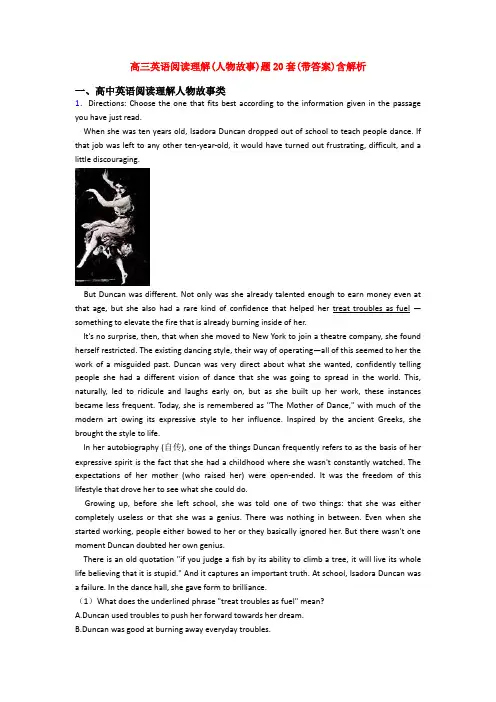
高三英语阅读理解(人物故事)题20套(带答案)含解析一、高中英语阅读理解人物故事类1.Directions: Choose the one that fits best according to the information given in the passage you have just read.When she was ten years old, Isadora Duncan dropped out of school to teach people dance. If that job was left to any other ten-year-old, it would have turned out frustrating, difficult, and a little discouraging.But Duncan was different. Not only was she already talented enough to earn money even at that age, but she also had a rare kind of confidence that helped her treat troubles as fuel —something to elevate the fire that is already burning inside of her.It's no surprise, then, that when she moved to New York to join a theatre company, she found herself restricted. The existing dancing style, their way of operating—all of this seemed to her the work of a misguided past. Duncan was very direct about what she wanted, confidently telling people she had a different vision of dance that she was going to spread in the world. This, naturally, led to ridicule and laughs early on, but as she built up her work, these instances became less frequent. Today, she is remembered as "The Mother of Dance," with much of the modern art owing its expressive style to her influence. Inspired by the ancient Greeks, she brought the style to life.In her autobiography (自传), one of the things Duncan frequently refers to as the basis of her expressive spirit is the fact that she had a childhood where she wasn't constantly watched. The expectations of her mother (who raised her) were open-ended. It was the freedom of this lifestyle that drove her to see what she could do.Growing up, before she left school, she was told one of two things: that she was either completely useless or that she was a genius. There was nothing in between. Even when she started working, people either bowed to her or they basically ignored her. But there wasn't one moment Duncan doubted her own genius.There is an old quotation "if you judge a fish by its ability to climb a tree, it will live its whole life believing that it is stupid." And it captures an important truth. At school, Isadora Duncan was a failure. In the dance hall, she gave form to brilliance.(1)What does the underlined phrase "treat troubles as fuel" mean?A.Duncan used troubles to push her forward towards her dream.B.Duncan was good at burning away everyday troubles.C.Troubles turned Duncan into a confident girl.D.Troubles lit the fire of dancing in Duncan.(2)Which of the following is TRUE about Duncan?A.Her experience in New York was the foundation of her career.B.Her teaching job when she was little destroyed her confidence.C.Her dancing style was not very well received at the beginning.D.Her mother set higher expectation on her than she could bear.(3)What does the author try to tell the readers in the last paragraph?A.It is useless climbing a tree to catch fish.B.Everybody is a genius in his own way.C.Miseries come from human stupidity.D.Teachers can impact students greatly.(4)What is this passage mainly about?A.Isadora Duncan's childhood and her achievements today.B.Duncan's career development and other dancers' opinions of her.C.Isadora Duncan's early experiences and the reasons for her success.D.Duncan's high status in the dancing world and her unique expressive style.【答案】(1)A(2)C(3)B(4)C【解析】【分析】本文是一篇记叙文,伊莎多拉·邓肯十岁时辍学去教别人跳舞,作者讲述了她的早期的经历以及其取得成功的原因。
【英语】英语阅读理解(人物故事)题20套(带答案)及解析
【英语】英语阅读理解(人物故事)题20套(带答案)及解析一、高中英语阅读理解人物故事类1.阅读理解Even if you've never been to Phoenix, you know this about the place It's hot. From June to September, the temperature can easily surpass the century mark. But that doesn't stop hikers from attempting the 1.3-mile hiking to the top of the city's famed Camelback Mountain. Signs warn that the trail is "extremely difficult". If you continue, a posted checklist suggests at least a liter of water per person. And if you're still not stopped, another sign farther up declares: "If you're halfway through your water, turn around!"Unfortunately, many people to not take the warnings seriously. Fortunate y, Scott Cullymore does. The 53-year-old Cullymore can be found hiking up and down Camelback a couple of times a day, giving out cold bottles of water to worn-out hikers. He has helped hydrate so many hikers that he has earned a heavenly nickname: the Water Angel.Cullymore was on Camelback Mountain one day in 2015 when a British tourist died after being lost for nearly six hours in the July heat. That experience inspired him to start helping people caught unaware by the cruelty of Mother Nature. "They underestimate the mountain, and they overestimate what they can do, and they get themselves in trouble." he warned.One hiker who was offered water agrees. "You think you know the heat, but then you get out here in the desert and it surrounds you like a blanket," said Austin Hill, who was hiking with a high school friend. They were lucky, he said pointing to Cullymore. "We ran into this Good Samaritan here." And with that, the Water Angel goes in search of another hiker in need.(1)What is the first paragraph mainly about?A. The risks involved in the hiking.B. The seriousness of the warnings.C. The distribution of signs that warn hikers.D. The influence of the temperature on hikers.(2)Why did some hikers on Camelback Mountain get in trouble?A. They were not well trained in hiking.B. They forgot to take enough water with them.C. They were too optimistic about the situation.D. They were not fit enough to hike the mountain.(3)What can we know about Austin Hill?A. He agreed to help others.B. He was saved by Cullymore.C. He hiked alone in the desert.D. He regretted taking a blanket.(4)What is the best title for the text?A. The Camelback MountainB. Surviving the HeatC. Hikers in NeedD. The Water Angel【答案】(1)A(2)C(3)B(4)D【解析】【分析】本文是一篇记叙文,远足者低估夏日的Camelback Mountain 同时高估自己的能力,所以在远足途中遇到麻烦,Cullymore了解情况后决定帮助他们。
【英语】英语阅读理解(人物故事)练习题20篇及解析

【英语】英语阅读理解(人物故事)练习题20篇及解析一、高中英语阅读理解人物故事类1.阅读理解Jon Hoffman was sitting at a red light when he saw a man run out of a store carrying a plastic donation jar full of cash. The Plano, Texas, detective, dressed in plain clothes but wearing his badge (徽章) and gun, caught the man and pinned him to the hood of his car. But Hoffman had trouble containing the thief, and they got into a struggle."The detective has a martial arts background, and he said he thought the suspect must have a martial arts background, too, because he was able to break away so easily," a Plano police spokesperson said.The detective called out for help as a crowd gathered. Among those watching: Andre Harvey and Kirby Sample, two day laborers. Harvey did what has become common these days—he took out his phone and hit record. "I hate to say it, but I thought that this policeman was doing something illegal," Harvey said. "But when he asked for help, I thought, well, there won't be a shooting if I get over there in time.” Harvey j umped into action—while he was still recording the video—as did Sample."Harvey caught hold of the suspect's arms, while Kirby seized his legs, and they were able to get the suspect to the ground to help Detective Hoffman put the handcuffs (手铐) on," said the police spokesperson. The 27-year-old suspect was charged with resisting arrest and other offenses. The charity jar he stole held less than $ 50."I've been on the wrong side of the law several times in my life," Harvey told WFAA. "It feels good to be on the right side and do something positive."After the arrest, the three men got to know each other over steaks and ribs at a local steak house—Hoffman's treat, as a thank-you. But the rescuers say Hoffman deserves credit too. "It could have turned real ugly." Sample told the media "He handled himself like a real professional."(1)What made Hoffman call for help when arresting the suspect?A. He was not on duty.B. He needed witnesses to support him.C. He wanted to push the thief into the car.D. He couldn't control the suspect.(2)Why did Harvey and Kirby record the scene at the beginning?A. To follow the fashion.B. To keep track of the criminal.C. To record the detective's violence.D. To avoid being involved in the incident.(3)What can be inferred about Harvey?A. He was ready to violate the law.B. He might have had some illegal behaviour.C. He was out of work at that time.D. He had a good martial arts background.(4)What is Harvey and Sample's attitude towards Hoffman?A. Appreciative.B. Prejudiced.C. Skeptical.D. Cautious.【答案】(1)D(2)C(3)B(4)A【解析】【分析】本文是一篇记叙文,侦探Jon Hoffman在捉偷善款的小偷时遇到困难寻求帮助,Andre Harvey和 Kirby Sample帮助了他。
英语阅读理解(人物故事)专项习题及答案解析及解析
英语阅读理解(人物故事)专项习题及答案解析及解析一、高中英语阅读理解人物故事类1.阅读理解When I was small, my mother and I would walk to our local library in Franklin Square. As we didn't always have access to a reliable car, walking hand in hand was the most convenient way to get anywhere. It was at story time for children that both my mother and I made lasting friendships.Today, I am fortunate to live around the corner from the Cold Coast Public Library in Glen Head and a short walk to the Sea Cliff Children's Library. My 18-imonth-old son, Colin, and I find ourselves in Sea Cliff several times a week, meeting and making friends. Well, that is what many people don't understand-a library is more than books; it's a community.Sure, the library in Franklin Square was the place where I was introduced to Judy Blume novels. But it was also the place where I got my first email address in 1997. At the library, friends and I learned how to research colleges and search for scholarships on the Internet. The library was the place where we sometimes giggled(咯咯笑)too loudly, and where the librarians knew us by name. Their knowing our names wasn't a bad thing. When I came home from my first term at Binghamton University, Mary LaRosa, the librarian at the Franklin Square library, offered me my first teaching job.I now teach reading at Nassau Community College. My students are often amazed that they can check out books via their smartphones and virtually(虚拟地)visit a variety of Long Island libraries. The app used by Nassau and Suffolk county public libraries, as well as the college library, makes their homework easier by helping them find resources. Even though they can't always easily visit their local libraries, the library is always with them.(1)Why does the author consider herself lucky today?A. She has become her mother's best friend.B. She has access to a reliable car now.C. She can meet friends at the library.D. She lives close to libraries.(2)What does the underlined word "that" in Paragraph 2 refer to?A. Socializing in a library.B. Reading books in a library.C. Visiting a library with a family member.D. Building parent-child friendship in a library.(3)What is the author's attitude to her students' way of visiting libraries?A. Cautious.B. Favorable.C. Doubtful.D. Disapproving.(4)Why does the author write the text?A. To discuss why libraries are important.B. To express her deep love for libraries.C. To explain how libraries change.D. To introduce her favorite libraries.【答案】(1)D(2)A(3)B(4)C【解析】【分析】本文是一篇记叙文,作者讲述了从自己小时候到成家生子再到工作教书这一路上图书馆的变化。
英语阅读理解(人物故事)专题练习(及答案)含解析
英语阅读理解(人物故事)专题练习(及答案)含解析一、高中英语阅读理解人物故事类1.阅读下列短文,从每题所给的A、B、C和D四个选项中,选出最佳选项。
The new president of Harvard University is the son of an Eastern European refugee and Auschwitz (奥斯威辛) survivor—Lawrence S. Bacow. His father worked full time while attending a state college in Detroit at night to earn his degree.Bacow, the former president of Tufts University, has taken over Harvard at a time when higher education is under attack for being financially out of reach to many Americans. But Bacow said his family's journey had reflected the power of college education to transform generations and the opportunities that have historically been available in the United States."My parents came to this country with almost nothing," Bacow said. "I wouldn't be here if this country had not been open to people like my parents at that time. Nor would I if my father hadn't had the opportunity to get the college education."Bacow grew up in Pontiac, Michigan. His father's family fled anti-Jewish (反犹太的) violence in Minsk, then part of the Soviet Union, before the start of World War II and went to the United States. His mother arrived in Brooklyn at age 19, having survived Auschwitz concentration camp. She was the only Jew from her town to have survived the war. Yet Bacow, who is married with two sons, said that while growing up in Michigan, he had a happy childhood, entering science fairs as a child and building radios like his dad.Bacow has spent most of his professional career at MIT, Harvard and Tufts. He was a professor of environmental studies at MIT, and later a principal at the university. He led Tufts from 2001 to 2011. At Tufts, Bacow earned a reputation for shaking up a sleepy university that was being overshadowed by its peers in Boston. He is also credited with leading it through both 9/11 and the 2008 financial crisis.As the Tufts president, Bacow traveled around the country, reaching out to alumni (校友), and he urged his faculty and deans to do the same, in an effort to boost donations to finance Tufts' academic ambitions. He raised more than $20 million for faculty recruitment, attracting up-and-coming professors by offering junior faculty perks (福利), such as long academic leaves that they couldn't get elsewhere.Under Bacow's leadership, Tufts spent millions on labs and libraries. He also made addresses nationally about the need to make higher education more accessible and affordable to low-income students.(1)The reason why Bacow appreciates college education is that ________.A. college education is out of reach to many AmericansB. his family changed their fate due to college educationC. few opportunities were available when his father came into the countryD. a college degree helped his mother survive Auschwitz(2)What can we infer from the passage?A. The fellow townspeople of Bacow were all killed besides his mother.B. Bacow's mother stimulated his interest in science.C. Bacow's father was good at working with electronics.D. Bacow's father came to the U.S. after World War II broke out.(3)The underlined word "shaking up" in paragraph 5 probably means ________.A. reactivatingB. causingC. damagingD. taking over(4)What is this passage mainly about?A. How to be admitted to Harvard University.B. The history of Bacow's family.C. The art of Bacow's leadership in Tufts.D. Bacow's way to individual success.【答案】(1)B(2)C(3)A(4)D【解析】【分析】本文是一篇名人传记,讲述了Bacow的个人成功之路。
高中英语阅读理解(人物故事)试题(有答案和解析)及解析
高中英语阅读理解(人物故事)试题(有答案和解析)及解析一、高中英语阅读理解人物故事类1.阅读理解Arthur Dubois isn't your typical grandfather. That's because at 72 years old, the Chicago resident is a newly discovered hip-hop artist.This week, Dubois walked into Haven Studios, a music program on the South Side of Chicago that supports young ambitious artists. The owner of Haven Studios, Andre "Add-2" Daniels, said Dubois claimed he was "young at heart." So, Daniels decided to listen to Dubois' music. He was completely floored. Daniels quickly took videos showcasing Dubois' talents and posted them to Twitter. His tweet went viral, receiving thousands of reactions within a matter of days. Now, Dubois' talents have even caught the attention of some famous hip-hop producers."It's not what you would expect, right?" Daniels says in one of the videos. Dubois music is playing in the background, giving a steady beat that easily invites listeners to dance.Dubois said his style was entirely self-taught. He first started teaching himself to produce hip-hop beats about six years ago, after he retired. "I found something to do," he told NPR's Scott Simon. "I had to learn how to do the computer and music at the same time." Dubois taught himself by using the audio editing software. Now he's learning another new skill-social media. Dubois' newfound social media fame has been a little overwhelming for him. "I was shocked," he said. "I broke down and cried because I didn't know that many people liked me." Daniels has helped Dubois set up accounts on Twitter and Instagram for his fans to follow, "I'd never used Instargram, Twitter and all that other stuff," Dubois said. "Because I didn't believe in that stuff myself. But now I've got to have it." The attention doesn't seem to have gone to Dubois' head though-he doesn't really care about getting famous or making money. "I just want to put it out there and let other people hear my music."(1)What does the underlined word "floored" in Paragraph 2 mean?A. Astonished.B. Scared.C. Nervous.D. Hurt.(2)Who helped Dubois take up hip-hop?A. Daniels.B. He himself.C. NPR's Scott Simon.D. Hip-hop producers.(3)What can we infer from the text?A. Daniels set up accounts for Dubois.B. Daniels didn't enjoy Dubois' music at first.C. Dubois seeks for personal fame and wealth.D. Dubois didn't expect his popularity on the Internet.(4)What can we conclude from the passage?A. Well begun in half done.B. It's never too late to learn.C. Lost time in never found again.D. One good turn deserves another.【答案】(1)A(2)B(3)D(4)B【解析】【分析】本文是一篇记叙文,72岁的爷爷Dubois自学嘻哈音乐,并在网上拥有大量的粉丝。
【英语】高二英语阅读理解(人物故事)题20套(带答案)含解析
【英语】高二英语阅读理解(人物故事)题20套(带答案)含解析一、高中英语阅读理解人物故事类1.阅读理解I'm not much of a gardener. I love having beautiful flowers-but I don't have a good track record when it comes to making them grow.A few months after our son left for the Middle East, my friend gifted me a box of tulip bulbs (郁金香球茎). She explained that these bulbs were put into the ground in the fall and lay sleeping all winter. They had all the nutrients they needed inside the bulb and would come out in the spring. ''When you see the leaves of the tiny flowers pushing toward the sun, you'll know that it's almost time for your son to come home. They'll give you what you need most.'' She walked me through the process of planting them. I thanked her — trying to show my gratitude for her gift.It was a long winter — cold and dark. I endured both the weather and the loneliness and fear I felt with my son away. Dead leaves, frost and finally a heavy snow covered the area where I'd planted those flowers, and I soon forgot they were there.Finally the weather began to warm. One day, as I walked down my front steps, I noticed an area of green. I bent down to inspect the situation more clearly and saw that those tulips had begun to grow, their tiny leaves forcing their way to the sun.Day after day I noted the flowers' progress. And day after day, the time approached when my son would finally be home. Now with spring just around the corner, nothing could keep either of us from marching toward the light. Almost all of those bulbs bloomed. And with each brightly colored flower, I marked off one day closer to getting to hold my son in my arms again.(1)What can we know about the author?A.She is a professional gardener.B.She is not good at growing flowers.C.She never plants flowers at home.D.She often sends friends flowers as gifts.(2)Why did the writer forget the tulip bulbs soon?A.The bitter winter reminded her of her son far away.B.She was discouraged from making another attempt.C.They failed to live through the cold and long winter.D.She had no hope for beautiful flowers indeed.(3)What were those flowers mentioned in the last paragraph referred to?A.A physical representation of the hope.B.Things deep inside her heart and soul.C.A lesson she will never forget completely.D.The trouble she had in making them come out.(4)What can be a suitable title for the text?A.A dark winter with hope.B.Planting hope in winter.C.An area of green in spring.D.Living a changeable life.【答案】(1)B(2)D(3)A(4)B【解析】【分析】本文是一篇记叙文,作者的儿子去了中东,作者感到孤独和寂寞。