
初中英语_Sad but Beautiful教学设计学情分析教材分析课后反思
教学设计Unit 9 I like music that I can dance to.Section B Sad but Beautiful教学目标:知识与技能:1.Be able to grasp the key words and expressions.2.Be able to understand the passage well and the characteristics of themusic review articles.过程与方法:1.Improve the reading skills and know the history of Erquan Yingyue by reading.2.Grasp the key points by finishing the connected tasks.情感态度与价值观:1.Experience the emotion conveyed by Erquan Yingyue and understand music is an authentic human expression.2.Learn the spirit of struggle in adversity.教学过程:Pre-reading:Step 1.Free talk:Show some pictures.Talk about Chinese musical instruments and famous pieces of music that are played on these instruments.Step 2.Presentation:Watch a video. Listen to the music Erquan Yingyue for the first time.Arouse students'interest to know about Abing.While-reading:Step 1. Skim the passage and match the main ideas with the paragraphs.Paragraph 1 Abing's lifeParagraph 2 Abing's popularityParagraph 3 Writer's feelingsStep 2. Read Paragraph 1 and try to finish the mind map.The music was________ but I sensed a strong ________ and ________._____as I listened.Step 3. Read Paragraph 2 and complete the following time shaft.Step 4. Read Paragraph 2 and complete the chart.Step 5. Read Paragraph 3 and try to answer the questions.1.How many pieces of music did Abing write during his lifetime ? How manyof them were recorded ?600 pieces . Only six pieces of music were recorded.2.Which piece do all the great erhu masters play and praise ?Erquan Yingyue.3.Why does Erquan Yingyue become one of China's national treasures ?Because its sad beauty not only paints a picture of Abing's own life butalso makes people recall their deepest wounds from their own sad or painfulexperiences .Step 6. Make an ID CARD for Abing.Post-reading:Step 1. Pair work:Make a conversation.Student A is a foreign visitor who is interested in Abing and his music.Student B is a Chinese student who knows about Abing.A:What kind of musical instruments did Abing play?B:He could play many instruments,but he is best known for playing the erhu.A: …… B: ……Step 2.Discussion:Watch a video. Listen to the music Erquan Yingyue for the second time.Havea discussion.Enable students'to understand its sad beauty .Think over whatthey can learn from the lesson.Homework:Write an article about your favorite kind of music.Blackboard Design: Unit 9 I like music that I can dance to.Section B Sad but BeautifulAbing Erquan YingyueHard Sad but beautiful学情分析音乐是学生非常感兴趣的话题,大部分学生在课堂上能够积极主动的参与课堂接受知识。
并且通过本单元前面几课时的学习,学生丰富了他们描述音乐的语言,学会了表达自己的喜好,增加了相关的音乐知识,在大脑中形成了一个有关“music”的信息包,这就为下一步阅读做好了准备。
但是经过两年多的英语学习,学生两级分化现象严重。
部分学生已具备一定的英语学习能力,教师可利用这部分学生当“火车头”,在新课传授时起到“示范”及“引领”作用。
部分学生由于英语基础差,Section B 2b文本材料又长而难,会产生畏难情绪,对学习失去信心。
针对这种情况,教师备课时要增加趣味性,以此来提高学生对英语的学习兴趣,上课时要多加注意他们的课堂反应,关注他们课堂任务的完成度,及时加以引导。
效果分析新课程理念突出“以人为本”,重视学生能力的培养,强调外语教学不仅要向学生传授语言知识,更要注重培养学生的语言技能,重视学生的情感和态度,激发学生的学习兴趣,培养学生的学习自信心,最终实现学用结合的目标。
本节课结合教材实际,精心设计各个教学环节,环环相扣、层层推进,以学生为主体,以任务为基础,创设情景鼓励学生积极探究,在做中学,在做中练,在完成任务的同时学习语言,促进英语技能的提高和情感、态度及价值观的升华。
在教学过程中,充分利用多媒体课件,增加直观性,激发学生学习兴趣,降低学习难度,突破重难点且提高课堂密度。
整节课采用任务型教学,教师将自己从仅作为知识传授这一核心角色中解放出来,成为学生学习的激发者、辅导者、各种能力和积极个性的培养者,把教学的重心放在如何促进学生“学”上,注重学生自主学习能力的培养。
整节课学生始终是教学活动的主动参与者,每位学生都要勤于思考、搜集和处理信息,教师与学生一起研究教材、拓展教材、升华对教材的思考,让每一个学生都有自己的感悟、生成及推理,让每个学生都有机会表达自己的所思所想,真正发挥学生内在学习的欲望与愿望。
在此基础上努力构建“人人参与,个个展示,尝试成功,体验快乐,激活思维,释放潜能,自主学习,个性发展”的课堂,虽然还有很多不足之处,却是一次有效阅读课堂的尝试。
教材分析本单元是新目标英语九年级下册的第九单元(Unit 9 I like the music that I can dance to.)。
此套教材集合了美式英语的特点也融入了中国的教学理念,着重于文化背景知识和学习策略等部分,增加了任务型学习成份和语篇输入。
本单元以音乐和电影(Ausic and movies)为话题,围绕表达喜好(Express preferences),使学生学会基本的定语从句句型(Attributive clauses with that,which and who)。
本单元的教学内容与学生的实际生活密切相关,易于引发学生运用简单的英语进行交际和交流。
本课时所学的文本材料为本单元Section B Reading Sad but Beautiful,内容是介绍中国的民间音乐家阿炳及其音乐作品二泉映月,重点是运用noting supporting details的阅读策略对文本进行解读,了解音乐评介类的文章特点,难点是运用具体信息描写事物。
同时,通过本课阅读的学习,教育学生正确面对生活中的困难。
阅读是一个单元语言输入较为集中的环节,阅读前的活动主要是为了激发学生阅读的动机,激活或提供必要的背景知识,引出话题。
阅读中的教学活动主要围绕阅读材料本身的内容展开,让学生在读的过程中学会运用阅读策略去理解关键信息,去获取关键信息。
阅读后的活动旨在让学生进一步加深对文章的理解,鼓励学生将所阅读的内容与自己的经历、知识、兴趣和观点联系起来,将阅读技能与其他语言技能进行整合,对学生进行综合语言能力训练。
评测练习Ⅰ.Circle that or who and fill in the blanks with the words.pain wounds sense pity praiseAbing played music (that/who) could touch the hearts of people. When we listen to his music, we can ______ both the beauty and the sadness in it. It makesus think about the _____ and _______(that/who) we have experienced in the past. For this reason, many people _____ him as the musician (that/who) has greatly influenced erhu music. So it is really a ______ that not many pieces of his music were recorded.Ⅱ.Complete the sentences.1.I sensed a strong ______ ______ ________.(我感觉到了一种强烈的悲伤和痛苦。
初中英语_Sad but beautiful教学设计学情分析教材分析课后反思

(一)教学策略与过程1.教学设计思路本课的研究方向为阅读教学。
设计思路:首先通过音乐欣赏引入话题并运用已给词汇谈论二泉映月; 然后通过选择合适的标题、找关键信息、根据短文回答问题、句子填空等训练学生skimming, scanning, detailed reading, guessing等阅读策略与技巧;接着通过观看video唤起对二泉音乐中凄美的认识;最后欣赏自己喜欢的音乐或电影。
通过阅读前、阅读中环节中由浅入深、从简到难的阅读任务进行大量的语言输入,为读后拓展活动中的语言输出做铺垫,帮助学生搭建语言输出的脚手架。
读后活动中,主题为“为什么二泉映月会凄美“小组讨论环节切合本课阅读主题、贴近生活,能激发学生谈论的兴趣,有效地促使学生在交际中运用目标语,很好地帮助学生学以致用。
2.教学过程(步骤、目的、教师活动、学生活动、媒介运用)Step 1. Warming upGreeting and daily talk.The purpose of this step: To warm Ss up.Step 2. Leading inShow some pictures and talk about the teacher.The purpose of this step: To lead in the new topic and get the Ss to beinterested in this lesson.Step 3. Pre-readingTwo students play a piece of music. Encourage the Ss to talk about the music by using these words.The purpose of this step: To get Ss to know something about erquan yingyue. Step 4. While-reading1. Task 1: Tell the Ss to skim the passage and answer the questions.2. Task 2: Tell the Ss to scan the passage and find out the main idea of eachparagraph .3. Help the Ss to analyse the style and structure of the passage.4. Task 3: Tell the Ss to read the passage carefully and answer the questions. Andthen ask some individuals to choose one golden egg and answer the question.(Encourage the Ss to compete in telling the answers to Tasks 1, 2 &3)The purpose of this step: To develop the Ss’ reading ability in getting the main idea and detailed information of a passage.Step 5. Post-reading1. Task 4: Encourage the Ss to retell the passage.2. Task 5: Tell the Ss to fill in the blanks with the correct forms of the words.The purpose of this step: To develop their ability in using the key languagepoints.Step 6. Extension1. Play a 2-minute video clip about erquan yingyue.2. Task 6: Encourage the Ss to discuss in groups and make a report about whyerquan yingyue is sad but beautiful.The purpose of this step: To teach the Ss a moral lesson .Step 7. Summing upReview the words and expressions.The purpose of this step: To develop the Ss’ ability in summing up knowledge.Homework assignmentItem 1. Read and translate the passage.The purpose of this step: To consolidate what was learnt.(二)教学对象分析1.学生已有知识和经验九年级的学生具有一定的英语基础和表达能力,学习的意识和目的性进一步增强。
初中英语《Sad but beautiful》优质教学设计、教案
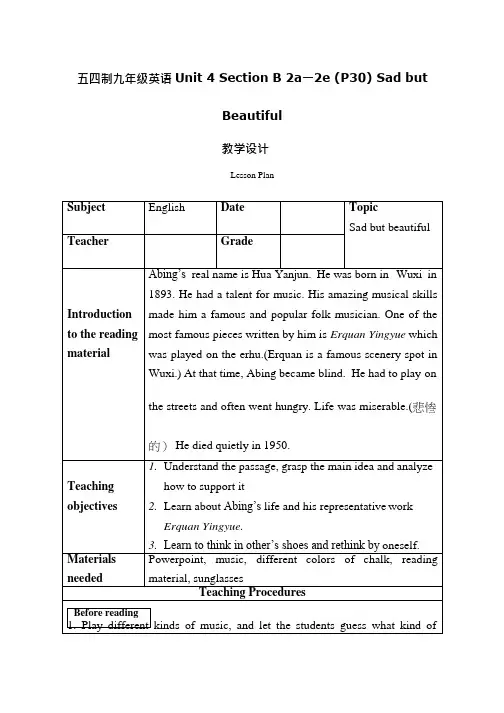
五四制九年级英语Unit 4 Section B 2a—2e (P30) Sad butBeautiful教学设计Lesson Planmusical instrument is played.(Purpose: To arouse the students’ interest in Chinese musical instruments) 2.Talk about the picture in the textbook1)Let the Ss describe what they see in one sentence.2)Ask: What do you want to know now?Then Let’s guess! Sad? But Beautiful?(Purpose: To develop the students’ imagination and learn to predict so that encourage them to read)3.Look, read and tell How many paragraphs? And match the main idea with each para.(Purpose: To have a basic idea of the text before further reading, which can help the Ss to analyze the structure of the text.)While readingActivity1. Analyze each paragraph.Para.11)Main idea Supporting detailsI was by a piece of 1. …music named Erquan 2…Yingyue. 3…2)Is the writer a foreigner or a Chinese? How do you know?(Purpose: To make the Ss learn to read between the lines.)3)Use pictures to give An introduction to Erquan YingyueErquan is a famous and beautiful spring (泉)in Wuxi. The writer of Erquan Yingyue was the famous musician Abing. At first the music had no name, because Abing often played it by the spring Erquan, people gave it a beautiful name Erquan Yingyue . Until now Erquan Yingyue is still famous and popular because of its sadness and beauty.(Purpose: To let the students learn about the background of the music so that they can understand the text better.)2.Para.21)S how pictures of Abing’s life, and let the Ss put them in order according to the text.2)M ain idea: Abing lived a very life.3)U se the pictures to retell Abing’s life with the given key words.3.P ara.33) Use pictures to give An introduction to AbingAbing’s real name is Hua Yanjun. He had a talent for music. When he was young, he could play all kinds of musical instruments, like dizi, erhu, drums and pipa. At the age of 35, he became blind because of a serious illness. Though he was famous, he had to play on the streets all day to make aliving(谋生). After Abing got married(结婚), he still had to play on the streets with his wife, and was still poor and hungry. But he still kept writing and playing music.After reading(Purpose: To let the students learn about the background of Abing so that they can understand the text better.)3. Para.3Main ideaSupporting details Abing’smusical 1… skillsmade him very 2… . 3…During the analysis of the text, present the following words on the blackboard which describe “sad” or “beautiful”.(Purpose: To train the students to be skillful readers and feel the beauty of language, which can also help them to be better writers.)Then draw an outline of the whole article.(Purpose: To make the Ss have a whole idea of the text)Activity1 Talk w ith Abing. Work in pairs.Imagine Abing traveled through time and place to talk with you. Make a dialogue in pairs according to the chart.(Purpose: To develop the students’ imagination and learn to think in the other’s shoes.)Activity2. Say Abing, say Erquan YingyueWhat do you want to say about Abing and his ErquanYingyue?(Purpose: To make the Ss recall what they have learnt in this class, to have a fulfilling feeling.)Sum upHomework Make a poster about Abing (Using A4 paper).。
人教新目标九年级英语Unit9SectionB(2a—2e)Sadbutbeautiful)教学设计

(一)导入新课
1.教师通过展示一张描绘大自然美丽与哀愁的图片,引发学生对本课时主题“Sad but beautiful”的思考。
2.邀请学生分享他们对图片的感悟,以及生活中遇到的美丽与哀愁的事情,激发学生的学习兴趣和情感共鸣。
3.教师引导学生关注图片中的细节,预测本课时可能涉及的内容,为新课的学习做好铺垫。
b. Can you describe some sad but beautiful things in your life?
c. How do the author's descriptions make you feel?
2.各小组进行讨论,鼓励每位成员积极参与,分享自己的观点。
3.各小组汇报讨论成果,教师给予点评和指导。
2.作业量适中,确保学生在规定时间内完成,不影响其他学科的学习和休息。
3.教师要及时批改作业,给予反馈,关注学生的进步和问题,为下一步教学提供参考。
4.鼓励学生积极参与作业,培养自主学习能力和良好的学习习惯。
2.培养学生热爱大自然、关爱生命的情感,让学生懂得珍惜眼前的人和事,学会感恩。
3.通过本课的学习,使学生认识到美丽与哀愁并存,生活中处处充满感动,学会用积极的心态面对生活中的困境。
4.培养学生的跨文化意识,了解世界各地的文化差异,尊重不同的文化背景,增进与他人的交流与理解。
5.引导学生树立正确的价值观,关注社会发展,关心国家大事,培养具有社会责任感的公民意识。
4.布置课后作业,要求学生结合所学内容进行拓展阅读和写作练习,巩固所学知识。
五、作业布置
为了巩固本节课所学知识,提高学生的英语综合运用能力,特布置以下作业:
1.写作练习:请学生以“Sad but Beautiful”为主题,结合自己的生活经历,写一篇短文,描述一件让自己感到悲伤却又美丽的事情。要求运用本节课所学的词汇和语法知识,注意篇章结构和逻辑性。
初中英语_ Unit 4 Sad but beautiful.教学设计学情分析教材分析课后反思
九年级Unit 4 Reading Sad but beautiful 教学设计一.课标解读英语课程标准倡导“体验、实践、参与、合作、交流”的学习方式和任务型的教学途径,发展学生的综合应用语言的能力,使语言学习的过程成为学生积极的情感态度,主动思维和大胆实践,提高跨文化意识和形成自主学习能力的过程。
在新授课中,教师应创设语言环境,提供大量的时间机会,使学生形成语感,提倡“任务型”教学思想,把综合语言运用能力的培养体现在教学过程中,使学生带着明确的任务目标,积极主动的进行学习,在执行任务中学生通过实践、思考、调查讨论、交流合作等方式使用英语完成学习任务。
1. 教材编写者的主要意图教材以“话题”统领每个单元的教学内容,语法结构为表述话题和实现与话题内容相关的交际功能服务。
因此,教材采用不同层次的“任务”的形式来组织教学活动,让学生通过“用语言做事情”来学习和使用英语。
本单元以“Music and movies”为话题,通过活动,旨在能表达喜好,能识别和理解that,which,who引导的定语从句,阅读策略是能根据篇章的主旨大意找出相关的细节信息。
2. 单元话题与学生生活的关系Music and movie是学生熟悉并感兴趣的话题。
本单元将引领学生了解各种音乐形式和电影类型,感悟和分享音乐和电影带来的情感体验。
3. 本单元的词汇目标重点词汇:prefer,suppose,stick,shut,sense,reflect,perform,praise,director,case,wardialogue,sadness,pain,pity,total,master,wound,Australian,electronic, smooth,spare,down,painful,plenty.重点表达:in that case,stick to,plenty of,shut off,once in a while,look up,in total.4. 句型、语法和交际功能目标A: What kind of music do you like?B: I like music that I can sing along with.A: What kind of movies do you like?B: I prefer movies that give me something to think about.A: What kind of musicians does Carmen like?B: She likes musicians who play different kinds of music.5. 本单元教学的基本设想1)采用“任务链”式活动设计,小步推进,螺旋上升。
初中英语_Sad but beautiful教学设计学情分析教材分析课后反思
(一)教学策略与过程1.教学设计思路本课的研究方向为阅读教学。
设计思路:首先通过音乐欣赏引入话题并运用已给词汇谈论二泉映月; 然后通过选择合适的标题、找关键信息、根据短文回答问题、句子填空等训练学生skimming, scanning, detailed reading, guessing等阅读策略与技巧;接着通过观看video唤起对二泉音乐中凄美的认识;最后欣赏自己喜欢的音乐或电影。
通过阅读前、阅读中环节中由浅入深、从简到难的阅读任务进行大量的语言输入,为读后拓展活动中的语言输出做铺垫,帮助学生搭建语言输出的脚手架。
读后活动中,主题为“为什么二泉映月会凄美“小组讨论环节切合本课阅读主题、贴近生活,能激发学生谈论的兴趣,有效地促使学生在交际中运用目标语,很好地帮助学生学以致用。
2.教学过程(步骤、目的、教师活动、学生活动、媒介运用)Step 1. Warming upGreeting and daily talk.The purpose of this step: To warm Ss up.Step 2. Leading inShow some pictures and talk about the teacher.The purpose of this step: To lead in the new topic and get the Ss to beinterested in this lesson.Step 3. Pre-readingTwo students play a piece of music. Encourage the Ss to talk about the music by using these words.The purpose of this step: To get Ss to know something about erquan yingyue. Step 4. While-reading1. Task 1: Tell the Ss to skim the passage and answer the questions.2. Task 2: Tell the Ss to scan the passage and find out the main idea of eachparagraph .3. Help the Ss to analyse the style and structure of the passage.4. Task 3: Tell the Ss to read the passage carefully and answer the questions. Andthen ask some individuals to choose one golden egg and answer the question.(Encourage the Ss to compete in telling the answers to Tasks 1, 2 &3)The purpose of this step: To develop the Ss’ reading ability in getting the main idea and detailed information of a passage.Step 5. Post-reading1. Task 4: Encourage the Ss to retell the passage.2. Task 5: Tell the Ss to fill in the blanks with the correct forms of the words.The purpose of this step: To develop their ability in using the key languagepoints.Step 6. Extension1. Play a 2-minute video clip about erquan yingyue.2. Task 6: Encourage the Ss to discuss in groups and make a report about whyerquan yingyue is sad but beautiful.The purpose of this step: To teach the Ss a moral lesson .Step 7. Summing upReview the words and expressions.The purpose of this step: To develop the Ss’ ability in summing up knowledge.Homework assignmentItem 1. Read and translate the passage.The purpose of this step: To consolidate what was learnt.(二)教学对象分析1.学生已有知识和经验九年级的学生具有一定的英语基础和表达能力,学习的意识和目的性进一步增强。
人教版九年级Unit 9 Sad but Beautiful教学设计
4) 培养学生的阅读能力和归纳能力。
2. 情感态度价值观目标:
继续学习表达个人喜好, 学会鉴赏不同类型的艺术形式并发表评论, 提高审美水掌握本课时出现的生词及用法。
2)阅读短文,获得相关信息,提高学生们的综合阅读能力。
3. …and by age 17, Abing was known for his musical ability.
4. Even after Abing got married and had a home again, he continued to sing and play on the streets.
2.教学难点
如何教会学生利用阅读策略完成2b部分的阅读任务并完成相关要求。
教学策略:
1、配合使用多媒体音频插入技术
2、小组合作学习
教学过程与方法
教学环节
教师活动
学生活动
设计意图
一、导入
1.问候
2.热身:播放几种中国古代乐器的声音片段;
How many Chinese music insruments do you know about?
Show out the picture of Abing: Do you know him?
Ss: It’sPipa....
抢答并说出听出来的乐器
Ss:No. / Yes, he’s Abing.
引出古典乐器二胡,
并用提问的方式为文章后面介绍的音乐家阿炳做一个简单的铺垫
二、快速阅读
1.播放短文录音,
三、
详读短文
1.分段阅读,同时完成2c部分:
九英 Unit9 Section B Sad but Beautiful精品教案
Unit9 Section B Sad but Beautiful 教学设计一、教学目标:1. 语言知识目标:1) 能掌握以下单词:sense, sadness, pain, reflect, moving, look up, perform, lifetime,Pity, total, in total, master, praise, recall, wound, painful,2) 能掌握以下重难句子:1. ...but it was one of the most moving pieces of music that I’ve ever heard.2. Abing’s father taught him to play many musical instruments, such as the drums,dizi, and erhu,3. …and by age 17, Abing was known for his musical ability.4. .4. Even after Abing got married and had a home again, he continued to sing andplay on the streets.5. He performed in this way for many years.6. It is a pity that only six pieces of music in total were recorded for the futureworld to hear, but his popularity continues to this day.7. Its sad beauty not only paints a picture of Abing’s own life but also makespeople recall their deepest wounds from their own sad or painful experiences.3) 运用that/which/who引导的定语从句来谈论自己在乐队,书籍,电影等方面的个人爱好。
鲁教版九年级英语Unit4sectionB2bSadbutBeautiful教学设计
3.语言技能:学生的英语听说读写技能发展不均衡,部分学生可能在口语表达和写作方面感到吃力。因此,教师需要针对学生的语言技能进行有针对性的训练。
在本章节的教学中,教师应充分关注学生的个体差异,运用多元化的教学策略,激发学生的学习兴趣,帮助他们克服困难,提高英语综合运用能力。同时,注重培养学生的情感态度和价值观,引导他们体验音乐的魅力,提升审美素养。
二、学情分析
针对九年级学生,他们在英语学习方面已经具备了一定的基础,但在情感态度、认知水平和语言技能方面仍存在差异。在学习本章节“Sad but Beautiful”时,学生可能面临以下情况:
1.情感态度:学生对音乐的情感体验各不相同,部分学生对悲伤音乐可能存在抵触情绪,需要引导他们正确理解和接纳不同情感的音乐表达。
1.写作任务:请学生撰写一篇短文,描述一次自己听音乐时的情感体验。要求至少使用本节课学习的五个新词汇和一般过去时态,字数在100-120词之间。通过这个写作任务,学生能够将所学知识与实践相结合,提高写作能力。
2.家庭听力练习:布置一项家庭听力作业,让学生在家中聆听一首悲伤但美丽的音乐,并记录下自己的感受和联想到的场景或故事。这项作业旨在培养学生的音乐鉴赏能力和情感表达能力。
3.文本解读:我会引导学生逐句阅读文本,讲解音乐家的人生故事,分析音乐是如何影响他的情感和生活的。
(三)学生小组讨论
1.分组活动:将学生分成小组,每组选择一位音乐家或一段音乐,讨论音乐对人物情感的影响。
2.话题讨论:引导学生讨论以下问题:“How does music express emotions?”、“Can music heal our souls?”等,鼓励他们发表自己的观点。
初中英语_Sad but beautiful教学设计学情分析教材分析课后反思
Sad but beautiful教学设计Teaching objectivesDuring and after this class, students should1. Be able to learn the vivid use of language to describe a person or a song.2. Be able to learn some information about Abing and his life, learn the spirit of Abing, never gives up hope for life.3.Be able to know a little about Chinese traditional culture.Focal points1.Develop reading strategies: predict ,scan, note supporting details2.Learn some information about Abing and Erquan Yingyue, try tounderstand the further information in the passage.Difficult points:1.To write something about Abing and Erquan Yingyue.2.Develop the habit of thinking further while reading.Teaching ProceduresPre-readingStep1: Warming upListen to two pieces of Chinese folk music and let students say their feelings.(Purpose: To lead in Abing and make some language preparations for the further reading.)Step2: PredictShow a photo of Abing, let students say something about him or ask some questions about him. (Purpose: to arouse students’ interests about Abing.)While-readingStep3: Read for main ideaAsk students to scan the whole passage and match the main idea of each paragraph.( Purpose:Learn the reading strategy)Step4: Read for details of para 11.How did the writer know this piece of music?2.What kind of musical instrument did Abing play?3.Did the writer have the same feeling as you after listening to the music?A further question: What are the differences between you and the writer in using the words to express the sad feelings.(Purpose: To learn about the meaning of some words and see how well writers make the passage come alive through his vivid use of language.) Step5: Read for details of para 21.When and where was Abing born?(Lead students to look at some pictures of 1893 and let them think of the history of China , during which Abing was living, and think about if Abing lived even a harder life)2.Analysize the conditions of Abing’s family according to a list. Further questions:Why did Abing continue to play and sing on the streets?3.Watch a video about Abing .(Lead students to know not only Abing but also the whole Chinese were having hard lives in those years.But , no matter how many difficulties he had to face , Abing didn’t give up hope for life or music , instead , he became very popular)Step6 : Read for details of para 31.How many pieces of music did Abing play?2.How many pieces of music by Abing were recorded?3.How do you feel about that?.(Lead students to know it’s a pity only six pieces of music were recorded .)3. Why is Erquan Yingyue so popular and moving?(Purpose: Let students know Abing’s achievements and learn from his vivid use of language in writing a feeling of a song again.)Post-readingStep 7. Read for thinking.1. After reading the whole passage, do you know the meaning of the title ?Think about the relationship between music and life.Lead students to think about : Music reflects life .2.Let students introduce Abing or Erquan Yingyue.3.Design a ticket to a Chinese folk music concert in Sydney . Discuss in groups and finish .Tips :Abing How popular …His most famous piece…TicketConcert of Chinese folk musicDate: Dec, 25thPlace: Sydney Opera HouseSeat : Floor 2 NO.57Price: $300Introduction:Abing wasHis most famous piece isStep 8 homework1.Write a short passage to introduce Abing. (for everyone)2.Make a survey about why only 6 pieces of music are left. (for interest).Sad but beautiful 学情分析语言学习方面:对于九年级的学生来说, 大部分学生已经有了一定的英语学习基础,文章大体内容不难理解。
初中英语_Sad but Beautiful教学设计学情分析教材分析课后反思
教学设计Unit 9 I like music that I can dance to.Section B Sad but Beautiful教学目标:知识与技能:1.Be able to grasp the key words and expressions.2.Be able to understand the passage well and the characteristics of themusic review articles.过程与方法:1.Improve the reading skills and know the history of Erquan Yingyue by reading.2.Grasp the key points by finishing the connected tasks.情感态度与价值观:1.Experience the emotion conveyed by Erquan Yingyue and understand music is an authentic human expression.2.Learn the spirit of struggle in adversity.教学过程:Pre-reading:Step 1.Free talk:Show some pictures.Talk about Chinese musical instruments and famous pieces of music that are played on these instruments.Step 2.Presentation:Watch a video. Listen to the music Erquan Yingyue for the first time.Arouse students'interest to know about Abing.While-reading:Step 1. Skim the passage and match the main ideas with the paragraphs.Paragraph 1 Abing's lifeParagraph 2 Abing's popularityParagraph 3 Writer's feelingsStep 2. Read Paragraph 1 and try to finish the mind map.The music was________ but I sensed a strong ________ and ________._____as I listened.Step 3. Read Paragraph 2 and complete the following time shaft.Step 4. Read Paragraph 2 and complete the chart.Step 5. Read Paragraph 3 and try to answer the questions.1.How many pieces of music did Abing write during his lifetime ? How manyof them were recorded ?600 pieces . Only six pieces of music were recorded.2.Which piece do all the great erhu masters play and praise ?Erquan Yingyue.3.Why does Erquan Yingyue become one of China's national treasures ?Because its sad beauty not only paints a picture of Abing's own life butalso makes people recall their deepest wounds from their own sad or painfulexperiences .Step 6. Make an ID CARD for Abing.Post-reading:Step 1. Pair work:Make a conversation.Student A is a foreign visitor who is interested in Abing and his music.Student B is a Chinese student who knows about Abing.A:What kind of musical instruments did Abing play?B:He could play many instruments,but he is best known for playing the erhu.A: …… B: ……Step 2.Discussion:Watch a video. Listen to the music Erquan Yingyue for the second time.Havea discussion.Enable students'to understand its sad beauty .Think over whatthey can learn from the lesson.Homework:Write an article about your favorite kind of music.Blackboard Design: Unit 9 I like music that I can dance to.Section B Sad but BeautifulAbing Erquan YingyueHard Sad but beautiful学情分析音乐是学生非常感兴趣的话题,大部分学生在课堂上能够积极主动的参与课堂接受知识。