
冀教版九年级上册第一单元英语课文翻译
[ti:UNIT 1 The Olympics Lesson 1 Higher, Faster, Stronger][0:01.349]UNIT 1 第一单元[0:02.884]The Olympics 奥运会[0:05.879]Lesson 1: 第一课:[0:07.300]Higher, Faster, Stronger 更高,更快,更强[0:10.902]THINK ABOUT IT![0:13.465]Have you ever watched the Olympics on TV?[0:18.274]What's your favourite Olympic sport?[0:21.967]Do you think the Olympics are important?[0:25.802]Why or why not?[0:28.618]When were the first Olympics? 第一届奥运会是在什么时候?[0:31.122]We call the first Olympic Games the "ancient" Olympics. 我们把第一届奥运会称为“古代”奥运会。
[0:35.311]"Ancient" means very, very old. “古代”意味着非常非常久远。
[0:38.381]The ancient Olympic Games began in Greece in 776 BC. 古奥运会始于公元前776年的希腊。
[0:45.131]When did the modern Olympics start? 现代奥运会是什么时候开始的?[0:47.649]We call today's Olympic Games the "modern" Olympics. 我们把如今的奥运会称为“现代”奥运会。
[0:51.611]What does "modern" mean? “现代”是什么意思?[0:53.550]"Modern", "now" and "today" mean the same thing. “现代”、“如今”、和“当今”是一回事。
[0:57.951]The modern Olympics started in Athens, Greece in 1896. 现代奥运会始于1896年的希腊雅典。
[1:04.304]Quick Quiz! 小测验![1:06.016]Did women compete in the ancient Olympics? 在古奥运会中女子参加竞赛吗?[1:09.285]No, women did not compete. 不,女子不参加竞赛。
[1:12.468]At the first ancient Olympics, there was only one sport. 在首届古奥运会时,只有一项运动。
[1:16.190]What was it? 是什么?[1:17.718]The sprint. 短跑。
[1:20.265]How many countries sent athletes to the 2004 Athens Olympics? 2004年的雅典奥运会有多少个国家参加?[1:25.670]Two hundred and two countries sent athletes to the 2004 Olympics. 2004年的奥运会,202个国家派运动员参加。
[1:31.910]How many athletes competed at the 2004 Olympics? 2004年奥运会有多少名运动员参赛?[1:35.858]More than eleven thousand athletes competed. 超过一万一千名运动员参赛。
[1:39.410]How many sports did the 2004 Olympics have? 2004年奥运会有多少项运动?[1:42.707]It had twenty-eight different sports. 有28种不同的运动。
[1:45.848]Amazing Olympic athletes 令人吃惊的奥运健儿[1:48.409]At the 1968 Olympics in Mexico City, 在1968年的墨西哥奥运会中,[1:52.602]American Bob Beamon won the gold medal in the long jump. 美国人鲍勃·比蒙获得了跳远金牌。
[1:57.400]He jumped an amazing 8.8 metres. 他跳出了令人吃惊的8.8米。
[2:01.368]Nobody broke his record for twenty-three years. 23年中没人打破他的记录。
[2:05.071]Xu Haifeng won China's first Olympic medal. 许海峰为中国获得了第一枚奥运奖牌。
[2:09.177]At the opening event of the 1984 Olympics, he won a gold medal in shooting. 1984年奥运会刚开幕,他就在射击中获得一枚金牌。
[2:15.529]At the Olympics, athletes compete for medals. 在奥运会上,运动员为奖牌而竞争。
[2:19.604]If you are first, you get a gold medal. 如果你名列第一,就得金牌;[2:22.976]If you are second, you get a silver medal. 如果你名列第二,就得银牌;[2:26.700]If you are third, you get a bronze medal. 如果你名列第三,就得铜牌;[2:30.402]If you are twentieth, do you get a medal? 如果你名列第二十,你会获得奖牌吗?[2:33.475]No! 不会![2:35.278]LET'S DO IT![2:36.693]In a small group, talk about the Olympic Games.[2:40.918]When and where did they begin?[2:43.759]Then, play "Charades."[2:46.744]Take turns acting out a sport.[2:50.445]One group member acts, while the others try to guess the sport by asking "Is it ______?"[ti:UNIT 1 The Olympics Lesson 2 Swimming for Gold][0:02.457]UNIT 1 第一单元[0:03.946]The Olympics 奥运会[0:06.231]Lesson 2: 第二课:[0:07.713]Swimming for Gold 游泳金牌[0:10.017]THINK ABOUT IT![0:11.562]Have you ever gone swimming?[0:14.308]Where do you like to swim?[0:17.117]List some other sports you are good at.[0:21.518]Barcelona, August 8, 1992 巴塞罗那,1992年8月8日[0:26.581]China's First Gold in Swimming 中国的第一枚游泳金牌[0:30.024]Zhuang Yong swam her way to a gold medal today. 庄泳今天游出了她的一枚金牌。
[0:34.124]It was the first gold medal in an Olympic swimming event for our country. 那是我们国家获得的首枚奥运游泳金牌。
[0:39.187]Zhuang Yong won the women's 100-metre freestyle with a time of 54.64 seconds. 庄泳以54.64秒的成绩获得女子100米自由泳比赛冠军。
[0:48.075]It was a very close race. 这是一场势均力敌的比赛。
[0:50.207]When it was over, no one knew who had won. 比赛结束时,没人知道谁会获胜。
[0:53.824]It seemed that Zhuang Yong and Jenny Thompson, an American swimmer, had finished at the same time. 庄泳和一名美国游泳运动员珍妮·汤普森似乎同时到达终点。
[1:00.923]Was it a tie? 这是平局吗?[1:02.598]When it showed: "First, Zhuang Yong, China. Second, Jenny Thompson, U.S.A." 当结果显示:“第一名,中国的庄泳。
第二名, 美国的珍妮·汤普森”时,[1:09.755]the Chinese spectators at the swimming pool jumped up and down, cheering. 游泳池看台上的中国观众跳跃着,欢呼着。
[1:14.532]They were very excited! 他们非常兴奋![1:17.083]Zhuang Yong surprised everyone. 庄泳令每一个人吃惊。
[1:19.861]Before the Olympics, her best time had been slower than Miss Thompson's. 在奥运会前,她最快的时候都要比汤普森慢。
冀教版九年级上册第一单元英语课文翻译

冀教版九年级上册第一单元英语课文翻译第一篇:冀教版九年级上册第一单元英语课文翻译[ti:UNIT 1 The Olympics Lesson 1 Higher, Faster, Stronger] [0:01.349]UNIT 1 第一单元[0:02.884]The Olympics 奥运会[0:05.879]Lesson 1: 第一课:[0:07.300]Higher, Faster, Stronger 更高,更快,更强[0:10.902]THINK ABOUT IT![0:13.465]Have you ever watched the Olympics on TV? [0:18.274]What's your favourite Olympic sport? [0:21.967]Do you think the Olympics are important? [0:25.802]Why or why not? [0:28.618]When were the first Olympics? 第一届奥运会是在什么时候?[0:31.122]We call the first Olympic Games the “ancient” Olympics.我们把第一届奥运会称为“古代”奥运会。
[0:35.311]“Ancient” means very, very old.“古代”意味着非常非常久远。
[0:38.381]The ancient Olympic Games began in Greece in 776 BC.古奥运会始于公元前776年的希腊。
[0:45.131]When did the modern Olympics start? 现代奥运会是什么时候开始的?[0:47.649]We call today's Olympic Games the “modern” Olympics.我们把如今的奥运会称为“现代”奥运会。
冀教版英语九年级上册 Lesson 1 What’s Wrong, Danny?

You should _d_r_i_n_k_a__lo_t_o_f__w_a_t_e_r ____.
X-ray X光
检查;考试
You need to t_a_k_e_a_n__X_-__ in the examination
room.
ray 照X光
检查室
You need to __s_ta_y__in__t_h_e__________.
He regrets eating so many donuts. 4.Where does Sara take them?
She takes them to a small examination room.
5. Doctor asks Danny to stay in the hospital tonight and take an X-ray.(翻译) 医生让丹尼今晚留在医院照X光片。
see your problem with the clear picture.
3. Danny’s father gets dressed quickly. 丹尼的爸爸快速穿衣服。
get dressed 穿衣
e.g服.快Ge起t u床p穿an衣d服ge,t d否re则sse你d会qu迟ick到ly。, or you will be late.
dress sb./oneself 给某人穿 衣eg:服My brother is old enough to dress himself.
__________(检查).
stomachs
3. Do you kaninow a cow has four _________(胃)?
4. I had a p_____fienvemr y head last night, but now I feel
冀教版九年级上 Unit 1 Stay HealthyStay Away from t
Unit1 Stay HealthyLesson 6Teaching Aims1.Know more about the disease.2.Learn more about the hospital in foreign country.Teaching Important Points1.Know something about the disease and hospital in foreign countries.2.How do we feel when we are in hospital?Teaching Difficult PointsDemonstrate the feeling in hospital.Teaching Preparation: picturesTeaching AidsAudiotape, flashcards, picturesType of lesson: new lessonTeaching ProceduresStep 1.Warming upWhat do you think of Danny? Do you miss him? What do you want to know about him?Let some students answer the questions in class in oral. Pay attention to the words that they are using. If you think it is necessary to show more words, you can show some new words to them. Step 2.Listen to the tape and answer the following questions:Ⅰ.What's wrong with Danny?Ⅱ.Where is Danny now?Let the students answer the questions in class in oral.Step 3.Read the text and encourage students to ask more questions:S1: What's wrong with Wang me?S2:S3: How are Danny and Wang me feeling?S4:S5: What did the doctor take from Danny's stomach?S6: An appendix.Give them hints and let them ask more questions.Step 4.Come to "LET'S DO IT".Divide the class into groups. Talk about the questions. After a while, let some students give their report to the class.Show them more words and expressions about disease with the flashcards.When the students are discussing, the teacher walk around the classroom and give them help if it is necessary.Step 5.Summary:We all have been ill. Sometimes illness can't be avoided. But talking about the disease is not so easy. We have so many things that we can't describe correctly. So we must research more words and expressions about the disease. The teacher must help them immediately if possible. Remember to discuss how to keep healthy in details.Homework1.Finish off the activity book.2.Go on next reading in the student book.。
Unit1 lesson1 -21-22学年冀教版九年级全册
his face.
P3
A. colour B. fear
2. We’d picture,
btheettderocttaokrewaTinllaXes-akrsaily4y.
With a see the
____ problem.
A. clear TheBw. coorldosurifnulitalics are
regret doing/ having done sth. 对做了某事后悔。
She deeply regretted losing her temper. 她为自己发了脾气而深感后悔。
I regretted not having worn a thicker clothes. 我后悔当初没有穿厚点。
Look at the pictures and guess.
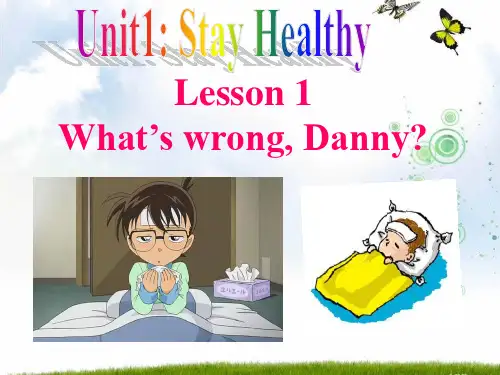
1. What’s wrong with Danny? 2. What did the doctor say?
Task 1 Read the dialogue and check your answers.
What’s wrong with Danny?
胃疼 stomach hurt 发烧 have a fever 与某人在一起 stay with sb.
Language Points
1.It’s 3:00 a.m. Danny wakes up his parents. 凌晨三点钟,丹尼叫醒了他的父母。
wake up 叫醒,闹醒; 及物动词短语
4. You’ve got a high fever. 你发高烧了。
have got =have
-- Have you got a new book? -- Yes, I have. He hasn’t got a new book. He’s got an old one.
九年级英语冀教版课文讲解
九年级英语冀教版课文讲解第一课:Unit 1 My New Teachers课文内容概述:本课的主题是“我的新老师”。
课文通过介绍学生们的新任班主任和各科老师,展示了他们对新老师的印象和期待。
学生们对新老师的认识和评价将成为他们未来学习生活中的重要依据。
关键词汇与短语:1.new teacher新老师2.kind和蔼的3.strict严格的4.funny有趣的5.favorite subject最喜欢的科目6.teaching style教学风格7.make lessons interesting使课堂有趣8.get along with与...相处融洽重点句子:1.Miss White is our new head teacher.(怀特小姐是我们的新任班主任。
)2.Mr. Smith teaches us English. He is very kind and patient.(史密斯先生教我们英语。
他很和蔼耐心。
)3.Mrs. Johnson teaches us math. She is a bit strict, but she makes the lessons interesting.(约翰逊女士教我们数学。
她有点严格,但她能使课堂有趣。
)4.My favorite subject is music. Mr. Brown is our music teacher. He is funny and we all like him.(我最喜欢的科目是音乐。
布朗先生是我们的音乐老师。
他很有趣,我们都喜欢他。
)阅读与讨论:学生们可以阅读课文,并回答一些问题来检查对课文内容的理解。
1.Who is the new head teacher?(新任班主任是谁?)2.How do the students describe Mr. Smith and Mrs. Johnson?(学生们如何描述史密斯先生和约翰逊女士?)3.What is the student's favorite subject? Who is their music teacher?(学生最喜欢的科目是什么?他们的音乐老师是谁?)第二课:Unit 2 Healthy Eating课文内容概述:本课的主题是“健康饮食”。
冀教版九年级上册英语课件:unit1Lesson1What'sWrong,Danny

• See a doctor
What will the doctor advise you to do? You should take some medicine
You should
• What is the worst illness you’ve ever
hhaadv?e a cold/fever
不, 不需要。 (只用于否定句和疑问句中)
② 作实义动词
*need sth. e.g. I need a lot of money to travel. *need doing (表被动) e.g. Your car needs mending. 你的车需要维修了 。
= Your car needs to be repaired. *need to do sth. 表示有义务或责任去做某事
4.You’re never late for school,__A____?
A. are you C. arenD’t you
B. are not you D. are you not
5.-___________?
-Nothing serious, but a bit tired.
A. Is that all B. Is there anything else C. What’s this D. What’s the matter with you
•
4.My father goes out.
geteslld______
quickly,
then
he
• 5.I don’t feel w___, my stomach hurts.
Choose the best answer.
最新九年级英语冀教版上册 Unit1 Lesson 2
其后不可以接宾语。 won't hurt yourself.小
相当于look out/be 心,你就不会伤了
careful。
自己。
讲解来自《点拨》
典例 Thanks for your invitation,but I'm so sorry I can't go. I need to ___C_____my baby at home.
讲解来自《点拨》
eg:She had a toothache and couldn’t fall asleep.
她牙痛得无法入睡。
拓展:表示身体某处疼痛时,常在表示身体器
官的名词后加-ache。 考向 -ache 常见的此类单词还有:
stomachache 胃痛;腹痛 headache 头痛
backache 背痛
讲解来自《点拨》
考向二【易错点】It's +形容词+of sb.+to do sth.和It's + 形容词+for sb.+to do sth.的区别
若形容词是描述不定式行为者的 性格,品质的,如kind,good, It's very kind of you to help clever,polite,careless,foolish等,m你e真. 好来帮我。 用It's+adj.+of sb.+to do sth. 若形容词仅仅是描述事物,不是 对不定式行为者的品格进行评价, It's very dangerous for 如dandgifefricouulst等,,eas此y,时h用ar:d,It'ism+paodrtja.+nt,cs繁thrie忙ledt的r.e对n街孩to道子cr很o们s危s来t险h说e。b,us横y 穿 for sb.+to do sth.
冀教版九年级英语上册 Unit 1 The Olympics
冀教版九年级英语上册 Unit 1 The Olympics 本单元的中心话题是“奥运会”。
“更高,更快,更强”,既是奥林匹克的口号,也是国际奥委会对所有参与奥林匹克运动的人们的号召,号召他们本着奥林匹克的精神奋力向上。
本单元围绕着“奥运会的起源,发展以及奥运选手”而展开的。
学生通过本单元学习掌握一些与奥运会有关的单词、短语和句型。
使学生更加了解有关奥运会的常识,培养他们为国争光的爱国情感;在学习中发扬“更快、更高、更强”的奥运精神。
教学重难点分词汇掌握词汇modern,gold,record,event,twentieth,clo se,race,seem,tie,eat,volleyball, abletennis,luck,tennis,believe, guest, such,ble, great, practise,dream,age,victory,include,result,none,few 接触词汇ancient, meaal, shaooting, athlete, silver, broke, sprint, freestyle, swimmer,spectator, design, rope, sit-up,push-up, diving, dive, diver, platform,springboard, champion, coach语言知识win a gold medal, up and down, the others, set a world record, jump rope, do one's best, give up, believe in, be able to, at age 13, catch up with ..., Dream Team Good luck! Thank you! The same to you.单词和句型Wishes and Congratulations希望和祝愿功能意念DirectSpeech and lndirectSpeech直接引语和间接引语了解一些奥林匹克运动的发展史及一些中外著名运动员的简况。
冀教版九年级上册英语课件:unit1Lesson1:What’sWrong,Danny?
句型转换
1.What’s wrong with you?(同义句) What’s ____ ___with you? What_____ _____you?
2.You ate ten donuts for dessert,___ __? 3.You’ve got a bad fever,___ ____? 4.Do you have a computer?(同义句)
冀教版九年级上册英语 课件:unit1Lesson1: What’sWrong,Danny
?
2020/8/19
疑难阐释
1.At 3:00 AM ,Danny woke up his parents. 凌晨3点,丹妮叫醒了他的父母. wake up “唤醒;叫醒”. wake sb. up 唤醒/叫醒某人. I woke up as soon as the telephone rang. Wake me up when you get up.
2.You are sick, aren’t you? 辩析:silk 和 ill ill 一般用作表语;sick既可用作表语又可用作定语.
3.I’ve got a pain here. 我这儿有点疼. have 和 have got have作“拥有”时,和have got意思相同,如果
使用一般现在时,have可以借助助动词do(主语 是单三时用does);而have got 只需将have提到 主语之前构成疑问式;在have之后加not构成否 定式.
rest. B:Yes, I think so. A:___________________ B:Thank you.
A:When did it start?
B:What’s wrong with you?
九年级英语上册Unit 1 The Olympics冀教版
九年级英语上册Unit 1 The OlympicsLesson 1 Higher Faster Stronger一、教材分析一)教材内容:冀教版英语九年级Book5 Unit1Lesson1 Higher , Faster, Stronger二)教材内容分析:本单元的中心话题是“奥运会”。
本课是本单元的第一课时,题目是“更高,更快,更强”,既是奥林匹克的口号,也是国际奥委会对所有参与奥林匹克运动的人们的号召,号召他们本着奥林匹克的精神奋力向上。
本课课文围绕着“奥运会的起源,发展以及奥运选手”而展开的。
学生通过本课学习掌握一些与奥运会有关的单词、短语和句型。
使学生更加了解有关奥运会的常识,培养他们为国争光的爱国情感;在学习中发扬“更快、更高、更强”的奥运精神。
三)教学目标1、知识目标词汇1)掌握词汇及短语:modern, gold, record, event, twentieth, win a gold medal.2)接触词汇及短语:ancient, medal, shooting, athlete, silver, bronze, sprint.功能意念:表示时间语法:名词作宾语补足语。
2、能力目标听1)能听懂有关奥运会的语段,识别主题,获取主要信息。
2)能根据简单的连续指令完成任务。
说1)能引出相关的话题并进行简单的交谈。
2)能用正确的语音、语调进行口语活动。
3)就日常生活中的祝愿和恭喜的话题与他人交换信息并陈述自己的意见。
读1)能连贯、流畅的朗读课文。
2)能从简单的文章中找出有关的信息,理解大意。
3)能读懂同步的简单读物,克服生词障碍,理解大意。
4)能理解课文中事件发生的顺序和人物行为。
写1)能用词组和简单句写有关奥运会的短文。
2)能在老师的帮助下练习和修改有关奥运会的作文。
3、学习策略目标1)树立自主学习的概念和意识。
2)能总结所学语言材料中的语言规律并加以利用。
3)善于抓住用英语交际的机会。