
【新教材】5.1 Listening and Speaking -人教版高中英语必修第三册
Unit 5 The Value of MoneyPeriod 1 Listening&Speaking导学案1. to master the stylistic features of news reports.2. to talk about their opinions about value of money.3. to use functional sentences of the dialogue such as “after that, then, later, so ,but , however etc”appropriately.1. to master the stylistic features of news reports.2. to talk about their opinions about value of money.Part 1: Listening and SpeakingStep 1: Is money the basis of a happy life? Why or why not?Step 2: Listen to a news report and fill in the blanks1. Chen Liyan a ______________at Taiyuan railway station2. Wang Zheng the _______________of the lost money3. Ma Dongbao a ______________living in Chen’s apartment building4. Liu Xia Chen’s 16-year –old __________________.Step 3:Listen again and put these sentences in the correct order___________Chen Liyan found Wang Zheng's money and returned it to him.___________Chen gave an interview to the local newspaper.___________Wang built a website to help raise funds for Liu Xia.___________Ma Dongbao shared Chen's story with Wang.___________Chen spent all her savings and took out a large loan.___________Wang offered Chen 5,000 yuan.Step 4: Listen again and decide if the following statements are true (T) or false (F).1 It was the first time Chen Liyan's story was reported. T口F口2 Chen found 10,000 yuan in a small plastic bag in Taiyuan railway station口F口3 Wang Zheng apologized to Chen because he couldn't offer her more money. T口F口4 Chen took out a large loan to cure her daughter, T口F口5 Wang set up a fundraising website for Chen's daughter after Chen told him about her situation. T口F口Step 5:After listening, discuss the questions.1 What kind of person do you think Chen Liyan is?2 Did Chen return the money because she didn't need it?3 Is it common for people to do what Chen did?4 How did Wang Zheng feel about the return of his money?5 Why did Ma Dongbao tell Wang about Chen's family?6 How did the news reporter feel about Chen's actions?Part 2: Viewing and TalkingStep1:Look at these photos and guess what happens in the film.Step 2:Watch the film clip and discuss the following questions.1 Why does the owner of the restaurant want Henry to sit somewhere else?2 What does Henry order? Why is the waiter surprised?3 Why does the owner think Henry hesitates to pay the bill?4 Why does the owner think the bank note is probably real?5 What happens in the end?Step 2:Speaking ProjectWork in groups. Retell the story in the film clip._______________________________________________________________________________ _____________________________________________________________________________________________________________________________________________________________ ______________________________________________________________________________ _______________________________________________________________________________ ______________________________________________________________________________ _______________________________________________________________________________ ______________________________________________________________________________ _______________________________________________________________________________ ______________________________________________________________________________ _______________________________________________________________________________ ______________________________________________________________________________【答案】Part 1: Listening and SpeakingStep 1: Lead inIs money the basis of a happy life? Why or why not?No. People can find happiness in some simple things. Money can’t buy love, health and real friendship.Step 2: Listen to a news report and fill in the blanks1. Chen Liyan a ______________at Taiyuan railway station2. Wang Zheng the _______________of the lost money3. Ma Dongbao a ______________living in Chen’s apartment building4. Liu Xia Chen’s 16---year –old __________________.1. cleaner2. owner3. police officer4. daughterStep3:Listen again and put them in the correct orderChen Liyan found Wang Zheng's money and returned it to him.Chen gave an interview to the local newspaper.Wang built a website to help raise funds for Liu Xia.Ma Dongbao shared Chen's story with Wang.Chen spent all her savings and took out a large loan.Wang offered Chen 5,000 yuan.2 6 5 4 1 3Step 4: Listen again and decide if the following statements are true (T) or false (F).1 It was the first time Chen Liyan's story was reported. T口F口2 Chen found 10,000 yuan in a small plastic bag in Taiyuan railway station T口F口3 Wang Zheng apologized to Chen because he couldn't offer her more money. T口F口4 Chen took out a large loan to cure her daughter. T口F口5 Wang set up a fundraising website for Chen's daughter after Chen told him about her situation. T口F口Step 5:After listening, discuss the questions.1 What kind of person do you think Chen Liyan is?Chen Liyan is generous and honest because she returned a large sum of money to the owner.2 Did Chen return the money because she didn't need it?No. She returned the money because it was the right thing to do.Evidence for this is that she refused to accept the reward money because she felt that it had not been earned.3 Is it common for people to do what Chen did?It depends on the culture. In some countries it is quite common to return money that has been found. In other countries, people believe "Finders are keepers!"4 How did Wang Zheng feel about the return of his money?He must have been very happy and relieved to have gotten his money back. We know this because he thanked Chen repeatedly and even offered her a reward.5 Why did Ma Dongbao tell Wang about Chen's family?He must have had great sympathy for Chen and her daughter and wanted to help them.'We know this because he arranged help for them.6 How did the news reporter feel about Chen's actions?The news reporter felt that it showed that money wasn't the most important thing in life. We know this because the reporter told us that this is what Chen believes. and then said, “that's a great attitude to take."Part 2: Viewing and TalkingStep1:Look at these photos and guess what happens in the film.A man looking very poor are eating a lot of food. After he finished his eating, the boss was very angry so I guess he couldn’t pay his bill at that time but later, when seeing a paper which might be a large bank note, the boss was surprised and all treated this poor man differently.Step2:Watch the film clip and discuss the following questions.1 Why does the owner of the restaurant want Henry to sit somewhere else?Since Henry is poorly dressed, the owner of the restaurant does not want him to sit in the middle of the room where everyone can see him.2 What does Henry order? Why is the waiter surprised?Henry orders ham and eggs, a nice big juicy steak with all the trimmings and a tall tankard of ale- twice. The waiter is surprised that Henry eats so much food.3 Why does the owner think Henry hesitates to pay the bill?The owner thinks Henry does not have the money to pay.4 Why does the owner think the bank note is probably real?Because no one would get into trouble to forge a bill of such a high amount- it would be crazy.5 What happens in the end?All the people in the restaurant think Henry is an eccentric millionaire and the owner let him leave without to pay the bill.Step 2: Speaking ProjectWork in groups. Retell the story in the film clip.After having the brother’s home, Henry went for a small restaurant. He was about to sit down at a table when the restaurant owner showed him to a different seat because he was dressed poorly and the restaurant owner did not want others to see him. Henry then ordered a large meal.After he was finished, he ordered the same meal again, because he was very hungry.The waiter was surprised and told the restaurant owner. This made the restaurant owner worried that he could not pay the bill. Later, when Henry finished eating, he hesitated to pay the bill. This made the restaurant owner quite angry. Then Henry opened the envelope, expecting to find some money to pay the bill. Henry, and all the people in the restaurant were shocked to see that it was a million-pound note. The restaurant owner decided that the note must be real, and that Henry was a strange millionaire. In the end, the owner let him leave without paying anything.。
2019新人教高中英语必修一Unit5Listening and Speaking教案
2019新人教必修一Unit5 Languages Around the WorldListening and speakingExplore languages around the worldTeaching aims:1.Enable students to get familiar with languages,especially the 6 official languages of the UN.2.Better understand the pronouns and what the pronouns refer to in listening.3.Talk about the languages and tell the reasons in simple English.Teaching key points:1.Help students get familiar with the vocabulary of different countries and their languages through listening practice.2.Try to arouse the students’ interest in language learning in thematic context. Teaching difficult points:1.Enable students to be aware of pronouns in daily conversation and be able to understand the content of pronoun reference correctly in the process of Listening.2.Enable students to fully discuss the reasons and motivation of language learning. Teaching procedures:Step1 Lead-inLook at the opening page and discuss the following questions with your students. T:Which languages do you think are officially used in the UN?Ss:English, French, Russian, Chinese, Spanish...T:How do you understand the quote:One language sets you in a corridor for life.Two languages open every door along the way?Ss:Mastering more languages can give you many chances in your life including your work opportunities, your horizon, your fully understanding of the world.Step2 Listening:Explore languages around the worldActivity1 Warming upBefore you listen, match each photo with the correct country name. Then discuss which languages are spoken in these countries.(Ex1on page 60) 1 23456 France 3 French Russia 4 Russian Germany 2 GermanSpain 6 Spanish Canada 1 English, French India 5 Hindi, EnglishActivity2: First listeningFor the first listening, you are required to tick the two languages with the most native speakers.Circle the official languages of the United Nations. And then answer the four questions below.1.What is the main topic of this speech?Learning a foreign language.2.How many languages are there in the world?Nearly 7000.3.How many people speak the UN’s official languages as their native or second language?Around 2.8 billion.4.What is the attitude of the speaker towards foreign language learning?It’s very useful to learn one or more foreign languages.Activity3 Second listeningT: Boys and girls, for the second listening, please pay special attention to the pronouns in the speech, especially focus on the italicized words in the sentences below and what they refer to.1.They think it means better job chances in the future.They:students who choose to study a UN language. it: studying a UN language2.They are spoken by around 2.8 billion people.They: the six official UN languages.Activity4 Third listeningListen to the speech for the last time and fill in the blanks with words and phrases you hear(通过最后一遍听力的练习,让学生掌握和熟悉表达态度以及原因的句式,从而为说的练习做好充足的语言支架)To some students,it seems that the only foreign language to learn is English.There are,however,nearly 7,000 languages in the world.After Chinese,the language with the most native language speakers isn’t English—it’s Spanish.Learning English is very useful,but, it is wise to learn at least one other foreign language if possible.There are many reasons why people learn a foreign language.Many students choose to study one of the languages that are spoken at the UN.As they think it means better job chances in the future.The UN has six official languages:Arabic,Chinese,French,Russian,and Spanish.They are spoken by around 2.8 billion people as their native or second language.Some students,though,choose to study a language because of family or friends.One American girl chose to learn Danish because her grandparents were from Denmark.When she was little,her grandpa used to read letters to her in Danish from their relatives in Denmark.Another young lady started learning French because she had several friends from African countries where French is spoken.Step3 Speaking1.Review the listening material and try to complete the table below.(红色部分为学生填写)2.Work in pairs or groups.Discuss which other languages you want to learn and why.(Ex5 on Page61)Example:A:What language do you want to study?B: I really want to study French. I think that the French language sounds beautiful. A:Why? Do you want to go to France some day?B: Yes, I’d love to. Also, French is used by many international organizations around the world. Do you know that FIFA’s full name is in French?A:oh, I remember that. But I don’t know how to pronounce it.Step 4 Homework1.Review the new words learnt from the listening material.2.Tell your partner what language you would love to learn in the future and why.。
2019新人教高中英语必修一Unit5 Listening and Speaking课件
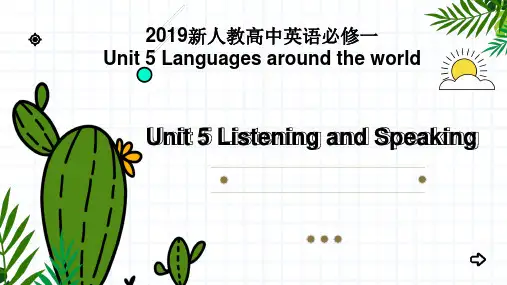
There are many reasons why people learn a foreign language. Many students choose to study one of the languages that are spoken at the UN. As they think it means better job chances in the future. The UN has six official languages: Arabic, Chinese, English, French, Russian, and Spanish. They are spoken by around 2.8 billion people as their native or second languages.
Unit 5 Listening and Speaking
Unit 5 Listening and Speaking
2019新人教高中英语必修一Unit 5 Languages around the world
Speaking
Portuguese
Italian
Arabic
French
Russian
2. How many languages are there in the world?
4. What is the attitude of the speaker towards foreign language learning?
Learning a foreign language.
France ____
Russia ____
高中英语_listening and speaking教学设计学情分析教材分析课后反思

Book 2 Unit 3 Using language教学设计上高一之后,英语难度突然增大,再加之本校学生的英语水平普遍较低,学生对英语学习就产生了惧怕和不自信。
害怕表达,不相信自己能学好。
这就需要降低难度,并且慢慢引导。
让少部分英语学习好的同学对其他同学进行帮助,加强小组的讨论与学习。
本课内容学生在获取词汇和句型时,老师给出更多的提示引导,多次反复让学生充分弄懂,才能进行小对话的输出。
在展示新词和表达的时候,让学生小组内先互相表达,增加学生的信心和熟练度,让学生更敢于表达。
本堂课为听说课,学生先通过单词和句子的学习,总结有用句型,充分理解句子,加深印象。
并通过对话输出,展示之前所学新词与表达,提高学生综合表达能力。
学生先听文本主线,了解大意。
在了解的基础上细听填词,最后针对个别难词,分段听,让学生听懂、听会。
学生们通过这样的输出形式通,从课文延伸到课外生活,情感方面能得到升华。
同时教师也会引导学生树立一个热爱运动,热爱传统运动的积极态度。
本单元的主题是人与社会—运动,而本节课为听说部分,主要介绍了一个外国人对中国太极从认识到喜欢的内容,引导学生分析她喜欢太极的原因。
通过真实语境下技能的综合训练,学生能够加深对单元主题的理解,提高语言应用能力。
主要内容包括三部分,首先对第一次热身对话的生词和句式结构进行引导熟悉,如,pull-up,skipping,push-up,jogging;It strengthens our upper body. It develops our balance and it is good for our heart .....学生第一次对话,通过对话输出,展示之前所学新词与表达,提高学生综合表达能力。
然后,师生共同总结现代运动,引出传统运动,太极。
并介绍有关太极的背景知识,为听力做铺垫。
接着听力部分,学生先听文本主线,了解大意。
在了解的基础上细听填词,最后针对个别难词,分段听,让学生听懂、听会。
新教材必修三Unit5 Section I Listening and Speaking

Unit 5THE VALUE OF MONEY主题语境——人与社会之文学、艺术与体育【语境概说】本单元的主题语境为人与社会的文学、艺术与体育。
本单元主要涉及小说、戏剧、诗歌、传记、文学简史、经典演讲、文学名著等。
该主题与学生学习和生活密切相关,在此主题意义引领下,引导学生理解戏剧语言(人物语言和舞台说明),进而分析人物的性格特点和戏剧冲突等,有助于刺激学生发散思维,提高思维缜密程度、思维广度和思维深度,培养创新思维和批判思维等思维品质;同时,扩大学生的视野,极大丰富学生的文化常识,提高文学欣赏水平;并通过语篇学习和戏剧表演等方式,帮助学生建立正确的人生观和价值观。
Not possession,but use,is the only riches.致富之道不在于所有,而在于使用。
He is richest who is content with least,for content is the wealth of nature.少量即可满足的人是最富有者,因为满足是自然的财富。
When wealth is centralized the people are dispersed;when wealth is distributed the people are brought together.财聚则民散,财散则民聚。
Section ⅠListening and Speaking1.Translate the following words and phrases.①basis n.基础;根据;基点②on the basis of 在……的基础上③loan n. 贷款;借款④take out a loan 取得贷款⑤apologise v i. 道歉;谢罪⑥ignore v t. 忽视⑦in return作为回报;作为回应⑧plastic n. 塑料adj.塑料制的⑨judge v t.& v i. 评价;评判;判断n.法官;审判员;裁判员2.Brainstorming:What do you think money can’t buy?happiness,love,friendship,respect,dream,courage,belief__etc. 3.Look at the picture on Page 49 and tell your classmates what they are doing? They__are__looking__at__the__million__pound__bank__note.4.Finish Ex.1 on Page 50.5.Try to translate the sentence in various ways.我相信他什么都知道。
新人教版 welcome unit listening and speaking
E.Ask our teacher for help
F.Have a heated discussion with classmates
Step Two: Listening
Ⅰ.Amy is getting her student ID card. Listen to Conversation
1 (P2) and complete the table.
Sorry, what's your last name again? A:Jones. J-O-N-E-S. W:OK. Thank you. And where are you from? A:I'm from the USA. W:OK. What's your student number?
ListeningandSpeaking教学设计-高一下学期人教版必修第三册
BOOK3 Unit1:Festivals and celebrations 听说课Period 1 --Listening and speaking 教学设计课型:听说课主题语境:人与社会授课时长:45 min语篇分析:本课语篇的主题语境是人与社会,主题群是文学、艺术与体育,主题语境内容要求是不同民族文化习俗与传统节日。
该语篇介绍了三个国家的一个典型节日,阐述了节日服装、节日意义与节日活动。
语篇共有3段对话。
✓What:第一篇对话是一段采访,一位外国记者正在采访刚参加完“成人礼”仪式的日本年轻女性,询问她的感受以及随后的庆祝活动。
第二篇对话是两个好朋友之是的聊天,中国女孩Li Mei第一次体验里约狂欢节,她的外国朋友Carla为她提供着装建议。
第三篇对话是中国导游向外国游客介绍元宵节习俗。
✓How:语境真实,语言自然,话题贴近学生生活;并且巧妙地融入了各具特色的节日文化元素;为了实现流畅地交流,语言中出现了语音同化、连读等语音现象;文本中渗透了本单元的目标语言结构-ing。
第一篇街头采访,语言表达礼貌,且有特定的范式,比如:excuse me, miss等。
对话中,常以问题的形式呈现,问题简明扼要,被采访者表述的内容更丰富。
第二篇朋友间的日常交际,语言自然,语言结构简单,互动性强。
第三篇导游讲解,导游与游客的互动问答。
导游引导游客关注趣味细节时,使用了常用导游结构“you will see”“you can get”等。
问答形式中,导游的阐述更丰富。
✓Why: 通过三段日常对话了解三个国家的节日,学生不仅可以打开视野,形成对不同节日的认知;而且通过跨文化的视野可以帮助学生思辨地认知三个节日,都具有趣味性,但又各不同。
第一篇对话是谈论日本成人节,在中国这个节日是孩子们心中一直期盼的,有个仪式宣告自己长大了,但对话是从访谈开始,重点关注了这个节日在孩子心里的感受与意义,实现了情感的共鸣。
第二篇对话是谈论里约狂欢节,一个快乐的节日,展现了欧洲国家不同风情的节日,对话是二个朋友之间的谈论,重点实现了跨文化的交流。
5.1 Listening and speaking 练习(2)(解析版)
Unit 5 Languages around the worldPeriod 1 Listening and speaking 练习解析版听力训练(共两节,满分30 分)第一节(共5小题;每小题2分,满分10分)听下面5段对话,每段对话后有一个小题,从题中所给的A,B,C三个选项中选出最佳选项,并标在试卷的相应位置;听完每段对话后,你都有10秒钟的时间来回答有关小题和阅读下一小题。
每段对话仅读一遍。
1. What are the two speakers talking about?A. Hobbies.B. Music.C. Plays.【答案】:选A【解析】:根据原文anything you like doing, 以及后面be fond of music,piano, enjoy music等可以判断出。
2. Where is Mr Jones now?A. At home.B. At the Health Center.C. At his office.【答案】:选C【解析】:根据原文But I can give you his office phone number.以及He won’t be back until six o’clock. 可以判断出。
3. What do the two speakers think of Tom?A. He gets nervous very easily.B. He is not an experienced speaker.C. He hasn’t prepared his speech well.【答案】:选B【解析】:首先要理解题干What do you think of sb...? 你认为......怎么样?根据原文Tom looks awfully nervous.以及He is not used to making speeches.可以判断出。
版选择性必修第一册 Unit5 Period 1 Listening and Speaking 教案
教学设计What countries do the pictures stand for? What official languages are spoken in these countries?教学提示:除了活动中提到的国家及相应的官方语言,教师补充,例如:China—Chinese、Japan—Japanese、Egypt—Arabic、Denmark—Danish、New Zealand—English and Maori、Brazil—Portuguese,补充的词汇可以包含活动1中未出现、但在听力中会出现的国家及其官方语言的名称。
教师在此环节也可提示学生,有些国家的语言与殖民地等历史原因有关。
Step3 While-listening(1)学生首先熟悉活动2中表示语言的单词,然后教师播放录音,让学生听并完成活动2。
教师还可以让学生根据构词法说出这些单词所对应的国家名称,例如:Russian—Russia、Danish—Denmark。
〔2〕学生阅读活动3中的第二至第四个问题,猜想billion、native、attitude的意思。
教学提示:教师不一定要求学生猜出这些单词确切的意思,但可以让学生依据它们在句中的前后联系,充分发挥联想,例如:billion 前有how many,可能与数量有关;native language 后有second language,对应的可能是first language; attitude 后有towards,可能是“看法〞之类的意思。
〔3〕学生根据从第一遍录音中听到的信息,答复活动3中的问题。
教师播放第二遍录音,让学生边听边核对答案。
之后师生核对答案。
〔4〕教师举例说明代词的指代用法,让学生熟悉活动4中的两个句子,尤其是句中的代词。
之后教师播放第三遍录音,让学生听并提醒学生关注这些代词前面出现的名词,最后要求他们说出这些代词在听力文本中分别指代什么。
2019-2020版高中英语新教材人教必修第一册Unit 1 TEENAGE LIFE:Section Ⅰ Listening and Speaking
主题语境——人与自我之校园生活【语境概说】本单元的主题语境为人与自我中的生活与学习,该主题语境主要包括学校生活、健康的生活方式、积极的生活态度、乐于学习、善于学习等等。
本单元主要涉及校园生活、学业上的挑战,生活中遇到的问题及解决方法。
该主题与学生生活密切相关,在此主题意义引领下,有助于了解校园生活的各个方面,促进学生语言能力、文化意识、思维品质和学习能力的融合发展。
No pains,no gains.没有付出就没有收获。
No cross,no crown.不经历风雨,怎么见彩虹。
It is never too late to learn.活到老,学到老。
If you don’t learn to think when you are young,you may never learn.如果你年轻时没有学会思考,那就永远学不会思考。
A young idler,an old beggar.少壮不努力,老大徒伤悲。
Section ⅠListening and Speaking1.Translate the following words and phrases.①teenage adj.十几岁的;青少年的②teenager n.青少年③ballet n. 芭蕾舞④volunteer n. 志愿者⑤debate n.辩论;争论v t.&v i.辩论;争论⑥prefer v t. 较喜欢⑦content n. 内容;目录;主题⑧movement n. 动作;运动;活动⑨greenhouse n. 温室;暖房⑩suitable adj. 合适的;适用的⑪proverb n. 谚语⑫actually ad v. 事实上;的确⑬predict v t. 预测⑭decide v t. 决定⑮prefer...to... 喜欢……多于……⑯clean up 打扫干净⑰suitable for 对……适合的⑱be interested in 对……感兴趣⑲make friends 交朋友⑳prepare for 为……做准备2.Brainstorming:What school clubs can you think of?Nature Club,V olunteer Club,Debate Club,Cartoon Club,Singing Club,Science Club,Handwriting Club,etc.3.Look at the pictures on Page 12 and tell your classmates what they are/she(he) is doing?They are discussing different questions./She is dancing ballet./He is helping others./They are planting trees.4.Finish Ex.1 on Page 12.5.Try to translate the sentence in various ways.我喜欢观看足球比赛。
新人教高中英语必修一Unit 5Listening and Speaking
1. refer to 指的是 2. do business with sb. 和某人做生意
3. Japanese cartoons 日本动漫 4. native speaker 说本族语的人
5. official language 官方语言
1. What languages can you speak? 2. What are the official languages of the
like watching Japanese cartoons,
so I'd like to learn Japanese.
Perhaps I should study French. I think it sounds beautiful, and I know it's used in
many countries.
P60 2
1. What is the main topic主题 of this speech?
___L_e_a__rn__in_g_a foreign language.
2. How many languages语言 are there in the world?
Nearly ___7_,_0_0_0____
United Nations (UN)? 3. What foreig3n languages do you want
to study? Why? 4. Can you tell the differences between
British accent and American accent correctly?
vt. 查询,叫……求助于
refer to 指的是;描述;提到;查阅