
2020年人教版初中英语基础语法 (八升九) 暑假专题突破与巩固 学案(八):动词的时态和语态篇
人教版初中英语基础语法暑假专题突破与巩固学案(八)基础语法专题:动词的时态和语态篇第一部分:定义概念清晰化动词的时态: 指的是谓语动词用来表示动作或情况发生时的各种动词形式。
英语中一共有16种时态,但在初中阶段常考的时态有以下8种:一般现在时、一般过去时、一般将来时、现在进行时、过去进行时、现在完成时、现在完成进行时、过去完成时。
考查重点集中在一般现在时在条件状语从句和时间状语从句中的用法、终止性动词在现在完成时中不能与for,since短语或从句连用、have been to与have gone to的用法以及在具体语境中动词的用法等。
动词的语态: 指的是表示句子主语与谓语动词之间关系的一种动词形式。
英语中的动词语态有两种:主动语态和被动语态。
主动语态表示的主语是动作的执行者或发出者,被动语态表示的主语是动作的承受者。
被动语态是中考中的必考内容之一,其中考查的重点是一般现在时、一般过去时和含有情态动词的被动语态。
第二部分:知识归类知识网络化We’ll have a picnic if it is fine next Sunday.如果下个星期日天气晴朗,我们将去野餐。
I’ll call you as soon as I get to Beijing tomorrow.我明天一到北京就给你打电话。
2.某些表示起始、往返、出发、到达之意的动词,可用一般现在时表示按规定、计划或安排将要发生的动作(此时一般都有一个表示未来时间的状语)。
这类动词有:begin, come, go, leave, start, arrive, end, stop, open, close等。
如:The meeting begins at 2:00 p.m. tomorrow.这个会议明天下午2点开始。
The next train leaves at 7 o’clock this evening.下一列火车将在今晚7点离开。
3.现在进行时与always, continually, forever等副词连用,表示反复出现或习惯性的动作,这种用法往往表达说话人的某种感情,如赞扬、遗憾、讨厌或不满等。
如:The rich woman is always laughing at the poor.这个有钱的夫人总是嘲笑穷人。
4.现在完成时中表示短暂动作的动词不能与for, since等引导的时间状语连用。
如与一段时间连用,要把短暂性动词转化为意思相近的延续性动词。
常见的变化有:【题组训练】一般现在时与一般过去时( )1.What a surprise to see you here! When ____ you _____back?A.do;getB.did;getC.have;gotD.will;get( )2.—Have you finished using my dictionary?—Yes,I put it back on your desk just now.Who _____ it away?A.will takeB.is takingC.tookD.has taken( )3.—What do you often do at weekends?—I often ________ my grandparents.A.visitB.visitedC.have visitedD.will visit( )4.—Are you going anywhere?—I _______ about visiting my sister,but I have changed my mind.A.think B .have thoughtC.will thinkD.thought( )5.If there _______ no buying and selling of animals,there will be no killing in nature.A.isB.will beC.hasD.will have现在进行时与过去进行时( )6.—The book store _____ a big sale. The books there must be very cheap now.—Sounds great. Let’s go into it and have a look.A.will haveB.hadC.is havingD.was having( )7.—What were you doing when we were playing basketball yesterday afternoon?—I _______ the classroom.A.was cleaningB.have cleanedC.will cleanD.clean( )8.Someone _____ at the door.Can you open it?A.knocksB.knockedC.is knockingD.was knocking( )9.—I was at the cinema at 8 o’clock last night.What about you?—I ________ the Internet at home.A.am surfingB.surfedC.will surfD.was surfing( )10.—Would you mind turning down your music player?Everybody ________now!——I’m sorry.I’ll do it right now.A.sleepB.sleptC.is sleepingD.are sleeping一般将来时与过去将来时( )11.I’m busy now. I ______ to you after school this afternoon.A.talkB.talkedC.will talkD.have talked( )12.Robots ______more heavy work for us in the future.A.will doB.didC.have doneD.were doing( )13.There ________ a sports meet in our school next week.A.isB.will haveC.areD.will be( )14.—Does this bus go to the beach?—No.You ________ the wrong way.You want the Number 11.A.goB.were goingC.are goingD.would go( )15.Hurry up! The sky is covered with black clouds. I’m afraid it_______ .A.rainsB.is going to rainC.rainedD.was raining现在完成时与过去完成时( )16.—Are you surprised at the ending of the movie?—No,because I ________ the story.A.readB.will readC.have readD.was reading( )17.—Jim isn’t in the classroom.Where is he now?—He _________ the library.A.will go toB.has been toC.has gone toD.goes to( )18.—Can you find our city _____ a lot in recent years?—Yes.The road is wider and the buildings are taller.A.has changedB.changesC.changedD.will change( )19.—Lily,why are you still here?School is over for half an hour.—Because I ________ my task yet.I still need one more hour.A.Won’t finishB.didn’t finishC.haven’t finishedD.hadn’t finished( )20.—I wonder when you ______ the new watch.—Well,I _________ it for two weeks.A.have bought;have hadB.bought;have boughtC.bought;have hadD.have bought;have bought等词作不及物动词时,它们的主语为物,可用主动语态表示被动意义。
如:This kind of pen writes very smoothly.这种钢笔写起来很流畅。
The kind of shirts sells well here.这种样式的衬衫在这里卖得很好。
2.look,sound,taste,smell等系动词用主动形式表示被动意义。
如:School uniforms look good on us.我们穿着校服很好看。
The cake smells delicious.蛋糕闻起来很香。
【题组训练】( )21.A new hospital _____ in my town next year.A.buildsB.builtC.is builtD.will be built( )22.When Tim ________ why he was late for school,he just kept silent.A.was askedB.askedC.was askingD.is asked( )23.I can’t understand what the book is about because it ________ in English.A.writesB.will writeC.will be writtenD.is written( )24.—Don’t forget to come to our school assembly(集会)tomorrow morning.—I won’t. I _______ just now.A.remindedB.was remindedC.reportedD.was reported( )25.—Have you moved into the new house?—Not yet.The rooms________ .A.are paintingB.have been paintedC.are being paintedD.wre painted【题组训练】( )26.The students in this school are made ____ school uniforms on Monday.A.to wearB.wearingC.wearD.worn( )27.—Mary was heard _______ just now.What happened?—Joe was telling her some jokes.A.cryughC.to laugh D .to cry( )28.If you see the cartoon film,you will ______ laugh.A.be madeB.be made toC.make toD.make( )29.—Clark,your room is really in a mess. It needs ______.—Sorry,mum. I’ll do it at once.A.cleanB.cleanedC.to cleanD.to be cleaned( )30.The old over 90 _______ not only by their family but also by the government in many places.A.is looked atB.are taken good care ofC.are taken good careD.is looking after第三部分:整合集训效果数据化动词的时态( )1.—Do you like the skirt?—Yes.It ________ soft.A.is feelingB.feltC.feelsD.is felt( )2.—What does your sister like doing in her free time?—She ________ watching TV.A.likesB.likedC.has likedD.had liked( )3.Do you know if_____ back next week? If he ______ back,please let me know.A.he comes;will comeB.will he come;comesC.he will come;comesD.will he come;will come( )4.—May I see Mr.Lin,please?—Well,I’m afraid he’s not in at the moment.I think he _____ back soon.A.cameB.has comeC.will beD.was( )5.Look at those big black clouds.It ______ rain.Let’s hurry.A.mustB.willC.wouldD.is going to( )6.Don’t talk loudly here.My little baby________ .A.has gone outB.is sleepingC.sleepsD.went to school ( )7.—Have you read a book called Jane Eyre?—Who _____ it?A.writesB.has writtenC.was writingD.wrote( )8.—Your e-mail address again? I _____ quite catch it.—Hul 23 @ .A.don’tB.can’tC.didn’tD.won’t( )9.—Oh,Mrs King,your necklace looks nice.Is it new?—No,I _______it for two years.A.hadB.have hadC.boughtD.have bought( )10.—_______ to the United States?—No,never. But I went to Canada a few years ago.A.Have you beenB.Have you goneC.Did you goD.Will you go( )11.—Are Li Yan and Wang Mei still living in Ningbo?—No,they _______ to Shanghai.A.had movedB.movedC.will moveD.have moved ( )12.—Do you know the man over there?—Yes.I ______ him several times since last month.A.seeB.sawC.have seenD.had seen( )13.—What do you think of my answer to the question?—Sorry.What’s that?I ______about something else.A.thoughtB.am thinkingC.had thoughtD.was thinking( )14.—Amy,I called you yesterday evening, but nobody answered the phone.—Oh,I _______ a walk with my mother at that time.A.takeB.tookC.am takingD.was taking( )15.—Did you see Henry at the party?—No,he _______ by the time I got there.A.leftB.was leavingC.had leftD.has left( )16.—What is the weather like today?—It is cloudy. And I think it _______.A.was rainingB.is going to rainC.is rainingD.rained( )17.—My sister will go to Hainan tomorrow.I’ll see her off at the airport.—Oh,when______ her plane ________?A.did;take offB.does;take offC.has;taken offD.was;taking off( )18.It ______ over sixty years since the People’s Republic of China was founded.A.wasB.had beenC.isD.will be( )19.Don’t make any noise.We _____ to a piece of wonderful music at the moment.A.will listenB.are listeningC.listenD.have listening( )20.—I saw her smoking in the restaurant yesterday afternoon.—But she seldom_______.A.smokesB.had smokedC.smokedD.is smoking ( )21.I used to love this film when I was young,but I ______ it that way any more.A.don’t feelB.didn’t feelC.haven’t feltD.hadn’t felt ( )22.—Was Kate happy to see her old friends yesterday?—Yes,she was.She ____ them for a long time.A.didn’t seeB.wouldn’t seeC.hasn’t seenD.hadn’t seen ( )23.—Has your mother finished her report?—Sorry,I don’t know.She ______ it this morning.A.is writingB.wroteC.writesD.has written( )24.—Why are you in such a hurry,Mike?—There _________ an NBA game in ten minutes.A.will haveB.will beC.is going to haveD.are going to be( )25.—Jenny wants to know if you ____ a hiking trip tomorrow.—Of course we will.But if it_____ ,we’ll visit the Space Museum instead.A.will go on;will rainB.go on;rainsC.will go on;rainsD.go on;will rain( )26.—What’s that terrible noise?—The neighbors ______ for a party.A.have preparedB.are preparingC.prepareD.will prepare( )27.—When did the meeting begin?—At four o’clock.It ______ for 15 minutes.A.was onB.beganC.has begunD.has been on( )28.—Li Kai,hand in your homework,please.—Oh,sorry.I _______ it at home this morning.A.was leavingB.have leftC.had leftD.left( )29.—How was your day off?—Pretty good! I _____ the science museum with my classmates.A.visitB.visitedC.am visitingD.will visit( )30.—Where ____ you _____ lunch?—At home.There was no school lunch.A.did;haveB.are;havingC.will;haveD.do;have动词的语态( )31.Boiled water _______ for free here in the daytime.A.offerB.offeredC.is offeringD.is offered( )32.—What a nice room!—Yes.It _______ every day.A.cleansB.cleanedC.has cleanedD.is cleaned( )33.—Dad,please open the door. It_____ .—OK,dear.I am coming.A.locksB.lockedC.is lockedD.was locked( )34.Mrs Johnson’s funny story _____ by everyone who heard it. ughed at B.was laughedughedD.was laughed at( )35.I believe that those mountains _____ with trees in a few years.A.are coveredB.will be coveredC.are coveringD.will cover( )36.Necessary action _______ so that students can be safe at school.A.can be takenB.may be takenC.must be takenD.might be taken( )37.—Did you go to Jim’s birthday party?—No,I _______.A.am not invitedB.wasn’t invitedC.haven’t invitedD.didn’t invite( )38.Please don’t stand up in class until you______ .A.were told toB.are told toC.were toldD.are told( )39.—When _____ the car________ ?—Sorry,I don’t know.A.does;inventB.did;inventC.was;inventedD.was;inventing( )40.—Do you have any problems if you _____ this job?—Well,I’m thinking about the working time.A.offerB.will offerC.are offeredD.will be offered( )41.Students _______ not to use mobile phones in our school now.A.askB.askedC.are askedD.were asked( )42.—God,your classroom is so dirty.—We were busy getting ready for the final exam last week.It ________.A.hasn’t cleanedB.didn’t cleanC.was cleanD.wasn’t cleaned( )43.—Is Bohai Bridge open to the public yet?—Yes.It _______ for almost one and a half months.A.has openedB.has being openedC.has been openD.was open( )44.So far,all the walls ______ white, and we are going to draw all kinds of pictures on them.A.have been paintedB.have paintedC.are paintedD.painted( )45.The lights in the room ______ before you leave.A.must turn offB.will turn offC.are turned offD.must be turned off( )46.Few students can understand the sentence until it ______ three times.A.explainsB.is explainedC.will be explainedD.explained( )47.—Can you sing this song in English?—Of course I can.It ______ often ______ by us kids.A.is;singingB.does;singC.has;sungD.is;sung( )48.—Students should _____ to smoke or drink.—Sure.They are both bad habits.A.allowB.be allowedC.not allowD.not be allowed( )49.—Can I take the magazines out?—No,Sir.They ______ out of the reading-room.It’s a rule.A.needn’t be takenB.can’t takeC.mustn’t be takenD.may take( )50.—I don’t know how to take care of these flowers.—It’s easy.This kind of flowers ________ only once a week,and that twice a week.A.is wateredB.waterC.should be wateredD.should water参考答案:动词的时态和语态篇题组训练1—5BCADA 6—10CACDC 11—15CADCB16—20CCACC 21—25DADBC 26—30ACBDB整合集训动词的时态1—5CACCD 6—10BDCBA 11—15DCDDC16—20BBCBA 21—25ADBBC 26—30BDDBA动词的语态31—35DDCDB 36—40CBBCC 41—45CDCAD 46—50BDDCC。
八升九英语暑期衔接课程(语法专题)

八升九衔接暑期课程英语(语法专题)1.数量词1._________+可数名词复数/____________+不可数名词many/much很多no t many/no t much不是很多too many/too much太多how many/how much多少(____________________有问价格的用法)e.g.There are__________________people in the supermarket.(太多)_________________money do you have?(多少)区别:too mu c h/much tootoo much+n.太多…much too+adj/adv.太….e.g.There is_____________________water in t he glass.She is__________________young t o go t o school.注意:n o t many=__________________./n ot much=____________________.e.g.There are n ot many students in this room.=________________________________2._________+可数名词复数/_____________+不可数名词few/little少到几乎没有(否定含义)a few/a little很少too few/too little太少e.g.There is_____________meat in the fridge.(a little/a few)3.a lot of=lots of+可数名词复数/不可数名词:许多a lot:①很多(替代名词)②非常=very muche.g.Y ou have a lot of pens,I have a lot,too.I like you a lot.4.enough足够的enough修饰名词放前,修饰形容词及副词一定要置后:e.g.He is______________________to go to school.(足够大)I have__________________to buy this car.(足够的钱)5.no+n.(一个也)没有e.g.There are no children here.=_______________________________I have no money.=____________________________________6.none一个也没有(指人或物)none of+n.no one没有人(指人)nothing什么也没有(指物)e.g.__________________us wants t o leave.--How many people in the r oom?--__________________--Who is in the room?--____________________--What is in the box?--______________________--How much p aper in the box?--_____________________I.选词填空。
2021-2022学年八年级升九年级英语人教版暑假专题讲义:情态动词(无答案)

八升九暑假专题训练Day 8 情态动词(一)情态动词概说概念:情态动词表示说话人对某一动作或状态的态度。
情态动词所表示的情态有:请求、命令、允诺、可能、需要、敢于、愿望、义务、能力等。
特点:情态动词本身有词义,但词义不完全,不能单独用作谓语,没有人称和数的变化,且后面只跟动词原形。
(二)情态动词的种类(三)情态动词的否定形式:情态动词+notcannot --- can’t could not --- couldn’t may not--- mayn’tmight not--- mightn’t must not --- mustn’t will not --- won’twould not --- wouldn’t need not --- needn’t shall not --- shan’tshould not --- shouldn’t ought not --- oughtn’t dare not --- daren’t考点1:情态动词的本身含义。
表格中常考的情态动词均有现在式和过去式,2.用法:①表过去式,①表示委婉语气,多用于疑问句中(四)常用情态动词的用法:1.can与could(1)表示体力或脑力方面的“能力”,也能表示根据客观条件能做某事的“能力”。
could主要指过去时间。
“能,会”He can drive. He couldn’t climb up the mountain.※can与be able to二者都表示“能够”,区别是:can只有现在时和过去式,而be able to可用于各种时态。
can(could)表达能力时,可用be able to 代替。
我一年半后将会说法语I____________________________in half a year.他没能够按时完成工作He ________________________________on time.(2)用于推测,表示可能性(理论上或是逻辑判断上)。
八升九语法过关复习学案4-人教版英语(新九年级)暑假衔接
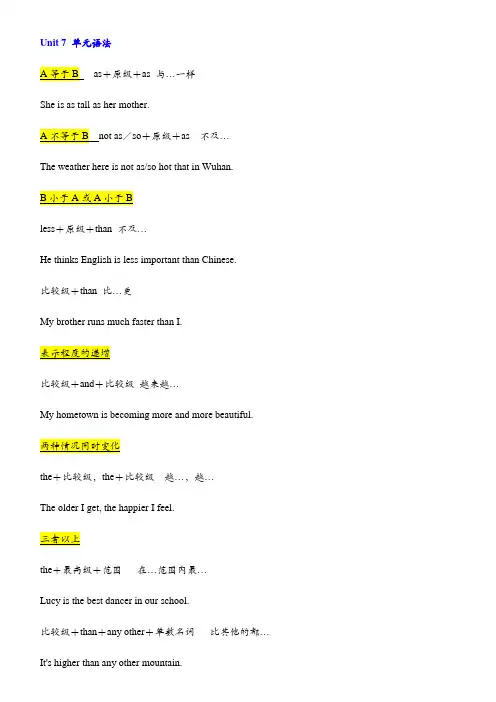
Unit 7 单元语法as+原级+as 与…一样She is as tall as her mother./so+原级+as 不及…The weather here is not as/so hot that in Wuhan.less+原级+than 不及…He thinks English is less important than Chinese.比较级+than 比…更My brother runs much faster than I.比较级+and+比较级越来越…My hometown is becoming more and more beautiful.the+比较级,the+比较级越…,越…The older I get, the happier I feel.the+最高级+范围在…范围内最…Lucy is the best dancer in our school.比较级+than+any other+单数名词比其他的都…It's higher than any other mountain.速记口诀两者相比用比较,三者以上用最高。
两者若是一个样,as...as要用上。
甲不如乙加not,意思与less than 差不多。
程度递增“越来越...”,比较级用and来连接。
两种情况同时变,“the more...,the better”是样板。
特别提醒1.在比较时,要注意比较的对象要一致且比较的双方不能重叠。
My pencil is longer than yours.我的铅笔比你的长。
(不用you)2.在比较级之前可用much,even, still, a little, a bit, a lot等修饰,以加强语气。
I think fish is much more delicious than pork. 我认为鱼肉比猪肉美味多了。
巩固练习一、单项选择。
1.LeBron James is one of __________ players in the NBA. He is my hero.A.betterB. the bestC.worseD.the worst2. Nobody worked the math problem out. It was__________ one of all.A.easierB. the casiestC. more difficultD. the most difficult3. __________our country gets, __________ the people will be, which is well known.A. The stronger; the happierB.The more strong; the more happyC. The stronger; the happyD. The strong; the happier4.-Roy never likes junk food. -Neither do I. That's probably why I'm becoming__________ now.A. healthy and healthyB. more and more healthilyC. weaker and weakerD. healthier and healthier5. Another reason for __________pandas is because people are cutting down the forestA. fewer and fewerB. less and lessC. few and fewD. less and less6. __________vegetables and __________meat can make you healthy.A.More;fewerB.Much;littleC.More;lessD. Less; more7.China has __________ population in the world.A. the mostB. the largestC.the hugestD. the big8.-Which is the __________Salt Lake in the world? -The Caspian Sea.A.highestB.deepestC.longestD.tallest二、根据汉语提示完成句子。
2020年人教版初中英语基础语法 (八升九) 暑假专题突破与巩固 学案(十三):主谓一致篇
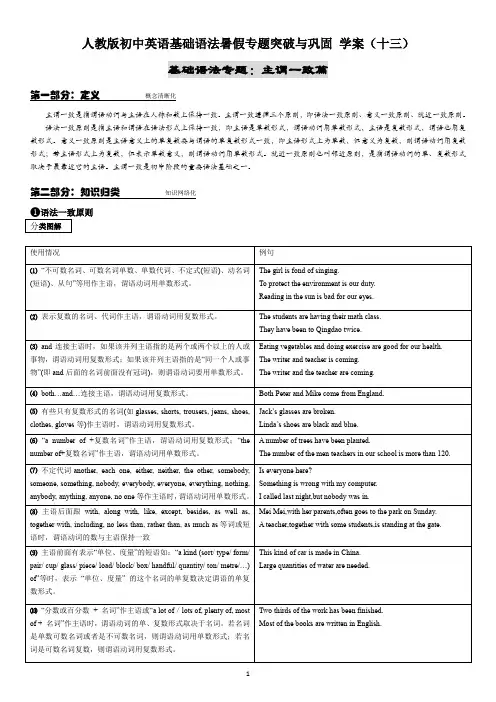
人教版初中英语基础语法暑假专题突破与巩固学案(十三)基础语法专题:主谓一致篇第一部分:定义概念清晰化主谓一致是指谓语动词与主语在人称和数上保持一致。
主谓一致遵循三个原则,即语法一致原则、意义一致原则、就近一致原则。
语法一致原则是指主语和谓语在语法形式上保持一致,即主语是单数形式,谓语动词用单数形式,主语是复数形式,谓语也用复数形式。
意义一致原则是主语意义上的单复数要与谓语的单复数形式一致,即主语形式上为单数,但意义为复数,则谓语动词用复数形式;若主语形式上为复数,但表示单数意义,则谓语动词用单数形式。
就近一致原则也叫邻近原则,是指谓语动词的单、复数形式取决于最靠近它的主语。
主谓一致是初中阶段的重要语法基础之一。
第二部分:知识归类知识网络化,如果表示的是单数意义,则谓语动词用单数形式;如果表示的是复数意义,则谓语动词用复数形式。
如:What we need is time.我们需要的是时间。
What she needs are good books.她需要的是一些好书。
2.and连接并列主语,若前面有each,every,many a,no等词修饰时,谓语动词通常用单数形式。
如:Each boy and each girl has got a present.每个男孩和女孩都收到了一份礼物。
【题组训练】( )1.Climbing hills _____ good for our health.A.areB.isC.wasD.were( )2.—What are you going to do this weekend?—I together with my classmates ____ going to climb Mount Qian.A.isB.amC.areD.Were( )3.—I called you at 5:00 yesterday afternoon,but no one answered.—Sorry,I with my parents______ at that time.A.was shoppingB.were shoppingC.are shoppingD.went shopping( )4.A number of volunteers ____ from far away cities.A.isB.areC.is comeD.arc come( )5.The zoo keeper is worried because the number of visitors ________ smaller and smaller.A.becomeB.are becomingC.is becomingD.have becomes结尾的地理名称,如果是国名,如the United States,the Netherlands等,谓语动词用单数形式;如果是群岛、山脉、海峡、瀑布等地理名称作主语,谓语动词用复数形式。
2020年人教版九年级英语Unit 8—9基础巩固与强化(无答案)
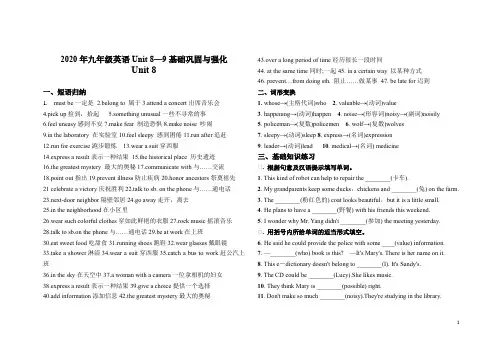
2020年九年级英语Unit 8—9基础巩固与强化Unit 8一、短语归纳1.must be一定是2.belong to 属于3.attend a concert出席音乐会4.pick up捡到,拾起5.something unusual一些不寻常的事6.feel uneasy感到不安7.make fear 制造恐惧8.make noise 吵闹9.in the laboratory 在实验室10.feel sleepy 感到困倦11.run after追赶12.run for exercise跑步锻炼13.wear a suit穿西服14.express a result表示一种结果15.the historical place 历史遗迹16.the greatest mystery 最大的奥秘municate with与……交流18.point out指出19.prevent illness防止疾病20.honor ancestors祭奠祖先21 celebrate a victory庆祝胜利22.talk to sb. on the phone与……通电话23.next-door neighbor隔壁邻居24.go away走开,离去25.in the neighborhood在小区里26.wear such colorful clothes穿如此鲜艳的衣服27.rock music摇滚音乐28.talk to sb.on the phone与……通电话29.be at work在上班30.eat sweet food吃甜食31.running shoes跑鞋32.wear glasses戴眼镜33.take a shower淋浴34.wear a suit穿西服35.catch a bus to work赶公汽上班36.in the sky在天空中37.a woman with a camera一位拿相机的妇女38.express a result表示一种结果39.give a choice提供一个选择40.add information添加信息42.the greatest mystery最大的奥秘43.over a long period of time经历很长一段时间44. at the same time同时;一起45. in a certain way 以某种方式46. prevent…from doing sth. 阻止……做某事47. be late for迟到二、词形变换1. whose→(主格代词)who2. valuable→(动词)value3. happening→(动词)happen4. noise→(形容词)noisy→(副词)noisily5. policeman→(复数)policemen6. wolf→(复数)wolves7. sleepy→(动词)sleep 8. express→(名词)expression9. leader→(动词)lead 10. medical→(名词) medicine三、基础知识练习Ⅰ. 根据句意及汉语提示填写单词。
八升九语法过关复习学案1-人教版英语(新九年级)暑假衔接
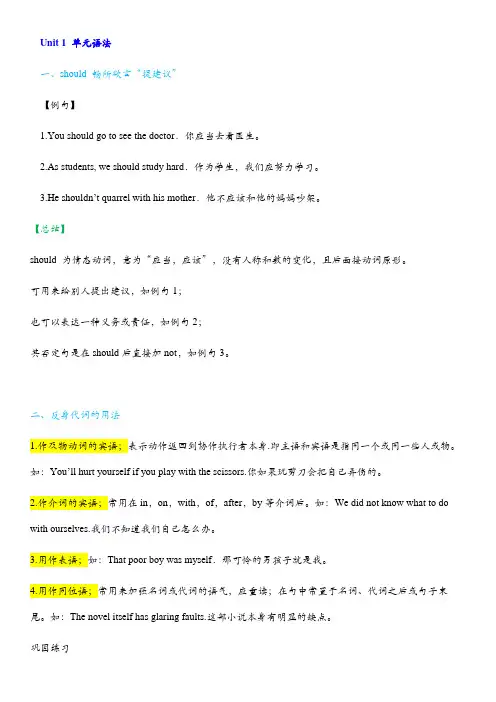
Unit 1 单元语法一、should 畅所欲言“提建议”【例句】1.You should go to see the doctor.你应当去看医生。
2.As students, we should study hard.作为学生,我们应努力学习。
3.He shouldn’t quarrel with his mother.他不应该和他的妈妈吵架。
【总结】should 为情态动词,意为“应当,应该”,没有人称和数的变化,且后面接动词原形。
可用来给别人提出建议,如例句1;也可以表达一种义务或责任,如例句2;其否定句是在should后直接加not,如例句3。
二、反身代词的用法1.作及物动词的宾语;表示动作返回到协作执行者本身.即主语和宾语是指同一个或同一些人或物。
如:You’ll hurt yourself if you play with the scissors.你如果玩剪刀会把自己弄伤的。
2.作介词的宾语;常用在in,on,with,of,after,by等介词后。
如:We did not know what to do with ourselves.我们不知道我们自己怎么办。
3.用作表语;如:That poor boy was myself.那可怜的男孩子就是我。
4.用作同位语;常用来加强名词或代词的语气,应重读;在句中常置于名词、代词之后或句子末尾。
如:The novel itself has glaring faults.这部小说本身有明显的缺点。
巩固练习一、用should或shouldn’t 填空。
1.I think you___________ go to the hospital at once.2. As a new driver, you ___________drive your car so fast. It's very dangerous.3. When you have a sore throat, you___________ drink more hot tea with honey.4.-Alice, my head feels hot now. -You___________ go to see a doctor.5.You ___________be angry with your mother. She is so kind to you.二、用所给单词的适当形式填空。
八升九语法过关复习学案5-人教版英语(新九年级)暑假衔接
Unit 9 单元语法现在完成时“来、去”追踪1.“have been to+地点”意为“曾经去过某地”,现在已不在那里,常与次数,如once, twice,three times 等连用,表示“去过某地几次”,也可与just, never, ever等连用。
I have never been to the Great Wall.我从未去过长城。
2.“have gone to+地点”意为“某人去了某地”,表示说话时,人不在现场,可能在去的途中,或已经到达目的地,该结构一般不用第一人称、第二人称代词作句子的主语。
-Where is Bob?鲍勃在哪里?-He has gone to Harbin for a meeting.他去哈尔滨参加会议了。
3.“have been in+地点”表示“已来了某地多少时间”,后面须加表示“段”的时间状语。
I have been in Shanghai for three years.我来上海已有三年了。
速记口诀“have been to+地点”“曾经到过某地方”“have gone to+地点”“去了某地”已走远“have been in十地方”“已来某地有多久”巩固练习一、从括号中选择合适的单词或短语填空。
1.Tina _________ (has been to/has been in) China for over ten years, so she knows a lot about Chinese culture.2. Though Ben has___________ (never/ever) been to Japan, he knows a lot about that country.3.-Have you___________ (ever/yet) watched this TV show?-Yes. It's interesting and educational.4. Lily isn't here. She___________ (has been to/ has gone to) the school library.5.Anna___________ (has gone to/has been to) Sanya once, and she thinks it's really a beautiful city.二、单项选择。
2020年人教版初中英语基础语法 (八升九) 暑假专题突破与巩固 学案(十):数词篇
人教版初中英语基础语法暑假专题突破与巩固学案(十)基础语法专题:数词篇第一部分:定义概念清晰化数词就是用于表示数目的多少或顺序的先后的词,分为基数词和序数词两种。
表示数量的数词是基数词,如one, two, three等;表示顺序的数词是序数词,如first, second, third等。
主要的知识点包括基数词和序数词的基本用法、hundred, thousand, million, billion后面加不加-s或of、特殊形式的序数词、倍数表示法等。
第二部分:知识归类知识网络化”分节,每三个数字为一个节,第一个分节号前用thousand,第二个分节号前用million,第三个分节号前用billion (美)或thousand million(英)。
如:2,418,000,000 two billion, four hundred and eighteen million或two thousand, four hundred and eighteen million2.hundred,thousand,million,billion等用在具体的数字后面时不能加-s或of;hundred, thousand, million, billion等前面没有具体的数字时通常加-s和of。
如:eight thousand people 八千人fifty thousand trees 五万棵树thousands of ...... 成千上万的millions of ..... 数百万的3.“基数词+单数名词”相当于复合形容词,作名词的定语,用于表示时间、距离等。
如:the 100-metre race 100米赛跑a ten-minute walk 10分钟的路程4.常见的数字符号和等式的读法:=(等于号)读作equals,+(加号)读作plus或and,-(减号)读作minus,×(乘号)读作times 或multiplied by,÷(除号)读作divided by。
2020年人教版初中英语基础语法 (八升九) (七):动词的类型篇
人教版初中英语基础语法暑假专题突破与巩固学案(七)基础语法专题:动词的类型篇第一部分:定义概念清晰化动词是表示人或事物动作和状态的词。
按照其语法功能,动词分为行为动词、系动词、助动词及情态动词四类。
行为动词又叫实义动词,分为及物动词(后面必须跟宾语意义才完整的动词),不及物动词(本身意义不完整,其后不能接宾语的动词);系动词(不能独立作谓语,必须与表语一起构成谓语);助动词(本身没有词义,不能独立作谓语,只能和别的动词一起构成谓语的词,这类词表示时态、语态、语气等特征,帮助构成否定、疑问等);情态动词(本身有一定意义,但没有人称和数的变化,不能单独使用,必须和实义动词一起构成句子的谓语,表示说话者的情感、态度和语气)。
动词的学习主要是动词的分类及各类动词的基本区别,动词的基本变化形式,常见的动词的词义辨析及动词短语固定搭配。
其中,动词和短语动词的辨析以及动词的变化形式是掌握的重点和难点。
第二部分:知识归类知识网络化The baby is smiling at us.小孩正对着我们笑呢。
He died of hunger.他死于饥饿。
Please listen to the teacher carefully.请仔细听老师讲课。
2.双宾语动词后面跟两个宾语,直接宾语为动词直接涉及的事物;间接宾语往往指涉及的人。
间接宾语有时可放到后面去,由介词to或for引导,变成介词短语。
◆能接以to引导的间接宾语的动词常见的有:bring,give,leave,lend,offer,pass,play,read,send,show,take,teach,tell,write等。
如:Could you lend your dictionary to me?请你把你的字典借我用用好吗?She passed the salt to him.她把盐递给了他。
◆能接以for引导的间接宾语的动词常见的有:bring,build,buy,cook,meet,find,get,keep,make,order,save,pick,play,sing,take,win,write等。
2020年人教版初中英语基础语法 (八升九) 暑假专题突破与巩固 学案(四):介词篇
人教版初中英语基础语法暑假专题突破与巩固学案(四)基础语法专题:介词篇第一部分:定义概念清晰化介词是英语中最活跃的词类之一,它是一种虚词,不能单独使用,必须和名词、代词或相当于名词或代词的词语连用构成介词短语,用来表明与它连用的词和句子中某个词或某些词之间的关系。
介词分为简单介词和短语介词两种。
简单介词即单个介词,如in, under, on, for, after等;短语介词指多个单词构成的介词,如in front of, instead of, far from等。
介词短语与短语介词不同。
介词短语指由“介词+名词/代词等”构成的短语,如at school, by bus, on Sunday等,在句中可以作定语、状语、表语、宾语补足语等。
有些单词,既可以作介词,也可以作连词(作连词时,其后接句子),如after, before等;而有些单词,既可以作介词,也可以作副词,如above, below等。
第二部分:知识归类知识网络化,用于将来时态;而after 意为“在……之后”,要用于一般过去时。
如:We are going to Beijing in two weeks.两周后我们将要去北京。
He went to America in 2003,after one year, he came back.他在2003年去了美国,一年后,他就回来了。
2.for和since在表示时间时,一般用于完成时,for与时间段连用,since与时间点连用。
如:We haven’t seen each other for years.我们已经有好多年没有见面了。
His father has taught in this school since 1985.他的父亲自从1985年起就在这所学校教书。
3.表示位置时,in表示某一小地点在另一大地点之内;on表示两个地点相互接壤;to则表示两个地点互不接壤,并有一定的距离。