
【PEP】三年级上册英语:Unit 5 Let's eat 第二课时说课稿·人教部编版
2、让学生观看Let's play 部分的活动,教师将活动稍加解释后即可以以“开火车”的形式开展活动。(出示课件)
我教学的是第二课时,内容为:A let's learn和let's play,本课是功能型的交际训练课,通过food和drink为话题,学习一些日常交际的用语.
二、说教学目标,结合新课程标准和大纲提出的基础教育阶段英语课程的总体目标和具体要求我将本课教学目标设计如下:
能力目标:
1、听、说、认读食物单词:juice egg milk bread。.掌握句型:I’d like … ,Here you are.
六、说课堂程序:整个教学程序我采用了听、说、玩、演、唱一系列的教学活动,具体设计为热身——复习旧知——新知——趣味操练——巩固练习。
Step1 warm-up通过和学生对话及英文歌曲,把学生带入到英语学习的氛围。
Step2课件出示单词图片,复习食物饮料名称。并在新课呈现前引入课堂竞争机制,激发学生学习的积极性。
(一)合作竞争激励法,把全班分成2个小组,事先向同学们说明竞争规则,鼓励学生互相交流,切磋,共同完成学习任务,在合作中感受学习英语的乐趣及交流的意义,也通过小组成员之间“荣辱与共”的关系而形成同步学习的环境。
(二)情境教学法,我将教学建立在满足学生心理需要的基础上。使教学活动带有浓厚的情感色彩,在单词和句型练习中使用直观的物体,学生设置了真实而有效的场景激发了想说的愿望也有利于学生表达能力的提高。
Step5、homework rewrite the five words: juice egg milk bread step6、activities after class
(1) 听录音,仿读会话,并在实际情景中运用所学内容。
(2) 将所学的食物说给家长听。
七:说板书
本节课主要是单词和句型的教学,因此,板书包括单词卡片和图片,及两个句型:I’d like … ,Here you are。
2充分利用教材和教师的多媒体教学所提供的学习资源,实现自由参与和创新,能主动与他人交流,并克服交流中的困难,使交际顺利进行。
三、说重难点,结合教学目标的要求,我把本课的重难点设置为:
1、能够听读说: juice egg milk bread
2、灵活运用句型:I’d like…,Here you are,清楚其运用的场合和语气,
2、通过在实际情境中运用简短的英语交际用语进行会话,能主动创造性的去学习和运用语言。
3、歌曲、游戏、会话表演,小组竞赛等活动,激发学生探究和自主学习的兴趣。在任务中,使学生学会如何表达自己喜欢的食物以及为别人提供或请别人吃东西时的表达语。
情感态度目标:
1通过本课学习使学生有兴趣听、说英语、做游戏、敢干开口,乐于模仿,在鼓励性评价中树立信心在小组活动中积极参与合作,从而意识到交流对于学习英语的重要意义。
3、对情境进行模仿,创新。能让学生运用所学的知识在实际生活中,正确表达自己想要的食物以及为别人提供或请别人吃东西时的表达语。
四、说教法与学法
我主要通过感知新教材——设置——灵活运用这三个主要步骤来突破教材重难点的。在教学开始让学生以旧带新引入新知,通过对教材的了解感知新任务,并在教师用单词卡片、图片、录音和PPT等多种媒介的感官刺激下实现对知识的体验和实践,最后在真实的生活情境中运用、实现能力的发展。
(三)鼓励法,课堂评价主要以鼓励性评价为主分别采用了师评、组评、自评为主要方式,课上师恰当的使用激励性评语和赠送小礼物的方法让学生渴望成功的心理得到满足,这也是激励学生积极投身英语学习的一个最简单而有效的方法。
五、下面说一下教具的安排和使用:依据英语教学的直观性,趣味性、实践性的教学原则,结合合作学习和任务型教学的新理念,我利用了图片、单词卡片及教材相配套的教学课件等媒体积极参与教学活动。
【PEP】三年级上册英语:Unit 5 Байду номын сангаасet's eat 第二课时说课稿·人教部编版
编 辑:__________________
时 间:__________________
’s eat第二课时说课稿
1、说教材
我说课的内容是小学英语三年级上册第五单元let's eat。以food和drink为话题,分为ABC三部分,以AB部分let's learn中的食物和饮料单词为线索,AB部分let's talk为桥梁,C部分的任务活动为中心,贯穿整个单元。AB部分let's learn为词汇教学,内容为五种食物单词和三种饮料单词,AB部分let's talk为句型教学,内容为应用食品和饮料单词进行日常交际对话,在学习新知识时落实任务型教学,将let's play let's do let's sing和story time等形式多样的任务活动与food和drink串联起来。
Step3 presentation
1、先通过单词卡片呈现单词,教学食物和饮料的单词。读准单词的发音。能将单词和食物对应,并通过游戏“大小声”巩固单词发音。
2、练习句型:I’d like some...... 以食物和饮料的单词为线索,表达自己想要的食物和饮料,
3、练习句型:Here you are 以食物和饮料的单词为线索,正确表达为别人提供食物和饮料时的表达用语。
人教版PEP英语三年级上册《Unit 5 Lets eat》 说课稿 2

人教版PEP英语三年级上册《Unit 5 Lets eat》说课稿 2一. 教材分析《人教版PEP英语三年级上册》第五单元的主题是“Let’s eat”,主要围绕食物和饮食文化展开。
通过本单元的学习,学生将能够掌握一些基本的饮食相关的词汇,如apple, banana, cake, milk等,同时学习到如何使用一般现在时表达饮食习惯。
本节课的内容贴近学生的生活,能够激发学生的学习兴趣。
二. 学情分析三年级的学生已经掌握了基本的英语语音和一定的词汇量,对英语学习有了一定的认识和兴趣。
然而,学生的英语水平参差不齐,部分学生对英语学习的兴趣不高,需要教师通过有趣的教学活动来激发他们的学习兴趣。
三. 说教学目标1.知识目标:学生能够掌握本节课的生词和句型,并能运用到实际情景中。
2.能力目标:学生能够用英语简单描述自己的饮食喜好和习惯。
3.情感目标:通过本节课的学习,学生能够培养对饮食文化的兴趣,提高对健康饮食的认识。
四. 说教学重难点1.重点:学生能够掌握本节课的生词和句型,并能运用到实际情景中。
2.难点:学生能够用英语描述自己的饮食喜好和习惯,并能正确使用一般现在时。
五. 说教学方法与手段本节课采用任务型教学法,通过各种有趣的活动和游戏,让学生在实际情景中运用英语。
同时,运用多媒体教学手段,如图片、视频等,帮助学生更好地理解和记忆。
六. 说教学过程1.热身(5分钟):通过唱一首关于食物的英文歌曲,激发学生的学习兴趣,并引入本节课的主题。
2.呈现(10分钟):教师通过展示食物图片,引导学生说出食物的名称,并介绍自己的饮食喜好。
3.任务(10分钟):学生分组,每组选择一种食物,用英语描述这种食物的特点和自己的饮食喜好。
4.练习(5分钟):学生进行角色扮演,模拟在餐厅点餐的场景,运用本节课的句型和词汇。
5.总结(5分钟):教师引导学生总结本节课所学内容,并提醒学生注意健康饮食。
七. 说板书设计板书设计简洁明了,主要包括本节课的主题“Let’s eat”和主要生词,如apple, banana, cake, milk等。
人教版小学英语三年级上册《Unit 5 Let's eat》说课稿
人教版小学英语三年级上册《Unit 5 Let's eat》说课稿一、说课题我们的课题是《在课堂教学中培养小学生倾听能力的研究》。
它是2008年的规划课题,其课题编号为2008-JKGHB-43,于2010年6月结题。
在平时的教学过程中,我们发现部分学生在课堂中不会倾听、不想倾听、不懂得倾听的重要性。
为了进一步了解学生产生这种现状的原因,并能针对这种现状及原因研究出相应策略,从而提高学生的倾听能力,使其养成良好的倾听习惯,因此,我们提出此课题研究。
课题研究小学生在课堂教学中倾听能力的现状,如何引导教师转变教育观念及提高学生的倾听能力,使其养成良好的倾听习惯。
本课题研究目标为:(1)准确把握学生倾听能力的现状,并积极探索出培养学生倾听能力的方法途径;(2)促使学生养成专注的倾听习惯,提高学生在各种倾听环境中排除外界干扰的能力;(3)提高学生的倾听能力,使学生能听得准、理解快、记得清,并且具有较强的倾听品评力和组合力。
通过一系列实验活动的开展,学生在课堂上不管是倾听老师流畅规范的语言表达,还是同学稚嫩的描述,都可以做到认真倾听,认真理解,通过倾听不断努力把规范、生动的语言内化成自己的语言,也能在认真倾听后去思考自己所要表达的语言,能做到正确的“思维反馈”,倾听能力有了显著提高。
今天我给大家展示的是《在小学英语课堂教学中培养小学生倾听能力的研究》这方面的内容。
作为英语老师,在平常的教学中我发现小学生的倾听意识淡薄,倾听能力也比较弱。
这样不仅会严重影响到学生综合能力的提高,使他们不能正确理解教师的意图,和吸收同学的长处,甚至还会对学生的思维发展造成非常不利的影响。
在英语课堂中,学生光有表达是不够的。
《英语课程标准》中明确指出,基础教育阶段英语课程的任务是:“使学生掌握一定的听、说、读、写技能”。
这里所指的“听”不但要求学生“听见”,还要求学生把所听的内容吸收内化为自己的知识。
结合课题,我在教学中通过行动研究法、调查研究法、文献资料法引导学生掌握基本的倾听技巧与方法,让学生能边听边想、听后复述、视听结合、听中生疑、听中解惑、听中积累、听中成长。
PEP小英三年级上册Unit5Let's-eat!(LessonTwo)教学设计
PEP小学英语三年级上册Unit 5 Let’s eat!(Lesson Two)教学设计教学内容:Unit 5Let’s eat!( A Let’s learn)教学目标:1 能听说、认读本课所学关于食物的单词bread ,juice, egg, milk, cake,water 。
2 能用英文介绍这些食物.3 能听懂一些简单的有关进食的指令语,并能按照指令做出相应的动作。
教学重点:能听说、认读本课所学关于食物的单词bread ,juice, egg, milk, cake,water 。
教学难点:能听懂一些简单的有关进食的指令语,并能按照指令做出相应的动作。
教具:单词卡片、录音机教法:TPR、小组合作。
教学流程:1 、热身、复习 (Warm-up/Revision)Listen and do。
全班听口令,做动作。
T:Act like a bird / panda/monkey/tiger/elephant.学生分组表演,比一比哪一组最好。
2 、呈现新课 (Presentation)板书教师课题Unit 5 Let’s eat并带读。
引入本节所学食品。
T:(1)教师置疑:你们还记得上节课 Sarah 的 party 中都有什么食物吗?学生凭借记忆说单词。
(2)单词bread教学。
教师画简笔画面包。
T: Ok. Let’s see together. What’s this?Ss:bread.T:Yes,It’s bread.并反复带读。
学生跟读。
教师边做吃面包的动作边说。
T:Have some bread.启发学生理解其含义。
学生与教师一起边说边做。
Have some bread.单词juice, egg, milk, cake,water 教学方法同bread。
(3)教师播放本课时的教学录音,学习食品单词bread ,juice, egg, milk, cake,water 。
听录音、指单词、跟读单词。
PEP三年级上册Unit-5-Let's-eat第二课时教案
PEP三年级上册Unit 5 Let's eat第二课时教案一、教学内容本课时的教学内容是PEP三年级上册Unit 5 Let’s eat第二课时A Let’s learn部分的内容。
本部分主要是学习关于食物的单词cake, hamburger, hot dog, chicken, French fries, bread及有关进餐的几个指令,并能根据指令做出相应的动作。
二、教学目标:知识目标:1、能够听、说、认、读cake, hamburger, hot dog, chicken, French fries 和bread六个关于食物的单词。
2、能够听懂有关进餐的几个指令,并能根据指令做出相应的动作。
如:Show me the hamburger. Pass me the French fries等。
能力目标:1、能够熟练掌握cake, hamburger, hot dog, chicken, French fries和bread 六个关于食物的单词。
2、能够将所学知识灵活运用到实际生活中。
三、教学重点:学习单词:cake, hamburger, hot dog, chicken, French fries, bread 。
四、教学难点:chicken, bread 和French fries 三个单词发音的纠正。
听懂有关进餐的几个指令,并按指令做动作。
五、教具准备:1 教师准备cake, hamburger, hot dog, chicken, French fries, bread 这些单词的图片和单词卡。
2 新课呈现时的教学课件。
3 教材配套的录音带。
六、教学过程:1 热身、复习(Warm-up/Revision)(1)日常口语会话展示。
(2)学生三人一组,模仿本课A 部分Let’s talk的对话,用各自所带的食物改编对话,教师可选择几组在班上表演。
2 呈现新课(Presentation)(1)教师置疑:你们还记得上节课Sarah 的party 中都有什么食物吗?学生凭借记忆说单词。
人教(PEP)三年级上册英语Unit 5 Let's eat第二课时教案
Unit 5 Let's eat!第二(dìèr)课时教学目标1. 听、说、认读单词juice,egg,milk,bread。
2. 要求学生能听懂、辨认图片中所学的食物及书写形式。
3.利用课文提供的场景和动作呈现句型,加深学生对I'm hungry.Have some…的理解。
4. 根据句型How some…做相应的动作。
教学重点1. 本课时单词juice,egg,milk,bread。
2. 运用句型Have some eggs/…进行表演。
教学难点1. 听懂有关进餐的几个指令,并按指令做动作。
2. 初步了解名词复数和不可数名词。
教学准备1. 教师准备juice,egg,milk,bread的实物、图片和单词卡片。
2. 教师准备本课录音及课件,教学挂图,小奖品等。
3. 学生准备A部分单词的词卡和图卡。
4. 学生可准备juice,egg,milk,bread 的实物。
教学方法1. 实物演示法:教师利用实物展示给大家:egg,juice,milk,bread,同时大声读出单词。
2. 情景教学法:学生们把自己准备的食物拿出来,教师说:Have some bread.学生迅速拿出面包,并放在嘴边开始“吃”。
教师要观察看哪一组学生的动作既快又准。
教学(jiāo xué)过程Step 1:Warm-up1. 教师播放歌曲Let's have a picnic today,学生一起拍手跟唱。
2. Greeting:T: Hello, boys and girls! I'm Miss Wang.Ss: Hello, Miss Wang!T: How are you?Ss: I'm fine, thank you! And you?T: Very well, thanks! Let's listen to a song, OK?Ss: OK!Step 2:Presentation1. 猜一猜复习Part A学过的单词,引出新单词milk。
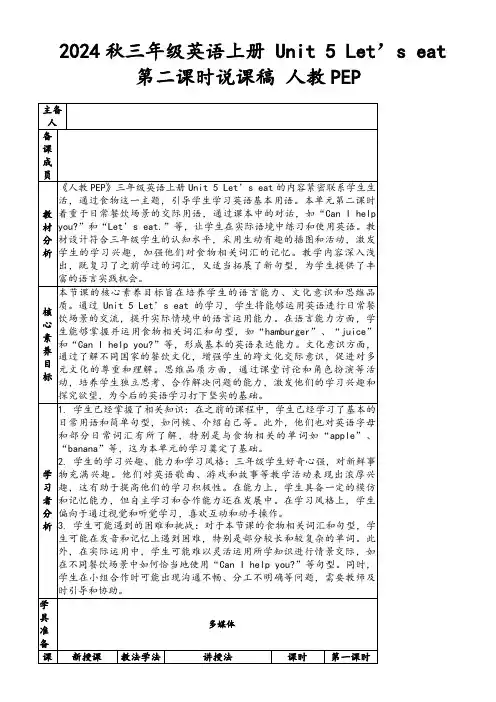
2024秋三年级英语上册Unit5Let’seat第二课时说课稿人教PEP
例子:
Name | Favorite Food
------------|--------------
Mom | Fish
Dad | Steak
Friend | Vegetables
作业布置与反馈
作业布置:
1. 设计自己的菜单:请学生用英语设计一份简单的菜单,至少包含5种食物和饮料,并标注价格。例如:
- hamburger: $5
- pizza: $8
- juice: $3
- ice cream: $4
- apple: $2
2. 角色扮演对话:学生两人一组,模拟餐厅点餐场景,编写并表演一段对话,其中一人扮演服务员,另一人扮演顾客。
3. 食物描述练习:请学生选择一种他们最喜欢的食物,用英语写一段描述,包括食物的名称、味道、颜色和如何食用。
4. 家庭餐厅游戏:学生与家人一起玩“家庭餐厅”游戏,学生扮演服务员,用英语向家人点餐,家人根据学生提供的菜单选择食物。
例子:
Student: Welcome to our family restaurant. Can I take your order?
Parent: Yes, I'll have the pizza, please.
2. 对学生角色扮演对话进行评价,关注学生在对话中的语音、语调、语法和表达流利程度Байду номын сангаас给出改进建议。
3. 对学生的食物描述练习进行批改,关注学生对食物特点的描述是否准确,指导学生如何运用形容词和动词来描述食物。
4. 对学生家庭餐厅游戏进行评价,关注学生是否能正确运用所学句型,以及家庭成员的参与度,鼓励学生多与家人进行英语交流。
最新人教PEP版小学英语三年级上册Unit 5 Let's eat ! 第2课时公开课教案
S1:Thank you.
Take out some pictures of food and make a dialogue with a student.
T:What would you like?
Let the student pick a picture.
Let students look at the picture of “Let’s talk” carefully. Ask some questions to help them predict the main idea of the dialogue.
T:Who are they? What do they have for breakfast?
S1: I’d like some bread.
S2: I’d like some bread and eggs.
Step 3 Consolidation&Extension
激发学生的学习兴趣和提高学生的综合语言运用能力。
1. Let’s chant
根据图片填空并形成歌谣。Let studentsfill in the blanks according to thepictures. Practice the sentence structure “I’d like some...” in groupsand make a chant,then show in class.
I say,you do
邀请学生上台听指令利用道具做出相应动作。Asksomestudentsto come to the frontandLet students do the actions according to the teacher’s instructions.
PEP三年级上册Unit5 Let's eat说课稿
Pep Primary English Student’s Book OneUnit Five说课稿Unit Five Let’s Eat-------By Allen Hello. My topic is Unit Five Let’s Eat, PEP Primary English Students’ Book One. I divide it into five parts.I、Talking about the teaching materials.(A). Analysis of the teaching materials.The new book is based on the things that the students know well, and uses the situations we meet everyday to bring out the new words and dialogues, which are required to be mastered according to the ‘New English Curriculum Standard’. Unit Five A Let’s Learn and Let’s Talk begins with the theme of the unit “Le t’s Eat”. The students need to master several names of food and know how to make dialogues in the restaurant. It’s very practical.(B). Teaching aims.According to the requirements from Bruno’s teaching aims theory on learning and the ‘New English Curriculum Standard’, I make this lesson’s teaching aims as below: 1, Language knowledge aims:1), Four skill words: hamburger, hot dog, French friescake, bread, chicken2), Three skill sentences: I like sth.Here you are.Thank you.2, Language function aims:Know how to say I want something.3, Moral education aims:Get used to be polite.4, Ability aims:Acquire the ability of communications in English.(C). Teaching key points:Four skill words and three skill sentences.(D). Teaching difficult points:The words in many syllables.II、Talking about the ways of teaching.“Every teacher should try his best to make the students be interested in his class, and let them love the subject.” Educationist B A Cyxomjnhcknn says in his book ‘100 advises for the teachers’. Therefore, teachers are asked to use lots of teaching methods which are suitable to inspire the students’ interest in learning. Based on this lesson’s specialties and the students’ level of English, I use the teaching methods as below: (A), Multimedia assistant approach.Psychological knowledge tells us: new and different stimulations can easily draw people’s attention, and people would pay the most attention to them. Multimedia is good at making stimulations in class, and can strongly attract the students. Therefore, I use the multimedia to teach my lesson, and bring out the new words and sentences through the dialogues between the customers and the waiters in the restaurant, so I can easily arouse the students’ interest in learning and more importantly, it can give a strong impression on the students.(B), Teaching in real situations.British Linguist Palmer and Hornby’s teaching in real situations emphasizes that the languages must be used in the real situations, and let the students learn in a vivid way. When they finish learning ‘I like something-Here you are-Thank you’, I use the multimedia to bring out real scenes, such as a restaurant, a stationer, and a pet shop to let the students to talk and use English.(C), Communicating approach.American society linguist Haymes’communicating teaching emphasizes that foreign language teaching should always cultivate the students’ communicating ability, and the students can only learn through the constant use of language in communications. According to the lesson’s applicability, I encourage the students touse the words and sentences from the text to communicate with each other in different situations, so as to improve their ability of learning English.(D), Teaching in activities.Most of the primary school students are inclined to play, to sing, to imitate and to act. Therefore, teaching English in a primary school should let the students acquire English unknowingly through activities, such as talking, singing, playing, and acting. In my teaching of the lesson, I have different forms of activities for them, songs, games, competitions, actings, etc. They can learn it happily and easily.III、Talking about the Learning methods.‘New English Curriculum Standard’ says: making the students to get into a better learning habit and study efficiently is one of the important tasks for the English class. As for teachers, we have to pay attention to the ways of learning for the students, and make them gradually acquire the skills of how to learn by themselves through the learning and the using of English. Therefore, I use the learning methods for the students as below:1, Preparations before class.Good learning habit must be started early. Every time before I give them a new lesson, I ask the students to find out the Chinese meanings for the new words and new sentences in it, and then listen to the recording, and read or simulate after the recording, therefore, before I teach them, they would know something about the contents of the new lesson. By the time we are having the new lesson together, they will easily understand and follow my class, and as for the difficult words or sentences, they would now learn from the teacher with aims, so as to cultivate their ability in learning all by themselves.2, Innovative thinking.‘New English Curriculum Standard’pays much attention to the student s’innovations of thinking. Therefore, in the lesson, I can not only request the students to read the words and sentences in the text, more importantly, I ask them to use what they have learned in the past and what they are learning right now to say out or talkinto new sentences. When they finish the new lesson, I ask them to have a competition in new and old sentences’ structures. They can learn to combine the old with the new, and so as to cultivate the students’ thoughts of innovations.IIII、Talking about the teaching procedures.IV. Talking about the blackboard writings.I put the new sentence structure of the new lesson ‘I like …, Here you are. Thank you.’with the new words on the blackboard, which means the teaching key and difficult points are shown and the students would easily know what they have learned from this class. Of course, the new words with the pictures give the students a strong impression. What’s more, I have a grading table for the four groups. See which group will be the best one in the class, and they would be very happy to learn with competitions.Blackboard WritingUnit Five Let’s eatI like hamburgers. cake. 一二三四hot dogs. chicken.French fries. bread.Here you are.Thank you.附表:Food Fruits Toys Animals Stationery。
人教PEP三年级上册英语说课稿Unit5Let'seat!第二课时
人教PEP三年级上册英语说课稿Unit 5 Let’s eat! 第二课时一. 教材分析《人教PEP三年级上册英语》Unit 5 “Let’s eat!” 主要围绕食物和饮食文化展开,通过学习本单元,学生能够掌握关于食物的基本词汇,如apple, banana, rice, cake 等,同时学会使用情态动词can来表达自己的能力,如I can eat, You can eat等。
此外,本单元还包括了简单的日常对话交流,如A: What can you eat? B: I can eat apples and bananas. 通过对教材的分析,我们可以看出,本单元主要目标是让学生能够用英语简单介绍自己能吃什么食物,并能够进行简单的日常交流。
二. 学情分析在三年级的学生中,他们已经初步掌握了英语的基本发音规则,能够听懂并说出一些简单的单词和句子。
但是,他们的语法知识和词汇量仍然有限,对于一些复杂的句子结构和情态动词的用法可能还不太理解。
因此,在教学过程中,我们需要注重基础知识的巩固,并通过生动的例子和实际操作,帮助他们理解和运用新学的词汇和句子。
三. 说教学目标根据教材和学情分析,本课的教学目标设定为:1.能够听懂并准确说出关于食物的基本词汇,如apple, banana, rice,cake等。
2.能够使用情态动词can来表达自己的能力,如I can eat, You can eat等。
3.能够用英语进行简单的日常交流,如A: What can you eat? B: I caneat apples and bananas.四. 说教学重难点本课的重难点主要是情态动词can的用法和关于食物的词汇。
对于情态动词can的用法,学生可能还不太熟悉,需要通过具体的例子和实际操作来帮助他们理解和运用。
而对于关于食物的词汇,学生需要通过图片和实际物品来加深对单词的记忆和理解。
五. 说教学方法与手段为了更好地实现教学目标,我采用了以下教学方法和手段:1.情景教学法:通过设定日常生活中的场景,让学生在实际交流中学习和运用英语。
Unit 5 Let’s eat! Part A Letters and sounds (说课稿)人
Unit 5 Let’s eat! Part A Letters and Sounds一、教学内容本课是人教PEP版英语三年级上册Unit 5 Let’s eat! Part A Letters and Sounds。
本课是围绕饮食话题展开,旨在让学生学会描述自己的饮食习惯以及从听、说、读、写四个方面提高学生的英语水平。
本单元的 Letters and Sounds 环节是让学生练习元音字母及固定单词的发音,提高学生的英语发音能力。
二、教学目标1.听懂并正确发音 5 个元音字母 /a/、/e/、/i/、/o/、/u/ 的发音,能够运用这些字母读出固定的单词。
2.能够准确拼写并使用单词 eat、meat、bread、egg、soup、juice、milk。
3.能够口头描述自己的饮食习惯和喜好。
三、教学重点和难点•教学重点:让学生正确发音元音字母及固定单词,能够准确拼写并使用单词eat、meat、bread、egg、soup、juice、milk。
•教学难点:发音时能够区分元音字母。
四、教学准备1.PPT 视频和图片。
2.小黑板和小白板。
3.英语单词卡片。
五、教学过程步骤一:导入新课(约 5分钟)1.教师出示 PPT 中关于饮食的图片,问学生们喜欢吃哪些食物。
2.引导学生自主说出他们最喜欢的食物和饮料。
3.通过回答问题来增加学生的积极性,调动学生的学习热情,为学习做好铺垫。
步骤二:学习元音字母(约 10分钟)1.通过 PPT 展示元音字母 a、e、i、o、u 的形态和发音,并用简单易懂的语言向学生介绍元音字母。
2.教师带领学生感受元音字母的发音,引导学生跟着老师一起说出元音字母的发音。
3.用 PPT 展示单词卡片,让学生读出卡片上的单词,并带领学生用正确的发音读出固定单词。
步骤三:学习单词(约 20分钟)1.教师通过 PPT 展示单词 eat、meat、bread、egg、soup、juice、milk,并带领学生跟着读单词。