
非谓语动词作定语
Pratice three
1. Have you read the novel __________(write) by Luxun.
2. This is the problem __________(disscuse) at the meeting yesterday.
3. At first, the English __________(speak) at that time was very different from the English __________(speak) today .
1.to send 2. to be sent 3. to leave 4. to be published 5. to be washed
分类 用途
动名词
定语 分词
将来 具体动作
不定式
doing
主动 进行
令人…的
被动 done 完成 感到…的
Let’s do some exercise!
Exercise
The boy wearing a red T-shirt is Jack.
done
The lesson given is very important.
doing 动名词的特点:
① 性能 ② 用途
a swimming pool = a pool for swimming a dancing Teddy = a Teddy for dancing
3.Please tell the childrenpl_a_y_in_g__(play)outside not to make so much noise. 4.They lived in a room_f_a_c_in_g(face) the south.
5. _B_a_r_k_in(bgark)dogs seldom bite. 6.Some of the experiments _d_e_s_c(rdibeesdcribe) in the book are easy to perform. 7.There have been several new events _a_d_d_e_d(add)to the program for the 2008 Beijing Olympic Games. 8. The building __to__b_e_b(buuilitld) next mouth is our new schook.
1.learning 2. lying 3. exciting 4. standing 5. being sung
Done 过去分词特点
被动、完成、 感到……的
I have a radio made in China. (被动)
Look at the broken glass. (被动、完成)
The excited people shouted and cheered.(感到……的)
系动词
He is sent to Shanghai. 被动语态
非谓语:主要包括不定式(to do),v-ing形式以 及过去分词pp(done)。无人称,数的变化,不 单独作谓语,但保留动词特点,可以有宾语或状语。
to do
I have something to tell you.
非谓语动词
doing
held
Infinitive (to do)
表将
表目的
来
表某一次具体的动作
I have a lot of work to do. 将来
We have made a plan to learn
from Lei Feng.
某一次具体的动作
I am looking for a room to live in.
1. Waiting 2. speeding 3. building 4. reading 5. walking
V-ing 现在imming boy is Tom. (主动、进行)
the room facing south (主动)
The film is disappointing. (令人……的)
Pratice four
1. Have you anything _____________ ( send )? 2. Have you anything _____________ ( send) ? 3. He had no reason _____________ (leave )his friends and live alone on the island. 4.His first book ____________(publish) next month is based n a true story. 5. Do you have any clothes ____________(wash).
The letter being written is for Sandy (被动)
Pratice two
1. A little child __________(learn) to walk often falls. 2. The pen __________(lie) on the desk belongs to me 3. We saw an __________(excite) film last night. 4. The boy __________(stand) there is my classmate. 5. Listen! The song __________(sing) is very popular with the students.
He is the first(student) to come and the last to leave. 一些需要不定式作宾语的动词转化成的名词,agreement,attempt, decision, need, promise, plan, wish等,常用不定式来修饰.
There is no need to send for a doctor .
目的
The bridge to be built next year is
large and wide.
被动
不定式作定语的基本条件
不定式与它所修饰的名词在逻辑上必 须具备以下条件之一:
1. 主谓关系 2. 动(介)宾关系 3. 说明所修饰词的内容
多为抽象名词或序数词
分析下列句子
He is the right person to do it. 主谓
动名词 drinking water
=the water for drinking reading room
=the room for reading
Pratice one
1. None is allowed to smoke in the __________(wait) room. 2. The __________(speed) car come to a stop all of a sudden. 3. These are the __________(build) materials. 4. The __________(read) room is bright and large. 5. He is holding a __________(walk) stick.
9. The building __b_e_i_n_g(bbuuiilldt ) now is our new schook.
10. The buildingb_u_i_lt___(build) last year is our new schook.
Thank you for listening! See you!
He has a lot of work to do. 动宾
It’s the best way to learn English.
说明内容
Attention
当特定的谓语动词(有,需要,给,找,弄have, need, want, give, find, get)后的名词(或宾语)用不定式来修饰. I want to get something to read . 当名词有特定的定语,如形容词\副词的最高级,序数词及next, only, right等,其后接不定式作定语。
非谓语动词 作定语
By Mrs Xiao
Revision
谓语动词与非谓语动词的定 义区别
谓语:说明主语所做的动作或具有的特征和状 态。它有人称、数量、时态和语态的变化。
e.g. We study.
单个谓语
We will go to colleage. You are students.
情态动词/助 动词+ v.
不定式、动名词和分词都可以作定语,主要区别在于它们的时态意义和语态意义。
1.Their decision_t_o_g_i_v(egive) up the experiment surprised us. 2.He was the last oneto__le_a_v_e_(leave)school yesterday.
4. China is a __________(civilize) country with a history of 5000 years .
5. The Olympic Games, first ________(hold) in 776 BC, did no1t.winrcitlutedne w2o. mdiesnsccuosmedpe3t.itsoproskuennt,isl1p9o1k2e.n 4. civilized 5.
非谓语动词作定语和宾语补足语总结
非谓语动词作定语和宾语补足语总结非谓语动词是指不带有谓语成分的动词形式,包括动词不定式、动名词和现在分词、过去分词。
在句子中,非谓语动词可以用作定语和宾语补足语,用于修饰名词或补充说明动作的情况。
本文将对非谓语动词作定语和宾语补足语的用法进行总结。
一、非谓语动词作定语非谓语动词作定语时,通常与被修饰词之间存在逻辑上的主动或被动关系。
常见的用法有以下几种:1. 动词不定式作定语动词不定式作定语时,说明所修饰名词的用途、目的、结果等。
常见结构为“名词 + 不定式”,不定式可以是带to的原形,也可以是不带to的原形。
例如:- 他有个完全实现梦想的机会。
- 这个女孩太害羞了,从不和人交流。
2. 动名词作定语动名词作定语时,表示该名词的用途、目的、结果等。
常见结构为“动名词 + 名词”。
例如:- 听力训练是学习英语的重要环节。
- 这本书是关于如何提高写作技巧的。
3. 现在分词作定语现在分词作定语时,表示所修饰名词正在进行的动作或状态。
常见结构为“现在分词 + 名词”。
例如:- 拉着行李箱的女人是我的妈妈。
- 那个躺在床上的男孩是我的弟弟。
4. 过去分词作定语过去分词作定语时,表示所修饰名词已经完成的动作或状态。
常见结构为“过去分词 + 名词”。
例如:- 这本被翻阅过许多次的书籍是我的宝贝。
- 我看过的那部电影非常精彩。
二、非谓语动词作宾语补足语非谓语动词作宾语补足语时,用于补充说明宾语的动作或状态。
常见的用法有以下几种:1. 动词不定式作宾语补足语动词不定式作宾语补足语时,说明宾语完成的动作。
常见的结构为“动词 + 宾语 + 不定式”。
例如:- 我喜欢听音乐。
- 她希望学好英语。
2. 动名词作宾语补足语动名词作宾语补足语时,表示宾语的动作或状态。
常见结构为“动词 + 宾语 + 动名词”。
例如:- 我通常喜欢读书。
- 他不值得你浪费时间。
3. 现在分词作宾语补足语现在分词作宾语补足语时,表示宾语正在进行的动作。
非谓语动词做定语举例

非谓语动词做定语举例一.非谓语动词的概念:指在句子中不充当谓语动词的其他动词。
二.非谓语动词的形式:动词不定式、动名词、分词(现在分词、过去分词)。
三.非谓语动词在句中充当定语(定语:常把用来修饰名词的成分称为定语。
)四:例子分析1.非谓语动词——《不定式》在句子中充当定语。
I have a meeting to attend.我有个会要参加。
(该句的主语为I;have为谓语动词;a meeting为宾语。
to attend为后置定语,用以修饰前面的名词a meeting.说明这个会议是我要参加的那个会议。
)He is the first to get to school.他是第一个到校的。
(该句中的动词不定式to get to school“到达学校”用以修饰其前面的名词the first,作其定语成分,说明“他”是第一个到校的。
)2.非谓语动词——《动名词》在句子中充当定语。
例如:There is a swimming pool.有一个池塘。
(该句中的短语a swimming pool“一个池塘”。
swimming用来修饰名词pool,说明pool“池塘”是用来“游泳的”。
)3.非谓语动词——《现在分词》在句子中充当定语。
例如:Look at the falling leaves.看那落叶。
(该句中的现在分词falling“(正在)落下的”修饰名词leaves“叶子”,说明其叶子的状态是正在掉落。
同学们注意区分现在分词与动动名词的区别,不明白这个知识点的小伙伴可以搜索冉老师历史发文哟。
)There were millions of people watching the opening ceremony live on TV.成千上万的人正在电视上观看开幕式直播。
(该句中的watching为现在分词,用以修饰名词people,说明“人们”正在观看的状态。
opening也为现在分词,用以修饰名词ceremony“开幕式”,说明开幕式是正在举办的,是一种现在进行时。
非谓语动词在句中用作定语
非谓语动词在句中作定语在英语句子中,不定式to do,分词v+ing 和v+ed 以及动名词v+ing 是非谓语动词,除不能作谓语外,其他成份都可担当,其中一个成份就是作定语。
不定式to do在句中作定语置于被修饰名词后,常同该名词构成动宾关系,要是不定式是不及物动词,其后应加上必要的介词。
例:I have something to say. (to say something )I’ll give you a magazine to read.That is a good company to work for.He is a pleasant fellow to work with.Would you bring me a bench to sit on?有些名词常接不定式作定语,如:chance ,time ,reason ,way ,effort ,right (权利), mo vement等,例:You haven’t any reason to leave me.You have no right to do such a thing.He succeeded in his effort to overcome his fatal weakness.He put himself out of the way to help others.We have no time to lose..Thank you for giving me the chance to make the speech.The first ,the last ,the second ,the best 等常与不定式连用作定语。
例:He is always the first to come.She would be the last to agree to our plan.You are the second to ask me that question.I’ll do my poor best to fix it up.当to go ,to spare 作“剩下”讲时可作定语。
非谓语动词做定语
在所修饰的后面。
doing 表主谓关系或者正在进行 The man by the windows is our teacher.
(standing 和所修饰的man形成主谓关系) In the following years he worked even harder.
rising/risen, falling/fallen, developing /developed , changing/ changed, fading /faded, boiled/ boiling ,drowning/ drowned
China is a developing country. (发展中的) America is a developed country. (发达的)
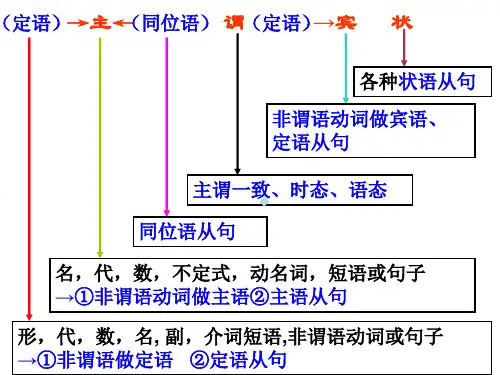
(定语)→主←(同位语) 谓(定语)→宾 状
各种状语从句 非谓语动词做宾语、 定语从句
主谓一致、时态、语态
同位语从句
名,代,数,不定式,动名词,短语或句子 →①非谓语动词做主语②主语从句 形,代,数,名, 副,介词短语,非谓语动词或句子 →①非谓语做定语 ②定语从句
非谓语动词做定语
一、认识翻译练习
1.站在那边的那个人是谁?
那个人是谁?
Who is the man?
站在那边的
定语 stand over there
Who is the stand over there man? Ⅹ
2.将要修建的建筑是属于峨眉二中
建筑是属于峨眉二中的
The building belongs to Emei No.2.
being done 表被动关系或者正在进行
非谓语动词作定语
二、非谓语动词作定语非谓语动词做定语有以下几种形式;doing 1、作动名词讲时做定语表示用途。
比如、living room, swimming pool.2、作现在分词讲时,所修饰名词或代词与其是一种主谓(主动)关系,有时还表进行。
如; falling leaves, the rising sun, boiling water, a developing country, the boy standing on the ground, the man introducing modern technology into China.done(过去分词)表示被动(与所修饰的词是动宾关系)或完成。
如;fallen leaves, the risen sun, boiled water, a developed country, the players selected fromthe whole country.being done 现在分词的被动结构,表是正在被……只做后置定语,即放在所修饰名词之后。
如;the bridge being built, the meeting being held.to do (to be done)动词不定式做定语常表示将来,有主动与被动两种形式。
1、所修饰的词与不定式动作是一种被动关系(也可以说动词不定式与所修饰的词是一种动宾关系,即所修饰的词是不定式动作的对象,)这时注意选择是用to do ,还是to be done.1、I have a lot of readings to complete before the end of this term.2、His first book to be published next month is based on a true story.2、所修饰的词与不定式是是一种主谓(主动)关系,这些词前面常常有 thefirst ,the second, the last, the next, the only等修饰。
非谓语动词作定语

bored/boring
frightened/frightening
embarrassed/embarrassing
disappointed/disappointing
encouraged/encouraging
整理课件
10
3.-ed分词作定语
The building ____b_u_il_t last year is our teaching building. (build) The building __t_o__b_e_bnueilxtt year is our teaching building. The building __b_e_i_n_g_bautilptresent is our teaching building.
It is no use thinking without action.
整理课件
26
二.
doing
宾语
to do
取决于谓语动词
整理课件
27
2.作宾语
①不定式和动名词都可作动词或介词的宾语。
有些动词后只跟不定式作宾语,如:
want, manage, demand, promise, refuse, pretend, plan, offer, decide, agree, expect/ hope/wish, choose, happen等。
2.wish
to do
3.happen to do
4.avoid doing
5.appreciate doing
6.refuse to do
5.resist doing
6.promise to do
7.pretend to do
非谓语动词作定语的用法
2、不及物动词的分词作定语: doing(表示正在进行)done(表示已经完成) 例如: boiling water 正在沸腾的水 boiled water 烧开了的水 例如: developing countries 发展中国家 developed countries 发达国家
非谓语动词作定语的用法
2.In some language ,100 words make up half of all words ___D__ in daily conversations. A using. B to use. C having used. D used
非谓语动词作定语的用法
语动词之间的被动关系;若为主动,则可选择doing ,to do ; 若为被动 ,则可选择性to be done ,being done, done
3,分析时间究竟是过去,现在还是将来; 4,考虑不定式作定语的几种情况.
非谓语动词作定语的用法
1 The room is empty except for a bookshelf _A____ in some
非谓语动词作定语的用法
(三)不定式 to be done, 现在分词being done 和过去分
词done作定语的区别
例如 1The question to be discussed tomorrow is very important .
非谓语动词作定语和宾语补足语总结归纳
非谓语动词作定语和宾语补足语总结归纳非谓语动词是指不具备人称和数的特征,在句中充当其他成分的动词形式。
在英语中,非谓语动词可以用作定语和宾语补足语。
本文将对非谓语动词作定语和宾语补足语的使用进行总结和归纳。
一、非谓语动词作定语1. 作定语的非谓语动词形式:动词的ing形式和过去分词形式。
2. 非谓语动词作定语的位置:通常放在被修饰名词之前,起修饰作用。
3. 非谓语动词作定语的作用:表示被修饰名词的性质、用途、来源、材料、状态等。
4. 非谓语动词作定语的例句:a) The running water in the river is very clear.(河中流动的水非常清澈。
)b) The damaged car has been towed away.(那辆受损的汽车已经被拖走了。
)二、非谓语动词作宾语补足语1. 作宾语补足语的非谓语动词形式:动词的不定式形式和现在分词形式。
2. 非谓语动词作宾语补足语的位置:通常放在及物动词、系动词、感官动词、使役动词等动词后面,起补充说明作用。
3. 非谓语动词作宾语补足语的作用:用来补充说明宾语的性质、特征、目的、结果等。
4. 非谓语动词作宾语补足语的例句:a) She wants to buy a new car.(她想买一辆新车。
)b) I found the children playing happily in the garden.(我发现孩子们在花园里快乐地玩耍。
)综上所述,非谓语动词作为定语和宾语补足语在英语中的应用较为广泛。
了解和掌握非谓语动词的用法对于提高语言表达能力至关重要。
通过灵活运用非谓语动词,可以使语言表达更加准确、生动,增加文章的表现力和吸引力。
因此,在英语学习中,我们要注重对非谓语动词作定语和宾语补足语的学习和应用,提高自己的语言能力。
高中英语知识点归纳非谓语动词作定语
高中英语知识点归纳非谓语动词作定语高中英语知识点归纳:非谓语动词作定语一、什么是非谓语动词作定语?非谓语动词是指动词的非谓语形式,包括不定式、动名词和现在分词。
当它们作为定语时,修饰名词或代词。
二、不定式作定语不定式作定语通常放在被修饰的名词或代词之后,用来修饰、限定该名词或代词的含义。
1. 不定式作定语的用法(1)表示将来的动作或状态:We have a lot of work to do tomorrow.(我们明天有很多工作要做。
)(2)表示目的或用途:I need a pen to write the letter.(我需要一支笔来写信。
)(3)表示结果或后果:We need a bigger table to put all the books on.(我们需要一张更大的桌子来放所有的书。
)2. 不定式作定语的注意事项(1)不定式与被修饰的名词之间可以有修饰成分:a book to read in my spare time(一本在我空闲时间读的书)。
(2)不定式可以有自己的宾语:a movie to watch(一部可以看的电影)。
三、动名词作定语动名词作定语通常放在被修饰名词之前,用来修饰、限定该名词的含义。
1. 动名词作定语的用法(1)表示被修饰名词的用途或用途:a writing desk(写字台)(2)表示被修饰名词的特征、特点:a running horse(奔跑的马)2. 动名词作定语的注意事项(1)有时动名词前面会加定冠词the:the rising sun(升起的太阳)(2)动名词可以有自己的宾语:a painting depicting nature(描绘自然的画作)四、现在分词作定语现在分词作定语通常放在被修饰名词之前,用来修饰、限定该名词的含义。
1. 现在分词作定语的用法(1)表示被修饰名词的原因:a crying baby(哭泣的婴儿)(2)表示被修饰名词的特征、状态:a falling star(坠落的星星)2. 现在分词作定语的注意事项(1)有时现在分词前面会加定冠词the:the shining moon(闪耀的月亮)(2)现在分词可以有自己的宾语:a smiling girl(微笑的女孩)五、对比不同非谓语动词作定语不定式、动名词和现在分词都可以作为定语,但它们的用法和表达的含义有所不同。
非谓语动词做定语
非谓语动词做定语非谓语动词做定语是指在句子中使用的不带有谓语动词功能的动词形式,用来修饰名词、代词或整个句子。
这类动词形式包括动名词、不定式和分词,作定语时,它们也可以表达与谓语动词相同的信息或者与之不同的信息,但其本身不表达动作的起始点或终点,也不发出一种完整的意思。
一般情况下,非谓语动词做定语都会在定语后置,只有当它们前面是一个非限定性定语时,才会放在定语前面,而限定性定语一般会放在它们前面。
另外,非谓语动词做定语时,它们的逻辑主语一般要与它们所修饰的名词保持一致。
1. 动名词做定语动名词做定语是指动名词放在它所修饰的名词之前,作为定语来修饰名词。
动名词作定语时,其后通常不加任何内容,但也可以加上“of”短语,表示把动作当做名词来看待,如:A: The announcement of the news shocked everyone. B: The news' announcing shocked everyone.此外,动名词作定语时,其逻辑主语一般与它所修饰的名词保持一致,如:The man's coming surprised us.2. 不定式做定语不定式做定语是指不定式放在它所修饰的名词之前,作为定语来修饰名词。
不定式作定语时,其后通常不加任何内容,但也可以加上“for”短语,表示不定式本身也是一种具体的动作,如:A: He was chosen to be the leader. B: He was chosen for leading the group.此外,不定式作定语时,其逻辑主语一般与它所修饰的名词保持一致,如:The dog's barking annoyed me.3. 分词做定语分词做定语是指分词放在它所修饰的名词之前,作为定语来修饰名词,这类分词包括现在分词和过去分词。
分词作定语时,其后可加上“-ing”、“-ed”或“-en”短语,表示分词本身也是一种具体的动作,如:A: The broken vase was thrown away. B: The vase broken was thrown away.此外,分词作定语时,其逻辑主语一般与它所修饰的名词保持一致,如:The girl singing on stage attracted manypeople's attention.总的来说,非谓语动词做定语时,可以用来表达与谓语动词相同的信息或者与之不同的信息,但其本身不表达动作的起始点或终点,也不发出一种完整的意思。