
译林牛津8A Unit 8 Natural disasters 教材全解及单元测试卷
译林牛津8 A Unit 8Natural disasters教材全解及单元测试卷【教材内容解析】ic strip(1)Didn’t you hear the rain? (P. 92)这是一个否定疑问句,表示一种惊讶或者不快,否定疑问句意为“难道……不……吗?”Aren’t you afraid of your father?Don’t you know you should finish your homework on time?(2)Who will mop up the water if I go home without you? (P. 92)mop此处用作及物动词,意为“用拖把擦干净”,mop up意为“擦干、抹去”。
They are mopping up the floor.2.Welcome to the unit(1)Earthquake kills thousands of people. (P. 93)thousands of表示“成千上万的”,后接可数名词复数形式,hundred, thousand, million, billion和具体数字连用时,用单数形式,只有与介词of连用,表示大约数字时,才能用复数形式。
Hundreds of birds are flying the sky.There are two thousand students in my school.(2)Coach crashes into tree. (P. 93)crash这里用作不及物动词,意为“碰撞、撞击”,crash into意为“撞上”。
The car crashed on the bend.I crashed into a tree and hurt my knee.(3)Flood washes away village. (P. 93)wash away表示“冲走”,代词作宾语只能放在两者之间,名词作宾语可以放在中间也可以放在后面。
The flood washed them away.The rain washed away the rubbish on the street.(4)Lightning starts big fire in classroom building. (P. 93)start此处用作及物动词,意为“引起、发起”,作不及物动词,表示“出发、动身、开始”。
We love peace and we don’t want to start a war.School starts at 8 o’clock.When will you start off?(5)Did you hear about the fire at a school in the UK last week. (P. 93)hear about意为“听说”,相当于hear of,hear from意为“收到……的来信”。
I never heard about/of that place.I heard from my elder brother last week.3.Reading(1)At first, I felt a slight shake. (P. 94)shake此处用作名词,表示“摇动、晃动”,还可以作动词,表示“摇动、振动”,shake hands with sb.“与某人握手”。
He gave the tree a shake.We usually shaking hands when we meet someone for the first time.(2) People screamed in fear. (P. 94)in fear意为“惊恐地”。
The thief shook in fear to see the police.When they heard the strange noise last night, they looked at me in fear.(3)Some ran out of the building. I tried my best to run out too, but I couldn’t. (P. 94)①run out意为“跑出去”,run out of“从……跑出去”,另外,run out还可以表示“用完、用光”,run out of“把……用完”。
The girl ran out of the shopping mall when she heard the noise.Time is running out. We must hurry up.If you run out of your money, you can ask me for some.②try one’s best to do sth. 意为“尽最大努力做某事”,相当于do one’s best to do sth.。
We should try/do our best to learn English well.(4) Outside, people were running in all directionswhile pieces of glass and bricks were falling down. (P. 94)①in all directions表示“四面八方、在各个方向”,与in every direction同义。
After the gunshot, the birds are flying in all directions.②while作连词,意为“当……时候”,表示两个动作同时进行,也可以表示对比,意为“而”。
My father was reading a book while my mother was washing her hair.Will you please look after my dog while I am away.(5)Then the walls began to come down too. (P. 94)come down此处意为“倒塌”,也可以表示“下来、下降、下跌”。
When did the bridge come down?The rain comes down in torrents.Meat is coming down in price.(6)I could not see anything at all. (P. 94)not...at all意为“根本不……、一点也不”。
I don’t like Beijing opera at all.(7)...and I did not know if anyone else was near me. (P. 94)if此处用作动词,意为“是否”,引导宾语从句。
I don’t know if it will rain tomorrow.【拓展】if表示“如果”时,引导条件状语从句,这时主句一般用将来时,从句用一般现在时表示将来。
If it is fine tomorrow, we’ll have a picnic.I don’t know if he will come tomorrow. If he comes, I’ll call you.(8)I felt nervous and my heart was beating fast. (P. 94)①nervous作形容词,表示“紧张不安的”,be nervous about“对……感到紧张”。
Most of the students are nervous about the coming exam.②beat作动词可以表示“(心脏、脉搏)跳动、敲打、打败”。
After running, your heart usually beats faster.My brother likes beating the drum.We beat Class 1 at basketball.(9)“I am trapped,”I said to myself. (P. 94)say to oneself意为“对自己说、自言自语”。
He likes saying to himself.(10)A moment of fear went through my mind...(P. 94)go through表示“穿过、穿越”。
They went through a park to their school.【拓展】through, over和across辨析through表示从物体内部空间穿过;over表示从物体上方越过;across表示从物体表面穿过。
The sun shines through the window.The plane flies over the city.He runs across the playground.(11)...but I told myself to calm down since I was still alive. (P. 94)①calm此处用作动词,意为“使平静、使镇定”,calm down“冷静、平静”。
Listening to music can make you calm down.He is out of control. You should calm him down.②since此处意为“既然、由于、因为”,表示众所周知或者显而易见的原因,相当于as。
Since everyone is here, let’s start the class meeting.③alive作形容词,表示“活着的、现存的”,常作表语,作定语时,需后置。
That fish was still alive without water for two hours.(12)I shouted for help, but no on came. (P. 94)shout for help意为“喊救命”,相当于scream/cry for help,shout用作动词,表示“呼喊、叫喊”,shout at sb. “朝某人大喊”。
Listen, someone is shouting for help.Don’t shout at others. It is impolite.(13)Hours later, as I was trying to find my way out...(P. 94)find one’s way out表示“找出路”。
初中英语译林版备课资料8AUnit 8 Natural disasters讲解分析+教案设计+习题设计+单元检测

Unit 8 Natural disasters单元概述单元教材分析:本单元围绕Natural disasters这个话题展开,让学生谈论了解各种自然灾难以及在各种自然灾难中如何自救,并注意从学生自己生活的实际环境出发,拓展了一些自然现象和自然灾害。
“Comic strip”部分通过Eddie和Hobo的对话情境,激发学生对本单元的学习兴趣,引出天气状况,同时初步导入本单元的重要语法——过去进行时。
“Welcome to the unit”部分通过对比自然灾难与人为事故来了解并掌握几种常见的自然灾难的名称,掌握句式:…if…和Was anyone hurt?等;“Reading”部分通过学习了解台湾地震幸存者Timmy的故事,了解台湾地震的基本情况,培养学生根据关键词和语境猜测大意的能力,学习并掌握大量的词汇、词组和句式,理解使用过去进行时的语境,同时培养学生根据已有的阅读材料抓住故事细节和故事情节发展的能力,引导学生运用正确的阅读技巧,全面提高阅读能力,教育学生在自然灾难中的自我保护。
“Grammar”部分介绍了过去进行时的构成和用法,学会“while”“when”和“as”在过去进行时中的具体运用;“Integrated skills”部分让学生通过听录音,从录音材料中提取信息,补全灾难预防提示表,并以“What should we do first?”让学生学会处理一些日常生活中的突发事故,训练学生的听、说、读、写技能;“Study skills”是英语构词教学中的一种,通过把两个独立的英语单词结合到一起构成另外一个单词,也就是“合成法”。
学生通过学会通过两个单词的意思,猜测出它们构成的新词的意思;“Task”部分通过回顾单元基础知识,学习在写作中陈述事实性信息,让学生根据一些要点完成Sandy 的范文,并根据范文设计出一种自然灾难文章的要点提纲,尝试写出相关文章。
训练学生的写作能力,综合运用英语的能力。
牛津英语8A Unit8 natural disasters 单元知识解析
牛津英语Unit8 natural disasters单元知识解析Welcome to the unit and comic strip❶ Didn't you hear the rain?难道你没听到雨声吗?(教材第92页)否定疑问句表示一.种惊讶或不快。
否定疑问句意为“难道.......吗?”Aren't you afraid of your father?难道你不怕你爸爸吗?Don't you know you should tidy up your bedroom?难道你不知道你应该把卧室收拾好吗?[拓展]①否定疑问句的用法归纳:a.表示说话人预期或希望得到肯定答复。
Don't you like the lovely snowman?你不喜欢这个可爱的雪人吗?b.表示赞叹或感慨,意为“真..... ,译成汉语时,句末用感叹号。
Isn't it a lovely day?今天天气真好!c.表示批评、厌烦、责难等。
Can't you speak a little louder?你不能大点儿声说话吗?d.表示较客气地提出请求、邀请等。
Don't you think we should keep it secret?你不认为我们应该保密吗?②否定疑问句的回答形式同肯定疑问句,且一定要根据事实回答,事实是肯定的就用yes,反之就用no。
-Don't you like English?难道你不喜欢英语吗?一Yes,I do. I like it very much.不,我非常喜欢。
一Can't you swim?难道你不会游泳?-No, I can't. I will learn to swim this year.对,我不会。
我今年要学游泳。
❷Who will mop up the water if I go home without you?如果你不跟我回家谁来把水拖干净呢? (教材第92页)(1) mop (mopped, mopped, mopping)此处用作及物动词,意为“用拖把擦干净”。
牛津译林版八年级上册英语Unit 8 语法讲解和练习-(含答案)
Unit 8 Natural disasters一、过去进行时1.定义过去进行时表示过去某一时刻正在进行的动作或过去某一段时问一直在进行的动作。
如:I was doing my homework at 8 P.m.1ast night. 昨晚8点我正在做家庭作业。
What were you doing last month?上个月你一直在做什么?2.构成过去进行时由‘‘助动词be的过去式was/were+现在分词”构成。
如:The boy was cleaning the house.那个男孩正在打扫房子。
They were playing football at four yesterday afternoon.昨天下午四点他们在踢足球。
3.句式变化(1)一般疑问句及回答变成一般疑问句时应将was或were移到句首。
如:Was it raining at 6 0’clock this morning? 今天早上六点钟天正在下雨吗?Yes, it was./No, it wasn’t.是的。
/不是。
Were they building a dam last winter? 去年冬天他们在建大坝吗?Yes, they were./No, they weren’t. 是的,他们在建。
/不,他们没有。
(2)否定句肯定句变成否定句时在was/were后加not,was not常缩写为wasn’t,were not常缩写为weren’t。
如:My brother was not/wasn’t playing computer game last night.昨天晚上我弟弟不在玩电脑游戏。
We were not/weren’t shopping at th is time yesterday.昨天这个时候我们不在购物。
4.用法(1)表示过去某一时刻正在进行的动作。
动作发生的特定时间常用一个时间短语或时间状语从句来表明。
译林版初中英语八年级上册Unit8Natural disasters知识点归纳及巩固练习题、参考答案
译林版牛津初中英语八年级上册Unit8Natural disasters知识点归纳及巩固练习题1. disaster n. 灾难;不幸,祸患natural disasters 自然灾害2. mop vt. 用拖把擦干净(mopped mopping)up adv 完全地mop up / eat up /clean up /use upmop up 拖干,把......拖干(mop it /them up)eg. Hobo wants Eddie to mop up all the water. earthquake n. 地震an earthquake in the earthquake eg. There was an earthquake in Sichuan in 2008.4. 1)thousands of 成千上万的/hundreds of 成百上千的/ millions of 成百万的+名词复数eg. Thousands of people lost their lives in the earthquake.There are thousands of people on the road.2)数词+hundred/thousand/million+名词复数There are three thousand students in our school.5. accident n. 事故,意外的事eg. There was a car accident yesterday.昨天有一场交通事故。
A car accident killed three men three days ago.Three men lost their lives in the car accident three days ago. 在三天前的一场交通事故中三人丧生。
6. coach n. 长途汽车(coaches) get on/off the coachIt took us three hours to go to Nanjing by coach. .7. crash vi. & vt. 猛撞;碰撞crash into 猛撞,碰撞eg. A car crashed into a tree last night. 昨天晚上一辆车猛撞到一棵树上。
译林牛津版8A Unit 8 Natural disasters Grammar 教学课件 (共17张PPT)
now
• What were you doing when the phone rang?
(background description – I was watching T.V.)
• What happened when you were watching T.V.?
3
PAST CONTINUOUS TENSE
• The Past Continuous describes an action that was already happening at a time in the past and was not finished at the time.
• It means that the action was in progress at a certain time in the past. Example: At 5 o´clock Mark was playing football with his friends.
Key word: when
Past Continuous
1. To say that something was in progress at a certain time in the past
2. To describe a background situation (was / were + ING)
•I was watching T.V. at 8.30 pm last night. (I started at 8.00 pm
and was still watching T.V. at 8.30 pm).
Unit8Naturaldisasters各部分单词短语句型讲义2023-2024学年牛津译林版八年
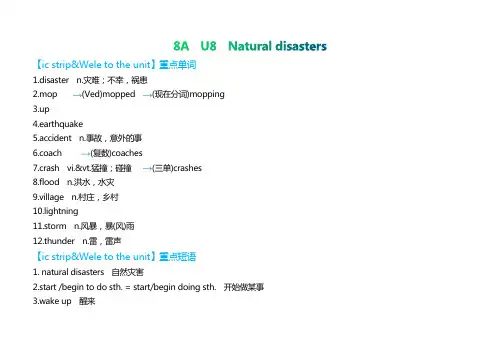
【ic strip&Wele to the unit】重点单词1.disaster n.灾难;不幸,祸患2.mop (Ved)mopped (现在分词)mopping3.up4.earthquake5.accident n.事故,意外的事6.coach (复数)coaches7.crash vi.&vt.猛撞;碰撞(三单)crashes8.flood n.洪水,水灾9.village n.村庄,乡村10.lightning11.storm n.风暴,暴(风)雨12.thunder n.雷,雷声【ic strip&Wele to the unit】重点短语1. natural disasters 自然灾害2.start /begin to do sth. = start/begin doing sth. 开始做某事3.wake up 醒来4.mop up 把......拖干净5.mop up the water 把水拖干净6.thousands of people 成千上万的人7.thousands of 成千上万的8.crash into 撞上9.wash away 冲走10.fall from ... 从...·落下11.hear about/of 听说12.what happened 发生了什么13.a heavy storm with thunder and lightning 一场雷电交加的大风暴14.catch fire 着火【ic strip&Wele to the unit】重点句型1. Didn't you hear the rain?难道你没听到雨声吗?2. Who will mop up the water if I go home without you? 如果你不跟我回家,谁将拖干水呢?3. Lightning hit a classroom building and it caught fire. 一幢教学楼被闪电击中而着火了。
牛津译林版8AUnit8 Natural disasters Grammar精讲(有答案)
牛津译林版8AUnit8 Natural disasters Grammar精讲(共2个语法【有答案】)【一. 过去进行时】1.定义过去进行时表示过去某一时刻正在进行的动作或过去某一阶段一直在进行的动作。
It was raining at 6 o’clock this morning. 今天早上六点钟时正在下雨。
They were building a dam last winter.去年冬天他们在建大坝。
2.构成过去进行时由“was/were+现在分词”构成。
I was having breakfast at six this morning.今天早上六点钟时我在吃早饭。
My younger brother was watching TV at that time.那时我弟弟在看电视。
They were playing football at four yesterday after-noon.昨天下午四点他们在踢足球。
3.句式变化(1)一般疑问句及回答变一般疑问句时应将was/were移到句首。
肯定回答为Yes,主语+was/were;否定回答为No,主语+wasn't/weren't.。
【例句一】一Was it raining at 6 o'clock this morning? 今天早上六点钟时正在下雨吗?一Yes, it was. , 是的,在下。
/—No, it wasn't.不,没在下。
【例句二】一Were they building a dam last winter?去年冬天他们在建大坝吗?一Yes, they were. No, they weren't. 是的,他们在建。
/不,他们没在建。
(2)否定句肯定句变否定句时在was/were之后加not,was not常缩写为wasn't,were not常缩写为weren't。
译林牛津版 8AUNIT8 Natural disaster Task 教学课件 (共20张PPT)
Useful expressions:
Which is useful for you? Choose them out !
1.What did you do? 1.wore more clothes/rain coat/glasses 2.called 110/119/120 hotline 3.closed the door and windows 4. went to high places---
Useful expressions for the last part:
1. hear noise/cries/shouts---
2. saw people removed the snow/cleaned the way / sent the victims to the hospital / got something from the flood---
I forgot to bring my keys. I
ansuhmarebdrella
with her and then Nhomakorabeae walked to the bus stop.
The weather was really terrible. We could only
hear the
. wind contiSnnuoewd to fall
What did she hear? noise of traffic
What did she see? people removed the snow
How did she feel? It was terrible
choose the topic 定题
牛津译林版八年级上册Unit8《Naturaldisasters》(Grammar)说课稿
牛津译林版八年级上册Unit 8《Natural disasters》(Grammar)说课稿一. 教材分析《Natural disasters》是人教版牛津译林八年级上册的一篇课文,主要介绍了一些自然灾害的成因及应对方法。
通过本节课的学习,学生能够掌握一般现在时的被动语态,提高阅读理解能力,同时增强对自然灾害的防范意识。
二. 学情分析八年级的学生已经具备了一定的英语基础,对一般现在时态和被动语态有所了解。
但部分学生对英语阅读兴趣不高,且对于自然灾害相关知识了解有限。
因此,在教学过程中,需要关注学生的兴趣,引导学生主动参与课堂活动,提高他们的阅读理解能力。
三. 说教学目标1.知识目标:学生能够掌握一般现在时的被动语态,正确运用动词的过去式和被动式。
2.能力目标:学生能够阅读并理解关于自然灾害的英语文章,提高阅读理解能力。
3.情感目标:学生能够增强对自然灾害的防范意识,学会保护自己和他人。
四. 说教学重难点1.重点:学生能够掌握一般现在时的被动语态。
2.难点:学生能够运用一般现在时的被动语态描述自然灾害。
五. 说教学方法与手段1.教学方法:采用任务型教学法,让学生在完成任务的过程中,自然而然地掌握语言知识。
2.教学手段:利用多媒体课件、图片、视频等,激发学生的学习兴趣,提高课堂效果。
六. 说教学过程1.导入:展示一些自然灾害的图片,如地震、洪水等,引导学生谈论对这些灾害的了解和感受。
2.阅读理解:让学生阅读课文《Natural disasters》,回答相关问题,检测学生对文章内容的理解。
3.语法讲解:讲解一般现在时的被动语态,让学生通过例句和实践,掌握这一语法知识。
4.小组讨论:学生分成小组,讨论如何用英语描述一种自然灾害,以及如何防范。
5.展示与评价:每个小组选择一名代表,展示他们的讨论成果,其他同学和老师进行评价。
6.总结与反思:教师引导学生总结课堂所学,让学生反思自己在课堂上的表现,以及如何提高。
新译林8AUnit8Naturaldisasters知识总结
8A Unit8 Natural disasters一.词汇拓展1.shak.v.→shakin.(n..摇.2.direc.v.→direction(n..方向3.liv.v.→aliv.(adj..活着的4.saf.adj.→safety(n..安全5.fear (n.) →fearful(adj.)可怕的、担心的二.重点短语1.was.awa.冲..was.代词away2.b.al.we.全湿了3.star.t.rai.开始下雨4.wak.u.醒.wake..u.wak.up+名词5.mo.u.th.wate.把水拖干净6.cras.int..tre.撞在树上7.star.bi.fir.引起大火8.fal.fro.th.tre.从树上掉下来9..heav.stor.wit.thunde.an.lightenin.伴有雷电的大暴雨10.catc.fir.着火11.in the early morning 在清晨12.feel a slight shake 感觉到轻微的晃动13.hear a loud noise like thunder 听到像雷声的噪音14.star.t.shak.开始摇. shak.hand.wit.sb.15.scream in fear 恐惧地尖叫16.ru.ou.o.th.buildin.跑出楼房17.try my best to run out 尽我所能的跑出18.begin to calm down 开始平静下来19.say to oneself 自言自语20.cal.dow.平静下来21.silen.silenc.silentl.安.寂静的22.no.a.al.一点也不23 find one’s way out 找到出路24.hea.abou.th.fir.听说火.hea.o. 听.hea.from收到...的来.25.Wa.anyon.hurt.有没有受伤? hur.v.adj.26.fea.v.fearfu.fearles.害..momen.o.fea.wen.throug.m.mind.一丝恐...掠过我的脑海。