
Unit4 A good read Grammar2 教案(牛津译林版八年级下)
1Let’swork out some class rules using must,must not, have toanddonot have to.
2read the class rules.
Step IV家庭作业
1记忆词汇、词组和句型。
2复习本课所学语法。
3完成教师布置的相关练习。
Step II操练
1What rules must we obey when we’re in the library? must、mustn’t、have to、don’t have to
2Amy is telling her cousin Shirley some library rules.Look at page plete what she says with must,must not,have to or do not have to.
课题
总备课
第5课时
课型
Grammar2
备课时间
主备人
教学目标
学会正确使用must和have to。
重点难点
学会正确使用must和have to。
教学过程
复备
B Using must and have to
Step I呈现
l We must obey school rules when we're at school.Whatschool rules dowe have?What must we do?What mustn’twe do?
2We usemustwhen the speaker feels that something isnecessary.We usemust notto say that something is not allowed.
提醒学生:Have tohas different forms:has to,had to,will have to and have/hasgot to.
(完整版)牛津译林版英语八年级上册Unit4Grammar教学设计
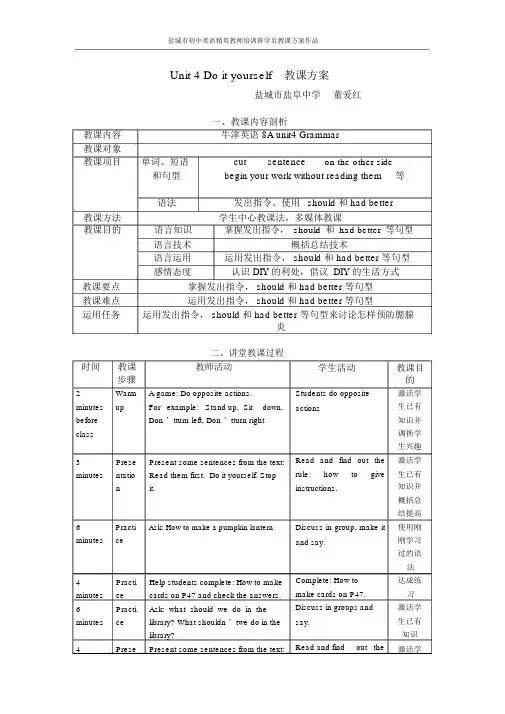
盐城市初中英语精英教师培训班学员教课方案作品Unit 4 Do it yourself教课方案盐城市盐阜中学董爱红一、教课内容剖析教课内容牛津英语 8A unit4 Grammar教课对象教课项目单词、短语cut sentence on the other side和句型begin your work without reading them等语法发出指令、使用should 和 had better教课方法学生中心教课法,多媒体教课教课目的语言知识掌握发出指令,should和had better等句型语言技术概括总结技术语言运用运用发出指令, should 和 had better 等句型感情态度认识 DIY 的利处,倡议 DIY 的生活方式教课要点掌握发出指令, should 和 had better 等句型教课难点运用发出指令, should 和 had better 等句型运用任务运用发出指令, should 和 had better 等句型来讨论怎样预防腮腺炎二、讲堂教课过程时间教课教师活动步骤2Warm A game: Do opposite actions. minutes up For example: Stand up, Sit down, before Don ’tturn left, Don ’tturn right class3Prese Present some sentences from the text: minutes ntatio Read them first. Do it yourself. Stop n it.6Practi Ask: How to make a pumpkin lantern minutes ce4Practi Help students complete: How to make minutes ce cards on P47 and check the answers. 6Practi Ask: what should we do in the minutes ce library? What shouldn ’twe do in thelibrary?4Prese Present some sentences from the text:学生活动Students do oppositeactionsRead and find out therule: how to give instructions.Discuss in group, make itand say.Complete: How tomake cards on P47.Discuss in groups andsay.Read and find out the教课目的激活学生已有知识并调换学生兴趣激活学生已有知识并概括总结提高使用刚刚学习过的语法达成练习激活学生已有知识激活学盐城市初中英语精英教师培训班学员教课方案作品minutes ntatio What should we do? You ’d better get rule: how to use should n some tools.and had better.6Prese Ask: How to be a good student?Discuss in groups and minutes ntatio sayn4Practi Help students complete: DIY advice Complete : DIY advice minutes ce and check the answers.6Prese Ask:How to prevent Mumps( 腮腺Discuss in groups and minutes ntatio炎 )sayn5Exerci Help the students complete the Complete the exercise. minutes se exercise and check the answers.English people like DIY . A lot ofpeople spend their holiday makingtheir homes more b______1______.If there is anything that needsrepairing or decorating around theirhomes, such as p_____2_____thewalls or putting in a new shower, theywill do the jobs themselves. Theys_____3______ DIY experience withtheir friends. More and more peopleshow an i______4_____ in DIY .Sometimes people also DIY in orderto s_____5_____ money. They aretrying to find ways to make theirhouse better when they can’t affordthe c______6_____. So,it ’s notsurprising that DIY is very popular.DIY can be different.People oftenfind it more e______7______ to builda piece of furniture because they can ’tunderstand the instructions well.Sometimes the instructions are simpleand clear,but the furniturei______8_____ is difficult to build.DIY can also be d______9_____.People should learn much about DIYwork before doing it.U______10_____, many people don ’tcare about that. So they may be in 生已有知识并概括总结提高使用刚刚学习过的语法达成练习拓展思维当堂检测盐城市初中英语精英教师培训班学员教课方案作品danger.1Home Say: Finish some exercises.minute work三、教课反省教课反省。
牛津译林版8上Unit4 Grammar 教案
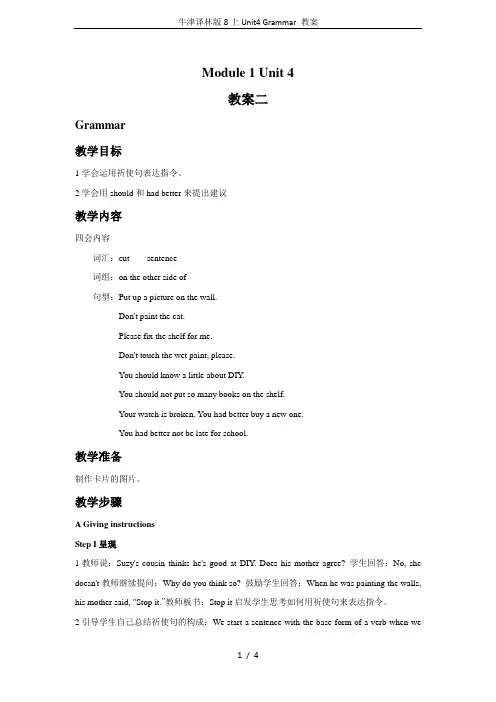
Module 1 Unit 4教案二Grammar教学目标1学会运用祈使句表达指令。
2学会用should和had better来提出建议教学内容四会内容词汇:cut sentence词组:on the other side of句型:Put up a picture on the wall.Don't paint the cat.Please fix the shelf for me.Don't touch the wet paint, please.You should know a little about DIY.You should not put so many books on the shelf.Your watch is broken. You had better buy a new one.You had better not be late for school.教学准备制作卡片的图片。
教学步骤A Giving instructionsStep I呈现1教师说:Suzy's cousin thinks he's good at DIY. Does his mother agree? 学生回答:No, she doesn't教师继续提问:Why do you think so? 鼓励学生回答:When he was painting the walls, his mother said, "Stop it.”教师板书:Stop it启发学生思考如何用祈使句来表达指令。
2引导学生自己总结祈使句的构成:We start a sentence with the base form of a verb when wewant to tell people what to do. We add do not/don't in front of the verb when we want to tell people not to do something. We often add please in a sentence if we want to give instructions politely.3教师说:Now open your books and turn to page 47, please Let's read the sentences together让学生翻到课本第47页,朗读A部分的例句。
+Unit+4+Agood+read+Grammar教案 牛津译林版八年级英语下册
课题译林版八下英语Unit 4 A good read - Grammar 教案课型新授时间课时 1 主备人I.Teaching objectives1. Knowledge goalsStudents can understand the basic concepts and usage of the simple past and present perfect tense.Students are able to master the common time adverbial of the simple past tense and the present perfect tense.Students can correctly use the simple past tense and present perfect tense to express themselves.2. Ability goalsThrough practice, improve students' ability to correctly use the two tenses in context.Cultivate students' language comprehensive use ability and logical thinking ability.3. Emotional goalsStimulate students' interest in learning English grammar and enhance their confidence in learning.Cultivate students' sensitivity and observation ability to the English language.II. Teaching key and difficult points1. Teaching focusConcconcept, structure and usage of simple past and present perfect tense.Distingudistinguish between simple past tense and present perfect tense.2. Teaching difficultiesUnderstanding the persistence of action in present perfect tense and the impact on the present.Accurately use the simple past tense and the present perfect tense in a practical context.III. teaching method1. Teaching method: explain the grammar rules and usage of simple past tense and present perfect tense.2. Practice method: consolidate the knowledge learned through practice and improve students' language use ability.3. Discussion method: Organize students to discuss relevant grammar points to deepen their understanding of knowledge.4. Induction method: guide the students to summarize the characteristics and differences of the two tenses.IV teaching process(1) Lead in (5 minutes)1. Show pictures or videos about events in the past and things that continue to the present, such as "a person went to the park yesterday" and "a person has lived in the city for five years now."2. Ask the students how to describe these situations in English, and guide them to think about different tense expressions.(2) Knowledge explanation (10 minutes)1. Simple past timeConcept: An action or state of existence at a certain time in the past.Structure: subject + verb past formula + other.Time adverbial: yesterday, the other day,last...,...ago et al.For example: I visited the Palace Museum with my grandparents the other day.2. Now is in the perfect tenseConcept: represents the effect or result of past actions on the present, or the action or state that continues from the past to the present.Structure: Subject + has / has + the past participle of the verb + other.Timbial language: already, ever, trust, recently, not yet, so far, up to now, until / till now, etc.For example: Daniel has lived in Beijing for two years.(Iii) Comparative analysis (15 minutes)1. Organize students to compare the usage and time symptoms of simple past tense and present completion tense, and complete the form:Ttense usage time adverbialAction or presence in a simple past state yesterday, the other day,last...,...ago et al Present perfect tense Impact or consequences of past actions on the present; actions or states continuing from the past to the present already, ever, trust, recently, not yet, so far, up to now, until / till now, etc2. Let the students discuss the difference between the two tenses, and the teacher will summarize and supplement them.(4) Practice and consolidation (10 minutes)1. Complete the exercises in the textbook, such as Simon is showing Millie some pictures. Complete his sentences with the correct forms of the words in brackets., etc.2. Give some sentences, let the students judge whether the simple past or the present, and explain why.For example: I saw the film yesterday. (simple past, because there is a clear past time "yesterday")He has finished his homework. (Now finish time, emphasize the impact on the present "work is completed")(V) Expand the application (5 minutes)1. Create a situation for students to have a dialogue between the simple past tense and the present completion tense.For example: A: Have you ever been to5. Teaching reflectionIn this teaching, through the introduction of pictures and videos has stimulated the students' interest in learning, so that the students can quickly enter the learning state. In the link of knowledge explanation, the method of comparative analysis is used to let the students clearly understand the difference and usage of simple past time and present perfect tense. Practice consolidation link, through various forms ofpractice, such as filling in the blanks, judgment, dialogue, etc., to help students to deepen the understanding and mastery of knowledge. Expand the application link, let the students use the knowledge learned in the actual situation, improve the students' comprehensive use of language ability.However, there are also some shortcomings in the teaching process. Some students do not have a thorough understanding of the continuous movements in present perfect tense, and they are easy to make mistakes when using them. In the future teaching, we should strengthen the practice and explanation of this aspect, and give some more vivid examples to help students understand. At the same time, in the design of teaching activities, can be more diversified, increase the group competition and other forms, improve the students' participation and enthusiasm.。
牛津译林版英语八年级上册Unit4Grammar教学设计
4.学生能够掌握英语日记的基本格式和写作方法,运用一般过去时进行日记写作,表达自己的过去经历和感受。
(二)过程与方法
1.通过小组合作、讨论、分享等方式,培养学生合作学习、探究学习的能力。
2.利用多媒体、网络资源等教学手段,创设丰富的语境,激发学生的学习兴趣,提高学生的英语实际运用能力。
4.布置课后作业,要求学生运用一般过去时编写一段话或日记,巩固所学知识。
五、作业布置
为了巩固本章节所学的一般过去时知识,培养学生实际运用英语的能力,特布置以下作业:
1.编写一篇关于自己过去经历的日记,要求使用一般过去时描述事件,不少于80词。
2.从课本中选择一个话题,如:My last weekend、A visit to a museum等,用一般过去时进行描述,不少于100词。
2.学生完成练习题,教师及时给予反馈和解答。
3.针对学生的薄弱环节,教师设计针对性练习,帮助学生提高。
(五)总结归纳
1.教师引导学生回顾本节课所学内容,总结一般过去时的用法和动词过去式的变化规律。
2.学生分享学习心得,交流学习方法和技巧。
3.教师强调一般过去时在实际语境中的重要性,鼓励学生在日常交流中多加运用。
二、学情分析
牛津译林版英语八年级上册Unit4 Grammar的教学对象为八年级学生。经过前三个单元的学习,学生已具备一定的英语基础,能够运用一般现在时、一般将来时进行简单的交流。在此基础上,学生对一般过去时的学习将更具挑战性。此外,学生在七年级阶段已接触过动词过去式,但对规则变化和不规则变化的掌握程度不一,需要在本章节中进行巩固和拓展。
八年级学生正处于青春期,思维活跃,求知欲强,对于新鲜事物充满好奇心。在本章节的教学中,教师应充分利用学生的这一特点,设计富有情境和趣味的教学活动,激发学生的学习兴趣。同时,学生已具备一定的自主学习能力和合作意识,教师可以引导他们通过小组合作、讨论等方式,共同探究语法知识,提高学习效果。
牛津译林版英语八下Unit4《Agoodread》(welcome)说课稿
牛津译林版英语八下Unit 4《A good read》(welcome)说课稿一. 教材分析《牛津译林版英语八下Unit 4 A good read》是一篇关于阅读和文学欣赏的课文。
本节课的主要内容是让学生通过阅读一篇关于名著《动物农场》的介绍文章,了解这本书的内容、特点以及作者的观点,并能够就自己的阅读体验进行交流和分享。
教材通过丰富的语言材料,引导学生关注英语阅读,培养他们的阅读兴趣和阅读能力。
二. 学情分析根据对学生的了解,他们在七、八年级时已经学习过一些关于文学作品的课文,对名著有一定的了解。
但是,对于《动物农场》这本书,可能了解不多。
因此,在教学过程中,我需要帮助学生更好地理解课文内容,引导他们欣赏文学作品,并能够就自己的阅读体验进行表达。
三. 说教学目标1.知识目标:学生能够掌握课文中的关键词汇和短语,理解课文的主要内容。
2.能力目标:学生能够阅读并理解英文文学作品,提高他们的阅读能力。
3.情感目标:学生能够欣赏文学作品,培养他们的阅读兴趣。
四. 说教学重难点1.重点:学生能够理解课文内容,掌握关键词汇和短语。
2.难点:学生能够欣赏文学作品,并能够就自己的阅读体验进行表达。
五. 说教学方法与手段在教学过程中,我将采用任务型教学法和交际法。
通过设计各种任务,引导学生积极参与课堂活动,提高他们的阅读和表达能力。
同时,我将使用多媒体教学手段,如PPT和视频,以丰富教学内容,激发学生的学习兴趣。
六. 说教学过程1.Pre-reading:我将以一段关于《动物农场》的视频导入新课,激发学生的学习兴趣,并引导学生思考:他们是否读过这本书?对这本书有什么了解?2.While-reading:学生将阅读课文,回答相关问题。
在这个过程中,我将引导学生关注课文中的关键词汇和短语,并帮助他们理解课文内容。
3.Post-reading:学生将就自己的阅读体验进行交流和分享。
在这个过程中,我将引导学生表达自己的观点,提高他们的表达能力。
2019-2020年牛津译林版英语8B Unit4 A Good Read单词学案

2019-2020年牛津译林版英语8B Unit4 A Good Read单词学案1.read n. 读物A good read is like a great read.v. 阅读read books/ newspapers2.cooking n. 烹饪,烹调(cook 动词“做饭”名词厨师)(cooker 炊具)My mother is good at cooking. / Have you cooked the meal? / My sister wants to be a cook in the future.3.novel n. 小说I like reading novels and plays.4.Germany n.德国I am reading a book about Germany in World War II.German adj. 德国的;德国人、语的;德国文化的This is a German book. I can’t read it.German n. 德国人,德语Germans e from Germany. They can speak German.5.knowledge n.知识(不可数)History books can improve my knowledge of the past.get/gain knowledge of ...学到...知识We go to school to get/gain knowledge of many different things.6.spare adj. 空闲的,多余的What do you like to read in your spare time(=in your free time)?v. 留出;匀出No matter how busy you are, you should spare time to read.7.French adj. 法国(人)的The Hunchback of Notre Dame by the French writer Victor Hugo is great.N. 法语Can you speak French?France 法国Frenchman 法国人(复数Frenchmen) Frenchmen e from France.8.writer n.作者,作家(动词write 过去式wrote 过去分词written)Mo Yan is the first Chinese writer who wins the Nobel Prize in literature.9.ugly adj. 丑陋的反义词(beautiful, good-looking, pretty)10.touch v. 感动,触动The story of the ugly man Quasimodo really touched me.v. 触摸,碰Please don’t touch anything in the room.11.against prep. 紧靠,碰,撞After our ship crashed against the rocks, I swam as far as I could.Bill is standing against the wall now.prep.反对;与...相对;逆Are you for or against our plan? They sailed against the wind.12.be tired out 筋疲力尽John was tired out after a hard day’s work.By the time I finally felt the land under my feet, I was tired out.13.tie v. 捆,绑(现在分词tying 过去式tied 过去分词tied)tie sth to sth 把...拴在...上Mr Green tied his horse to the tree.My arms, legs and hair were tied to the ground!tie n. 领带,领结I wear a shirt and tie at work.14.over prep. 从一边到另一边The boy climbed over the wall.15.stomach n.腹部,胃(复数stomachs)on one’s stomach 趴着The children lay down on their stomachsstomachache 胃疼If you have a stomachache, you can take this medicine.16.until conj. 直到...为止=up to the time whenuntil 用于肯定句中时,主句的谓语动词常为延续性动词,表示该动作一直持续到until 所表示的时间I will wait for him until he es back.until 用于否定句中时,主句的谓语动词常为非延续性动词,not...until直到...才...I will not leave until he es back.until prep. 直到...为止She worked until 11:30 p.m. She did not go to bed until 11:30 p.m.17.finger n. 手指He was the same size as my little finger!18.tiny adj. 极小的Who was this tiny person?19.fall over 摔倒I shouted at them—the loud noise made them all fall over.fall down 跌倒The boy fell down to the ground.fall off 从...摔下来Bob fell off the bike when he was crossing the road.20.continue v.继续You can continue your homework after supper.continue doing/ continue to do ... After a short rest, he continued reading/ to read the book.However, they soon got up again and continued moving across my body.21.either adv.(否定句中)也I did not know what to say either.区别:My brother also likes playing football.=My brother likes playing football as well. =My brother likes playing football, too.My brother does not like playing football either.conj. “或者”He either watches TV or reads books in the evening.pron. “(两者中)任一个” You can choose either of these two rooms.22.manage v. 设法完成;管理manage to do sth. 设法做成了某事I have managed to give up smoking.I tried to pull one hand free and finally managed to break the ropes.23.lift v. 举起,抬高,提高When I lifted my left hand into the air, the small men began to shout.lift up 举起,抬起The stone is very heavy. I can’t lift it up.lift n. 电梯=(elevator)Take the lift to the fifth floor.24.army n. 大批,大群I looked down and saw a huge army of tiny people.an army of 一大批,一大群There are an army of young people in the street.n.军队He joined the army three years ago.=He has been in the army for three years.= He has been a soldier since three years ago.25.must 情态v. 应该,必须,一定You must finish your homework first.26.unable adj. 不能的,不会的(反义词able)be able to+v.原=can+v.原be unable to +v.原= can not+v.原He is unable to do such a difficult job now.=He _______ _______ such a difficult job.Ann was able to speak French last year.=Ann __________ __________ speak French last year.27.shoulder n.肩膀A tiny man climbed onto Gulliver’s body and stood on his shoulder.28.hand v.交,递,给hand in 上交,递交By the way, can you tell me when to hand in our book report? hand out 分发,发出Can you help me to hand these books out?hand n. 手The boy’s hands were dirty.give sb. a hand 帮助某人on the other hand 另一方面29. and so on ...等等She spends her day doing housework, watching TV, reading and so on.You can write anything about your book--what the book is about, what you think of it and so on.30.review n.评论You should read some reviews about the book before writing.reviewer n.评论家31.return v.归还=give sth. back32.on time 准时You must return the books on time.区分:in time 及时If you e back on Saturday, you can be in time for the sports meeting.33.renew v.续借;更新;重新开始I need to renew these two books.retell (复述)rewrite(重写) reuse( 再使用) rebuild(重建)34.series n. 一系列;系列节目Suzy plans to read the Harry Potter series.a series of ...一系列的... The reporter asked him a series of questions.35.publishing house n. 出版社I want to know more about that publishing house.36.refuse v. 拒绝refuse to do sth 拒绝做某事His mother refused to go back into the hospital37.publish v. 出版All the British publishing houses refused to publish it.His first book was published in 1982.publisher n. 出版商,出版社38.so far 到目前为止=by now/ up to now/ until now (一般与现在完成时连用)How many English words have you learned so far?39.success n. 成功The secret of success is hard work. / The film Tiny Times was a great success. successful adj. 成功的J.K.Rowling is one of the most successful writers in the world.successfully adv. 成功地The fireman saved the old man successfully.succeed v. 成功Some people will succeed in giving up smoking.40.translate v. 翻译(translator 名词,“译者,翻译家”translation 名词“翻译,译文”)translate...into...把...译成... Can you translate the text into English?translate...for sb.为某人翻译Can you translate this English letter for me?41.sales n.(复)销售量The newspaper has sales of 1.72 million.供出售,待售for sale In the past , the house was advertised for sale at $49000.降价出售on sale There are many things on sale in the supermarket today.动词sell 卖,销售过去式sold 过去分词sold 名词:salesman 售货员(复数salesmen) 42.copy n.一本(份,册);副本If your article is chosen, you will receive a copy of School Life and a special gift.复数copies Don’t worry. There are many copies here.copy v. 抄写,模仿,复制We shouldn’t copy others’ homework.43.Canadian adj. 加拿大(人)的J.K.Rowling is a Canadian writer.Canadian n. 加拿大人(复数Canadians)Canada n.加拿大Canadians e from Canada.44.at a time 每次,依次How many books can I borrow at a time?45.online adv. 在线,联网= on the Internet Just renew them online.adj.联网的,在线的online schools46. sail n.帆The Sydney Opera House looks like a ship with many sails.v.航行He sailed across the English Channel when he was 16. (sailing 名词,“航行”)46.hidden adj. 隐藏的动词hideYou should realize the hidden danger in our life.For example, Treasure Island tells the story of a young boy who sailed the sea to look for hidden treasure.47.confidence n.信心His story gave me a lot of confidence.have confidence in sb./sth. 对某人或某事有/获得信心All of us have confidence in you.lose confidence in sb./sth. 对某人或某事缺乏/失去信心Never lose confidence in yourself.confident adj. 有信心的;自信的He is very confident about the future.48.experience n. 经历(可数)I also want to travel and have exciting experiences in the future.n.经验(不可数)My English teacher has lots of teaching experience.v. 经历;体验He has experienced a terrible traffic accident.49.advice n. 建议,忠告,劝告(不可数a piece of advice much advice)向某人征求意见ask sb. for advice You can ask your teacher for advice.就某事向某人提建议give sb. advice on sth. He gave us some advice on how to learn English.advise v. 建议;忠告,向...提出意见advise sb. to do sth. 建议某人做某事I advised you to give up smoking.区别:suggestion 名词a suggestion / many suggestionssuggest 动词suggest doing sth.50.librarian n. 图书管理员图书馆library 复数libraries51.habit n. 习惯She has a habit of drinking milk before sleep.52.classical adj. 古典的The four great classical Chinese novels are my favourite.53.opposite prep. 在...对面;与...相反I got most of my books from Sunshine Library----it is just opposite my home.54.open up 开启;开创;开辟They also open up a new whole world to me.。
(完整版)牛津译林版英语八年级上册Unit4Grammar教学设计
情感态度 6
了解 DIY 的好处,倡导 DIY 的生活方式 O
掌握发出指令,should 和 had better 等句型 I
运用发出指令,should 和 had better 等句型 h
运用发出指令,should 和 had better 等句型来谈论如何预防腮腺
炎6
时间
2 minutes before class4
Help the students complete the exercise and check the answers. English people like DIY. A lot of people spend their holiday making their homes more b______1______. If there is anything that needs repairing or decorating around their homes, such as p_____2_____ the walls or putting in a new shower, they will do the jobs themselves. They s_____3______ DIY experience with their friends. More and more people show an i______4_____ in DIY. Sometimes people also DIY in order to s_____5_____ money. They are trying to find ways to make their house better when they can’t afford the c______6_____. So, it’s not surprising that DIY is very popular. DIY can be different. People often find it more e______7______ to build a piece of furniture because they can’t understand the instructions well. Sometimes the instructions are simple and clear, but the furniture i______8_____ is difficult to build. DIY can also be d______9_____. People should learn much about DIY work before doing it. U______10_____, many people don’t care about that. So they may be in
牛津译林版八年级下册Unit4《Agoodread》说课稿9
牛津译林版八年级下册Unit 4《A good read》说课稿9一. 教材分析《A good read》是牛津译林版八年级下册Unit 4的一篇课文,主要讲述了如何选择一本好书以及读书的重要性。
通过本节课的学习,学生能够掌握阅读的方法和技巧,提高阅读兴趣,培养良好的阅读习惯。
教材内容丰富,插图生动有趣,激发学生的学习兴趣。
二. 学情分析八年级的学生已经具备了一定的英语基础,对于阅读短文已经有了一定的能力。
但是,学生在阅读过程中可能会遇到生词、长句等问题,需要教师在教学过程中给予引导和帮助。
此外,学生可能对阅读的重要性认识不足,需要教师在教学中进行启发和引导。
三. 说教学目标1.知识目标:学生能够掌握阅读的方法和技巧,提高阅读兴趣,培养良好的阅读习惯。
2.能力目标:学生能够流利地朗读课文,理解课文大意,能够运用所学知识进行简单的阅读交流。
3.情感目标:学生能够认识到阅读的重要性,养成良好的阅读习惯,丰富自己的课余生活。
四. 说教学重难点1.重点:学生能够掌握阅读的方法和技巧,提高阅读兴趣,培养良好的阅读习惯。
2.难点:学生能够运用所学知识进行简单的阅读交流,理解课文的深层含义。
五. 说教学方法与手段1.教学方法:采用任务型教学法,引导学生通过完成任务来学习课文,提高学生的阅读能力。
2.教学手段:利用多媒体课件,为学生提供丰富的视觉、听觉资源,帮助学生更好地理解课文内容。
六. 说教学过程1.导入:教师通过提问方式引导学生谈论自己喜欢的书籍,激发学生的学习兴趣。
2.自读:学生自主阅读课文,遇到生词或长句时,教师给予引导和帮助。
3.分享:学生分组讨论,分享自己的阅读心得和感受,教师进行点评和指导。
4.讲解:教师针对课文内容进行详细讲解,解答学生的疑问。
5.练习:学生完成课后练习,巩固所学知识。
6.总结:教师对本节课的内容进行总结,强调阅读的重要性。
七. 说板书设计板书设计主要包括课文标题《A good read》、教学目标(知识、能力、情感目标)以及教学重难点。
牛津译林版英语八下Unit 4《A good read》(Grammar)教学设计
牛津译林版英语八下Unit 4《A good read》(Grammar)教学设计一. 教材分析《A good read》是人教版牛津译林英语八年级下的一个单元,主题是关于书籍和阅读。
本课的主要内容是通过介绍两本书的评价,让学生学会如何使用过去时态和现在时态描述事件的顺序。
教材中包含了丰富的阅读材料,有助于提高学生的阅读兴趣和阅读能力。
二. 学情分析学生在学习这个单元前,已经掌握了动词的过去式和现在式的变化规则,同时也具备了一定的阅读理解能力。
但学生在阅读长篇文章时,可能会遇到生词和难句,影响阅读理解。
因此,在教学过程中,需要帮助学生克服这些困难,提高他们的阅读能力。
三. 教学目标1.知识目标:学生能够正确使用过去时态和现在时态描述事件的顺序。
2.能力目标:学生能够读懂文章,提高阅读理解能力。
3.情感目标:激发学生对阅读的兴趣,培养良好的阅读习惯。
四. 教学重难点1.重点:学生能够正确使用过去时态和现在时态描述事件的顺序。
2.难点:学生能够读懂文章,提高阅读理解能力。
五. 教学方法1.任务型教学法:通过完成各种任务,激发学生的学习兴趣,提高学生的参与度。
2.互动式教学法:教师与学生,学生与学生之间的互动,促进知识的传递和能力的培养。
3.情境教学法:创设情境,让学生在真实的环境中学习,提高学生的应用能力。
六. 教学准备1.教师准备:准备好教材、多媒体教具、教学卡片等教学资源。
2.学生准备:学生提前预习课文,了解文章大意。
七. 教学过程1.导入(5分钟)教师通过提问方式引导学生谈论他们喜欢的书籍和阅读体验,激发学生的学习兴趣。
2.呈现(10分钟)教师通过多媒体展示两本书的评价,让学生听懂并理解文章的内容。
3.操练(15分钟)学生分角色朗读文章,模仿文章中的评价语言。
教师引导学生运用过去时态和现在时态描述事件的顺序。
4.巩固(10分钟)学生分组讨论,总结文章的主旨大意,并用自己的话进行表达。
教师巡回指导,纠正学生的错误。
Unit4Grammar教案牛津译林版英语八年级下册
A. on timeB. in timeC. at timesGrammar考点1 疑问词+动词不定式一“疑问词+动词不定式”可在句中用作宾语、主语和表语。
eg:Can you tell me how to spell the word?你能告诉我怎么拼写这个单词吗?How to go there is a question.如何去那里是个问题。
二【重点】疑问词+动词不定式"作宾语是初中阶段的重点。
在"疑问词+动词不定式”结构中,只有疑问词why不能与不定式连用。
有些疑问词,其后可先接名词再接动词不定式。
作宾语时,此结构常用于know, learn, see, hear, ask, tell,advise, decide, explain, find out, forget, remember, think, understand, wonder 等动词或动词短语中。
也可用于sure,clear等形容词之后。
eg:The teacher is telling the students what to do.老师正告诉学生们要做什么。
Have you found out what time to start?你査淸楚什么时间开始了吗?I am not sure which way to take.我不确定走哪条路。
【测一测】—I’ll have a tenday holiday. But I don’t know一How about Paris?A. what to doB. where to goC. when to go考向三:“疑问词+动词不定式”结构可以改写为该疑问词引导的从句。
eg:We do not know what to do. = We do not know what we should do.我们不知道该做什么。
考点二must和have to一【重点】:must的用法must为情态动词,后接动词原形。