
高中英语语法-形容词和副词
C. obviously
D. formally
16.(NMET2004天津) Mr Smith used to B but he has given it up. smoke ___ A. seriously B. heavily
C. badly
D. hardly
17.(2004湖南) Everyone was on time for the meeting ____ C Chris, who’s usually ten minutes late for everything. A. but B. only C. even D. yet
3) 只用作表语的形容词:well, ill, content, fond, glad, likely, ready, sorry, sure He is likely to see me today. This is a possible solution. The boy is ill/sick. The sick boy is lying in bed. ill news, ill wind, ill luck
表语
宾补
状语
√ √
√
√
adv
副词是用来说 明动作或状态 的特征,说明时 间,地点,程 度等概念。它 用来修饰动词、 形容词、副词、 短语或句子。
√ √
√
√
形容词的用法及位置
adj 作定语
1. 前置定语 A difficult situation, efficient approach|way 2. 后置定语: 1)修饰不定代词:something, anything, nothing, everything Nothing serious, anything special 2) 某些a-开首的形容词:afraid, alike, alive, alone, asleep, ashamed, awake, aware He is the only man alive.
13. (01北京春) In that case, there is B than wait. nothing you can do ___ A. more B. other C. better D. any other than 除了
14.(NMET2004全国) I don’t mind picking up D , The your things from the store. ____ walk will do me good. A. Sooner or later C. In time B. Still D. Besides
felt quite _____ . A.sad; sad C. sad; sadly B. sadly; sadly D. saC. quietly D. quite
C to get back to 7.—Mum, I think I’m __ school. --Not really, my dear. You’d better stay at home for another day or two.
He is ______________ (严重)ill. seriously
widely (wide) used • English is a __________ language. badly • This soldier was ________(bad) wounded. great/very great • This painting is of ________ value. very valuable. • This painting is _______
9.John was so sleepy that he could hardly A keep his eyes ____. A. open B. to be opened
C. to open D. opening 10.(02北京) It was raining heavily. Little A Mary felt cold, so she stood _____ to her mother.
18.(NMET2004广东) It is ____ any wonder that his friend doesn’t like watching television much. A.no B.such C.nearly D.hardly
D
19.(NMET2004广东) The great success of D due to the this programme has been ____ support given by the local businessmen. A. rather C. quickly B. very D. largely
15.(2004上海) Most people on this island C are recreational fishers, and _____, fishing forms an actual part of their leisure time.
A. accidentally B. purposefully
形容词、副词 比较等级的用法
形容词和副词的比较等级
原级
1. 肯定
2. 否定 3. 倍数
3) available, possible, imaginable前后置意义不变 He is the best person available. He is the best available person.
adj 作表语
1) 用在be之后. They are capable of doing the job. 2) 相当于be 的动词之后:appear, seem, come, cook, die, fall, keep, lay,prove, remain, run, look, smell, taste, sound, feel, go, get, grow, become, turn… remain calm, go hungry, fall asleep, come true, appear effective, die young
D. well; good B. correctly D. correcting
C 2. The apple tastes _____ and sells ___ .
A 3. Your answer sounds _____ .
C talk between 4. There was a ____ the two lively, lonely, deadly, silly, teams last week.
adj 作宾补
You keep the classroom clean. Leave me alone, please.
adj 作状语
She came home sick. He went to bed, cold and hungry and exhausted.
副词的用法及位置
adv. 作定语
1.You can’t sit on this newly bought chair___. C
fort fortable
fortably A. well; well
C. good; well A. correct C. correctness
D.with comfortable B. good; good
A. close B. closely C. closed D. closing high / highly , deep / deeply , wide / widely
close/closely , etc.
11.(03北京,春) --- I was riding along the street and all of a sudden, a car cut in and knocked me down.
adj & adv?
• • • She always looks ___________ beautiful .(美丽) She is always dressed ____________ beautifully (美丽)
serious 严重) illness. He has got a ___________(
A. so well B. so good
C. well enough
D. good enough
8.we decided not to climb the mountains because it was raining ____. D A. badly C. strongly B. hardly D. heavily
adv. 作宾补
• Let her upstairs. • We’ll see you off at the airport. • They made him out yesterday.
adv. 作状语
• The boy swims well.(修饰动词) • The room is quite small and dark. (修饰形容词) • He worked out the problem very easily.(修饰 副词) • He got on that train fortunately. • Fortunately, he got on that train. (修饰全句)
D careful in the --- You can never be ___ street.
A. Much B. very C. so D. too
can not (never) … too… 怎么…也不为过
12.(NMET00’) It’s always difficult being in D if you don’t speak a foreign country, ____ the language. A. extremely C. basically B. naturally D. especially
高中英语语法系列――形容词和副词
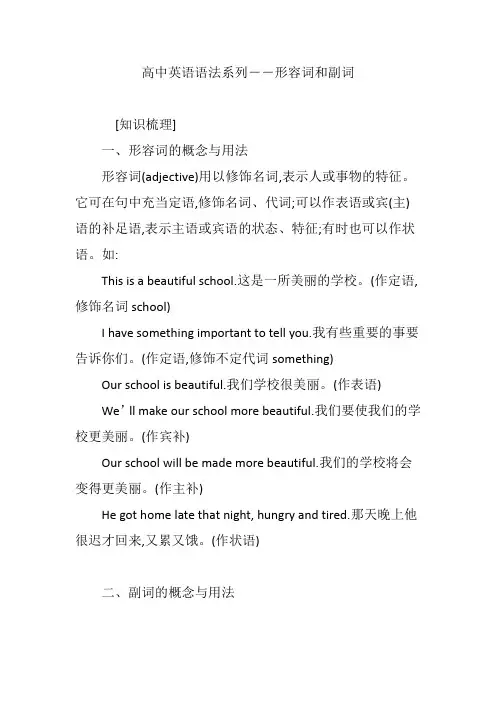
高中英语语法系列――形容词和副词[知识梳理]一、形容词的概念与用法形容词(adjective)用以修饰名词,表示人或事物的特征。
它可在句中充当定语,修饰名词、代词;可以作表语或宾(主)语的补足语,表示主语或宾语的状态、特征;有时也可以作状语。
如:This is a beautiful school.这是一所美丽的学校。
(作定语,修饰名词school)I have something important to tell you.我有些重要的事要告诉你们。
(作定语,修饰不定代词something)Our school is beautiful.我们学校很美丽。
(作表语)We’ll make our school more beautiful.我们要使我们的学校更美丽。
(作宾补)Our school will be made more beautiful.我们的学校将会变得更美丽。
(作主补)He got home late that night, hungry and tired.那天晚上他很迟才回来,又累又饿。
(作状语)二、副词的概念与用法副词(adverb)用以修饰动词、形容词或其它副词。
它在句中主要作状语,个别副词也可作表语、定语、或宾(主)语补足语。
He studies hard.他学习很努力。
(作状语,修饰动词)I’m terribly sorry for being late. 非常抱歉,我迟到了。
(作状语,修饰形容词)This coat fits him very well.这件上衣他穿着很合适。
(作状语,修饰副词)The people here are kind to us.这里的人对我们很好。
(作定语,修饰The people)When will you be back? 你什么时候回来?(作表语)三、形容词与副词的转换有的形容词加上ly后可转换成副词,规则如下:注意:friendly, motherly, lovely等词虽然以ly结尾,但不是副词,而是形容词。
高中英语语法—形容词、副词

例题
1) Tony is going camping with ___ boys. A. little two other B. two little other C. two other little D. little other two
答案点拨:C 由"限定词--数词--描绘词--(大小,长短,形状,新 旧,颜色) --性质--名词"的公式可知数词,描绘词,性质依次顺序 只有C符合答案。
2、+ed
excite—excited worry—worried surprise—surprised close—closed interest—interested frighten—frightened
3、+ing
interest—interesting excite—exciting surprise—surprising follow—following
4、+y 所有表示天气状况的的形容词
sun—sunny snow—snowy wind—windy rain-rainy cloud—cloudy health—healthy
5、+ en
wool-woolen wood--wooden
6、+ern (东西南北)
east--eastern south-southern west--western north--northern
多个形容词做定语时的排列顺序:
在不确定的时候,可参照如下口诀: 美小圆旧黄,法国木书房 注释:美——描述性质;小——大小、长短、 高矮胖瘦 旧——新旧、年龄 圆——形状;黄——颜色;法国——产地、 国籍;木——材料;书房——用途 a new red silk cap一顶红色新丝帽 a short young Japanese businessman
2025届高考英语语法总复习形容词副词课件
however然而,otherwise否则,though尽管,yet虽然,instead相 反 besides而且,moreover而且,still还是,furthermore而且
表结果
therefore因此,thus因而
表让步
anyway不管怎样,无论如何
George didn’t study law.Instead,he decided to become an actor.
friend朋友→friendly友好的;time时间→timely 名词/动词
有……特征的 及时的;day一天→daily日常的;love爱→lovely
构成 意义
例词
end终止→endless无穷无尽的;aim目标→aimless无目 名词/动词 没有……
标的;home家→homeless无家可归的;use使用 +-less 的
形容词有时也作状语,通常说明主语的情况,主要表示原因、 结果、伴随、时间、条件或方式,可位于句首、句中或句末, 一般用逗号将其与其余部分隔开。
Hot and wet,you couldn’t imagine the climate here in summer.
又热又潮湿,你根本无法想象这儿的夏天(形容词作状语,表示原因)
……的 →comfortable舒适的;admire钦佩→admirable
able
可钦佩的
attract吸引→attractive有吸引力的;create创造 名词/动词
有……性质的 →creative创造性的;expense花费→expensive +-ive
昂贵的;effect效应→effective有效的
比较级、最高级的变化规则分为规则变化和不规则变化
高中英语语法之形容词与副词

新旧+颜色+国籍+材料+ 新旧+颜色+国籍+材料+名词
old + brown + wood + table
副词的定义 副词的定义与分类 定义与
副词主要用来修饰动词,形容词,副词或 副词主要用来修饰动词,形容词,副词或 其他结构。 时间和频度副词: 副词:
now, then, often, always, usually, early, today, late, next, last day, already, generally, frequently, seldom, ever, never, yet, soon, too, immediately, finally, shortly, before, ago, sometimes, yesterday, once,twice … once,
高中英语语法之
形容词与 形容词与副词
形容词定义 形容词定义与分类 定义与
形容词分成性质形容词和叙述形容词 形容词分成性质形容词和叙述形容词
直接说明事物的性质或特征的形容词是 直接说明事物的性质或特征的形容词是性质形 容词,它有级的变化,可以用程度副词修饰, 容词,它有级的变化,可以用程度副词修饰, 在句中可作定语、表语和补语。 在句中可作定语、表语和补语。
You speak English very well. well. Food here is hardly to get. We could see very clearly a strange light ahead of us. Let's be out. out. Let him out! out! Are you old enough to go to school? The villagers there are busy getting in wheat.
高中英语语法总结大全-形容词和副词
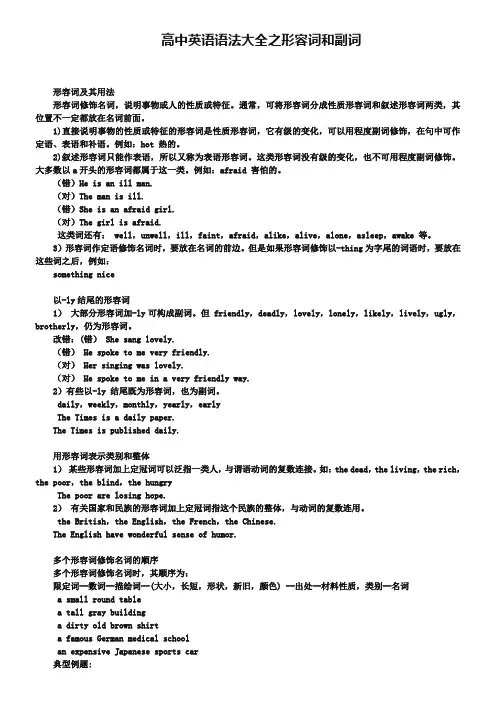
高中英语语法大全之形容词和副词形容词及其用法形容词修饰名词,说明事物或人的性质或特征。
通常,可将形容词分成性质形容词和叙述形容词两类,其位置不一定都放在名词前面。
1)直接说明事物的性质或特征的形容词是性质形容词,它有级的变化,可以用程度副词修饰,在句中可作定语、表语和补语。
例如:hot 热的。
2)叙述形容词只能作表语,所以又称为表语形容词。
这类形容词没有级的变化,也不可用程度副词修饰。
大多数以a开头的形容词都属于这一类。
例如:afraid 害怕的。
(错)He is an ill man.(对)The man is ill.(错)She is an afraid girl.(对)The girl is afraid.这类词还有: well,unwell,ill,faint,afraid,alike,alive,alone,asleep,awake 等。
3)形容词作定语修饰名词时,要放在名词的前边。
但是如果形容词修饰以-thing为字尾的词语时,要放在这些词之后,例如:something nice以-ly结尾的形容词1)大部分形容词加-ly可构成副词。
但 friendly,deadly,lovely,lonely,likely,lively,ugly,brotherly,仍为形容词。
改错:(错) She sang lovely.(错) He spoke to me very friendly.(对) Her singing was lovely.(对) He spoke to me in a very friendly way.2)有些以-ly 结尾既为形容词,也为副词。
daily,weekly,monthly,yearly,earlyThe Times is a daily paper.The Times is published daily.用形容词表示类别和整体1)某些形容词加上定冠词可以泛指一类人,与谓语动词的复数连接。
高中语法形容词副词
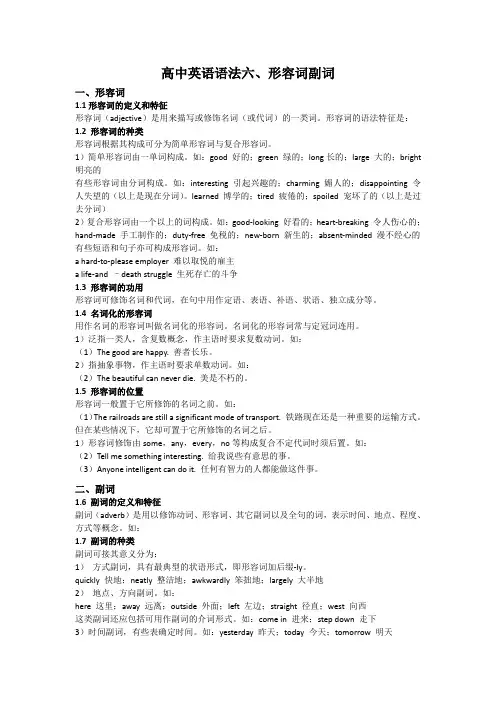
高中英语语法六、形容词副词一、形容词1.1形容词的定义和特征形容词(adjective)是用来描写或修饰名词(或代词)的一类词。
形容词的语法特征是:1.2 形容词的种类形容词根据其构成可分为简单形容词与复合形容词。
1)简单形容词由一单词构成。
如:good 好的;green 绿的;long长的;large 大的;bright 明亮的有些形容词由分词构成。
如:interesting 引起兴趣的;charming 媚人的;disappointing 令人失望的(以上是现在分词)。
learned 博学的;tired 疲倦的;spoiled 宠坏了的(以上是过去分词)2)复合形容词由一个以上的词构成。
如:good-looking 好看的;heart-breaking 令人伤心的;hand-made 手工制作的;duty-free 免税的;new-born 新生的;absent-minded 漫不经心的有些短语和句子亦可构成形容词。
如:a hard-to-please employer 难以取悦的雇主a life-and –death struggle 生死存亡的斗争1.3 形容词的功用形容词可修饰名词和代词,在句中用作定语、表语、补语、状语、独立成分等。
1.4 名词化的形容词用作名词的形容词叫做名词化的形容词。
名词化的形容词常与定冠词连用。
1)泛指一类人,含复数概念,作主语时要求复数动词。
如:(1)The good are happy. 善者长乐。
2)指抽象事物,作主语时要求单数动词。
如:(2)The beautiful can never die. 美是不朽的。
1.5 形容词的位置形容词一般置于它所修饰的名词之前。
如:(1)The railroads are still a significant mode of transport. 铁路现在还是一种重要的运输方式。
但在某些情况下,它却可置于它所修饰的名词之后。
高中英语语法知识:形容词和副词
高中英语语法知识:形容词和副词形容词是用来修饰名词或代词的词,主要用作定语、表语和补足语等。
副词是用来修饰动词、形容词、副词、介词短语或全句的词,主要用状语、表语和定语等。
下面就形容词和副词的相关知识作如下讲解。
1. 形容词及其用法1) 直接说明事物的性质或特征的形容词是性质形容词,它有级的变化,可以用程度副词修饰,在句中可作定语、表语和补语。
例如:hot。
2) 叙述形容词只能作表语,所以又称为表语形容词。
这类形容词没有级的变化,也不可用程度副词修饰。
大多数以a开头的形容词都属于这一类。
例如:afraid 害怕的。
这类词还有well,unwell,ill,faint,afraid,alike,alive,alone,asleep,awake 等。
3) 形容词作定语修饰名词时,要放在名词的前边。
但是如果形容词修饰以-thing 为字尾的词语时,要放在这些词之后。
例如:something nice.2. 以-ly结尾的形容词1) 大部分形容词加-ly可构成副词。
但friendly,deadly,lovely,lonely,likely,lively,ugly,brotherly,仍为形容词。
改错:(错) She sang lovely.(错) He spoke to me very friendly.(对) Her singing was lovely.(对) He spoke to me in a very friendly way.2) 有些以-ly 结尾既为形容词,也为副词,如daily,weekly,monthly,yearly,early等。
例如:The Times is a weekly paper. 《时代周刊》为周刊。
The Times is published weekly. 《时代周刊》每周发行一期。
3. 用形容词表示类别和整体1) 某些形容词加上定冠词可以泛指一类人,与谓语动词的复数连接,如the dead,the living,the rich,the poor,the blind,the hungry等。
高中英语语法:形容词和副词(共61张PPT)
一、形容词和副词的句法功能
1.作定语 形容词作定语一般位于被修饰词的前面;副词作定语多表示时间 或地点,位于被修饰词的后面。 Widespread poverty in Africa means that many people there cannot get the water, clothing, housing, electricity, or education they need.非 洲普遍的贫穷意味着那里的许多人不能获得他们需要的饮用水、 衣服、房屋、电力及教育。 The people there were friendly.那儿的人很友好。(副词作定语须 后置)
the English英国人
(2)“the+形容词”表示抽象概念,作主语时谓语动词用单数。
the best最好的情况
the unknown未知的事
the impossible不可能的事
the right正确的事
二、形容词和副词的位置
1.形容词的位置 (1)一般情况下,单个形容词都位于所修饰的名词前。
一二、介 形词 容的 词分 和类副词的位置
(3)形容词也可位于被修饰名词之后。
③两个意义相近或相反的形容词用and, or或but连接,作定语时须后 置。 Power stations, large or small, have been set up all over the country.大大 小小的发电站已经在全国建立起来了。 All the people on this island, young or old, are fond of music.这个岛上的 老老少少都喜欢音乐。(意义相反。) ④当“形容词+不定式”构成的短语作定语时。 A man so difficult to please must be hard to work with.一个如此难以取悦 的人一定很难共事。 He enjoys the music pleasant to listen to.他很喜欢这首听起来很好听的 音乐。
高中英语2025届高考语法复习形容词与副词知识讲解
高考英语语法复习
形容词与副词知识讲解
一、形容词的用法
被形容词修饰的名词若还有其他词修饰,如冠词、指示代词、形容词性物主代词等,这些词要置于形容词前。
名词前的多个修饰语可用
“限定描绘大长高,
形状年龄和新老,
颜色国籍出材料,
作用类别往后靠”
来记忆。
二、易用错的几类形容词
三、形容词的比较等级
English is as interesting a subject as Chinese.
Which is the better of the two watches?
She is the taller of the two girls.
other或else把主语排除在比较对象之外;但如果不在同一范围比较则不需要用。
Susan is taller than any girl in her sister’s class.
四、副词的句法功能
五、副词的位置
六、副词比较等级的用法。
高中语法之形容词 副词
… too+原级+ to do sth.
He is too young to join the army. 形容词原级+ enough to do sth. This truck is big enough to carry 5 tons.
比较级+than…
Our school is larger than theirs. This bridge is longer than that one.
He made us happy.
Colour it green.
Attention : • 有些单词以-ly结尾,但却是形容词而非副 词: • lively、lonely、lovely、deadly、friendly、 ugly、silly、likely、 timely 、 brotherly sisterly motherly fatherly 等。
巧记: 特殊形式比较级 共有三对二合一 坏病两多并两好 little意思不是小 一分为二有两个 一是老来二是远
as+形容词原形+as Tom is as tall as Mike. Tom is three times as old as Mike. There are as many students in our school as yours.
注意 no/ not + 比较 级 + than 的特殊含义
• A is no more careful than B. • A和B两人都不仔细。 • A is not more careful than B. • A不如B仔细。
• more…. than…与其说…倒不如说 • It is more like a wall than a spear. • They are more like father and son than teacher and student. • more than + n. / num. / adj. • There are more than fifty students in our class. • He is more than a teacher; he is our friend. • She is more than kind to us all.