
Unit 7 Will people have robots教学反思
Unit 7 Will people have robots?教学反思
本课是本单元第一课时,内容为教材1a—2b,本课内容围绕探讨未来的变化引导学生正确使用一般将来时will,并提高学生对社会,环境等各方面的认识。
全程主线以乘坐时光穿梭机飞到10年后,20年后,100年后,在相应的时间变化中分别展开描述日常生活,城市及世界的变化,且引导学生以后各方面的发展是越来越好的。
以下是我对本课的教学反思:
本课思路清晰,主线明朗,层层递进。
全班分为三个小组并为其命名,全课贯穿竞争评价机制,激发学生的学习积极性,且在最后情感升华部分,结合三个小组的名字Yesterday, Today, Tomorrow, 教育学生昨日已逝,珍惜今天,笑对明天,梦想终会成真。
新课展示部分导出There will be…的句型环节,由我10年后生活的变化为切入点,引出我将有一座大房子,要学生猜测What there will be in my house?
此处我觉得设计得较好,让学生开放式地展开想象,并在说中不知不觉地学会了there will be…句型。
同时学生也对老师以后生活的设想比较感兴趣。
“找不同”环节中,通过代表现在和以后的城市图片的对比,用there will be…句型说出以后城市的变化,且这些图片的前后出现是有寓意的,从there will be fewer cars到there will be less pollution,再到there will be more free time, 以致全城市拥有和谐生活,引出there will be more smiling faces.
People will be happier.让学生对未来的城市拥有美好的憧憬。
不足之处:
本课虽思路清晰,但过于注重勾勒形式上的设计。
对各个环节的具体设计考虑不够周到,目标语运用得不够全面,让学生运用目标语时受到局限。
仔细回想,学生本课主要是操练了I will…,There will be…,Our school will…,未操练到相应的否定句型。
本课整体上显得不够大气,话题不够开阔,全部与学生自己相联系,虽然与学生相联系的话题课让学生有话可说,但整课全是如此,使得学生对社会,世界,人类生活的变化拓展不够,了解不深,未开阔学生的视野。
本课最大的不足是课堂设计策略上发生了问题,先对学生的输出太多,对学生的输入太少,以致本课应用的各种句型未得到全面地运用。
另外,过多得调整了教材的设计顺序,打乱了教材设计者合理的设计思路,而经我重新整合后的教材设计显得有些突兀,不大能让学生全面掌握本课知识和运用本课语言知识。
虽“找不同”环节有亮点之处,但我觉得就城市环境变化,学生拓展不够,事实上本环节应让学生联系当前环境,城市,世界等方面进一步拓展,做到全面地语言运用。
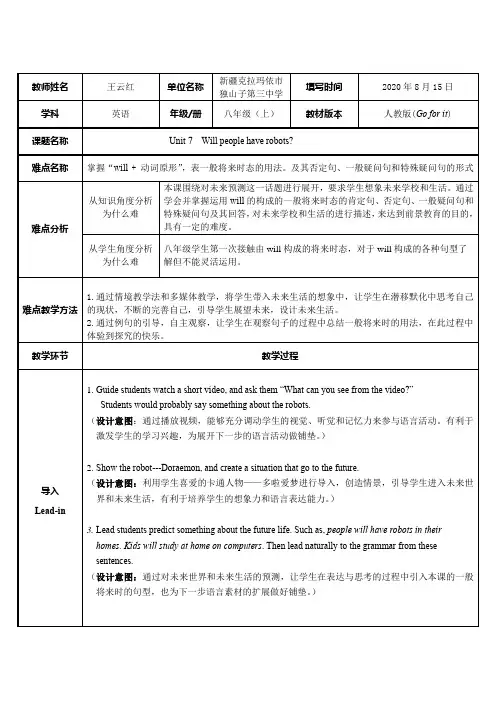
Unit 7 Will people have robots 初中八年级上册英语教案教学设计课后反思
4. There will be some robots in our home. (改否定句)
There won’t be some robots in our home.
5. Every one will have a small car. (对划线部分提问)
(设计意图:利用学生喜爱的卡通人物——多啦爱梦进行导入,创造情景,引导学生进入未来世界和未来生活,有利于培养学生的想象力和语言表达能力。)
3.Lead students predict something about the future life. Such as,people will have robots in their
难点教学方法
1.通过情境教学法和多媒体教学,将学生带入未来生活的想象中,让学生在潜移默化中思考自己的现状,不断的完善自己,引导学生展望未来,设计未来生活。
2.通过例句的引导,自主观察,让学生在观察句子的过程中总结一般将来时的用法,在此过程中体验到探究的快乐。
教学环节
教学过程
导入
Lead-in
1.Guide studentswatch a short video, and ask them“What can you see from the video?”
课堂练习
(难点巩固)
Exercises
6.Practice makes Perfect!
Present some exercises, then check the answers and explain the rules for students.
按要求完成下列句子
1.Iwill buy(buy) some flowers tomorrow.(用所给词的适当形式填空)
Unit 7 Will people have robots(课件 教案 练习 反思)

Will people have robotsAnalysis of the Teaching Material 【Curriculum requirements】Talk about future intentionsFuture with be going to and want to beAnalysis of the Teaching Material:Learn the language points by listening to the recorder, role play, watching the pictures and asking and answering between students and teacher.Teaching Aims and Demands KnowledgeObjects1) 学习掌握下列词汇:peace, sea, sky2) 进行一步复习巩固运用Section A 部分所学的生词和词组。
3) 进一步学习运用所学的知识来陈述自己对将来的看法;学会谈论自己的对将来的预言。
4) 掌握情态动词will来表达一般将来时态这一语法知识;AbilityObjects1) 能了解以下语法:will + v来表达一般将来时态。
2)学会表达自己对未来的看法;学会谈论自己未来的打算。
MoralObjects通过引导学生展望未来,及对未来生活的设计,来达到前景教育的目的,同时也通过对前景的设想,让学生在潜移默化中反省自己的现状,使之对目前的学习、生活习惯作适当的调整,并不断的改善自己的现状,使学生的理想观和价值观更为科学,更具发展价值。
Teaching Key PointsAnd Teaching Difficult Points Teaching KeyPoints1) 进一步学习运用所学的知识来陈述自己对将来的看法;学会谈论自己的对将来的预言。
2) 掌握情态动词will来表达一般将来时态这一语法知识;并运用所学的知识来表达将来的活动。
初中英语_Unit7 Will people have robots?教学设计学情分析教材分析课后反思

Unit 7 Will people have robots?--Section B 2a -2e (Reading)Ⅰ. Learning aims1. Knowledge aims(1)Function: Make predictions.(2)Words and phrases: human, dangerous, believe, disagree,impossible, fall down, wake up etc. (3)Structure: will+V.2. Ability aims(1)Enable students to talk about what they will do using “will do” .(2)Improve students’reading abilities by using the context.(3) Get the Ss to grasp the main idea of reading, comb the information and output their own ideas.3. Emotional attitudes and moral values(1). Make students learn science and technology to make the country stronger.(2).We should study hard and make our dreams come true. Ⅱ.The Important and difficult Points1. The important point is using the reading strategies whilereading and get the ideas about the passage.2. The difficult points are to summarize and retell the passageaccording to the mind map.Ⅲ. Method selection1.Teaching methodsACTIVE阅读教学:1.激活背景知识(Activate prior knowledge),2.培养词汇知识(Cultivate vocabulary),3.传授阅读技巧(Teach for comprehension), 4.提高阅读速度(Increasing reading rate), 5.验证阅读策略(Verify reading strategies),6.评估学习效果(Evaluate progress).2.Learning methodsPersonalizing and group-evaluationCooperating in groups and competing among groups . Ⅳ. Teaching Procedure学情分析对于初二学生而言,必须掌握大量的词汇量,和必要的阅读方法策略,我校的生源主要农村学生,特点是优生少,差生多;主动学习的少,被动、应付学习的多;家长关心学生的少,督促学习的更少,加上英语学科的特殊性,缺少语言环境,需要读背的多,接触和学到英语的机会非常少;我班的英语阅读也存在一些问题:词汇量低,猜词的能力较差,联系上下文捕捉信息的能力都有待提高,而我市的中考语篇占很大比例,无论从知识能力,还是阅读素养,学生的阅读都非常重要本课是一篇关于机器人的阅读,力求通过问题推进,图示小结,思维导图,复述输出这一指导思想。
初中英语_Unit7 Will people have robots Section B(2a教学设计学情分析教材分析课后反思
Unit 7 Will people have robots?Section B (2a-2d)Learning Goals:一、语言知识:1.能够熟练掌握以下词汇和短语: human, dangerous, already, factory, over and over again, hundreds of, look for2.能够掌握以下句式:(1) However, they agree it may take hundreds of years.(2)…, it will be difficult to make them think like a human.二、语言功能:引导学生通过阅读机器人将来发展情况学会预测。
三、学习策略:1.通过略读的方式,猜测文章大意。
2.借助关键词,通过寻读的方式,找寻细节内容。
3.通过提供阅读策略指导,提高学生独立阅读文章的能力。
【设计意图】目标引领,表述了本节课的知识、能力、学习策略。
Teaching and Learn Steps:Step I: Pre-reading:1.Warming up and leading inT: Did you see any robots?Ss: Yes, I did.T: Do you want to watch a video about robots?Ss: Yes.T: But after watching this video, you should answer my questions: What do the robots look like? And what can they do?(After watching the video)T: What do the robots look like?Ss: They look like humans.T: What can they do?Ss: They can dance and walk.T: Yes. We saw many interesting robots just now, and this class we’ll learn a new passage about robots.【设计意图】通过让学生带着问题观看关于机器人的视频,既激发了学习动机,又提高了学生学习兴趣。
unit 7 will people have robots section a 2a-2d教学反思

教学反思:Unit 7 "Will People HaveRobots?" Section A 2a-2d这节课的教学内容是关于未来人们是否拥有机器人的讨论,主要从听力、阅读和口语三个部分进行。
以下是我对这节课的教学反思:1.听力部分:在听力部分,我为学生播放了一段关于未来机器人发展的录音。
学生们能够较好地捕捉到关键信息,但在一些专业词汇上出现了一些困惑。
未来在听力训练中,我应更加注重词汇的扩展,为学生提供更多的背景知识。
2.阅读部分:在阅读部分,学生需要阅读一段关于机器人是否会取代人类工作的文章。
大部分学生能够较好地理解文章内容,但在推理和判断上还存在一些不足。
未来在阅读教学中,我应加强对学生逻辑思维的培养,帮助他们更好地理解和分析文章。
3.口语部分:在口语部分,学生需要就机器人对未来的影响进行讨论。
我发现学生的参与度很高,但部分学生在表达上还存在一些语法错误和词汇不足的问题。
未来我将增加口语练习的机会,并注重纠正学生的发音和语法错误。
4.课堂氛围与互动:整体来说,这节课的课堂氛围比较活跃,学生积极参与了各项活动。
但在互动环节,我发现一些学生还是有些拘谨。
未来我将设计更多的团队活动,让学生们更加自然地交流和表达。
5.技术应用:本节课我使用了多媒体技术来辅助教学,如PPT展示和在线听力软件。
这些技术有效地提高了课堂效率,但在某些环节上,我发现技术的响应速度有些慢,影响了课堂节奏。
未来我将提前做好技术准备,确保课堂流畅进行。
综上所述,这节课总体上取得了一定的效果,但也存在一些不足之处。
在未来的教学中,我将继续改进教学方法,提升学生的英语应用能力。
辽宁省锦州市实验学校八年级英语上册Unit7Willpeoplehaverobots反思

一.对教材的分析:我的展示课是八年上Unit 7Will people have robots ? Section A(1a-2c)本课时为单元的第一课时讲授课,主要围绕“未来世界”这一话题,通过学习一般将来时,以“robot“为线索,运用“一般将来时谈论对未来的预测”的语言的功能,本节课要呈现一般将来时(will)的肯定句,否定句,一般疑问句和what引导的特殊疑问句,其中包括there be结构在一般将来时的用法和Do you think---中的宾语从句。
二.对学情的分析:在本单元Section A 部分,涉及的语法内容太多:用“will or won’t”对未来进行预测,呈现了本节课的核心语法句型(一般将来时(will)的肯定句,否定句),主语(people、everything、kids/they)+谓语(will do)+其他,还包括几个There will be---的句子,本部分以学习there be 结构在一般将来时中的用法为主以及more,less,和fewer的用法。
学生变换起来感到困难,因此,学生完成对话部分不是很流畅。
三.教学设计思路:1a-1c是本单元的导入部分。
1a主题图中的对话内容是两个男孩对人类未来生活的预测,将学生引入本单元“谈论对未来的预测”的话题语境中。
活动1a中我用了6个图片启发学生,用“will or won’t”对未来进行预测,呈现了本节课的核心语法句型(一般将来时(will)的肯定句,否定句),要求学生判断自己是否同意这些观点。
活动1b一听力训练的形式再现上述句型,让学生进一步体会一般将来时对未来进行预测的语言功能。
活动1c让学生就1a活动中的预测进行问答,尝试把一般将来时的陈述句改成一般疑问句,并学会作肯定或否定回答。
2a-2d一听说教学为主。
本部分的听力材料拓展了第一页的语言输入:第一页已呈现基本的一般将来时的句式为主,即:主语(people、everything、kids/they)+谓语(will do)+其他,还包括几个There will be---的句子,本部分以学习there be 结构在一般将来时中的用法为主。
初中英语_Unit 7 Will people have robots教学设计学情分析教材分析课后反思
【设计意图】让学生归纳总结本节课所学知识点,可以使知识得以概括、深化,使整个课堂教学结构严谨;可以助推学生思维的高潮,启迪智慧。
StepVI:开放性交际运用
Discuss:3c.T: We know our environment will be worse and worse.But all of us want to have a good environment. Yes?Now BRT is popular in our Zaozhuang city.What will happen if we use BRT more?
5. In 50 years, people will have ________free time because there will be _________ things to do.
StepV:半控制性意义练习
3b. Complete the predictions with what you think will happen.
Iwill nothave lots of money in 10 years.
Iwill nothave a big house in 10 years .
Iwill nothave two beautiful cars in 10 years.
Iwill nothave a beautiful wife in 10 years.
S: Yes.
T: So from now on, do everything you can to protect the earth. It’s the only homeland for us. Though many things aren’t big deals, they are help.
初中英语_Unit 7will people have robots section B (2a教学设计学情分析教材分析课后反思
Unit7 Will people have robotsSectionB(2b--2e)ByStep1:每日一语: If you laugh once, you will be ten years younger. 笑一笑,十年少. Step2:Teaching aims:一Knowledge aims:(知识目标)1必记单词:human,servant,dangerous,already,factory, believedisagree,even,shape,inside,side,possible, impossible2必记短语over and over again,wake up,look for,hundreds of,fall down3重点语法:will 构成的一般将来时二技能目标:通过阅读,了解未来机器人的作用及对人类的影响,能就未来的生活展开想象,进行书面描写。
三情感目标:亲近自然,热爱科学,激发对美好未来生活追求的梦想。
Step3: Free talksStep4:Skimming(2b)Listen to the tape and match each paragraph with the question it discuss. Paragraph 1 Will robots think like humans in the future?Paragraph 2 What will robots be like in the future?Paragraph 3 What can robots do today?Paragraph 4 What are robots like in moviesStep5:Careful reading task 1Read Para. 1, and answer:1.In what kind of movies ,we sometimes see robots?2. What are they like?Step6:Careful reading task 2Read Para 2. complete the sentences.1.Robots can build in factories.2.They can do jobs many times andnot get bored.Step7:Careful reading task 3Read Para 3. decide True or False.( )1.Some robots in Japan are fun to watch, because they can dance and walk ( )2.scientists are trying to make robots look like animals.( )3.we can make robots move like people and think like a human .( )4.Scientist James White believes that robots will never be able to do the same things as we can.Step8: Careful reading task 4Read Para 4. complete the diagram.Robots in the future How long:________________Shapes :__________________-in India:_______use for:___________________Step8: Post reading (先根据课文填空再复述2d)Some robots are very human-like. They can walk and ______ like people. Some scientists think that in the future they will _______ robots more like humans. This may not _______ in the near future, but at some point, robots will even be able to ______ like people. However, some scientists ________.James White believes that robots will not be able to do the _______ things as we can. For example, he thinks that robots will ______ be able to wake up and know where they are. Which side do you ________ with?Step9:Pairwork•A:If you have a robot ,what would you like the robot to do for you?•B:I would like the robot to ……help with the housework help look for people play games with me walk and dance with me look after babies talk to me help me do the most unpleasant jobsStep10: Write a short paragraph.I want to have a robot in the future. It will look like a ______.It will be able to _____, and it will also be able to help me _______________________________________________... .I think I will like it very much.help with the housework, walk and dance with me,look for people,play games with me,look after babies do the most unpleasant job …….当堂检测一.单项选择1.The next time you see Nikos, he _____sixteen years old.A. will beB. isC. wasD. will2.Margot_______computer science last year.A. studiesB. studiedC. will studyD. is studying3.In ten years, John_______ an astronaut.A. isB. will beC. wasD. will4. ______ travelers come to visit our city every year. (2011 哈尔滨市)A. Hundred ofB. Hundreds ofC. Five hundredsD. Hundred5. ______ trees have been planted near here, so the air is very fresh. (2010 四川达州)A. Two hundredsB. Hundred ofC. Hundreds ofD. Hundreds二翻译短语1.科幻小说2.帮忙做家务3.花费好几百年的时间4.看起来像5.让机器人走路或跳舞6.和人一样做相同的事三.用动词的适当形式填空。
Unit7Willpeoplehaverobots反思
Unit7Willpeoplehaverobots反思Unit 7 Will people have robots?教学反思阳城五中陈兰兰本课的教学内容是第七单元Will people have robots?的sectionA部分对于学生来说非常新鲜。
这堂课除了要求学生掌握书上的单词和句型、熟练运用这些单词和句型外,更重要的是拓宽学生的思路,为学生创设情景,让学生自主学习、了解更多的相关知识。
本单元通过三个任务活动的设计,即第一个任务:未来生活,让学生从1.自然环境(空气,水,植物,动物)2.未来教育(学习,电脑,考试,学校)3.家庭生活(人口,食物,衣着,机器人)4.政治经济(国家,语言,医疗,工作)四个方面分小组讨论他们设想的未来生活。
第二个任务:梦想未来,依据同学们对未来生活的探讨,相互采访你的同伴,让他结合自己的过去与现在,谈谈他对自己未来10年,20年,30年后的设计与梦想。
第三个任务:预测未来,请同学们大胆预测你想象中的未来世界,并用画笔将你的预测画出来,加上文字说明。
也许多少年后,你也将成为一位著名的预言家。
通过亲身体验、梦想未来、预测未来等活动使学生紧密联系自己的生活实际,掌握一般将来时态的用法、more, less, fewer表达数量的使用方法;学会陈述表达各自观点、学会预测未来和排列先后顺序等学习策略与思维技巧。
总之,语言是思维的工具,思维需要语言进行表达,从而应用于课堂中。
如果一味地进行机械式的操练容易限制学生内在潜能的发挥,因此,教师应该不断改变自己的教学观念,在课堂中努力创造条件鼓励学生发散思维,督促学生灵活地去思考,让学生在教师“指南针”的“领航”中放开思绪,驰骋在想像的海洋中;让课堂教学由原来的学生不想说、不会说到现在的学生乐说会说、思如泉涌;让学生懂得展开想像的翅膀,你的面前海阔天空!。
初中英语_Unit 7 Will people have robots教学设计学情分析教材分析课后反思
Unit 7 Will people have robots?(Period one:New words and phrases)I have designed the following steps to train the students’ ability of speaking, reading and writing, especially the ability of mastering vocabularies and the use of them. The entire steps are: before-class activities, lead-in and preparation for learning, pronunciation(语音关), semantic learning(语用关), usage(语义关),summary, test and homework. At last I’ll show the evaluation tools of students’ learning effect.Step 1 Before-class activities(1). Greetings and warming up.(2)Tell the class: This class we will have a PK (Boys & Girls) Students’ activities(学生活动): Say good morning to the teacher and listen to the teacher carefully.Purpose(教学目的):To arouse the students’ interest in learning English by competing between boys and girls.Methods(教学方法):Task-based activities.Step 2 Lead-in and preparation for learning.(1)Ask the students to enjoy a video about the robots in the future to lead in the new lesson.(2)Show the learning goals to the class.(3)Show the key to remember vocabularies to the students.Students’ activities(学生活动): Enjoy a video about the robots in the future ,have a look at learning goals and then know about the key to remember vocabularies.Purpose(教学目的):To arouse the students’ interest of study and bring in new subject :something about robots.Methods(教学方法):watch a video, use question—and—answer activity. Step 3 Pronunciation (语音关):Learn to read the words.1. Read the new words using the phonetics and mark the words difficultto pronounce.2. Read the words difficult to pronounce in turns in small groups. Onestudent read, the others listen and help to correct the wrong pronunciation.3. Read after the loudspeaker.Students’ activities(学生活动):Learn to read the new words correctly in many ways and master the pronunciations.Purpose(教学目的):Improve students’ ability of pronouncing and reading vocabularies. At the same time I want to train them the ability of cooperation by learning in groups.Methods(教学方法):Individual work and group work.Step4 .Semantic learning(语义关):Learn to remember the word. 一.Remember the words by looking at pictures.1 . Remember the words by pictures.2 Challenge: Who has the best memories?二.Remember the words by conversion(转换) 、complex words (合成)and derivative(派生)..三.Remember the words by their similar pronunciation and forms.四.Remember the words by matching itself with its meaning.1 Remember the words by matching itself with its meaning2 Play a game: Can you speak them out?Students’ activities(学生活动):Learn to remember the new words correctly in many ways, master the meanings of the vocabularies ,find out the rules and then take part in the challenge part and play games.. Purpose(教学目的):I mean to train the students’ ability of remembering the vocabularies and have them find out the ways and then master different ways to remember the vocabulariesMethods(教学方法): Situational methods, use question—and—answer activity, Individual work and group work, double activities teaching methods, competition, playing games.Step5. Usage(语用关):Read the story and try to retell it.1Lead in the story: Show a picture and lead in like this: What will the future be like? Will we still live on the earth in the future?1. Watch a short play and enjoy a story.2. Read the story and circle the new words(in Unit7 )by yourselves.3. Read the story freely by yourselves.4.R etell the story together using the mind map(思维树)5.Ask some students to r etell the story together using the mind6 Moral education : Lead in the students to realize--- We should love our earth no matter what happens.Students’ activities(学生活动):Enjoy a story ,try to retell the story in their own words and then realize that they should love the earth no matterwhat happens.Purpose(教学目的):TO train the students ability of translating and organizing words. I’d like also to improve the ability of cooperation. Methods(教学方法): use question—and—answer activity, Individual work and group work, competition, situational methods.Step6 Summary1.Sum up what they have learnt this lesson.2.Have a look at the learning goals again.Students’ activities(学生活动):Try to sum up what they have learnt this lesson in their own words and then look at the learning goals again to see if they have completed the goals in this lesson.Purpose(教学目的):I’d like to know if the students have finished the goals in this lesson and I want toMethods(教学方法): use question—and—answer activityStep6 TestHave a test then check on one by one.Students’ activities(学生活动):Complete the sentences using the right words individually and then check on one by one.Purpose(教学目的):Check on if the students can use and write the vocabularies correctly through the related exercise.Methods(教学方法):By testing.Step6 Homework & show the competition result1 Show the multi-level homework (梯度作业)to the class.2 Calculate the points, show the competition result and congratulate the winner.Students’ activities(学生活动):Have a look at the multi-level homework and choose one or more according to their own situations. At last, calculate the points together and congratulate the winner.Purpose(教学目的):Set up multi-level homework for different-level students At the same time, I mean to improve the students ability of writing and do-it-yourself.Methods(教学方法): Multi-level homework methods.本节课所运用的学习效果测评工具:与传统课堂教学不同,本节课对学生的学习效果采用了多维度、多种工具并用的测评方式,并采用积分制对学生的最终学习效果进行测评。