
无机化学英文课件:chapter6
constant.
Copyright © Cengage Learning. All rights reserved
Chapter 6 Thermochemistry
Section 6.1 The Nature of Energy
Energy
▪ Capacity to do work or to produce heat. ▪ Law of conservation of energy – energy can
▪ Surroundings – include everything else in the universe.
Copyright © Cengage Learning. All rights reserved
7
Section 6.1 The Nature of Energy
Chemical Energy
Copyright © Cengage Learning. All rights reserved
6
Section 6.1 The Nature of Energy
Chemical Energy
▪ System – part of the universe on which we wish to focus attention.
Copyright © Cengage Learning. All rights reserved
8
Section 6.1 The Nature of Energy
CONCEPT CHECK!
Is the freezing of water an endothermic or exothermic process? Explain.
2
Section 6.1 The Nature of Energy
Energy
▪ Potential energy – energy due to position or composition.
▪ Kinetic energy – energy due to motion of the object and depends on the mass of the object and its velocity.
Copyright © Cengage Learning. All rights reserved
5
Section 6.1 The Nature of Energy
Energy
▪ Heat involves the transfer of energy between two objects due to a temperature difference.
▪ Endothermic Reaction: ▪ Heat flow is into a system. ▪ Absorb energy from the surroundings.
▪ Exothermic Reaction: ▪ Energy flows out of the system.
▪ Energy gained by the surroundings must be equal to the energy lost by the system.
Copyright © Cengage Learning. All rights reserved
3
Section 6.1 The Nature of Energy
Initial Position
▪ In the initial position, ball A has a higher potential energy than ball B.
▪ Work – force acting over a distance. ▪ Energy is a state function; work and heat are not
▪ State Function – property that does not depend in any way on the system’s past or future (only depends on present state).
Copyright © Cengage Learning. All rights reserved
9
Section 6.1 The Nature of Energy
CONCEPT CHECK!
Classify each process as exothermic or endothermic. Explain. The system is underlined in each example.
Copyright © Cengage Learning. All rights reserved
4
Section 6.1 The Nature of Energy
Final Position
▪ After A has rolled down the hill, the potential energy lost by A has been converted to random motions of the components of the hill (frictional heating) and to the increase in the potential energy of B.
Exo a) Your hand gets cold when you touch ice.
Endo Endo
b) The ice gets warmer when you touch it.
c) Water boils in a kettle being heated on a stove.
d) Water vapor condenses on a cold pipe.
第6章 化学平衡常数

CO2 + H2 2KCl + 3O2
∆
条件下可逆反应: 2H2O(g) 2H2(g) + O2(g)
2. 化学平衡: 化学平衡是在一定条件下,可逆反应 正逆反应速率相等时体系的一种状态。
正 逆 0
化学平衡是动态平衡!
正
H2 (g) I 2 (g)
2HI(g)
逆
正 逆
系数为幂的连乘积是一个常数。
H 2 (g) I 2 (g)
2HI(g)
2
[ p(HI) / p ] K [ p(H 2 ) / p ][ p(I 2 ) / p ]
pӨ为标准压力,1105 Pa或100 kPa
K 称为标准平衡常数
是温度的函数,与浓度、分压无关。
对于溶液中的反应:
Sn2+(aq)+2Fe3+(aq) Sn4+ (aq)+2Fe2+(aq)
p(H2)
64.74 65.95 62.02 61.96 0 0
p(I2)
57.78 52.53 62.50 69.49 0 0
p(HI)
0 0 0 0 62.10 26.98
p(H2)
16.88 20.68 13.08 10.64 6.627 2.877
p(I2)
9.914 7.260 13.57 18.17 6.627 2.877
K3Ө = K1Ө K2Ө
6-3 浓度对化学平衡的影响
对于溶液中的化学反应: J = K J < K 平衡 平衡向正向移动
(反应物浓度增大或生成物浓度减小时)
J > K
平衡向逆向移动
(反应物浓度减小或生成物浓度增大时)
第六章 配位化合物

制作:张思敬等
理学院化学系
13
Example 2
写出下列配合物的化学式:
(1)羟基· 水· 草酸根· 乙二胺合铬(Ⅲ)
(2) 氯· 硝基· 四氨合钴配阳离子(Ⅲ)
Solution
(1) [Cr(OH)(H2O)(C2O4)(en)]; (2) [Co(NH3)4(NO2)Cl]+
制作:张思敬等
理学院化学系
图6-3 [Cu(en)2]2+的结构
如果配位化合物的形成体是中性原子,配位体是CO分 子,这类配合物称为羰合物。如Ni(CO) 4, Fe(CO)5 。
制作:张思敬等
理学院化学系
7
3. 价键理论 基本要点
中心离子
中心离子(或原子)有空的价电子轨道可接受由配位 体的配原子提供的孤对电子而形成配位键。
Cu2+
H3N NH3
图6-2 [Cu(NH3)4]2+离子的结构
制作:张思敬等 理学院化学系 6
2. 特殊配合物(螯合物和羰合物)
每一个配位体只能提供一 个配位 原子的配位体称为单齿配体,而含有 两个或两个以上配位原子的配位体称 为多齿配体。能提供多齿配体的物质 称为螯合剂。由多齿配体形成的环状 结构的配合物称为螯合物,如 [Cu(en)2]2+。
{c(Cu 2+ ) / cQ }{c(NH 3 ) / cQ }4 - 14 K 解离 = = 4.78 ? 10 c{Cu(NH 3 )4 }2+ / cQ
当忽略浓度量纲时,可简化为:
c(Cu 2+ ){c(NH 3 )}4 - 14 K 解离 = = 4.78 ? 10 + c{Cu(NH 3 )2 4 }
无机化学讲义

Inorganic Chemical Teaching Materials 小组成员:林梅莹、黄旋燕、李淑妍、赖家雄、张锦捷Chapter ⅠInorganic Chemical Terms(无机化学术语)Part 1 periodic table (周期表)这是一个元素周期表,最下边的这两行第一个是Lanthanide Series (镧系),第二个是Actinide Series (钶系)。
The periodic table groups the elements in order of increasing atomic(原子)number in such a way that elements with simialr properties (性质)fall near each other.元素周期表是按照原子数的增加把性质相似的元素排列在一起的。
As the atomic number increases ,the number of electrons(电子)in eachatom also increases.当元素的原子数增加时,每个原子里的电子数也会随之增加。
The elements in a single vertical(垂直)column(纵行)in the periodic table are referred to as members of a group or family.(族)A horizontal(水平)row in the periodic table is called a period.(周期)我们会把元素周期表里的一个垂直纵行叫做族,而水平行的叫周期。
同一个族或者是同一个周期的元素都有相似的性质。
The periodic table have 18 groups and 7 periods.元素同期表还可以分为五个区,有S区、P区、ds区、d区和f区。
6 酸碱
织中的生理、生化过程起着重要的作用。
本章主要讨论电解质溶液中离子平衡的基本规 律、溶液 pH 值的基本运算、酸碱质子理论以及缓 冲溶液方面的知识。
二、活度与活度因子
活度— 是指有效浓度,即单位体积电解质溶液中
表现出来的表观离子有效浓度,即扣除了离子间相
互作用的浓度。以 a 表示。
α=γ·c
γ:活度系数。 反映电解质溶液中离子间相互牵 制作用的大小。
稀溶液中, γ < 1;极稀溶液中, γ 视为 1。
Inorganic Chemistry
第六章 电解质溶液
Inorganic Chemistry
第六章 电解质溶液
无机化学
电解质的基本概念
电解质 — 在化学理论中,把在水溶
液中,或在熔融状态下能电离形成相 应阴阳离子的物质叫“电解质”。
强电解质 —指在水溶液中能全部电离
为相应离子的电解质。
弱电解质 — 指在水溶液中只能部份
电离为相应离子的电解质。
Inorganic Chemistry
—— 酸给出质子变为其共轭碱; —— 碱接收质子变为其共轭酸。
仅相差一个质子的酸碱对。
Inorganic Chemistry
第六章 电解质溶液
无机化学
轭—
牛马等拉东西时架在脖子上的器具。
Inorganic Chemistry
第六章 电解质溶液
Inorganic Chemistry
大学化学专业英语PPT课件 第6章 chapter6
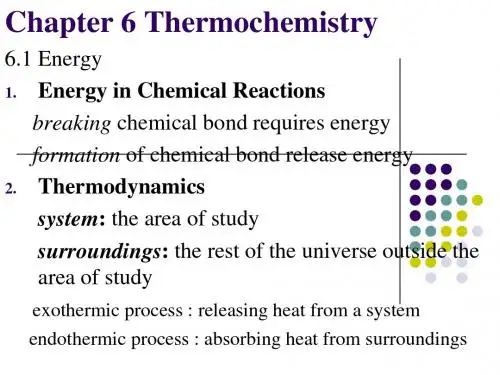
2. Standard State and Standard Enthalpy Changes, Heats of Formation, and Heats of Combustion Standard state of sustance: at 1atm and a specified temperature (usually 298K) Standard enthalpy changes: H Standard enthalpy of fo.g.
A calorimeter with a Cp of 60 J/K was used to find the heat flow associated with the dissolution of 24 g of NaCl in 176g of water. The observed △T was -1.6K. The specific heat of the resulting NaCl solution is 3.64 J(K· g). What is the heat flow for this process?
4. Heats of Changes of state
solid liquid gas H (condensati on)
H (crystallization)
H ( sublimation) solid gas H (deposition )
H ( fusion )
H ( vaporizati on )
6.3 Measuring Heat
无机化学课件

Example 2:
Solution:
Equilibrium Concentration: 平衡浓度
9
The Comparision betweenAgCl) > S (AgBr) S (AgCl) < S (AgBr) 10
If two compounds have the same ion ratio, the one with the larger Ksp will have the higher molar solubility
AgCl (s) Ag+ (aq) + Cl-1 (aq)
The reduction in the solubility of slightly soluble electrolyte by the addition of a electrolyte that has an ion in common with it 在难(微)溶电解质的溶液 在难( 中加入与该电解质具有相同离子的易溶强电解质时, 中加入与该电解质具有相同离子的易溶强电解质时,难 (微)溶电解质的溶解度减小的现象
11
二. Forming and Dissolving of Precipitate沉淀的形成与溶解
1. Solubility Product Rule溶度积规则 溶度积规则: 溶度积规则
Solubility Product :
Ion Product离子积 离子积: 离子积 a)J > Ksp , Forming of Precipitate沉淀形成 沉淀形成
No Precipitate
26
Others:
27
4. Effect of Coordination on Solubility 配位对沉淀溶解平衡的影响
无机化学英文版
due to the excess KMnO4.
Copyright 1999, PRENTICE HALL
Chapter 20
Байду номын сангаас
5
Balancing Oxidation-Reduction Equations
Balancing Equations by the Method of HalfReactions
• MnO4- is reduced to Mn2+ (pale pink) while the C2O42is oxidized to CO2.
• The equivalence point is given by the presence of a pale pink color.
• If more KMnO4 is added, the solution turns purple
Electrochemistry
Copyright 1999, PRENTICE HALL
Chapter 20
Chapter 20
1
Oxidation-Reduction Reactions
• Zn added to HCl yields产量the spontaneous自发的reaction Zn(s) + 2H+(aq) Zn2+(aq) + H2(g).
Half-Reactions
• Half-reactions are a convenient way of separating oxidation and reduction reactions.
Copyright 1999, PRENTICE HALL
Chapter 20
[理学]无机化学Lect06 化学键与分子结构
2020/11/19
h
11
Lewis学说的成绩与局限性
❖ Lewis学说成绩: 1. 指出了共价键与离子键的差异。 2. 解释了一些简单的非金属单质和化合物分子的形成过程(第二
周期元素)。 3. 给出了分子的总价电子数。 ❖ Lewis学说的局恨性: 1. 共价键的本质是什么? 2. 为什么都带负电荷的2个电子不是互相排斥,而配对成键? 3. 八偶体规则的例外很多,如PCl5 、 SF6 、 BeCl2 (g) …… 4. 不能解释一些分子的性质,如O2的顺磁性。 5. 不能很好表达分子的立体结构。 6.不能解释共价键的方向性和饱和性。
第六章 化学键与分子结构 Chemical Bonds And Molecular Structure
主讲人:石锦芹 单 位:浙江工商大学 食品与生物工程学院
教学内容和要求
❖ 6.1 离子键理论
❖ 6.2 共价键理论
经典的Lewis学说 价健理论
杂化轨道理论
分子轨道法
共价键的极性和分子的极性
❖ 6.3 金属键理论
子轨道
❖ 不同符号部分重叠,负重叠,无效重叠,波函数相减,反键 分子轨道
❖ 同号重叠部分与异号重叠部分正好抵消,零重叠,无效重叠
2020/11/19
h
17
Positive overlap
Negative overlap
2020/11/19
h
18
Zero overlap
2020/11/19
h
19
共价键的价健理论:共价键的类型
✓ 离子半径 ✓ 离子电荷 ✓ 离子的电子构型
➢ 离子键的强度
2020/11/19