
闽教版小学四年级上册Unit 5 Daily Activities Part A
Unit 5 Daily Activities Part A
占泽中心后庄小学何婉倩教学目标
语言知识目标
1、学习单词bus ,car和短语get into, get up, have breakfast, go to school 。
2、学习句型When do you......?
3、学习字母c 在单词中的发音。
4、学唱歌曲:It’s Time to Go to School。
5、功能:描述日常活动
语言技能目标
1、能够认读和正确书写单词bus ,car和短语get up, have breakfast, go to school等。
2、能够用句型When do you....? 和At....... 表达日常活动的时间。
情感态度
珍惜时间,养成良好生活作息习惯。
教具
1、单词和词组卡片。
2、时钟模型,玩具公共汽车和小汽车。
3、教学光盘。
教学过程
Step 1 Warming up
1、Greetings.
2、Enjoy a song. “It’s Time to Go to School.”
3、教学歌曲中出现的词组“go to school”并操练。
4、揭示并板书课题Unit 5 Daily Activities Part A,介绍本节课评价方式。
Step 2 Presentation
1、师出示时钟模型,把时间调到八点半,并问学生“What’s the time?”引导学生回答“It’s eight thirty.”
2、利用时钟模型复习数字和时间的表达法。
3、根据复习的最后一个时间6:30,引出“I get up at six thirty.”
4、教学词组get up 并操练。
学习单词at
5、问学生“When do you get up?”帮助学生理解该句子的意思,板书该句子,并教学单词when。
引导学生回答I get up at ......
6、What about Sally? When does Sally get up?播放课文视频,找出答案。
7、学习单词bus,car(通过这个单词,学习字母c 在单词中的发音cat, cow, card, cake)和句子The bus is full. 和Get into the car.
8、教学词组have breakfast
9、I have breakfast at seven thirteen. When do you have breakfast?邀请学生回答。
What about Sally? 播放视频找出答案。
10、When do you go to school? 邀请学生回答。
What about Sally? 播
放视频找出答案。
11、再次播放课文视频,全班学生跟读。
12、巩固练习P40 Learn to write.
Step 3 Extension
选一个同学来做调查
Do a survey
A: When do you .........?
B: I ...........at................ .
Step 4 Homework
1、听录音,熟读本科内容。
2、完成《活动手册》中本课的练习。
3、写出爸爸妈妈起床及吃早餐的时间,下节课汇报。
小学四年级英语上,,Unit5,partB,Daily Activities,全英文面试说课稿(闽教版)
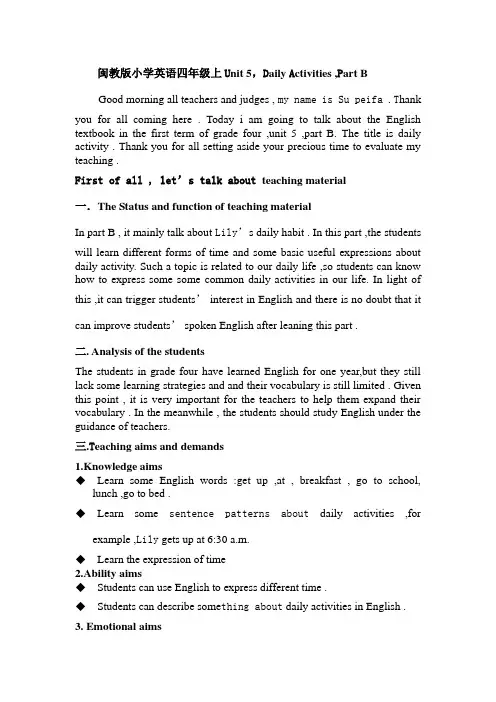
闽教版小学英语四年级上U nit 5,D aily A ctivities ,P art BGood morning all teachers and judges , my name is Su peifa .T hankyou for all coming here . Today i am going to talk about the English textbook in the first term of grade four ,unit 5 ,part B. The title is daily activity . Thank you for all setting aside your precious time to evaluate my teaching .First of all , let’s talk about teaching material一.The Status and function of teaching materialIn part B , it mainly talk about Lily’s daily habit . In this part ,the studentswill learn different forms of time and some basic useful expressions about daily activity. Such a topic is related to our daily life ,so students can know how to express some some common daily activities in our life. In light of this ,it can trigger students’ interest in English and there is no doubt that itcan improve students’ spoken English after leaning this part .二. Analysis of the studentsThe students in grade four have learned English for one year,but they still lack some learning strategies and and their vocabulary is still limited . Given this point , it is very important for the teachers to help them expand their vocabulary . In the meanwhile , the students should study English under the guidance of teachers.三.T eaching aims and demands1.Knowledge aims◆ Learn some English words :get up ,at , breakfast , go to school,lunch ,go to bed .◆ Learn some sentence patterns about daily activities ,forexample ,Lily gets up at 6:30 a.m.◆ Learn the expression of time2.Ability aims◆ Students can use English to express different time .◆ Students can describe some thing about daily activities in English .3. Emotional aims◆ Cultivate students’ ability to work in group◆ Foster students’ awareness of time◆ Enhance students’ interest in learning English四.The difficult and key points of this class◆ The expression of time◆ Use English to express some daily activities五.Teaching aids :computer and clock,chalkSecond ,let’s talk about t eaching and studying methods◆ Student-centering learning:many teachers often ignorestudents’roles in class. As a matter of fact ,it is not right .Teachers should know more about students’ feature and then ask them to give a response in due course.◆ Activity learning:students tend to lack interest in learningenglish . The best way to enhance their motive to learn is activity ,because most of students like activity .◆ Group work : ask students to find partners to make a dialogueby using some related vocabulary and sentence patterns that they have learned in this class . They can have a better understanding of language points by doing so.Third, let’s talk about t eaching procedure sStep one warm-upWhen i come into the classroom , i will sing an english song for students:it is time to go to school. After that ,i will draw a clock in the blackboard and ask students if they know how to say clock in English .If so ,it is indisputable that they will have interest in this topic,which will undeniably arouse students’attention and their efficiency will be also enhanced.Step two lead-in/presentation◆ The teacher will ask students what time it is now . Students will beeager to know how to express time in English. During that t i me i will teach them the correct ways to express different forms of time.◆ Ask some students to look at the picture 1 in page 38 and require themto speak the time that shows in that clock .◆ Learn some useful new words and expressions :get up ,has breakfast,go to school ,go home ,have lunch and so on .◆ The teacher will lead students to read the text in part B ◆ Talk about students’daily habits or activities and then ask them ifthey know how to express it in English . For example,when do they often go to school ?◆ The teacher teach the exact meaning and some useful expressions ofthe text.Step three practice◆ Ask students to listen to radio in page 38 again and then imitate it◆ Ask students turn to page 39 and then fill in the blank according torelated pictures,for example ,Lily gets up at 6:30 a.m. She has breakfast at 6:45/.........................◆ The students will be required to answer the question one by one◆ Learn the pronunciation of ck ,such as duck and clock .Step four consolidation◆ Ask students to look at the the picture in page 38 and make a responseto speak the daily activities of Lily one by one .◆ Ask students to work with their partners and talk about their dailyactivities by using the useful expressions that they have learned in this class.Step 5 general reviewReview what they have leaned in this class and make a conclusion so that they can get a better deeper comprehension of the language.Homework1.Ask them to memorize the new words and useful expressions2.Ask them to review what they have leaned in this class.3.Ask them to find a partner and then make a dialogue . They will be required to practice it in class next time .。
闽教英语四年级上册Unit5 Daily-Activities-PartA
• I go home at five. • 我五点回家。
• ......goes home at five. • 某某人五点回家。
• I go to bed at nine. • 我九点睡觉。
• ...goes to bed at nine. • 某某人九点睡觉。
When do you get up?
你什么时候起床?
I get up at six forty-five.. 或 At six forty-five.
when:什么时候
When do you have breakfast?
你什么时候吃早餐?
When do you go to school?
你什么时候去上学?
你什么时候起床,莎莉?
你什么时候吃早饭?
我六点四十五起床。 你什么时候去学校? 七点二十五。
再见!
七点。 谢谢你,再见!
get up
起床
I get up at six thirty.
我6点30分起床。
have breakfast
吃早餐
I have breakfast at seven o’clock.
她九点上床睡觉。
1.熟读并背诵课文 P 38 2.完成手册Unit 5 part b
我7点吃早餐。
12
9
பைடு நூலகம்
3
6
go to school
去上学
I go to school at seven twenty-five.
我7点25分去上学。
I have lunch at seven twenty-five.
小学英语闽教版四年级上册Unit 5《Part B》省级名师优质课教案比赛获奖教案示范课教案公开课教案

小学英语闽教版四年级上册Unit 5 Daily Activities《Part B》省级名师优质课教案比赛获奖教案示范课教案公开课教案【省级名师教案】1教学目标1.会读会说词组have lunch,go home和go to bed。
2.学习第三人称单数动词的表达形式。
3.学习字母组合ck在单词中的读音。
4.学唱韵律诗:Tick,Tock.5.功能:能用英语介绍他人的日常活动。
6. 通过了解与互相介绍他人的作息时间,培养学生与人沟通的能力。
2学情分析四年级的同学对英语学习的主动性都比较高,课堂参与度高,喜欢英语活动、游戏和表演。
孩子们对英语都很感兴趣,很聪明,上课发言也非常积极。
但相当一部分同学学习习惯不是很好,不够勤奋。
3重点难点1.能够认读和正确书写词组have lunch,go home和go to bed。
2.能够介绍他人的日常活动及时间。
知道第三人称单数的变化4教学过程新设计Step 1 Warming up1.Greetings.2.Song:It’s Time to Go to School.Step 2 Revision1.复习词组get up,have breakfast,go to school和go home。
(1)游戏——我说你做。
游戏规则:每组请一位学生上台,教师站在台上学生的背后,出示卡片,全班学生根据卡片内容说词组,台上的学生做动作。
做错的学生出局,最后获胜的学生所在的小组得分。
2.复习时间表达法。
出示表示时间的卡片,请学生认读,复习时间表达法。
3.揭示并板书课题:Unit 5 Daily Activities Part BStep 3 Presentation(一)句型教学1.教师说:“Sally gets up at 6:45 a.m. She has breakfast at 7:00 a.m. She goes to school at 7:25 a.m. How about Lily? Let’s listen and watch the video.”2.教师播放课文教学光盘,引出Lily gets up at 6:30 a.m.She has breakfast at 6:45 a.m.和。
闽教版英语四年级上册Unit 5《Daily Activities》(Part B)ppt课件1
( ) 1. She ggooestotosscchhooooll. at 7:15.
T
FF
( ) 2. You get up at 6 a.m.
TT
F
( ) 3. He ggoetsotobbeedd. at 9 p.m
T
FF
( ) 4. I go home at 5 p.m.
go to bed 22:30
10:30 p.m
bred a red bed
Schedule
get up
6:50 a.m
go to school 7:20 a.m
go home 17:00 p.m go to bed 22:30 p.m
Lily
???
Schedule
gets up
6:30 a.m
go to bed
have lunch
farmer nurse teacher
dancer
doctor
singer pilot
policeman
单数第三人称 动词 后缀 s / es get --- gets go --- goes 不规则变化 have --- has
Learn to arrange your time.
Schedule
I you
单数第一,二人称
get up go to school go home
he she 单数第三人称
gets up
6:30
goes to school 7:15
goes home 16:30
go to bed
goes home 21:00
(猜谜语)
砸T or F 金蛋,都会有意
最新四年级英语上册Unit5DailyactivitiesPartA1(新版)闽教版优选教学课件

男孩冷静的和鱼进行拉锯战,但是强大的水流加上大鱼有力地挣扎,孩子渐渐地被拉到布满漩涡的下游深水去的边缘。我知道一但鲑鱼到达深水区就可以轻而易举地逃脱了。孩子的父亲虽然早把自己的钓竿他在一旁,但一言不发,只是站在原地关注着儿子的一举一动。
这个男生实在是非常清秀,白衬衣蓝色牛仔裤,在夕阳下眯着眼睛轻轻地笑。他朝她伸出白葱样修长的手拉她起来。那一瞬间,蕊敏的目光怔怔的,很像电视里的慢镜头。路边的野姜花开得很艳,蕊敏傻傻地说,我没钱。 男生捂着胸口装很受伤的样子,眉眼笑成一团。他说,把你的IP卡,IC卡,IQ卡通通交出来……呵呵,我还以为你要跳河,准备英雄救美,结果你把我当劫匪了。不过,就算是匪徒劫财劫色也轮不上你吧! 他笑得花枝乱颤,看得蕊敏目瞪口呆。突然想起落出来的不及格的数学试卷,赶紧扑过去藏起来。
28.几岁的孩子会玩高级游戏,觉得你很笨,非要教你。 29.无论你的事业多么成功,你都没有被人忘记是一个女人。 30.在你打扮得最漂亮的那天,在街上偶遇你很在乎的人。
一 劫财劫色也轮不上你吧! 拿到数学试卷的时候,杨蕊敏恨不得一口吞了它。宁亚使劲把脑袋往她这边凑,她哗啦地把卷子塞进书包,转身就出了教室。
What time do you______?
get up have breakfast
go to school have English class come back home
go to bed
It’s time for us to say
繁华的城市,川流不息的车流和人群,让人无顾及四季的美景.有人说,在这座城市中很难看到星星,因为它太渺小了.其实不然,只是你没有这份心情,身边的灯红酒绿让你视他而不见。 我常常站在阳台上望着满天的星星,想着我们曾经有过的那一幕幕。这个城市见有多少人和我一样在望着那些星星。默默地看着星星在流泪?是不是寂寞的人都喜欢看星星?
Unit 5 Daily Activities Part A教学设计闽教版
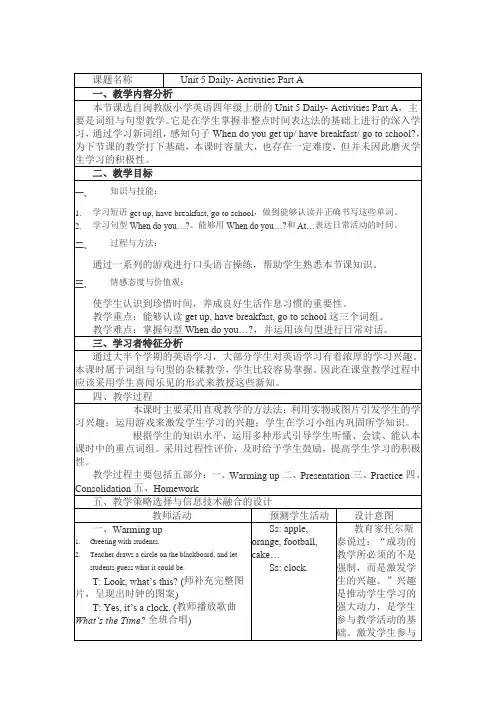
学习的兴趣,是新课导入的关键,可以让学生迅速地进入英语课堂,既能够活跃气氛,又能消除紧张,集中学生的注意力。
二、 Presentation1. 教授when和get upT: Then what’s the time now? (PPT展示出一幅完整的时钟图)T: Right. Then what are you doing at that time?T: Now look at this picture. What is he doing?T: The girl gets up at 6:30. When do you get up?教师出示单词卡片get up的图片,借此引出单词when和句型When do you get up?,教师板书,带读。
T: 当有人问When do you get up?的时候,我们此时要回答At…,for example, now it’s six thirty. Then we should answer “at six thirty”.游戏“敲桌子”操练句型When do you get up?和 At six thirty.2. 词组have breakfast, go to school以及配套句型When do you…?教学T: After you get up, what will you do?T: What is he doing?教师板书词组have breakfast,带读,重点breakfast的读音,游戏“警察抓小偷”操练该词组。
师出示单词卡片have breakfast,指着图画T:如果我们想知道这个女孩什么时候吃早饭,我们可以用When do you have breakfast? 进行提问,假如是(师出示相应钟表图),那就回答…T: 吃完早饭后该干什么呢?T: Right, it’s time to go to school. (教师板书词组,带读)T: If we want to know the time he goes to school, we can ask when do you go to Ss: It’s sixthirty. (复习相关的时间问法)S1:睡觉……Ss: 起床。
小学英语闽教版四年级上册Unit5DailyActivitiesPartB教学设计
小学英语闽教版四年级上册Unit5DailyActivitiesPartB教学设计小学英语闽教版四年级上册Unit5DailyActivitiesPartB教学设计【名师授课教案】1教学目标1.会读会说词组have lunch,go home和go to bed。
2.学习第三人称单数动词的表达形式。
3.学习字母组合ck在单词中的读音。
4.学唱韵律诗:Tick,T ock.5.功能:能用英语介绍他人的日常活动。
6. 通过了解与互相介绍他人的作息时间,培养学生与人沟通的能力。
2学情分析四年级的同学对英语学习的主动性都比较高,课堂参与度高,喜欢英语活动、游戏和表演。
孩子们对英语都很感兴趣,很聪明,上课发言也非常积极。
但相当一部分同学学习习惯不是很好,不够勤奋。
3重点难点1.能够认读和正确书写词组have lunch,go home和go to bed。
2.能够介绍他人的日常活动及时间。
知道第三人称单数的变化4教学过程4.1.1新设计Step 1 Warming up1.Greetings.2.Song:It’s Time to Go to School.Step 2 Revision1.复习词组get up,have breakfast,go to school和go home。
(1)游戏——我说你做。
游戏规则:每组请一位学生上台,教师站在台上学生的背后,出示卡片,全班学生根据卡片内容说词组,台上的学生做动作。
做错的学生出局,最后获胜的学生所在的小组得分。
2.复习时间表达法。
出示表示时间的卡片,请学生认读,复习时间表达法。
3.揭示并板书课题:Unit 5 Daily Activities Part BStep 3 Presentation(一)句型教学1.教师说:“Sally gets up at 6:45 a.m. She has breakfast at 7:00a.m. She goes to school at 7:25 a.m. How about Lily? Let’s listen and watch the video.”2.教师播放课文教学光盘,引出Lily gets up at 6:30 a.m.She has breakfast at 6:45 a.m.和She goes to school at 7:15 a.m.等句子。
最新四年级英语上册Unit5Dailyactivitiespartb1(新版)闽教版优选教学课件
你也很高兴有过那样的一份感情,纯净而又绵长,在这纷繁复杂的人世中,有这样的一个朋友,值得你去祝福,去思念……我都会想起以前的快乐。或许再美丽的语言,再美丽的往事,都及不上一次伤害来得深刻。伤口会慢慢结痂,变成一个坚硬的外壳,但是藏在这个坚硬外壳下的,还是一颗柔软的心。 夜深人静的时候听着清新流畅的音乐,像春天初融的雪花,纯净,沁凉,在茫茫的白消逝的时候,可以听到花开的声音。我沉静在这一尘不染的音乐中,可以忘却伤痛,抛开烦恼,回到最初的平静。还希望在这样的夜里,可以看到美丽的星空,一切让爱做主。我环顾周围的钓鱼者,一对父子引起我的注意。他们在自己的水域一声不响的钓鱼。父亲钓到、接着又放走了两条足以让我们欢呼雀跃的大鱼。儿子大概是12岁左右,穿着高筒橡胶防水靴站在寒冷的河水里。两次有鱼咬钩,但又都挣扎着跑脱了。突然,男孩的钓竿猛地一沉,差一点把他整个人拖倒,卷线轴飞快地转动,一瞬间鱼线被拉出很远。
10.在花季结束的时候,采摘到最后一朵玫瑰。多情的人,最后一次恋情以最美的方式成为标本。 11.说话投机:有些迷乱豁然开朗,如同苗圃除尽了杂草;有些感觉处处共鸣,如同鲜花映照在清潭。
12.没有预谋的闲聊空谈,却生出实际漂亮的事情来。如同野游采摘到美味的山果。 13.一张好碟,自己单独看一次,和自己喜欢的人看一次。
看到那鱼跳出水面时,我吃惊得合不拢嘴。“他钓到了一条王鲑。个头儿不小。”伙伴保罗悄悄对我说,“相当罕见的品种。”
男孩冷静的和鱼进行拉锯战,但是强大的水流加上大鱼有力地挣扎,孩子渐渐地被拉到布满漩涡的下游深水去的边缘。我知道一但鲑鱼到达深水区就可以轻而易举地逃脱了。孩子的父亲虽然早把自己的钓竿他在一旁,但一言不发,只是站在原地关注着儿子的一举一动。
闽教版英语四年级上册Unit 5 daily activities part B课件
当遇到第三人称单数,动词需变化: get gets gets up
havgoes goes to school 遇到I、you、we都不变。
针锋相对
• 游戏规则:我说“get”,你就说 “gets”;我说“goes”,你就说 “go”
游戏:变第三人称说句子。 I get up at 2:00 p.m. She gets up at 2:00 p.m. I have breakfast at 7:20 a.m. She has breakfast at 7:20 a.m. She goes to school at 7:40 a.m.
a.m 上午
Mr. Pig
at 2:00 p.m
p.m 下午
at 3:00 p.m
Q1: When does Lily get up? A. at 6:00 a.m.
B. at 6:30 a.m.
C. at 6:45 a.m.
Q2: When does Lily have breakfast?
When does When does When does
get up? have breakfast go to school ?
Let’s learn
Sally gets up at 6:45 a.m. She has breakfast at 7:00 a.m. She goes to school at 7:25 a.m.
这三个句子都是一般现在时。 一般现在时表示一段时间内经常性、习惯性动 作,或存在的状态。
这三个句子的主语是谁? Lily she 1.单个人名或称呼作主语,是第三人称单数。 2.人称代词he, she, it,是第三人称单数。
• get up 与gets up:
小学英语闽教版四年级上册Unit 5 Daily Activities《Part A》优质课公开课教案教师资格证面试试讲教案
小学英语闽教版四年级上册Unit 5 Daily Activities《Part A》优质课公开课教案教师资格证面试试讲教案1教学目标◆语言知识目标1. 学习单词car,bus 。
学习短语get up,have breakfast,go to school。
2. 学习句型When do you...?3. 功能:描述日常生活。
◆语言技能目标1. 能够认读和正确书写短语get up,have breakfast,go to school。
2. 能够用句型When do you…?和At….表达日常活动的时间。
◆情感态度珍惜时间,养成良好生活作息习惯。
2学情分析本课是闽教版《英语》四年级上册第五单元的Part A部分。
作为本单元的第一课时,主要的教学目标是:让学生能听懂,会读单词car, bus.会说短语:get up, have breakfast ,go to school; 能运用句型When do you...?来询问他人日常活动的时间;用句型At....来表达日常活动的时间。
通过课堂教学,进一步提高学生实际运用语言的能力,培养学生珍惜时间,养成良好的生活作息习惯。
学生在第四单元学过时间的表达法,因此为本课的时间表达扫除学习障碍。
对四年级的学生来说,词组go to school,单词car, bus学习起来比较迅速,较难的是词组get up, have breakfast各句型When do you...?来询问他人日常活动的时间。
3重点难点教学重点是让学生会说短语:get up, have breakfast ,go to school; 能运用句型When do yo u...?来询问他人日常活动的时间;用句型At....来表达日常活动的时间。
教学难点是词组get up,h ave breakfast的读音及句型When do you...?4教学过程教学活动1【导入】Step 1 Warming up师生互致问候。