
八年级英语下册 Unit 1 What’s the matter Section B(第3课时)教案 (新版)人教新目标版
What' the matter
Section B 第三课时(1a—1d)
自主学习方案
1.自学生词,记住拼读及拼写。
2.预习课本,找出重点短语及句子。
3.读记后完成自学导练作业。
课堂导学方案
Step 1情景导入
T :There are many accidents happening every day. But do you know how to deal with these problems? What should you do
when you have a nosebleed? And what should you do when you cut yourself? If you don’t know the answers to the questions,please don' worry. Today we will learn how to deal with the problems.
环节说明:由生活中经常出现的意外为话题引出本节课所要学的内容,贴近生活,引起学生的学习兴趣。
Step 2完成教材1a的任务
1. 让学生仔细观察1a中的三幅图片,然后根据图片信息回答问题:What happened to them?
2. 小组讨论出现1a中的意外情况时,我们应该怎么办?然后将1a中所给出的句子按正确的顺序排序,集体核对答案。
3. 两人一组利用1a中的信息编练对话,并邀请几组学生表演对话。
参考案例
A:What’s the matter with you?
B:I fell down and hurt my back.
A:You should go to hospital to get an X-ray and rest for
a few days.
4. 小结训练
汉译英。
(1) 在上面扎上绷带。
Put a bandage on it.
(2) 在自来水下冲洗。
Run it under water.
(3) 把你的头仰起来。
Put your head back.
环节说明:通过本环节的学习让学生知道出现这些意外后的应急措施,同时,对话练习又提高了学生的口语表达能力。
Step 3完成教材1b—1d的任务
1. 学生齐读1b中的句子,为听力练习做好准备。
2. 认真听录音,将对话中护士所提的问题标注出来,集体核对答案。
3. 再认真听一遍录音,将相应问题治疗方案的字母与在冋题后面,完成1b,集体核对答案。
4. 听第三遍录音,并跟读,整体感知对话。
5. 利用1b、1c中的信息,仿照1d的形式两人一组来练习对话,并邀请几组学生表演对话。
参考案例
A: Who came to your office today?
B: First,a boy came in. He hurt himself in P . E. class.
A: What happened?
B:…
6.小结训练。
(C)The teacher tells the students in the hallway.
A. not run C . not to run Step
B . don' run D. doesn’t to run
4问题探究
happen的用法
1.这个故事发生在2003年。
This story happened in 2003.
2. 今天上午她发生了交通事故。
An accident happened to her this morning.
3. 昨天我碰巧在街上遇到了我的一个朋友。
I happened to see one of my friends in the street.
教学反思
本课时情景导入贴近实际生活,并通过问答和小组讨论的形式增强学生课堂参与性和趣味性,起到了较好的教学效果。
Unit1What'sthematterSectionB2a-2cReading教案
4.写作练习:根据所给情景,编写一段关于询问和描述身体不适的对话。
二、核心素养目标
《Unit 1 What's the matter? Section B 2a-2c Reading》
本节课的核心素养目标为:
1.语言能力:培养学生阅读理解能力,掌握描述身体不适的词汇和句型,提高英语口语表达能力,能够流利地运用所学知识进行实际场景对话。
在实践活动环节,分组讨论和角色扮演活动让学生们将所学知识运用到实际场景中,提高了他们的英语口语表达能力。不过,我也发现有些小组在讨论过程中存在依赖性,个别成员参与度不高。针对这一问题,我计划在接下来的课堂中,加强对小组讨论的引导,确保每位学生都能积极参与。
学生小组讨论环节,大家围绕“身体不适表达方式在实际生活中的应用”展开讨论,提出了很多有创意的想法。但在引导讨论过程中,我发现部分学生对于开放性问题的回答还不够深入。为此,我将在后续教学中,继续提高问题的质量,引导学生深入思考,提升他们的思维品质。
2.思维品质:通过分析、归纳文章内容,培养学生的逻辑思维和批判性思维,使其能够自主总结语言规律,形成知识体系。
3.文化意识:让学生了解并尊重不同文化背景下人们对身体不适的表达方式,培养跨文化交际意识。
4.学习能力:激发学生的学习兴趣,培养其合作学习、探究学习的能力,提高自主学习效率。
三、教学难点与重点
-在阅读过程中,教师引导学生关注文章中的关键信息,如:人物、地点、事件等,帮助学生理解文章内容。
-针对语法结构,教师可以通过例句展示,让学生明白主语为第三人称单数时,动词需要使用第三人称单数形式。
四、教学流程
(一)导入新课(用时5分钟)
新目标八下U1sectionB知识点
八年级下册Unit 1 What’s the matter? Section B知识点梳理Section B重点单词sick adj.生病的;有病的knee n.膝;膝盖ourselves pron. (we的反身代词)我们自己climber n.登山者:攀登者risk n.&v.危险;风险;冒险situation n.情况;状况kilo n.千克;公斤rock n.岩石knife n.刀blood n.血;mean v.意思是; 打算; 意欲importance n.重要性;重要decision n.决定;抉择control n. &v.限制;约束;管理death n.死;死亡spirit n.勇气;意志nurse n.护士Section B重点短语1. put a bandage on it 绑上绷带2. run... under water 在水下冲洗....3. put one's head down 把头后仰4. feel sick 感到不舒服5. have a nosebleed 流鼻血6. get hit on the head 撞到头7. mountain climbing 爬山(名词)8. fall down 摔倒9. have problems breathing 呼吸有问题10.get hit by a ball 被球撞了一下11. get sunburned 晒伤12. a mountain climber 一个登山运动员13. be used to doing sth. 习惯于做某事14. take risks 冒险14. lose one's life 失去性命15. because of accidents 由于事故16.run out (of) 用完17. use sth. to do sth 使用...去做某事18. cut off 切除19. so that 以便于;为了20. a book called.. 一本叫...的书21.get out of 离开;从…出来22. the importance of.... .. 的重要性23. make decisions 做决定24. be in control of 掌管;管理25. so... that. .. 如此....以至于.....26. keep on doing sth. 继续做某事27. in a very dangerous situation 在非常危险的情况下28. free his arm 解放他的手臂29. have the same spirit as 有着和....同样的精神31. give up 放弃give up doing sth. 放弃做某事Section B重点句型5. 一Should I put some medicine on it? 我应该敷药吗?一Yes, you should, /No, you shouldn't. 是的,你应该要敷药。
人教版八年级英语下Unit1What’sthematter(SectionA3a4c)说课稿

5.联系生活:将教学内容与学生的生活实际相结合,让学生感受到英语学习的实际意义,提高他们的学习兴趣。
三、教学方法与手段
(一)教学策略
我将采用任务型教学法、情境教学法和合作学习法作为主要教学方法。任务型教学法通过设计真实、有意义的任务,让学生在完成任务的过程中习得语言知识,提高语言运用能力。情境教学法则是通过模拟生活情境,让学生在情境中感知、体验和运用语言,增强学习的现实意义。合作学习法则强调学生之间的互动和协作,通过小组讨论、角色扮演等活动,促进学生之间的交流与合作,共同完成学习任务。选择这些方法的理论依据主要是交际语言学习理论、建构主义学习理论和人本主义学习理论,这些理论强调学习者的主动参与、意义建构和情感因素在学习过程中的重要性。
(三)互动方式
为了促进学生的参与和合作,我计划设计以下师生互动和生生互动环节:
1.师生互动:通过提问、回答、示范等方式,引导学生积极参与课堂讨论,及时给予反馈和鼓励,建立良好的师生互动关系。
2.生生互动:组织学生进行小组活动,如角色扮演、小组讨论、共同完成任务等,鼓励学生相互交流、相互学习,提高合作能力。
(三)学习动机
为了激发学生的学习兴趣和动机,我将采取以下策略或活动:
1.创设情境:设计有趣的情境,如医生就诊、朋友关心等,让学生在真实语境中运用所学知识;
2.小组合作:组织学生进行小组讨论、角色扮演等活动,提高他们的参与度和合作意识;
3.激励评价:对学生的表现给予及时、积极的评价,关注每个学生的进步,提高他们的自信心;
1.生活情境:通过展示一位学生在体育课上受伤的视频,引发学生对健康问题的关注,进而引出本节课的主题“What’s the matter?”。
人教版八年级英语下册Unit 1 What’s the matterSection B (1a-1d
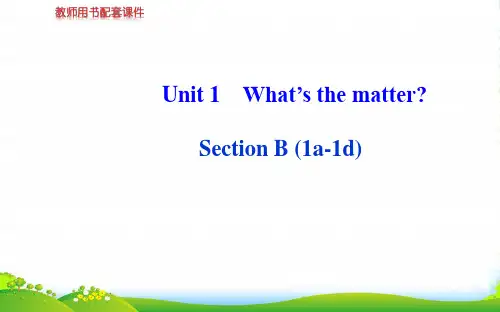
1. If you have a
, you should put your head back.
2. Bob hurt
in P. E. class and he couldn’t move.
3. She
her finger while getting ready for the supper
yesterday.
What happened? 发生了什么事? 【自主领悟】 happen意为“发生”, 为不及物动词, 常表示某事发生的偶然 性。例如: On their way to work, they saw an accident happen on the street. 在上班的路上, 他们看到街上发生了一起事故。
【活学活用】
①—What happened
Mr. Smith yesterday?
—He fell down and hurt his leg.
A. to
B. on
②Great changes have
C. with
D. for
in my hometown these years.
A. happen
(3)“sb. +happen+ _t_o_d_o_sth. ”意为“某人碰巧做某事”。 例如: I happened to meet an old friend of mine in the street yesterday. 昨天我在街上碰巧遇到了一位老朋友。
【误区警示】 (1)happen为不及物动词, 不能用于被动语态。 (2)happen为短暂性动词, 不能与表示一段时间的状语连用。 (3)happen一般用来强调某事发生的偶然性。如要表示事先 安排或有准备的事情或活动, 则不能用happen, 而要用 _ta_k_e__p_la_c_e_。
人教版八年级英语下册unit 1 what's the matter ?Section A2优件
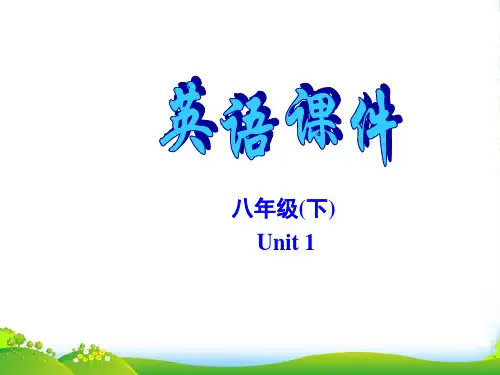
A: What’s the matter? Do you have a sore throat?
B: No, I don’t. A: Do you have a headache? B: Yes, I do. A: You should lie down and rest.
Name Liu Peng
A:What’s the matter?
B: I’m not feeling well.I have a _s_o_re__t_h_ro_a_t_. A: When did it start? B: About _a__w_e_e_k__ago. A: Oh, that’s too bad.You should
Advice: What should they do? A:What’s the matter with you? B:I have a stomachache. A:You should l_i_e_d_o_w__n_a_n_d__r_e_st_. B: That’s a good idea.
_se_e__a_d_e_n_t_i_st____. B: Yes, I think so. A: I hope you feel better soon.
Game time One student mimes an illness. The other students guess the illness and give advice.
2. I have a sore throat. 我喉咙痛。
(1)have vt. 患(得)病, (不用于 进行时态)
He had a bad cold last week. 他上周患了重感冒。
She often has a stomachache.
Unit1 what's the matter sectionB(1a-1d)课件
Period(Four) sectionB(1a-1d)
新人教版八年级下册
Objectives
1. Learn to use new words & expressions: bandage press sick knee nosebleed put a bandage on; run it under water; get hit on the head; hurt one’s back…
He should _ca_l_l_1_2_0__fo_r__h_e_lp__a_n_d__g_et__a_n_X__-r_a_y__.
I cut my finger when peeling an apple with a knife accidently. It was bleeding. What should I do?
When someone hurt his back …
What should you do?
When your knee got hurt …
What should you do?
When your sister is sick …
What should you do?
When someone got hit on the head …
拍个X光片。
__3__ Rest for a few days.
休息几天。
__2__ Press the sides of your nose.
按你鼻子的两侧。
__1__ Put your head down.
把头低下。
__3__ Clean your face.
人教版 八年级英语 下册 Unit1_what's_the_matter课件(完整)
Conversation 4 Girl :What’s wrong with your face? Boy: It’s not my face.It’s my tooth.I have a toothache. Girl:You should see a dentist and get an X-ray. Boy:But will it hurt? Girl:No,and if you don’t go to the dentist now,it’ll hurt even more later!
night,I got a stomachache. I almost couldn’t get myself out of bed this morning.
Conversation 3 Nurse:What’s the matter,Ben?Can you move? Ben:Not really.I was playing soccer the other day and I hurt myself.It
foot n. 脚;足 neck n. 颈;脖子
Words and expressions
stomach n. 胃;腹部 throat n. 咽喉;喉咙 fever n. 发烧 lie v.躺;平躺
lie down 躺下 rest v. 放松;休息
cough v. 咳嗽 X-ray n. X射线;X光
Lisa: OK. Thanks, Mandy.
3b Read the passage again and check the things that happened in the story.
最新人教版 八年级下册 Unit_1_What's_the_matter_Section_B 1a-1d
1. What would you do in these situations?
2. What could we do to prevent these accider or an ambulance(救护车). Never pull her out of the car. Find enough people to lift the car safely and take her to hospital at once. Look at both sides when crossing the street. Follow the traffic rules and be attentive and careful.
___ Put s bandage on it. ___ Run it under water. ___ Put some medicine on it.
___ Clean your face. ___ Put your head back. ___ Put on a clean T-shirt.
Unit 1
Section B 1a — 1d
When these accident happen, what should you do?
nosebleed
When these accident happen, what should you do?
hurt his back
When these accident happen, what should you do?
cut his knee
When these accident happen, what should you do?
sick
When these accident happen, what should you do?
Unit1what’sthematter_SectionA知识点梳理人教版八年级英语下册
人教版八年级下册英语课本知识点梳理Unit 1 wh at’s the matter? sectionA课文内容:What's the matter? 怎么了? (教材第1页)【用法详解】What's the matter? 怎么了?/出什么事了?常用于询问某人患了何种疾病,遇到了什么困难等,也可用于询问某物出了什么故障,其后可接with sb./sth.,表示“某人/某物怎么了?”。
其中matter 用作名词,意为“问题;事情”matter前须加定冠词the。
【例句】What's the matter? 怎么了?Bad luck.I lost my pen. 真倒霉,我弄丢了钢笔.What's the matter with him? 他怎么了?He has a sore back.他背痛【拓展】matter[动词] 要紧;有关系多用在否定句、疑问句或条件句中It doesn't matter.没关系。
(通常用来回答对方的道歉)I have a cold. 我感冒了。
(教材第1页)【用法详解】have a cold (患)感冒。
其中have 用作及物动词,意为“患(病);遭受(病痛)”,常用于结构“have a/an +疾病名称”表示患病或身体某部位不舒服。
此时它不能用于进行时态,其第三人称单数形式为has,过去式为had。
常见的表示病痛的短语还有:have a fever 发烧have a toothache 牙疼have a headache头痛have a cough 咳嗽have a stomachache胃痛Do you often have a cold? 你经常感冒吗?Jim had a stomachache after supper yesterday.吉姆昨天晚饭后胃痛。
l have a stomachache.我胃痛。
( 教材第1 页)【用法详解】stomachache [名词]胃痛;腹痛是由“名词stomach(;腹部)+ache(疼痛)”构成的复合名词。
Unit+1+What’s+the+matter课件-2024-2025学年人教版八年级英语下册
Homework
If you can: Be a health helper.Care about
students who have health problems
and give them some proper advice in
You must:
English.
1.Read the tape- scripts
Listen and number the pictures(1-5) in the order you hear them.
2 3
4
1
5
Listen and match the problems with the advice.
Problems
1.fever
Advice
a. lie down and rest
Watch a video.
Game time: Act and guess
have a headache /ˈhedeɪk/
have a toothache /ˈtuːθeɪk/
have a stomachache /'stʌməkeɪk/
have a cough /kɒf/
have a fever
Chapter III
Dangerous situation Self-protection Spirit
Chapter IV
Practical Activities
Name Problem
Listen and write down their problems.
Sarah has a _c_o_l_d______
A:What’s the matter with...?