
中考英语专项复习-句子的类型Ⅰ-简单句和并列句
(十一)句子的类型Ⅰ简单句和并列句01 命题趋势考标导向化近几年对简单句的考查主要体现在对陈述句、感叹句、疑问句和祈使句上,对并列句的考查主要是在并列句的构成、并列连词和从属连词上。
预计2016年对简单句的考查仍以感叹句、反意疑问句为主,对并列句的考查以并列连词和从属连词为主。
02 定义概念清晰化简单句是只有一个主语(或并列主语)和一个谓语(或并列谓语)的句子。
根据句子的功能可分为陈述句、疑问句、祈使句和感叹句。
陈述句用来陈述一件事或表达一种看法,有肯定和否定两种形式,句末通常用句号。
疑问句是用以提问的句子,句末用问号。
疑问句又分为一般疑问句、特殊疑问句、选择疑问句和反意疑问句。
祈使句是用以表示命令、请求或建议的句子,通常省略主语。
感叹句是用以表达快乐、痛苦等强烈感情的句子,感叹句有用what或how开头的两种形式。
并列句是指由两个或两个以上的并列分句构成的句子。
并列句的分句间没有修饰和被修饰的关系,也没有限定或被限定的关系,其间的关联是靠并列连词实现的。
03 知识归类知识网络化be动词、情态动词或助动词与not 的缩略形式开头,往往表示惊讶、赞叹、怀疑等语气。
作简略回答时也要用yes或no,但其汉语翻译与其原意正好相反。
如:—Don’t you hear of that?你没有听说过吗?—Yes,I do.不,我听说过。
—No,I don’t.是的,我没有听说过。
2.特殊的反意疑问句(1)当陈述部分含有否定意义的词如hardly, few, little, no, nobody, no one, nothing等时,附加疑问部分须用肯定形式。
但若陈述部分含有带否定前缀如im-,un-,in-,dis-等的派生词,仍作为肯定结构,附加疑问部分用否定式。
(2)I am…反意疑问句的附加疑问部分应为aren’t I。
(3)如果陈述部分是肯定或否定的祈使句,疑问部分须用will you。
(4)当陈述部分是let’s do sth.时,疑问部分须用shall we来反问;而当陈述部分是let sb.do sth.时,疑问部分仍然用will you来反问。
(5)当陈述部分主语是不定代词nobody,somebody,no one等时,疑问部分须用复数代词they,也可以用he;当陈述部分主语是不定代词nothing,something时,疑问部分须用代词it。
(6)若陈述部分为there be句型,附加疑问部分仍用there。
(7)陈述部分含有must,表示“必须”时,附加疑问部分用mustn’t。
若陈述部分含must,表示推测意义“必定”时,则附加疑问部分应根据陈述部分不定式结构用相应的系动词或助动词。
(8)主从复合句的反意疑问句附加疑问部分的助动词与人称应与主句的谓语动词和人称保持一致。
若宾语从句的主句为“I think/suppose/believe”等表示说话人的看法,反意疑问句的疑问部分应与宾语从句一致。
(9)陈述部分含情态动词ought to时,附加疑问部分有两种形式:oughtn’t+主语人称代词或shouldn’t+主语人称代词。
3.不能出现在一个句子里的连词(1)because (因为),so(所以)不能出现在一个句子里,只能用其一。
(2)(al)though(虽然),but(但是)不能出现在一个句子里,只能用其一。
但though可以与still或yet连用。
如:Though he was tired, he still worked hard.虽然他很累,但他仍然努力工作。
【题组训练】陈述句与疑问句( )1.(2014·南宁)She doesn’t like pop music, _____?A.does sheB.is sheC.doesn’t sheD.isn’t she( )2.(2014·兰州)—Did you use to have long hair or short hair,Sally?—_________.A.Yes l didB.No,I didn’tC.Long hairD.Curly hair( )3.(2014·北京)—_______people are there in your family? —Three.A.How oftenB.How longC.How manyD.How much( )4.(2014·济宁)—________ are you always staying up so late these days?—To prepare for my final exam.A.HowB.WhyC.WhenD.Where( )5.(2014·湖州)—Excuse me,Sir. ____ is it from here to the nearest shopping mall?—Well,only about five minutes’ walk.A.How oftenB.How longC.How farD.How soon祈使句( )6.(2014·广州)—Sorry I’m late.—_______ tell me the bus broke down again!A.Never toB.NotC.Don’tD.No( )7.(2014·重庆) ________wake up your sister,Ben. She needs a good sleep.A.Don’tB.Do esn’tC.Aren’tD.Can’t( )8.(2014·黄石)—I’m leaving for Xisai Mountain this afternoon.— _________you have packed everything.A.To be sureB.Been sureC.Being sureD.Be sure( )9.(2014·黄冈)—What are the rules at your school?—Don’t run in the hallways and ______arrive late for class.A.not toB.won’tC.don’tD.no( )10.(2014·梅州)____play with fire. _____with fire is dangerous.A.Don’t;PlayingB.Not;PlayingC.Don’t;PlayD.Not to;To play感叹句( )11.(2014·漳州)— ____beautiful blouse she is wearing!—But it doesn’t look good against her skin.A.WhatB.What aC.How( )12.(2014·咸宁)— _______sweet music!—And I really like the V oice of China TV programs.A.WhatB.What aC.HowD.How a( )13.(2014·镇江)—Do you know the book One Hundred Years of Solitude(《百年孤独》)has been printed again?—It is expected to be.______ unusual novel it is!A.WhatB.What aC.HowD.What an( )14.(2014·南京)— ________brave Zhang Hua is!—Yes. He helped his neighbour,Mrs Sun,out of the fire.A.What aB.HowC.How aD.What( )15.(2014·滨州)—_______ interesting the film is!—Yes.I have seen it twice.A.WhatB.HowC.What anD.How an用于否定句中:(1)当列举成分是主语,又在否定词前时,用and连接,而当列举成分在否定词之后时,用or构成完全否定。
如:I can’t sing or dance.我既不会唱歌,也不会跳舞。
Lucy and Lily can’t speak Chinese.露西和莉莉不会说汉语。
(2)在否定句中,如果所连接的两部分都有否定词,那么用and 不用or连接。
如:There is no water and no air on the moon.月球上既没有水,也没有空气。
【题组训练】( )16.(2014·丽水)Good friends are like stars. You don’t always see them,_______ you know they are there.A.asB.butC.forD.then( )17.(2014·成都)Confucius once said,“Everything has beauty,_____ not everyone sees it.”A.butB.orC.and( )18.(2014·安徽)Spend more time talking with your parents,______ they may not well understand you.A.orB.soC.andD.but( )19.(2014·苏州)Read this article,______ you will understand that not everything can be bought with money.A.orB.andC.butD.so( )20.(2013·兰州)The thing that matters is not whether you fail or not,_______ whether you try or not.A.andB.orC.soD.but04 整合集训反馈层级化( )1. _______you wait a few more minutes? It’ll be your turn soon.A.MustB.ShouldC.CouldD.Might( )2.—______T-shirt do you like better, the red one or the blue one?—I prefer the red one.A.How muchB.How manyC.Whose D .Which( )3.— _______do you clean your room?—Every day.A.How longB.How manyC.How oftenD.How soon( )4.—Lily, ______do you study for a math test?—By asking my teacher for help.A.howB.whoC.whyD.what( )5.You’ve just finished your listening exam. Please get yourself ready for the next part,______?A.shall weB.will youC.do youD.are you( )6.—You like listening to Sally’s songs,don’t you?—_______.She has a sweet voice.A.Yes,I doB.Yes,she doesC.No,I don’tD.No,she doesn’t( )7.—Remember to turn off the lights when you leave the room.—______.A.No,I won’tB.I know thatC.It doesn’t matterD.OK.I will( )8.Yoga helps people to keep healthy and relaxed, _____?A.does itB.is itC.doesn’t itD.isn’t it( )9. _______exercising, and you’ll be healthier.A.KeepB.To keepC.KeepingD.Kept( )10. _______smoke here, Dad. Smoking has been banned (禁止) in public places.A.Don’t beB.Don’tC.Not to beD.Be not( )11.______ me back my money, I’ll ring the police.A.Giving;orB.Give;andC.To give;andD.Give;or( )12.—Listen!Someone is playing the piano.—Wow!______ beautiful music!I like it very much.A.WhatB.How aC.What aD.How( )13. _____nice day it is! Let’s go and fly a kite.A.WhatB.What aC.HowD.How a( )14._________ interesting it is to go sailing in Qingdao in summer!A.WhatB.What anC.HowD.How an( )15.—________today!—Yes.Shall we have a picnic in the open air?A.What fine weather isB.How fine weather it isC.What a fine weather it isD.How fine the weather is( )16.I like noisy music, _____ neither my parents nor my sister likes it.A.andB.orC.butD.so( )17.—My mom works as a teacher and she likes her students very much.—____- great job it is! You know, being a teacher is my dream.A.HowB.How aC.WhatD.What a( )18.—______do you spend on your homework every day?—Three hours.A.How oftenB.How longC.How manyD.How much( )19.There will be a volleyball match in our school,_____?A.be thereB.is thereC.will thereD.won’t there( )20. ______sleep too late. It’s bad for your health.A.DoB.NotC.Don’tD.Please not( )21.— _____ pencil is this?—I think it’s Jane’s. I saw her use it just now.A.WhatB.WhoC.WhoseD.Which( )22.—There are always many volunteers in great events,______?—Yes.Many hands make light work!A.aren’t thereB.are thereC.aren’t theyD.are they( )23.—You’ve never seen dinosaur eggs, have you? —______.How I wish to visit the Dinosaur World!A.Yes,I haveB.No,I haven’tC.Certainly,I haveD.Of course,I haven’t( )24.Let’s go somewhere interes ting to relax ourselves,______?A.do weB.don’t weC.will youD.shall we( )25. ______cross the road before the traffic lights turn green.A.NotB.Won’tC.Don’tD.Doesn’t参考答案:(十一)句子的类型Ⅰ简单句和并列句题组训练1—5ACCBC6—10CADCA11—15BADBB 16—20BAABD整合集训1—5CDCAB6—10ADCAB11—15DABCD 16—20CDBDC21—25CABDC。
中考语法高频考点提升训练专题9 简单句和并列句.doc
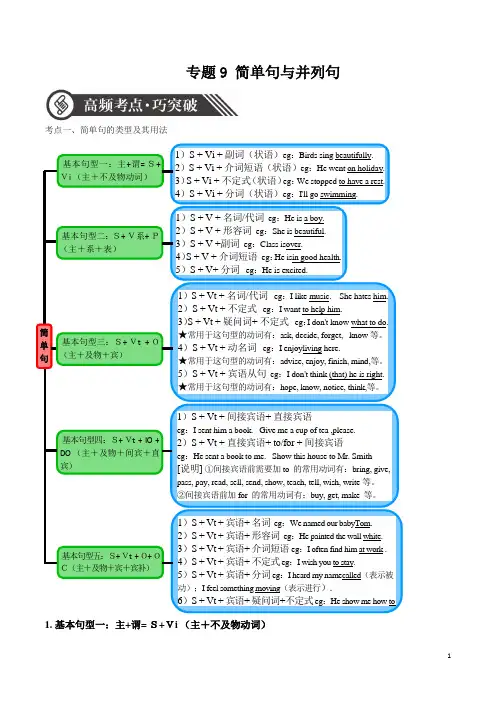
专题9 简单句与并列句考点一、简单句的类型及其用法1. 基本句型一:主+谓= S+Vi (主+不及物动词)简单句 基本句型一:主+谓= S+Vi (主+不及物动词) 1)S + Vi + 副词(状语)eg :Birds sing beautifully.2)S + Vi + 介词短语(状语)eg :He went on holiday. 3)S + Vi + 不定式(状语)eg :We stopped to have a rest.4)S + Vi + 分词(状语)eg :I'll go swimming.基本句型二:S+ V系+ P(主+系+表) 1)S + V + 名词/代词 eg :He is a boy.2)S + V + 形容词 eg :She is beautiful.3)S + V +副词 eg :Class isover.4)S + V + 介词短语 eg :He isin good health.5)S + V+ 分词 eg :He is excited.基本句型三:S+ Vt + O(主+及物+宾) 1)S + Vt + 名词/代词 eg :I like music. She hates him.2)S + Vt + 不定式 eg :I want to help him.3)S + Vt + 疑问词+ 不定式 eg :I don't know what to do.★常用于这句型的动词有:ask, decide, forget, know 等。
4)S + Vt + 动名词 eg :I enjoyliving here.★常用于这句型的动词有:advise, enjoy, finish, mind,等。
5)S + Vt + 宾语从句 eg :I don't think (that) he is right.★常用于这句型的动词有:hope, know, notice, think,等。
中考英语专题简单句和并列句课件
②疑问副词:when何时,where何地,how怎样, why为什么,对状语进行提问。 When were you born? How do you usually go to school? Why did your mother get angry?
③疑问词组:how long多长时间,how far多远, how many/much多少,how often多经常,how old多大年龄,what time什么时候。 How many students are there in your class? How often do you visit the museum?
They must come on time, needn’t they? That man must be Mr. Zhang, isn’t he?
⑩ 当陈述句是主从复合句,反意疑问句的主语通常与主句 的主语保持一致。 She said he would come tomorrow, didn’t she? 注意:若主句的主语是第一人称I/we,其谓语动词又是 think, suppose, expect, believe, imagine等时,反意疑 问句部分的主语和谓语和从句保持一致。 I don't think he is a good student, is he? We think it is a good idea, isn’t it?
中考英语语法专题复习13五种简单句、宾语从句、并列句.doc
中考英语语法专题复习13五种简单句、宾语从句、并列句(-)初中所学的句型一般要分为陈述句、疑问句、祈使句和感叹句。
陈述句中有肯定句与否定句之分。
其中可以分为以下五种:%1主语+不及物动词。
如:I arrived at six last night.%1主语+及物动词+宾语,如:1 bought a good English Chinese Dictionary yesterday.%1主语+及物动词+间接宾语+直接宾语,如:Please tell me a story before I go to bed.这样可加双宾语的句子有buy,tell, give, ask, pass, teach.%1主语+及物动词+宾语+宾语补足语,如:I found it impossible to do it. Please keep the classroom clean and tidy.%1主语+系动词+表语,/ill: Tom is an American boy. The grass turned green in spring.在初中常见的句型中有There be...句型,表示存在某种事物,如:There is a map on the wall 其be动词的形式要与其后而相近的那个名词相一致。
要注意的是这种句型加入助动词后,也要保持be动词,不要换用have,如:There is going to be a meeting tomorrow. 在句子结构中要注意主谓一致的问题,即句子的主语与谓语动词要相呼应。
要注意的有如下儿点:%1用and连接两个主语时一般应视为复数,但如一人身兼两职时则要用单数谓语动词形式,如: A singer and dancer is coming to our party, a singer and dancer 既歌唱又可舞的演员。
而a singer and a dancer则要译为:一位歌唱家和一位舞蹈家。
中考英语语法总总结复习讲义专题简单句及并列句中考总结复习英语

中考英语语法总复习讲义专题:简单句和并列句 ( 中考复习英语) 依照语气可分为:陈述句、疑问句、祈使句和感想句。
依照结构可分为:简单句、并列句和复合句。
※简单句是只包括一个主谓结构的句子。
※并列句是包括两个或两个以上主谓结构的句子,句子之间常用并列连词连接。
常有的连词有 and, but, or, so 等。
一、常有的五种根本句型。
1. S+V,主谓,谓语动词一般为不及物动词;①The bus stopped. ② Tom has arrivedS Vi .2. S+V+P,主谓〔系〕表,谓语动词一般为连系动词;〔表语可以是名词,形容词,动词不定式、动名词短语、介词短语或句子等〕。
连系动词主要有: be(am, is, are), look( 看起来 ), sound 〔听起来〕 , smell 〔闻起来〕, taste〔尝起来〕, feel 〔感觉,摸起来〕;stay/keep( 保持) ;seem(好像,忧如 ). turn/get/become/grow(变得 ); appear( 表现) :appear red①The skirt looks beautiful. ② she is a student. ③ My dream is to bea teacher.S V P3. S+V+ O,主谓宾,谓语动词一般为及物动词,若是是不及物动词,后边要跟介词再接宾语;①I like English. ②She likes watching TV. ③She wants to go shopping.更多资料 QQ378459309制作:S V O4. S+V+O+ OC,主谓宾补,宾语补足语可以是形容词、名词、动词不定式等 .①I find English [easy]. ②They keep their eyes [closed].S V O OC③She asked me [to go shopping]. ④She makes me [laugh].5. S+V+IO+DO,主谓双宾,接双宾语的动词有 buy, give, show, tell, teach, offer, provide一般物为直接宾语〔 D O〕,人为间接宾语〔 IO〕。
中考英语复习之句子结构
句子的结构英语中的句子可分为简单句、并列句和复合句。
简单句结构:主语+谓语并列句结构:简单句+并列连词+简单句 复合句结构:主句+连词+从句;连词+从句+主句复合句中的从句包括:主语从句、宾语从句、表语从句、状语从句和定语从句等。
1.简单句简单句只包含一个主谓结构,它的各个结构都只由单词或短语表示。
简单句有五种基本句型:主谓;主谓宾;主系表;主谓+间宾+直宾;主谓宾+宾补 2.并列句 句型:简单句+并列连词+简单句并列句由2个或2个以上的简单句连接而成。
并列句中各简单句的地位同等重要,相互之间是平行并列的关系。
它们之间用and, but, or 等并列连词连接。
例如: My friend was at home, and we studied together.I liked the story very much, but Li Ming wasn’t interested in it. Hurry up, or you’ll be late. 常用并列连词:.复合句句型:主句+连词+从句;连词+从句+主句复合句包含一个主句、一个或一个以上的从句;或只包含一个从句,但有两个或两个以上的主句。
例如: I went to bed after I (finished my homework ). 主句 连词 状语从句If (he is all right tomorrow ), he will come. 连词 状语从句 主句 在复合句中作宾语的从句叫宾语从句。
宾语从句可由从属连词、连接代词或连接副词引导。
这三类词在句中功能各1.宾语从句的用法例句:1)We know (that) we should study hard. (that可以省略,在句中不作任何成分)2)I don’t think he can pass that exam.(think后的that 一般都省略不用,believe, suppose也是如此)3)We don’t know whether/if our teachers will attend the class meeting.(连接主句和从句,不作成分但不可省略)4)Please let me know whether or not you’ll come to the party.(不作任何成分,只起连词作用,此时不用if)5) I know who did the good deed.(who既作连接代词,又在从句中作主语)6)You must take back wha t you said.(what既作连接代词,又在从句中作谓语动词said的宾语)7)Could you tell me who he is?(who既作连接代词,又在从句中作表语)8)She asked me which shirt I liked best.(which在从句中作定语,修饰shirt)9) I want to know when the plane will take off.(when既作连接副词,又在从句作时间状语)10)He told me where the accident happened.(where是连接副词,在从句中作地点状语)11)Our teacher asked me why I was late.(why在从句中作原因状语)12)Mike asked me how I could do the work without any help.(how在从句中作方式状语)可带宾语从句的形容词*在动词、介词、动词不定式、动词-ing形式和过去分词之后都可以带有宾语从句。
2025年中考英语专题复习专题9 简单句和并列句课件
上一页 返回首页 下一页
专题九 简单句和并列句
类型
常见句式
Do型
肯定形式:动词原形+其他 否定形式:Don’t+动词原形+其他
Let 型
肯定形式:Let+宾语+动词原形+其他 否定形式:Let+宾语+not+动词原形+其他
No型 No+名词/动词-ing形式
Never型 Never+动词原形+其他
上一页 返回首页 下一页
专题九 简单句和并列句
3. 感叹句 (1)what引导的感叹句结构 ①What+a/an+adj.+单数可数名词 (+主语+谓语)! What a good idea it is! 多么好的一个主意! ②What+adj.+复数名词/不可数名词(+主语+谓语)! What wonderful races! 多么精彩的比赛啊! (2)how引导的感叹句结构 ①How+形容词/副词+主语+谓语! How useful the information is!此信息多么有用啊! ②How+形容词+a/an+单数可数名词(+主语+谓语)! How tall a boy he is!他是一个多么高的男孩啊!
上一页 返回首页 下一页
专题九 简单句和并列句
(2)特殊疑问句 由疑问词开头,对句中某一成分提问的句子为特殊疑问句。常用的疑问 代词有what、which、who、whom、whose等,疑问副词有when、where、 why、how,疑问词组有how soon“多久以后”、how often“多久一 次”、how long“多长,多久”、how far“多远”、how much“多少 (钱)”、how old“多少岁”等。
上一页 返回首页 下一页
专题九 简单句和并列句
(4)here、there、out、in、down、away等表示方位的副词位于句首时,如 果主语是名词(短语),要用完全倒装;如果主语是代词,则语序保持不 变。谓语动词的数由倒装句的主语决定。 Here comes the bus.公共汽车来了。 Here you are.给你。
中考英语语法专项冲刺——句子突破(简单句、并列句和复合句)
中考英语语法专项冲刺——句子突破简单句、并列句和复合句句子按结构可分为简单句、并列句和复合句。
复合句中包含宾语从句、状语从句或定语从句等。
◆一简单句简单句就是只包含一个主谓结构的句子,其句式结构主要有五种:①主 + 谓。
He works in a big company. 他在一家大公司工作。
②主 + 系 + 表。
She is a kind girl. 她是一个善良的女孩。
③主 + 谓 + 宾。
Ann eats junk food twice a week .安一周吃两次垃圾食品。
④主 + 谓 + 间宾 + 直宾。
He gave me a pen .他给我一支钢笔。
⑤主 + 谓 + 宾 + 宾补。
He kept me waiting for two hours .他让我等了两小时。
◆二并列句并列句由两个或两个以上的简单句连接而成。
并列句中的各简单句同等重要,没有从属关系,是并列的关系,之间用并列连词连接。
1. 表示顺承的并列连词有and / not only …but (also)等。
如:She not only gaveus a lot of advice, butalso helped us to overcome difficulties .他不仅给了我们很多建议,而且还帮助我们克服困难。
2. 表示选择的并列连词有or,either …or …等。
如:Either you or Maria will haveto go .你或玛丽亚得去一趟。
3. 表示转折的并列连词有but,yet,however 等。
如:It is hot in summer here , butit’s not cold in winter .这里夏天热,但冬天不冷。
4. 表示因果关系的并列连词有so,如:He works hard , so he is one of the topstudents in our class .因为他学习努力,所以他是我们班最优秀的学生之一。
中考英语语法专题简单句,并列句(带答案)
答案:1.What a 2.How 3.How 4.What an 5.What a 6.How
四.祈使句
祈使句表示命令、请求、建议或劝告。其主语you常省略,谓语动词用原形,句末用感叹号或句号。
▲肯定的祈使句:动词原形+其他
A. How far B. How often C. How soon D. How long
( )2. — ______ have you been married? —For twenty years
A. When B.How often C.How long D.How soon
( )3. — ________ is it from the village to your farm? —It’s about 10 minutes’ walk.
--_________________________________________ --He will come backin a week.
答案:How long have you stayed here?
How often does she play badminton?
How soon will she come back?
如:Which do you likebetter, coffee, tea or milk?
▲选择疑问句的回答:不能用yes或no.如:—Do you go to workby bus or by bike? —By bus.
4.反意疑问句(简单了解即可)
反意疑问句表示对事情没有把握,希望别人给出意见。反义疑问句时态一致、主语一致、前后意思相反。
中考英语语法专项复习:简单句、并列句和复合句
中考英语语法专项复习:简单句、并列句和复合句句子按结构可分为简单句、并列句和复合句。
复合句中包含宾语从句、状语从句或定语从句等。
◆一简单句简单句就是只包含一个主谓结构的句子,其句式结构主要有五种:①主 + 谓。
He works in a big company. 他在一家大公司工作。
②主 + 系 + 表。
She is a kind girl. 她是一个善良的女孩。
③主 + 谓 + 宾。
Ann eats junk food twice a week .安一周吃两次垃圾食品。
④主 + 谓 + 间宾 + 直宾。
He gave me a pen .他给我一支钢笔。
⑤主 + 谓 + 宾 + 宾补。
He kept me waiting for two hours .他让我等了两小时。
◆二并列句并列句由两个或两个以上的简单句连接而成。
并列句中的各简单句同等重要,没有从属关系,是并列的关系,之间用并列连词连接。
1. 表示顺承的并列连词有and / not only …but (also)等。
如:She not only gaveus a lot of advice, butalso helped us to overcome difficulties .他不仅给了我们很多建议,而且还帮助我们克服困难。
2. 表示选择的并列连词有or,either …or …等。
如:Either you or Maria will haveto go .你或玛丽亚得去一趟。
3. 表示转折的并列连词有but,yet,however 等。
如:It is hot in summer here , butit’s not cold in winter .这里夏天热,但冬天不冷。
4. 表示因果关系的并列连词有so,如:He works hard , so he is one of the topstudents in our class .因为他学习努力,所以他是我们班最优秀的学生之一。
2023中考英语专题: 简单句和并列句二轮复习语法专项精编课件(全国通用)
进一步证实
—Yes, there is./ No, there isn’t.
表示命令、请求、建议、劝告等
Come in, please.
表示惊讶、喜悦、愤怒等感情,常用what或how引导
What beautiful flowers! How clever the girl is!
02简单句的功能分类
经典范例
(2022•全国•期末)— Is there a pay phone around here?
A 【典例3】— ________. It’s in front of the clothes store.
A.Yes, there is B.Yes, it is
C.No, there isn’t D.No, it isn’t
简单句和并列句
2023中考语法专项精编
2022
中
考
语
法 专
对本章知识点及经典范例进行精讲,结合典型考题精炼巩固,
题
意在让学生掌握:
之
1.简单句的构成和功能分类;
简
2.并列连词和并列句;
单
3.其它句型(It句型、There be句型、特殊句式等)的使用;
句
和 并
经过学习,以上句子类型的熟练运用。
列
句
C.“Will he be here soon?” “I hope so.”
D.I hope see you soon.
【答案】D 【详解】句意:下面哪个句子是错的?考查陈述句。分析四个选项可知,D选 项中hope的用法是“hope to do sth”或者“hope that从句”,没有hope do的结构, 所以D选项错误,故选D
经典范例