
南京航空航天大学Matrix-Theory双语矩阵论期末考试2015
0 1 0
1 1 0 0
Solve
(A 2I ) p3 p2 ,
( A 2I ) p3
0
0
0
p3
0
we
obtain
that
0 1 0 1
1 0 1
P
0
0
1 ,
0 1 0
1 1 0
(1) -----------------------------------------------------------------------------------------------------------------
(2)
1 0 1
T
0
1
0
ห้องสมุดไป่ตู้
(The column vectors of T are the eigenvectors of A)
1
p, q p(t)q(t)dt . 1
(1) Construct an orthonormal basis for P[1,1] from the basis 1, x, x2 by using the Gram-Schmidt orthogonalization process.
Suppose that AR33 and A2 5A 6I O . (1) What are the possible minimal polynomials of A? Explain. (2) In each case of part (1), what are the possible characteristic polynomials of A? Explain.
0
1 2
Determinant divisor of order D1() 1 , D2 () 1 , D3 () p() ( 1)( 2)2
Elementary divisors are ( 1) and ( 2)2 .
---------------------------------------------------------------------------------------------------------------------(2) The Jordan canonical form is --------------------------------------------------------------------------------------------------------------------------
------------------------------------------------------------------------------------------------------------------is the subspace consisting of all constant polynomials.
--
第 3 页(共 3 页)
Part II (选做题, 每题 10 分) 请在以下题目中(第 6 至第 9 题)选择三题解答. 如果你做了四题,请在题号上画圈标明需要批改的三题. 否 则,阅卷者会随意挑选三题批改,这可能影响你的成绩. 第 6 题 Let P4 be the vector space consisting of all real polynomials of degree less than 4 with usual addition and
(1) Find the matrix A representing with respect to the ordered basis [1, x, x2 ] for P3 .
(2) Find a basis for P3 such that with respect to this basis, the matrix B representing is diagonal. (3) Find the kernel(核) and range (值域)of this transformation. Solution:
(2) Let f (x) x2 1 P[1,1] . Find the projection of f onto the subspace spanned by{1, x }. Solution:
(1)
1
1 1 , 1 dx 1
,2 u1
1, 2
p1 x,
Case x 1, the characteristic polynomial is (x 1)3
Case x2 5x 6 , the characteristic polynomial is (x 1)2 (x 6) or (x 6)2 (x 1)
------------------------------------------------------------------------------------------------------------------第 5 题(10 分) 得分
第 2 题(15 分) 得分
Let be the linear transformation on P3 (the vector space of real polynomials of degree less than 3) defined by ( p(x)) xp '(x) p ''(x) .
(3) Compute eAt . (Give the details of your computations.)
Solution:
第 2 页(共 3 页)
(1)
1 1 0
I
A
0
2
0
,(特征多项式
p() ( 1)( 2)2 . Eigenvalues are 1, 2, 2.)
The range is the subspace spanned by the vectors x, x2 1
----------------------------------------------------------------------------------------------------------------------第 3 题(20 分) 得分
Solution:
(1) An annihilating polynomial of A is x2 5x 6 .
The minimal polynomial of A divides any annihilating polynomial of A. The possible minimal polynomials are x 6 , x 1, and x2 5x 6 . --------------------------------------------------------------------------------------------------------------(2) The minimal polynomial of A divides the characteristic polynomial of A. Since A is a matrix of order 3, the characteristic polynomial of A is of degree 3. The minimal polynomial of A and the characteristic polynomial of A have the same linear factors. Case x 6 , the characteristic polynomial is (x 6)3
(2)
proj x2 1,u1 u1 x2 1,u2 u2 x2 1,
1 2
1 x2 1, 2
3x 2
3x 2
----------------------------------------------------------------------------------------------------------------
P 1
0
0
1
0 1 0
--------------------------------------------------------------------------------------------------------------------
第 4 题(10 分) 得分
Let
A
1 0
2 0
0 0
.
Find
the
Moore-Penrose
inverse
A of
A.
Solution:
1
P (PT P )1 PT
(1,
,0
)
G
GT
(GGT
)1
1 5
2 0
也可以用 SVD 求.
----------------------------------------------------------------------------------------------------------------
0 0 1
The corresponding eigenvectors in P3 are
0 0 0
T 1 AT
南京航空航天大学Matrix-Theory双语矩阵论期末考试2015

NUAALet 3P (the vector space of real polynomials of degree less than 3) defined by(())'()''()p x xp x p x σ=+.(1) Find the matrix A representing σ with respect to the ordered basis [21,,x x ] for 3P .(2) Find a basis for 3P such that with respect to this basis, the matrix B representing σ is diagonal.(3) Find the kernel (核) and range (值域)of this transformation. Solution: (1)221022x x x x σσσ===+()()() 002010002A ⎛⎫⎪= ⎪ ⎪⎝⎭----------------------------------------------------------------------------------------------------------------- (2)101010001T ⎛⎫ ⎪= ⎪ ⎪⎝⎭(The column vectors of T are the eigenvectors of A)The corresponding eigenvectors in 3P are 1000010002T AT -⎛⎫⎪= ⎪ ⎪⎝⎭(T diagonalizes A ) 22[1,,1][1,,]x x x x T += . With respect to this new basis 2[1,,1]x x +, the representingmatrix of σis diagonal.------------------------------------------------------------------------------------------------------------------- (3) The kernel is the subspace consisting of all constant polynomials.The range is the subspace spanned by the vectors 2,1x x +-----------------------------------------------------------------------------------------------------------------------Let 020012A ⎛⎫⎪= ⎪ ⎪-⎝⎭.(1) Find all determinant divisors and elementary divisors of A .(2) Find a Jordan canonical form of A .(3) Compute At e . (Give the details of your computations.) Solution: (1)110020012I A λλλλ-⎛⎫ ⎪-=- ⎪ ⎪-⎝⎭,(特征多项式 2()(1)(2)p λλλ=--. Eigenvalues are 1, 2, 2.)Determinant divisor of order 1()1D λ=, 2()1D λ=, 23()()(1)(2)D p λλλλ==-- Elementary divisors are 2(1) and (2)λλ-- .---------------------------------------------------------------------------------------------------------------------- (2) The Jordan canonical form is100021002J ⎛⎫ ⎪= ⎪ ⎪⎝⎭--------------------------------------------------------------------------------------------------------------------------(3) For eigenvalue 1, 010010011I A ⎛⎫⎪-=- ⎪ ⎪-⎝⎭ , An eigenvector is 1(1,0,0)T p = For eigenvalue 2, 1102000010I A ⎛⎫⎪-= ⎪ ⎪⎝⎭, An eigenvector is 2(0,0,1)T p =Solve 32(2)A I p p -=, 331100(2)00000101A I p p --⎛⎫⎛⎫⎪ ⎪-== ⎪ ⎪ ⎪ ⎪-⎝⎭⎝⎭we obtain that3(1,1,0)T p =-101001010P ⎛⎫ ⎪=- ⎪ ⎪⎝⎭, 1110001010P -⎛⎫⎪= ⎪ ⎪-⎝⎭ 1At J e Pe P -=22210100110001000101000010tt t t e e te e ⎛⎫⎛⎫⎛⎫⎪ ⎪ ⎪=- ⎪ ⎪ ⎪ ⎪ ⎪ ⎪-⎝⎭⎝⎭⎝⎭22220000t t t t t t e e e e tee ⎛⎫-⎪= ⎪ ⎪-⎝⎭ --------------------------------------------------------------------------------------------------------------------Suppose that ∈R A and O I A A =--65.(1) What are the possible minimal polynomials of A ? Explain.(2) In each case of part (1), what are the possible characteristic polynomials of A ? Explain.Solution:(1) An annihilating polynomial of A is 256x x --.The minimal polynomial of A divides any annihilating polynomial of A. The possible minimal polynomials are6x -, 1x +, and 256x x --.---------------------------------------------------------------------------------------------------------------(2) The minimal polynomial of A divides the characteristic polynomial of A. Since A is a matrix of order 3, the characteristic polynomial of A is of degree 3. The minimal polynomial of A and the characteristic polynomial of A have the same linear factors. Case 6x -, the characteristic polynomial is 3(6)x - Case 1x +, the characteristic polynomial is 3(1)x + Case 256x x --, the characteristic polynomial is 2(1)(6)x x +- or 2(6)(1)x x -+-------------------------------------------------------------------------------------------------------------------Let 120000A ⎛⎫=⎪⎝⎭. Find the Moore-Penrose inverse A +of A .Solution: ()12011200000A PG ⎛⎫⎛⎫=== ⎪ ⎪⎝⎭⎝⎭1()(1,0)T T P P P P +-==, 111()250T T G G GG +-⎛⎫⎪== ⎪ ⎪⎝⎭110112(1,0)2055000A G P +++⎛⎫⎛⎫ ⎪⎪=== ⎪ ⎪ ⎪ ⎪⎝⎭⎝⎭也可以用SVD 求.------------------------------------------------------------------------------------------------------------------Part II (选做题, 每题10分)请在以下题目中(第6至第9题)选择三题解答. 如果你做了四题,请在题号上画圈标明需要批改的三题. 否则,阅卷者会随意挑选三题批改,这可能影响你的成绩.Let 4P be the vector space consisting of all real polynomials of degree lessthan 4 with usual addition and scalar multiplication. Let 123,,x x x be three distinct real numbers. For each pair of polynomials f and g in 4P , define 31,()()i i i f g f x g x =<>=∑.Determine whether ,f g <> defines an inner product on 4P or not. Explain.Let n n A ⨯∈R . Show that if x x A =)(σis the orthogonal projection fromn R to )(A R , then A is symmetric and the eigenvalues ofA are all 1’s and 0’s.n n A ⨯∈C . Show that x x A H is real-valued for all n C x ∈if and only if Ais Hermitian.Let n n B A ⨯∈C , be Hermitian matrices, and A bepositive definite. Show thatAB is similar to BA , and is similar to a real diagonal matrix.若正面不够书写,请写在反面.123()()()x x x x x x ---. Then ,0f f <>=. But 0f ≠. This does not define an inner product. For any x , ()()x x T A R A N A ⊥-∈=, ()x x 0T A A -=. Hence, T T A A A =. Thus. T A A =.From above, we have 2A A =. This will imply that λλ-2is an annihilating polynomial of A. The eigenvalue of A must be the roots of 02=-λλ. Thus, the eigenvalues of A are1’s and 0’s.See Thm 7.1.1, page 182. 也可以用其它方法.Since A is nonsingular, 1()AB A BA A -=. Hence, A is similar to BASince A is positive definite, there is a nonsingular hermitian matrix P such that H A PP =. 1()H H AB PP B P P BP P -==Since H P BP is Hermitian, it is similar to a real diagonal matrix.is similar to H AB P BP , H P BP is similar to a real diagonal matrix. Thus AB is similar to a real diagonal matrix.。
南航矩阵论期中考试试题2013可修改全文

Mid-term Exam of Matrix TheoryPart IRequired Questions (4×15′=60′).Q1.1)Let A = 2−344−686−78,1.Calculate the characteristics polynomial and eigenvalues of A .2.Find the determinant divisors,invariant divisors and elementary divisors of A .2)Given B =(17−645−16)and C =(14−603−13),please determine if B and C are similar or not.And prove your conclusion.Q2.Denote V ={(a 11a 12a 21a 22)∈R 2×2|a 11=a 22}.For any X ∈V ,let T (X )=P X +XP ,where P =(0110).1.Find a basis of V and show the dimension.2.Arbitrarily given A =(a 11a 12a 21a 22)and B =(b 11b 12b 21b 22)in V ,define (A,B )=a 11b 11+2a 12b 12+a 21b 21.Please show that (A,B )is an inner product on V .3.Given an orthonormal basis of V under the inner product of 2.4.Prove that T is a linear transformation on V ,and show the matrix representation of T with respect to the basis given in item 1.Q3.Consider the inner product space C [−1,1]with inner product defined as(f,g )=∫1−1f (x )g (x )dx,∀f (x ),g (x )∈C [−1,1].11.Show that1and3x2−1are orthogonal.2.Determine∥1∥and∥3x2−1∥.3.Let S=L{1,3x2−1}be a subspace of R[x]3,find the optimal approximation of xover S.Q8.Denote R[x]3to be the vector space of zero and polynomials with degree less than3.1.Determine the dimension of R[x]3and give a basis of R[x]3.2.Define the linear transformation D on R[x]3,D(f(x))=f′(x),∀f(x)∈R[x]3.Please give the matrix representation of D with respect to the basis given in the above item.Show R(D)and ker(D).3.Prove that D is not diagonalizable.4.Define the inner product on R[x]3,(f,g)=∫1−1f(x)g(x)dx,∀f(x),g(x)∈R[x]3,please Gram-Schmidt orthogonalize the basis given in item1.Part IIPreferential Questions(2×20′=40′).Q5.For any x∈R n,several definitions are given as follows,∥x∥0=∑x i=0|x i|0,∥x∥p=(m∑i=1|x i|p)1p(0<p<1),∥x∥1=m∑i=1|x i|.(1)1.Please determine if∥x∥0,∥x∥p and∥x∥1are valid vector norms or not.And try todefense your decision.2.Especially when n=2,plot the curves of∥x∥0=1,∥x∥p=1and∥x∥1=1respectively.2Q6.Given A∈R n×n,summarize the necessary and sufficient conditions of A to be di-agonalizable,and prove at least one of them.Determine if the matrix A given in Q1is diagonalizable or not.If yes,please explain why,if not,please give the Jordan canonical form of A.Q7.Given A∈R n×n,denote W={X∈R n×n|AX=XA}.1.Show that W is a subspace of R n×n.2.DenoteD=λ10 00λ2 0............00···λn,whereλ1,λ2,···,λn are different from each other.If A=D,please determine the dimension of W.3.If A is similar to D defined as in item2,please prove that any X∈W is diagonalizable.4.Given some X∈W,if X and A are both diagonalizable,then there exists a nonsingularmatrix P∈R n×n such that P−1XP and P−1AP are diagonal simultaneously.3。
南航双语矩阵论matrixtheory第五章部分习题参考答案

第五章部分习题参考答案#2. Find determinant divisors and elementary divisors of each of the following matrices.(a) 1000100015432λλλλ-⎛⎫ ⎪-⎪ ⎪- ⎪+⎝⎭ (b)001010100000λλλλ⎛⎫⎪ ⎪ ⎪ ⎪⎝⎭Solution(a ) 100010()0015432A λλλλλ-⎛⎫ ⎪- ⎪= ⎪- ⎪+⎝⎭det (())A λ4322345λλλλ=++++100det 10101λλ-⎛⎫⎪-=- ⎪ ⎪-⎝⎭. Hence, the determinant divisors are 123()()()1D D D λλλ===,4324()2345D λλλλλ=++++. Invariant divisor are 123()()()1d d d λλλ===,4324()2345d λλλλλ=++++Unfortunately, it is not easy to factorize 4324()2345d λλλλλ=++++ by hand. With the help of Maple or Matlab, we can see that ()A λ has four distinct linear elementary divisors. (b) 44()D λλ=, 123()()()1D D D λλλ===. There is a unique elementary divisor 4λ #3. Let11a a A a ⎛⎫ ⎪ ⎪= ⎪ ⎪⎝⎭ , a a B a εε⎛⎫ ⎪⎪= ⎪ ⎪⎝⎭ be n n ⨯ matrices, where 0ε≠. Show that A and B are similar.Proof The Smith normal forms of both I A λ- and I B λ-are11()n a λ⎛⎫ ⎪⎪ ⎪ ⎪-⎝⎭. A and B have the same set of elementary divisors. Hence they are similar to each other. #4. Let11a a A a ⎛⎫ ⎪ ⎪= ⎪ ⎪⎝⎭ , 11a a B a ε⎛⎫ ⎪⎪= ⎪ ⎪⎝⎭be n n ⨯ matrices, where 0ε≠. Show that A and B are NOT similar. ProofThe determinant of I A λ- is ()n a λ- . The determinant of I B λ- is ()n a λε--. A and B have distinct characteristic polynomials. Hence, they are not similar.#11. How many possible Jordan forms are there for a 66⨯ complex matrix with characteristic polynomial 42(2)(1)x x +-?Solution The possibilities for the sets of elementary divisors are { 42(2),(1)x x +-}, {4(2),(1),(1)x x x +--}{32(2),(2),(1)x x x ++-}, {3(2),(2),(1),(1)x x x x ++--} {222(2),(2),(1)x x x ++-}, {22(2),(2),(1),(1)x x x x ++--},{22(2),(2),(2),(1)x x x x +++-}, {2(2),(2),(2),(1),(1)x x x x x +++--}{2(2),(2),(2),(2),(1)x x x x x ++++-}, {(2),(2),(2),(2),(1),(1)x x x x x x ++++--}. For each set of elementary divisors, there is a Jordan canonical form up to similarity. There are 10 Jordan canonical forms up to similarity.#12. Classify up to similarity all 33⨯ complex matrices A such that 3A I =. Solution An annihilating polynomial of A is 321(1)()()x x x x ωω-=---, where ω A is diagonalizable.The possibilities for the minimal polynomial of A are1x -, x ω-, 2x ω-;(1x -)(x ω-), (x ω-)(2x ω-), (1x -)(2x ω-);2(1)()()x x x ωω---Up to similarity, all 33⨯ complex matrices A are100010001⎛⎫ ⎪ ⎪ ⎪⎝⎭, 000000ωωω⎛⎫⎪ ⎪ ⎪⎝⎭, 222000000ωωω⎛⎫ ⎪ ⎪ ⎪⎝⎭; 10001000ω⎛⎫⎪ ⎪ ⎪⎝⎭, 1000000ωω⎛⎫ ⎪ ⎪ ⎪⎝⎭; 22000000ωωω⎛⎫ ⎪⎪ ⎪⎝⎭, 2000000ωωω⎛⎫ ⎪ ⎪ ⎪⎝⎭;221000000ωω⎛⎫⎪ ⎪ ⎪⎝⎭,210001000ω⎛⎫⎪ ⎪ ⎪⎝⎭21000000ωω⎛⎫ ⎪ ⎪ ⎪⎝⎭#14. If N is a nilpotent (幂零的) 33⨯ matrix over C , prove that 21128A I N N =+- satisfies2A I N =+, i.e., A is a square root of I N +. Use the binomial series for 1/2(1)t + to obtain asimilar formula for a square root of I N +, where N is any nilpotent n n ⨯ matrix over C .Use the result above to prove that if c is a non-zero complex number and N is a nilpotent complex matrix, then cI N +has a square root. Now use the Jordan form to prove that every non-singular complex n n ⨯ matrix has a square root.Solution If N is an n n ⨯ matrix and k N O =, then k x is an annihilating polynomial for N . The minimal polynomial of N must be of the form p x , where p n ≤ and p k ≤ since the minimal polynomial of a matrix divides its characteristic polynomial. Thus, n N O =.(1) If N is a nilpotent 33⨯ matrix, then 3N O =. By straightforward computation, we can verify that 2A I N =+.(2) If N is an n n ⨯ nilpotent matrix, n N O =.1/22111111(1)(1)((1)1)122222(1)122!(1)!n n t t t t n -----++=+++++- 1/22111111(1)(1)((1)1)122222()22!(1)!n n I N I N N N n -----++=++++-(3) Since1N c is a nilpotent matrix, 1I N c + has a square root 1/21()I N c+. cI N + has a square root 1/21/21()c I N c+.(4) Suppose that 12121()0()000()r d d d r J J P AP J J λλλ-⎛⎫ ⎪⎪==⎪ ⎪ ⎪⎝⎭. Then each ()k d k J λ has asquare root 1/2()k d k J λ since ()k d k J λ is of the form k I N λ+, where 0k λ≠ because A is nonsingular and N is nilpotent.Let 121/211/2211/2()000()000()r d d d r J J B P P J λλλ-⎛⎫⎪⎪=⎪ ⎪⎪⎝⎭, then 2B A =. Hence, A has a squareroot.#20. Prove that the minimal polynomial of a matrix is equal to the characteristic polynomial if andonly if the elementary divisors are relatively prime in pairs.Proof Suppose that a Jordan canonical form of A is1212()000()000()r d d d r J J J J λλλ⎛⎫⎪ ⎪=⎪ ⎪ ⎪⎝⎭(where 12,,,r λλλ are not necessarily distinct. Each ()i d i J λ is a Jordan block.)The minimal polynomial of A is the same as that of J . The characteristic polynomial of A is the same as that of J . The elementary divisors of A are 11()d λλ-, , ()rd r λλ-The minimal polynomial of ()i d i J λ is ()i d i λλ-. The minimal polynomial of J is the least common multiple (最小公倍式) of 11()d λλ-, , ()rd r λλ-. The characteristicpolynomial of J is 1212()()()()rd d d r p λλλλλλλ=--- .The least common divisor of 11()d λλ-, , ()rd r λλ- is equal to the product of11()d λλ-, , ()r d r λλ- if and only if ()j dj λλ-and ()k d k λλ-are relatively prime forj k ≠. Thus the minimal polynomial of a matrix is equal to the characteristic polynomial ifand only if the elementary divisors are relatively prime in pairs.。
南京航空航天大学研究生课程《矩阵论》内容总结与习题选讲
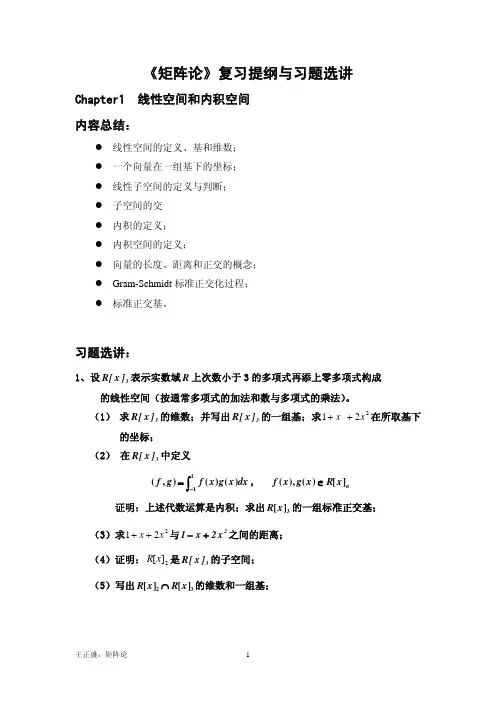
《矩阵论》复习提纲与习题选讲Chapter1 线性空间和内积空间内容总结:z 线性空间的定义、基和维数;z 一个向量在一组基下的坐标;z 线性子空间的定义与判断;z 子空间的交z 内积的定义;z 内积空间的定义;z 向量的长度、距离和正交的概念;z Gram-Schmidt 标准正交化过程;z 标准正交基。
习题选讲:1、设表示实数域3]x [R R 上次数小于3的多项式再添上零多项式构成 的线性空间(按通常多项式的加法和数与多项式的乘法)。
(1) 求的维数;并写出的一组基;求在所取基下的坐标;3]x [R 3]x [R 221x x ++ (2) 在中定义3]x [R , ∫−=11)()(),(dx x g x f g f n x R x g x f ][)(),(∈ 证明:上述代数运算是内积;求出的一组标准正交基;3][x R (3)求与之间的距离;221x x ++2x 2x 1+−(4)证明:是的子空间;2][x R 3]x [R (5)写出2[][]3R x R x ∩的维数和一组基;二、 设22R ×是实数域R 上全体22×实矩阵构成的线性空间(按通常矩阵的加 法和数与矩阵的乘法)。
(1) 求22R ×的维数,并写出其一组基;(2) 在(1)所取基下的坐标; ⎥⎦⎤⎢⎣⎡−−3111(3) 设W 是实数域R 上全体22×实对称矩阵构成的线性空间(按通常矩阵的加法和数与矩阵的乘法)。
证明:W 是22R ×的子空间;并写出W 的维数和一组基;(4) 在W 中定义内积, )A B (tr )B ,A (T =W B ,A ∈求出W 的一组标准正交基;(5)求与之间的距离; ⎥⎦⎤⎢⎣⎡0331⎥⎦⎤⎢⎣⎡−1221 (6)设V 是实数域R 上全体22×实上三角矩阵构成的线性空间(按通常矩阵的加法和数与矩阵的乘法)。
证明:V 也是22R ×的子空间;并写出V 的维数和一组基;(7)写出子空间的一组基和维数。
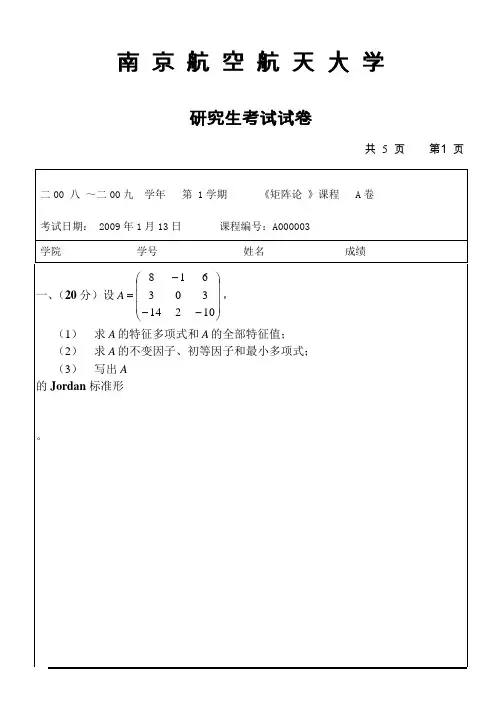
南京航空航天大学矩阵论08-09A试卷及答案
(2)在 中定义线性变换 :
求 在(1)中所取基下的矩阵表示;
(3)求(2)中线性变换 的值域 和核 ,并确定他们的维数;
(4)在 中能否取一组基使得(2)中线性变换 在所取基下的矩阵为对角矩阵?如果能,则取一组基;如果不能,则说明理由。
五(20分)设 为 阶Hermite矩阵,证明:
(1)存在唯一Hermite矩阵 使得 ;
(2)如果 ,则 ;
(3)如果 ,则 。
三20分)设 , ,
(1)作出 的满秩分解,计算 ;
(2)应用广义逆矩阵判断线性方程组 是否相容。若相容,求其通解;
若不相容,求其极小最小二乘解。
(3)设 是 实矩阵, 是 维实向量,证明:不相容线性方程组 的最小二乘解唯一当且仅当 列满秩
四(20分)设 表示实数域 上全体 上三角矩阵作成的线性空间(对矩阵的加法和数量乘法)。
一、(20分)设 ,
(1)求 的特等因子和最小多项式;
(3)写出
的Jordan标准形
。
二(20分)(1)设 ,求 , , , ;
(2)设 是 上的相容矩阵范数,证明:
(i)如果 是 阶可逆矩阵, 是 的任一特征值,则 ;
(ii)如果 是可逆矩阵,令 ,则 是 上的相容矩阵范数。
南京航空航天大学2007-2014硕士研究生矩阵论matrixTheory试题

2 3 4 A 4 6 8 6 7 8 。 一(20 分) (1)设
2010 ~ 2011 学年《矩阵论》 课程考试 A 卷
(i)求 A 的特征多项式和 A 的全部特征值; (ii)求 A 的行列式因子,不变因子和初等因子; (iii)写出 A 的 Jordan 标准形;
1 A* A2 A* (3)证明: n 。
1 1 1 1 A 0 0 0 0 四、 (20 分)已知矩阵
(1)求矩阵 A 的 QR 分解;
1 2 0 1 b 1 1 2 1 ,向量 ,
(2)计算 A ;
17 6 14 60 A , B 45 16 3 13 ,试问 A 和 B 是否相似?并说明 (2)设
原因。
2 1 A 1 2 3 1 ,求 A 1 , A 2 , A , A F ; 二(20 分) (1)设
(3)用广义逆判断方程组 Ax b 是否相容?若相容,求其通解;若不相容,求其极小最小二乘解。
五、 (20 分)
(1)设矩阵
问当 t 满足什么条件时, A B 成立?
5 3 2 0 1 A 3 2 t , B 1 1 2 t 2 2 0 .5 t
五(20 分)设
A ( a ij )
为 n 阶 Hermite 矩阵,证明:
3
存在唯一 Hermite 矩阵 B 使得 A B ;
2
(2)
(3) 如果 A 0 ,则 tr ( A)tr ( A ) n 。
1
如果 A 0 ,则 tr ( A ) (tr ( A)) ;
2
南航双语矩阵论matrix theory第4章部分习题参考答案
)
If i is a root of p( ) 0 , then p(i ) 0 . We obtain that eigenvalue of C T with eigenvector x (1, i ,, in 2 , in 1 )T .
Exercise 16
Let be an orthogonal transformation on a Euclidean space V (an inner product space over the real number field). If W is a -invariant subspace of V, show that the orthogonal complement of W is also -invariant. Proof Let V W W , where W is -invariant. Let {u1 , u2 ,, uk } be an orthonormal basis for
0 1 T C x 0 0 0 0 1 0 0 0 0 0 0 an 0 an 1 0 an 2 1 a1
T
i i 1 2 2 i i i n2 n 1 n 1 i i i n 1 n n 1 a a a p ( i n i n 1 i 1 i i
C T x i x . Then i is an
(b) If p( ) has n distinct roots, then all roots of p( ) are eigenvalues of C T . We obtain that the characteristic polynomial of C T and p( ) have the same n distinct roots. And also they have the same degree and the same leading coefficient. Hence, the characteristic polynomial of C T is the same as p( ) . Since C and C T have the same characteristic polynomial, we know that p( ) is the characteristic polynomial of C.
南京航空航天大学MatrixTheory双语矩阵论期末考试
--------------------------------------------------------------------------------------------------------------------------
(2) Find a basis for such that with respect to this basis,thematrixBrepresenting is diagonal.
(3) Find thekernel(核)andrange(值域)of this transformation.
Solution:
南京航空航天大学Matrix-Theory双语矩阵论期末考试
———————————————————————————————— 作者:
———————————————————————————————— 日期:
Part I (必做题,共5题,70分)
第1题(15分)
得分
Let denote the set of all real polynomials of degree less than 3 withdomain(定义域) .The addition and scalar multiplication are defined intheusual way.Definean inner product on by
第2题(15分)
得分
Let be the linear transformation on (the vector space of real polynomials of degree less than 3) defined by
南航矩阵论试卷
2.求 的加号逆 ;
3.求方程组 的极小范数解〔要求解中不含有参数t〕.
答案及评分标准:
1. 的一种满秩分解为 ;
(注意:满秩分解不唯一,需要检验).
2.因为 ,所以
.
3.由相容性,解得 ,从而极小范数解为 .
共5页第4页
四、(20分)设矩阵 .
1.求 ;
2.证明对于 中的任意矩阵 ,有 ;
案及评分标准:
1.特征多项式为 ;初等因子为 .
2. 的最小多项式是 ,Jordan标准形为 .
3.因为 的初等因子为 ,与 的初等因子不同,所以 与 不相似.
〔5分〕
共5页第2页
二、(20分)设 ,映射 使得
.
1.证明 是 的一个子空间,并求它的维数和基;
2.证明 是 的线性变换,并求 在题1所取基下的矩阵;
3.求 的核 与值域 的维数和基;
4.证明: .
答案及评分标准:
1.直接验证,知 是线性子空间. 的维数是3,一组基是
.
2.直接验证,知 是线性变换.
在题1所取基下的矩阵是 .
3.由于 ,所以 , 为 的一组基;由于 ,所以 , 是 的一组基.
4.由于 ,所以 .
共5页第3页
三、(20分)设非齐大学2015级硕士研究生
共5页第1页
2015~ 2016学年第1学期《矩阵论》课程考试A卷
考试日期:2015年12月28日课程编号:A080001命题教师:阅卷教师:
学院专业学号成绩
一、(20分)设 阶矩阵 .
1.求 的特征多项式和初等因子;
2.求 的最小多项式和Jordan标准形;
3.问: 与矩阵 是否相似?并说明理由.
南航双语矩阵论matrixtheory第7章部分习题参考答案
南航双语矩阵论matrixtheory第7章部分习题参考答案第七章部分习题参考答案Exercise 1Show that a normal matrix A is Hermitian if its eigenvalues are all real.Proof If A is a normal matrix, then there is a unitary matrix that diagonalizes A . That is, there is a unitary matrix U such that H A UDU =where D is a diagonal matrix and the diagonal elements of D are eigenvalues of A . If eigenvalues of A are all real, then ()H H H H H H A UDU UD U UDU A ====Therefore, A is Hermitian.Exercise 2Let A and B be Hermitian matrices of the same order. Show that AB is Hermitian if and only if AB BA =. ProofIf AB BA =, then ()()H H H H AB BA A B AB ===. Hence, AB is Hermitian. Conversely, if AB is Hermitian, then ()H AB AB =. Therefore, H H AB B A BA ==.Exercise 3Let A and B be Hermitian matrices of the same order. Show that A and B are similar if they have the same characteristic polynomial.Proof Since matrix A and B have the same characteristic polynomial, they have the same eigenvalues 12,,,n λλλ . There exist unitary matrices U and V such that12diag(,,,)H n U AU λλλ= , 12diag(,,,)H n V BV µµµ= .Thus,H H U AU V BV =. (11,H H U U V V --==)That is 1()H H UV AUV B -=. Hence, A and B are similar.Exercise 4Let A be a skew-Hermitian matrix, i.e., H A A =-, show that (a) I A - and I A + are invertible.(b) 1()()I A I A --+ is a unitary matrix with eigenvalues not equal to 1-. Proof of Part (a)Method 1: (a) since H A A =-, it follows that()()H I A I A I AA I A A -+=-=+For any x 0≠()()0x x x x x x x x x x H H H H H H H I A A A A A A +=+=+>Hence, ()()I A I A -+ is positive definite. It follows that ()()I A I A -+ is invertible. Hence, both I A - and I A + are invertible. Method 2:If I A - is singular, then there exists a nonzero vector x such that()x 0I A -=. Thus, x x A =,x x x x H H A =. (1)Since x x H is real, it follows that()x x x x H H H A =.That is x x x x H H H A =. Since H A A =-, it follows thatx x x x H H A -= (2)Equation (1) and (2) implies that 0x x H =. This contradicts the assumption that x is nonzero. Therefore, I A - is invertible. Method 3:Let λ be an eigenvalue of A and x be an associated eigenvector. x x A λ=x x x x H H A λ=. ()x x x x x x x x x x x xH H H H H H H H A A A λλ===-=-Hence, λ is either zero or pure imaginary. 1 and 1- can not be eigenvalues of A . Hence, I A -and I A + are invertible.Method 4: Since H A A =-, A is normal. There exists a unitary matrix U such that 12diag(,,,)H n U AU λλλ=12()()diag(,,,)H H H H H H n U AU U A U U AU ==-= 12diag(,,,)n λλλ= 12diag(,,,)n λλλ- Each j λ is pure imaginary or zero. 12(diag(,,,))H n I A U I U λλλ-=-12diag(1,1,,1))H n I A U U λλλ-=---Since 10i λ-≠ for 1,2,,j n = , det ()0I A -≠. Hence, I A - is invertible. Similarly, we can prove that I A + is invertible.Proof of Part (b) Method 1:Since ()()()()I A I A I A I A +-=-+, it follows that11[()()]()()H I A I A I A I A ---+-+11()()()()H H I A I A I A I A --=+--+ ( Note that 11()()H H P P --= if P is nonsingular.)11()()()()I A I A I A I A --=-+-+ 11()()()()I A I A I A I A I --=--++=Hence, 1()()I A I A --+ is a unitary matrix. Denote 1()()B I A I A -=-+.Since 111(1)(1)()()()()2()I B I I A I A I A I A I A I A -----=---+=-++-+=-+,1det()(2)det[()]0n I B I A ---=-+≠Hence, 1- can not be an eigenvalue of 1()()I A I A --+. Method 2:By method 4 of the Proof of Part (a),12diag(1,1,,1))H n I A U U λλλ-=---12diag(1,1,,1))H n I A U U λλλ+=+++1()()I A I A --+1212111diag(,,,))111H n nU U λλλλλλ---=+++ The eigenvalues of 1()()I A I A --+ are1212111,,,111n nλλλλλλ---+++ , which are all not equal to 1-.Method 3: Since ()()()()I A I A I A I A +-=-+, it follows that11()()()()I A I A I A I A ---+=+-If 1- is an eigenvalue of 1()()I A I A --+, then there is a nonzero vector x , such that1()()x x I A I A --+=-. That is 1()()x x I A I A -+-=-.It follows that()()x x I A I A -=-+.This implies that x 0=. This contradiction shows that 1- can not be an eigenvalue of1()()I A I A --+.Exercise 6If H is Hermitian, show that i I H - is invertible, and 1(i )(i )U I H I H -=+- is unitary. Proof Let i A H =-. Then A is skew-Hermitian. By Exercises #4, I A - and I A + are invertible, and 1()()U I A I A -=-+ is unitary. This finishes the proof.Exercise 7Find the Hermitian matrix for each of the following quadratic forms. And reduce each quadratic form to its canonical form by a unitary transformation (a) 12312131213(,,)i i f x x x x x x x x x x x =+-+ Solution()1123123230i 1(,,)i 00100x f x x x x x x x x ???? ???=- ??? , 0i 1i 00100A ?? ?=- ? ???3d e t ()2I A λλλ-=-. Eigenvalues of Aare 1λ=2λ=30λ=.Associated unit eigenvectors are1i 1,)22u T =-, 2i 1,)22u T =-, and3u T =, respectively. 123,,u u u form an orthonormal set.Let 123(,,)u u u U =, and x y U =. Then we obtain the canonical form1122y yExercise 9Let A and B be Hermitian matrices of order n , and A be positive definite. Show that AB issimilar to a real diagonal matrix.Proof Since A is positive definite, there exists an nonsingular Hermitian matrix P such that H A PP = 1()H H AB PP B P P BP P -==AB is similar to H P BP . Since H P BP is Hermitian, it is similar to a real diagonal matrix. Hence, AB is similar to a real diagonal matrix.Exercise 10Let A be an Hermitian matrix of order n . Show that there exists a real number 0t such that t I A +is positive definite.Proof 1: The matrix t I A + is Hermitian for real values of t . If the eigenvalues of A are12,n λλλ,,, then the eigenvalues of t I A +are 12,,n t t t λλλ+++ ,. Let 12max{,,}n t λλλ> ,Then the eigenvalues of t I A + are all positive. And hence, tI A +is positive definite.Proof 2: The matrix t I A + is Hermitian for real values of t . Let r A be the leading principle minor of A of order r .d e t ()r r r I A t +=+terms involving lower powers in t . Hence, det()r r t I A + is positive for sufficiently large t .Thus, if t is sufficiently large, all leading principal minors of t I A + will be positive.That is, there exists a real number 0t such that det()r r t I A + is positive for 0t t > and for each r . Thus t I A + is positive definite for 0t t >.Exercise 11 Let11121222H A A A A A ??=be an Hermitian positive definite matrix. Show that 1122det()det()det()A A A ≤Proof We first prove that if A is Hermitian positive definite and B is Hermitian semi-positivedefinite, then det()det()A B A +≥. Since A is positive definite, there exists a nonsingular hermitian matrix P such thatHA P P =11(())H H A B P I P B P P --+=+ 11det()det()det(())H A B A I P B P --+=+11()H I P B P --+ is positive semi- definite. Its eigenvalues are all greater than or equal to 1.Thus11det(())1H I P B P --+≥111121112112111222H H I O A A I A A A A I A A O I --??-?-11112111112112212111222121112H H A A A O I A A O A A A A O A A A A O I ---??-== ? ? ?--?122121112H A A A A -- is positive definite, and 1121112H A A A - is positive semi-definite, and11122121112det()det()det()H A A A A A A -=- Hence, 111222212111212111222121112det()det()det(H H H A A A A A A A A A A A A ---=-+≥-)This finishes the proof.Exercise 12Let A be a positive definite Hermitian matrix of order n . Show that the element in A with the largest norm must be in the main diagonal.Proof Let ()ij A a =. Suppose that 00i j a is of the largest norm, where 00i j ≠. Consider theprincipal minor 00000000i i i j i j j j a a a a ??. It must be positive definite since A is positive definite. (Recall that an Hermitian matrix is positive definite iff all its principal minors are positive.) Thus, 00000000det 0i i i j i j j j a a a a ??>. On the other hand, 000000000000002det 0i i i j i i j j i j i j j j a a a a a a a ??=-≤since 00i j a is of the largest norm.(Remark: The diagonal elements in an Hermitian matrix must be real.)This contradiction implies that the element in A with the largest norm must be in the main diagonal.。