
人教版八年级下册 Unit 6 Section A (3a-3c) 学案设计(无答案)
课题:Unit 6 An old man tried to move the mountains.课时:Period 2范围:Section A 3a-3c (P43)一、Learning objectives:二、Learning tasks:I.Match the main idea with each paragraph. (Underline the key sentences)Para. 1 Western children are also becoming interested in the story ofthe Monkey King.Para. 2 The Monkey King is new to pupils in England but not newto Chinese children.Para. 3 The Monkey King is not just a normal monkey--he can domagical things.II.Read each paragraph carefully and finish the tasks.Task 1: Paragraph 1T or F: Write T for true or F for false. If it's false, correct the mistakes.____1. Most pupils in England watch the TV program called Monkey in 1979 for the first time.____2. Journey to the West is a new Chinese book. It’s new to Chinese children.Task 2: Paragraph 2 (Work on 3b)Task 3: Paragraph 3Question: Why are children interested in reading about the Monkey King?_____________________________________________________________________ _____________________________________________________________________III.Read the passage and fill in the blanks.The Monkey King is not just any normal monkey. In fact, he sometimes does not even look like 1.__________ monkey! This is because he can make 72 2.__________ to his shape and size, turning himself 3.__________ different animals and objects. But 4.__________ he can hide his tail, he cannot turn himself into a man. To fight bad people, the Monkey King uses a magic 5.__________. Sometimes he can make the stick 6.__________ small that he can keep it in his ear. At other times, he is able to make it big and long. The Monkey King has 7.__________ the children of China for many years. And as soon as the TV program came 8.__________ more than 30 years ago, Western children became 9.__________ in reading this story because the clever Monkey King keeps fighting to help the weak and never 10.___________ up.IV.Further reading: Read and answer the questions.He stands on two flaming wheels(风火轮). He has three heads and six arms. He is Ne Zha! Most of you might already know the story of Ne Zha. But the new film Ne Zha last summer shows a different side of the young hero.In the film, Ne Zha is born as a demon(魔鬼). People hate and fear him. Their prejudice(偏见) is like a mountain. No one can move it. However, Ne Zha doesn't believe in his fate(认命). He wants to be a hero and helps people catch monsters. “The one that shapes my destiny(命运) will always be myself rather than the gods”, Ne Zha says.“Prejudice is the real robber(盗贼),” French writer Victor Hugo once said. Dealing with prejudice can be hard or even painful. But it is still worth fighting.1.What is the main character in the new film last summer?_____________________________________________________________________2.Which sentence means “我命由我不由天”?_____________________________________________________________________ _____________________________________________________________________3.What do the Monkey King and Ne Zha have in common?_____________________________________________________________________ _____________________________________________________________________三、Homework:I.根据句意及首字母或汉语或音标提示完成单词。
1. Mrs. Li knows a lot about w________ culture.2. The Monkey King has a ______ stick that can fight bad people.3. The girl is shy. She often ______(隐藏) after her mother in front of strangers.4. My pet dogs always wag(摇摆) their _______ when I come back home.5. There are many ________ /ˈɒbdʒɪkt/ on the desk. They are in a mess.II. 短文填空。
Long ago, there was a boy named Ma Liang. He loved to 1.______, but he didn't have a brush. He was too 2.______ to buy one. He often used sticks to draw pictures on the ground. He said to himself, “3.______ I have a brush, I won’t need to draw onthe ground 4.______ sticks.”One night Ma Liang had a dream and he met 5._____ old man. The old man gave him a magic brush. He said to Ma Liang, “I give you a magic brush. You can use it to help the poor 6.__________ in your village.”The next morning, when Ma Liang woke 7.______, he found a real brush in his hands. Ma Liang felt very 8.______. He went to the village and decided to help the villagers. Some villagers said, “There has been a drought(干旱) and our crops are dying.” Ma Liang took out 9.______ magic brush and drew some rain. Then it began to 10.______. The villagers were very thankful to Ma Liang.III. Design a poster for your favorite Chinese character.。
人教版英语八年级下册 Unit 6 Section A(3a-3c) 导学案

Unit 6 An old man tried to move the mountains.Section A(3a-3c)第二课时【学习目标】1、能够学习掌握下列单词及表达:turn…into, object, magic stick, hide, excite等。
2、能够运用Skimming, Scanning以及上下文猜词等阅读策略来获取文章信息。
3、通过完成阅读,能够感受到Monkey King的正直善良,嫉恶如仇,并以他为傲。
【学法指导】研读课本第43页及第119页单词表对应部分,根据导学案上的要求完成【自主学习】、【整体建构】、【小试牛刀】和【我的困惑】部分。
【自主学习】学习活动一:基础知识大联盟任务一:请自主预习单词和短语,写出对应单词或者短语。
1.物体n._____________2.隐藏v.___________(过去式)3.尾巴n.____________4.有魔力的adj.__________5.棍条n.________6.使激动v.____________7.西方n._____________西方的adj.____________8.把...变成__________________ 9.主要的任务_______________________________ 10.对..感兴趣___________________ 11.出版_____________________________________任务二:自主阅读精读3a文篇,完成下列题目。
1.What does the passage talk about?(主旨大意题)二、细读3a,选择正确答案2.How many changes could the Monkey King make?(细节查找题)A.12.B.36.C.72.D.108.3.Which is NOT true according to the passage?(细节推理题)A.The Monkey King didn't look like a monkey sometimes.B.The Monkey King could keep his stick in his ear.C.The Monkey King could make his stick big and long.D.The Monkey King could turn himself into a man without hiding his tail.4.The word“magic”in Paragraph2means .(词义猜测题)A.movedB.scaredC.magicalD.powerful任务三:继续精读3a,尝试翻译长句汉语以及重点语法点拨。
人教版初中英语八年级下册Unit6SectionA3a-3c教案设计
第二课时Section A 3a—4c教学目标:1.Improve the reading ability。
2.理解并掌握的重点单词和短语:object, hide, tail, magic, stick,excite,Western, fit, couple, smile, marry, turn…into…, keep doing sth., become interested in, once upon a time, fall in love, get married。
3.熟练运用as soon as, unless, so…that…结构。
教学重难点:1.掌握本部分出现的生词和词组,达到熟练运用的目标。
2.阅读短文,获得相关的信息。
通过阅读练习,来提高阅读能力。
3.熟练运用as soon as, unless, so…that…来讲述故事。
教学思路:本课教学内容是八年级下Unit 6 第二课时,是一节阅读课。
它的任务是训练和提高阅读技能,掌握语法、词汇和知识点等内容,让学生根据问题讲故事,练习句型,总结状语从句的基本用法。
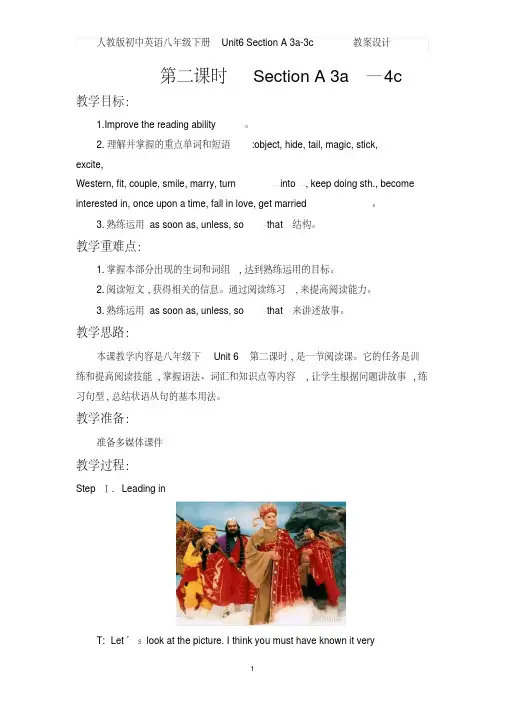
教学准备:准备多媒体课件教学过程:Step Ⅰ.Leading inT: Let’s look at the picture. I think you must have known it verywell. In this story, there are four main characters. They are Zhu bajie, Sha Wujing, Tangseng a nd Sun Wukong. And I like Sun Wukong best. What about you? Do you like him? In fact, he has another name, the Monkey King. Sun Wukong h as a stick, and it’s a magic stick.He can make i t big and long. He can also make it small and short to keep it in his ear. So this classlet’s learn something more about him.Now let’s come to 3a.[设计意图]通过图片老师直接引出话题,引入新课,让学生提前感知所学内容。
人教八年级下册Unit6SectionA(3a3c)教学设计

3.课堂活动:设计丰富多样的力。
教学策略:结合教材内容,设计不同类型的练习题,让学生在活动中巩固所学知识,提高语言技能。
4.个性化教学:关注学生的个体差异,给予每个学生个性化的指导和帮助。
三、教学重难点和教学设想
(一)教学重难点
1.重点:本节课的重点在于学生对一般将来时态的掌握,以及运用该时态描述未来计划和行动。同时,新词汇和短语的识记、理解和运用也是教学的重点。
难点:如何引导学生在实际场景中灵活运用一般将来时态,以及如何帮助学生在交流中准确使用新词汇和短语。
2.重点:培养学生通过听力、口语、阅读等多种途径获取信息,提高其综合语言运用能力。
(二)过程与方法
1.通过小组合作、讨论等形式,让学生在互动中学习,培养其团队协作能力和解决问题的能力。
2.运用多媒体教学资源,如图片、视频等,创设真实语境,帮助学生理解和记忆目标词汇和句型,提高学生的学习兴趣和积极性。
3.引导学生通过听力、口语、阅读等多种方式获取信息,培养其综合语言运用能力。
(三)情感态度与价值观
3.交流展示:各小组展示旅行计划,组内成员用目标句型进行汇报,如:“I will visit my aunt and go shopping.”
(四)课堂练习
1.听力练习:教师播放3c部分的听力材料,学生听后完成相应的练习,巩固一般将来时态的用法。
2.口语练习:学生两人一组,根据3c部分的提示,进行角色扮演,模拟旅行场景,练习目标句型。
3.鼓励学生互相分享、交流作业成果,互相学习,共同进步。
4.家长应积极配合,关注孩子的学习进度,共同参与孩子的学习过程。
Unit6SectionA3a3c教案人教版英语八年级下册
An old man tried to move the mountain.SectionA3a3c1.Teaching material$ Students analysisThis is a reading lesson. It is taken from Unit6 SectionA 3a3c,Book8B of Go Ror It. This is the second period of this unit. It is mainly abouta story Journey to the West. Students have learned a story Yu GongMoves a Mountain last period. This class continues to tell a story.Students in Grade 8 are still outgoing and active. They are interested in telling stories and they are also familiar with the story Journey to the West. So it is not too difficult for them to have this class.2.Teaching objectivesLanguage ability Ss are able to learn the new words and expressions, uch as: object, magic, urn…into….Learning ability Ss are able to learn the way of reading and to understand the story ,then to retell it by using the key words.Thinking quality Ss are able to learn from Monkey King to bee a brave and wise person.Cultural awareness Ss are able to study hard and face any trouble bravely.3.Teaching important$DifficultTeaching important: to teach students to understand the passage and learn the reading skills.Teaching difficult: Students’ reading ability will be improved.4.Teaching$Learning methodThe taskbased teaching method, situational approachThe cooperative learning method5.Teaching proceduresStep1. Leadin(3min)Show a video about Journey to the west and ask students some questions:What’s the name of the video?How many characters are there?Which character do you like best? Why?(To arouse students’ interests and lead in topic)reading(2min)Show the picture in 3a and ask students to guess the main idea of the passage.( To improve students’ predicting skills)Step3. Whilereading(20min)Fast reading1.Read the passage quickly and answer the questions.Which book is talked about?Who is the main character?What is he like?2.Lead students to analyze the structure of the passage.Careful reading1.Read paragraph 1 and answer the questions?What’s the name of the new TV program in England?Who is the main character?2.Read paragraph 2 and plete the chart about Monkey King.What he can do what he can’t do3.Read paragraph 3 and answer the question.What’s the influe nce to Chinese and Western children?4.Read the passage again and plete the sentences in 3c.5.Explain some language points.(To understand the main idea and the structure of the passage.) Step4. Postreading(10min)Pair work Work in pairs to talk about why you like or dislike Monkey King.3.Retell the story based on the mind map.Step5.Summary(2min)1.Summarize the key words and phrases.2.Retell the story by the mind map.Step6. Homework(1min).1.(You must)read a aloud the passage fluently and learn the useful expressions.2.(You can)retell or recite the story by the mind map.design.An old man tried to move the mountain.SectionA3a3cbackgroundwhat he can dospirit Monkey King what he can’t doChinese childrenInfluencewestern children。
Unit6 Section A(3a~3c)导学案 人教版八年级下册英语

Unit 6 An old man tried to move the mountains.Section A 2(3a~3c)一、新单词以及词汇西游记:n.object n.tail n.stick n.excite v.western adj.traditional :传统的出现:become interested in : make changes: turn him into :把自己变成 能够: 主人公: Never give up:二、 3a :快速浏览回答问题阅读策略: 略读:Skimming(略读,即不追求句子细节的含义,只求了解句子和段落想表达什么,摸清楚文章的主旨大意)略读技巧:How to skim for the main idea?如何快速略读获得文章主旨大意?1. analyze the structure2. find the topic sentences.a. the beginning/endb. pay attention to the key words三、3a:Scanning:跳读Scan: read the passage carefully for details.跳读:快速地看全文并找到需要的细节。
How to scan?如何跳读?跳读技巧:1. Before reading, remember what you are looking for.2. Underline the sentences you find.3. Compare the information.利用跳读策略完成3C四、Retell。
人教版八年级下Unit6SectionA3a3c教学设计

f.课后作业:布置与环保相关的作业,如调查问卷、写作等,让学生在实际操作中深化对环保知识的理解。
6.教学评价:采用过程性评价和终结性评价相结合的方式,关注学生在学习过程中的表现,激发他们的学习积极性。
四、教学内容与过程
(一)导入新课
需要注意的是,学生在英语学习中仍存在一定程度的个体差异,部分学生对词汇和语法掌握不够扎实,可能会影响他们对本章节内容的理解和掌握。因此,在教学过程中,教师应关注每一个学生的成长,给予个性化指导,确保他们在原有基础上得到提高。
三、教学重难点和教学设想
(一)教学重难点
1.重点:本节课的重点在于让学生掌握环保相关的词汇和短语,如"prevent", "pollute","environment", "waste", "reuse", "recycle"等,并能运用一般现在时描述环保行为。此外,学会使用目标句型“What can we do to…?”, “We can…”进行问题回答和讨论。
2.任务型教学法:设计各种任务,如小组讨论、角色扮演等,让学生在实际操作中运用所学词汇和句型,提高他们的语言表达能力。
3.分层教学:针对学生的个体差异,设计不同难度的练习和活动,使每个学生都能在原有基础上得到提高。
4.情感教育:在教学过程中,注重培养学生的环保意识,让他们认识到自己日常行为对环境的影响,激发他们积极参与环保行动。
人教版八年级下Unit6SectionA3a3c教学设计
一、教学目标
(一)知识与技能
1.学生能够理解并掌握本节课所学的词汇和短语,如"prevent", "pollute", "environment", "waste", "reuse", "recycle"等,并能正确运用这些词汇描述环保相关的行为和措施。
人教英语八下Unit6SectionA3a3c优秀教学案例
一、案例背景
本案例背景基于人教英语八下Unit6 SectionA 3a 3c的内容展开。本节课的主题是关于第三人称单数的特殊疑问句及回答。在掌握了一般疑问句的基础上,学生需要理解并运用第三人称单数的特殊疑问句及回答,提高他们的语言运用能力。
3.鼓励小组成员相互评价、相互学习,培养他们的批判性思维和自我反思能力。
小组合作教学策略能够培养学生的团队协作能力、沟通能力和批判性思维。通过小组合作,使学生能够更好地理解和运用第三人称单数的特殊疑问句及回答,提高他们的英语语言能力。
(四)反思与评价
1.教师引导学生对自己的学习过程进行反思,找出自己在学习第三人称单数特殊疑问句及回答过程中的优点和不足。
(二)讲授新知
1.教师通过展示PPT,系统地讲解第三人称单数的特殊疑问句及回答,如:“Does Tom have a soccer ball? Does he?”。
2.结合实例,让学生理解并掌握第三人称单数的特殊疑问句及回答的用法,如:“Tom has a soccer ball. He has two bicycles.”。
三、教学策略
(一)情景创设
1.利用多媒体展示真实情境,如Tom的日常生活场景,让学生在实际语境中感受并理解第三人称单数的特殊疑问句及回答。
2.设计具有趣味性和生活化的课堂活动,如角色扮演、情境模拟等,让学生在实践中掌握第三人称单数的特殊疑问句及回答。
3.创设互动式课堂氛围,鼓励学生主动提问、回答,提高他们的参与度和积极性。
在小组活动中,我让学生们相互提问并回答关于第三人称单数的问题,如:“Does Tom have a soccer ball? Does he?”,鼓励他们运用所学知识进行实际操作。通过这一环节,学生们更好地掌握了第三人称单数的特殊疑问句及回答。
英语人教版八年级下册Unit 6 Section A 3a-3c 教案
Teaching DesignUnit 6 An old man tried to move the mountains.Section A 3a-3c汨罗市罗城学校何潺Ⅰ. Teaching aims:1. Knowledge aims:1)To grasp the words and phrases:object, hide, tail, magic, stick, excite, Western, turn…into2)To understand the passage of the Monkey King.2. Ability aims:To enable Ss to give a brief introduction of the Monkey King.3. Moral aims:To understand and spread the great traditional Chinese culture.Ⅱ. Key points and difficult points:1. To understand the passage and improve the reading ability.2. To introduce the Monkey King briefly.Ⅲ. Teaching method: Task-based Teaching MethodⅣ. Teaching procedures:Step 1.Pre-reading1. Warming-upSs watch a video about Thanksgiving.2. T teaches difficult words and phrases.Step 3. While-readingTask One (Skimming)Read the passage quickly and choose the right answer:What’s the passage about?A. The book, Journey to the westB. The Monkey KingTask Two (Scanning)Read the passage again and answer the questions.1. Which book is talked about?2. Who is the main character?3. What is he like?Task Three (Careful reading)Complete the sentences below with phrases from the passage.1. Journey to the West is a __________ Chinese book. It tells one of the mostpopular stories in China.2. When the English TV program Monkey ________ in 1979, Westernchildren _________________ this wonderful story.3. The Monkey King can ______________ to his body. He is able to___________ ____ different animals and objects.4. The Monkey King ________ make his magic stick small or large.Step 3. Post-ReadingTask Four: Group workIntroduce the Monkey King with the help of the following words:book, character normal, change, turn, fight, stick, keep, help, give upStep 4. ExercisesChoose the correct words.magic, birth, hide, tail, turn…into, western1. Four years later, Laura gave _____ to a son.2. They want to _____ the old house into a hotel.3. England lies to the _______ part of Europe.4. She broke her _______ mirror into pieces.5. Dogs wag their_____ when they’re pleased.6. Don’t ______behind the door. It’s not safe.Step 5. Summary1. To ask students to summarize what they have learned in this lesson2. To extend: ancient and brilliant Chinese cultureStep 6. HomeworkMake sentences with these words.be able to; make 72 changes, turn…into;so…that; came out; become interested in; keep doing sth.。
八年级英语下册(人教版)Unit6第3课时SectionA(3a3c)优秀教学案例
2.掌握本节课的主要句型,如"The ... is/are... They are... They have... They can... We should..."等,并能够灵活运用于实际情景中,表达对动物特征的描述和建议。
3.能够理解并运用一般现在时描述动物的一般特征,如" Lions are big cats. They have strong bodies and sharp teeth. They live in Africa."等。
1.教师引导学生回顾本节课所学的核心词汇和句型,让学生通过自己的语言进行总结归纳。
2.教师通过提问和总结,强调描述动物特征的词汇和句型的运用,让学生加深对知识点的理解和记忆。
3.教师强调动物保护的重要性,引导学生树立正确的价值观,培养他们的社会责任感和公民意识。
(五)作业小结
人教版英语八年级下册Unit6SectionA3a3c优秀教学案例
一、案例背景
本案例背景以人教版英语八年级下册Unit 6 Section A 3a 3c为例,本节课主要围绕“Will people have robots in the future?”这一主题展开。通过阅读短文,学生能够了解未来社会中机器人的应用前景,提高他们的阅读理解能力。同时,通过本节课的学习,学生能够运用所学知识进行情景交际,提高他们的语言运用能力。
4.教师利用多媒体课件、网络资源等现代教育技术,为学生提供丰富的学习材料,帮助学生更好地理解和掌握知识。
(三)学生小组讨论
1.教师将学生分成小组,每组选择一个特定的话题,如医疗、教育、交通等,讨论未来机器人在该领域的应用前景。
2.每个小组选择代表,向全班同学分享他们的讨论成果,其他同学可以提出问题或给予评价。
3.教师引导学生进行小组内讨论,鼓励他们发表自己的观点,培养他们的团队合作意识和沟通能力。
(四)总结归纳
1.教师引导学生总结本节课所学的知识,如重点词汇、句型和情景交际等。
2.教师强调本节课的重点和难点,提醒学生注意掌握。
3.教师针对学生的讨论成果,进行总结归纳,提炼出未来机器人应用前景的共性和特点。
(五)作业小结
1.教师布置作业,要求学生运用所学知识进行情景交际,如设计一个机器人,编写一个关于机器人的故事等。
2.教师提醒学生在完成作业的过程中,注意运用本节课所学的词汇和句型。
3.教师鼓励学生在课后进行自主学习,查找相关资料,拓宽自己的知识视野。
4.教师对学生的课堂表现和学习成果进行评价,给予鼓励和建议,为学生的后续学习提供指导。
(二)讲授新知
1.教师引导学生通过阅读短文,理解并掌握文章的主旨大意。