
仁爱版七下英语Unit5 topic3重要知识点总结和语法点归纳
Unit5-Our School Life
Topic 3 My school life is very interesting.
一、重点单词
1.easy容易的(形容词)反义词 hard/difficult
2.interesting有趣的(形容词),修饰事物的
3.best最好地(的)(good和well的最高级)like best最喜欢
4.study学习(动词)三单studies
5.between在……中间(介词)表示在两者之间。
between A and B在A和B之间
6.night夜晚 at night 在晚上on that day在那天
二、重点短语
1.outdoor activity 课外活动
2.easy and interesting 容易又有趣
3.difficult and boring 又难又乏味
4.be friendly to sb. =be kind to sb. 对某人友好
5.between…and…在……之间…
6.learn(…)from…向…学习/从…中学…
7.learning about the past了解过去8.working on computers操作电脑,用电脑工作
9.talk about 谈论10.from…to…从……到……
11.in the morning/afternoon/evening在早上/下午/晚上12.on Monday 在星期一
13.on Monday morning在星期一的早上14.have an English/art class 上英语/美术课
15.tell sb. about sth告诉某人关于某事
三、重点句型
1.What day is it today? It’s Wednesday. What day…?常用来表示对星期几进行提问。
2.What class are they having? ——They are having a music class. What class 用来询问“什么课程”, c lass与lesson表示“课”时同义。
区别:What class are you in?
3.What time does the class begin? 什么时间开始上课?——At ten o’clock.
4.What time is the class over?这节课几点结束?——At twenty to eleven.
5. How many lessons does he have every weekday? 他每天上几节课?
6. You must like English very much 你一定非常喜欢英语。
( must在这里表示肯定推测。
)
7.What subject do you like best?
8.I like English best(我最喜欢英语)
9.Can you tell me something about it?你能告诉我一些关于它的事情吗?
情态动词Must 用法:
①表示义务或必要性,意思是“应该、必须”,通常用于肯定句及疑问句.如:
You must go to bed now.你现在必须上床睡觉了.
Must I go to bed now?我必须睡觉了吗?
②must的否定式是must not/ mustn’t,意思是“不应该、千万别”表示禁止,语气较强烈.
如:You mustn't eat anything in the classroom.你不许在教室里吃东西.
③由must引出的一般疑问句,肯定回答用must,否定回答用needn’t,don’t need to或don’t have to均可,但不用mustn’t,因为mustn’t表示“不许、禁止”的意思,与问句的原意不符.
如:
—Must I finish my homework now?我必须现在完成作业吗?
—Yes,you must.是的,你必须. /No,you needn’t.或No,you don’t have to.不,你不必.
④当说话人对所发生的事情进行推测时,must的意思是“一定、准是”,主要用于肯定句,否定句常用can’t.
e.g.He works in a hospital. He must be a doctor.He can’t be a teacher.
他在医院工作,他一定是个医生。
他不可能是教师.
She is not at home. She must be out.她不在家里,她一定外出了.
must be 一定是,can’t be一定不是、不可能是, may be 可能是。
7.——What do you think of it?——Sometimes it’s difficult and boring, so I don‘t like it very much.
What do you think of…?相当于How do you like …?意思是“你认为怎么样?”询问对方对某事或者某人的看法。
8.——What’s your favorite subject?你最喜欢的科目是什么?——My favorite subject is English.
同意表达:What subject do you like best?—— I like English best.
9.——Why do you like it? 你为什么喜欢它?—Because it’s easy and interesting.
因为它既简单又有趣。
回答Why…?用Because…。
如果表示你为什么不用 Why not+动词原形…?或Why don’t you do…?
10.My teachers are very kind to me.
be kind to sb.意思是“对某人很友好”注意: kind=friendly是形容词“友好的”“友善的”
观察区别:It’s very kind of you.你真是太好了。
发现不同了吗?当主语是表示人的时候用be kind to;
而主语是It的时候要用be kind of。
11.I have four classes in the morning and two in the afternoon.我上午上四节课,下午上两节课。
12.I study Chinese,English,…and other subjects.我学习语文、英语……和一些其他的科目。
other(形容词)别的,其他的修饰名词,后跟名词复数。
other+名词复数=others(代词),表示泛指剩下的人或事物中的部分;
the other+名词复数=the others(代词),表示剩下的所有人或事物。
I have many friends. Three friends are boys,the others/the other friends are girls.
我有许多朋友。
三个是男生,其他的是女生。
Some students like Zhao Liying very much,others like Xiao Zhan.
有的学生喜欢赵丽颖,有的喜欢肖战。
13.What do you think of it?=How do you like it?
你认为。
怎么样?询问某人对某物的观点或看法。
四、重点语法
1.区别一般现在时与现在进行时
备注:以上图片来自阳春白雪教育公众号,图片转载只为知识共享以及与同仁交流。
最新(仁爱版)七年级下册Unit5topic3知识全解
七年级下Unit 5重点全解Unit 5 School LifeTopic 3 my school life is very interesting一. 重点词汇:一)星期名词:Sunday, Monday, Tuesday, Wednesday, Thursday, Friday, Saturday二)学科名词:Chinese, math, English, geography, biology, history, P.E., science, art, politics, physics, music三)相关形容词:easy, interesting, difficult, boring, useful, hard, wonderful四)相关动词:learn,study五)其他名词:meeting, subject, sound, night, attention, February.二、重点短语:1. do outdoor activities 做户外活动indoor activities室内活动2. draw pictures 画画3. work on math problems 解答数学问题;work on 致力于…,专心于…4. learn about the past 学习了解过去5. a student of Class 1, Grade 7一个七年一班的学生6. some other subjects 一些其他课程other作为形容词,用在名词或代词之前7. be kind to 对…友好8.Have a music class.上音乐课9.at ten fifty 在十点五十分10.be over (=finish) 结束11.on+星期名词在星期几12.outdoor activities 户外活动13. learn about the past 了解历史14. it’s time for …=it’s time to do sth. 该干…了15. play with sb 和某人玩耍Play with sth玩弄某物16.swim in the swimming pool 在游泳池游泳17.draw pictures 画画18. every Tuesday and Thursday 每周二和周四19.tell sb sth=tell sth to sb 把某事告诉某人20. learn sth from 从…学到…21. hard work 辛勤工作22. thank sb for sth/ thank sb. for doing sth因某事而感谢某人23. try to do my best 试图尽我的最大努力24. care about 关心,担忧25. read stories 读故事三、重点句型讲解1 询问星期几用What day…?回答:It’s Wednesday/Sunday…。
七年级下册仁爱英语Unit5知识点总结
七年级下册仁爱英语Unit5知识点总结Unit 5是七年级下册的英语单元。
在这个单元里,学生们将深入学习各种语法、词汇和句型,并与之前学到的知识进行巩固。
为了帮助学生们更好地掌握这些知识点,以下是Unit 5的知识点总结:一、动词的ing形式在Unit 5中,学生将学习使用动词的ing形式。
动词的ing形式在英语中有多种用法,如作为动词的进行时态、作为名词、形容词和副词等。
以下是该知识点的练习:1. 你喜欢在做什么时候听音乐?2. 我们正在进行一场足球比赛,你想加入吗?3. 他的工作是教人们如何放松。
二、形容词的比较级和最高级形容词的比较级和最高级是英语衡量大小的常见方式。
当比较两个或多个事物的大小、数量或程度时,我们可以使用比较级或最高级。
以下是该知识点的练习:1. 哪个城市比你住的城市更大?2. 你喜欢什么颜色的衣服?3. 她的英语比我好一些。
三、名词单复数在Unit 5中,学生将学习名词的单复数形式。
在英语中,名词单复数的变化规则很多,如在单数名词后加s或es,在某些名词后加ies,或只是在词尾加一个s等。
以下是该知识点的练习:1. 我喜欢吃苹果和橙子。
2. 她有两只小狗。
3. 有些动物从不会变老,比如鲨鱼。
四、祈使句祈使句是一种命令句,用于向他人发出请求、建议或指示。
在祈使句中,动词不需要主语。
以下是该知识点的练习:1. 给我一支笔。
2. 不要在教室里跑步。
3. 拿一个椅子。
五、限定词在英语中,限定词用于在名词前表示数量、身份、归属等信息。
在Unit 5中,学生将学习使用不同的限定词,如冠词、数词、所有格等。
以下是该知识点的练习:1. 我有两本好书。
2. 这是我的学生证。
3. 请把这本书还给我。
总结在Unit 5中,学生将学习使用动词的ing形式、形容词的比较级和最高级、名词单复数、祈使句以及限定词等知识点。
通过充分理解和练习这些知识点,学生将能够更好地运用英语,为未来的学习和生活做好准备。
仁爱版七年级英语下册unit5topic3教材讲解

仁爱版七年级英语下册unit5topic3教材讲解第一篇:仁爱版七年级英语下册unit5 topic3教材讲解Unit 5 Our School Life Topic 3 My school life is very interesting 一.重难点讲解1、What day is it today? 今天星期几?--It is Wednesday.今天星期三。
What day……?用来询问星期几或是节日。
回答:It is……Eg: What day is it today? 今天是什么节日?It’s Children’s Day.今天是儿童节。
在星期几用介词 on.Eg: on Wednesday.周三2、What class are they having? 他们正在上什么课?--They are having a music class.他们正在上音乐课。
= Which class are they having?(1)What class 用来询问“什么课程”= which classclass=lessonEg: Morning classes/lessons begin at eight o’clock.Class: ①班级。
Eg: What class are you in? –I am in Class Seven.②一个班级的全体学生。
此时是一个集合名词。
Eg: Good morning, class!(2)have a music class/lesson.上音乐课Eg:We are having an English class/lesson.我们在上英语课。
3、What time is it over?几点下课?be over 结束(指状态)= end 结束;完成(强调动作)Eg:What time does it end? 几点结束?4、Working on math problems.解数学题work on 从事……;致力于……(根据多种语境可以有多种译法)Eg:He is working on a new novel.他正在写一部小说。
仁爱英语七年级五单元知识点
仁爱英语七年级五单元知识点仁爱英语七年级第五单元主要包括比较级和最高级、动词的时态、副词的用法等内容,是英语学习中非常基础和重要的一部分。
本文将介绍仁爱英语七年级第五单元的重点知识点。
一、比较级和最高级1. 比较级原级和最高级的构成方法比较级的构成方法为:形容词或副词+er,如taller、stronger;或者在单音节词和少数双音节词的后面加上more,如more beautiful、more helpful。
最高级的构成方法为:形容词或副词+est,如tallest、strongest;或者在单音节词和少数双音节词的后面加上the most,如the most beautiful、the most helpful。
2. 形容词、副词的比较级和最高级的用法形容词、副词的比较级和最高级用于对两个及以上的人或物进行比较。
比较级表示“更……”,最高级表示“最……”。
3. 不规则比较级和最高级有些形容词、副词的比较级和最高级是不规则的,如good-better-best、well-better-best、bad-worse-worst等,需要多加练习记忆。
二、动词的时态1. 一般现在时一般现在时表示习惯性动作、永久性状态或客观真理。
动词第三人称单数加s,否定句在动词前加don’t,一般疑问句用Do/Does+主语+动词原形。
2. 一般过去时一般过去时表示过去某个时间发生的动作或存在的状态。
动词加ed,不规则动词需牢记。
否定句在动词前加didn’t,一般疑问句用Did+主语+动词原形。
3. 现在进行时现在进行时表示正在进行的动作。
构成为be+Ving,第一人称用am,第二人称用are,第三人称用is,否定句在be前加not,一般疑问句用Be+主语+Ving。
4. 过去进行时过去进行时表示过去某个时刻正在进行的动作。
构成为was/were+Ving,否定句在was/were前加not,一般疑问句用Was/Were+主语+Ving。
知识点七年级英语(仁爱版)(下册)Unit-5-Topic-3语言点归纳
Unit 5 Topic 3I 重点词汇和短语today, Monday, Tuesday, Wednesday, Thursday, Friday, Saturday, Sunday, lesson, subject, Chinese, math, English, politics, history, geography, biology, physics, science, art, P.E., learn, activity, meeting, easy, difficult, interesting, boring, which, best, other, friendly, news, attention, stamp, between, world, night, program, place, February, newspaper, hard, wish, storyoutdoor activity, work on, fro m…to…,II 语言点Section A1.---What day is it today? 今天是星期几?---It’s Wednesday. 今天是星期三。
对星期几提问,用what day …?回答用:It’s + 星期(Monday/Tuesday/…)对日期提问,则用What’s the date today?2. What time does the class begin? 几点上课?与When does the class begin? 意思相同。
--- What time does the class begin? 几点钟上课--- At ten o’clock. 10 点。
What time常对具体的几点几分进行提问; 而when 的使用围更广, 可以对年、月、日、几时几分等进行提问。
另外, when 还可以用作连词, 表示“当…….的时候”。
仁爱版英语七年级下全部知识点总结
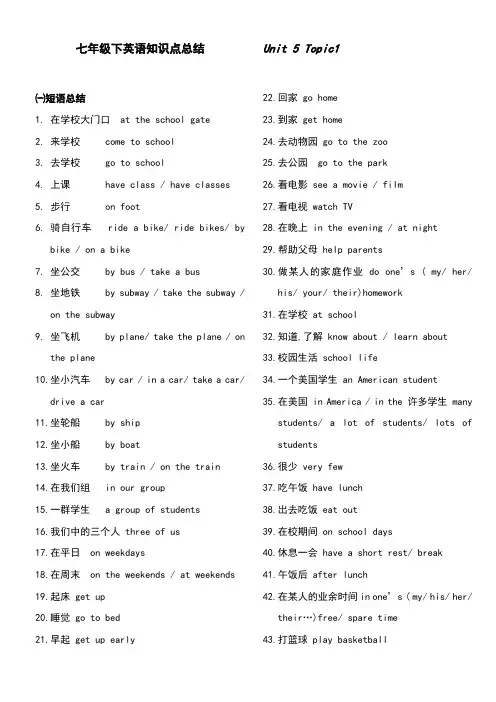
七年级下英语知识点总结Unit 5 Topic1㈠短语总结1.在学校大门口 at the school gate2.来学校 come to school3.去学校 go to school4.上课 have class / have classes5.步行 on foot6.骑自行车 ride a bike/ ride bikes/ bybike / on a bike7.坐公交 by bus / take a bus8.坐地铁 by subway / take the subway /on the subway9.坐飞机 by plane/ take the plane / onthe plane10.坐小汽车 by car / in a car/ take a car/drive a car11.坐轮船 by ship12.坐小船 by boat13.坐火车 by train / on the train14.在我们组 in our group15.一群学生 a group of students16.我们中的三个人 three of us17.在平日 on weekdays18.在周末 on the weekends / at weekends19.起床 get up20.睡觉 go to bed21.早起 get up early 22.回家 go home23.到家 get home24.去动物园 go to the zoo25.去公园 go to the park26.看电影 see a movie / film27.看电视 watch TV28.在晚上 in the evening / at night29.帮助父母 help parents30.做某人的家庭作业 do one’s ( my/ her/his/ your/ their)homework31.在学校 at school32.知道,了解 know about / learn about33.校园生活 school life34.一个美国学生 an American student35.在美国 in America / in the 许多学生 manystudents/ a lot of students/ lots of students36.很少 very few37.吃午饭 have lunch38.出去吃饭 eat out39.在校期间 on school days40.休息一会 have a short rest/ break41.午饭后 after lunch42.在某人的业余时间in one’s ( my/ his/ her/their…)free/ spare time43.打篮球 play basketball44.踢足球play soccer / football45.弹钢琴 play the piano46.弹吉他play the guitar47.拉二胡 play erhu48.去游泳 go swimming / go for a swim49.去划船 go boating50.球赛 a ball game / ball games51.一年四次 four times a year52.听音乐 listen to music53.读书 read books54.看报 read newspapers 55.看医生 see a doctor56.去图书馆 go to the library57.一周两次 twice a week58.见朋友 meet friends59.每天 every day60.在七点半 at half past seven61.一小会 for a little while / for a shorttime62.晚饭后 after supper63.吃饭 have dinner64.吃早饭 have breakfast㈡重要句型1.I usually come to school by subway.同义句: I usually take the subway to school.对划线部分提问: How do you usually come to school类似的有:go to school by bike=go to schoolon a bike= ride a bike to school=ride to schoolgo home by bus=go home on a bus=take a bus home2.How do you usually/ often…你通常/经常怎样…3.It’s time for class.=It’s time to haveclass. =It’s time for having class.4.What about you =How about you5.How often …询问频率,回答可以用频率副词:always, usually, often, sometimes, seldom, never, every day ,every +其他时间名词或表示频率的短语回答表示频率的短语:次数+单位时间. : once a day / twice a week / three timesa month6. The early bird catches the work. (谚语) 笨鸟先飞7. Work / Study must come first. 工作/ 学习必须放在第一位!8. Classes begin at eight. =Class begins at eight.提问: What time does the class begin / What time do the classes begin㈢重要单词的用法1.look (感官动词) 看起来,后面加形容词His mother looks very young.They look very cute.Her dress looks very nice.You look very cool in this coat.2.by 介词by 后面直接加表示交通工具的名词,中间不用任何词修饰,如:by bikeby +动词ing形式,表示通过某种方式People show love to their mothers by giving cards.You can be a good student by working hard.3.over (形容词)School / Class is over.4.begin现在分词: beginning 过去式: beganbegin to do sth , begin doing sthHe begins to write a letter. =He begins writing a letter.如果begin本身为分词,只能用begin to do sthHe is beginning to run.5.listen to 听(动作), hear 听见(结果)6.always 反义词 never7.本话题涉及的时态为一般现在时,句中常有频率副词或表示频率的短语,如果主语为三单,动词一定要用三单!(四)易错题1.You new watch ______ (look) very nice!2.Here ______(be) some news.3.Oh, come on! It’s time_____ going toschool.4.They usually go to school on________(feet).5.In my class, forty of _______(we) go toschool by bike.6.The early bird ______ (catch) the worm.7.Kangkang often _____ (ride) a bike to thepark.8.What time _____ (be)school over9.Work must come ______(once).10.It’s time ____you to get up.11.We often _____ books in the morning.12.Jill’s friend like ______(study) in ourschool.13.Mr. Wang teaches ______(we) English._____ of us like him.14.How about ______(go) out with me15.Most students go to school _____ theschool bus.16._______ do you go shopping with yourmotherA. How soonB. How farC. How oftenD. How much17.What time do you usually get up _____weekdays18.He ______ busy, so he has no time to playwith us.A. is alwaysB. seldom isC. always isD. often is19. The last class______(finish) at twelve o’clock.20. Let’s go______(boat).21. It’s time to have breakfast. (同义句) _________________________________________ _____________.22. Michael often rides a bike to school. (同义句)_________________________________________ _____________.23. I always go to work on foot. (对划线部分提问)_________________________________________ _____________.24. My mother goes shopping twice a week. (对划线部分提问)_________________________________________ _____________.25. Mary always reads books in the library. (反义句)_________________________________________ _____________.26. He usually does his homework at school. (否定句)_________________________________________ _____________.27. They often go to school by bus in the morning. (对划线部分提问)_________________________________________ _____________.28. Jane seldom watches TV on weekdays. (改为一般疑问句)_________________________________________ _____________.29. He usually has lunch at home. (对划线部分提问)_________________________________________ _____________.30. Li Ping often goes to work on foot. (同义句)_________________________________________ _____________.31. 几乎没有学生乘地铁去学校。
仁爱七年级下知识点总结Unit 5 Topic 3
Unit 5 Topic3知识点:1. ---What day is it today? 今天星期几?---Wednesday.星期三。
What day…?常用来询问星期几或节日。
如: ---What day is it today?今天是什么节日?---It's Teachers’ Day.今天是教师节。
与特殊疑问句词what有关的短语:what class几班/什么课 what color什么颜色what time几点 what date几号(日期)2. have a music class上音乐课3. I think they are having an English class.我认为他们正在上英语课。
主从复合句注意:在I/ We think/believe/suppose等的主从复合句中,如果从句表示否定,要将否定词转移到主句之中,即:否定转移。
I don't think you are right. 我认为你不对。
4. What time is the class over? 什么时候下课?be over 结束5. on that day在那天,在具体的某天要用介词on。
on Tuesday 在星期二 on the morning of May 1st在5月1号早上6. How many lessons does he have every weekday?How many+可数名词的复数形式;How much+不可数名词。
7. read an English book 读/看英语书拓展: look, see, watch, read 的用法区别这四个词都有“看”的意思。
look强调“看”的动作。
单独使用时,用来引起对方的注意;如果跟宾语,要和at连用。
Look! Tom is over there.Look at the blackboard, please.see强调“看”的结果,意为“看见、看到”。
仁爱版七下英语Unit5-topic3重要知识点和语法点归纳
Unit5-Our School LifeTopic 3 My school life is very interesting.一、重点单词1.easy容易的(形容词)反义词 hard/difficult2.interesting有趣的(形容词),修饰事物的3.best最好地(的)(good和well的最高级)like best最喜欢4.study学习(动词)三单studies5.between在……中间(介词)表示在两者之间。
between A and B在A和B之间6.night夜晚 at night 在晚上on that day在那天二、重点短语1.outdoor activity 课外活动2.easy and interesting 容易又有趣3.difficult and boring 又难又乏味4.be friendly to sb. =be kind to sb. 对某人友好5.between…and…在……之间…6.learn(…)from…向…学习/从…中学…7.learning about the past了解过去8.working on computers操作电脑,用电脑工作9.talk about 谈论10.from…to…从……到……11.in the morning/afternoon/evening在早上/下午/晚上12.on Monday 在星期一13.on Monday morning在星期一的早上14.have an English/art class 上英语/美术课15.tell sb. about sth告诉某人关于某事三、重点句型1.What day is it today? It’s Wednesday. What day…?常用来表示对星期几进行提问。
2.What class are they having? ——They are having a music class. What class 用来询问“什么课程”, cl ass与lesson表示“课”时同义。
仁爱版英语七年级下册Unit5 Topic 3同步知识点总结
仁爱版英语七年级下册Unit 5 Our School LifeTopic 3 My school life is very interesting.【重点单词】1.Wednesday [ˈwenzdeɪ] n. 星期三2.Monday [ˈmʌndi] n. 星期一3.Tuesday [ˈtju:zdeɪ] n. 星期二4.Thursday [ˈθɜ:zdeɪ] n. 星期四5.Friday [ˈfraɪdeɪ] n. 星期五6.physics [ˈfɪzɪks] n. 物理(学)7.geography [dʒɪ'ɒɡrəfɪ] n. 地理(学)8.P.E n. 体育(physical education的缩写)9.art [ɑ:t] n. 美术;艺术10.history [ˈhɪstri] n. 历史11.math [mæθ] n. 数学= mathematics12.biology [baɪˈɒlədʒi] n. 生物(学)13.politics [ˈpɒlətɪks] n. 政治14.science ['saɪəns] n. 科学15.meeting [ˈmi:tɪŋ] n. 会议;会面16.easy [ˈiːzi] adj. 容易的17.interesting [ˈɪntrəstɪŋ] adj. 有趣的18.difficult [ˈdɪfɪkəlt] adj. 难的19.learn [lɜːn] v. 学习;学会20.which [wɪtʃ] det. & pron. 哪一个;哪一些21.subject ['sʌbdʒɪkt] n. 学科;主题22.best [best] adv. & adj. 最好地(的) (goo d和well的最高级)23.study [ˈstʌdi] v. 学习;研究n. 书房24.outdoor [ˈaʊtdɔ:(r)] adj. 户外的25.activity [æk'tɪvətɪ] n. 活动26.attention [əˈtenʃn] n. 注意27.between [bɪˈtwi:n] prep. 在……中间28.stamp [stæmp] n. 邮票v. 跺(脚)29.Saturday [ˈsætədeɪ] n. 星期六30.night [naɪt] n. 夜间31.sound [saʊnd] n. 声音v. 听起来好像32.February [ˈfebruəri] n. (Feb.) 二月33.hard [hɑ:d] adj. 努力的;困难的adv. 艰难地;努力地【重点短语】1.from … to …从……到……2.think of 认为3.work on 致力于4.talk about 谈论5.be kind to sb 对某人友好6.some other subjects 其他一些科目7.outdoor activity 户外活动8.tell sb about sth 告诉某人某事9.between … and …在……和……之间10.learn sth from sb 向某人学习某事11.the next class 下一节课12.help each other 互相帮助13.like … best 最喜欢……14.speak English with sb 和某人说英语15.thank you for doing sth 谢谢你做了某事【重点句型】1.What day is it today? 今天星期几?2.What class are they having? 他们在上什么课?3.They are having a music class. 他们在上音乐课。
仁爱英语七年级下册各单元知识点总结归纳 Unit5 Topic3
仁爱英语七年级下册各单元知识点归纳Unit5 Topic3 Section A学习目标1.学习表示星期和科目的单词,并学会谈论课程表。
2.巩固现在进行时和一般现在时的用法。
3.学习字母组合 ear/eir/ere/eer/gh/ght的发音。
重点短语1.have a music class 上音乐课puter science 计算机科学3.class meeting 班会名师课堂1.What class are they having?他们在上什么课?(1)have classes 上课。
have...class意为“上······课”。
其中,lesson也有“课”的意思。
class着眼于“上课”这一行为,而lesson一般指课本中的一课书,有时指功课,着眼于所学内容。
但是have a lesson/lessonshave a class均指“学上课(听课)”的意思。
(2)该句中,what class=which class,意为“什么课”。
e.g.We are having an English class now.我们在上一堂英语课。
We are learning lesson 9.我们正在学第9课。
2.What time is the class over?什么时候下课?be over 结束(指状态),还可说成 What time does the class end/finish?End finish表示“结束,完成”,强调动作。
e.g The geography class is over at 10:40.这节地理课在10点40分结束。
3.How many lessons does he have every weekday?周一至周五他有几节课?how many 多少(跟可数名词复数);how much 多少(跟不可数名词)e.g.How many days are there in a week?一周有多少天?Section B学习目标1.谈论喜欢和不喜欢的学科及原因。