
(牛津译林版)七年级英语上册教学课件:Unit4 My day
________
always
Adverbs of frequency
100% 80% 60% 40% 20% 0% seldom never often sometimes
always usually
频率副词在句中的位置: 1. 频率副词用在be动词后。 It is usually hot in summer. 夏天天气通常是热的。 2. 频率副词用在主要动词前。 My father usually walks home. 我的父亲经常步行回家。 3. 频率副词用在助动词与主要动词之间。 I will always love you. 我将永远爱你。
Read Part A on P45 and finish Part A1
Dear Millie,
Thanks for your email. I would like to tell you about my life here.
Our lessons begin ____ at nine o’clock. Usually we have three in in lessons ____ the morning and two ____ the afternoon. We on Saturday or Sunday. do not have lessons ____ I love sports. I am good at playing football. I often play it on Saturday afternoon. We have a with my friends ____ in football match _____ autumn every year. This year, it is on 15 November. My friends and I always have great _____ fun then.
at
time of day We use ‘at’ before:___________, age mealtimes __________, ______________and some festivals _______________.
(at 用于表示某一时刻、年龄、三餐饭 及特定的节日。)
(in用于表示上午,下午和晚上,月份,季 节或者年。)
on
days dates We use ‘on’ before:_____, _____,
parts of a specific day special holidays _____________Βιβλιοθήκη and ______________.
(on 用于表示星期、某一天、某天的 早中晚及特定的节日。)
Fill in the blanks with “in”, “on” and “at”.
1. Christmas Day is ___ on 25th December. 2. The new school term begins ____ in September. at Easter. 3. Uncle Bob visits his family ___ 4. David plays basketball ____ on Saturday. 5. Tommy wants to go to America at 18. ____
He eats bread from Tuesday to Saturday. He often eats bread. He sometimes eats fruit. He seldom eats meat. He never eats hamburgers.
PartB: Adverbs of frequency
at four o’clock. 3. We’re going to see the doctor_______
in the evening. 4. He often takes Eddie for a walk _____ in November. 5. They have a long holiday______ in 1992. 6. He was born ________ at breakfast. 7. He likes reading newspapers_______ 8. It’s cold _______ in winter in China. 9.They play the game________ on the evening of 31st October.
on the morning of the 4th last month. 10. He got home _____
11. My father usually goes fishing ____ at the weekend.
on a sunny morning. 12. It is a good idea to go for a walk ____
Unit 4
My day
Part A: Prepositions of time
I go to school at seven o’clock.
We have our history lessons on Monday.
We have Chinese lessons in the morning.
1. He was born ______ in 1992. at 2. He likes reading newspapers ______ breakfast. 3. She starts to learn English _____6. at in 4. It’s cold _______ winter in China. 5. They play the game ________ the on evening of 31st October.
Prepositions of time at: we use ‘at’ before: ______, 点钟 _______, 三餐 不只一天的节日 年龄 ________________, _____. 星期 天 日期 ______ on: we use ‘on’ before: ____,_____, 特殊的节日 . ___________ 一天中的早,中,晚 in: we use ‘in’ before: _________________, 月份 _______, 年 _______, ______. 季节
频率副词位置记忆口诀: 实前 Be后 How often是对表示频度副词
的时间状语的提问,可翻译为
“多久(一次)”。
How often do they exercise?
• 1.Simon loves playing football. He_____ often plays football in the playground. • 2.Sandy doesn’t have much time to play tennis. She _____ plays tennis. seldom • 3.Amy is a member of the swimming team. She usually _____ swims after school. • 4.Daniel doesn’t like basketball. He_____never plays it. • 5.kitty goes to her dancing lessons every day. She ______dances for half an hour. always • lie__________goes roller skating, but she’s not good sometimes at it.
13. I don’t have a party ____ this week.
14. We’ll have a party ____ next week.
15. The story happened _____ on a cold winter morning. 16. My friends give me some presents _____ at Christmas every year.
在10月23号的早上on the morning of October 23
Fill in the blanks with in, on or at where necessary.
on Sunday. 1. We don’t go to school_______
2. My birthday is _______ on April 1st.
II. Fill in the blanks with ‘in’, ‘on’ or ‘at’. 1. We don’t go to school ______ on Sunday. 2. My birthday is _______ on April 1st. 3. We’re going to see the doctor _______ at four o’clock. 4. He often takes Eddie for a walk _____ in the evening. in 5. They have a long holiday ______ November.
We do our homework in the evening. We have no classes on Sunday.
…
in
parts of the day We use ‘in’ before _______________, months seasons years _______, _______and ______.
Simon eat apples loves every eating day, cakes. I ____ He ____ have has an appleafter them between school. meals. Millie Sandy Daniel IIhave ___has doesn’t milk hatesthree carrots, fish have times for time so lunch. a he to week, _____eats go She outside, Idoesn’t _____ them. she__eats drink like it after very hamburgers. school. much .
always
Adverbs of frequency
100% 80% 60% 40% 20% 0% seldom never often sometimes
always usually
频率副词在句中的位置: 1. 频率副词用在be动词后。 It is usually hot in summer. 夏天天气通常是热的。 2. 频率副词用在主要动词前。 My father usually walks home. 我的父亲经常步行回家。 3. 频率副词用在助动词与主要动词之间。 I will always love you. 我将永远爱你。
Read Part A on P45 and finish Part A1
Dear Millie,
Thanks for your email. I would like to tell you about my life here.
Our lessons begin ____ at nine o’clock. Usually we have three in in lessons ____ the morning and two ____ the afternoon. We on Saturday or Sunday. do not have lessons ____ I love sports. I am good at playing football. I often play it on Saturday afternoon. We have a with my friends ____ in football match _____ autumn every year. This year, it is on 15 November. My friends and I always have great _____ fun then.
at
time of day We use ‘at’ before:___________, age mealtimes __________, ______________and some festivals _______________.
(at 用于表示某一时刻、年龄、三餐饭 及特定的节日。)
(in用于表示上午,下午和晚上,月份,季 节或者年。)
on
days dates We use ‘on’ before:_____, _____,
parts of a specific day special holidays _____________Βιβλιοθήκη and ______________.
(on 用于表示星期、某一天、某天的 早中晚及特定的节日。)
Fill in the blanks with “in”, “on” and “at”.
1. Christmas Day is ___ on 25th December. 2. The new school term begins ____ in September. at Easter. 3. Uncle Bob visits his family ___ 4. David plays basketball ____ on Saturday. 5. Tommy wants to go to America at 18. ____
He eats bread from Tuesday to Saturday. He often eats bread. He sometimes eats fruit. He seldom eats meat. He never eats hamburgers.
PartB: Adverbs of frequency
at four o’clock. 3. We’re going to see the doctor_______
in the evening. 4. He often takes Eddie for a walk _____ in November. 5. They have a long holiday______ in 1992. 6. He was born ________ at breakfast. 7. He likes reading newspapers_______ 8. It’s cold _______ in winter in China. 9.They play the game________ on the evening of 31st October.
on the morning of the 4th last month. 10. He got home _____
11. My father usually goes fishing ____ at the weekend.
on a sunny morning. 12. It is a good idea to go for a walk ____
Unit 4
My day
Part A: Prepositions of time
I go to school at seven o’clock.
We have our history lessons on Monday.
We have Chinese lessons in the morning.
1. He was born ______ in 1992. at 2. He likes reading newspapers ______ breakfast. 3. She starts to learn English _____6. at in 4. It’s cold _______ winter in China. 5. They play the game ________ the on evening of 31st October.
Prepositions of time at: we use ‘at’ before: ______, 点钟 _______, 三餐 不只一天的节日 年龄 ________________, _____. 星期 天 日期 ______ on: we use ‘on’ before: ____,_____, 特殊的节日 . ___________ 一天中的早,中,晚 in: we use ‘in’ before: _________________, 月份 _______, 年 _______, ______. 季节
频率副词位置记忆口诀: 实前 Be后 How often是对表示频度副词
的时间状语的提问,可翻译为
“多久(一次)”。
How often do they exercise?
• 1.Simon loves playing football. He_____ often plays football in the playground. • 2.Sandy doesn’t have much time to play tennis. She _____ plays tennis. seldom • 3.Amy is a member of the swimming team. She usually _____ swims after school. • 4.Daniel doesn’t like basketball. He_____never plays it. • 5.kitty goes to her dancing lessons every day. She ______dances for half an hour. always • lie__________goes roller skating, but she’s not good sometimes at it.
13. I don’t have a party ____ this week.
14. We’ll have a party ____ next week.
15. The story happened _____ on a cold winter morning. 16. My friends give me some presents _____ at Christmas every year.
在10月23号的早上on the morning of October 23
Fill in the blanks with in, on or at where necessary.
on Sunday. 1. We don’t go to school_______
2. My birthday is _______ on April 1st.
II. Fill in the blanks with ‘in’, ‘on’ or ‘at’. 1. We don’t go to school ______ on Sunday. 2. My birthday is _______ on April 1st. 3. We’re going to see the doctor _______ at four o’clock. 4. He often takes Eddie for a walk _____ in the evening. in 5. They have a long holiday ______ November.
We do our homework in the evening. We have no classes on Sunday.
…
in
parts of the day We use ‘in’ before _______________, months seasons years _______, _______and ______.
Simon eat apples loves every eating day, cakes. I ____ He ____ have has an appleafter them between school. meals. Millie Sandy Daniel IIhave ___has doesn’t milk hatesthree carrots, fish have times for time so lunch. a he to week, _____eats go She outside, Idoesn’t _____ them. she__eats drink like it after very hamburgers. school. much .
合集下载
牛津译林英语七年级上册Unit4reading (共40张PPT)

What time is it? It’s eight fifteen.
It’s fifteen pass eight.
What time is it? It’s eleven fifty.
It’s ten to twelve.
What time is it? It’s one thirty.
Homework:
Tell your partners about your day.
What time do you have lunch?
I have lunch at 11:50.
At ten to twelve.
What time do you do after-school activities
At 4:00.
What time do you go home?
I go home at 4:30. At half pass four.
Aunt: Millie, when do you go to school every day?
Millie: I usually go to school at 7:20. I’m never late for it.
Aunt: Good. What time do you start lessons? Millie: At a quarter pass eight. Aunt: Do you enjoy school, Millie? Millie: Yes, I enjoy it very much.
Unit 4 My day.
A day at school.
教学目标:
• 介绍日常学习和生活的基本安排和活动。 • 对自己或他人的一天进行简单描述。
牛津译林版7A Unit4 My day Study skills课件(共16张PPT)

around panda
tomorrow today tonight o’clock over cover order
读一读,找不同。
(
( (
(
(
) 1. A. tea B. meat C. weather D. beach ) 2. A. back B. fast C. have D.map ) 3. A. warm B. garden C. market D. party ) 4. A. school B. tooth C. choose D. good ) 5. A. book B. mood C. look D. cook
Homework: 1. Read Part B and C on page 51; 2. Complete the exercises on the workbook; 3. Preview the Task.
Bye.
Task4:Production:Write the words. 1 /weɪk/ /hɪl/ /ni:d/ 2 /'nevə/ /stɑ:t/ /fɜ:st/ 3/'præ ktɪs/ /wɪʃ/ /pɑ:st/ /'ʌðə/ 4 /laɪf/ /i:tʃ/ /dɜʌst/ 5/æ k'tɪvɪtɪ/ /'həumwɜ:k/ /wɪʃ/ /lʌk/ 6 /twaɪs/ /'pɪknɪ/ /wʌns/ /'ri:zn/ /'redɪ/ 7/lɜ:n/ /wɜ:ld/ /mju:'zi:əm/
A good cook stood in a wood to have a look at a good book.
ir or ur ear
牛津译林版7A Unit4 My day reading1课件(共21张PPT)

What is the e-mail about?
A Millie’s family C Millie’s class B Millie’s everyday life D Millie’s school life D
Millie’s e-mail
Dear Tommy: To…… Now I am a student at Sunshine Middle School. …… Main body正文 Best wishes, Millie From……
Read Para.1- 3 carefully and fill in the blanks.
Millie
is a student at Sunshine ________ ______ Middle ________. ___________ at School Her school starts/begins from Monday eight in the morning ______ to ______ Friday. Millie ______ ________ does morning _________ exercises first. Her favourite subject English She has a lot of _______ friends in is _______. nice to her the school. They are all _____ with _____ each ______ other and they often chat ____ ____ playground or play in the ___________.
School life
Millie’s email about her school life
牛津译林版七年级英语上册Unit4 Reading 课件 (共28张PPT)

6. Where does Millie sometimes go in the
afternoon ?
She goes to the library.
Careful reading
7. When does Millie practice volleyball ?
On Wednesday afternoon.
Warm-up
What do they do at school?
do morning exercises
have lessons
chat with each other
play in the playground
play volleyball
read books
Fast reading
Listen and do T or F questions.
1. Millie likes her school very much.T
2. School starts at 8:00 8:15 at Millie’s school. F 3. English is Millie’s favourite lesson. T
often chats with her friends after 4. friends’ after-school activities.
Para. 1 Para. 2
Para. 3 Para. 4
Careful reading
1 2 3
7
6 4 5
Careful reading
1. On what days does Millie go to school ?
2. 进一步了解Millie 的在校生活。 3. 掌握描述校园生活的方式并运用所学知识,描述自己 的学校生活。
afternoon ?
She goes to the library.
Careful reading
7. When does Millie practice volleyball ?
On Wednesday afternoon.
Warm-up
What do they do at school?
do morning exercises
have lessons
chat with each other
play in the playground
play volleyball
read books
Fast reading
Listen and do T or F questions.
1. Millie likes her school very much.T
2. School starts at 8:00 8:15 at Millie’s school. F 3. English is Millie’s favourite lesson. T
often chats with her friends after 4. friends’ after-school activities.
Para. 1 Para. 2
Para. 3 Para. 4
Careful reading
1 2 3
7
6 4 5
Careful reading
1. On what days does Millie go to school ?
2. 进一步了解Millie 的在校生活。 3. 掌握描述校园生活的方式并运用所学知识,描述自己 的学校生活。
牛津译林版7AUnit4MydayGrammar共12张PPT
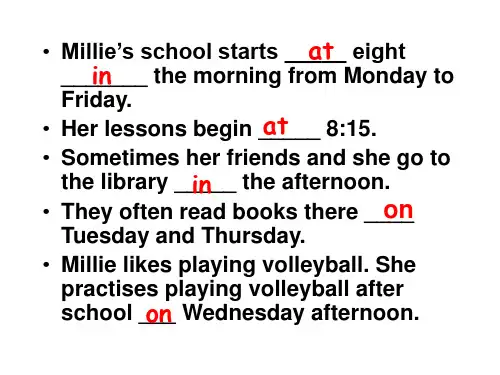
the library __in___ the afternoon. • They often read books there __o_n_
Tuesday and Thursday.
• Millie likes playing volleyball. She practises playing volleyball after
6. 我上学从来不迟到.
I am _n__e_v_e_r__ late for school.
频率副词在句中的位置:
1. 频率副词用在be动词后。
It is usually hot in summer. 夏天天气通常是热的。 2. 频率副词用在实意动词前。
My father usually walks home. 我的父亲经常步行回家。 3. 频率副词用在助动词与实意动词之间。
I love sports. I am good at playing football. I often play it with my friends _o_n__ Saturday afternoon. We have a football match __in___ autumn every year. This year, it is __o_n__ 15 November. My friends and I always have great fun then.
I don’t often go swimming. 我不经常游泳。
频率副词位置记忆口诀: 实前 Be后
How often是对表示频度副词 的时间状语的提问,可翻译为 “多久(一次)”。
➢How often do they exercise?
1.Simon loves playing football. He o_f_t_e_n_ plays football in the playground.
Tuesday and Thursday.
• Millie likes playing volleyball. She practises playing volleyball after
6. 我上学从来不迟到.
I am _n__e_v_e_r__ late for school.
频率副词在句中的位置:
1. 频率副词用在be动词后。
It is usually hot in summer. 夏天天气通常是热的。 2. 频率副词用在实意动词前。
My father usually walks home. 我的父亲经常步行回家。 3. 频率副词用在助动词与实意动词之间。
I love sports. I am good at playing football. I often play it with my friends _o_n__ Saturday afternoon. We have a football match __in___ autumn every year. This year, it is __o_n__ 15 November. My friends and I always have great fun then.
I don’t often go swimming. 我不经常游泳。
频率副词位置记忆口诀: 实前 Be后
How often是对表示频度副词 的时间状语的提问,可翻译为 “多久(一次)”。
➢How often do they exercise?
1.Simon loves playing football. He o_f_t_e_n_ plays football in the playground.
牛津译林初中七年级上册英语 Unit 4《My day Reading 1》课件3

with their PE teacher.
III. 根据所给汉语完成句子。 1. 人们说玛丽是个聪明伶俐的女孩。
People say Mary is a_c_le_v_e_r_ __g_ir_l__. 2. 我们学校的一天从八点开始。 Our _sc_h_o_o_lday_s_ta_r_t_s__a_t_8:00 every day. 3. 我们期待着在外面好好过一天。 We __w_i_sh__ to _h_a_v_e_ a great day outside.
( T ) 1. Millie likes her school very much. ( F ) 2. School starts at 8.15 at Millie’s
school.
( T ) 3. English is Millie’s favourite subject. ( F ) 4. Millie seldom chats with her friends
We read books
We practise volleyball.
Now let’s read the passage together and then finish B3 on P46
Complete the conversation between Joan and Tommy. Joan: I know your friend Millie is now at
every Saturday. 3. I __a_m__g_o_o_d__a_t_ English, for I go to
the English Club every Wednesday. 4. We must learn from ___e_a_c_h_o_t_h_e_r___. 5. The students always _h_a_v_e_a__g_o_o_d__ti_m_e_
III. 根据所给汉语完成句子。 1. 人们说玛丽是个聪明伶俐的女孩。
People say Mary is a_c_le_v_e_r_ __g_ir_l__. 2. 我们学校的一天从八点开始。 Our _sc_h_o_o_lday_s_ta_r_t_s__a_t_8:00 every day. 3. 我们期待着在外面好好过一天。 We __w_i_sh__ to _h_a_v_e_ a great day outside.
( T ) 1. Millie likes her school very much. ( F ) 2. School starts at 8.15 at Millie’s
school.
( T ) 3. English is Millie’s favourite subject. ( F ) 4. Millie seldom chats with her friends
We read books
We practise volleyball.
Now let’s read the passage together and then finish B3 on P46
Complete the conversation between Joan and Tommy. Joan: I know your friend Millie is now at
every Saturday. 3. I __a_m__g_o_o_d__a_t_ English, for I go to
the English Club every Wednesday. 4. We must learn from ___e_a_c_h_o_t_h_e_r___. 5. The students always _h_a_v_e_a__g_o_o_d__ti_m_e_
牛津译林版2020-2021学年七年级英语上册Unit 4 My day Reading (2)课件
2. Millie always_________________ (过得愉快) at schoolh. as a good time
3.We go to school Monday ______
Friday(从...到...). from
to
单项选择。(3 points)
1. I go to school C 7:00 every morning.
039、:0少成57年功.1易都2.学永20老远20难不09成会:0,言57一弃.1寸 ,2.光放20阴弃20不者09可永:0轻远50。不9。会:05成:0功37。.12.202009:057.12.2020
盛开的春地去方春,又在回这,醉新人桃芬换芳旧的符季。节在,那愿桃你花 409、:0桃57花.1潭2.水20深20千09尺:0,57不.1及2.汪20伦20送09我:0情50。9:05:037.12.202009:057.12.2020 盛开的地方,在这醉人芬芳的季节,愿你 74.、12敏不.2而要02好为07学它.1,的2.不结20耻束20下而09问哭:0。 ,50。应9当7:0.15为20.9它2:0的250:开073始.1029而.:20笑052:。00309:0509:0509:05:0309:05:03
Time
Millie’s school day
at 8 a.m first at 8:15 Subject
school starts do morning exercises lessons begin English
Tell T or F
1、Millie goes to school five days a weeTk.
Her favourite subujest is...
2020牛津译林版七年级上册Unit 4《My day》(Grammar)课件
October.
11. We’ll have one party ____ next week.
12. My friends give me some presents __a_t__
Christmas every year.
13. He got home _o_n___ the morning of the 4th last month. 14. The story happened __o_n__ a cold winter morning. 15. I never go to a party0_o%_n__ Halloween. 16. My father seldom h2as0%free time _a__t__ the weekend. 17. It sometimes snows40__%_in____ winter in Wuxi. 18. He often takes Edd6ie0%for a walk _i_n___ the evening.
3. Amy is a member of the swimming team. She u__su_a_l_l_y swims after school.
never seldom sometimes often usually always
4. Daniel doesn’t like basketball. He n_e_v_e_r_ plays it.
never seldom sometimes often usually always
How often do they exercise?
1. Simon loves playing football. He _____ plays football in the playground.
11. We’ll have one party ____ next week.
12. My friends give me some presents __a_t__
Christmas every year.
13. He got home _o_n___ the morning of the 4th last month. 14. The story happened __o_n__ a cold winter morning. 15. I never go to a party0_o%_n__ Halloween. 16. My father seldom h2as0%free time _a__t__ the weekend. 17. It sometimes snows40__%_in____ winter in Wuxi. 18. He often takes Edd6ie0%for a walk _i_n___ the evening.
3. Amy is a member of the swimming team. She u__su_a_l_l_y swims after school.
never seldom sometimes often usually always
4. Daniel doesn’t like basketball. He n_e_v_e_r_ plays it.
never seldom sometimes often usually always
How often do they exercise?
1. Simon loves playing football. He _____ plays football in the playground.
Unit 4 My day词汇和短语预习课件牛津译林版七年级英语上册
New words and phrases
need rest just have fun have lessons after-school activity go to bed
需要vt. 休息,歇息 n. 只是adv. 玩得高兴 上课 课外的,课后的adj. 活动 n. 去睡觉
New words and phrases
Unit 4 My day
词汇预习
New words and phrases
wake
醒,醒来,唤醒vi. & vt.
wake up
醒来
shall
(表示提出或征求建议)v.
hill
小山 n.
seldom
很少,不常adv.
odv.
go out
出去
have breakfast / lunch / dinner 吃早饭/中饭/晚饭
usually
通常,经常adv.
never
从不,绝不adv.
be late for
迟到
start
开始,着手vt. & vi.
quarter
一刻钟 n.
past
晚于 prep.
in the morning / afternoon/ evening 在上午/下午/晚上
first
首先adv.
New words and phrases
once dislike reason ready get ready for sth. learn world
一次 adv. 不喜爱,厌恶 n. 原因 ,理由 n. 准备好,准备完毕adj. 为...准备好 学,学习,学会vt. & vi. 世界 n.
牛津译林版7A Unit4 My day task课件(共17张PPT)
They are good for us. They help us get ready for the day. Teachers are nice and the subjects are interesting. I am not tall, so I cannot play it well. I can learn a lot about the world. It is fun. We always have too much homework!
Dicussion:
1. What do you uቤተ መጻሕፍቲ ባይዱually do at school? 2. What activity do you love? Why? What activity do you like? Why? What activity do you dislike? Why? e.g. I love/ like ... because... I really I love/ like ... because... I love/ like ... a lot/ very much because... I dislike ... because... I don't like... at all because...
教学目标:
本节课后,所有学生 1. 至少会使用1种方式表述自己“热爱”, “喜欢”和“不喜欢”某活动。 2. 至少写出5句话的一篇小文章。 3. 写作能有段落意识。
教学目标:
本节课后,所有学生 1. 至少会使用1种方式表述自己“热爱”, “喜欢”和“不喜欢”某活动。 2. 至少写出5句话的一篇小文章。 3. 写作能有段落意识。
Do you think I like running?