
高二英语选修7unit 2 section 2
out 开出,列出
人教版英语 · 选修7
课前自主预习
要点层级解读
课时演练广场
人教版英语 · 选修7
课前自主预习
要点层级解读
课时演练广场
desire(P10) (1)n.[C,U]渴望;欲望;渴求 ①He has a strong desire to succeed.
=He has a strong desire for success.
have a desire to do sth.渴望做某事
satisfy/meet one’s desire满足某人的愿望
人教版英语 · 选修7
课前自主预习
要点层级解读
课时演练广场
人教版英语 · 选修7
课前自主预习
要点层级解读
课时演练广场
(2)vt.渴望,期望;希望得到;想要(不用于进行时)
③He desired a college education. 他渴望受到大学教育。 ④She desires you to come at once. =She desires that you(should)come at once.
人教版英语 · 选修7
课前自主预习
要点层级解读
课时演练广场
③His success is a great satisfaction to his parents.
他的成功让他的父母很满足。 ④The new dress satisfied her. 那件新衣服令她满意。 ⑤The boss wasn’t satisfied with my work.
comfortable
答案:1.D 2.A 3.E 4.B 5.C
人教版英语 · 选修7
课前自主预习
要点层级解读
课时演练广场
二、根据所给词性和汉语意义写出英语单词 1. satisfy vt.满足;使满意→ satisfaction n.满意;满足; satisfied 令人满意的事物→ satisfying/satisfactory adj.令人满意的→______
My grandma
last week.
答案:①tested out ②was tested for heart disease
人教版英语 · 选修7
课前自主预习
要点层级解读
课时演练广场
alarm(P11) (1)vt.使惊慌,使不安;使警觉
①I don’t want to alarm you,but I can’t find the key.
课时演练广场
[归纳拓展] give/raise/sound the alarm发警报 ring the alarm敲警钟 in alarm惊恐地
人教版英语 · 选修7
课前自主预习
要点层级解读
课时演练广场
人教版英语 · 选修7
课前自主预习
要点层级解读
课时演练广场
test out试验;考验(P11) ①Scientists test out theories by experiment.
科学家用实验来检验理论。
②The new product was tested out in 2012 and launched in 2013. 新产品于2012年通过检测,2013年投放市场。 ③I’m going to test you for diabetes.
Unit 2
Robots
Section Ⅱ Warming Up & Reading—Language Points
课前自主预习
要点层级解读
课时演练广场
人教版英语 · 选修7
课前自主预习
要点层级解读
课时演练广场
Ⅰ.重点单词
一、将下列单词与所对应的英文解释连线 1.envy 2.desire A.to want or hope for sth.very much B.the feeling of being sorry for someone who is in a bad situation and understanding how
leave much to be desired还有许多不足之处
人教版英语 · 选修7
课前自主预习
要点层级解读
课时演练广场
[即境活用]
1.完成句子 ①我们都希望与邻居和睦相处。 We all peace our neighbours. ②他有强烈的求知欲。
He has
knowledge.
人教版英语 · 选修7
④The bank teller pushed the alarm button.
那个银行出纳员按了报警按钮。 ⑤The news fills me with alarm. 这消息使我大为惊慌。 ⑥He jumped up in alarm.
他惊慌地跳了起来。
人教版英语 · 选修7
课前自主预习
要点层级解读
我将要检查你是否有糖尿病。
④They have decided to test the medicine on cats. 他们已决定在猫身上试验这种药。
人教版英语 · 选修7
课前自主预习
要点层级解读
课时演练广场
[归纳拓展] (1)test sb.on sth.就某事(物)测试某人 test sth.on sb./sth.在某人/某物身上做试验 test sb.for sth.为某事检查某人
课时演练广场
[即境活用] 2.完成句子
①他对结果感到满意。
He the result. ,my son passed the examination. ③他满意地点了点头。 ②令我感到满意的是,儿子通过了考试。
He nodded
。
②To
答案:①found/took satisfaction in/was satisfied with my satisfaction ③with satisfaction
他非常渴望成功。 ②He expressed his desire that his books(should)reach as many people as possible. 他表达了希望他的书能够被尽可能多的人阅读的愿望。
人教版英语 · 选修7
课前自主预习
要点层级解读
课时演练广场
[归纳拓展] at sb.’s desire应某人的要求 by desire应邀 have a desire for sth.渴望某物
adj.满足的;(感到)满意的
2. alarm vt.使警觉;使惊恐;惊动 n.警报;惊恐 → alarmed adj.担心的;害怕的 3. elegant adj.优雅的;高雅的;讲究的 → elegance n.优雅;高雅
人教版英语 · 选修7
课前自主预习
要点层级解读
课时演练广场
4. favour n.喜爱;恩惠 vt.喜爱;偏袒→favourite adj.最 喜欢的n.最喜爱的东西 5. declare vt.宣布;声明;表明;宣称→ declaration n.宣 言;声明;公告
10. counter n.柜台;计数器→ count vi.&vt.点数;计数
人教版英语 · 选修7
课前自主预习
要点层级解读
课时演练广场
Ⅱ.重点短语
根据汉语意思补全短语 1.test 3.reach out for 试验;考验 伸手去够 给„„打电话 2. or rather 更确切地说
4. with
5.ring up
wonder 惊奇地;疑惑地
人教版英语 · 选修7
课前自主预习
要点层级解读
课时演练广场
6.turn around
7.fall off 8.leave... alone 9.feel alarmed
转向;回转
不管;别惹;让„„一个人 感到恐惧的
从„„上掉下来
待着;和„„单独在一起
10.write
6. sympathy n.同情;怜悯→ sympathize vi.(对某人)同情→
_____________ sympathetic adj.有同情心的
人教版英语 · 选修7
课前自主预习
要点层级解读
课时演练广场
7. absurd adj.荒谬的;可笑的→ absurdness n.荒谬 8. awful 9. envy adj.极坏的;极讨厌的;可怕的;(口语)糟透的 vt.忌妒;羡慕→ envious adj.忌妒的;羡慕的 →adv. awfully 非常;很;十分
(2)satisfy vt.使满意,使满足
satisfied adj.(感到)满意的,满足的 be/feel satisfied with对„„感到满意 (3)satisfying adj.令人满意的 satisfactory adj.令人满意的;令人愉快的
人教版英语 · 选修7
课前自主预习
要点层级解读
老板对我的工作不满意。
人教版英语 · 选修7
课前自主预习
要点层级解读
课时演练广场
[归纳拓展] (1)to sb.’s satisfaction=to the satisfaction of sb. 令某人满意的是 with satisfaction满意地 afford/give satisfaction to sb.满足某人
they feel
3.cushion C.to go somewhere with someone,especially in order to look after him/her
人教版英语 · 选修7
课前自主预习
要点层级解读
课时演练广场
4.sympathy 5.accompany
高中英语 新课标人教版选修7unit 2篇章2阅读课课件 (共16张ppt)

1948 Got PhD in chemistry.
Reading
1949
Became a biochemistry teacher, Boston University School of Medicine.
1950
19511953
Published his first novel. Published “I, Robot” Developed three laws for robots.
Paragraph 3. His education and occupation Paragraph 4. How he started his writing career Paragraph 5. His major achievements and influence
Paragraph 6. His personal life
Example: I think he is a prolific writer because it is mentioned in the text that he wrote around 480 books, which is a lot!
Reading & Thinking
Some possible answers
1983 Had a blood transfusion. Became infected with HIV.
1992 Died in New York
Reading & Thinking
1. Does this biography follow time order? Why or why not? 2. Why is Asimov’s marriage mentioned last in the text?
高二英语人教版选修7课件:unit+2单元
My car is being repaired so I can't lend it to you.
When we got to the meeting room, we found the speech had been cancelled.
The hotel manager thought that the fire might have been caused by some cigarette butts.
• Solving the safety problem well enough to move forward in AI seems to be possible but not easy.There are probably decades in which to plan for the arrival of super intelligent machines.But the problem should not be dismissed out of hand, as it has been by some AI researchers.Some argue that humans and machines can coexist as long as they work in teams—yet that is not
• C.It will be solved but with difficulty.
• D.It will stay for a decade.
• 解析:考查推理判断。根据第四段中的“Solving the safety problem well enough to move forward in AI seems to be possible but not easy”可知,人工智能的安全问题 有可能得到解决,但又困难重重。
人教版高中英语选修7Unit2教案2

Unit 2 RobotsPart 1 Teaching Design 第一部分教学设计Period 2 A sample lesson plan for Learning about Language(Revise the passive voice including the infinitive)IntroductionIn this period students will be first helped by the teacher to discover and learn to use some useful words and collocations, and then to discover and revise the passive voice including the infinitive. The following steps of teaching may be taken: warming up by having a dictation, discovering useful words and collocations, reading more about the 22nd century, learning about the passive voice, discovering useful structures and closing down by putting on stage a text play of Satisfaction Guaranteed.ObjectivesTo help students revise the passive voiceTo help students discover and learn to use some useful words and collocationsTo help students discover and learn to use some useful structuresProcedures1. Warming up by having a dictationTo begin with, let’s take a dictation to strengthen our memory of the text.Larry Belmont worked for a company that make robot. Recently a robot that could do housework would be tested out Larry's life, Clair, for three weeks. Clair felt alarmed by the robot's humanly appearance. Before long she began to trust him. She told him that she and her home were not elegant enough for her husband and she envied the rich and powerful woman .The robot decided to protect her from being harm. He gave her a new haircut and changed her makeup and asked her to buy something to decorate her home. Before the night he was to leave Clair, they held a party. The guests were impressed by Clair and her home, especially by the handsome robot, whom they thought was her husband. Claire knew this is almost a dream and she felt very sad. However, the company was very satisfied with Tony, the robot although he needed rebuilding because it is absurd to have women falling in love with a machine.2. Discovering useful words and collocationsA collocation is two or more words that often go together. These combinations just sound "right" to native English speakers, who use them all the time.While going over the text, try to recognize the collocations, treat them as single blocks of language and copy them out into your Collocation Book.Now go to page 13. Work in pairs to finish the three exercises in 10 minutes.3. Learning about the passive voiceACTIVE AND PASSIVE TENSES CHARTSIMPLE PRESENT and SIMPLE PASTThe active object becomes the passive subject.am/is/are +past participlewas/were + past participleActive: Simple PresentThe movie fascinates me.The movie bores Jack.The movie surprises them.Passive: Simple PresentI am fascinated by the movie.Jack is bored by the movie.They are surprised by the movie.Active: Simple PastThe movie bored me.The movie fascinated Jack.The movie surprised them.Passive: Simple PastI was bored by the movie.Jack was fascinated by the movie.They were surprised by the movie.PRESENT and PAST CONTINUOUS (PROGRESSIVE) Passive form:am/is/are + being + past participlewas/were + being + past participleActive: Present ContinuousI am helping Shannon.June is helping Su and Ling.Passive: Present ContinuousShannon is being helped by me.Su and Ling are being helped by June.Active: Past ContinuousI was cleaning the bathroom.They were cleaning the bedroom.Susan was cleaning the kitchen and patio.Passive: Past ContinuousThe bathroom was being cleaned by me.The bedroom was being cleaned by them.The kitchen and patio were being cleaned by Susan.PRESENT PERFECT, PAST PERFECT and FUTURE PERFECT Passive form:have/has been + past participlehad been + past participleActive: Present PerfectI have mailed the gift.Jack has mailed the gifts.Passive: Present PerfectThe gift has been mailed by me.The gifts have been mailed by Jack.Active: Past PerfectSteven Spielberg had directed the movie.Penny Marshall had directed those movies.Passive: Past PerfectThe movie had been directed by Steven Spielberg. The movies had been directed by Penny Marshall.Active: Future PerfectJohn will have finished the project next month.They will have finished the projects before then.Passive: Future PerfectThe project will have been finished by next month. The projects will have been finished before then.FUTURE TENSESPassive forms: will + be + past participleis/are going to be + past participleActive: Future with WILLI will mail the gift.Jack will mail the gifts.Passive: Future with WILLThe gift will be mailed by me.The gifts will be mailed by Jack.Active: Future with GOING TOI am going to make the cake.Sue is going to make two cakes.Passive: Future with GOING TOThe cake is going to be made by me.Two cakes are going to be made by Sue.PRESENT / FUTURE MODALSThe passive form follows this pattern:modal + be + past participleActive: WILL / WON'T (WILL NOT)Sharon will invite Tom to the party.Sharon won't invite Jeff to the party. (Sharon will not invite Jeff to the party.)Passive: WILL / WON'T (WILL NOT)Tom will be invited to the party by Sharon. Jeff won't be invited to the party by Sharon. (Jeff will not be invited to the party by Sharon.)Active: CAN / CAN'T (CAN NOT)Mai can foretell the future.Terry can't foretell the future.(Terry can not foretell the future.)Passive: CAN / CAN'T (CAN NOT)The future can be foretold by Mai.The future can't be foretold by Terry.(The future can not be foretold by Terry.)Active: MAY / MAY NOTHer company may give Katya a new office. The lazy students may not do the homework.MIGHT / MIGHT NOTHer company might give Katya a new office.The lazy students might not do the homework.Passive: MAY / MAY NOTKatya may be given a new office by her company.The homework may not be done by the lazy students. MIGHT / MIGHT NOTKatya might be given a new office by her company. The homework might not be done by the lazy students.Active: SHOULD / SHOULDN'TStudents should memorize English verbs.Children shouldn't smoke cigarettes.Passive: SHOULD / SHOULDN'TEnglish verbs should be memorized by students. Cigarettes shouldn't be smoked by children.Active: OUGHT TOStudents ought to learn English verbs.(negative ought to is rarely used)Passive: OUGHT TOEnglish verbs ought to be memorized by students.Active: HAD BETTER / HAD BETTER NOTStudents had better practice English every day. Children had better not drink whiskey.Passive: HAD BETTER / HAD BETTER NOTEnglish had better be practiced every day by students. Whiskey had better not be drunk by children.Active: MUST / MUST NOTTourists must apply for a passport to travel abroad. Customers must not use that door.Passive: MUST / MUST NOTA passport to travel abroad must be applied for.That door must not be used by customers.Active: HAS TO / HAVE TOShe has to practice English every day.Sara and Miho have to wash the dishes every day. DOESN'T HAVE TO/ DON'T HAVE TOMaria doesn't have to clean her bedroom every day.The children don't have to clean their bedrooms every day.Passive: HAS TO / HAVE TOEnglish has to be practiced every day.The dishes have to be washed by them every day. DOESN'T HAVE TO/ DON'T HAVE TOHer bedroom doesn't have to be cleaned every day. Their bedrooms don't have to be cleaned every day.Active: BE SUPPOSED TOI am supposed to type the composition.I am not supposed to copy the stories in the book.Janet is supposed to clean the living room.She isn't supposed to eat candy and gum.They are supposed to make dinner for the family.They aren't supposed to make dessert.Passive: BE SUPPOSED TOThe composition is supposed to be typed by me.The stories in the book are not supposed to be copied. The living room is supposed to be cleaned by Janet. Candy and gum aren't supposed to be eaten by her. Dinner for the family is supposed to be made by them. Dessert isn't supposed to be made by them.PAST MODALSThe past passive form follows this pattern:modal + have been + past participleActive: SHOULD HAVE / SHOULDN'T HAVEThe students should have learned the verbs.The children shouldn't have broken the window.Passive: SHOULD HAVE / SHOULDN'T HAVEThe verbs should have been learned by the students. The window shouldn't have been broken by the children.Active: OUGHT TOStudents ought to have learned the verbs. (negative ought to is rarely used)Passive: OUGHT TOThe verbs ought to have been learned by the students.Active: BE SUPPOSED TO (past time)I was supposed to type the composition.I wasn't supposed to copy the story in the book.Janet was supposed to clean the living room.She wasn't supposed to eat candy and gum.Frank and Jane were supposed to make dinner.They weren't supposed to make dessert.Passive: BE SUPPOSED TO (past time)The composition was supposed to be typed by me. The story in the book wasn't supposed to be copied. The living room was supposed to be cleaned by Janet. Candy and gum weren't supposed to be eaten by her. Dinner was supposed to be made by them.Dessert wasn't supposed to be made by them.Active: MAY / MAY NOTThat firm may have offered Katya a new job.The students may not have written the paper.MIGHT / MIGHT NOTThat firm might have offered Katya a new job.The students might not have written the paper.Passive: MAY / MAY NOTKatya may have been offered a new job by that firm. The paper may not have been written by the students. MIGHT / MIGHT NOTKatya might have been offered a new job by that firm.The paper might not have been written by the students.4. 被动语态小结●被动语态的特殊结构形式1)带情态动词的被动结构。
高二英语人教版选修七讲义Unit2SectionⅡ

Ⅰ.单词拼写1.The minister is busy with the affairs (事务) of state.2.I was once a prisoner, so I have a lot of sympathy (同情) for other people in prison.3.He constantly gets into awkward and absurd (荒唐的) situations where audience can be greatly amused.4.She was tired of the hard life in the mountain village and desired (想要) to go out.5.Many medical conditions are caused by being overweight(超重的).6.The headmaster is to acpany (陪伴) a group of American students on a tour of our city.7.It would be awful (糟透的) if he found out the truth that he was refused.8.My father is fond of scanning (浏览) the morning papers while eating breakfast.Ⅱ.拓展词汇1.Satisfaction n.满意;满足;令人满意的事物→satisfy v t.满足;使满意→satisfying/satisfactory adj.令人满意的→satisfied adj.满足的;(感到)满意的2.alarm v t.使警觉;使惊恐;惊动n.警报;惊恐→alarmed adj.担心的;害怕的3.favour n.喜爱;恩惠v t.喜爱;偏袒→favourite adj.最喜欢的n.最喜爱的东西4.declare v t.宣布;声明;表明;宣称→declaration n.宣言;声明;公告5.absurd adj.荒谬的;可笑的→ridiculous (同义词)6.elegant adj.优雅的;高雅的;讲究的→elegance n.优雅;高雅→elegantly ad v.优雅地;高雅地;讲究地[巧记单词]Ⅲ.补全短语1.experiment on/with用……做实验;试验;验证2.test out 试验;考验3.or rather 更确切地说4.reach for 伸手去够5.with wonder 惊奇地;疑惑地6.ring up 给……打7.turn around 转向;回转8.fall off 从……上掉下来9.leave ...alone 不管;别惹;让……一个人待着;和……单独在一起1.[教材原句]His name was Tony and he seemed more like a human than a machine. 他的名字叫托尼,他看起来与其说像一台机器,倒不如说像一个人。
高中(人教版)英语选修7课件:unit 2 section 2
才意识到托尼早就把前边窗户的窗帘拉开了。
佳句诵读: ______________________sweep the streets in It is the cleaners that spite of the chilly wind or the heavy rain.
正是那些清洁工不顾寒风暴雨,为我们清扫街道。
英语 选修7
Unit 2 Robots
课前 自主预习 课内 研析探究
Ⅱ.重点短语 test out 1.________________
试验;考验 更确切地说
or rather 2.________________ reach for 3.________________
ring up 4.________________ turn around 5.________________ fall off a ladder 6.________________ more than 7.________________ leave...alone 8 . ________________ 着;和……单独在一起
台机器,倒不如说更像一个人。 more sad than angry 佳句诵读:She was ________________________ when her
little son lied to her again.
当她的小儿子再次对她说谎时,与其说她生气倒不如说她 伤心。
英语 选修7
U一个常见的现象,孩子是家庭的中心, ( 他
们)肩负着父母的希望。
英语 选修7
Unit 2 Robots
课前 自主预习 课内 研析探究
3 .教材原句: As she turned around , there stood Gladys Claffern.
选修7unit2课文讲解
▪ How absurd! ▪ What a sweet victory to be envied by those women!
1. __ an interesting book it is! 2. __ interesting a book it is! 3. __ interesting books they are! 4. __ delicious food I had! 5. __ kind of you to help! 6. __ I wish I were a bird!
What How What What How How
As she turned around, there stood Gladys Claffern.
▪ There 可以引出完全倒装的句子,除了常见的 there be 句型,there还可以接appear, exist, lie, remain, seem to be, stand等。一般都翻译 为有。
▪ More than one student was given away a ticket to the concert.
▪ It took more than building supplies to construct these energy-saving houses. It took brains, too.
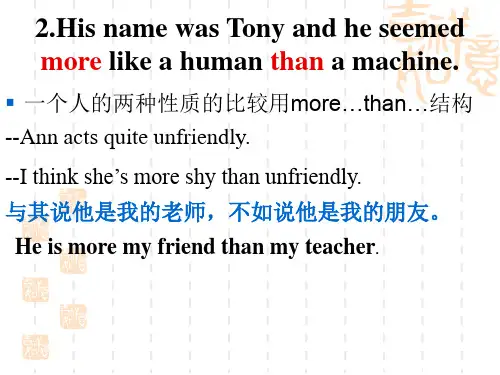
2.His name was Tony and he seemed more like a human than a machine.
▪ 一个人的两种性质的比较用more…than…结构 --Ann acts quite unfriendly.
高中选修7英语unit2—【教学课件】
help dressing. But she began to ______ him
antrduasstked him to make herself and her house ________el.eTgoannyt gave Claire a new _____h_a_ir_c_u. tHe also declared that he didn’t
Read a short story about a robot. It was originally written by the science fiction writer, Isaac Asimov, and published in 1951. Here the story has been retold by another writer.
Iafahbtoohuuseetrh?eoldisrAobnhooot.uIttsowepahisocgldosienrognbttoeotbnecete,stehdoowut by dLoWaryrhyoo'su?wigfee, tCwfalatamrhsieie.ltye.mstaeidn oiudteian?a It is mainly about howWhaaht?ousehold
machine.
2. Why did Claire feel embarrassed one day? A. Because Tony asked her whether she needed help dressing. B. Because Tony offered sympathy for her. C. Because Tony helped her a lot.
高二英语译林版选修7学案:Unit2FitforlifeSectionⅡ 含解析
Unit 2Fit for lifeSection ⅡGrammar1.Today I feel worn out。
(Page 25)今天,我累坏了。
wear out使筋疲力尽;使厌烦;用旧,用坏,穿破;磨损,损耗We must wear the enemy out in a month。
我们必须在一个月之内让敌人筋疲力尽.The kids have totally worn me out.孩子们简直把我烦透了.Cheap shoes soon wear out.便宜的鞋子不耐穿。
The car is wearing out。
这辆车已经开始磨损。
辨析:wear out,be tired out和give out三者都有“筋疲力尽"的意思。
只有wear out是及物动词短语。
完成句子1)如果你经常爬,鞋就会容易磨破。
If you climb a lot,your shoes will ______ ______ easily。
2)我的大衣穿破了,所以我得另买一件新的。
My coat was ______ ______,so I had to buy a new one.3)工作这么多小时后,我筋疲力尽了。
I was ______ ______ after working for so many hours.2.He made some quite reasonable points 。
(Page 25)他说出了一些极为合理的论点……reasonable adj.合理的,有理由的;公道的;明智的He is reasonable in his demands。
他提出的要求是合理的。
The hotel charged me a very reasonable price for a room.这家旅馆向我收取一间房间的合理费用。
Don't be afraid to talk to the teacher because she is very reasonable。
新人教高二英语选修7 Unit 2 language points
turn off turn out 结果是;证明是;生产(产品) • turn in 上交 • turn down 拒绝, 调小/低 • turn up 出现;到达,调大/高 • turn over 翻动”,把……反过来
affair 暖昧关系, 事情, 私通 Don’t mind one’s own affaires/business. 别管闲事! have an affair with sb. 跟某人有不正当的男女关系 She was having an affair with someone who has a wife (有妇之夫). It’s not my affair. 这不关我的事。
e.g. Thunders accompanied by heavy rain in this season are very common. 这个季节,雷鸣常常伴有大雨。
ring (sb) up call (sb) up give sb a call/ring; make a (telephone) call call sb on the telephone phone/telephone sb
4. She felt embarrassed and quickly told him to
go.她感到有点儿不好意思,赶紧叫他离开。
embarrass
vt. 使困窘,使局促不安
embarrassed adj. 尴尬的,害羞的
embarrassing adj. 使人尴尬 / 难堪的
embarrass sb. with sth./ by doing sth. 做…使某人尴尬/窘迫 be/feel embarrassed by (doing) sth. Don’t embarrass them with (by asking) personal questions. I felt embarrassed by my being late.
人教英语选修7Unit2UsingLanguage课件共25张
▪ 1_9_4_1_ Gained Master’s degree in chemistry.
▪ 1942 Finished working in the candy store.
▪ 1942-1945 _________________________. ▪ ____ Got PWhoDrkiendcahsemjunisitorryc. hemist . ▪ ____ BecaPmheilaadbeilopchhiaemNaisvtyrYyatreda.cher,
1B9o4s8ton University School of Medicine.
▪ 11994590 Published his first novel.
1951-1953 Published “The Foundation Trilogy” and won an award for it.
_1_9_5_3_ Published first science book _1_9_5_8_ Became a full-time writer.
————————————————
2. Deep Reading :
▪ Date
Event
▪ 1920 Born in Russia. ▪ __t_o_N__e_w. York
▪
Parents bought a candy store.
1973 Divorced his first wife. _1_9_8_3_ Had a blood transfusion. 1992 __D_ie_d__in__N_e_w__Y_o_rk_________.
Step III: Read the passage aloud. If you still have any question, mark it and put it forward later. If not, do the following exercises to check yourself.