
必修5 unit2 the united kingdom reading优质课课件
Paragraph 3
Parts of the UK How did England and Wales join together and how did Great Britain and UK come into being Administration of UK
Paragraph 4
The geographical division of England and characteristics of each zone The culture of London
The UK
The Queen gentlemen
Shakespeare
London Mr. Bean
Beckham
耿马县一中 李美兰
London Bridge The Tower of London The Big Ben
牛津大学建立时间不详,因为那并不是一个独立的事件, 它可以追溯到1096年于那里开始的教学。
格林威治皇家天文台
The London Eye
Let’s have a quiz
1. How many countries does the UK consist of ?
A. two
B. three C. four
Northern Ireland
Scotland
England
Wales
2. How long does it take to fly from Beijing to London Heathrow Airport?
5. Which is the longest river in England?
A. The River Avon
B. The River Thames
C. The River Severn
Thames
Severn
Avon
The River Thames and Severn are very similar in length but River Thames is slightly longer. The River Thames is 338 km and the River Severn is 290 km. The River Avon is much shorter.
Pre-reading
Can you name the capital cities of the countries of the UK?
E S
Scotland
Edinburgh Belfast England
Wales Cardiff
Irish Sea
Northern Ireland Dublin
A. About 6 hours B about 10 hours C about 16 hours
London Heathrow Airport
Beijing
3. Who rules the country? A. The Queen B. The Prime Minister C. both
4. What are the provinces called in England? A. counties B. departments C. states
Republic of Ireland
London
reading
Please read the whole text as fast as you can, and try to find out the main idea of each paragraph.
Paragraph 1 Paragraph 2
Paragraph 5-6
the United Kingdom
England
13th century 17th ced
20th century
North Ireland
13th century
17th century
20th century
Get Ireland connected to form the United Kingdom
The influence of the invaders
The Romans
The Anglo-Saxons The Viking The Normans
left their language and their government left their towns and roads left castles and words for food influenced the vocabulary and place-names of the North
20th century
Northern Ireland
Only Northern Ireland joined with Great Britain to become the United Kingdom
Administration of the UK
Paragraph 4
North : large industrial cities
theatres parks buildings
The oldest port built by … in the 1st century.
The oldest building built by … in the 1060s.
The oldest castle constructed by …rulers in 1066.
About England
Midlands: large industrial cities
South:
Most of the population settled there
Paragraph 5--6
About London
historical treasures
museums
art collections
Which group of invaders did not influence London?
• That’s all!
牛津产生了4位英国国王, 46位诺贝尔奖获得者,25位英国首相,3位圣人, 86位大主教以及18位红衣主教。
成立于1209年,是世界十大学府之一, 73位诺贝尔奖得主出自此校。
David Beckham
Buckingham Palace 白金汉宫
Royal Greenwich Observatory
人教版必修五Unit2TheUnitedKingdomReading2教学课件

We know this because: both were princes; both wore young boys; their uncle was Richard who later became King Richard III.
2. Who had the two princes killed?
Alternatives words that can be used instead of “ nice” and“ is”
smart, clean, excellent, exciting, famous, beautiful, grand, great, nice huge, special , unusual, amazing, wonderful, splendid…
Sample dialogue: A: Excuse me. Are you a guide? B: Yes, I am. Can I help you? A: Can I ask you a questions about the
Temple of Heaven? B: Of course. What do you want to know? A: What is this Temple for?
Day 3 ➢Strange ➢Famous ➢Sadly
Highgate Cemetery
The British Museum
英国最大的综合性博物馆,位于伦敦
Day 3 1 Thrilled 2 wonderful 3 felt proud of her country
The next day
Scanning:
Make a list of Zhang Pingyu’s tour of London
人教版高中英语:必修5Unit2TheUnitedKingdom2.2Reading课件
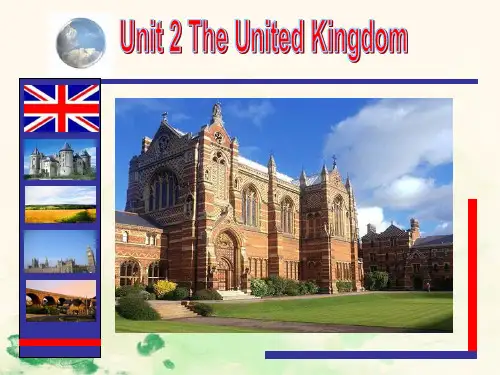
The greatest historical treasure in London:
Museums art collections parks theatres ports
Divide the passage into three parts and write down the main idea of each part. Part 1 (Para 1-3) __H_o_w__t_h_e_U__K__c_a_m_e__in_t_o__b_e_in_g_?___ Part 2 (Para 4): _E__n_g_la_n_d__is__d_iv_i_d_e_d__in_t_o_3__z_o_n_e_s_. _ Part 3 (Para 5-6): _T_h_e__c_u_lt_u_r_a_l_i_m_p_o_r_t_a_n_c_e_o_f_L__o_n_d_o_n_.
England is divided into 3 zones.
Most population settled in
_t_h_e_S_o_u__th__o_f_E_n_g_l_a_n_d_.
Most of the large industrial
cities are in
_t_h_e_N__o_r_th__a_n_d__th_e__M__id_l_a_n_d_s____.
Para5
3. The oldest building in London was begun by the Anglo-Saxons in the 1060s. T
人教新课标高中英语必修五 Unit 2 The United Kingdom reading 课件(共32张PPT)
Part 3-London London is the greatest historical treasure the center of national government and its
administration. London has the oldest port, building and Castle, which are influenced by some invaders.
…… national flower
river
the UK
consist of...
language
sports
flag
the 13th century AD, England + Wales.
first only England
Part 2-England
Look at the map of England and Wales in the following page. Divide it into three parts. Draw lines across to show the zones of the South, Midlands and North of England. Now put each town or city into its correct zone.
Make a guess.
The USA.
Japan
France
perfume Red wine
fashion
Italy
Spaghetti
the Leaning Tower of Pisa比萨斜塔
Pizza
The UK
the UK
America
Europe
高中英语人教版必修5第二单元The United Kingdom (Reading)教案
优秀教案2(2011------2012学年度第一学期)Teaching Contents: The United Kingdom-- Warming up and Reading教案Teaching aims:Get the students interested in talking about the UK, and at the same time improve their speaking ability.Enable them to get some basic information about the UK. through reading.Improving Ss’ reading skills such as prediction, scanning, skimming.Teaching difficult and important points:Express the ideas freely in EnglishUnderstand the history and the geography of the UK. .Improve the reading skills.Teaching procedures:Step 1 Warming up& lead-in1. Game playingT: Morning everybody! You see, nowadays, travelling abroad are becoming more and more popular. So if you have a chance to go aboard, which country do you want to go most? How much do you know about that country?T: Very good! Just now some of you shared your ideas, and now let’s play a short game: Guess which country it is! Altogether there are 8 groups, you are asked to choose one item and guess which country it is according to the related information offered to you.1. People----America2. Music----Argentina3. Video----Australia4. Food-----Italy5. Shopping----France6. Architecture-----China7. Poetry-----the UKStep2 Pre-Reading1. Brainstorming :T: Now you have a chance to go to the UK. , before you go there you’d better go to the library to search for some information about the country. What kind of information about it you want to find out?S: geography, literature, politics, sports, sightseeings, cultures, ethnic groups, famouscities, food, history, language, fashion, life styles …….T: How much do you know about these?Step 3 Reading1. Fast-reading.1)Task 1:Question: What kinds of information are mentioned in the text?(sports, geography, history, flag, London, The biggest country England, flag, invasions).2) Task 2:How many parts can this passage be divided into and what the main idea of each part is?.Part1(para1-4): How the UK came into beingPart2 (para5): England is divided into 3 zones.Part3 (para6): The reason why London became the cultural capital of England.2. Careful readingPart 11) T: Very good! So could you tell me how many countries the UK consists of and what they are? S: The UK consists of four countries, that is England, Wales, Scotland and Northern Ireland. 2) T: Exactly! Then does these four countries united in one day?S: No.T: Then how can the UK come into being?S: First there was only England, then in the 13th century AD, Wales was linked to the England, and in 1603, the two were joined to Scotland to make the Great Britain come into being. Later, Northern Ireland was united to the Great Britain to form the UK.T: Wonderful job! Actually the history can be shown in the national flag called the Union Jack.Cross of St George (England) Cross of St Andrew (Scotland)Cross of St Patrick (Ireland) Union Jack or Union Flag3) T: By the way, you see, the flag Union Jack only unites England, Scotland and Northern Ireland, with Wales left out. So do you know why?S: Because it is usually assumed to be part of England.T: Yes! And according to the passage, although the four countries belong to the UK, they are still quite different in some aspects, so in what ways are the four countries different?S: They are different in international relations. They have different educational and legal systems as well as football teams.Part 2T: Among the four countries, England is the largest, and for connivance it is divided into 3 zones. What are they?S: The South of England, the Midlands and the North.T: Good! And now could you tell me what the feature of each zone?Most population settled in The South of England.Most of the large industrial cities are in the North and the Midlands.Many cities have famous football teams.Part 31) T: So we all know the UK has a long history and of course rich culture, and the cultural center is, obviously, the capital city London. So why can London become the cultural center ?S: Because there are a lot of historical treasure in London.T: Why there are so many historical treasure in London?S: London has been influenced by some invaders.2) T: Actually, in the England history, altogether there are four invasions, do you know what they are?S: The Romans; The Anglo-Saxons; the Vikings; the Normans.T: What did they left in England?S: the Romans left towns and roads, the Anglo-Saxons language and government, the Vikings influence the vocabulary and place-names of the North and the Normans castles and words for food.Step 4. Post-Reading1. Task 1 Role-playTwo students act as tourist guides, and two students act as the tourists who want to go to the UK. Before they start, they ask the guides some background information of the UK.2. Task 2 Discussion of ideasThis is an opportunity to allow students to draw connections in the history and the geography of England. Ask students work in groups of 4, and every group choose 1 topic. At last the group leader should give a representation of their ideas.1) What similarity is there between the invasions of the Romans and the Normans?2) What similarity is there between the invasions of the Anglo-Saxons and the Vikings?3) Why does London only have evidence from three of the four invaders?4) What geographical factors make it difficult to invade England successfully?2. Task 2 DebateIn the history of the UK. , there are some important inventions. Those invaders ruled the country for sometime. They brought pains to the local people, but at the same time, they also brought something new to the country, which is important for the making up of its history.“Is the inventions good or bad to the country Britain?”Step5 Homework1. Read the text and try to find out some important or difficult words and expressions.2. Write a short summary of the passage.(The writer examines how the UK developed as an administrative unit. It shows how England is also divided into 3 zones. It explains why London became the cultural capital of England. )3. Preview “Learning about Language—Discovering useful words and expressions”.。
英语必修5Unit2 The United Kingdom公开课优质课件
Homework
• 1. A further study about the reading. (Page 9-Page10). Find out the difficult language points in the text.
• 2. Prepare for Learning about language. • 3. Finish doing Ex.1 on Page 11 .
A brief introduction to the UK
1. How many countries does the UK consist of ? A. two B. three C. four 2. Who rules the country: the Prime Minister or the queen? A. The Queen B. The Prime Minister C. both 3. When did London hold the Olympic Games? A. 2004 B. 2012 C. 2000 4. Which is the longest river in England? A. The River Avon B. The River Thames C. The River Severn
The reason why London became the_c_u_lt_u_r_a(lculture) capital of England.
人教版高中英语必修5 Unit2 The United Kingdom---reading 教学课件 (共28张PPT)
Outline of the text
Part 1 (Para __1_-3__ )
How did the UK come into being?
Part 2 (Para ___4__ )
England is divided into 3 zones.
Part 3 (Para __5_-6__ )
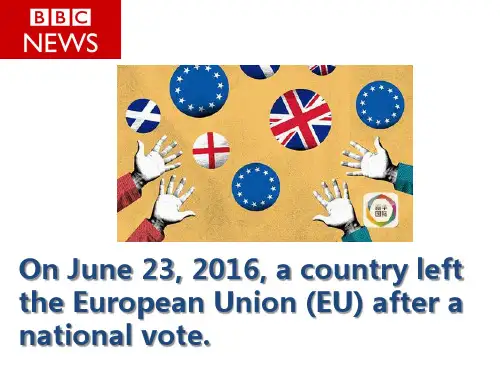
On June 23, 2016, a country left the European Union (EU) after a national vote.
Brexit ['bresit]
Britain exiting from the EU
(the UK left the EU )
What will come into your mind
when it comes to
the
?
Big Ben
Buckingham Palace
London Tower Bridge
British Broadcasting Company
double-decker bus
telephone box
pub
football games
All of them are famous people of England?___th_e_U_K_?__G_r_e.at Britain?
1. In the 13th century, Wales was joined to __E_n_g__la_n_d____.
Scotland Wales
Task 2 More puzzles in geography
4. So only Northern Ireland joined with England, Wales and Scotland to become the _U__n_it_e_d__ Northern Ireland _K_athreeyfadimffeoreunst?people of England?___th_e_U_K_?__G_r_e.at Britain?
高中英语 必修5 Unit 2 The United Kingdom Period 3 优质教案
高中英语必修5 Unit 2 The United Kingdom Period 3 优质教案Period 3Reading and WritingThe General Idea of This PeriodThis period lays emphasis on extensive reading and writing.At first the teacher will check the students’ homework, by asking some individual stud ents to read out their summaries of the reading passage “Puzzles in Geography”.Then the teacher will ask the students some detailed questions based on the reading passage.This step has two goals.One is to help the students to consolidate what they have learnt during the last period.The other goal is to lead the topic to“Sightseeing in London”.In the next step the students are asked to read the passage fast and write down the places that Zhang Pingyu visited.After reading the passage again, the students will write down the comments on these places.This will be done by filling in a chart.Since it is an extensive reading passage, there is no need to understand it in detail.But the students should pay special attention to how the writer described these places, because they will undertake aAs is well known, language can only be mastered by being used.So, the students will next undertake a rather challenging task, that is, to introduce one of the famous buildings or attractions in their hometown or home village to a tourist.They should practice in pairs by asking and answering questions.Then the students will organize the information from the dialogue into an introduction to the attractions in their local guide book.While doing this, the students should pay special attention to wording, especially verbs andTeaching Important PointsTeaching DifficultiesTrain the students’ speaking ability, especially the ability to deal with some problems in understanding each other.Teaching AidsThree Dimensional Teaching AimsKnowledge Aimssightseeing, available, tower, uniform, royal, splendid, statue, communism, thrill, pot, smart, site, delight,be worried about, make a list of, to one’s great surprise, on special occasions,hour, set the time, have a photo taken, stand on either side of the line, on show, be proud of, leave sp.for sp., fallWorried about the time available, Zhang Pingyu had make a list of the sites she wanted to see in LondIt seemed strange that the man who had developed communism should have lived and died in London.Ability AimsTrain the students’ speaking ability, especially the ability to deal with some problems in understanding eachTrain the students’ writing aEmotional AimsKnow thatTeaching ProcedureStep 2 RevisionT: In the last period, we learned some basic information about the United Kingdom, especially the historical infl uence on the geography and its historical attractions.First, who’d like to read your summary of the passage?S: The United Kingdom consists of four countries, which joined together little by little in history, and this can be seen from the Union Jack.But t he four countries don’t work together in every area.England is the largest of allT: I will ask you some general questions about the UK.While answering them, you can’t refer to yourtextbooks.S: It came into being in 1603, when King James of ScotlandS: No.They work together in some areas, but they have developed different educational and legal systems asS: The Romans built the oldest port in the 1st century AD, the Anglo-Saxons built the oldest building in theStep 3 ET: Do you still remember the pictures of some beautiful buildings in the United Kingdom shown at the beginning of this unit?Have you dreamed of going there one day and seeing all the sceneries with your ownT: So today we(Teacher gives the students several minutes to read the passage and finish the task.)S: She visited the Tower, St Paul’s Cathedral, Westminster Abbey, Buckingham Palace, Greenwich, HighgateT: You are right.Then what did Zhang Pingyu hear when she came out of the Westminster Abbey?S: In Greenwich there is a longitude line.It is an imaginary line dividing the eastern and western halves of theT: Is the original LibraryS: No.It is used to display wonderful treasures from different cultures, including some beautiful old ChineseT: In our hometown, there are also some interesting buildings or attractions.Work in pairs and choose one of them.One of you is the tourist and the other is the tour guide.The tourist may have a few problems understanding the guide.If so, you may use some expressions on Page 15 to help you.Now work in pairs and five minutes later, I will ask pairs of you to come to the front to demonstrate your dialogues.(Ss work in pairs, meanwhile, the teacher goes round the classroom and helps the students to deal with any questiA: I suggest you should go toA: The cave, which is also known as Dragon Cave, is faced to Taihu Lake.In the cave staglites stand like aB: Pardon?What did you mean by“staA: I mean, in the cave there are lime rocks.It is sa id that the cave is below the bottom of Taihu Lake.The cave is acclaimed by Taoist believers as No.9 Cave under Heaven.There are also some Taoist cultural relics in theB: How deep is thA:T: Next use the information you have collected about this buil ding or attraction and write about it in your local guide book.You want to encourage people to visit it so you should write in an exciting way.Think about the(The students write the introduction, and the teacher goes around the classroom and helps the students toExample:Why not visit our Linwu Cave?Lake.The Cave has a long history.In the cave staglites stand like a forest under smooth ceiling.There are also some Taoist cultural relics in it, and the cave was acclaimed by Taoist believers as No.9 Cave under Heaven.On the way here, you will also cross Taihu Bridge, the longest bridge over the inland lake in China.It is the lake that hasStep 5 HomeworkIf the students haven’t finished writing the introduction to one of the attraction s in their hometown, they can go on to do it after class.Even if the students have finished writing, they should try to beautify the words andThe Design of the Writing on the BlackboardUnit 2Period 3Ⅰ.Places visited and comments: Ⅱ2.I beg your pardon?3.Please, can you spe6.I didn’t understand...Advertisement-After class, each pair should try to finish their introduction to the chosen attraction and make it into an advertisement.They can go to the library or surf the Internet for some further information or pictures.Then each pair should put up their advertisement on the wall.Every student will act as a tourist and choose one place that he or she wants to visit most after reading the advertisements.And everyone is asked to put one flag under themakers will be supplied with a prize.Reference for TeachingThe City of LondonThe old St.Paul’s Cathedral, there fo r a thousand years before that, went in the fire.The Cathedral you see today was built by Sir Christopher Wren.There is also a monument to the fire, near Eastcheap, where there fire started, and you can climb up it and look down on the city.Or, if you feel like climbing, you can go up the 627 stairs to the top of St Paul’After the fire of London, some Londoners made new homes in new parts of London.Others wanted to come back, but found the new houses too expensive.The city started to lose its people and then, when the railways came, it was even easier to work in the city and live outside it.In the Second World War, many homes in the city werestreet names make you think of the people who used to live there, and bought their food in Fish Street and Breadoften they only sleep there, and go away for weekends.The shops are shut on Saturdays, and the restaurants and pubs shut at six o’clock in the evening.If you go into the city at eight o’clock at night, you feel you are in dead city, while a kilometer away; the streets of the West End arThe CockneyAlmost everyone who has heard of London has heard of the term“Cockney(伦敦佬)”.Strictly speaking, in order to call oneself a Cockney, one should have been born“within the sound of Bow bells”, that is to say, within the sound of the bells of the church of St Mary-le-London.But, in fact, all London’s citizens who were born and bred in the city may call themselves Cockneys if they like.However, the term is geThey Cockney accent is not a particularly pleasant or melodious(悦耳的)one, and the Cockney’s distortion (扭曲, 变形)of the English language is such that the foreigner often finds it impossible to understand the speaker until his ear has become acclimatized(适应)to the peculiar tones.The principal characteristics of the Cockney accent consist in a general slurring of consonants and a distortion of vowel sounds.The best known example of Cockney speech is mod ern English literature is that of Eliza Doolittle, the heroine of Bernard Shaw’sBut if Cockney speech is unpleasant, the Cockney himself is usually far from being so.The average Cockney is distinguished(区分, 辨别)by his quick wit, his ready sense of humor, his ability to“carry on”under unusual or difficult conditions and by his willingness to be of help if he can.The Cockney’s humor is often satirical(讽刺的)but it is never vicious(邪恶的); he is always ready to laugh at other people’s peculiarities(怪癖)but he is equally ready to laugh at his own.He often makes jokes under the most difficult conditions, a quality that was very apparent during World War Ⅱ.This rather lugubrious type of humor is well exemplified(举例证明)by theNowadays, as the tempo of life in big cities grows ever faster (although the Cockney opposes this processwhen he can), the opportunities for the Cockney to exercise his wit and humor diminish(减少, 变小).But if one keeps one’s ears open on buses, in railway stations, in street markets and similar places, it will soon become evident that the spirit of Cockney humor is still very much alive, although the old Cockney pronunciation is lessMost people who call themselves Cockneys usually do so with some pride.And, by and large, they areFamous Buildings in London Hyde ParkCovering an area of 350 acres (140 hectares) Hyde Park is one of the best known Royal parks.Originally owned by the monks of Westminster Abbey, the park was later seized by Henry Ⅷ.Since then the park was historically recognized for duels(决斗), hunts and political demonstrations.The Rolling Stones and Pavarotti have performed concerts here, amongst many others.The Serpentine is an artificial lake used for boating and bathing, and Speakers Corner situated at the north-Westminster AbbeyFounded in 1065 by Edward the Confessor, Westminster Abbey has been the site of every Royal Coronation since 1066 (except those of Edward Ⅴand Edward Ⅷ) and is the final resting place of many sovereigns, politicians, poets and artists.Burial in the abbey is one of the rarest and greatest honors in Britain.The nave is over a hundred feet high, the tallest of any church in the country.Behind the High Altar, in the Chapel of Edward the Confessor, the most sacred part of the abbey, rests the Coronation Chair.Coronations and royal weddings have been performed here for centuries.Buckingham PalaceBuckingham Palace has served as the Monarch’s permanent (永久的)London residence, since the accession (就职)of Queen Victoria in 1837. Built on the site of a notorious(声名狼藉的)brothel(妓院), its days began in 1702, as the Du ke of Buckingham’s city ter it was sold by the Duke’s son, to George Ⅲ in 1762.Whilst the Queen is in residence the palace is closed to the public.During the two months that Her Majesty is not at home, the doors to the Palace are open to the general public.Tickets must be purchased in advance for aKew GardensSpring is probably the best time to visit, but all year round you will find a stunning array of flowers, lawns, formal gardens and bo tanical greenhouses.More than 50 000 different species of plants are cultivated at Kew. Commissioned(代理)by George Ⅲ’s mother, Princess Augusta, in 1759, Kew is now one of the world’s most important botanical research centres.Kew also offers many historical buildings including Palm house, a metal andSt Paul’s CathedralSet amongst the tower blocks of London’s financial sector, St Paul’s Cathedral has a dominatingamazing 160 m spire(尖顶)which was one of the wonders of medieval Europe until it was destroyed by fire.The Cathedral is open for visitors on Monday to Saturday from 8: 30.The last admission to the Cathedral for sightseeing is at 16: 00.The Cathedral Shop in the Crypt and the Crypt Cafe are open from 9: 00 to 17: 00 on Monday to Saturday and from 10: 30 to 17: 00 on Sundays.Special services and events may close all or part of the Cathedral—sometimes at short notice.It is a great privilege to welcome those who come here from many parts of the world to share the worship of St Paul’s Cathedral.Inside the enormous dome lies the Whispering Gallery(回音廊).It is said that if you whisper close to the wall it can be heard over a hundred feet away at the other side of the dome, although the gallery is normally too busy to try this for yourself.Tower of LondonThe Tower of London started as a simple watch tower, built by William the Conqueror, to keep an eye on the city.The Tower of London has acted as a royal residence, treasury, mint(造币厂)and a prison. The Crown Jewels are found in the Jewel House, and for many catching a glimpse of these precious stones can be the highlight of their visit.Tower BridgeDespite being just over one hundred years old, Tower Bridge ranks as one of London’s most famous attractions. A steel frame clad in granite(花岗岩)and Portland Stone, represents an amazing engineering achievement, allowing the road crossing to be raised giving tall ships access to upper reaches of the Thames.It is an impressive sight although it happens infrequently.Inside the north tower an exhibition expl ains the bridge’sShakespeare in LondonSome time between 1585 and 1592, it is believed that Shakespeare left Stratford for London and joined a company of actors as a performer and a playwright.Legend long held that Shakespeare left Stratford because he was being pursued by the law for poaching deer on private property.By 1592 Shakespeare had received some recognition, though not entirely positive, as an actor and playwright.He was mentioned in a pamphlet (A Groats-worth of Wit) written by Robert Greene.Greene refers to Shakespeare as an“upstart crow”in the London the ater and charges that Shakespeare was an unschooled player and a writer who used material written by his better educated contemporaries.Also during this year, the theaters in London closed due to the plague.By 1594 Shakespeare had joined a theater troupe known as the Lord Chamberlain’s Men.Scholars attribute several of Shakespeare’s plays to this time period.Although no one can be certain of the dates of composition for any of the plays, a considerable amount of scholarship has gone into the endeavor of accurately determining an approximate time period during which Shakespeare wrote each play.Some believe that The Comedy of Errors, a farcical play centering on the mistaken id entities of two sets of twins, may have been Shakespeare’s first play.A few counter that The Two Gentlemen of Verona, which focuses on the confl ict between romantic love and friendship, may have been Shakespeare’s first play.Some scholars suggest that the se plays may have been written as early as 1588 or 1589, while many others date both plays several years later, suggesting that they were written between 1592 and 1594.Other plays written during this early period include one of the histo ry tetralogies: Henry Ⅵ, Part One(1589-1590); Henry Ⅵ, Part Two (1590-1591); Henry Ⅵ, Part Three(1590-1591); and Richard Ⅲ-Ⅵ, Part One was Shakespeare’s first play.This tetralogy treats the Wars of the Roses, the conflict between two factions of nobles.The last play of the sequence, Richard Ⅲ, ends with the establishment of the Tudor dynasty, to which belonged Queen Elizabeth, who ruled during much of Shakespeare’s life.It is also believed that Shakespeare wrote Titus Andronicus (1592-1594), The Taming of the Shrew(1593-1594), and Love’s Labor’s Lost (1593-1595) during this period of his life. Titus Andronicus, Shakespeare’s earliest tragedy, deals with the cycle of revenge which destroys the families involved in the play’s action.The Taming of the Shrew is a lively comedy featuring the willful Kate and her“tamer, ”Petruchio.Kate’s“taming”(her apparent and uncharacteristic submission to her husband) often troubles modern audiences. Love’s Labor’s Lost has been described as a satiriz ation of the courtly and somewhat artificial love of male nobles, and of the academic pursuits, which were often more fashionable than serious in Shakespeare’s time, of the nobility.In addition to these dramatic works, it is believed that Shakespeare wrote the poem Venus and Adonis and began composing his sonnets in 1592 or 1593.He eventually wrote 154 sonnets.Between 1593 and 1594, he probably wrote the poem The Rape of Lucrece.In 1596 the patron of the Lord Chamberlain’s Men (Henry Carey, Lord Hunsdon, the Queen’s Chamberlain) died, leaving Shakespeare’s company under the patronage of his son, George Carey, second Lord Hunsdon.The next year, Shakespeare bought a spacious Stratford home, known as New Place.Shakespeare continued to be notedas an actor; in 1598 he appeared in a performance of Ben Jonson’s Every Man in His Humor, and was listed as a principal actor in the London performance of the drama.Soon after, in 1599, Shakespeare and other members of the Lord Chamberlain’s Men leased land for the Glob e Theater, which opened later that year.Also in 1599, the poet John Weever published a poem (“Ad Guglielmum Shakespeare”) in which he praised Shakespeare as a poet and playwright.During this period of his life, from about 1595 through 1600, Shakespeare wrote a number of plays, including the second historical tetralogy (Richard Ⅱ [1595]; Henry Ⅳ, Part One[1596-97]; Henry Ⅳ, Part Two[1598]; and Henry ⅤRichard Ⅱ is usurped by Henry Bolingbrook and later assassinated.The new ki ng, Henry Ⅳ, worries over his role in Richard’s death and about the ability of his“madcap”son, Hal, to rule.A subplot focuses on Hal’s wild adventures with the comical knight, Sir John Falstaff.Hal becomes King Henry Ⅴafter his father’s death; he conquers France and restores peace.King John, a historical drama dealing with the reign of King John and the tragedy of the young Arthur, is estimated to have been written between 1594 and 1596. A Midsummer Night’s Dream and the famous tragedy Romeo and Juliet were probably written in 1595 or 1596. A Midsummer Night’s Dream, a fantastical comedy complete with fairies and magic, deals with such topics as love, imagination, and art.One of Shakespeare’s most popular a nd well-known plays, Romeo and Juliet is the story of ill-fated lovers who attempt to escape the disapproval of their feuding families.The comedies The Merchant of Venice and The Merry Wives of Windsor are believed to have been written between 1596 and 1597.Identified by critics as a problem play (one that raises moral dilemmas which it does not resolve), The Merchant of Venice is like The Two Gentlemen of Verona in that it deals with the relationship between romantic love and masculine friendship; the play also focuses on the theme of mercy. The Merry Wives of Windsor is a farce dealing with middle class life and values; it features the knight Falstaff, who was introduced in Henry Ⅳ, Part One as Hal’s drunken and waywardng this period of Shakespeare’s life include Much Ado about Nothing (1598-1599); Julius Caesar(1599); and As You Like It(1599-1600). Much Ado about Nothing is the witty comedy featuring Beatrice and Benedick.The play is sometimes considered flawed by critics due to what they and many audiences see as the insensitive treatment of the female characters, particularly the falsely accused Hero.The Roman tragedy Julius Caesar dramatizes the downfall of the title character and examines the nature of political rivalry, ambition, and power. As You Like It depicts the beautiful Forest of Arden as a haven from the trappings of courtly life.Shakespeare also wrote several comedies during these years, including All’s Well That Ends Well (1601--Measure for Measure have both been tagged as problem plays.The first comedy ends abruptly with Bertram’s sudden acceptance of his wife Helena, whom he had essentially abandoned earlier in the play.In Measure for Measure, deception plays a central role in the play’s action; this includes the deception perpetuated by amature comedies.Like other comedies, it features some disguise and role-playing, such as that of one the central figures, Viola, who disguises herself as the page Cesario.The play also concerns gender roles and class differences.In this period Shakespeare also produced Greek and Roman dramas, including Troilus and Cressida(1601-1602); Antony and Cleopatra (1605-1607); Coriolanus (1607-1608); and Timon of Athens(1607-1608). Troilus and Cressida, a Greek drama, emphasizes the differences between the ideal and the real by portraying legendary Greek figures as people with less-than-admirable qualities. Antony and Cleopatra is the story of the love and passion between the famous Roman general and the sensuous, legendary Egyptian queen. Coriolanus is a Roman political tragedy dealing with issues of character and pride.Feelings of bitterness and disillusionment permeate the Greek drama, Timon of Athens.Shakespeare also wrote Pericles, Prince of Tyre probably between 1607 and 1608. Pericles is an adventurous tale of a prince who suffers the loss of his wife and daughter, but is, in the end, reunited with his family. Pericles is thought by some scholars to have been acollaborative effort.After 1608 Shakespeare’s dramatic production lessened somewhat.The Globe Theater bu rned down, but was rebuilt a year later on the opposite bank of the Thames River.During these years, Shakespeare wrote romantic tragicomedies (that is, romances featuring elements of both tragedy and comedy).The romantic tragicomedies include Cymbeline(1609-1610); The Winter’s Tale(1610--1611), Cymbeline and The Winter’s Tale are both stories of loss and pain, but, like Pericles, they end with a happy reunion. The Tempest features the same elements of loss and reunion, but it also emphasizes the balance of wisdom and power that Prospero achieves at the play’s end.It has been noted that The Tempest was probably the last play Shakespeare wrote on his own, and that the character of Prospero, as one who manipulates events, stages masques, and directs the actions of other characters, represents Shakespeare the playwright and his farewell to the theater.During this later period, Shakespeare also wrote two plays that most scholars believe were composed in collaboration with the dramatist John Fletcher: Henry Ⅷ(1612-1613), a historical drama, and The Two Noble Kinsmen (1613), the story1612 or 1613, Cardenio, but it has been completely lost.。
人教新课标高中英语必修五 Unit 2 The United Kingdom Reading 课件(共31张PPT)
North: Leeds, York, Manchester, Sheffield Midlands: Coventry, Birmingham South: Reading, London, Brighton, Plymouth
Part 3--London
Why did capital London become the cultural center of England? There are a lot of historical treasures in London.
Tip 2
For convenience England … 3 zones. The south part is near … it is called …and most of the population… The middle zone is … and the one near Scotland is … Most of the … are in the Midlands and … Although the cities aren’t large, they have… You have to go to …but…towns if you want to visit some historical …
Careful reading: Part 1---the history of the UK
Great Britain
England
the UK
Part 1---the UK
the United Kingdom
Great Britain
England
Union Jack
Later, Great Britain + No to England in the 13th century AD.
高中英语 必修5 Unit 2 The United Kingdom Period 2 优质教案
高中英语必修5 Unit 2 The United Kingdom Period 2 优质教案Period 2ReadingThe General Idea of This PeriodThis period is the highlight of the whole unit.It lays emphasis on reading and understanding.First the teacher should check if the students have mastered thto fill in the blanks of some sentences by using some of the words and phrases that will appear in the reading passage.This part can help the students to learn words and expressions by heart in a certain language Then in Pre-reading part, the students are asked to distinguish the differences between the UK, Great Britaincountry.Provided with two simplpassage fast and find the answers directly in the passage.Next, the students will first listen to the tape with their textbooks closed.In order to make this step efficient, the teacher will provide them with five statements based on the passage.While listening, the students should judge whether these statements are true or false.If it is false, the students should correct it.Then the students will be given several minutes to read the passage silently.They should divide the passage into three parts and write the main ideas of each part.In order to help the students understand the passage better, the teacher can provide some cability of reading comprehension, which is a very important skill.At last, the students will do a speaking task in pairs.One acts as a visitor to England and the other acts as ageography the United Kingdom.This part not only helps the students to revise what the have learned in this part but also provides themTeaching Important PointsTrain the stTeaching DifficultiesTeaching A idsthe blackboThree Dimensional Teaching AimsKnowledge Aimsdebate, clarify, legal, relation, convenience, attraction, influence, collection, construct, puzzle, educational,break away from, leave out, divide...into..., be linked t o, to one’s surprise, as well as, be known as, lookThere is no need to debate any more about why different words are used to describe the four countries: England, Wales, Scotland and Northern IrelAbility AimsTrain the students’ ability to grasp keEmotional AimsKnow about the historical treasures left by the invaderTeaching ProcedureStep 1 GreetingsStep 2 RevisionT: At the beginning of this period, I will check if you have mastered the new words and phrases in this unit.Please finish the following sentences using some words and phrase in this unit.Please pay attention to the forms of the words and phrases.4.8.The explanation in the note__________10.It takes about two years to__________a large bridge.(Give the students several minutes to think about them.)Suggested answers:1.consists of2.puzzling3.legal4.left out5.collection7.break away from8.clarified9.convenienceStep 3 Pre-T: In the first period, you have learned a brief introduction to the UK.Do you know the difference between the United Kingdom, Great BritaT: The official name of the country is“The United Kingdom of Great Britain and Northern Ireland.”The United Kingdom consists of Great Britain and Northern Ireland.Great Britain is the name of the island northwest of France and east of Ireland that can be divided into three regions: England, Wales and Scotland.Therefore,England is part of Great Britain, which is part of the United Kingdom.The puzzling situation was caused by the history.In this unit we will learn about the historical influence on the geography of the country.Step 4 Fast ReadingT: Read the passage entitled“Puzzles in Geography”, and answer the following questions.1.Did the countries of the UK unite peacefully or byS: The countrieS: We should go to some older but smaller towns to appreciate some historical attractions.T: Now I’ll play the tape for you to listen.While listening, please find out whether the following statementsTrue or False Questions:3.The countries in the U5.The Normans influenced the vocabulary and place-names of the North of London.Suggested answers:1.False Because Great2.False5.False Because the Normans left castles and words for food, whilvocabulary and p lace-Step 6 Detailed ReadingT: Now I will give you several minutes to read the passage again.While reading, please try to divide the passage iPart 2: Paragraph 2-Part 3: Paragraph 6 HistoT: Look at the first sentence in Paragraph 1, “There is no need to debate any more about why different words are used to describe the four countries: England, Wales, Scotland and Northern Ireland.”Can you say it in ano therIt is __________ to __________ any more about why people __________ different words to describe theS: It is unnecessary to argue any more about why people use different words to describe the four countries.T: Read the second part.S: The Union Jack.Blue field with the red cross of St George (England) edged in white superimposed on the diagonal red cross of St Patrick (Ireland), which is superimposed on the diagonal white cross of St Andrew (Scotland).It is properly known as the Union Flag, but commonly called the Union Jack.The design and colors (especially the Blue Ensign) have been the basis for a number of other flags including other Commonwealth countries and their constituent states or provinces,S: Wales.Wales was linked to England in the 13th century AD, so when people refer to England, it is included as well.T: Have you found out how the four countries joined together?Use the information from the passage to fill in the blanks.__________→__________→__________→__________S: England → Wales joined England (13th century A.D.) → England, Wales joined Scotland (1603) → England, Wales, Scotland got Northern Ireland connectedT: Often will use England to stand for the UK.One of the reasons is that England is the largest of the four countries.So England is divided into three zones.Do you know the three zones?S: The South, the Midlands andT: Yes.Look at the map in part 2 on Page 11.Draw lines across to show the zones of the South, Midlands andS: BiS: What does “those” mean in the sentence “For those you have to go to older but smaller towns first built bythe historical attractions of other places.”So now do you know what “those” refers to?T: You are very clever.Now try to paraphrase the sentence by finishing the following sentence.__________ you want to __________ some __________ __________, you have to go to older but smaller towns __S: If you want to see some historical attractions, you have to go to older but smaller towns which were first built by the Romans.T: The last part tells us about the invaders’ influence on England and London.Read it and try to fill in theStep 7 Pair WorkThe students work in pairs to make a dialogue.One of them is a native Englishman, while the other is a visitor to England.The visitor is asking the native Englishman about the geography of the United Kingdom.(T(Then the teacher asks one or two pairs to come to the front to demonstrate their dialogues.)One example:B: Yes.I’m veryA: Actually, the whole country is called the UK, which stands for the United Kingdom of Great Britain andB: Then why do peopleB: I see.I have another st time when I watched the World Cup, I noticed there is a football team of England.But there are also teamsA: The four countries do work together in some areas, but they are still very different.For example, Northern Ireland, England and Scotland have developed different educational and legal systems as well as different footballStep 8 Homework1.Try to write a short summary of the passage in aboThe Design of the Writing on the BlackboardUnit 2The United KingdomPeriod 2ReadingⅠ Words & phrases:1.consists of2.puzzling3.legal4.left out6.influen10.constructⅡ Fast-2.Where should we go if we want to appreciate some historical attractions of the UK?Ⅲ Invaders’ influence on England and LondonLondonResearch and ActivitiesRead another passage about the United pare it with the passage “Puzzles in Geography”, paying special attention to the writinBRITAIN AND IRELANDThe island of Britain lies to the east of Ireland.The two are separated by the Irish Sea.The letters“UK”stand for“The United Kingdom of Great Britain and Northern Ireland.”The UK is made up of four countries.In the north is Scotland, with its capital Edinburgh.Scotland has many lakes and mountains, andWales lies to the west of England.Its capital is Cardiff.Everyone there can speak English, but the first language in North Wales is Welsh.There are Welsh newspapers.Programmes on the radio and TV are in Welsh.The countryside here is very beautiful too, with lots of mountains and rivers.There used to be a lot of coal mines in the south, but many of them have been closed, or are about to be closed.England, the larges t country in Britain, is in the southeast.Its capital is London, which is also the capital of the UK.London lies on the River Thames and has a population of seven million. Much of England is rather flat, although there are hills in the northeast and in the centre of the country.Ireland is divided into two countries.In the north, Northern Ireland, with its capital Belfast, is part of the United Kingdom.The Southern part of the island is a separate country, called the Republic of Ireland with DublinGenerally, the weather in Britain is neither too cold in winter nor too hot in summer.It is colder in the north, warmer in the south, drier in the east and wetter in the west.Ireland is especially wet.In all parts of Britain it rains every month of the year; there is no“dry season”.Snow falls in Scotland every winter and sometimes in England*Question for discussion:Both passages are about the United Kingdom, but the two writers focused on different things.What are theReference for TeachingAn Introduction to the United KingdomThe United Kingdom of Great Britain and Northern Ireland is a country in western EuropCommonwealth Realm, and a member of the European Union and ually known simply as the United Kingdom or the UK, it is also often inaccurately named Great Britain, Britain or England (the most populous ofthe home nations).The UK has four constituent parts, three of which—the ancient nations of England, Wales and Scotland—are located on the island of Great Britanin.The fourth part is Northern Ireland, which is located on theThe border between Northern Ireland and the Rep ublic of Ireland forms the United Kingdom’s principal international land border, although there is also a nominal frontier with France in the middle of the Channelveral CrownThe UK was formed by a series of Acts of Union which united the Kingdom of England (which included Wales as a principality) with those of, first, Kingdom of Scotland and then Kingdom of Ireland under a single government in London.The greater part of Ireland left the United Kingdom (then called the United Kingdom of Great Britain and Ireland) in 1922 to form an independent state (in which, until 1949, the King of the United Kingdom was also King of Ireland).This state later became the Republic of Ireland.Six counties in the north-eastern portion of the island, meanwhile, remained a part of the United Kingdom, forming Northern Ireland to this day.The UK is situated off the north-western coast of continental Europe, and has a land border with the Republic of Ireland, but is otherwise surrounded by the North Sea, the English Channel, the Celtic Sea, the Irish Sea, and the Atlantic Ocean.Great Britain, or just Britain, is the geographical name of the largest of the British Isles (often also including its smaller neighboring islands, though never Ireland).Politically, the term Great Britain refers collectively to the nations of England, Wales and Scotland (i.e., the United Kingdom except for Northern Ireland).This political usage of “Great Britain” dates from the personal union of the Crowns of Scotla nd and England (including Wales) in 1603, with the term being used in the sense “all of Britain”.In the early years of the “United Kingdom of Great Britain”, formed by the Act of Union of 1707, it was customary to refer officially to Scotland and to England and Wales as, respectively, “North Britain” and“South Britain”, though the usage never really caught on.It should be noted that the practice by some, the informal media in particular, of using “(Great) Britain” as shorthand for the United Kingdom is an inaccuracy, which can cause offence.The British Isles is a term frequently used to refer to the archipelago which includes the mainland of Great Britain, the mainland of Ireland, and the smaller islands associated with these two, such as the Channel Islands, the Hebrides, the Isle of Man, the Isle of Wight, Orkney, the Shetland Islands, etc.The term is, however, often avoided, especially in Ireland, by those who are cons cious that it is sometimes misunderstood internationally to mean “the islands belonging to Britain (i.e. the United Kingdom)”, a description out of date in the Irish case since 1922.An alternative, the Islands of the North Atlantic(IONA) has been proposed, but is little used outsideKing James ⅠBIOGRAPHYAN INFANT KING.James Charles Stuart was born on June 19, 1566 at Edin burgh Castle in Scotland.His father, Lord Darnley, was murdered in early 1567 before young James was 1 year old.His mother, Mary Queen of Scots, subsequently ascended(上升)to the Scottish throne.Her reign(统治), however was short lived and she was forced to abdicate (退位)in favor of her son on July 24, 1567.Little James was crowned King James Ⅵ of Scotland five days laterat the tender age of 13 months.Reformation leader John Knox preached the sermon at his coronation(加冕礼)James’ mother, Mary, was imprisoned in England by her cousin Queen Elizabeth and 19 years later, in February of 1587, was executed for her part in the conspiracy(阴谋)(暗杀)QueenAnd so, like many monarchs of the time, King James was reared by neither father nor mother but rather by tutors.Of his four tutors, perhaps one of the most influential was George Buchanan, a staunch(坚定的)Calvinist.It was under Mr.Buchanan’s strict teaching methods that King James bec ame one of the most learned and intellectually curious men to ever sit on any throne. Mr. Buchanan was 64 years old when he began tutoring the young king.KING JAMES BEGINS TO REIGN IN SCOTLAND.King James began to rule his native Scotland when he was 19 years old.A few years later, he took Anne of Denmark to be his queen.King James loved his wife and wrote beautiful poetry for her.Together they had nine children.Once, when the King and Queen were out hunting, Queen Anne accidentally killed the King’s fav orite hunting dog, Jewell.The Queen felt badly about this and the King bought her a gift to ease her mind of thisKing James believed in the Divine Right of Kings and the monarch’s duty to reign according to God’s law and the public good.In order to pass on his kingly instruction to his eldest son, Prince Henry, King James wrote Basilicon Doron which means, “the Kingly Gift”.Basilicon Doron was not meant for general publication, but for the instruction of the young prince in the likely event that his father would not survive to instruct him—King James was sickly and survived a number of assassination attempts.The King bound his printer Robert Waldegrave to secrecy and ordered an edition of only seven copies.Somehow, however, intelligence of the book and its contents got abroad.Subsequently, there was so much demand for Basilicon Doron that forged(稳步前进), corrupted copies werebestseller.ItBasilicon Doron is a short treatise(论文), only 153 pages long.It consists of three short volumes, the first of which is “A King’s Christian Duetie towards God.”James D’israeli said, “James had formed the most elevatedIn Basilicon Doron, King James’ understanding o f Christian discipleship, style and prose are at their best.He skillfully intertwines sacred scripture with godly and Christian advice.The King offers his son this importantDiligently read his word, & earnestly...pray for the right understanding thereof.Search the scriptures saithChrist for they will bear testimony of me.The whole Scriptures saith Paul are profitable to teach, to improve, to“The whole Scripture contayneth but two things: a command and a prohibition.Obey in both...The worship ofKing James’ great aspiration to be the first King of both Scotland and England was realized in 1603 upon the death of Queen Elizabeth.When he ascended to the English throne that year he had already been king of Scotland for 36 years.He was now known as King James VI of Scotland & I of England. The king played a masterly political game and kept his kingdom out of war.For the first time a Scottish monarch wielded effective authority over the more far-flung areas of the realm(领域).He supported literature both through his own writing and his patronage(赞助).There was peace during his reign—both with his subjects and foreign powers.As a Scotsman ruling over the English, the King endured much racism and slander—especially from the once powerful English Lords and Ladies who he replaced with his Scottish countrymen.Unfortunately, ma ny of today’s historians look to the writings of hostile sources such as Sir Anthony Weldon and Francis Osborne as accurate descriptions of this great king.One of the king’s detractors(诽谤者), Sir Anthony Weldon, was knighted by King James but was subsequen tly dismissed after King James found racist writings by Weldon about the King’s native Scotland.Many historians today quote Weldon as if he were a reliable his torical source. Examples of Weldon’s racism are found in his treatise entitled, “A Perfect Description of the People and Country of Scotland” where he says that the Scots are a “stinking people” who hold “fornication...but a pastime”.He also said,“...their flesh naturally abhors cleanness.Their breath commonly stinks of pottage...to be chained in m arriage with one of them, were to be tied to a dead carcass, and cast into a stinking ditch...I do wonder that...King James should be born in so stinking a town as Edinburgh in lousy Scotland.”Despite this obvious bias, historians continue to consult thethat King James had inordinate affections towards other men—but he did not do this until 25 years after King James was dead and could not defend himself.Today’s sodomite/ homosexual community is touting the King as one of their own, which he was not.These misinformed sources, virtually without exception, fail to mention that King James and his Queen had nine children together.You can read about the rumors in this article or check out an excellently researched book on the subject by Stephen Coston, Sr.entitled, King James: Unjustly Accused?“They quarrel me (not for any evil or vice in me) but because I was a king, which they thought the highest evil, and because they were ashamed to profess this quarrel they were busy to look narrowly in all my actions, and—James I, Basilicon Doron The religion was also an enemy of king James.Papists (as King James called them) attempted to assassinate him a number of times.Most notably, in 1605 Roman Catholic Guy Fawkes attempted to blow up Parliament when the king was to have been present.The conspiracy was discovered and all co-conspirators were executed.ThisJames strongly delineated the errors of Roman superstition and spurned them yet he treated Romanist subjects“He is a Protestant...the King tries to extend his Protestant religion to the whole island. The King is a bitt er enemy of our religion.He frequently speaks of it in terms of contempt.He is all the harsher because of this last11 conspiracy against his life...He understood that the Jesuits had a hand in it.”Despite his detractors, King James the Ⅵ of Scotland andⅠAs a lover of the theatre, King James became patron to the troop of one of his most famous subjects —William Shakespeare the playwright.Shakespeare’s troop came to be known as the King’s Men.Shakespeare and the King held a special relationship as they both loved literature. Shakespeare even wrote his famous play, “Macbeth”specifically for King James.Another little recognized fact is that King James the Ⅵ and Ⅰ is the founding monarch of the United States.Under his reign, we have the first successful colonies planted on the American mainland —Virginia, Massachusetts, and Nova Scotia (Latin for New Scotland) in SE Canada.The King himself ordered, wrote and authorized the Evangelistic Grant Chartercalled Virginia...in propagating of Christian religion to such people as yet live in darkness...to bring a settled and。
必修五 Unit 2 The United Kingdom-Reading[课件]
population: About 6o million
Sports: Manchester United, Beckham, Owen…
climate: mild Language: English, Welsh, Scottish Ethnic groups:English 81.5%, Scottish 9.6%, Irish 2.4%, Welsh 1.9%, Ulster 1.8%, West Indian, Indian, Pakistanis, and other 2.8%
現在的米字旗
Task 3
1 Finish Comprehending 1 and 2
Answer the questions 1. The Union Jack flag unites the three flags of three countries in the United Kingdom. Which country is left out? Why? _______________________________________ ________________________________ The country left out is Wales. It is usually assumed to be part of England.
• North : Leeds, York, Sheffield, Manchester • Midlands: Coventry, Birmingham • South: Reading, London, Brighton, Plymouth
Does England, Britain or the Great Britain mean the same as the UK? If not, tell the difference between them?