
仁爱版七年级Unit5 topic1 SectionA教案
Unit 5 Our School Life
Topic 1 How do you usually come to school?
Section A
Section A needs 1 period. Section A需用1课时。
The main activities are 1a and 2a. 本课重点活动是1a和2a。
一、Teaching aims
1.Knowledge aims
能根据已学语音、音标及发音规则,正确朗读下列词汇并在实际的对话操练中加以应用:
gate, by, subway, underground, always, come on, on foot等;
能正确使用how来询问日常的交通方式,并能正确使用表示交通方式的介词by;
能就询问和表达交通方式的话题进行交流与对话操练,如:
(1)—How do you usually come to school?
—I usually/often… by…
(2)Do you often come to school by bike?
(3)I usually come to school by subway/by bus/on foot.
2.Skill aims
能听懂有关表达交通方式的简单对话或叙述;
能根据图文就交通方式进行交流;
能理解并执行有关学习活动简单的书面指令;
能正确写出黑体单词和词组;
能写出表达交通方式的简单句子。
3.Emotional aims
通过小组间良性的竞争与合作,培养友好互助的精神;
通过了解他人的校园生活培养关心他人的意识;
采用游戏、角色扮演等灵活多样的学习方式,激发学习英语的兴趣。
二、The key points and difficult points
2.在情景对话中,能学会用how来询问交通方式,学会用“by+交通工具”表达交通方式,并在情景对话中进行操练。
三、Learning strategies
1.能够清楚、大声地进行朗读,培养语感和自信心;
2.培养借助图片等非文字信息帮助理解的习惯;
3.根据图片预测对话内容。
四、Teaching aids
多媒体、录音机
五.Teaching Plan教学方案
Stage 1 Review 第一步复习
复习日常用语并呈现1a部分内容。
1. (师生互相问好, 复习学过的问候语。
)
T: Good morning, everyone!
Ss: Good morning, Miss Rui!
T: Nice to see you again. Happy New Year!
(教师帮助学生回答。
)
Ss: Happy New Year!
T: We can also say, “The same to you!”
(自然引入“The same to you!”并练习强化。
)
(板书)
Happy New Year! 新年好!
The same to you! 你也一样。
(新年好!)
Stage 2 Pre-listening
1.老师借助动作引入I usually come to school by bike?
2.(用事先准备好的PPT图片给学生展示bike,由此导入本课重点:交通方式。
)
3. (用同样的方式教学其他交通工具,并板书相关词组。
)
by bike, by car, on foot, by subway, by bus, by ship, by boat, by plane, by train
(1)(熟读板书的词组。
)
(2)老师引出
I usually come to school by bike.
How do you usually come to school?
(3)(用PPT图片和词组,让学生看图片并模仿例句造句:)
Example:
T: How do you usually come to school?
S1: I come to school by bus.
S2: I go to school on foot.
4.完成2a。
(1). (让学生将2a中与图片相对应的短语代码填入圆圈中。
)
T: Just now we talked about the means of transportation. Now let’s look at the pictures in 2a.
Then match the pictures with the corresponding phrases. Do you understand?
Ss: Yes, we do.
T: Good. Let’s begin!
(2). (核对答案。
)
5.教师借助PPT图片引入How does …go to school?
He/She goes to school by bus/subway…
6. (用PPT图片和词组,让学生看图片并模仿例句造句:)
Example:
How does Maria go to school?
She goes to school by bus.
3. (让学生听录音, 完成2b。
掌握生词Ms.和grandmother。
)
T: Next, we will have a listening practice. Let’s find out how people come to school or come to work. Do you understand?
Ss: Yes, we do.
(播放录音,并核对答案。
)
Stage 3 While-listening
学习1a,完成1b和1c。
1. (播放1a的录音,跟读并模仿语音和语调。
)
T: Listen to the tape and follow it. Pay attention to your pronunciation and intonation.
2. (呈现1a并学习对交通方式的提问。
)
(1)(让学生听1a的录音, 回答下列问题。
)
. Are you ready?
Ss: Yes.
T: OK, let’s begin.
(播放录音。
)
(2)(核对答案, 提取重点句并型完成1b。
)
T: Who can answer the first question?
S1: I can. They meet at the school gate.
T: Well done. What about the answer to Question 2?
S2: Helen usually comes to school by subway.
T: Good. Next question?
S3: Jane always comes to school by bus.
T: Good job.
(在问题2后板书画线部分并做相应的讲解操练。
)
Stage 4 Post-listening
3. (完成1c, 让学生三人一组, 练习1a的对话。
要求他们仿照1a与同伴编类似的对话。
) T: Now, boys and girls, please practice 1a in groups of three and make similar dialogs with your partners. Then I will ask some groups to act them out.
4. (选几组表演他们的成果。
)
T: Which group can act your dialog out?
G1: We can. (表演对话。
)
T: Wonderful! Anyone else?
G2: We can. (表演对话。
)
…
(对学生的表演进行点评,并适当鼓励,必要时纠正学生对话中存在的错误。
)
Stage 5 Assigning homework
(1)学生分组,调查同学上学的交通方式,并写书面报告。
(2)(预习Section B, 注意其中的频度副词。
六.Blackboard design。
仁爱版七年级英语教案

仁爱版七年级英语教案【篇一:仁爱七年级英语上册教案】仁爱七年级上册英语教案unit 1 making new friendstopic 1 welcome to china!section athe main activities are 1a, 2a and 3a. 本课重点活动是1a, 2a和3a。
Ⅰ.teaching aims and demands 教学目标1.(1)learn the letters aa-gg.(2)learn some new words:good, morning, welcome, to, china, thank, you, hello, i, am, are, yes, no, not, nice, meet, too2. learn about greetings and introductions:(1)—good morning.—good morning.(2)—welcome to china!—thank you./thanks.(3)—hello/hi!—hello/hi!(4)—i’m … are you …?—yes, i am./no, i’m not. i’m …(5)—nice to meet you.—nice to meet you, too.Ⅱ. teaching aids 教具投影仪/教学挂图/录音机/字母卡片/小黑板Ⅲ. five-finger teaching plan 五指教学方案step 1 introduction 第一步介绍(时间:6分钟)本节课是开篇,教师应向全体学生说明以下两点:1.学习英语的重要性。
2.学习英语的正确方法。
目的:激发学生学习英语的兴趣,使学生树立自信心,养成良好的学习习惯和形成有效的学习策略。
step 2 presentation 第二步呈现(时间:9分钟)呈现简单的打招呼用语,并进行听说练习,学以致用。
仁爱版九年级英语下册Unit5Topic1SectionA教学设计

5.鼓励学生发表自己的观点,培养学生的思辨能力和创新精神。
(三)情感态度与价值观
在本章节的学习中,学生将形成以下情感态度与价值观:
1.关注全球环境问题,认识到环境保护的重要性,树立环保意识。
2.增强社会责任感,积极参与环保行动,为保护地球家园贡献自己的力量。
2.学生观看图片后,教师提出问题:“What do you think of these environmental problems? Are they serious?”,引导学生谈论对环境问题的认识。
3.学生分享自己的观点后,教师总结:“Environmental problems are becoming increasingly serious. In this unit, we will learn about some global environmental issues and discuss possible solutions.”
1.学生在语言表达方面,对一般现在时和一般将来时的运用尚需巩固,对词汇的拓展和应用能力有待提高。
2.学生在阅读理解方面,对文章深层含义的把握和作者观点的判断能力有待加强。
3.学生在情感态度上,对环保问题的关注程度不同,需要引导他们树立正确的环保观念,增强社会责任感。
4.学生在合作交流方面,团队合作精神和倾听他人意见的能力有待培养。
2.学生针对所选择的环境问题,运用所学词汇、句型和时态,讨论可能的解决方案。
3.各小组汇报讨论成果,教师给予点评和指导,引导学生关注环境问题并思考解决途径。
(四)课堂练习(500字)
1.教师设计不同类型的练习题,如填空、选择、匹配等,让学生巩固所学知识。
U 5 Topic 1 Section A(同步练习)-试题版七年级英语下册同步精品课堂(仁爱版)
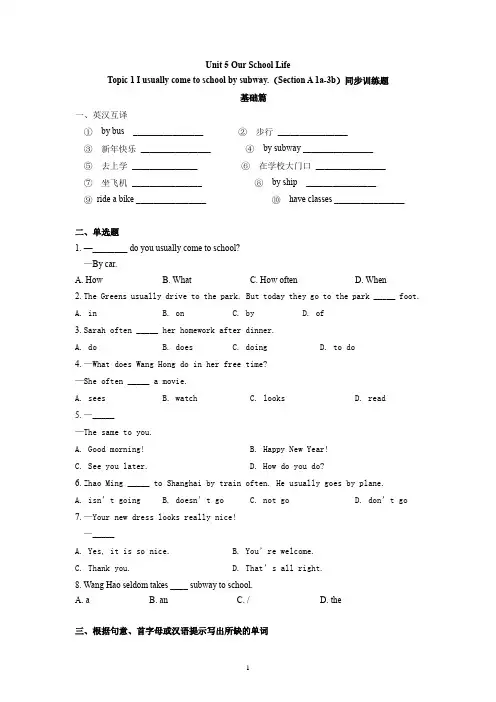
Unit 5 Our School LifeTopic 1 I usually come to school by subway.(Section A 1a-3b)同步训练题基础篇一、英汉互译①by bus ________________ ②步行________________③新年快乐________________ ④by subway ________________⑤去上学_______________ ⑥在学校大门口________________⑦坐飞机________________ ⑧by ship ________________⑨ride a bike ________________ ⑩have classes ________________二、单选题1. —________ do you usually come to school?—By car.A. HowB. WhatC. How oftenD. When2. The Greens usually drive to the park. But today they go to the park _____ foot.A. inB. onC. byD. of3. Sarah often _____ her homework after dinner.A. doB. doesC. doingD. to do4. —What does Wang Hong do in her free time?—She often _____ a movie.A. seesB. watchC. looksD. read5. —_____—The same to you.A. Good morning!B. Happy New Year!C. See you later.D. How do you do?6. Zhao Ming _____ to Shanghai by train often. He usually goes by plane.A. isn’t goingB. doesn’t goC. not goD. don’t go7. —Your new dress looks really nice!—_____A. Yes, it is so nice.B. You’re welcome.C. Thank you.D. That’s all right.8. Wang Hao seldom takes ____ subway to school.A. aB. anC. /D. the三、根据句意、首字母或汉语提示写出所缺的单词1. --Have a good weekend! --The s______ to you!2.They ______ (总是)go to Beijing by train.3. —Does she often ______ (listen) to music?—No, she doesn’t.4. The store is open only on w______.5. I often help my parents do the h__________ on weekends.6. Mike hardly ever talks with his father, but he o__________ talks with his mother.7. He gets up early every day. He h__________ ever goes to school late.8. Jack is a good student. He is n __________late for school.9. My grandma always gets up e______ every day.10. Jenny ______(很少) goes to school by bike. She always takes a bus to school.11. It takes me 40 minutes from home to school by u______.四、用单词的适当形式填空1. You new watch ______ (look) very nice!2. Kangkang often _____ (ride) a bike to the park.3. How about ______ (play) basketball with Jim this evening?4. He often _________ (watch) his favorite program.5.How often do you go to the (movie)?五、用方框中所给单词的恰当形式填空。
七年级英语(仁爱版)下册 Unit-5-Topic-1 知识点总结语言点归纳
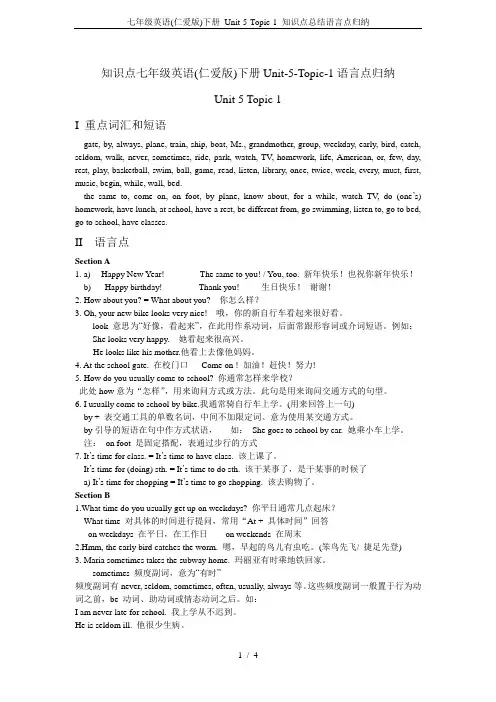
知识点七年级英语(仁爱版)下册Unit-5-Topic-1语言点归纳Unit 5 Topic 1I 重点词汇和短语gate, by, always, plane, train, ship, boat, Ms., grandmother, group, weekday, early, bird, catch, seldom, walk, never, sometimes, ride, park, watch, TV, homework, life, American, or, few, day, rest, play, basketball, swim, ball, game, read, listen, library, once, twice, week, every, must, first, music, begin, while, wall, bed.the same to, come on, on foot, by plane, know about, for a while, watch TV, do (one’s) homework, have lunch, at school, have a rest, be different from, go swimming, listen to, go to bed, go to school, have classes.II 语言点Section A1. a) ---Happy New Year! ---- The same to you! / You, too. 新年快乐!也祝你新年快乐!b) ----Happy birthday! -----Thank you! 生日快乐!谢谢!2. How about you? = What about you? 你怎么样?3. Oh, your new bike looks very nice! 哦,你的新自行车看起来很好看。
仁爱版七年级下Unit5-Topic1语法专项课件频度副词PPT课件一等奖新名师优质课获奖比赛公开课
考 察 频 度 副 词 。 hardly 几 乎 不 , sometimes 有 时 , only仅仅,usually经常。由too expensive(太贵)可 知,“几乎不看电影”,所以答案选A。
考点大观 易错辨析 通关训练
【典例3】— _____ is it from home to the shopping mall?
→How often do you write to your brother?
考点大观 易错辨析 通关训练
易错点1 how often与how long/far/soon旳使用方法
区别 How often “多久一次”,用来对表达频率旳副词或短语提问。
(多用于一般目前时)
How long
问询时间时,表达“多长时间”,回答用“for+时间段”或
“有时;不时”,意思与at times相近,多用于一般目前 时。
some times “几次;几倍”,其中time为“次;倍”,是可数名词。
some time “某些时间”,其中time意为“时间”,是不可数名词。 sometime “某个时候”,常用于一般将来时。
易错点3
考点大观 易错辨析 通关训练
这冰很硬,能够在上面滑。
考点大观 易错辨析 通关训练
【典例1】— Zhang lili, “The most beautiful teacher”, is good to
her students.
— Yes, and she is ________ popular with her
students.
never旳频度是0,意为“历来不;永不”。
频度副词经典例句
考点大观 易错辨析 通关训练
仁爱版英语七年级下册 Unit5 Topic1 Section A 教案设计
4.Are ableto understand and follow simple written instructions regarding learning activities;
3.情感目标
Cultivate a spirit of friendship and mutual assistance;
e.g.
A: Happy New Year!
B: The same to you. Nice to see you again.
A: Nice to see you, too.
B: Do you go to school by bike?
A: Yes. What about you? How do you often go to school?
②frequencyadverb:always,noun:gate, preposition:by
③new phrases:come on, on foot
2.Ss can be used the sentences flexibly in real situations:
①—How do you usually come to school?
5.Try to read the words in 3b. Circle the words with the sound /i:/ or /e/ individually. Then listen to the tape and check the answersin pairs.
Ⅴ.Make a report and conversation:(10 minutes)
+Unit+5+Topic+1+Section+D 仁爱版七年级英语下册
Grammar 语法
Adverbs of Frequency 频度副词 我从不乘地铁来学校。 I _n_e_v_e_r_ come to school by subway. 我很少走路去上学。 I _s_e_ld_o_m_ walk to school. 玛瑞亚有时乘地铁回家。Maria _s_o_m__e_ti_m__e_s takes the subway home. 李想经常骑自行车去上学。 Li Xiang _o_f_t_e_n_ rides a bike to school. 我们通常步行去公园。 We _u_s_u_a_l_ly_go to the park on foot. 他们总是乘公交车去动物园。They _a_l_w_a_y_s_ go to the zoo by bus.
…
2. Compare the school life of American students with yours and report it to the class.
Chinese Students
American Students
3. Write a passage. You may use the expressions in Functions if necessary.
Interviewer: Where do they usually have lunch?
Michael: They usually have lunch at school and
then begin class at about one o’clock in the
afternoon.
be over 结束
Project
1. Survey your classmates about their school life.
仁爱英语七年级下五单元topic1 知识点
Unit5 Our School LifeTopic1 I usually come to school by subway Section A一.背一背1.Happy new year! 新年快乐!2.at the school gate 在学校门口3.The same to you. 你也是。
4.Nice to see you again. 再次见面很高兴。
5.by bike 骑自行车6.by subway=by underground坐地铁7.You’re right. 你说得对。
8.How about you? 你呢?e on! 快点;加油10.on foot 步行二.金点剖析1. --Happy new year! 新年快乐!-- The same to you. 你也一样.【记一记】:【考一考】--Merry Chrismas!-- _____________. (回答)2. Oh, your new bike looks very nice! 你的新车看起来很漂亮!【记一记】:拓展:look ____ 看look ____ 看上去像look ____ 照看【考一考】1. Ann’s mother is not at home. So Ann has to _________ her sister.2.Jim _______ his father. They both(都) have small eyes.3. Please _______ the photo! It’s wonderful.4. Your dress _____ very nice. May I have a look?A. watchB.seesC. looksD. shows3.--How do you usually come to school? 你平时怎么去上学?-- I usually come to school by subway.【记一记】:注意:① by,on, in 引导的短语在句中只能作状语,与go,come,get等连用。
Unit 5 Topic 1 Section A(29页)仁爱版七年级下册英语课件
02 新 课 讲 授
What are these?
bike
car
What are these?
subway/underground
bus
What are these?
boat
ship
骑自行车 by bike
(1) look“看起来,好像”,是系动词,后加形容词。 e.g. She looks very beautiful. 她看起来很漂亮。 (2) look 用作行为动词,表示“看”,当后面要跟宾语时,必须要跟介词at。 (3) look 还可以做名词,表示“外貌,长相”。 (4) 与look有关的短语: look at… =have a look at…看一看 look like 看起来像 look the same 看起来一样
I usually come to school by subway.
04 当 堂 检 测
一、根据句意及汉语提示,完成句子 1. Let’s meet at the school gate (大门口). 2. Look at that nice boat (小船). That’s my uncle’s. 3. Mr. Ge often goes to Canada by plane (飞机). 4. Do you usually come to Jinan by train (火车)? 5. Jim wants to go to Shanghai from Chongqing by ship (轮船).
Enjoy the பைடு நூலகம்ideo
Listen again and answer the questions.
七年级英语下册Unit5OurschoollifeTopic1IusuallycometoschoolbysubwaySectionB教案(新版)仁爱版
Unit 5 Our School LifeTopic 1 I usually come to school by subway.Section B一、教学目标1. 能根据已学语音、音标及发音规则,正确朗读下列词汇并运用于情景对话中:weekday, early, bird, catch, worm, sometimes, seldom, walk, never, ride, park, watch, TV, television, watch TV, soccer, football, movie, film2. 在Section A的基础上,复习交通方式,能正确运用always, usually, sometimes, seldom, often, never等频度副词,同时能用介词by加交通工具和动词短语两种不同方法来表示交通方式。
3. 在情景对话中,能够表达“日常的交通方式、某项活动的频度”等语言功能,如:1) I usually come to school on foot, but sometimes by bike.2) I seldom walk to school. I often come by subway.3) I never come to school by subway.4. 使学生明白早睡早起的重要性。
二、教学重点及难点在对话操练、两两问答、小组调查等活动中,学习用频度副词来进行日常活动频率的有关表达,同时还学习和操练用两种不同的表达(介词by加交通工具和动词短语)对交通方式进行问答及切换。
三、教学准备教师:教学课件;多媒体设备学生:课前预习四、相关资源五、教学过程Task 1Step 1 Warming-upFree talk1. Work in pairs based on the following structures.T: How do you usually come to school?S1: By bike.T: How do you usually go to the zoo?S2: By bus.2. Choose a few pairs to act them out.【设计意图】复习上节课所学知识点,培养学生口语表达能力。