
高中英语外北师大版(2019)必修第三册-Unit 9 Learning Writing Works
Activity 4
1. What are the two sensitive stages mentioned in the video?
1. Experience Expectant Learning refers to the fact that the normal environment provides babies with the necessary input to develop the brain
学 升学宴 的主持 。 首 先 让 我 们 用最最 最热烈 的掌声 ,欢迎今 天的主 角、xx 大 学的 准高才生、人中俊秀 的 杰 才 xx同 学 上台 。xx同 学,槐梧 、英俊 、聪明 、睿智 。十几 载寒窗 使他的 身姿更 加 挺 拔 ,丰 富 的知识 使他的 目光更 加睿智 ,求学的 道路使 他的身 影更加昂扬。宝剑锋 从 磨 砺 出 ,梅 花香自 苦寒来 。xx同 学在书 山中攀 越,在学 海中荡 舟,寒 窗苦读 ,我们的 xx以 骄 人 的 成 绩,考 取了让 莘莘学 子和家 长都仰 慕的厦 门大学 ,真正成为了我们心中 俊 秀 杰 出 的 人才。 让我们 用热烈 的掌声 向他表 示祝贺 !同 时,也 请xx同 学发 表感言 ! “染 于 苍 则 苍 ,染于 黄则黄 。”家庭 是人生 的第一 个课堂 ,父母是 孩子的 第一任 教师 ,xx同 学 的 成 功 离不 开自身 的努力 ,更离不 开父母 多年的 精心养 育。看着自己的孩子
learning it, and what you know about it now; • include how you will use your new
skill/knowledge in the future.
Activity 7
Compose your writing: Editing.
The Dynamic Brain
1. What does “dynamic” mean? Dynamic: characterized by constant change, activity, or progress
2. What do you think is a “dynamic brain”?
2. Experience Dependent Development
refers to the continuing process of the creation and organisation of brain development
2. What abilities or actions are best learnt or done in the two sensitive stages?
Activity 5
Compose your writing: Outlining.
My Outline The topic I am going to reflect on ___________________________ Paragraph 1: ________________________________ Paragraph 2: ________________________________ Paragraph 3: ________________________________
Unit 9 Learning Writing Workshop
Activity 1
A Brief Unit Review
1. What have you learnt from this unit? 2. Did you learn anything useful or interesting? Give an example.
Question: Do you think we can only learn certain topics at certain times? Why?
We can continue to learn even after the development years due to brain plasticity.
2) What is the result of the people taking juggling exercises in just three months in the 2004 research?
There was significant expansion in areas of the brains associated with visual processing in the experiment.
Activity 3
Watch the video again. Find out what the video is mainly about.
a The latest research finding on brain research. b Why people can learn from birth until death. c√ How different stages of brain development affect our learning ability.
3. What else do you want to know about your brain?
Activity 2
Watch the video and find out the answers according to Dr. Frederic Dick, a scientist in brain research.
A Learning Reflection
1. What is a reflection paper? A reflection paper is an essay that lets you share your thoughts on an experience, such as a reading assignment or a class, and apply what you’ve learned to your life and education.
即将 步 入 理 想 的 大学殿 堂,此时 此刻,父 母的心 中一定 是
Activity 1
“You can never teach an old dog new tricks.”
1. How do you understand the saying?
2. Do you think we can only learn certain topics at certain times? Why?
Edit your learning reflection in pairs. Use the Peer Editing Sheet on page 93.
Thank You
Activity 6
1. What did you learn from the video? 2. What advice would you give to the following two groups of people?
A. To elderly people B. To parents of school children
Unit 9 Learning Viewing Workshop
XX高 考 升 学 宴 主 持 词 十 年 寒 窗 苦 读,终于 等到金 榜题名 时。XXXX整 理 了 “”仅 供 参 考 ,希 望能帮助到大家
!【 一 】 尊 敬 的 各 位 来宾,各 位朋友 ,女士们 、先生 们:
大家中午好! 在 这 金 风 送 爽、阳 光灿烂 、硕果 累累的 八月,我 们满怀 喜悦,满 怀自豪 ,满怀 祝福,欢 聚 一 堂 ,在 绍 兴饭店 共同庆 祝xx同 学金榜 题名。 我非常 激动,也 非常荣 幸能担 任xx同
Activity 6
Compose your writing: Drafting.
Writing Help
Writing a Learning Reflection It’s important to: • understand why you should reflect on what
you have learnt; • choose one topic that you want to reflect on; • list what you knew about the topic before
• What he’s learnt • The difference between what he knew before and what he knows now • What he found interesting in what he has learnt • Questions about what could happen in the future as a result of what he’s learnt
2. What information should a learning reflection include?
Activity 2
Read the learning reflection on age 62. List the things the writer has reflected on.
about • What changes he’s going to make to his life as a result of what he’s learnt
Activity 3
What does each paragraph talk about?
Paragraph 1 Paragraph 2 Paragraph 3
a What I can do to improve my memory b Reflections on what I’ve learnt from the lesson c Reflections on my past knowledge about memory
Unit 9 Learning Writing Workshop 教学课件-英语北师大版(2019)
阅读下面短文,然后写一篇学习反思。 With more cellphone companies designing models for children, many parents are attracted to buy their kids phones and pay the bill. According to a July 2020 study, 56% of parents of children aged 8 to 12 have given their children a cellphone. According to a recent Youth Beat survey, 12 is the magic number. It is the most common age for kids to get their first cellphone. But 13% of children aged 6 to 10 already have one. That's more than one out of every 10 kids.
练习:Meg stared at her ___r_e_fl_e_c_t_io_n___ in the
bedroom mirror.
GET READY FOR WRITING
Group Work You are going to write a reflective journal on what you have learnt from this unit. Discuss with your group members. • What have you learnt from this unit? • Did you learn anything useful or interesting? Give an example.
北师大版(2019)英语必修 第三册 Unit 9 Learning—Writing Workshop 教案
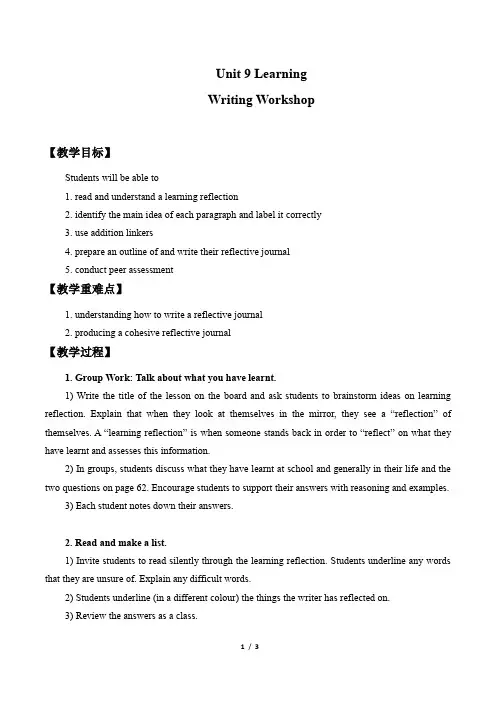
Unit 9 LearningWriting Workshop【教学目标】Students will be able to1. read and understand a learning reflection2. identify the main idea of each paragraph and label it correctly3. use addition linkers4. prepare an outline of and write their reflective journal5. conduct peer assessment【教学重难点】1. understanding how to write a reflective journal2. producing a cohesive reflective journal【教学过程】1. Group Work: Talk about what you have learnt.1) Write the title of the lesson on the board and ask students to brainstorm ideas on learning reflection. Explain that when they look at themselves in the mirror, they see a “reflection” of themselves. A “learning reflection” is when someone stands back in order to “reflect” on what they have learnt and assesses this information.2) In groups, students discuss what they have learnt at school and generally in their life and the two questions on page 62. Encourage students to support their answers with reasoning and examples.3) Each student notes down their answers.2. Read and make a list.1) Invite students to read silently through the learning reflection. Students underline any words that they are unsure of. Explain any difficult words.2) Students underline (in a different colour) the things the writer has reflected on.3) Review the answers as a class.3. What does each paragraph talk about?1) Read the list of headings on page 63.2) Independently, students complete the task, by marking the paragraphs.3) Call out the headings for students to point at the corresponding paragraph.4. Write three things you have learnt.1) Tell students: I learnt that some people have amazing memories. It’s amazing to know how a person’s memory changes with age. I was surprised to learn that 25 is the age the human memory works best. Discuss with students on how these three sentences could be better linked.2) Read the Sentence Builder. Point out that using addition linkers makes both speech and writing easier and more interesting to follow.3) Students work through the learning reflection text on page 62 and underline any examples of addition linkers they can find.4) Students write down the three things they have learnt in this unit. Check students are using addition linkers correctly.5. Compose your writing: Outlining.1) Ask students to use their notes in Activity 4 and the structure of the learning reflection on page 62 in order to complete the outline of their own reflection.2) Remind them to only fill it in with notes at this point. Ask stronger students to help any struggling students with the preparation of their reflection.6. Compose your writing: Drafting.1) Read through the Writing Help. Point out that students need to organise the information they have into clearly structured paragraphs.2) Students should also pay attention to how they link sentences and paragraphs so that their work is cohesive.3) Students complete their learning reflection.7. Compose your writing: Editing.1) Tell students that the final stage of writing, before publishing, is editing. When we edit, we check that our ideas are clear and that our sentences are complete.2) Have students exchange their writing with a partner and offer each other suggestions to improve their drafts.3) After editing, writers will make changes to their drafts and either rewrite or print a clean copy of the work.4) Ask students to prepare a final draft of their work to submit for your review and then place ina writer’s portfolio.。
Unit 9 Learning 大单元说课课件高中英语北师大版(2019)必修第三册

Step 1
Step 2 Reading Post-reading Step 3
Step 4
Step 5
Activity 8
Which of these suggestions do you think is the most useful for you?
Intention
To practice critical thinking
What attitude should be adopted to deal with learning and life under different cultural backgrounds so as to improve students' logical and critical thinking
Theme: Human & Self
What
Topic: Learning
Aim: To form correct outlook on
Why
learning & strive to be an active lifelong learner
Value Orientation: Willing to learn, good at learning, lifelong learning
Method
Activity-based Teaching
Method
Individual Study
Communicative Teaching Method
Cooperative Study
Audio-visual Teaching Method
P art
大观念 小观念 单元目标 语篇 学生活动 学生评价
北师大2019新版高中英语必修三UNIT 9 LEARNING 单词表
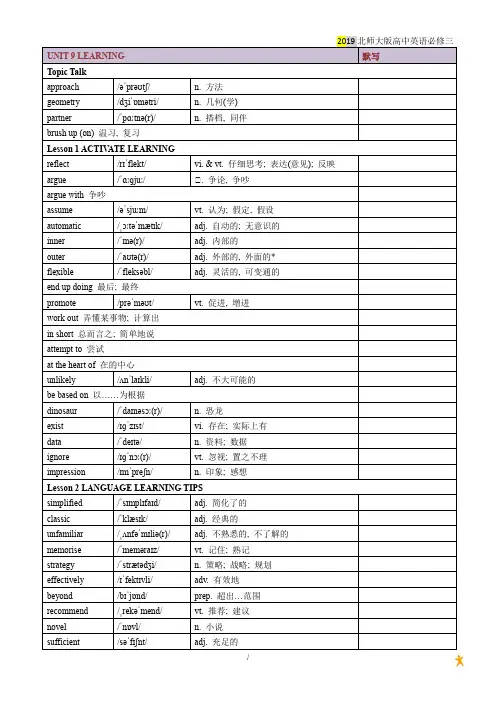
UNIT 9 LEARNING默写Topic Talkapproach /əˈprəʊtʃ/ n. 方法geometry /dʒiˈɒmətri/ n. 几何(学)partner /ˈpɑːtnə(r)/ n. 搭档, 同伴brush up (on) 温习, 复习Lesson 1 ACTIV ATE LEARNINGreflect /rɪˈflekt/ vi. & vt. 仔细思考; 表达(意见); 反映argue /ˈɑːɡjuː/ ⅵ. 争论, 争吵argue with 争吵assume /əˈsjuːm/ vt. 认为; 假定, 假设automatic /ˌɔːtəˈmætɪk/ adj. 自动的; 无意识的inner /ˈɪnə(r)/ adj. 内部的outer /ˈaʊtə(r)/ adj. 外部的, 外面的*flexible /ˈfleksəbl/ adj. 灵活的, 可变通的end up doing 最后; 最终promote /prəˈməʊt/ vt. 促进, 增进work out 弄懂某事物; 计算出in short 总而言之; 简单地说attempt to 尝试at the heart of 在的中心unlikely /ʌnˈlaɪkli/ adj. 不大可能的be based on 以……为根据dinosaur /ˈdaɪnəsɔː(r)/ n. 恐龙exist /ɪɡˈzɪst/ vi. 存在; 实际上有data /ˈdeɪtə/ n. 资料; 数据ignore /ɪɡˈnɔː(r)/ vt. 忽视; 置之不理impression /ɪmˈpreʃn/ n. 印象; 感想Lesson 2 LANGUAGE LEARNING TIPSsimplified /ˈsɪmplɪfaɪd/ adj. 简化了的classic /ˈklæsɪk/ adj. 经典的unfamiliar /ˌʌnfəˈmɪliə(r)/ adj. 不熟悉的, 不了解的memorise /ˈmeməraɪz/ vt. 记住; 熟记strategy /ˈstrætədʒi/ n. 策略; 战略; 规划effectively /ɪˈfektɪvli/ adv. 有效地beyond /bɪˈjɒnd/ prep. 超出…范围recommend /ˌrekəˈmend/ vt. 推荐; 建议novel /ˈnɒvl/ n. 小说sufficient /səˈfɪʃnt/ adj. 充足的input /ˈɪnpʊt/ n. 输入; 投入normally /ˈnɔːməli/ adv. 通常, 平常context /ˈkɒntekst/ n. 上下文; 语境; 背景chunk /tʃʌŋk/ n. 语块*acquire /əˈkwaɪə(r)/ vt. 学习, 获得(知识, 技能)be honoured to do sth 很荣幸做某事odd /ɒd/ adj. 奇特的soccer /ˈsɒkə(r)/ n. (美)足球subway /ˈsʌbweɪ/ n. (美)地铁in one way or another 不管怎样worldwide /ˌwɜːldˈwaɪd/ adj. & adv. 遍及世界的; 在全世界Lesson 3 THE SECRETS OF YOUR MEMORYarrangement /əˈreɪndʒmənt/ n. 计划; 安排childhood /ˈtʃaɪldhʊd/ n. 童年, 儿童时代emotional /ɪˈməʊʃənl/ adj. 情感上的; 情绪上的excitement /ɪkˈsaɪtmənt/ n. 兴奋, 激动as a result 作为结果photographic /ˌfəʊtəˈɡræfɪk/ adj. 详细准确的; 照片的; 摄影的digit /ˈdɪdʒɪt/ n. (09的任何一个)数字pi(π) /paɪ/ n. 圆周率*helicopter /ˈhelɪkɒptə(r)/ n. 直升机*publish /ˈpʌblɪʃ/ vt. & vi. 出版; 发表; 刊登curve /kɜːv/ n. 曲线, 弧线*sharp /ʃɑːp/ adj. 急剧的, 猛烈的; 尖的, 锋利的timely /ˈtaɪmli/ adj. 适时的, 及时的cell /sel/ n. 细胞periodically /ˌpɪərɪˈɒdɪkəli/ adv. 定期地take it easy 放轻松memorisation /,meməraɪ'zeɪʃən/ n. 记忆technique /tekˈniːk/ n. 技巧, 手法Writing Workshop A LEARNING REFLECTIONreflection /rɪˈflekʃn/ n. 沉思; 想法; 反射reflective /rɪˈflektɪv/ adj. 沉思的; 深思的journal /ˈdʒɜːnl/ n. 日记, 日志moreover /mɔːrˈəʊvə(r)/ adv. 此外, 而且Reading Club 1surfing /ˈsɜːfɪŋ/ n. 冲浪seafood /ˈsiːfuːd/ n. 海鲜Reading Club 2gap /ɡæp/ n. (大的)差距, 差额, 差别gender /ˈdʒendə(r)/ n. 性别identical /aɪˈdentɪkl/ adj. 完全相同的; 非常相似的comic /ˈkɒmɪk/ adj. 滑稽的, 好笑的fiction /ˈfɪkʃn/ n. 小说evidence /ˈevɪdəns/ n. 证据, 证明expose /ɪkˈspəʊz/ vt. 使接触; 使体验outcome /ˈaʊtkʌm/ n. 结果, 后果说明:带*号的词为《普通高中英语课程标准(2017年版)》必修和选择性必修以外词汇。
高中英语新北师大版必修第三册UNIT9LEARNING单元重点小结课件
主题语境 重点词汇 重点句式 重点语法
主题语境 重点词汇 重点句式 重点语法
19.acquire vt.学习,获得(知识,技能) acquisition n.(知识、技能等的)获得,得到 20.be honoured to do sth 很荣幸做某事 honour n.尊敬;荣幸 v.尊敬;给予表扬 in honour of为了纪念;为了表示敬意 It’s a great honour to do sth.做某事感到荣幸。 honour sb with sth用某物向某人表示尊敬;授予某人某种荣誉 21.arrangement n.计划;安排 arrange vt.安排;筹备 arrange sth筹备某物;筹划某事 arrange to do sth安排好做某事 arrange for sb to do sth安排某人做某事 arrange for sth安排某物
Hale Waihona Puke 主题语境 重点词汇 重点句式 重点语法
1.If you try to find out the source of an idea,no matter how crazy it seems,you will increase your chance of learning something. 如果你试图找出一个想法的来源,不管它看起来有多疯狂,你都会 增加你学习的机会。 2.Now I understand why we remember the events in childhood better than those that happened recently. 现在我明白了为什么我们对童年发生的事情要比最近发生的事情 记得更好。 3.Getting to know the secrets of our memory means learning not only the facts about it,but also the ways to improve it. 了解我们记忆的秘密意味着不仅要了解有关它的事实,还要了解提 升它的方法。
2019北师大版高中英语必修三UNIT 9 LEARNING 知识清单(教师版)

I.阅读单词认读01.geometry n. 几何(学)02.outer adj. 外部的, 外面的03.dinosaur n. 恐龙04.data n. 资料; 数据05.sufficient adj. 充足的06.input n. 输入; 投入07.chunk n. 语块08.odd adj. 奇特的09.soccer n. (美)足球10.subway n. (美)地铁11.photographic adj. 详细准确的; 照片的; 摄影的12.digit n. (0~9的任何一个)数字13.pi(π) n. 圆周率14.helicopter n. 直升机15.curve n. 曲线, 弧线16.periodically adv. 定期地17.seafood n. 海鲜18.gender n. 性别19.identical adj. 完全相同的; 非常相似的ic adj. 滑稽的, 好笑的II.重点单词识记01.approach n. 方法02.partner n. 搭档, 同伴03.inner adj. 内部的04.impression n. 印象; 感想05.classic adj. 经典的06.strategy n. 策略; 战略; 规划07.effectively adv. 有效地08.beyond prep. 超出……范围09.recommend vt. 推荐; 建议10.novel n. 小说11.normally adv. 通常, 平常12.context n. 上下文; 语境; 背景13.acquire vt. 学习, 获得(知识, 技能)14.worldwide adj. & adv. 遍及世界的; 在全世界15.childhood n. 童年, 儿童时代16.emotional adj情感上的; 情绪上的17.publish vt. & vi. 出版; 发表; 刊登18.timely adj. 适时的, 及时的19.cell n. 细胞20.technique n. 技巧, 手法21.journal n. 日记, 日志22.moreover adv. 此外, 而且23.gap n. (大的)差距, 差额, 差别24.fiction n. 小说25.outcome n. 结果, 后果III.核心词汇拓展01.reflect vi. & vt. 仔细思考; 表达(意见); 反映→reflection n. 反映; 映像; 思考; 反射; 沉思→reflective adj. 沉思的; 深思的02.argue vi. 争论, 争吵→argument n. 争吵; 争论; 辩论03.assume vt. 认为; 假定, 假设→assuming conj. 假设, 假定→assumption n. 假定, 假设04.automatic adj. 自动的; 无意识的→automatically adv. 无意识地; 自动地05.flexible adj. 灵活的, 可变通的→flexibly adv. 灵活地→flexibility n. 柔韧性; 灵活性06.promote vt. 促进, 增进→promotion n. 促进, 增进07.unlikely adj. 不大可能的→likely adj. 可能的08.exist vi. 存在; 实际上有→existing adj. (只用于名词前)现存的; 现有的→existence n. 存在09.ignore vt. 忽视; 置之不理→ignorant adj. 无知的; 不了解的→ignorance n. 无知10.simplified adj. 简化了的→simplify v. 简化→simple adj. 简单的→simply adv. 简单地; 朴素地; 仅仅11.unfamiliar adj. 不熟悉的, 不了解的→familiar adj. 熟悉的, 了解的→familiarity n. 熟悉; 通晓12.memorise vt. 记住; 熟记→memory n. 记忆力; 回忆→memorisation n. 记忆13.arrangement n. 计划; 安排→arrange v. 计划; 安排14.excitement n. 兴奋, 激动→excite v. 刺激, 使……兴奋→excited adj. 激动的→exciting adj. 令人激动的15.sharp adj. 急剧的, 猛烈的; 尖的, 锋利的→sharply adv. 急剧地, 猛烈地; 锋利地→sharpen v. (使)变锋利16.surfing n. 冲浪→surf v. 冲浪17.evidence n. 证据, 证明→evident adj. 明显的→evidently adv. 明显地, 显然地18.expose vt. 使接触; 使体验→exposed adj. 无遮蔽的; 无保护的; 易受攻击的→exposure n. 接触; 暴露IV.核心短语速记01.brush up (on)温习, 复习02.reflect on思考03.argue with争吵04.end up doing最后; 最终05.work out弄懂某事物; 计算出06.in short总而言之; 简单地说07.attempt to尝试08.at the heart of... 在……的中心09.be based on... 以……为根据10.be honoured to do sth很荣幸做某事11.in one way or another不管怎样12.as a result作为结果13.take it easy放轻松14.cannot help doing sth忍不住做某事15.find out发现; 查明16.in the way挡某人的道; 妨碍某人01.deadline n. 最后期限, 截止日期02.decade n. 十年03.decline vt. & vi. 婉拒; 衰落; 减弱04.decrease vi. 减少05.deliberately adv. 故意地06.delighted adj. 高兴的, 快乐的07.deserve vt. 应受(报答或惩罚); 值得08.dignity n. 尊严; 高贵09.dilemma n. 进退两难的困境10.diploma n. 毕业文凭; 学位证书01.Your inner voice expresses your personal opinions, while the outer voice tells you about opinions from whatyou hear or read. (while 连接并列分句)你内心的声音表达了你的个人意见, 而外部的声音告诉你关于你听到或者读到的观点。
Unit 9 Learning 必备知识清单高一英语单元同步知识梳理(北师大版2019必修第三册)
Unit 9 必备知识清单一、词汇知识清单Section A TOPIC TALK & LESSON 1I、阅读词汇知其意[注意英译汉]1.approach /əˈprəʊtʃ/ n. 方法2.geometry /dʒiˈɒmətri/ n. 几何(学)3.assume /əˈsjuːm/vt. 认为; 假定, 假设4.automatic /ˌɔːtəˈmætɪk/ adj. 自动的; 无意识的5.inner /ˈɪnə(r)/ adj. 内部的6.flexible /ˈfleksəbl/ adj. 灵活的, 可变通的7.promote /prəˈməʊt/ vt. 促进, 增进8.dinosaur /ˈdaɪnəsɔː(r)/n. 恐龙9.exist /ɪɡˈzɪst/ vi. 存在; 实际上有10.data /ˈdeɪtə/ n. 资料; 数据11.ignore /ɪɡˈnɔː(r)/vt. 忽视; 置之不理II、写作词汇知其形[注意汉译英]1.partner /ˈpɑːtnə(r)/ n. 搭档, 同伴2.reflect /rɪˈflekt/ vi. & vt. 仔细思考; 表达(意见); 反映3.argue /ˈɑːɡjuː/ⅵ. 争论, 争吵4.unlikely /ʌnˈlaɪkli/ adj. 不大可能的III、重点短语知搭配[注意固定短语的英汉互译]1.reflect on 思考2.argue with 争吵3.end up doing 最后,最终4.work out 弄懂某事物,计算出5.in short总而言之,简单说6.attempt to 尝试7.at the heart of 在…… 的中心8.be based on 以……为根据9.take part in 参与10.lead to 导致,通向IV、语法词汇知其变[注意词性变化]1.flexible --- flexibility[名词]2.promote --- promotion[名词]3.exist --- existence[名词]4.ignore --- ignorance[名词]5.reflect --- reflection[名词]6.argue --- arguement[名词]Section B LESSON 2 & LESSON 3I、阅读词汇知其意[注意英译汉]1.simplified /ˈsɪmplɪfaɪd/ adj. 简化了的2.memorise /ˈmeməraɪz/ vt. 记住; 熟记3.strategy /ˈstrætədʒi/ n. 策略; 战略; 规划4.effectively /ɪˈfektɪvli/ adv. 有效地5.beyond /bɪˈjɒnd/ prep. 超出…范围6.novel /ˈnɒvl/ n. 小说7.sufficient /səˈfɪʃnt/ adj. 充足的8.input /ˈɪnpʊt/ n. 输入; 投入9.normally /ˈnɔːməli/ adv. 通常, 平常10.context /ˈkɒntekst/ n. 上下文; 语境; 背景11.acquire /əˈkwaɪə(r)/ v t. 学习, 获得(知识, 技能)12.odd /ɒd/ adj. 奇特的13.soccer /ˈsɒkə(r)/ n. (美)足球14.photographic /ˌfəʊtəˈɡræfɪk/adj. 详细准确的; 照片的; 摄影的15.digit /ˈdɪdʒɪt/ n. (09的任何一个)数字16.cell /sel/ n. 细胞17.periodically /ˌpɪərɪˈɒdɪkəli/ adv. 定期地18.memorisation /,meməraɪ'zeɪʃən/ n. 记忆19.technique /tekˈniːk/n. 技巧, 手法II、写作词汇知其形[注意汉译英]1.impression /ɪmˈpreʃn/ n. 印象; 感想2.classic /ˈklæsɪk/ adj. 经典的3.unfamiliar /ˌʌnfəˈmɪliə(r)/ adj. 不熟悉的, 不了解的4.recommend /ˌrekəˈmend/ vt. 推荐; 建议5.worldwide /ˌwɜːldˈwaɪd/ adj. & adv. 遍及世界的; 在全世界6.arrangement /əˈreɪndʒmənt/ n. 计划; 安排7.childhood /ˈtʃaɪldhʊd/ n. 童年, 儿童时代8.emotional /ɪˈməʊʃənl/ adj. 情感上的; 情绪上的9.excitement /ɪkˈsaɪtmənt/ n. 兴奋, 激动10.subway /ˈsʌbweɪ/ n. (美)地铁11.publish /ˈpʌblɪʃ/ vt. & vi. 出版; 发表; 刊登12.sharp /ʃɑːp/adj. 急剧的, 猛烈的; 尖的, 锋利的13.timely /ˈtaɪmli/ adj. 适时的, 及时的III、重点短语知搭配[注意固定短语的英汉互译]1.as a result 作为结果2.take it easy 放轻松3.again and again 一次又一次的4.be good at 擅长5.according to 根据IV、语法词汇知其变[注意词性变化]1.simplified --- simplify[动词] --- simple[形容词]2.memorise --- memory[名词]3.effectively --- effective[形容词]4.periodically --- period[名词] --- periodical[形容词]5.impression --- impress[动词]6.recommend --- recommendation[名词]7.arrangement --- argue[动词]8.emotional --- emotion[名词]9.excitement --- excite[动词]Section C WRITING WORKSHOP & VIEWINGWORKSHOP & READING CLUB & ASSESSMENTI、阅读词汇知其意[注意英译汉]1.reflection /rɪˈflekʃn/ n. 沉思; 想法; 反射2.reflective /rɪˈflektɪv/ adj. 沉思的; 深思的3.journal /ˈdʒɜːnl/n. 日记, 日志4.moreover /mɔːrˈəʊvə(r)/ adv. 此外, 而且5.surfing /ˈsɜːfɪŋ/n. 冲浪6.seafood /ˈsiːfuːd/n. 海鲜7.gender /ˈdʒendə(r)/ n. 性别8.identical /aɪˈdentɪkl/ adj. 完全相同的; 非常相似的ic /ˈkɒmɪk/ adj. 滑稽的, 好笑的10.expose /ɪkˈspəʊz/ vt. 使接触; 使体验II、写作词汇知其形[注意汉译英]1.fiction /ˈfɪkʃn/ n. 小说2.evidence /ˈevɪdəns/ n. 证据, 证明3.outcome /ˈaʊtkʌm/ n. 结果, 后果4.gap /ɡæp/n. (大的)差距, 差额, 差别二、重点语篇清单语篇复述记忆语篇一We need to train ourselves to be better learners—to actively take part in the learning process and to reflect on what we have learnt.Listen to the outer voice. There are two kinds of voices: the inner voice and the outer voice. Active learners are open-minded and focus on what the speaker / writer is saying, not on what their brain is saying in the background.Argue with your inner voice. If you find your inner voice difficult to control, you can argue with it as most active learners do. Be flexible in your opinions and you might end up agreeing with the speaker / writer after all.Ask questions. Asking questions is the easiest way to promote active learning. The very act of working out questions will help you to achieve a higher level of understanding about the topic.Get to the truth. Active learners attempt to find the truth at the heart of each idea. Even when an idea sounds entirely unlikely, there may be an aspect of it that is based on truth.Focus on the message. Many people miss out on learning opportunities because they let their feelings get in the way. They refuse to learn or ignore what is said because of who the speaker / writer is.我们需要训练自己成为更好的学习者——积极参与学习过程并反思学到的东西。
北师大版(2019)英语必修 第三册 Unit 9 Learning-Writing Workshop 课件(共10张PPT)
Activity 3
What does each paragraph talk about?
Paragraph 1 Paragraph 2 Paragraph 3
Activity 5
Compose your writing: Outlining.
My Outline The topic I am going to reflect on ___________________________ Paragraph 1: ________________________________ Paragraph 2: ________________________________ Paragraph 3: ________________________________
learning it, and what you know about it now; • include how you will use your new
skill/knowledge in the future.
Activity 7
Compose your writing: Editing.
Activity 6
Compose your writing: Drafting.
Writing Help
Writing a Learning Reflection It’s important to: • understand why you should reflect on what
you have learnt; • choose one topic that you want to reflect on; • list what you knew about the topic before
北师大版(2019)英语必修 第三册 Unit 9 Learning—Viewing Workshop 教案
Unit 9 LearningViewing Workshop【教学目标】Students will be able to1. discuss ways to learn and develop our brain2. watch and understand a video on the lesson topic3. extract specific details from a video and answer questions4. give a presentation【教学重难点】Understanding specific details of a video and talking about ways to develop our brain【教学过程】1. Do you think we can only learn certain topics at certain times?Discuss the saying “You can never teach an old dog new tricks.” with the students. It means that it is very difficult to teach someone new skills or to change someone’s habits or character. Do you think some people cannot learn a new skill or habit? Is it easier to learn something new when you are younger or older? Encourage all students to participate in the discussion.2. Watch the video and find out.1) Explain to students that they will be watching a video and find out the answers to the questions in activity 1.2) Play the video once for general understanding. Students note down the answers as they watch.3) In pairs, students review their answers. Play the video a second time to confirm students’ answers.4) Review the answers as a class.3. Watch again and find out the main idea.1) Read the three sentences on page 64. Explain that one option best summarises the video.2) Students can note down their answer.3) Play the video to confirm students’ answers. Review as a class.4. Watch the first part. Find out abilities or actions for two sensitive stages.1) Read the options. Ask students to share what they remember about the two sensitive stages: experience expectant learning and experience dependent development.2) Students can note down their answers while watching the video.3) Pause the video at key stages if the students are struggling and explain any difficult concepts.4) Review the answers as a class.5. Watch the final part and answer questions on page 64.1) Read and discuss the questions. Ask students to share what they remember about brain plasticity and the effects of juggling exercises.2) Students can note down their answers while watching the video.3) Pause the video at key stages if the students are struggling and explain any difficult concepts.Review the answers as a class.6. Express yourself: Give advice to elderly people and parents of school children.1) Divide the class into two groups; one group discusses advice for the elderly and the other group discusses advice for parents of school children.2) Students can use the video script as reference. If possible, students can research online or provide resource material. Encourage students to add any further advice they would suggest.3) Each group discusses and notes down advice that they would give.4) Each group presents their advice. The other group can ask questions and brainstorm further advice.。
北师大版(2019)英语必修 第三册 Unit 9 Learning-Topic Talk 课件(共12张PPT)
Activity 5
Quote … Unquote
2. What is your favourite quote? Why? 1) He who learns but does not think is lost. He who thinks but does not learn is in great danger. 2) I believe that the most beautiful meaning of life, and the happiest result of our experiences, is learning. 3) There is no end to education. It is not that you read a book, pass an examination and finish with education. The whole of life, from the moment you are born to the moment you die, is a process of learning. 4) Being ignorant is not so much a shame, as being unwilling to learn.
Activity 3
Use the Text Builder to talk about the way you learn.
Things to Do/Learn • work with a partner • do group work • go online/to the library • learn new skills/about new ideas • take part in problem-solving activities/musical activities/ sports • write for the school magazine/blogs •…