
牛津上海版(试用本)三年级下册英语Module 3 Unit 2 Colours_教案
Unit 2 Colours
【教学目标】
1.能用英语进行简单的打招呼及用This is…向别人介绍身边的人。
2.通过创设实际情景,让学生能在相应的情景中准确运用以上句型。
3.培养学生正确、自然的模仿语音、语调的能力。
【教学重难点】
1.This is…的得体运用。
2.This is…句型字母i及th的发音不容易到位。
【教学过程】
一、热身/复习(Warm-up/Revision)
1.播放歌曲Good morning,让学生跟唱,集中学生注意力,调动学生学习兴趣。
2.游戏Do a game. "SIMON SAYS" 。
3.师生同唱歌曲"Hello"。
教师可以边唱边用手势示意学生,将歌曲中的人名改为同班同学的名字。
4.教师用头饰介绍人物。
例如:教师举起Miss White的头饰说:This is Miss white然后戴上Miss white的头饰说:Good morning, boys and girls. I'm Miss White.
5.请三个学生扮演Mr. Jones, Miss White, Miss Green,用唱歌的
形式互相问候。
"Hello"。
二、呈现新课(Presentation)
1.师生观看教学课件。
教师利用与教材内容相同的教学课件,使学生一目了然,既了解了句型的含义,又了解句型运用的情景。
2.再次观看课件,教师提问:
T: What are they doing?
3.教师演示Let's talk/A 的内容,使学生进一步理解对话。
方法为:教师戴上Miss White 的头饰,左手举起Mr. Jones的头饰,右手举起Miss Green 的头时,用不同声调引出对话内容。
在此次演示活动中,教师强调This is…。
4.教师提问:Miss White 是如何介绍Miss Green 给Mr. Jones 的?Miss Green 和Mr. Jones是怎样用英语打招呼的。
5.听本课时Let's talk/A 教学配套的录音带,学生跟读并模仿发音。
教师注意带读不易掌握的读音,如:This is…一句中的元音字"i" 的读音是[i] ,提示学生要读得短促些。
而this一词中的th 在发音时,要让舍尖顶住上齿,教师可以夸大口型,让学生了解发音方法。
教师要适当纠正,切不可一味的纠正发音,打击孩子学习的积极性。
6.分组练习。
每三个学生一组进行练习Good morning ,this is…。
三、趣味操练(Practice)
画一画,说一说(Draw and say )
(1)让学生在纸上画出一个自己熟悉的人的头饰。
(2)向同桌用句型:This is…介绍自己所画的人物。
(3)分四个大组用句型:This is…介绍自己所画的人物大组进行比赛。
四、扩展性活动(Add-activities)
自己画喜欢的头饰,并用句型This is…介绍,并把此句型抄写下来。
三年级英语下册 MODULE3 unit3 Lesson2教案 沪教牛津版

(沪教牛津版)三年级英语下册教案Module3Unit 3 The seasonsThe second period一、主要新授内容(New contents)Vocabulary: autumn, winter, wind, blow, scarves, glovesStructures: It is ____. It’s not____.In autumn/winter, we can see……二、学习目标(Learning objectives)1. 通过介绍秋冬两季的特征,培养学生一定的观察能力和表述能力。
2.学习.autumn, winter, wind, blow, scarves, gloves的正确发音。
三、教学建议(Teaching Suggestion)1、任务前期准备阶段(Pre-task preparation section)Activity 1 (Warming-up)1.教学辅助:录音机图片2.活动过程(Process)Activity 2 ( Daily talk )1.教学辅助:图片2.活动过程(Process)2.任务中期实施阶段(While-task procedure section)Activity 1 (Introduction)1、教学辅助(Aids) 图片2、活动过程(Process)Activity 2 (Read and spell)1、教学辅助(Aids) 多媒体2、活动过程(Process)Activity 3 (Introduction)1、教学辅助(Aids) 录音机或媒体2、活动过程(Process)Activity 4 (Read and spell)1、教学辅助(Aids) 多媒体2、活动过程(Process)Activity 5 (Game)1、教学辅助(Aids) 图片2.活动过程(Process)3. 任务后期完成阶段(Post-task activity section)Activity 1( Read the text)1、教学辅助(Aids) 图片书本2.活动过程(Process)Activity 2 (Game)1、教学辅助(Aids) 图片2.活动过程(Process)Activity 3 (Story)1、教学辅助(Aids) 多媒体2.活动过程(Process)Activity 4(Assignment)1、教学辅助(Aids): 2.活动过程(Process)。
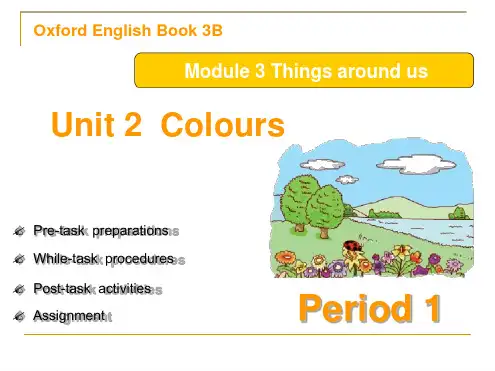
三年级下英语课件 Module 3 Unit 2 Colours4牛津上海版
sun tree
+
+
+
+
sky
mountain
the Tai Mountain 泰山
the Yellow Mountain 黄山
river
the Yellow River 黄河
the Yangtze River 长江
sea
Is this a river? No, it isn't . It's the sea.
sky
sea
mountain river
What is it?
It's a cloud.
What are they?
They are flowers.
What colour is the cloud? It's white.
What colour are th Nhomakorabea flowers? They are …
Oxford English Book 3B
Module 3 Things around us
Unit 2 Colours
? Pre-task preparations ? While-task procedures ? Post-task activities ? Assignment
Period 1
What colour is the… It's … What colour are the …? They're…
1. 听读课本P30-31五遍。 2. 抄写单词sky, sea ,mountain, river,
leaf, leaves 和Look and say 的课文。
What can you see? I can see a ladybird. What colour is the ladybird? It's red and black.
三年级英语下册 MODULE3 unit2 Lesson2教案 沪教牛津版
(沪教牛津版)三年级英语下册教案Module3Unit 2 NoisesThe second period一、主要新授内容(New contents)1.Vocabulary: waves2. Structures: Do you like these noises?/ Do you like this noise? Is this noise loud/quiet?二、学习目标(Learning objectives)1. 通过Do you like these noises?/ Do you like this noise? / Is this noise loud/quiet?的询问来了解学生对生活中各种声音的喜好,培养学生的表述能力。
2. 学习新词wave及其复数形式。
3.通过整合以前有关Noises这一主题的内容,培养学生观察生活,热爱生活,关心周围事物的生活态度。
三、教学建议(Teaching Suggestion)1、任务前期准备阶段(Pre-task preparation section)Activity 1 (Song)1.教学辅助:1)录音机2.活动过程(Process)Activity 2 ( Revision)1、活动过程(Process)2.任务中期实施阶段(While-task procedure section)Activity 1 (Ask and answer)1、教学辅助(Aids)1) 图片 2)录音机2、活动过程(Process)Activity 2 ( Read and spell )1、教学辅助(Aids)1)图片2.活动过程(Process)Activity 3 ( Tick and answer )1、教学辅助(Aids)1)图片2.活动过程(Process )3. 任务后期完成阶段(Post-task activity section )Activity 1(Do a survey )1、教学辅助(Aids)1)调查表2.活动过程(Process )Activity 2(Noises around us)1、教学辅助(Aids)1)调查表2.活动过程(Process)。
2019年三年级下英语课件-Module 3 Unit 2 Colours(4)牛津上海版精品物理
What can you see? I can see a ladybird. What colour is the ladybird? It’s red and black.
a leaf
leaves
What can you see? I can see trees. What colour are the leaves? They are green.
grass
sun tree
+
+
+
+
sky
mountain
the Tai Mountain 泰山
the Yellow Mountain 黄山
river
the Yellow River 黄河
the Yanghis a river? No, it isn’t . It’s the sea.
I see green. I see yellow. I see blue. I see purple. I see the beautiful rainbow Shining over there, Outside my window.
What can you see? I can see… What colour is it? It’s …
Oxford English Book 3B
Module 3 Things around us
Unit 2 Colours
Pre-task preparations While-task procedures Post-task activities Assignment
Period 1
sky
sea
mountain river
三年级下册英语课件-Module2Unit3Clothes|牛津上海版
shoes
socks
gloves
car scarf (g)
What’s this? It’s a scarf.
wolf( 复数 ) wolves scarf(复数) scarves They are scarves.
Socks, a jacket, a hat and a scarf. What do you need? What do you need? I need a jacket. I need a scarf. I need a jacket and a scarf.
Sure.
I want to ride it. May I have a try?
Learn and sound
Practice
Ask and answer
What’s that? It’s a scarf.
What’s this? It’s a hat.
S1:What’s this/that? S2: It’s a … S1: What are they? S2: They are …(s)
Play a game
love
Jackets, jackets.
They are jaຫໍສະໝຸດ kets.glovesa pair of gloves
hair
rocks socks
a pair of socks
two pairs of socks
a pair of shoes
shorts
trousers
a pair of
三年级下册英语课件Module2Unit3Clothes
|牛津上海版
2020/8/28
Shorts, a T-shirt, a dress and a blouse. What do you need? What do you need? I need a blouse. I need a dress. I need a blouse and a dress.
新人教版PEP上海牛津3起点英语三年级下册unit 3 A2附反思
教学课时 第 二 课时 教学课型
句型教学 是否集体备课
否
教材 分析
Teaching content Let' s talk. Look,Amy! I have a new kite. Oh, it' s beautiful! Let' s fly it! OK! How many kites can you see ! 1,2,3,...I can see 12.
教学 反思
在从众多的风筝中挑出最漂亮的一只时,我提前把 one 的用法和 beautiful 结合起来。教学生用 以下的这个句子:I like the purple one. It's beautiful!我觉得这样更能帮助学生理解 one 在句 子中的意思。更有意思的是操练 beautiful 的时候。我是先从夸自己的东西开始,接着就是夸教 室里的装饰,最后用到人身上,教室里的人,比如同学。三年级的孩子还不太懂得害羞,只知 道,是女生都是 beautiful 的。两个班都有学生夸到了老师,嘿嘿!乐一下!
No ,11. The black one is a bird.
教学 掌 握 句 型 How many…can you see? I can see…以 及 如 何 赞 美 别 人 的 东 西 : How 目标 nice/beautiful
教学 重点
能在实际情景中运用 How many …can you see? I can see ….
(新授部分主要借助于图片,复习了数字,也渗透了单词的复数,教师 根据图片进行体温,使学生容易理解新授句型;同时通过多组图片,使学 生操练得熟练。) 3. Practice a. 两人一组用实物或图片进行对话。 b. 进行对话表演。 c. 教师引导学生对教室内的东西提问,一生问,其余生回答或由该生指名 回答。 4. Assessment 通过做课堂作业本。 检查学生对对话的掌握情况。
三年级下册英语课件-Module 3 Unit 2 Colours|牛津上海版(共21张PPT)
Homework
1. Finish the passage and share with your classmate; 2. Read the books on P30-33; 3. Recite the word and sentences.
Presentation
Look and learn
sea lake river
mountain
Look and say
Look at this picture. It's spring. What colour is the sky?
What colour are the leaves?
They're green. It's blue.
He is hardworking because he likes…
He isn’t hardworking because he likes ……
He is lazy.
I like singing and dancing. La la la la. What a fine day! I like sleeping. Oh, so happy! I like eating leaves. They are yummy. I like playing with my balls. How happy!
More words : cloudy, clever, classroom, clean, close, climb, clap, class
Summary
重点单词:sky, sea, mountain, river, clothes, plant, gloves. 重点句型:What colour is/are …? It's/They're …
2019-2020年三年级英语下册 3B Module3 Unit2教案 沪教牛津版
2019-2020年三年级英语下册 3B Module3 Unit2教案沪教牛津版Teaching Aims: 1.Words: raindrop, falling down, lorry, loud, noise2.Sing a song3.New sentences: What’s that noise?Emotion aims: 让学生懂得环境保护的重要Difficult teaching points: noise, lorry, loudTeaching aids: pictures, cassette and a cassette playerTeaching Process:Step One: Warming-up1.S ay a rhyme2.A sk and answerStep Two: Revision1.A ct out the dialogues2.T alk about the picture3.I ntroduce your friends’ dress/blouse…Step Three: Presentation1.S ing a song(1)Listen to the song(2)Show the picture and teach words: raindrop, falling downDraw some clouds and raindrops on the board.Introduce: raindrops say after the teacherIntroduce: falling down while draw the raindrops from the clouds to the ground say after the teacher(3)Listen to the rain “ pitter patter”(4)Read the song:I hear raindrops, falling down; I hear the raindrops, falling down.Pitter patter raindrops, pitter patter raindrops, falling down, falling down(5)Sing a song2.S ing and act3.L ook and say(1)Ask students to be perfectly quiet. Ask: What can you hear? To elicit: I canhear…Invite students to imitate sounds of cats, dogs and raindrops, etc.(2) Play the cassette(the FX of a lorry)a.Listen to the tape and look at the picture of the lorryWrite “lorry” on the board.b. Read the lorry one by one(3) Review: an aeroplane, a drill, a telephone, a car, a busInvite students to come to the front to imitate the sound of one object. Introduce:noise3. Students start imitating the sounds of different o bjects. Ask: What’s that noise?Is it a/an…? To elicit: Yes, it is. / No, it is a/an…For more able students, prompt them to make guesses and give answers by using the above dialogue. Or divide the class into groups. Groups take turns to make guesses and imitate sounds. The group that makes the most correct guesses is the winner.Step Four: Consolidation1.C ome to the front , sing and act2.R ead the song (rhyme)3.W orkbook page22(1)Students work in pairs to finish the exercise orally. Remind students that theycan finish this exercise according to their own preferences.(2)Invite pairs of students to read the dialogue. Encourage the class to imitatethe sounds while their classmates are reading the dialogues. The class check answers.(3) Do a simple survey about their noise preferences.Step Five: Homework1.L isten to the tape2.S ing a songPeriod TwoLook and say Ask and answerTeaching Aims: 1. Words: quiet, loud, television,2. Sentences: What’s that noise? It’s loud. I don’t like it.Can you hear raindrops?Emotion aims: 让学生懂得环境保护的重要Difficult teaching points: quiet, loud,What’s that noise?Can you hear…Teaching aids: pictures, cassette and a cassette playerTeaching Process:Step One: Warming-up1.S ing a song2.L isten and actStep Two: Revision1.A sk and answer :What’s this/that? It’s…What can you see? I can see…What colour can you see? I can see..2.S ay something about the pictureStep Three: Presentation1.S tudents start imitating the sounds of differ ent objects. Ask: What’s that noise?Is it a/an…? To elicit: Yes, it is. / No, it is a/an…2.l oud, quieta.Turn up the radio. “It’s loud.”Say “loud” loudly Write “loud” on the boardb.Turn down the radio. “It’s quiet.”Say “quiet” quietly Write “quiet” on th e board.c. Imitate the sounds of different objects. Ask: Is it loud or quiet? To elicit:It is loud / quiet.d: Play a game. Blindfold one of the students. Choose an object and hide itsomewhere in the classroom. The rest of the class provides hints by saying : loudloudly when the student is getting closer to the object and quiet quietly whenthey are moving further away from it.3.t elevisiona.Look at the picture of television , then read after the teacher.b.draw and say4.Make some noises, then ask: What’s that noise? Is it a/an…5.Play the cassette very softly. Ask: Can you hear? To elicit: No. Play the cassetteproperly for a few seconds. Ask: Can you hear? To elicit: Yes.Write “Can you hear?” on the board.6.A sk students to predict the answers and tick the boxes of Ask and answer. Playthe cassette: Look and say. Students listen and follow in their books to checkif their prediction is correct.7.P lay the cassette again. Students listen and repeat.8.S tudents work in pairs to check answers by asking and answering. Invite pairsof students to read the questions and answers to the class.9.F orm students into groups and act the story. For more able students, encouragethem to change the objects in the story.Step Four: Consolidation1.S tudents work in groups and discuss what noises they don’t like to hear whilethey are in the cinema or in their bedroom.2.Grammer Practice bookStep Five: Homework1.L isten to the tape2.C opy the words: noise, lorry, loud, television, quiet, radioPeriod ThreeListen, look and writeTeaching Aims: 1. Review the sentences2. Listen, look and write3.Words: wave, parrotEmotion aims: 鼓励学生善于模仿,仔细观察Difficult teaching points: Do you like these noise?Teaching aids: pictures, cassette and a cassette playerTeaching Process:Step One: Warming-up1.L isten and act2.S ing a songStep Two: Revision1.A sk and answer2.R ead the words and spell the words: lorry, loud, raindrop, noise, quiet…3.A ct out the dialogueStep Three: Presentation1.I nvite students to imitate the sounds of the different objects on page 34.Ask: What’s that noise? Is it a …? To elicit: Yes, it is./ No, it is a/an…Ask: Is it quiet or loud? To elicit: It is loud./ It’s quiet.2.T eaching “wave, parrot”(1)Show the picture and Listen to the wavesIntroduce: wave write “wave” on the boardImitate the sounds of the wave.(2)T: Listen to the sound, what can you hear? ( hello, hello..)Show a picture of a parrot:This is Dotty. Dotty is a parrot. I can hear the parrot.Sing a song<I am Dotty>Say the sentence as a parrot: Hello, hello! I’m a parrot.(3) Make a dialogue use the new word ”wave” & ”parrot”eg: What can you hear?I can hear a parrot.Is this your parrot?No, it’s her parrot.3.G ames: What can you hear?I can hear an aeroplane. ( a drill, waves, a dog, a cat, a bird, a duck, a hen,a parrot…)4.D o you like these noises?Play the cassette again. Ask: Do you like this noise? After each FX to elicit:I like it. / I don’t like it.5.D ivide students into pairs. Students ask each other whether they like a certainnoise or not. Ask students to use a different coloured pencil to record theanswers.Students check their recordings against their partner’s.6.F or more able students, divide them into groups. Prompt them to ask their groupmembers: Do you like this noise? And find out the most popular noise in theirgroup.Step Four: Consolidation1.L isten to the tape2.I nvite individual students to talk about noises they like or dislike. Ask: Doyou like this noise? by pointing at a certain picture to elicit: I like it./Idon’t like it.3.A sk students to group the noise according to their likes and dislikes. Askstudents to make guesses and write down whether they think that a noise is loudor quiet.4.M ake a short dialogues and act out it.5.W orkbook page23,24Step Five: Homework1.L isten to the tape2.W rite down the sentencesPeriod FourLook and write Learn the soundTeaching aims: 1. Learn the sound /ju:/2. Ask and answerEmotion aims: 让学生学会仔细观察,懂得环境保护的重要Difficult teaching points: Is this noise loud/quiet? Yes, it is./No, it isn’t.Do you like this noise? Yes, I like it./ No, I don’t like it. Teaching aids: pictures, cassette and a cassette playerTeaching Process:Step One: Warming-up1.Sing a song2.Ask and answerStep Two: Revision1.Ask and answerT: What’s that noise? Is it an aeroplane?Do you like the noise? Can you hear a drill?Can Kitty hear a dog?2.Listen to the tape<Look and write>Do you like these noises?Step Three: Presentation1.Introduce: loud quiteT: Turn up the radio and say “It’s loud.” Turn down the radio and say “It’s quite.”Write on the blackboard: loud quite2.Invite students to imitate sounds of different animals or different object.3.(1)Invite individual students to come to the board and make any noise theylike. Remind these students that they can make the noise loud or quiet.(2)Ask : What’s that noise? To elicit: It is…Is this noise loud/quiet? Do you like this noise? To elicit: Yes,it is. No, it isn’t. Yes, I like it. No, I don’t like it.4.Play the cassette. Students listen and tick the boxes to show whether thenoises are loud or quiet. Ask students to draw happy or sad faces besideeach illustration to show whether they like or dislike the noise.5.Students work in pairs to check answers and find out whether their partnerlikes or dislikes the noises by using the dialogue. Students take turns toask: Is this noise loud/quiet? Do youlike this noise? And answer: Yes, it is. No, it isn’t. Yes, I like it. No,I don’t like it.6.Ask and answerS1: Is this noise loud / quite? S2: Yes, it is. / No, it isn’t.S1: Do you like this noise? S2: Yes, I like it. / No, I don’t like it.a.Work in pairb.Act out the dialogue7.Learn the sound /ju:/(1)_T: Look at the picture, what are you doing? I’m listening to the beautifulmusic. It is super. Do you like it” Yes, I do.(show the card)(2) I like the beautiful music. It is super.(pay attention the sound /ju:/)(3) Find out the words of the sound /ju:/(4) Read the sentences loudStep Four: Consolidation1.Listen to the tape2.Read the sentences3.Do the exercisesStep Five: Homework1.Listen to the tape and say it by yourself2.Work book附送:2019-2020年三年级英语下册 3B Module3 Unit3教案沪教牛津版Teaching Aims:1. Word: season, spring, warm, wet, plant, grow, nestsummer, cool, shine, shell, hot2. Sentences: Plants grow and grow.The sun shines and shines.Emotion aims: 培养学生热爱大自然的情感Difficult teaching points: season, spring, summer, warm, cold, hot cool,Teaching aids: pictures, cassette and a cassette playerTeaching Process:Step One: Warming-up1.sing a song2.Listen and actStep Two: Revision1.Ask and answer2.Introduce your clothing: I have a dress. It’s…I have a T-shirt.It’s…Step Three: Presentation1. Teaching: “plant, nest” show a picture of springT: Look at the picture. What can you see?(1)Introduce: trees flowersIntroduce plant using the picture. Write “plant” on the board(2)Draw a nest on the tree to introduc e nest. Write ”nest” &”nests” on theboard. Draw two birds in the nest and introduce birds.(3)Sing the song<I hear raindrops> Introduce umbrella while singing2. Teaching “spring”T: The weather is warm. The grass is green. The swallow iscoming. Now the spring is coming.Write “spring in spring” on the board.3.Write “warm, cold” on the board. Introduce :warm, cold byinviting students to touch a glass of warm water and a can of cold coke. Introduce:wet. Ask students to look at the water vapor on the can.4.Draw three pictures which show the growth of a plant on theboard. Introduce: grow and write it on the board.5.play the cassette: In spring…Students listen and repeat6.In spring, we can see…(1)I can see the trees.(plants, birds, flowers)(2)In spr ing, we can’t see umbrellas.(3)In spring, is the weather cold? No, it’s warm.warm---coolIn spring, it’s wet. Plants grow and grow.7.Teaching : summer ,shellsShow summer on the picture. Encourage the students to predict what they cansee in summer and tick the appropriate boxes. Introduce: shells , summer Writethem on the board8.Play the cassette: In summer…Students listen and check theprediction.9.Write hot, cool on the board. Introduce: hot, cool by invitingstudents to touch a glass of hot water and a can of cool coke.10.Draw: the sun on the board. Introduce: shines by drawing linesout from the sun. Add a match stick figure wearing a pair of sunglasses. Step Four: Consolidation1.Divide students into groups. Invite each group to read page36aloud.Step Five: Homework1.Listen to the tape2.Copy the wordsPeriod TwoRead and TickTeaching Aims: 1. Words: dry, fall, autumn, bicycle, scarf, winter, wind, gloves 2. Sentences: Leaves fall and fall.The wind blows and blows.Emotion aims: 培养学生热爱大自然的情感Difficult teaching points: autumn, winter, dry, scarves, gloves,windTeaching aids: pictures, cassette and a cassette playerTeaching Process:Step One: Warming-up1.Listen and act2.Ask and answerStep Two: Revision1.In spring, what can you see? I can see…/ I can’t see…How is the weather in spring? Is it cold?2.Read “In spring”3.In summer, what can you see? I can see…/I can’t see…4.Read “In summer”Step Three: Presentation1.Teaching “autumn, dry”Show the picture of autumn.(1)What can you see? I can see kites, slides, bicycles…Is it spring? No, it isn’t. It is autumnWrite “autumn in autumn” on the board.Say after teacher(2)Soak a tissue with water. Ask students to feel the wet tissue and a dry one.Introduce: dry2.Teaching :fallIntroduce: fall by drawing some falling leaves. Add an arrow to show that theyare falling down from the tree to the ground.Say : Leaves fall and fall3.Play the cassette: In autumn…Students listen and repeat4.Look at the picture, ask and answer(1)In autumn. What can you see?We can see… We can’t see…(2)Is it hot(cool, warm, wet, dry)? Yes, it is. No, it isn’t.5.Teaching: winter, scarves,glovesShow the picture of autumn.(1)What can you see? I can see hats, coats…Is it autumn? No, it isn’t. It is winterWrite “winter in winter” on the board.Say after teacher(2) Introduce: gloves scarves using the pictureWrite “scarf scarves” on the board6. Teaching :wind ,blow(1)T: In winter, is it hot? No, it’s cold. Is it wet? No, it’s dry.Imitating the sounds of the wind and draw some lines on theboard to introduce “wind”What can you hear? Write wind on the board(2)Ask students to imitate the sounds of the wind loudly orquietly. Introduce: The wind blows and blows.7.Play the cassette: In winter…Students listen and repeat8.Look at the picture, ask and answer(1)In winter. What can you see?We can see… We can’t see…(2)Is it hot(cool, warm, wet, dry)? Yes, it is. No, it isn’t.Step Four : Consolidation1.Listen to the tape2.Tick the correct boxStep Five: Homework1.Listen to the tape2.Write down the sentencesPeriod ThreePlay a game Learn the soundsTeaching Aims: 1.Asking “wh-“questions to find out the time of year2. Asking “yes/no” question to obtain simple responses3.Learn the sound /✈/ /✞/Emotion aims: 要求学生大胆模仿,善于观察Difficult teaching points: What season is it? Is it winter?Yes, it is. / No, it isn’t.Teaching aids: pictures, cassette and a cassette playerTeaching Process:Step One: Warming-up1.Sing a song.2.Ask and answerStep Two: Revision1.Read the new words2.Answer the following questions:In spring, what can you see?What can you see in summer?What can you see in autumn?In winter, what can you see?3.warm---cool hot---cold wet---dry4.Step Three: Presentation1. Teaching : What season is it?(1)Look at the picture. We can see plants. We can hear theraindrops. IWhat season is it? To elicit: Is it spring?(summer)(2) It is wet. It is warm. What season is it? To elicit: Is itspring(summer)?(3) Write “What season is it ?” on the board. Ask and answer/eg: S1:It is wet. It is hot. What season is it?S2: Is it summer?S3: Yes, it is.2. Tell students that there are four seasons in a year. Invite them tolist the four seasons on the board.3. Pretend to be swimming. Ask students to look at the book of page38 and see in which season characters are dong the same thing asyou. Ask and answer.4. Invite individual students to come to the board and demonstratethe actions of the characters on the book. Prompt those students to ask: What seasonis it? To elicit guesses from the class: Is it…? They then respond to theirclassmates’ guesses: Yes, it is./No, it isn’t.5. Play the cassette. Students listen and repeat.6. Ask and answer(1) Which do you like? Spring or summer? Why?(2) Which season do you like best? Why?7. Learn the sound /✈/ /✞/(1)Play the cassette. Students listen(2)Play the cassette again. Students listen and repeat.(3) Find out the words of the sound /✈/ /✞/(4) Read the sentences loudStep Four: Consolidation1.Workbook page282.Grammars practice book page37Step Five: Homework1.Listen to the tape2.Copy the wordsPeriod FourLook and sayTeaching Aims: 1.New words: his, her2. Asking “wh-” question to obtain simple responses3. Using pronouns to refer to people and thing.Emotion aims: 教育学生要有助人为乐,相互关心的好品质Difficult teaching points: his herThat’s his/ her …Teaching aids: pictures, different objects, cassette and a cassette playerTeaching Process:Step One: Warming-up1. Sing a song.2. Ask and answerStep Two: Revision1. Review: my your by holding up your belongings and yourstudents’ belongings. Say: This is my… That is your …Students work in pairs2. Ask: Is this my…? Is this your… to elicit Yes, it is. / No, it isn’t.Students ask and answerStep Three: Presentation1. Teaching: his her That’s hie/her…(1) Invite students to put their bel ongings on the teacher’s desk.(2) Introduce : That’s (a boy’s name) …. That’s his …by pointingat that boy as well as his belongings on the desk.Write “his ” on the board.(3) Introduce: That’s (a girl’s name) …. That’s her …by point ingat that girl as well as her belongings on the desk.Write “her ” on the board.(4). Students work in pairs That’s (a student’s name). That’s his/her …2. Teaching: Here’s your…Return the belongings to the owners and say Here’s your…to elicit: Thank you./Thanks3. Teaching: Where’s my…?Hide one belonging in one student’s desk and ask: Where’s my ,…? To elicit:Here it is./ Here you are.Students work in pairs.4. Play the cassette. Students listen and follow in their books.5. Play the cassette again. Students repeat.6. Divide students into groups to act the story.7. Students vote for the best group.8. Encourage students make a new storyStep Four: Consolidation1. Play the cassette the third time. Ask the students to read the page and fillin the blanks.2. Students work in pairs to check answers.3. Invite individual students to point at the pictures on the page and read aloud the sentences in Point and say.4. Exercise: Write my ,your, his or her(1) This is Ben. This is _______bicycle.(2) I am Kitty. ______ bag is blue(3) She’s Alice. That’s _____ umbrella.(4) You are Mr Li. ______ car is black.(5) Is this ______ hat? Yes, it’s my hat.(6) That’s my mother. That’s _____ coat.(7) Where’s ______ scarf? Here you are.(8) He’s Mr Wang. _____ gloves are new.Step Five: Homework1. Listen to the tape2. Work book page30 31Period FiveSay and actTeaching Aims: 1. Using imperatives to give instructions2. Asking “wh-” question to find out the time of year3. Using predicative adjectives to describe conditionsEmotion aims: 鼓励学生与他人的交流,发表自己的观点Difficult teaching points: Use appropriate intonation in questions and statements Teaching aids: pictures, photograph, cassette and a cassette playerTeaching Process:Step One: Warming-up1. sing a song2. Read the wordsStep Two: Revision1. Show students pictures of four seasons.Ask and answer(1)What can you see in spring/summer/autumn/winter?(2)Is it hot / cold / warm / cool?(3)Is it wet / dry?(4)It is hot. We can see shells. What season is it?(5)Do you like spring?(6)Which season do you like best? Why2. Invite students to say the rhyme: Four seasonsEncourage individual students to say the rhymeStep Three: Presentation1. Encourage students to s ay : In spring / summer / autumn / winter, it’s…/ Wecan see…2. Show a photograph and say: Look at the photograph. To elicit : Who is he/she.Then answer: He’s my…/She’s my …Take out student’s photograph and introduce the person in the photograph.Students work in pairs. Ask and answer.3. Talk about the season4. Ask : Do you like …(season)?5. Play the dialogue on the cassette while students follow in their books.Students content through listening.6. Play the dialogue in four parts. Students follow the tape and repeat.7. Divide students in pairs. Ask them to act out the dialogue.8. Encourage the more able students to make a new dialogue.eg: S1: Look at this photograph. Who is she?S2: She’s my big sister, Rose.S1: What season is it?S2: It is summer. It’s hot. The sun is shining. Rose has her bluesunglasses.S2: She has a nice dress. It is pink.S1: I like summer. It’s hot. I like swimming. I like ice-creams. Do youlike summer?S2: No, I don’t like it. I li ke autumn. I like kites. It is not hot.It is cool.S1: But in autumn it is dry. The leaves fall.S2: Yes, it is.Step Four: ConsolidationWorkbook page321. Students first work in pairs to finish the exercises orally. They needto look at each picture, and find the corresponding word from the centipede.2. Students write the correct words in the blanks provided.3. Students exchange their work and check answers.Step Five: Homework1. Listen to the tape2. Write 5 sentences about your favorite season.。
2019-2020年三年级英语下册 MODULE3 unit2教案 沪教牛津版
2019-2020年三年级英语下册 MODULE3 unit2教案沪教牛津版【单元分析(UNIT ANALYSIS)】一、学习目标(LEARNING OBJECTIVES)知识目标:1. 语音:掌握元音字母“U”在非开音节中的发音/ju:/2. 词汇:(1)认识形容“noises”的形容词loud,quiet以及掌握生活中发出各种声音的物体的名称,如:drill, aeroplane,boat, bus, car, telephone,raindrop, lorry, waves等名词。
(2)学会区分指示代词“this/that/these/those”在句子中的不同用法。
3. 句型:(1)复习巩固特殊疑问句“What can you hear? What do you like?”以及一般疑问句“Do you like…? Is this…?”及其肯定/否定回答。
(2)学会运用新句型What’s that noise? Is this noise loud/quiet? 进行流利的问答,并能表达自己对各种声音的喜好。
能力目标:1. 通过巩固学习使学生对‘Wh- question’的用法有更进一层地了解和掌握。
2. 通过巩固学习What ’s that noise? Is this noise loud/quiet? 相关的问答,使学生对能发出声音物体的名称,描述声音的形容词的运用和理解进一步加深。
3. 通过学习,使学生能够准确运用自己已有的语言能力对自然界的部分现象进行简单描述。
情感目标:通过学习使学生热爱自己生活的环境,养成细心观察生活的好习惯。
二、教学资源(TEACHING RESOURCES)1.现代技术支撑(I.P. support)电脑多媒体辅助设备2、视听材料辅助(Audio-visual aids)图片录音机3、学习材料(Materials)学生用书配套练习册活页资料设计的练习和表格三、课时划分(PERIOD DIVISION)Unit2建议分二课时完成。
牛津上海版三年级下册教材电子版
Module1 Using my five sensesUnit1 Seeing and hearingLook and sayWhat can you hear / see? I can hear / see1.Listen, Ben. What can you hear? I can hear a ship.What else can you hear? Hmm I can hear an areoplane.Yes. There is an aeroplane.2.What can you see, Kitty? I can see a bus and some cars too.Look and learnaeroplane bus ship car Playa gameMake and play a spinner. What colour can you see? Tell your classmates.1.Draw a circle2. Cut the cilcle.3. Colour the circlee a toothtick. 5. Spin the spinner.6. What colour can you see? I can seeSay and actBy the window1.What can you see? I can see some children.How many? Three. A boy and two girls.I can’tsee them, but I can hear them.2.What can you see? Now I can see. I can see a toy car and a toy ship. Ask and answerS1: What can you hear?S2: I can hear What can you see?S1: I can seeListen and enjoyI hear raindropsI hear raindrops. I hear raindrops. Falling down. Falling down. Pitter-patter raindrops. Pitter-patter raindrops. Falling down. Falling down. Learn the soundch—chick chairCharlie has a chick. Charlie has a chair.Charlie and his chick are sitting on the chair.Module1 Using my five sensesUnit2 Touching and feelingLook and sayHow does it / do they feel? It ’s / They’re .1.Look. I have two bananas, two glasses and a bag.2.Please touch the bag, Alice. How does it feel? It’s rough and soft.3.Touch the glasses, Kitty. How do they feel? They’re smooth and hard.4.Touch the bananas, Peter. How do they feel?This bananas is soft, but that one isn’t.Look and learnpineapple cake bread glass bagDo a surveyTick the correct boxes, and then ask and answer in pairs.Touch the desk, Alice. How does it feel? It’s smooth and hard.Read a storyOn the moon1.I ’m hungry. Look. There is a supermarket. Let’s go and get somefood.2.What’s that? How does it feel? It’s Moon cake. Oh, it’s too hard.3.What’s this? It’s a Moon pie. It’s soft and nice.4.How much? Ten Moon yuan, please.5.I like the Moon Pie. Me too. It ’s yummy.True or false1.Supergirl and Superdog are on the Moon.2.Moon bread is rough and soft.3.Supergirl and Superdog like Moon bread.Listen and enjoyI have two hands. I have ten fingers.I can touch and feel with my hands and fingers.I have two eyes. I have two ears.I can see and hear with my eyes and ears.Learn the soundsh—ship shopI can see a shop. I can see the ships. How many ships? In the shop? One, two, three, four, five,six.Come and see the six ships in the shopModule1 Using my five sensesUnit1 Tasting and smellingLook and sayHow does it smell / taste? It’s1.Close your eyes. Smell this. How does is smell? It’s nice.2.What is it? Is it a lemon? Yes, it is.3.Now taste the lemon. How does it taste? Oh, ’its verysour. Look and learnsweet / sweets lemon / sour salt / salty coffee / bitterDo a surveySmell and taste these things. Then tick the correct boxes.1.How does the lemon smell? It’s nice.2.Taste it. How does it taste? It’s sour.lemon apple salt cake coffee sweetsoursaltybitterSay and actAt the fruit shop1. Good morning. Good morning. Can I help you?May I have some apples, please? Sure.2.Taste this apple, please. How does it feel? ’Its sour.3.Taste this. How does this apple taste? Is it sweet, Kitty? Yes, it is.4.How many? Six, please. How much are they? Ten yuan.Here you are. Thanks.Listen and enjoyIt can be bitter. It can be sweet.Sometimes it’s black. Sometimes it’s white.Don’tdrink it at night. Or you can’sleept right.Learn the soundwh—whale whiteWhat can you see in the photograph? I can see Mr. White.I can see his toy whale and its white tailModule 2 My favourite thingsUnit1 AnimalsLook and sayDo you like .? Yes, I do. No, I don’t.Look at the dogs. I like the dogs. They are clever.Look at the monkeys. They can ride bicycles.Do you like monkeys, Kitty? Yes, I do. They are clever too.Look at the elephant. Wow. It ’s strong.Look and learntiger lion panda monkeyDo a surveyWhat animals do your friends like?Do you like elephants? Yes, I do. No, I don’t.Read a storyMonkeys and hats1.It’s so hot. It’s a hot summer day. Uncle Bai has many hats.2.It’s cool here. He sees a tree and takes a rest under the tree.3.Look. What’s this? It’s a hat. Do you like it? Yes. Some monkeys takehis hats and jump into the tree.4.They are my hats. They are our hats. Uncle Bai is angry.5.I don’twant this hat. I don’twant this hat. Finally, he gets his hats back. .Answer the questions1.What season is it?2.Do the monkeys like the hats?3.Does Uncle Bai get his hats back?Listen and enjoyWe can see all kinds of animals in the zoo. Lions, tigers, bears and bulls too.We can see all kinds of animals in the zoo. Monkeys, zebras, foxes and pandas too.Learn the sound--ck clock rockJack is sitting on a rock. He has a clock. It goes tick-tock, tick-tock. ‘Six o’clock. Six o’clock’Says the chick in the clock.Module 2 My favourite thingsUnit2 ToysLook and sayWhat do you like? I like1.What do you like? I like skateboards. I don’tlike skateboards.I like dolls.2.I like this skateboard. It s’nice. I like this doll. It ’s lovely.Look and learntoy train doll skateboard robotPlay a gameMake a robot and then play with your friend. boxes, foil, glue, buttons 1. Stick the foil 2. Stick the boxes 3. Stick the buttons4.Hello. My name is Ben. Hi, Ben. I’m Ron the robot.Say and actThe dog and the cat1.Let’s play together. OK. What do you like?2.I like skateboards. Look. I can ride it well. It ’s fun. I don’t likeskateboards. I like robots. Look at my robots. It can walk. It’s super.3.Oh.4.I ’m sorry. Are you OK? That’s all right. I don’tlike robots.Do a surveyWhat toys do your friends like? I like robots.Do you like robots, Ben? No, I don’tlike robots. I like bicycles. What do you like, Alice?I like dolls.Learn the sound--ll small tall wallA small ball and a tall wall. The small ball is on the way.A small girl and a tall boy. They are standing behind the wall.Module 2 My favourite thingsUnit 3 ClothesLook and sayWhat are these / those? They are1.Oh, you draw a robot. Hmm, what is it? It ’s his hat. I like the hat. It ’sfunny.2.What are these? His hands? No, they’re gloves. Oh, I see.3.Oh, he has a pair of trousers too. Yes. That’s a nice picture, Paul. Ilike it.Look and learnhat scarf jacket a pair of gloves a pair of socksa pair of shoesPlay a gameWhat are they? Ask and answer in pairs.What’s this / that? It’s a .What are these / those? They areSay and actDanny’s hatDanny and Peter like reading English books together. Peter can read the English words for ‘hat’and ‘horse’.Danny can make a ‘hat’and ride a‘horse’.1. What’s this in English Peter? It’s a hat.2.What are these in English? No. They are horses.3.Look, Peter. Wow. What ’s that? It’s a hat. Is it nice? Yes, it is. I likeit.4.What’s this, Danny? It’s my horse. I want to ride it. May I have a try?Sure.Learn and enjoyWhat are those? What are those?They’re yellow gloves. They’re for my hands. Not for my toes.What’s that? What’s that? Beside the yellow gloves?It’s a scarf. It’s a scarf. For my toy giraffe.Learn the sound--ss classroom glassHurry. Hurry. Miss Tang. Don ’tmiss the bus.The pupils are in the classroom. They are cleaning the glass.Module3 Things around usUnit1 ShapesLook and sayI have1.I have some shapes. Can you make a house?2.I have a big triangle. I have a big rectangle. I have some smallrectangles. I have two small squares. I have a star.3.It’s a beautiful house.Look and learncircle square triangle star rectangleAsk and answerCount the shapes. Then ask and answer in pairsLook at the picture.How many stars? Eight stars,How many stars / circles / squares / triangles / rectangles?Play a gameRead and guessIt’s a rectangle. It’s blue. What is it?It’s a circle. It’s brown. What is it?It’s a rectangle. It’s long. It’s yellow. What is it?It’s a square. It’s big. It’s red. What is it?Say and actAfter school1.Mum, we’re home. How are you today? Very well.2.Are you hungry? Yes. I have some cakes for you.3.Here you are. Thank you, Mum.4.Look at my cake. What shape is it? It’s a triangle.What shape is your cake, Kitty? It’s a circle.Listen and enjoyA circle is like a ball. A circle is like a ball. Heigo-ho, the derry-o.A circle is like a ball.A square is like a box. A square is like a box. Heigo-ho, the derry-o.A square is like a box.A triangle has three sides. A rectangle has four sides.Learn the sound-ff turn off take offTake off the fan. We are cold.Turn off the light. It is bright.Take off the coat. It is so hot.Module3 Things around usUnit 2 ColoursListen and enjoyLook at the rainbow, the rainbow, the rainbow.Look at the window, in the skyRed, orange, yellow, green and blue, purple and violet too.Look at the rainbow, the rainbow, the rainbowLook at the rainbow in the skyLook and learnsky sea mountain riverLook and sayWhat colour is / are ? It ’s / They’reLook at the picture.It’s spring. What colour is the sky? It’s blue.What colour are the leaves? They’re green.Ask and answerthe sky--- a sunny day / a cloudy day the leaves--- autumn / winterS1: It’s What colour is the sky / are the leaves?S2: It’s / They’reRead a story1.I like sleeping in spring and summer. Look at the grass. It’s green.2.I like singing and dancing in autumn. Look at the leaves. They are redand yellow.3.Look at the snow. It’s white. I don’tlike winter. It ’s too cold.4.It’s cold outside. Please come in. Thank you.Read and tick1.The grasshopper likes sleeping / dancing in summer.2.The grasshopper likes sleeping / dancing in autumn.3.In winter, the ant is cold / warm at home, and the grasshopper is cold/ cool outside.Do a surveyWhat colour are the things around you? Find and write.What colour are the clouds? They’re white.Learn the soundscl---clothes pl---plant gl---glovesOne, two, three. What can you see? I can see Clare and Gladys.They are in warm clothes.Clare has a plant on a plate. Gladys has gloves on her hands.Module 3 Things around usUnit 3 SeasonsLook and sayWhat season is it? Is it ?1.It’s warm and rainy. We can plant trees.What season is it? Is it spring? Yes, it is.2.It’s cool. The leaves are yellow and red. I can ride a bicycle and fly akite. What season is it? Is it spring? No. It’s autumn.Look and learnplant a tree have a picnic ice-skate skiAsk and answerspring summer autumn winterS1: It’s We can What season is it?S2: Is it ?S1: Yes, it is. / No. It’sLook and readThe four seasons1.In spring, it is warm. We can plant trees. We can have picnics inthe park.2.In summer, it ’s hot. We can go to the beach. We can swim and makesandcastles there.3.In autumn, it’s cool. We can fly kites and ride bicycles in the park.4. In winter, it’s cold. We have hats, gloves and scarves. We canice-skate. It’s fun.Think and writeWhat is your favourite season?My favourite season is______. It is _______. I can _______.Listen and enjoySpring is warm. The plants grow and grow.Summer is hot. The sun shines and shines.Autumn is cool. The leaves fall and fall.Winter is cold. The wind blows and blows.Module4 More things to learnUnit1 My bodyListen and sayI have two eyes. My eyes are big. I have two ears. I can hear.I have two arms and two hands. I have two legs and two feet.Look and learna body a head finger a knee a foot a shoulder an arma hand a legSay and actI can draw myself1.Can you draw yourself, Danny? Yes, of course. That’s easy.2.I have a big head and a big body. They’re my eyes. They’re big.3.My nose is small. And my mouth is big.4.They’re my arms and hands.5.And I have two long legs and two big feet.6.Ha. Ha. Look. It’s me. How funny.Play a gameAct and say1. Touch your shoulders.2. Touch your knees.3. Stretch your arms.4. Raise your hands.5. Stamp your feet6. Clap your hands Draw and sayDraw and talk about yourselfS I have My is / areListen and enjoyHead, shoulders, knees and toes Head, shoulders, knees and toes Knees and toes Head, shoulders, knees and toes Knees and toes And eyes and ears and mouth And nose Head, shoulders, knees and toes Knees and toesModule4 More things to learnUnit2 Children ’s DayListen and say1.Hello, Kitty. Hello, Alice. How are you? Very well. Thanks.2.Good morning, Miss Fang. Good morning. Happy Children’s Day.3.Alice and Linda, let’s sing a song together. OK.4.Let’s take a photograph here. Great.Today is the first of June. It is Children’s Day. Our classroom is beautiful today. In the morning, we have a class party at school. We sing and dance.In the afternoon, I go to the park with my parents. I like Children’s Day. Look and learnpark cinema zooDo a surveyWhat do your classmates do on Children’s Day?What do you do on Children’s DayDo you on Children’s Day? Yes, I do. / No, I don’t.have a class party go to the zoo go to the park go to the cinemaListen and read1.In China, Children’s Day is on the first of June.2.In the UK, Children ’s Day is on the fourteenth of July.3.In Singapore, Children’s Day is on the first of October.4.In Thailand, Children’s Day is on the second Saturday of January.5. In Japan, there are two Children’s Days. The Children’s Day for girlsis on the third of March, and the Children’s Day for boys is on the fifth of May.True or false1.Children’s Day in the UK is on the first of July.2.Children’s Day in Thailand is in January.3.In Singapore, there are two Children’s Days.4.In Japan, the Children’s Day for boys is in March.Ask and answerS1: What do you do on Children’s Day?S2:I .S1: Do you have a class party at school? go to . with your parents?S2: Yes, I do. / No, I don’t.Listen and enjoyEveryone is having fun. Everyone is playing catch.We are. They are. We are. They are.Everyone is skating. Everyone is having fun.We are. They are. Everyone.Module4 More things to learnUnit 3 Story timeListen and enjoyThree little pigs1.Hello, my name ’s Tom. Hi, my name ’s Tim. Hello, my name ’s Jim.Tom, Tim and I are brothers.2.Hello, my boys. Now you can go and make your own houses. Hooray.3.Look. This is my new house.4.Look. This is my new house.5.Let’s go fishing, Jim. Sorry, I can’t. I ’m busy.6.Look at my new house. It’s very strong. The wolf can’tcome in.7.Wow. Two little pigs. I ’m hungry.8. The wolf is coming.Help. Help.Stop9.Open the door, little pigs. You can’tcome in, Big Bad Wolf.10.Help.11.Open the door, little pigs. You can’tcome in, Big Bad Wolf.12. Help.13.Open the door, little pigs. My house is very strong. You can’tcome in,Big Bad Wolf.14.Look, the wolf is over there. Let’s boil the water.15.It’s hot. It’s hot. Hooray. Hooray. The Big Bad Wolf is going away.16.Who is afraid of the Big Bad Wolf, Big Bad Wolf? Who is afraid ofthe Big Bad Wolf? Tra la la la la。