
高中英语人教版必修1教案-Unit_3_Travel_journal_教学设计_教案_3
教学准备
1. 教学目标
Linguistic objective:
keywords:persuade, cycle,graduate,schedule, shortcoming, stubborn, organize,care about,determined,altitude,give in,valley,pace, bend
phrases: be fond of, change one\'s mind, make up one\'s mind
Skill objective:
enable the students to talk about travelling with some expressions and phrases.
enable the students to understand the dream and the plan fully.
enable the students to plan a great trip.
Affection objective:
develop the students\' interest in travelling
2. 教学重点/难点
enable the students to talk about travelling with some expressions and phrases.
enable the students to understand the dream and the plan fully.
3. 教学用具
课件
4. 标签
Unit 3 Travel journal
教学过程
Step1.leading-in &warming-up&pre-reading
Lead-in
to begin the class with the theme song of 'journey to the west' to arouse the students' interest in travelling and ask the student whether they like travelling and why.Lead the students to realize
that they may suffer, get injured or enjoy a lot while travelling and help them build up an idea that it is necessary to make a plan before starting a trip.
Warming-up
question:Why do you like travelling?
Task:answer teacher' question with the help of Chinese hint(提示)
Because travelling can help me________发展友谊_________开拓眼________增长知识
Because i can _________________in the travelling(享受美景)
_________________享受生活
———————获得乐趣
What else?_________________了解风俗文化
Pre-reading
finish the exercise about the Mekong river's background on P34 of the book《名师伴你行》
Step2 Fast-reading
to get the main idea of the passage and each paragraph and tell how
finish the exercise of the choice and matching line on P35(选择和连线)
step3 Careful-reading
Para1. main idea: the dream of taking a great bike trip
task: in order to make the dream come true, what did we do ?list out
a series of facts according to the ____clue(线索)。
回答老师之前,学生
相互交流答案。
facts:
1._______________________________________________________________
2.——————————————————————————
3.——————————————————————————
4.——————————————————————————
5.——————————————————————————
quesiton:
Who first created the idea to cycle along the Mekong river?how do you know it?引导学生找出该句子,并讲解意思it is...that...(强调句)and make a comment on WanWei(creative)
para2
what do you think of WanWei?
Main idea:WangWei is more determined than stubborn(请填写形容词)
Task:list out 6 points to support your opinion.(How do you know she is...?)
1._______________________________________________
2._______________________________________________
3._______________________________________________
4.________________________________________________
5._______________________________________________
6.________________________________________________
Questions:
What difficulty shall we meet on the journey?______________________
What can we infer from the word "give in"?
a.WangKun decided to follow her and go on planning the trip
b.Wangkun said no and gave up the plan
what's my attitude toward the trip?positive or negative?
What's my attitude toward WangWei?like or dislike her?
How do you know it?(be fond of)
para3
main idea:_______________of the Mekong river
place clue
task:以地点为线索,填写湄公河概貌的相关信息
places
the appearance of the river
1.on a mountain in Qinghai
province ___________________(冰河)
2.in the deep valley, Yunnan
province _________________________
3、in the wild
valley ______ ___________________
4、at high altitude
5、in the low valley, in the plain, Southeast
Asia_______________________
6、entrance to the South China
Sea _______________________
step4 Summary (retell the whole text)课件或者名师伴你行P35
Step5 Discussion
What does a great journey call for?(回顾全文特别是课文第一段找答案)
what can we learn from the text?(感悟)。
Unit 3《Travel Journal》学案4-词汇句型与语法讲解(人教版必修1)
Unit 3 Travel journal【重难突破——重拳出击】Warming Up1.Choose three places to visit and find out the one-way fare to get there for different kinds of transport. 选择三个不同的游览地方并查明不同游览方式的单程票价。
(1)one way 单程;round way 往返(2) . transportn. 运输;运输工具;交通工具例如:Air transport is more expensive than road transport. 航空运输比公路运输要贵。
v. 运送;运输These goods will be transported to the USA by ship.这些货物将用轮船运到美国。
【精彩总结】英语中有很多单词作名词和动词使用时重音不同,名词一般在第一音节重读,而动词一般在第二音节重读。
类似的单词还有:record, desert, permit, import, produce.【趁热打铁】It’s believed that______ in bulk is not good to the goods.A. sendingB. transportC. trafficD. communication答案为 B.人们认为散装运输对货物不利。
A. sending 用在此处不对;C. traffic交通;D. communication 交流Reading1.Since middle school, my sister Wang Wei and I have dreamed about taking a great bike trip.从中学起,我姐姐王蔷和我-王坤就一直梦想做一次自行车experience v. 意为to feel, suffer, or know as an experience, 常用于to experience joy/ difficulties/ defeat等。
人教版高一英语必修一Unit3Traveljournal教学设计、教案
Unit 3Travel journal学科:English 授课班级:Senior One 授课时间:10/6旁注I.Teaching aims and demands:1.Skill goals:Describe a journey.Revise means of transportation.The Present Progressive Tense expresses futurity.Keep a travel journal to show personal impressions.2.Function sentence patterns---Good wishes and farewellsHave a nice/ good time. Have a nice/good time.Tare care. Good luck on your journey.Say “ hello” to …Write to me.Give my love / best wishes to …Have fun.3.Vocabulary:journal, fare, transport, finally, cycle, persuade, stubborn, insist, proper(ly),determine(d), altitude, valley, attitude, shorts, camp, record, topic, familiar, brave, givein, change one’s mind.detail, atlas, glacier, rapids, waterfall, plain, delta, canyon, afterthought.Vientiane, Laos, Phnom Penh, Cambodia, Ho Chi Minh, Vietnam, Mekong, Tibetan.4.Grammar:The Present Continuous Tense to express future actions.II.The analysis of the teaching material:1.Warming-up and listening: Let students know that travel is very common in modernsociety. Ask them to discuss the fares to get to one place for different kinds oftransport. Do some listening practice2.Pre-reading and reading: The word has many great rivers. One of them is theMekong. Introduce a travel journal---Journey down the Mekong to students.3.Learning about language: In this part, students will discover useful words andexpressions and also learn useful structures---- the Present Continuous Tense to express future actionsing language: Present how to write a travel journal and then practise writingIII.Teaching arrangment1st Period warming-up and listening2nd-3rdPeriod Reading4th Period learn about language5th Period Using languageThe First Period warming-up and listeningTeaching aims1. To talk about things related to travel, e.g. the place the fares and transport, etc.2. To improve the Ss’ listening ability.Teaching important points1.To talk about travel.2.To tell the Ss how to catch the key points when they do listening.Emotion goals:There are so many beautiful places in China and the whole world. We should love our country, love the whole world and love nature.Teaching aidsa tape recorder, a projector and a computerStep 1. A song (歌词见后面)Step 2 Warming upShow the photos of some beautiful places on the PowerPoint. (The Great Wall; Yuanming Yuan ; Budala Palace; Venice; The Liberty Statue in New York,America; Fujiyama.)Ask students whether they know where they are.Then T ask: Do you like traveling? Ss: YesT: Why do you like traveling? (图片):Enjoy beautiful scenery; Increase our knowledge; Make friends; Be good to health…Ss may have a lot of different ideas. Give them time to talk freely.T ask: How will you prepare for traveling?(including the time, the place, the means, the cost, the things you’ll take along, … of traveling)(图片) :1. time (图片):the Spring Festival; National Day; May Day; weekend;summer( winter) vacation…2.destination(图片): Enjoy some beautiful pictures of famous places with the whole class: Huangshan黄山;; Guilin桂林;) Jiuquxi(九曲溪; Yunufeng,wuyi(武夷玉女峰); Tian’anmen Square(天安门广场);Terracotta,Xi’an(西安兵马俑); The Opera House悉尼歌剧院; Eiffel Tower艾菲尔铁塔.3.What to do(图片): Rock climbing; rafting; bengee; skiing; hikingAllow the Ss to talk more about it.4.travel cost: talk with the Ss quickly.Step 3 SpeakingT: Now, imagine that you live in Qinghai Province. You plan to spend a holiday with a friend somewhere in Southeast Asia. Choose three places to visit and find out the one –way fare to get there for different kinds of transport. Then, make up a dialogue In pairs, discuss the fares and decide where to go.Before they do that task, show a map of Southeast Asia with detailed position ofLaos; Vietnam; Ho Chi Minh City; Phnom Penh;Thailand; Cambodia; Singapore; Malaysia.Then show some pictures of the sceneries in these countries. Then give the Ss several minutes to prepare for the dialogue and then call some of them to act their dialogues out.Step 4 Listening1.Listen to Part 3 CHATTING WITH A GIRL and tick the words .2. Listen again to the tape and fill in the chart3.Listen to Part 4 of JOURNAL DOWN THE MEKONG and tick the words you hear on the tape.4.Listen to this material again and answer the questions.(1)Who is telling the story?Wang Kun(2)When did Wang Wei meet her cousins?In October in Dali(3)Why didn’t they begin the journey in Tibet with Wang Wei and Wang Kun?The story doesn’t say(4)Find a word that describe how the person telling the story feels about travelling in Laos.Afraid,alone,excited,glad…5.Listen to Part 5. Wang Kun is describing a few of the things they saw during their tour. Pick out the correct in formation and then tell about their experience in Laos.(1)In the village the cyclists saw ____B___.A. electric lightsB. candle lightsC. kerosene lights(2)After lunch they went to Vientiane ,the capital city of Laos by B.A. bikeB. busC. truck(3)They greeted an old man by ____A____.A. putting their hands togetherB. moving their headsC. waving their arms.(4) In Vientiane, they saw _____C_____A. trucks, buses and bicyclesB. cars, motorbikes and busesC. trucks, buses, jeeps and motorbikes(5) The Mekong River is very rich in ____C__.A. goldB. pearsC. fishStep 5 HomeworkMake up a dialogue .P57. Using structuresP59. Reading taskThe Second Period and the Third PeriodReadingTeaching goals1.Learn something about the Mekong River through reading.2.Students can use what they have learned to describe a trip.3.Students should realize if they want to be successful, what personalities they shouldhave.Teaching important and difficult points:1.Understand the text well.2.Try to master the useful new words & expressions in this period.Teaching aids: a computer & a projectorTeaching proceduresStep 1 Warming UpT: Do you like travelling?Present some pictures of beautiful places to arouse their interest of travelling. Meanwhile,the teacher can also ask some more questions to make the students say something about their journey, such as their plans of trips, the difficulties they met in their journey and so on.Step2 Lead InT: Q1:Have you visited any river? Q2: How many great rivers do you know?Q3 : If you could travel down only one of them, which one would you choose? Why?Ask the students the locations of some famous rivers in the world .(Mekong, Rhein, Seine, Nile, Thames, Congo, Amazon, Mississippi, Volg)Step 3 Pre-readingT: Have you visited the Mekong River? If no, let’s learn something about it.1. Show a picture of the Mekong River and the brief introduction of it. Ask them:Can you list the countries that the Mekong River flows through?3.Enjoy the beautiful sights along the Mekong River to arouse their interest of it.Step 4 ReadingIn this step, get the students to read the text and finish some tasks.Task1: Scan the text quickly, then answer some questionsQ1. Who are Wang kun and Wang Wei?Q2.What are their dreams?Q3.Who are Dao Wei and Yu Hang?Q4. Is it a difficult journey to cycle along the Mekong? Why?Q5.What can you see when you travel along the Mekong River?Task2: Listen to the tape and pay attention to the pronunciation, then do the T or F exercise.1.Wang kun is a high school student.2.Both Dao Wei and Yu Hang are Dai and they grew up in eastern Yunnan province3.The source of Mekong is in Qinghai province .4.Finally Wang Kun agreed with his sister to cycle with her.5.They found few atlas and books about Mekong River in library.6. Mekong river beginsat glacier on a Tibet mountain. the water there is clear but not cold.7. Only a small part of the river is in China.8.As it enters Southeast Asia, it moves slowly.Task3: Careful readingRead the text again and try to complete a form.their dreamTheir journeyTheir preparationTask4: ConsolidationFill in the blanksMekong River begins ___ a glacier on a Tibetan mountain. At first ,The river is small andthe water begins to move_______. It becomes ______as it passes ______ deep valleys.Traveling ______western Yunnan Province. Sometimes The River ______ wide Valley and becomes a_________. W e were both surprised to learn that half of the river is in China .After it leaves china and the high altitudes, the Mekong becomes _____ , brown and warm.As it enters Southeast Asia, it travels slowly _________hills and low valleys, and the _____ where rice grows. at last the river’s delta enters the South China Sea.Step 5 Language pointsReading text:Para.1: 1. dream of / about doing 梦想,梦见(后接名词,代词,动名词)e.g. What a small world! I wou ldn’t dream of meeting you here. 、2 finally, adv.最后,终于final adj. 最后的,n (常用复数)决赛,期末考试e.g. We waited and waited, and the train finally arrived.3.persuade sb (not) to do, 说服某人(不)做…persuade sb that + clause 使某人相信Then she persuaded me to buy one.=Then she succeeded in asking me to buy one.e.g. The salesman persuaded us to buy his product.persuade sb to do sth 指成功地说服,“说而不服, 或说而无果”应用advise sb to do sth / try to persuade sb to do4.get / make sb interested in = interest sb, show interest in sth/ sbget+ n./pron.+adj.=make + n./pron.+adj.e.g. They didn’t get home after school as usual, which got/ made mother worried.虽然,但是”,引导让步状语从句, Para.2: 5. Although she didn’t know the best way of… although “不与but连用通常放于句尾,一般可与although互用,引导的让步状语从句有时用倒装语序.作副词时, “然而,可是”,并用逗号与句子隔开e.g. Young though he is, he is very rich.He said he would come; he didn’t, though.6.a way of doing/ to do *get to places.e.g. She didn’t know the best way of getting to places.= She didn’t know the best way to7.insist (若insist后面宾语从句的主语与主句的主语不一致,谓语由加动词原形构成,其中should可省略)insist that sb (should)do 坚持认为,坚持说insist on/upon sth/ doing 坚持做,坚决做e.g. We insisted that father (should) give up smoking.She insisted on/upon going to Beijing by air.8.care about, care for, care to docare about关心,忧虑care for喜欢,照顾care to do愿意/同意做某事e.g. I don’t care (about) what happens to him.Would you care for a drink?Would you care to go for a walk?9.give sb a determined look, determined坚定的,坚决的e.g. They were determined to drive the enemy away from their country.=They determined to drive… determine to do= make up one’s mind to do, decide to do10. change one’s mind, mind此处解“意见,想法”,[C]下定决心,拿好主意make up one’s minde.g. Once he has made up his mind, nothing can be done to change his mind.在海拔…米处at a altitude of 10,000 feet11. at a altitude of…*12. experience [U] “经验,感受” have experience in/at doing[C]“经历,体验”e.g. I’d prefer a lady with rich experience in/ at looking after babies.His experiences in Africa are interesting.13 give in 屈服,投降,让步give in to sb 向某人让步,屈服于某人give up 放弃give up doing/sthe.g. The mother gave in and bought a toy for her child.Don’t give up. You still have chances to win in the match.Para.3: 14. pass through through指从两边穿过或穿过空间内部, across指从一定范围的一边到另一边“横跨”表面Step 6 Sentence focus:1. It was my sister who first had the idea…强调句型:It is / was+被强调部分+ that/ who+其余部分注意:强调句中it不能更换,is/was与“其余部分”的时态一致,数不受被强调部分单复数的影响,被强调部分可以是除谓语以外的任何成分,被强调部分是人可用that/who,其它一律用that.被强调若是原句的主语,who/that之后的谓语动词在人称和数上与该主语一致。
人教课标版高中英语必修一 Unit3 Reading for information 教案-新版
Unit3 Reading for information 教学设计Unit 3 Travel journal (BookⅠ)第一部分单元总览1. 教材解读本单元的中心话题是旅游(Travel),通过旅游日记的方式描述了“王坤”等人沿着湄公河自上而下的自行车旅行见闻。
一共六则日记(一、二、六为阅读材料,三、四、五则为听力材料),从开始为旅行做计划,直到圆满完成他们的旅行梦想。
具体涉及旅游所需的准备工作、选择安排旅游时间、景点、路线、交通工具以及沿途的一些见闻等。
通过本单元的听读学习与练习,不但使学生们学到了围绕旅游这一中心话题展开的语言技能和语言知识,而且了解了湄公河流域的文化背景和知识,使学生对旅游产生兴趣,增强对祖国大好河山的热爱,进而培养学生的跨国文化知识,同时也可启迪学生保护环境,爱护大自然,继承传统文化的意识。
同时,在学习现在进行时表示将来和听读旅行日记的同时,涵盖了课程标准24个话题项目中的个人情况Personal information、家庭、朋友与周围的人中的relatives and other people、兴趣与爱好Interests and hobbies中的hobbies、人际关系Interpersonal relationships 中的making plans、计划与愿望Plans and intentions、旅游与交通Travel and transport中的methods of transportation, travel and describing a journey、自然nature、历史和地理History and geography以及68个功能意念项目中的告别Farewells、祝愿Expressing wishes、偏爱和选择Preference、意愿和打算Intentions and plans等项目,让学生在话题情景中学习、巩固和运用谈论未来计划、祝愿与告别的表达,并在语境中理解掌握现在进行时表示将来的用法。
人教版高中英语必修一教案Unit 3 Travel journal (含答案)
Unit 3 Travel Journal 单元教学目标I.Target language目标语言Ⅲ教材分析与组合1. 教材分析本单元以travel为主题,使学生通过travel了解他们所去国家或地区的风土人情,地理地貌及气候特征。
让学生体会英语作为工具给他们带来的乐趣。
学生可以利用英语扩大自己的视野,获取知识,了解世界。
学生可以通过相互讨论和相互交流以丰富各自的地理知识。
进一步扩大学生的词汇量。
能正确使用现在进行时的形式表达将来的计划和安排。
本单元把Travel Down the Mekong分成六部分,其中三部分作为阅读材料而另三部分作为听力材料。
通过本单元的学习使学生掌握一些重要词汇及词组,并能够写出自己的旅行日志来提高自己的写作水平。
1.1 Warming-up 让学生想象去旅游并选择一个地方为题,讨论所需费用,并决定四种交通方式,使学生了解旅行前的准备及计划。
1.2 Pre-reading 部分的三个问题是通过讨论河流在人民生活中的作用以及看图回答问题,让学生找到湄公河流域的国家,作为阅读的“热身”1.3 Reading 是日志的第一部分,它讲述了王坤和王薇的骑车旅行梦想和计划,描述了他们为这次旅游所做的准备,对旅游路线的选定以及他们通过查阅地图对湄公河情况的了解。
文章用第一人称的方式,通过对王薇做事的方式的介绍,让大家了解了她的性格特点,使人倍感亲切,给人留下深刻的印象。
日志的第二部分放在workbook 中,主要讲述他们在西藏山中度过的一宿,以及旅行中的苦与乐。
1.4 Comprehending第一题是信息题,通过问答使学生进一步理解课文以训练学生获取信息的能力。
第二题是理解题,让学生用自己的话解释课文中的句子。
第三题是推断题,让学生通过主人公的行为来推断他们对旅行的态度。
第四、五题是语言运用题,用以提高学生运用语言的能力。
1.5 Learning about language分两部分,第一部分是旨在通过三个题型的练习使学生掌握目标语言。
高中英语新课标(人教版必修一) 教案 Unit3 Travel journal (The Third Period)

必修一Unit 3 TraveljournalThe Third Period●从容说课This is the third period of this unit.To test if Ss have understood the phrases and patterns they learned during the second period,the teacher can first give them some revision exercises.“It is ...that”is a very difficult structure,so the teacher can design some exercises for Ss.Ss have got some idea about the present continuous tense for future use in the first period,to make them more familiar with its function,the teacher can give them more practice,both oral and written.Meanwhile,the teacher will help them go over another two ways of expressing future actions.These tasks are designed to improve their ability of using language.To make Ss well prepared for the reading of the fourth period,the teacher can deal with the rest few new words in this class.As to the homework,the teacher will ask Ss to preview Part 3 on Page 19 after class.Because this work is a bit difficult,tell Ss any group work is welcome.Since the five-day National holidays are coming.Suppose that one student and his friends will go for a trip.Ask them to go to a nearby travel agency and find a schedule for their ter they are required to talk about what they will do on their travel,using present continuous tense.Through this activity,Ss can get to know what a travel plan is like,and consolidate what they have learned,which is correspondent to the teaching method “Learn through doing”.●三维目标1.Knowledge:(1)Learn the present continuous tense for future use.(2)Go over the other two ways of expressing future actions.2.Ability:Learn to make sentences,using the above three ways.3.Emotion:Develop Ss’ sense of group cooperation.●教学重点The present continuous tense for future use.●教学难点(1)It is ...that...(2)The present continuous tense for future use.●教具准备Multi-media classroom and other normal teaching tools.●教学过程Step 1 GreetingStep 2 RevisionT:First I will test how well you understand what you learned yesterday.Please judge whether the following sentences are right.If they are not right,please correct them.(1)It is with the help of the teacher that I passed the exam.(2)It is I who is wrong.(3)It was she that he helped with her homework yesterday.(4)It was at the post-office where we met each other.(5)It was yesterday afternoon when they played a close basketball game.(6)Who was it that discovered the secret?S:I think it’s right.T:Do you agree with him?S2:No,I think it is not right.But I don’t know why.T:Does any one know the reason?S3:In that cause,the past tense is used,so I think we should change “is”to “was”.T:Quite Good.That is to say:当原句的时态为表示现在的各种时态时,用It is...;当原句的时态为表示过去的各种时态时,则用It was...。
英语:unit3《travel journal》教案(1)(新人教版必修1).doc
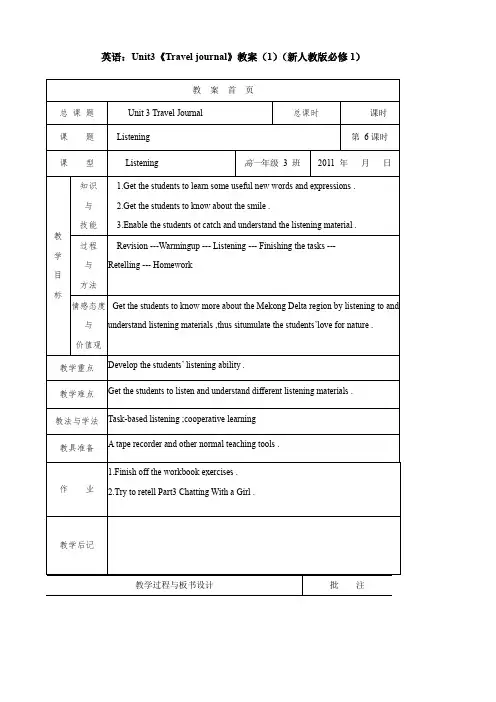
批注
Step1.Revision
1.Check the homework exercises .
2.Ask some students to make a dialogue,using the Present Continuous Tense for future actions .
教学重点
Develop the students’ listening ability .
教学难点
Get the students to listen and understand different listening materials .
教法与学法
Task-based listening ;cooperative learning
情感态度与
价值观
Enable the students love and enjoy nature .
Develop the student’s sense of group cooperration .
教学重点
Develop the students’ reading skills by extensicve reading .
Feel
Legs heavy and cold ,to vlimb the mountain was hard work ,but to go down the hills was great fun.can hardly wait to see their cousins
教学过程与板书设计
批注
3. Scanning
教学难点
Enable the students to learn to use reading stratagies .
人教版高中英语必修1全册教案
人教版高中英语必修1全册教案
Unit1Friendship
Unit2Englisharoundtheworld
Unit3Traveljournal
Unit4Earthquakes
Unit5NelsonMandela-amodernhero
新课标高中英语1(必修)教学设计与案例
Unit1
(1)课题:Friendship
(2)教材分析与学生分析:本单元的中心话题是“友谊”,几乎所有的内容都是围绕这一中心话题展开的。
WarmingUp部分以调查问卷的形式引导学生了解日常生活中朋友之间发生的真实问题以及解决这些问题的方法;Pre-Reading部分的几个问题启发学生对“友谊”和“朋友”进行思考,使学生明确不仅人与人之间可以做朋友,日记也可以成为人们的朋友;Reading部分Anne’sBestFriend以日记形式讲述了犹太女孩安妮的故事;Comprehending 部分通过连句、多项选择和问答形式帮助学生对课文内容、细节进行更深入的理解;UsingaboutLanguage部分教学本课重点词汇和重点语法项目。
(3)课时安排:Thefirstperiod:Speaking:WarmingUpandPre-Reading
Thesecondperiod:Reading
Thethirdperiod:Grammar
TheforthPeriod:Listening
Thefifthperiod:Writing
(4)教学目标:。
人教版高中英语必修1《Unit3Traveljournal》教案
人教版高中英语必修1《Unit3Traveljournal》教案人教版高中英语必修1《Unit 3 Travel journal》教案【一】教学准备教学目标1. 通过学生分享自己的旅游经历,用英语进行交流与表达。
2. 通过略读与找读,使学生获取文章主要信息,练习阅读技巧。
3. 通过小组讨论为旅游准备的物品,使学生用英语简单的语言实践活动。
教学重难点教学重点:利用阅读技巧,获取文章大意及细节教学难点:用英语交流并进行简单实践活动—旅游需要准备的物品教学过程I、Warming Up:1. I’d like to share my travelling experience with you, and would you like to share your travelling experience?2. The world has many great rivers. Have you been to these rivers?设计意图:大部分学生都喜欢旅游,老师谈谈自己旅游的经历,询问学生的旅游经历。
列举世界上著名的河流图片,让学生来欣赏认识美好的河流。
能有效地调动学生的学习积极性。
河流图片的展示,学生猜测河流的名字,唤起学生的学习兴趣以及对大自然的热爱。
II. Pre-readingHave you been to the Mekong River? What countries does the Mekong River flow through?设计意图:展示沿湄公河的地图,引起学生的兴趣,让学生观察地图,说出湄公河流经的国家,为随后的阅读做好了内容和词汇上的铺垫。
III. Reading1. SkimmingSkim the passage and find the main idea for each paragraph Para 1: DreamPara 2: A stubborn sisterPara 3: Preparation设计意图:略读:学生快速浏览课文,寻找相关信息并搭配段落大意。
人教版高中英语必修1教案Unit 3 Travel Journal
人教版高中英语必修1教案Unit 3 Travel Journal一、教学目标1.学习和掌握本单元的重点词汇和短语;2.理解并能正确运用学过的语法知识,如现在完成时等;3.能够流利地描述旅行中的经历,并表达自己对旅行的感受和看法。
二、教学内容1.重点词汇和短语:travel, journal, destination, journey, adventure, accommodation, sightseeing, scenic spot, tourist, attractions, brochure, brochure, souvenir, local, tradition;2.语法:现在完成时的构成和用法;3.阅读和写作:阅读和理解旅行日记,模仿写作旅行日记。
三、教学过程1. 导入新课老师通过展示一些美丽风景的照片来引起学生的兴趣,激发学生对旅行的兴趣,并谈论一些他们自己的旅行经历。
2. 词汇和短语学习老师通过PPT展示教材中的重点词汇和短语,并帮助学生理解和记忆。
学生可以带着课本,一起跟读和练习。
3. 语法学习老师给出现在完成时的定义和用法,并在白板上列出肯定、否定和疑问句的构成和例句。
老师解释时态中的时间状语的使用和位置,并通过举例子帮助学生理解。
4. 阅读和写作练习•老师给学生分发几篇关于旅行的日记,让学生进行阅读,并回答一些问题。
•学生根据给出的要点,模仿写一篇旅行日记。
•老师分组让学生互相交流并修改彼此的日记。
•学生在组内互相朗读自己的日记,并进行点评。
四、教学评价教师通过学生课堂表现、参与度以及小组内的互动来评价学生的学习情况。
同时,教师检查学生书写的旅行日记是否条理清晰、语法用法是否准确,并给予相应的反馈和指导。
五、拓展活动为了拓展学生的知识和兴趣,老师可以组织学生进行有关旅行的问答比赛,或者带领学生参观当地的旅游景点,增加实践和体验的机会。
六、总结通过本节课的学习,学生能够掌握旅行相关的词汇和短语,理解并运用现在完成时的语法知识,并能够写一份简单而有条理的旅行日记。
人教版高中英语必修1教案Unit3TravelJournal
人教版高中英语必修1教案Unit 3Travel urnalUnit3TravelurnalPartne:TeahingDesignPerid1:Asapleles snplanfrreadingAisTtalabuttravelingTreadabuttravelin gPreduresIaringup1aringupbdisussingGdrning,lassDul ietraveling?hdulietraveling?Andhnt?herehaveueverbee nbefre?Hdidugetthere?Ifuaregivenahanettravelarundt herld,hatindftransprtatinsilluuseandh?Nlatthefllingpit uresanddisussitinpairsNaefthetransprtatinseansftrans prtatinReasnsbarbbiebplanebtrainbbusbshipinahtball nbtrbiebeepbtruinaplate2aringupblingandspeaingNbs andgirls,hatduneedttaeithuifuarepreparingfrabietripal ngthehangiangRiver?Latthepituresandtellthehlelasshi hbetuthinisthestusefulandhihneistheleastusefulGivear easnhuthins3aringupbasingandanseringNsuppseulivei nQinghaiuplantspendahlidaithafriendsehereinSutheas tAsiauhavebeengivenahanethsethreeplaestvisitPleasef indutthene-afaretgettherefrdifferentindsftransprtatinP erhapsuantntheexatfare,butuanguesshuhthefareisPlea sehaveashrtdisussinithurpartnersandthendeideheretg,nI’dlieutasurpartnerthefllingquestins1hereareugingnhlid a?2henareuleaving?3Hareugingt…?4henareuarrivingin /at…?hereareustaing?6Hlngareustaingthere?7henareui ngba?IIPre-reading1IagingandsharingDulietravelingal ngariver,agreatriver?hatrledesariverplainpeple’slife?Intherrds,hdpeplehlivealngariveruseit?Thesugges tedansers:PepleandrintheaterinariverrashtheirlthesPep leansiinariverinsuerPepleanusearivertirrigatetheirfields PepleanusearivertprdueeletriitPepleantravelalngariver 2TalingandsharingAsealln,therearealtfriversintherldan dalsthereareangreatriversNlatthehartIntheleftlunarena esfsegreatriversIntherightlunarelatinsheretheriverslieP leaseaththeathanserNaesfRiverLatinNaesfRiverLatinengIndiaenghina,SEAsiaRhineFraneRhineGeranGangesRussiaGangesInd iaSeineEnglandSeineFraneNileentralAfriaNile EgptThaesGeranThaesEnglandngBrazilngentralAfriaNigerhina,SEAsiaNigerestAfriaVlgaUSVlgaRussiaDanube EgptDanubeentralEurpeAaznestAfriaAaznBrazilississip pientralEurpeississippiUSIIIReading1Readingaludtther erdingDunhatuntriestheengRiverflsthrugh?Nlattheapf theengRiverandpintuttheuntriesitflsthrugh,tdae’regingtreadapassageabutURNEDNTHEENGPleaseliste nandreadaludabutthererdingfthetextURNEDNTHEENG Paattentinttheprnuniatinfeahrdandthepausesithineahs enteneIillplathetapetieandushallreadaludtie,t2Reading andunderliningNpleasereadandunderlinealltheusefule xpressinsrllatinsinthepassageptheturntebafterlassashe rllatinsfrURNEDNTHEENGdreaabut,taeagreatbietrip,gr aduatefr,gtthehanetdsth,lealngtheriver,gfrlngbierides, untainbie,persuadesbtdsth,grup,getsbinterestedinsth, bestubbrn,nthebestafgettingtplaes,thesureftheriver,ar eabut,givesbadeterinedl,hangene’sind,atanaltitudef,seetd,theairbehardtbreathe,anintere stingexperiene,aeupnesind,givein,alargeatlasithgdaps, eepdingsth,atfirst,passthrugh,besurprisedtdsth,halff,at last,theSuthhinaSea3ReadingaludandunderstandingN extearegingtreadaludthetextandthenansersequestins1) hareangunandangei?2)hatastheirdrea?3)hareDaeianduHang?4)hereisthesureftheengRiverandhihseadesitenter?) hatanuseehenutravelalngtheeng?6)Isitadiffiulturnetlealngtheeng?h?4Disussingehavegtth egeneraleaningfthepassage,andenangeiandangunhav esesiilaranddifferentattitudesabutthetripuahaveashrtd isussinithurpartnersandthenfillinthehartSiilarattitudes abutthetripDifferentattitudesabutthetripBthangeianda ngunthins:1)taingthistripisadreathatestrue2)thattheille nthistripalt3)theshuldseealtftheeng4)thatstftheengillb efundinSutheastAsiaangeibelieves:1)theuststartinQing haiheretheriverbegins/seeallftheeng2)thatthedn’tneedtprepareuhangunbelieves:1)itistldandhightstarti nQinghai2)thatusinganatlasisveriprtantIVlsingdnlsing dnbanseringquestinshatshuldudbefretraveling?hatillurfailandurfiendssahen uleavehettravel?lsingdnbtranslatingInthelastfeinutesu areasedttranslatesediffiultsentenesinthepassageAssig nentRevisethententsfthepassagepletethepassagenPag e6inrbDexerise2npage7inuexerisebsPerid2:Asapleless nplanfrLearningabutLanguageAisTlearnabutthePresen tntinuusTenseTdisveranduseseusefulrdsandexpressins PreduresIaringuparingupbdisveringusefulrdsandexpre ssinsHelleverneAfterreadingthepassage,ehavegttnthe usageftherdsandexpressins,buteshulddrepratieNturnt page20tfindtherretrdsandexpressinsfrthepassagetfinis hthesentenesuaregiventinutestfinishtheanddisussithur partnersTinuteslater,heinpairsandthenheiththehlelassII Learningabutlanguage1ReadingandfindingGd,uhavea steredtheserdsandexpressinsLet’sturntpage17andlatthequestinsinaringup4Underlineth everbsinthequestins,andpaattentinttheverbfrsanddsee xplanatinsburselves2LearningGraareanseethattheverb sareallusedinthe“-ing”frTheare “thepresentntinuustense”,buttheexpressfutureatinsr plansThePresentntinuusTenseabeusedtdenteanatintha tanbepre-plannedrprearrangedinsteadfthefutureindefiniteinllquialEnglishButpleasentethat,ntallverbsanbeus edinthe“-ing”frtexpressfutureatinsSuhverbsase,g,leave,fl,al,ride,driv e,sta,eet,die,see,have,arriveetareainlusedinthe“-ing”frtexpressfutureatins3DingexerisesN2and3npage21Nt urntpage21anddexerise2Inthedialgueanespaperreprte risintervieingangeiabutherplansfrthetripalngtheengRi verHever,thearentsureabutseftheverbtensesanuhelpth epletetheirnversatin?Let’sntinuetdexerise3Duhaveanplansfrthefutureurselves?If uhavean,pleaseusethePresentntinuusTensetexpressurf utureatinsGiveasuhinfratinasuanIIIReadusedaterialsfrt hepresentntinuustensefrfutureatinsrplansbe+v-ing与表示以后的时刻连用,表示不久的以后,含义是“预定要做”。