
2014人教版八年级英语下册unit3
What will you response if somebody says “Could you please not…”?
play football on the road
Could you please not play football on the road?
I’m sorry. I won’t do it again.
Try to remember the pictures in order.
1 2 3
do the dishes
fold the clom
4
5
6
take out the rubbish
sweep the floor
make the bed
10 30 29 28 27 26 25 24 23 22 21 20 19 18 17 16 15 14 13 12 11 9 8 7 6 5 4 3 2 1
—我不喜欢这件连衣裙。 — I don’t like this dress. —我也不喜欢。 — Neither / Nor do I.
―So+系动词 (助动词或情态动词)+主语” 表示前面所述肯定内容也适用于另一主语。 Practise —玛丽经常帮她妈妈做家务。 — Mary often helps her mother do housework. — 我也是(经常帮妈妈做家务)。 — So do I.
get up early
sweep the floor
cook for us
Could you please not ...?
look out of the window
play soccer here play the computer games
有礼貌地提出请求句型: Could you please do sth.?
Unit 3
Could you please clean your room?
Section A
Period One
Words rubbish n. 垃圾;废弃物 take out the rubbish 倒垃圾 fold v. 折叠;对折 sweep v. 扫;打扫 floor n. 地板
Words
do the dishes (Yes, sure.) fold the clothes (do my homework) take out the rubbish
(clean the living room)
clean the living room
(study for my test)
make the bed (babysit my sister)
1
2
3
4
5
6
I think it is a little bit hot in our classroom and I want to ask someone to open the window. What can I say?
Different ways of saying. Can you find the difference?
could 表示有礼貌的请求,语气委婉,
常用于非熟人之间或晚辈对长辈、下级 对上级的场合。例如: Could you pass the salt to me? 请你把盐递给我,好吗? Could you please clean your room? 请你打扫一下你的房间,好吗?
She didn’t do any housework and neither did I. neither作副词,意为“也不”, “Neither +系动词 (助动词或情态动词) +主语”表示前面所述否定内容也适用 于另一个人或物。此时也可用nor替换 neither 使用。 Practise
sweep the floor (Yes, sure.)
Yes, you can. Could I … No, you can’t.
Peter
go to the movies stay out late use the car
get a ride
go to the movies
-- Could I go to the movies? -- Yes/sure, you can.
-- Could you please do the dishes?
-- Yes, Sure./ Of course. / All right. / OK.
(am studying for my test)
-- Could you please fold the clothes?
-- Sorry, I can’t. I am studying for my test.
Could you please take out the rubbish? Yes, Sure./ Of course. / All right. / OK.
(have to do my homework)
A: Could you please make the bed? B: Sorry, I can’t. I have to do my homework.
1
2
turn off the light
3
close the window
4
not play basketball here
cook for me
A: Could you please take out the rubbish? B: Yes, sure./ Of course./ All right. /OK. Sorry, I can’t. I have to do my homework. Sorry, I can’t. I am doing the dishes.
do the dishes wash the dishes
make the bed clean the living room
fold the clothes
take out the rubbish
sweep the floor
Try to remember the pictures in order.
3b Read the sentences below. Underline the sentences from the reading that mean the same thing. 1. Neither of us did any housework for a week. For one week, she did not do any housework and neither did I. 2. My mom came over as soon as I sat down in front of the TV. The minute I sat down in front of the TV, my mom came over. 3. You’re tired, but I’m tired, too. I’m just as tired as you are!
-- Yes, you can.
get a ride (搭便车)
-- Could I get a ride? -- Yes, you can.
Pair work
2c Make conversations between Peter
and his father.
A: Could I use your computer? B: Sorry. I’m going to work on it now. A: Well, could I watch TV? B: Yes, you can, but first you have to clean your room.
play computer games
(I’m going to work on it.)
-- Could I play computer games? -- Sorry, you can’t. I’m going to work on it.
-- Could I listen to music?
Which is the most polite expression?
I can say
1. Open the window! 2. Can you open the window? 3. Could you please open the window?
Look and say
Could you please ...?
smoke in public
Could you please not smoke here?
I’m sorry. I’ll go out.
Make requests and responses --- Could you please (not)…? --- Yes, sure. Of course. / All right. / OK. Ok, but I want to…first. Sorry. I can’t. I have to…
请你(做)……好吗?
Could you please not do sth.? 请你不要(做)……好吗?
What will you response if somebody says “Could you please …”?
a dirty room
Could you please clean your room? I’m sorry. I’ll do it right away. 不好意思,我马上做。
could 与 can 的用法区别 could 与 can 都是情态动词,二者都可用 于表示请求的句子中,但是用法稍有不同。 can 表示一般性的请求,语气较随便,常 用于熟人之间或长辈对晚辈、上级对下级 的场合。例如: Can you tell us your story, Tony? 请你给我们讲讲你的故事好吗,托尼?
人教版初中八年级英语下册第三单元Unit 3 教案含教学反思
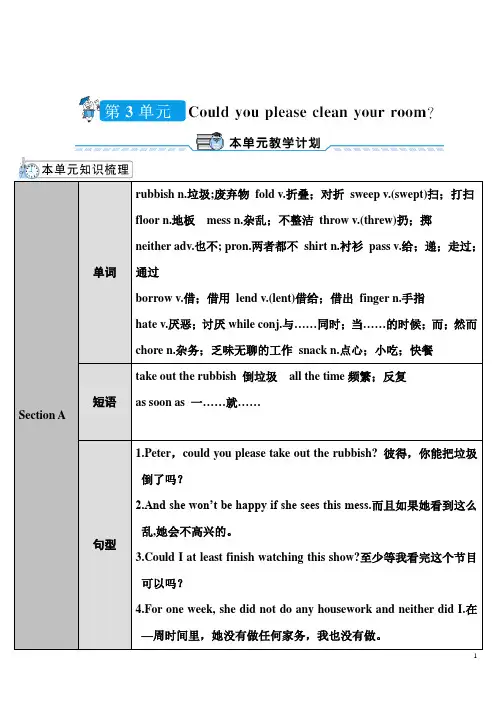
Section A 单词rubbish n.垃圾;废弃物fold v.折叠;对折sweep v.(swept)扫;打扫floor n.地板mess n.杂乱;不整洁throw v.(threw)扔;掷neither adv.也不; pron.两者都不shirt n.衬衫pass v.给;递;走过;通过borrow v.借;借用lend v.(lent)借给;借出finger n.手指hate v.厌恶;讨厌while conj.与……同时;当……的时候;而;然而chore n.杂务;乏味无聊的工作snack n.点心;小吃;快餐短语take out the rubbish 倒垃圾all the time频繁;反复as soon as 一……就……句型1.Peter,could you please take out the rubbish? 彼得,你能把垃圾倒了吗?2.And she won’t be happy if she sees this mess.而且如果她看到这么乱,她会不高兴的。
3.Could I at least finish watching this show?至少等我看完这个节目可以吗?4.For one week, she did not do any housework and neither did I.在—周时间里,她没有做任何家务,我也没有做。
that everyone should do their part in keeping it clean and tidy.既然他们和父母生活在同一所房子里,他们就应该知道每个人都应该为保持房屋的干净和整洁尽一份力。
5.The earlier kids learn to be independent,the better it is for theirfuture.孩子们越早学会独立,对他们的未来就越好。
语法情态动词could的用法掌握本单元中的重点词汇及相关短语,并灵活运用。
2014年人教版八年级英语下册Unit3单元试卷含答案
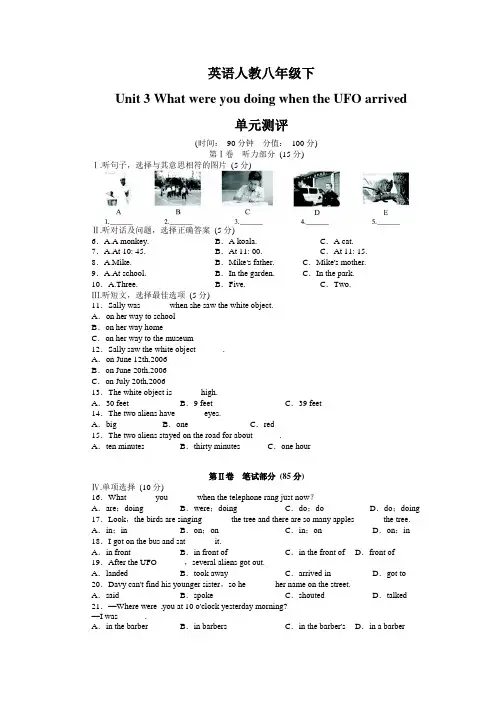
英语人教八年级下Unit 3 What were you doing when the UFO arrived单元测评(时间:90分钟分值:100分)第Ⅰ卷听力部分(15分)Ⅰ.听句子,选择与其意思相符的图片(5分)Ⅱ.听对话及问题,选择正确答案(5分)6.A.A monkey.B.A koala.C.A cat.7.A.At 10: 45. B.At 11: 00. C.At 11: 15.8.A.Mike. B.Mike's father. C.Mike's mother.9.A.At school. B.In the garden. C.In the park.10.A.Three. B.Five. C.Two.Ⅲ.听短文,选择最佳选项(5分)11.Sally was ______ when she saw the white object.A.on her way to schoolB.on her way homeC.on her way to the museum12.Sally saw the white object ______.A.on June 12th,2006B.on June 20th,2006C.on July 20th,200613.The white object is ______ high.A.30 feet B.9 feet C.39 feet14.The two aliens have ______ eyes.A.big B.one C.red15.The two aliens stayed on the road for about ______.A.ten minutes B.thirty minutes C.one hour第Ⅱ卷笔试部分(85分)Ⅳ.单项选择(10分)16.What ______ you ______ when the telephone rang just now?A.are;doing B.were;doing C.do;do D.do;doing 17.Look,the birds are singing ______ the tree and there are so many apples ______ the tree. A.in;in B.on;on C.in;on D.on;in 18.I got on the bus and sat ______ it.A.in front B.in front of C.in the front of D.front of 19.After the UFO ______,several aliens got out.A.landed B.took away C.arrived in D.got to 20.Davy can't find his younger sister,so he ______ her name on the street.A.said B.spoke C.shouted D.talked 21.—Where were you at 10 o'clock yesterday morning?—I was ______.A.in the barber B.in barbers C.in the barber's D.in a barber22.—I heard that Emilio got an “A” in this history test.—______.A.You're kidding B.I don't think soC.Oh,bad luck D.I'm sorry to hear that23.I don't know ______ her party yesterday.A.why did you go to B.why you went toC.why do you go to D.why you go to24.I met Julia ______ I was walking around the playground.A.while B.until C.before D.when25.During the past three years,several earthquakes ______ in different places of the world.A.happen B.happened C.took place D.take placeⅤ.完形填空(10分)Many people today like reading stories about UFOs.In many countries,people are 26 UFOs.There are some different ideas about UFOs.Among them,the most 27one is that they carry visitors coming from other stars.They28to fly much faster than planes.Some UFO scientists and many other people 29this idea.Some people said they saw a few UFOs land on the earth. 30people said they saw some strange visitors coming out of the UFOs.Some 31 said they were carried away in the UFOs,and then were 32by the strange visitors.Some people made mistakes when they said they ever saw UFOs.33they saw a weather balloon or an uncommon plane.Sometimes the y saw the light from the moon.But there are a lot of things we can't understand.Now,people still can't understand UFOs 34.It may35many years to find a clear answer and then people will give UFOs another name.26.A.finding B.looking for C.studying D.waiting27.A.boring B.popular C.beautiful D.unpleasant28.A.seem B.look C.like D.want29.A.agree B.disagree C.love D.believe30.A.Another B.Others C.Some D.The other31.A.even B.ever C.never D.also32.A.sent back B.sent for C.sent away D.sent down 33.A.However B.But C.Though D.Maybe34.A.strangely B.clearly C.hard D.calmly35.A.cost B.spend C.take D.payⅥ.阅读理解(20分)AIt's sometimes reported that strange objects have been seen high up in the sky.These unidentified flying objects—UFOs have made a lot of people interested.Some of the reports about them are difficult to believe.Some have been explained in scientific ways,and others have never been explained.It is not easy to decide whether a report is true or not.One report of UFOs came from a British plane on its way from New York to London in 1954.The British plane was flying over an island at 19,000 feet when the captain (机长) noticed that something was on their left and a little lower than their plane.It was about five miles away.“It was not one object but several,” the captain said,“We saw one large and six smaller objects.I sent out a signal(信号) to report about them and I received the answer that the other planes were coming out to meet us.Before the planes arrived,the smaller objects entered the big object.The big object then became smaller and moved away fast.”36.Some ______ have been explained in scientific ways.A.people B.planesC.strange objects D.of the reports about UFOs37.In 1954,a British plane met a UFO when it was flying from______to ______.A.Ame rica;France B.England;AmericaC.America;England D.New York;a small island38.The captain ______ and saw something on the left of their plane.A.looked up B.looked down C.looked back D.looked ahead 39.How many objects did the captain see?A.Seven. B.Six. C.Five. D.Only one.40.The big object moved away because ______.A.of some unknown reason B.it was afraid of the planeC.it had received a radio report D.it had stayed long enough with the planeBMary and Peter were having a picnic with some friends near a river when Mary shouted,“Look!That's a spaceship up there and it's going to land here.”Frightened(受惊吓的) by the strange spaceship,all the young people got into their cars and drove away as quickly as possible except Peter and Mary.They were more curious (好奇的) than frightened.They watched the spaceship land and saw a door open,but n obody came out,so they went to look into it.In the centre of the floor,there was a lot of food.Peter followed Mary into the spaceship and did not hear the door close behind him.The temperature fell in no time and very soon the two young people didn't know anything.When they came to themselves,they were surprised to see that they were back by the river again.The spaceship had gone.Their car was nearby.“What happened?”asked Mary.Peter scratched (搔) his head,saying slowly,“Don't ask me.Perhaps we had a pro e on.It's time to go home.”After driving about fifty metres,they found a thick wall made of something like glass stood in their way.On the other side of the wall,a few strange aliens were looking through the wall and reading a notice which,translated into (译成) English,said,“New comers at the zoo: a pair of earth villagers in their field with their house_on_wheels.”41.Which of the following is TRUE?A.It was Peter who saw the spaceship first.B.The spaceship landed on the river.C.All the young people went for the picnic by car.D.When Peter went into the spaceship,Mary followed him.42.What happened after Mary and Peter entered the spaceship?A.They were asked to eat much food.B.The temperature went up.C.Someone they couldn't see knocked them down.D.The spaceship flew away with them.43.What can we learn from the end of the story?A.Peter and Mary became villagers.B.Peter and Mary were in another planet (星球) .C.Peter and Mary went back home.D.Peter and Mary visited the zoo.44.The underlined p art “house on wheels” means “______” in this story.A.car B.space C.wall D.zoo45.How did Peter and Mary feel when they saw the strange spaceship?They felt______.A.frightened B.surprised C.amazed D.curiousⅦ.任务型阅读(10分)Many people were waiting for the train.Some were reading newspapers,and some were saying goodbye to their friends.Dr Wang,Mr Li and Mr Chen were talking so happily that they didn't know the train was going to leave.Then the guard called loudly, “The train is going to le ave.Hurry up,please.” The three men heard the call and two of them jumped on the train quickly before it moved.One was left behind.It was Dr Wang.He looked very sad.The guard came to him and said, “Don't feel sad.(A) The next train will come in_ten_minutes.” “I know,” Dr Wang said, “But it was my train.My friends only came to (B) see me off.”根据短文内容简要回答问题。
Unit 3 词汇讲解课件人教版英语八年级下册

The temperature will drop/fall in the night. drop n. 滴,水滴 a drop of 一滴… Eg: The big drops of rain fell/dropped on his head.
You can borrow some money from your parents. He refused to lend me his dictionary. You can keep the book for two weeks.
drop-dropped-dropping (及物/不及物v. ) = fall (不及物v) 落下/降落/下降
while conj 当…时(when),与…同时 while: 一般指一段时间,谓语动词用延续性v
常用进行时 when: 可指瞬间,也可指一段时间,谓动瞬间/延续
常用一般时
Eg:I came home while/when Mom was cooking. = While/When Mom was cooking, I came home. = When I came home, Mom was cooking. I was doing my homework while Mom was reading.
常用短语:
drop in on sb 顺便拜访某人 drop in at sp顺便拜访某地 drop by 顺便拜访 drop down 落下 drop out 退学
hate: = dislike ---like/love 不用于进行时 hate doing sth(经常性) hate to do sth (一次性) 讨厌做某事 Eg: I hate rainy days.
人教版初中英语八年级下册Unit3 课文讲解知识点及练习

1Unit3 Could you please clean your room? Section Ahelp sb. (to ) d o /with sth 帮助某人干某事重点短语bring a tent带顶帐篷来go out for dinner 出去吃饭buy some snacks买些小吃stay out late 在外面待到很晚go to the store去商店go to the movies 去看电影invite sb. to a partyget a ride 搭车邀请某人参加聚会make sb. do sth. 使某人做某事work on 从事enough stressfinish doing sth. 足够的压力完成做某事waste of time浪费时间clean and tidy 干净整洁in order todo the dishes 洗餐具为了get good grades取得好成绩take out the rubbish 倒垃圾mind doing sth. 介意做某事your/the clothes 叠衣服folddepend on依赖sweep the floor 扫地;依靠develop children's independence发展孩子的整理床铺make your/the bed独立性打扫客厅clean the living roomlook after/take care of no problem 没问题照顾;照看do one's part in (doing ) sth.做某人分内的事欢迎某人welcome sb.二、重点句型下班回家放学come home fro m school/ work/..do sth. ? 1. Could you please…throw down 扔下你能整理room?please clean your you Could sit down 坐下过来come over 一下你的房间吗?take sb. for a walk 带某人去散步我必须干些活。
人教版八年级下册英语Unit3重点知识汇总
人教版八年级下册英语Unit3重点知识汇总Unit 3 in the People's Education Press edition of the 8th grade English textbook covers various topics related to free time activities. Here is a summary of the key knowledge points in this unit:1. Vocabulary:- Free time activities: such as playing sports, playing musical instruments, reading books, watching movies, listening to music, shopping, and so on.- Verbs related to activities: play, go, do, watch, listen to, read, go shopping, etc. - Adjectives to describe activities: fun, interesting, relaxing, exciting, etc.- Adverbs of frequency: always, usually, often, sometimes, rarely, never, etc.- Expressing preferences: like, love, enjoy, don't mind, dislike, hate, etc.2. Grammar:- The present simple tense: used to talk about general truths, habits, routines, and permanent situations.- The present simple tense with adverbs of frequency: used to talk about how often something happens.- Questions and short answers with the present simple tense: used to ask about habits, routines, and preferences.- Imperatives: used to give instructions or commands.- Comparatives and superlatives: used to compare two or more things.3. Sentence structure:- Sentence patterns for talking about free time activities: subject + verb + object. - Sentences with adverbs of frequency: subject + adverb of frequency + verb + object.- Questions with the present simple tense: Auxiliary verb + subject + infinitive verb + object?- Imperatives: Just verb + object.- Comparatives and superlatives: Subject + verb + (adjective/adverb) + than + object.4. Listening and speaking skills:- Listening for specific information: listening for details about someone's free time activities.- Speaking about preferences: expressing likes and dislikes about free time activities.5. Reading skills:- Reading for main ideas: skimming a text to understand the overall topic.- Reading for details: scanning a text to find specific information.It's important to review and practice these key knowledge points through various activities, such as completing exercises, having conversations, and reading and listening to texts in order to reinforce understanding and improve language skills.。
2014春季最新八年级人教版英语下册unit3SectionB 2b 课文详解
花费 spend pay cost take
• sb. spend money/time on sth. • (in) doing sth. • 花时间或金钱在某物上/干某事
• sb. pay money for sth.某人付钱买某物 • sth. costs sb. money 某物花了某人多少钱 • It takes sb. time to do sth.干某事花了某人 多少时间
家长让孩子做家务活的好处:
• 孩子帮助家长从事适当的家务劳动可以加 强责任感,培养动手能力和观察能力,有 利于家庭成员间的理解和沟通。在做家务 中会遇到各种难题,会促使他们思考解决 的办法,还能增强耐心和坚持不懈的精神。
Reading strategy :Skimming 阅读策略:略读
• This means looking quickly through a piece of writing to find the main idea without reading every word. It is still a good idea to read the first sentence in each paragraph a little more carefully. • 这意味着不用读每一个单词,而是快速地 浏览一篇文章去找到主要意思。再仔细一 点去读每段中第一个句子也是一个很好的 主意。
Useful words and phrases 1
• a waste of time浪费时间
• • • • • •
in order to为了 provide …for…提供某物给某人 depend on依靠 develop one’s independence 培养某人的独立能力
人教版英语八年级下册 Unit 3 课文解读(含单词、短语等)
BSroetchtieorn: FAin(e2.dW) h中a英t d文o you want me to do? Sister: Could you take out the rubbish, fold the clothes and do the dishes?
3. all the time
一直;总是=always 常见的含all的短语: after all 毕竟,终究;all in all 总而言之 all over 遍及;not … at all 一点也不 all of a sudden 突然;first of all 首先 above all 最重要的是;in all 总共,共计
八下Unit 3 Could you please clean your room?
Grace
八下Unit 3 Section A (2d)
Sister: Tony, could you please help out with a few things?
Brother: Could I at least finish watching this show?
Brother: So much?
Sister: Yes, because Mom will be back from shopping any minute now. And she won't be happy if she sees this mess.
Brother: But the house is already pretty clean and tidy!
“Well, I work all day at school, too! I'm just as tired as you are!” I shouted back. “哦,我在学校也学习一天了!我和你一样累!”我大喊着回应道。
人教版八年级下册英语Unit3 重点词汇讲解练习
人教版八年级下册英语Unit3 重点词汇讲解练习Unit3 Could you please clean your room?一、课文短语1.borrow sth. from sb. 向某人借东西2.lend sth. to sb.=lend sb. sth. 把东西借给某人3.hate to do chores 讨厌做家务4.invite my friends to a party 邀请我的朋友参加聚会5.have enough stress from school 来自学校足够的压力6. a waste of time 浪费时间7.spend their time on schoolwork 花费时间在学业上8.There is no need for sb. to do sth. 对于某人来说没有必要做某事9.provide a clean and comfortable environment 提供一个干净、舒适的环境10.d on’t mind doing sth 不介意做某事11.l earn how to do chores 学习怎样做家务12.I t’s not enough to do sth. 做某事是不够的13.d epend on 依赖;依靠14.d evelop children’s independence 培养孩子们的独立性15.t he grades dropped 成绩下降二、重点词汇讲解1. as a result2. waste3. pass4. borrow&lend5. depend6. while7. provide讲解版1. as a resultas a result意为“因此;结果”as a result of意为“由于……;作为……的结果”2. wastewaste 作不可数名词,意为“浪费,废物,垃圾”。
waste 作及物动词,意为“浪费”。
人教版八年级下册英语 Unit 3 单元知识点总结(含练习题及答案)
人教版八年级下册英语Unit 3 单元知识点总结Section Augh v. & n. 笑We all laughed loudly when she made a joke. 她说了个笑话,我们都大声笑起来。
We all laughed at his joke. 听了他的笑话我们都笑起来。
He laughs best who laughs last. 谁笑在最后,谁笑得最好。
/不要高兴得太早。
(与at连用)嘲笑Don’t laugh at him. 别嘲笑他。
People have often laughed at stories told by seamen. 人们常常嘲笑海员所讲的故事。
Everyone laughed at his foolish antics. 大家都笑他那种愚蠢的滑稽动作。
N. 笑;笑声We had a good laugh at his joke. 我们被他的笑话逗得哈哈大笑。
2. though conj. 虽然;纵然;即使;尽管= althoughThough it was raining,he went there. 虽然当时正下着雨,他还是到那里去了。
Though he was poor he was happy. 虽然他很穷却很快乐。
注意:不能受汉语的影响,在though引导的从句后使用but。
如:Though he was poor,but he was happy.(误)though adv.. 不过,可是,然而,常用于句末,用逗号隔开。
Jim said that he would come, he didn’t , though.English is difficult to learn. I like it,though.英语难学,不过我喜欢它。
3. quietly轻声地,安静地,平静地quiet轻声的,安静的,平静的The students walked to a quiet place.同学们向一个安静的地方走去。
年春人教版最新八年级英语下册《Unit3 Could you please clean your room》教案(第4课时)
课时编号:授课时间:第周星期(2014年月日)第周星期(2014年月日)科目英语年级八年级班主备教师钟丽课题Unit 3Could you please clean yourroom? Section B 1 (1a-2e)授课教师教学目标1. 生词和短语care, feed, take care of, mine2. 重点句式Could you please do these things every day?Give him water and feed him.Don’t forget to clean his bed.3.能力目标Enable students to write an e-mail message asking for help.4.学能目标Help students learn how to write an e-mail message with the target language.教学重点Expressions used to make request.教学难点Expressions used to make request.教具教法Tape recorder, a projector, a computer and test papers.教学过程教学活动个人复备Step 1 Review单项选择。
1. -- Could you please take care of my dog?-- ______. I’m too busy.A. Yes, you canB. SureC. Sorry, I can’t2. -- Could you please ____ his bed?-- Certainly!A. makesB. makingC. make3. -- Could I use your car?-- ______.A. Sure, you canB. Sorry, you canC. Sure, I can4. Could you help _____?A. making the bedB. make the bedC. made the bedStep 2 DiscussionQ1: Do you help your parents do the chores at home?Q2: Do you ask your parents’ permission for?Q3: Do your parents ask you to do some things for them?Give some pictures and answer the following questions.What do your parents ask you to do?What do you ask your parents’ permission for?Step 3Finish 1a. What do teenagers ask their parents’permission for? What do parents ask their teenagers to do?Write parents or teenagers next to each phrase.1. buy some drinks and snacks2. borrow some money3. clean your room4. invite my friends to a party5. go to the store6. use your CD player7. take out the rubbish8. make your bedStep 4.Finish 1b. Use the phrases in 1a to make conversations.Step 5 Pair work1. Parents: Could you please…?Child: Yes, sure. / Sorry, I can’t. I have to ...2. Child: Could I …?Parents: Yes, you can. / No, you can’t. You ...Finish 1c. Listen to a conversation between Sandy and her mom. Check (√ ) the things in 1a that you hear.1. buy some drinks and snacks2. borrow some money3. clean your room4. invite my friends to a party5. go to the store6. use your CD player7. take out the rubbish8. make your bedFinish 1d. Listen again. Fill in the chart.What are they going to do?Sandy’s momSandy invite her friendsSandy and DaveStep 7 Finish 1e.You are having a party. Invite your partner to come your party and ask for help with these things. So, talk about the following things with your partner.e.g.A: Would like to come to my birthday party?B: Yes, I’d love to./Sorry, I can’t. I have to…A: Could you please take out the rubbish?B: Yes, sure./No, I can’t. I have to do…1. Warming up2a. Discuss the questions with your partner1) What do you often do to help your parents at home?2) Do you think kids should help out with chores at home?2. New wordsstress n. 精神压力; 心理负担waste n.浪费; 垃圾v. 浪费; 滥用depend v. 依靠; 依赖w W w . X k b 1.c O mdevelop v. 发展; 壮大fairness n.公正性; 合理性since conj. 因为; 既然prep., conj. & adv. 从……以后; 自……以来eighbor(= neighbour) n. 邻居drop v. 落下; 掉下3. Skimming2b. The Sunday Mail magazine invited parents to write about whether they think young people should do chores at home. Skim the following letters. Which one agrees and which one disagrees?了解阅读策略:Skimming 意为“快速掠过,从中提取最容易取得的精华”。