
日语专八考题(2012)
2012年日语专业八级考试文学文化题及答案
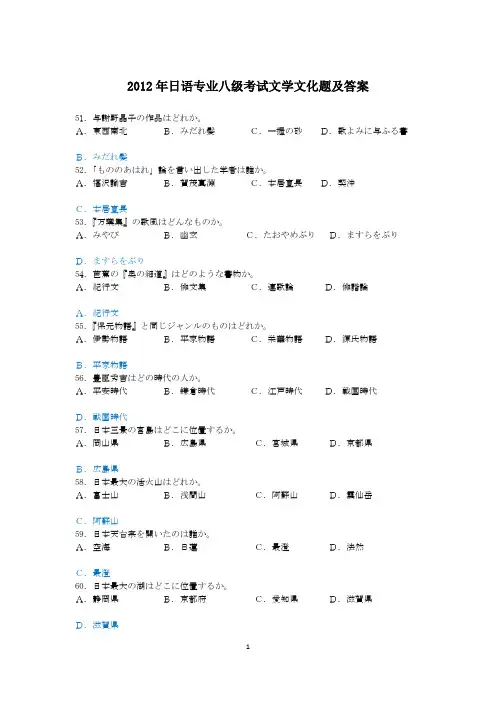
2012年日语专业八级考试文学文化题及答案
51.与謝野晶子の作品はどれか。
A.東西南北B.みだれ髪C.一握の砂D.歌よみに与ふる書
B.みだれ髪
52.「もののあはれ」論を言い出した学者は誰か。
A.福沢諭吉B.賀茂真淵C.本居宣長D.契沖
C.本居宣長
53.『万葉集』の歌風はどんなものか。
A.みやびB.幽玄C.たおやめぶりD.ますらをぶり
D.ますらをぶり
54.芭蕉の『奥の細道』はどのような書物か。
A.紀行文B.俳文集C.連歌論D.俳諧論
A.紀行文
55.『保元物語』と同じジャンルのものはどれか。
A.伊勢物語B.平家物語C.栄華物語D.源氏物語
B.平家物語
56.豊臣秀吉はどの時代の人か。
A.平安時代B.鎌倉時代C.江戸時代D.戦国時代
D.戦国時代
57.日本三景の宮島はどこに位置するか。
A.岡山県B.広島県C.宮城県D.京都県
B.広島県
58.日本最大の活火山はどれか。
A.富士山B.浅間山C.阿蘇山D.雲仙岳
C.阿蘇山
59.日本天台宗を開いたのは誰か。
A.空海B.日蓮C.最澄D.法然
C.最澄
60.日本最大の湖はどこに位置するか。
A.静岡県B.京都府C.愛知県D.滋賀県
D.滋賀県
1。
2012年专八 真题(完整版)
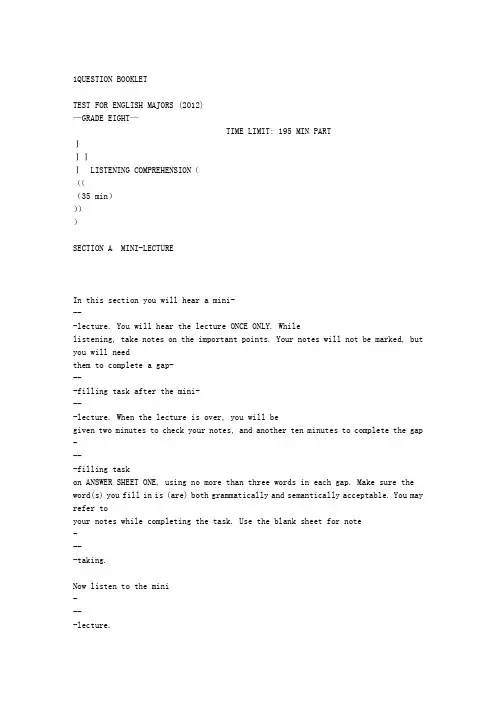
1QUESTION BOOKLETTEST FOR ENGLISH MAJORS (2012)¡ªGRADE EIGHT¡ªTIME LIMIT: 195 MIN PART¢ñ¢ñ¢ñ¢ñ LISTENING COMPREHENSION£¨£¨£¨£¨35 min£©£©£©£©SECTION A MINI-LECTUREIn this section you will hear a mini----lecture. You will hear the lecture ONCE ONLY. Whilelistening, take notes on the important points. Your notes will not be marked, but you will needthem to complete a gap----filling task after the mini----lecture. When the lecture is over, you will begiven two minutes to check your notes, and another ten minutes to complete the gap----filling taskon ANSWER SHEET ONE, using no more than three words in each gap. Make sure theword(s) you fill in is (are) both grammatically and semantically acceptable. You may refer toyour notes while completing the task. Use the blank sheet for note ----taking.Now listen to the mini--lecture.Observing BehaviourPeople do observation in daily life context for safety or for proper behaviour. However, there aredifferences in daily-life observation and research observation.A. Differences---- daily life observation-casual-(1) ________-dependence on memory (1)____________---- research observation- (2) _________ (2)____________2- careful record keepingB. Ways to select samples in research---- time sampling- systematic: e.g. fixed intervals every hour- random: fixed intervals but (3) _______ (3)____________Systematic sampling and random sampling are often used in combination. ---- (4) _______ (4)____________- definition: selection of different locations- reason: humans¡¯ or animals¡¯ behaviour (5) ______ across (5) ____________circumstances- (6) ______: more objective observations (6)____________C. Ways to record behaviour (7) _______ (7)____________---- observation with intervention- participant observation: researcher as observer and participant - field experiment: research (8) ______ over conditions (8)____________---- observation without intervention-purpose: describing behaviour (9) ______ (9)____________- (10) ______ : no intervention- researcher: a passive recorder (10) ____________SECTION BINTERVIEWIn this section you will hear everything ONCE ONLY. Listen carefully and then answer thequestions that follow. Mark the correct answer to each question on ANSWER SHEET TWO.Questions 1 to 5 are based on an interview. At the end of the interview you will be given 10seconds to answer each of the following five questions.3Now listen to the interview.1. Which of the following statements about creativity is INCORRECT?A. Creativity stems from human beings' novel thinking.B. The duration of the creative process varies from person to person.C. Creative people focus on novel thinking rather than on solutions.D. The outcome of human creativity comes in varied forms.2. The interviewee cites the Bach family to show that creativityA. seems to be attributable to genetic makeup.B. appears to be the result of the environment.C. appears to be more associated with great people.D. comes from both environment and genetic makeup.3. How many types of the creative process does the interviewee describe?A. One.B. Two.C. Three.D. Four.4. Which of the following features of a creative personality is NOT mentioned in the interview?A. Unconventional.B. Critical.C. Resolute.D. Original.5. The interviewee's suggestion for a creativity workout supports the view thatA. brain exercising will not make people creative.B. most people have diversified interests and hobbies.C. creativity can only be found in great people.D. the environment is significant in the creative process. SECTION C NEWS BROADCASTIn this section you will hear everything ONCE ONLY. Listen carefully and then answer thequestions that follow. Mark the best answer to each question on ANSWER SHEET TWO.Question 6 is based on the following news. At the end of the news item, you will be given 10seconds to answer the question.Now listen to the news.6. What is the news item mainly about?A. A problem in the cooling system was solved.B. A 350-kilogram ammonia pump was removed.4C. U.S. astronauts made three space walks.D. An international space station was set up.Questions 7 and 8 are based on the following news. At the end of the news item, you will begiven 20 seconds to answer the questions.Now listen to the news.7. In which country would parents often threaten to punish children by leaving them outside?A. India.B. Egypt.C. The Philippines.D. Not mentioned.8. What is the main purpose of the study?A. To reveal cultural differences and similarities.B.. To investigate ways of physical punishment.C. To analyze child behaviour across countries.D. To expose cases of child abuse and punishmentQuestions 9 and 10 are based on the following news. At the end of the news item, you will begiven 20 seconds to answer the questions. Now listen to the news.9. According to the news item, Japan's economic growth in the second quarter was ____less than the first quarter.A. 4 percentB. 3 percentC. 0.6 percentD. 3.4 percent10. How many reasons does the news item cite for Japan's slow economic growth?A. 2.B. 3.C. 4.D. 5.PART ¢ò¢ò¢ò¢ò READING COMPREHENSION (30 MIN)In this section there are four reading passages followed by a total of 20 multiple-choicequestions. Read the passages and then mark the best answer to each question on ANSWERSHEET TWO.TEXT A5I used to look at my closet and see clothes. These days, whenever I cast my eyes upon thestacks of shoes and hangers of shirts, sweaters and jackets, I see water. It takes 569 gallons to manufacture a T-shirt, from its start in the cotton fields to itsappearance on store shelves. A pair of running shoes? 1,247 gallons. Until last fall, I'd been oblivious to my "water footprint", which is defined as the total volumeof freshwater that is used to produce goods and services, according to the Water FootprintNetwork. The Dutch nonprofit has been working to raise awareness of freshwater scarcity since2008, but it was through the "Green Blue Book" by Thomas M. Kostigen that I was able to seehow my own actions factored in.I've installed gray-water systems to reuse the wastewater from my laundry machine andbathtub and reroute it to my landscape - systems that save, on average,50 gallons of water per day.I've set up rain barrels and infiltration pits to collect thousands of gallons of storm water cascadingfrom my roof. I've even entered the last bastion of greendom -installing a composting toilet.Suffice to say, I've been feeling pretty satisfied with myself for all the drinking water I'vesaved with these big-ticket projects.Now I realize that my daily consumption choices could have an even larger effect ¨Cnot onlyon the local water supply but also globally: 1.1 billion people have no access to freshwater, and, inthe future, those who do have access will have less of it.To see how much virtual water 1 was using, I logged on to the "Green Blue Book" websiteand used its water footprint calculator, entering my daily consumption habits. Tallying up thewater footprint of my breakfast, lunch, dinner and snacks, as well as my daily dose ofover-the-counter uppers and downers - coffee, wine and beer- I'm using 512 gallons of virtualwater each day just to feed myself.In a word: alarming.Even more alarming was how much hidden water I was using to get dressed. I'm hardly aclotheshorse, but the few new items I buy once again trumped the amount of water flowing frommy faucets each day. If I'm serious about saving water, I realized I could make some simplelifestyle shifts. Looking more closely at the areas in my life that use the most virtual water, it wasfood and clothes, specifically meat, coffee and, oddly, blue jeans and leather jackets.Being a motorcyclist, I own an unusually large amount of leather - boots and jackets inparticular. All of it is enormously water intensive. It takes 7,996 gallons to make a leather jacket,leather being a byproduct of beef. It takes 2,866 gallons of water to make a single pair of bluejeans, because they're made from water-hogging cotton.Crunching the numbers for the amount of clothes I buy every year, it looks a lot like myfriend's swimming pool. My entire closet is borderline Olympic. Gulp.My late resolution is to buy some items used. Underwear and socks are,of course, exemptfrom this strategy, but 1 have no problem shopping less and also shoppingat Goodwill. In fact, I'dbeen doing that for the past year to save money. My clothes' outrageous water footprint justreintbrced it for me.More conscious living and substitution, rather than sacrifice, are the prevailing ideas with thewater footprint. It's one I'm trying, and that's had an unusual upside.I had a hamburger recently,and I enjoyed it a lot more since it is now an occasional treat rather than a weekly habit.(One gallon =3.8 litres)6 11. According to the passage, the Water Footprint NetworkA. worked for freshwater conservation for nonprofit purposes.B. collaborated with the Green Blue Book in freshwater conservation.C. made the author aware of freshwater shortage.D. helped the author get to know the Green Blue Book 12. Which of the following reasons canbest explain the author's feeling of self-satisfaction?A. His house was equipped with advanced water-saving facilities.B. Money spent on upgrading his household facilities was worthwhile.C. He made contribution to drinking water conservation in his own way.D. He could have made even greater contribution by changing his lifestyle.13. According to the context, "...how my own actions factored in" meansA. how I could contribute to water conservation.B. how much of what I did contributed to freshwater shortage.C. what behaviour could be counted as freshwater-saving.D. what efforts I should make to save fresh water. 14. According to the passage, the author was more alarmed by the fact thatA. he was having more meat and coffee.B. his lifestyle was too extravagant.C. globally there will be less fresh water.D. his clothes used even more virtual water. 15. "My entire closet is borderline Olympic" is an example ofA. exaggeration.B. analogy.C. understatement.D. euphemism.7 16. What is the tone of the author in the last paragraph'?A. Sarcastic.B. Ironic.C. Critical.D. Humorous.TEXT B In her novel of "Reunion, American Style", Rona Jaffe suggests that a class reunion "is morethan a sentimental journey. It is also a way of answering the question that lies at the back of nearlyall our minds. Did they do better than I?"Jaffe's observation may be misplaced but not completely lost. According to a study conductedby social psychologist Jack Sparacino, the overwhelming majority who attend reunions aren'tthere invidiously to compare their recent accomplishments with those of their former classmates.Instead, they hope, primarily, to relive their earlier successes. Certainly, a few return to show their former classmates how well they have done; othersenjoy observing the changes that have occurred in their classmates (not always in themselves, ofcourse). But the majority who attend their class reunions do so to relive the good times theyremember having when they were younger. In his study, Sparacino found that, as high schoolstudents, attendees had been more popular, more often regarded as attractive, and more involvedin extracurricular activities than those classmates who chose not to attend. For those who turnedup at their reunions, then, the old times were also the good times! It would appear that Americans have a special fondness for reunions, judging by theirprevalence. Major league baseball players, fraternity members, veterans groups, high school andcollege graduates, and former Boy Scouts all hold reunions on a regular basis. In addition, familyreunions frequently attract blood relatives from faraway places who spend considerable moneyand time to reunite.Actually, in their affection for reuniting with friends, family or colleagues, Americans areprobably no different from any other people, except that Americans have created a mind-bogglingnumber and variety of institutionalized forms of gatherings to facilitate the satisfaction of thisdesire. Indeed, reunions have increasingly become formal events that are organized on a regularbasis and, in the process, they have also become big business. Shell Norris of Class Reunion, Inc., says that Chicago alone has 1,500 high school reunionseach year. A conservative estimate on the national level would be 10,000 annually. At one time,all high school reunions were organized by volunteers, usually female homemakers. In the last fewyears, however, as more and more women have entered the labour force, alumni reunions areincreasingly being planned by specialized companies rather than by part-time volunteers.8The first college reunion was held by the alumni of Yale University in 1792. Graduates ofPennsylvania, Princeton, Stanford, and Brown followed suit. And by the end of the 19th century, most 4-year institutions were holding alumni reunions.The variety of college reunions is impressive. At Princeton, alumni parade through the townwearing their class uniforms and singing their alma mater. At Marietta College, they gather for adinner-dance on a steamship cruising the Ohio River.Clearly, the thought of cruising on a steamship or marching through the streets is usually not,by itself, sufficient reason for large numbers of alumni to return to campus. Alumni who decide toattend their reunions share a common identity based on the years they spent together asundergraduates. For this reason, universities that somehow establish a common bond ¨C forexample, because they are relatively small or especially prestigious - tend to draw substantialnumbers of their alumni to reunions. In an effort to enhance this common identity, larger collegesand universities frequently build their class reunions on participation in smaller units, such asdepartments or schools. Or they encourage "affinity reunions" for groups of former cheerleaders,editors, fraternity members, musicians, members of military organizations on campus, and thelike.Of course, not every alumnus is fond of his or her alma mater. Students who graduatedduring the late 1960s may be especially reluctant to get involved in alumni events. They were partof the generation that conducted sit-ins and teach-ins directed at university administrators,protested military recruitment on campus and marched against "establishment politics." If thisgeneration has a common identity, it may fall outside of their university ties - or even be hostile tothem. Even as they enter their middle years, alumni who continue to hold unpleasant memories ofcollege during this period may not wish to attend class reunions. 17. According to the passage, Sparacino's studyA. found that interest in reunions was linked with school experience.B. found evidence for attendees' intense desire for showing off success.C. showed that attendees tended to excel in high school study.D. provided strong evidence for Jaffe's statement. 18. Which of the following is NOT mentioned as a distinct feature of U.S. class reunions?A. Class reunions have become a profitable business.B. Class reunions have brought about a variety of activities.C. Reunions are regular and formal events organized by professional agencies.D. U.S. class reunions are usually occasions to show off one's recent success. 19. What mainly attracts many people to return to campus for reunion?A. Shared experience beyond the campus.9B. Shared undergraduate experience on campus.C. The special status their university enjoys.D. The variety of activities for class reunion. 20. The rhetorical function of the first paragraph is toA. serve as prelude to the author's argument.B. present the author's counterargument.C. introduce Rona Jeffe's novel.D. bring into focus contrasting opinions. 21. What is the passage mainly about?A. Alumni reunions and American university traditions.B. Alumni reunion and its social and economic implications.C. Reasons for popularity and (non)attendance for alumni reunions.D. A historical perspective for alumni reunions in the United States. TEXT COne time while on his walk George met Mr. Cattanzara coming home very late from work.He wondered if he was drunk but then could tell he wasn't. Mr. Cattanzara, a stocky, bald-headedman who worked in a change booth on an IRT station, lived on the nextblock after George's,above a shoe repair store. Nights, during the hot weather, he sat on his stoop in an undershirt,reading the New York Times in the light of the shoemaker's window. He read it from the first pageto the last, then went up to sleep. And all the time he was reading the paper, his wife, a fat womanwith a white face, leaned out of the window, gazing into the street, her thick white arms foldedunder her loose breast, on the window ledge.Once in a while Mr. Cattanzara came home drunk, but it was a quiet drunk. He never madeany trouble, only walked stiffly up the street and slowly climbed the stairs into the hall. Thoughdrunk he looked the same as always, except for his tight walk, the quietness, and that his eyeswere wet. George liked Mr. Cattanzara because he remembered him giving him nickels to buylemon ice with when he was a squirt. Mr. Cattanzara was a different type than those in theneighbourhood. He asked different questions than the others when he met you, and he seemed toknow what went on in all the newspapers. He read them, as his fat sick wife watched from thewindow."What are you doing with yourself this summer, George?" Mr. Cattanzara asked. "l see youwalkin' around at night."George felt embarrassed. "I like to walk.""What are you doin' in the day now?"11 B. George was forced to tell a lie and then regretted.C. Mr. Cattanzara was doubtful about George throughout.D.. Mr. Cannazara was surprised at George's reading plan.24. After the street conversation with Mr. Cattanzara, GeorgeA. remained the same as usual.B. became more friendly with Mr. Cattanzara.C. began to like his neighbours more than ever.D. continued to read the books from the list. 25. We can tell from the excerpt that GeorgeA. found his neighbours liked to poke their nose into him.B. found that his sister remained skeptical about him.C. was dissatisfied with his life and surroundings.D. had a neither close nor distant relationship with his father. TEXTD Abraham Lincoln turns 200 this year, and he's beginning to show his age. When his birthdayarrives, on February 12, Congress will hold a special joint session in the Capitol's NationalStatuary Hall, a wreath will be laid at the great memorial in Washington, and a webcast will linkschool classrooms for a "teach-in" honouring his memory.Admirable as they are, though, the events will strike many of us Lincoln fans as inadequate,even halfhearted - and another sign that our appreciation for the 16th president and his toweringachievements is slipping away. And you don't have to be a Lincoln enthusiast to believe that thisis something we can't afford to lose.Compare this year's celebration with the Lincoln centennial, in 1909. That year, Lincoln'slikeness made its debut on the penny, thanks to approval from the U.S. Secretary of the Treasury.Communities and civic associations in every comer of the country erupted in parades, concerts,balls, lectures, and military displays. We still feel the effects today: The momentum unloosed in1909 led to the Lincoln Memorial, opened in 1922, and the Lincoln Highway, the first pavedtranscontinental thoroughfare.The celebrants in 1909 had a few inspirations we lack today. Lincoln's presidency was still aliving memory for countless Americans. In 2009 we are farther in time from the end of the SecondWorld War than they were from the Civil War; families still felt the loss of loved ones from thatawful national trauma.But Americans in 1909 had something more: an unembarrassed appreciation for heroes andan acute sense of the way that even long-dead historical figures press in on the present and makeus who we are.One story will illustrate what l'm talking about.12In 2003 a group of local citizens arranged to place a statue of Lincoln in Richmond, Virginia,former capital of the Confederacy. The idea touched off a firestorm of controversy. The Sons ofConfederate Veterans held a public conference of carefully selected scholars to "reassess" thelegacy of Lincoln. The verdict - no surprise - was negative: Lincoln was labeled everything from aracist totalitarian to a teller of dirty jokes.I covered the conference as a reporter, but what really unnerved me was a counter-conferenceof scholars to refute the earlier one. These scholars drew a picture of Lincoln that only ourtouchy-feely age could conjure up. The man who oversaw the most savage war in our history wasdescribed - by his admirers, remember - as "nonjudgmental," "unmoralistic," "comfortable withambiguity."I felt the way a friend of mine felt as we later watched the unveiling of the Richmond statuein a subdued ceremony: "But he's so small!"The statue in Richmond was indeed small; like nearly every Lincoln statue put up in the pasthalf century, it was life-size and was placed at ground level, a conscious rejection of the heroic -approachable and human, yes, but not something to look up to.The Richmond episode taught me that Americans have lost the language to explain Lincoln'sgreatness even to ourselves. Earlier generations said they wanted their children to be like Lincoln:principled, kind, compassionate, resolute. Today we want Lincoln to be like us.This helps to explain the long string of recent books in which writers have presented aLincoln made after their own image. We've had Lincoln as humorist and Lincoln asmanic-depressive, Lincoln the business sage, the conservative Lincoln and the liberal Lincoln, theemancipator and the racist, the stoic philosopher, the Christian, the atheist - Lincoln over easy andLincoln scrambled.What's often missing, though, is the timeless Lincoln, the Lincoln whom all generations, ourown no less than that of 1909, can lay claim to. Lucky for us, those memorializers from a centuryago - and, through them, Lincoln himself- have left us a hint of where to find him. The LincolnMemorial is the most visited of our presidential monuments. Here is where we find the Lincolnwho endures: in the words he left us, defining the country we'veinherited. Here is the Lincolnwho can be endlessly renewed and who, 200 years after his birth, retains the power to renew us. 26. The author thinks that this year's celebration is inadequate and even halfhearted becauseA. no similar appreciation of Lincoln will be seen.B. no activities can be compared to those in 1909.C. no Lincoln statue will be unveiled.D. no memorial coins will be issued.27. According to the passage, what really makes the 1909 celebrations different from thisyear's?A. Structures constructed in memory of Lincoln.B. Variety and magnitude of celebration activities.C. Respect for great people and their influence.D. Temporal proximity to Lincoln's presidency.1328. In the author's opinion, the counter-conferenceA. rectified the judgment by those carefully selected scholars.B. resulted in similar disparaging remarks on Lincoln.C. came up with somewhat favourable conclusions.D. offered a brand new reassessment perspective.29. According to the author, the image of Lincoln conceived by contemporary peopleA. reveals the variety of current opinions on heroes.B. shows the present-day desire to emulate Lincoln.C. reflects the present-day tendency of worship.D. conforms to traditional images.30. Which of the following best explains the implication of the last paragraph?A. The memorial is symbolic of the great man's achievements.B. Lincoln's greatness remains despite the passage of time.C. Each generation has it own interpretation of Lincoln.D. People get to know Lincoln through memorializers. PART III GENERAL KNOWLEDGE (10 MIN) There are ten multiple-choice questions in this section. Mark the best answer toeach question on ANSWER SHEET TWO. 31. The Maori people are natives ofA. Australia.B. Canada.C. Ireland.D. New Zealand.32. The British monarch is the Head ofA. Parliament.B. Government.C. State.D. Cabinet.1433. Americans celebrate Independence Day onA. October 11th.B. July 4th.C. May 31st.D. September 6th.34. Canada is bounded on the north byA. the Great Lakes..B. the Atlantic Ocean.C. the Pacific OceanD. the Arctic Ocean.35. Who is the author of The Waste Lana?A. T.S. Eliot.B. W.B. Yeats.C. Dylan Thomas.D. George Bernard Shaw.36. Which of the following novelists wrote The Sound and the Fury?A. John Steinbeck.B. Ernest Hemingway.C. Scott Fitzgerald.D. William Faulkner.37. "The lettuce was lonely without tomatoes and cucumbers for company" is an example ofA. exaggeration.B. personification.C. understatement.D. synecdoche.1538. In English if a word begins with a [l] or a [r], then the next sound must be a vowel. This is a(n)A. sequential rule.B. grammar rule.C. deletion rule.D. assimilation rule.39. Which of the following is an example of clipping?A.APEC.B.Motel.C. Disco.D. Xerox.40. The type of language which is selected as appropriate to a particulartype of" situation is calledA. variety.B. dialect.C. slang.D. register. PART IV PROOFREADING & ERROR CORRECTION (15 MIN)The passage contains TEN errors. Each indicated line contains amaximum of ONE error. In each case, only ONE word is involved. Youshould proof-read the passage and correct it in the following way: Fora wrongword, underline the wrong word and write the correct one inthe blankprovided at the end of the line.16For a missingword, mark the position of the missing word with a " ¡Ä" signand writethe word you believe to be missing in the blank provided at the endof the line.For an unnecessary word, cross the unnecessary word with a slash "/"and put the word in theblank provided at the end of the line. EXAMPLE When¡Äart museum wants a new exhibit, (1) anit never buys things in finished form and hangs (2) neverthem on the wall. When a natural history museumwants an exhibition, it must often build it. (3) exhibitProofread the given passage on ANSWER SHEET TWO asinstructed. The central problem of translating has always been whetherto translate literally or freely.The argument has been going since at least the first (1) ______century B.C. Up to the beginning of the 19th century, many writersfavoured certain kind of ¡°free¡± translation: the spirit, not theletter; the (2) _______sense not the word; the message rather the form; the matter not (3) _______the manner. This is the often revolutionary slogan of writers who (4) _______。
全国职称日语等级考试B级题库【历年真题及详解】【圣才出品】
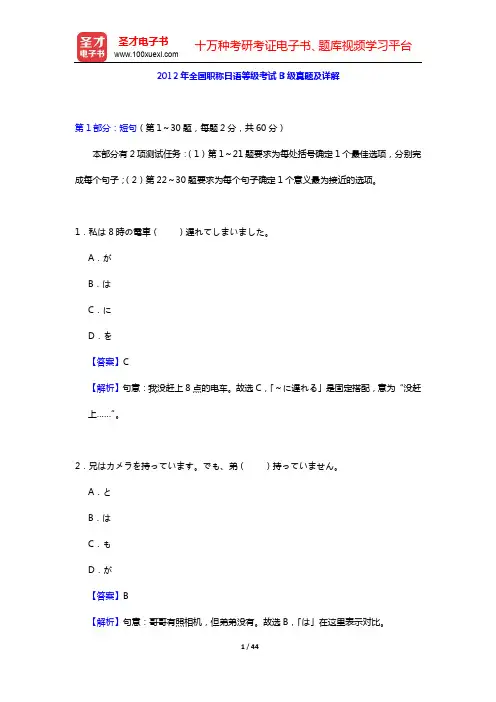
12.雨だったので、家まで先生の車に乗せて( )。 A.あげた B.くれた C.いただいた
5 / 44
圣才电子书
D.差し上げた
十万种考研考证电子书、题库视频学习平台
【答案】C
【解析】句意:因为下雨,所以老师开车把我送回了家。故选 C,「~ていただく」是
「~てもらう」的谦逊语,表示说话者从他人那里得到恩惠,他人的身份地位比说话者
为“从什么时候开始”。
8.東京の住宅事情のことを考えると、両親と一緒に住むのは( )大変ですよ。 A.とうとう B.なかなか C.そろそろ D.だんだん 【答案】B 【解析】句意:考虑到东京的住宅情况,和父母住在一起是很不容易的。故选 B,「なか なか」意为“颇,很,非常”。选项 A「とうとう」意为“终究,到底”。选项 C「そ ろそろ」意为“就要,快要”。选项 D「だんだん」意为“逐渐,渐渐地”。
7.寒いと思ったら、( )からかわからないが、雨が雪に変わっていた。 A.いつでも B.いつも C.いつか D.いつ 【答案】D 【解析】句意:我觉得很冷,果然不知从何时起雨转成了雪。故选 D,「いつからか」意
3 / 44
圣才电子书 十万种考研考证电子书、题库视频学习平台
圣才电子书 十万种考研考证电子书、题库视频学习平台
2012 年全国职称日语等级考试 B 级真题及详解
第 1 部分:短句(第 1~30 题,每题 2 分,共 60 分) 本部分有 2 项测试任务:(1)第 1~21 题要求为每处括号确定 1 个最佳选项,分别完
成每个句子;(2)第 22~30 题要求为每个句子确定 1 个意义最为接近的选项。
1 / 44
圣才电子书 十万种考研考证电子书、题库视频学习平台
专八改错(2000年-2012年)真题及答案

2012年专八真题改错部分年专八真题改错部分The central problem of translating has always been whether to translate literally or freely. The argument has been going since at least the first (1) ______ century B.C. Up to the beginning of the 19th century, many writers favored certain ki nd of “free” translation: the spirit, not the letter; the (2) _______sense not the word; the message rather the form; the matter not (3) _______ the manner. This is the often revolutionary slogan of writers who (4) _______ wanted the truth to be read and understood. Then in the turn of 19th (5) _______ century, when the study of cultural anthropology suggested that the linguistic barriers were insuperable and that the language (6) _______ was entirely the product of culture, the view translation was impossible (7) _______ gained some currency, and with it that, if was attempted at all, it must be as (8) _______ literal as possible. This view culminated the statement of the (9) _______ extreme “literalists” Walter Benjamin and Vladimir Nobokov.The argument was theoretical: the purpose of the translation, the nature of the readership, the type of the text, was not discussed. Too often, writer, translator and reader were implicitly identified with each other. Now, the context has changed, and the basic problem remains. (10) _____ 1.going ∧ since -加入on 题解:go on 的意思是“继续”,符合句子表达的含义“争论一直在继续”。
2012年专八答案

2012年专八答案Mini-lecture1: rarely formal records2: systematic objective manner3: variable4: situation sampling5: vary6: advantage7: as it occurs8: have more control9: in natural setting10: methodInterview1: creative people focus on novel thinking rather than solution 2: comes from both environmental and genetic makeup3: two4: critical5: the environment is significant in the creative process News broadcast6: a problem in the cooling system was solved7: the Philippines8: to expose cases of child abuse and punishment9: 4 percent10: 2Reading11: worked for freshwater conservation for nonprofit purpose12: he made contribution to drinking water conservation in his own way(更多考试资讯尽在)13: how I could contribute to water conservation14: his clothes used even more virtual water15: exaggeration16: humorous17: found that interest in reunions was linked with school experience. 18: US class reunions are usu ally occasions to show off one’s recent success 19: shared undergraduate experience on campus20: bring into focus contrasting opinions21: reasons for popularity and attendance for alumni reunions22: was fond of drinking23: George lied at the beginning and then became serious24: remained the same as usual25: was dissatisfied with his life and surroundings26: no similar appreciation of Lincoln will be seen27: respect for great people and their influence28: resulted in similar disparaging remarks on Lincoln29: reveals the variety of current opinions on heroes.30: the memorial is symbolic of the great man’s achievement. General knowledge31: new Zealand32: state33: July 4th34: the Arctic Ocean35: T.S.Eliot36: William Faulkner37: personification38: sequential rule39: Disco40: register短文改错单词错误下划线,多出的单词划斜线,掉的单词插入号1:going Λsince on2: certain some3: ratherΛthe than4: is was5: in at6: /the the7: viewΛtranslation that8: / was was9: statement statements10: and but翻译:1: Pain gathered in the heart, hot burnt between eyebrows , depression suffused in the chest, a stream of gas rushed out the stomach through the throat. When the dean said that the child was in developmental delay, she got lost in the me(更多考试资讯尽在)ssy mind. He strided up and down in the house where the child stayed in. There was only one window in the whole room, shadows whirlinged out of the window. Let children stay behind, here are the benevolent priests and nuns, here will be extended to a foster care centre for medical function , here is the best place to keep the children.。
対策二 文学史
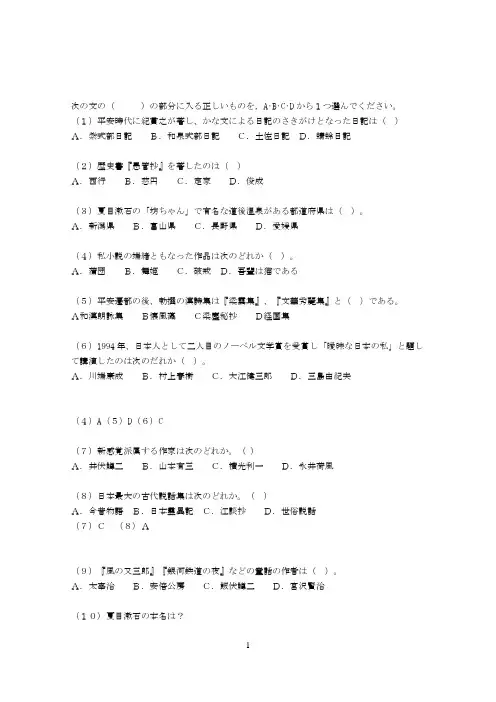
次の文の()の部分に入る正しいものを,A•B•C•Dから1つ選んでください。
(1)平安時代に紀貫之が著し、かな文による日記のさきがけとなった日記は()A.紫式部日記B.和泉式部日記C.土佐日記D.蜻蛉日記(2)歴史書『愚管抄』を著したのは()A.西行B.慈円C.定家D.俊成(3)夏目漱石の「坊ちゃん」で有名な道後温泉がある都道府県は()。
A.新潟県B.富山県C.長野県D.愛媛県(4)私小説の端緒ともなった作品は次のどれか()。
A.蒲団B.舞姫C.破戒D.吾輩は猫である(5)平安遷都の後、勅撰の漢詩集は『梁雲集』、『文華秀麗集』と()である。
A和漢朗詠集B懐風藻C梁塵秘抄D経国集(6)1994年、日本人として二人目のノーベル文学賞を受賞し「曖昧な日本の私」と題して講演したのは次のだれか()。
A.川端康成B.村上春樹C.大江健三郎D.三島由紀夫(4)A(5)D(6)C(7)新感覚派属する作家は次のどれか。
()A.井伏鱒二B.山本有三C.横光利一D.永井荷風(8)日本最大の古代説話集は次のどれか。
()A.今昔物語B.日本霊異記C.江談抄D.世俗説話(7)C(8)A(9)『風の又三郎』『銀河鉄道の夜』などの童話の作者は()。
A.太宰治B.安倍公房C.飯伏鱒二D.宮沢賢治(10)夏目漱石の本名は?A.夏目金之助B.夏目文太郎C.夏目龍之介D.夏目文乃助(9)A(10)A(11)和歌は奈良時代までに発生した日本固有の韻文学で、後世、()をさすようになった。
A. 長歌B. 短歌C. 旋頭歌D. 片歌(12)「枕草子」は()が書いた随筆である。
A. 吉田兼好B. 鴨長鳴C. 清少納言D. 紫式部(13)「古池や蛙飛びこむ水の音」は()によって書かれた有名な俳句である。
A. 与謝蕪村 B. 小林一茶 C. 松尾芭蕉 D. 井原西鶴(14)大正期に「悪魔主義」と呼ばれていた作家は次のだれか。
A. 永井荷風B. 芥川龍之介C. 川端康成D. 谷崎潤一郎(15)「俘虜記」や「野火」を書いた作家は次のだれか。
日语专业八级考试古典文法试题练习
4 . 明I如/ L。 A夜 明 I 耋f 2夜 于 、 : 于为c-
L 圭, )
4. 自 . 岛 A 明 卞 5夜 加I9 。 夜老 加 6弓 夜老 加L 、 6弓 夜老 加L 圭 D . - B 明 为 c 明 L 弓 夜老
明 加 L L 圭, )
4 .花哄 墨如 9 A花力 哄 、 6 ,允 上弓 )
6 弓 B花 哄 、 6 ’ C花 哄 < 6 ’ D 花 哄 、 L圭 、 为 j j
C 4 7 D
3 8
D 4 8 C
3 9
D 4 9 C
4 0
D 5 0 C
3. 屯 7 秋 遇 如。 A秋 屯 卞 为 B秋 屯 遇
3 .花 哄 加 8 。 A 花 力 哄 、
、 c秋 屯 遇 允 D秋 屯 遇
L圭, ) 允
B花 力 哄 L圭 ’ C 花 哄 < 6 弓 D 花 哄 } 、 、 j 、 L
3 .文 藐 为。 A 手 糸 力 虢 为 2 氏
B手 豪 氏老莸
3. 唣墨 3息 为。 A息 唱 、 、 B息 舄 、 、 加 C息 为 口 为 唱 、 、 、、 D息 舄 、 、 力 Ⅱ 为
6弓 3 .花 4 哄 墨如 为。 A 花 c 加 、 B 花 c哄 、 耋哄 耋 允 C花 c哄 、 、 、 D 花 c 哄 、 L圭 ’ 耋 耋 j
维普资讯
鬯 诚 辅 导 2 5
3 . 更 I 。 A 夜 更 I 1夜 于 于为 6 弓 B夜 力 更 I 于
大学日本语専攻生 专八复习
佐藤 佐藤 佐藤 田中 田中 三木 福田 大平 大平 鈴木
栄作 栄作 栄作 角栄 角栄 武夫 赳夫 正芳 正芳 善幸
61 62 63 64 65 66 67 68 69 70
中曽根 康弘 71 中曽根 康弘 72 中曽根 康弘 73 竹下 登 74 宇野 宗佑 75 海部 俊樹 76 海部 俊樹 77 宮沢 喜一 78 細川 護熙 79 羽田 孜 80
気候
気候は、年平均気温は約15度と概して温暖で四季の区別がはっ きりとしてい。降水量は年間約1700mmと多いが、多くが台風(9 月~10月)や梅雨(6月)の時期に集中するのが特色である。ま た、日本海側と太平洋側では山脈を境にして気候が異なっており、 日本海側は世界で最も雪が多い地域の一つである。
所属領域 経済 歴史、名人 文化、名人
政治
政治
●P77 模擬テスト2 問56-60
問題点 2001新省庁制度 日本経済団体連合会 都道府県 憲法記念日 自民党
所属領域 政治、社会 経済 地理
記念日
政治
●P97 模擬テスト3 問56-60
問題点 県庁所在地 弥生時代 江戸の改称 年号 鑑真、唐招提寺
各問題点と繋がる知識ーー歴史部分
昭和元年 =1926年 平成元年 =1989年
平成23年 =2011年
●時代
/wiki/%E6%97%A5%E6%9C%AC%E3%81%AE%E6%AD%B4%E 5%8F%B2
旧石器時代 縄文時代 弥生時代 古墳時代 飛鳥時代 奈良時代 平安時代 鎌倉時代 室町時代 南北朝時代 建武の新政 戦国時代
吉田 茂 51 小磯 国昭 41 鳩山 一郎 52 鈴木 貫太郎 42 東久迩宮 稔彦王 43 鳩山 一郎 53 鳩山 一郎 54 幣原 喜重郎 44 石橋 湛山 55 吉田 茂 45 岸 信介 56 片山 哲 46 岸 信介 57 芦田 均 47 池田 勇人 58 吉田 茂 48 池田 勇人 59 吉田 茂 49 池田 勇人 60 吉田 茂 50
2012试题
大学日本語専攻生四級能力試験問題(2012)(試験時間:160分)一、聴解(1×20=20点)二、次の文の下線をつけた単語の正しい読み方や漢字を、後のA,B,C,Dから一つ選びなさい。
(1×10=10点)21.この料理は手間がかかる。
A、てまB、てかんC、しゅかんD、てひま22、この椅子は細かい細工がほどこされている。
A、ほそこうB、ほそくC、さいこうD、さいく23、社長はきびしい口調で社員に注意した。
A、こうちょうB、こちょうC、くちょうD、くうちょう24、山田さんの家は町の大通りに臨んでいる。
A、りB、めC、しのD、のぞ25、日本列島に梅雨前線が停滞している。
A、うめうB、ばいうC、まいうD、めいう26、風の音や虫の音におもむきを感じ、詩に表した。
A、趣B、味C、興D、情27、この問題をとくのに、2時間もかかった。
A、梳 B 溶 C、解D、説28、外出の際はかぎをフロントにあずけてください。
A、助B、預C、授D、擱29、私の子供時代をかえりみると、いまより自然に触れる機会が多かった。
A、帰B、省C、返D、顧30、彼はほがらかな人で、いつもクラスをあかるくしてくれる。
A、朗B、爽C、清D、明三、次の文の_に入れるのに最も適当な言葉を後のA,B,C,Dから一つ選びなさい。
(1×15=15点)31、主要国の政策協調努力もあり、為替__はこのところ安定的に推移しています。
A、市場B、売場C、相場D、立場32、褒められたり__を言われたりしたことを人間はなかなか忘れないものだ。
A、利口B、無口C、悪口D、閉口33、うちの__は、ミステリー小説を創作する集まりとして、雑誌の読者欄などに紹介文を出して会員を募集しています。
A 、サークルB、サービスC、スピーチD、チーム34、どんな本かというと、算数の計算力を付けるために使用する学習用__を一冊にまとめたものです。
A、パターンB、プランC、プリントD、ベテラン35、昼前に若い一人の男が来て、兎を__買ってくれという。
2012年专业八级听力及阅读答案
听力选择题1: creative people focus on novel thinking rather than solution 2: comes from both environmental and genetic makeup3: two4: critical5: the environment is significant in the creative processNews broadcast6: a problem in the cooling system was solved7: the Philippines8: to expose cases of child abuse and punishment9: 4 percent10: 22012专八阅读参考答案Text A11. worked for freshwater conservation for nonprofit purposes.12. His house was equipped with advanced water-saving facilities.13. how I could contribute to water conversation.14. his lifestyle was too extravagant.15. exaggeration.16. Humorous.Text B17. found that interest in reunions was linked with school experience.18. U.S. class reunions are usually occasions to show off one's recent success.19. Shared undergraduate experience on campus.20. bring into focus contrasting opinions.21. Reasons for popularity and (non)attendance for alumni reunions.Text C22. showed a wide interest.23. Mr. Cattanzara was surprised at George's reading plan.24. remained the same as usual.25. was dissatisfied with his life and surroundings.Text D26. no activities can be compared to those in 1909.27. Variety and magnitude of celebration activities.28. resulted in similar disparaging remarks on Lincoln.29. reveals the variety of current opinions on heroes.30. Lincoln's greatness remains despite the passage of time.。