
上海牛津沪教版六年级(下)同步讲义unit3
第3讲Unit3 Dragon Boat Festival上海牛津沪教版六年级(下)同步讲义Unit3 Dragon Boat Festival适用学科初中英语适用年级初中六年级适用区域上海课时时长(分钟)120分钟(一对一)知识点知识点1:本单元词汇知识点2:词组知识点3:句型知识点4:一般过去时知识点5:介词with,without的用法教学目标知识:学生能够基本掌握6年级下册Unit2中的词汇、词组、句型及语法。
方法:牢记各个知识点的用法,归纳总结异同点,通过习题加强巩固。
能力:熟练掌握各种词汇的用法;具备准确判断词性及转换的能力;熟练掌握现在完成时的运用能力;熟练运用现在进行时表将来的能力。
教学重点词性转换;一般过去时;介词with,without的用法教学难点介词with,without的用法教学过程一、课堂导入教师讲述一个与本节课题目有关的英文小故事,引出今日所要讲解的知识点,然后让学生简单梳理一下所涉及的问题,带着问题学习本节课的内容。
二、复习预习教师引导学生复习上节课学的重点内容,检测单词的用法,(以提问、回顾的形式进行),针对上节课的作业进行讲评、订正、答疑,并通过英文小故事导入本节课所要学习的新知识。
三、知识讲解1. 知识点一:重点单词1)something [ 'sʌmθiŋ ]【词性】pron.【词义】某物;某事【易混淆点】anything 任何事everything 一切【经典例句】Miss Guo, I would like to know something about the Dragon Boat Festival.郭女士,我想知道一些关于端午节的事。
2)celebrate [ 'selibreit ]【词性】v.【词义】庆祝【易混淆点】celebration庆祝【经典例句】Why do people celebrate it ?为什么人们要庆祝它?3)ago [ ə'gəu ]【词性】adv.【词义】以前【易混淆点】before以前【经典例句】Qu Yuan was born about two thousand years ago in China.屈原出生于两千多年以前的中国。
4)country [ 'kʌntri ]【词性】n.【词义】国家【易混淆点】countryside 乡下;农村【经典例句】The country was in danger.国家处于危险之中。
5)advice [ əd'vais ]【词性】n.【词义】劝告;忠告【易混淆点】suggestion 建议【经典例句】The king always took his advice.国王总是采取他的建议。
6)die [ dai ]【词性】v.【词义】死;死亡【经典例句】However, the king died and the new king did not listen to him.但是这个国王死了,新国王不听他的。
7)later [ 'leitə ]【词性】adv.【词义】以后;后来【易混淆点】late 晚的【经典例句】Later, the new king lost a battle because he did not take Qu Yuan’s advice.后来新国王战败了,因为他没有采纳屈原的意见。
8)lose [ lu:z ]【词性】v.【词义】输掉【经典例句】Later, the new king lost a battle because he did not take Qu Yuan’s advice.后来新国王战败了,因为他没有采纳屈原的意见。
9)danger [ 'deindʒə ]【词性】n.【词义】危险;风险【易混淆点】dangerous 危险的【经典例句】The country was in danger.国家处于危险之中。
10)remember [ ri'membə ]【词性】v.【词义】记得;纪念【经典例句】Today, people eat rice dumplings and have dragon boat races to remember him on that day every year.如今,每一年在那天人们吃粽子和赛龙舟去纪念他。
11)without [ wið'aut ]【词性】prep.【词义】没有【易混淆点】with 有【经典例句】But I don’t like salty ones without meat.但是我不喜欢吃没有肉的咸粽子。
12)send [ send ]【词性】v.【词义】发送;寄【经典例句】I will send you some then.到时我会给你发一些。
2. 知识点二:重点词组1)on the Dragon Boat Festival 在端午节2)have dragon boat races 举办龙舟赛3)a salty/ sweet rice dumpling 一只咸、甜棕4)a story of 一个关于某事的故事5)a piece of advice 一条意见give advice to sb. 给某人提意见take one’s advice 接受某人意见6)in danger/ dangerous -- safe 处境危险、危险的、安全的7)jump into 跳入8)the fifth day of the fifth lunar month 农历五月初五the first/ second/ third/ twelfth/ ninth/ twentieth第一、二、三、九、十二、二十9)remember / forget to do sth. 记住、忘记要做某事remember / forget doing sth. 记住、忘记曾做过某事10)salt (n.)/ salty(a.) 盐、咸11)sweets (n.)/ sweet(a.) 糖、甜12)with/ without 有、没有13)one/ ones 代替可数名词单数、复数14)would rather do/ not do sth. 宁愿做某事、不做某事15)w rite an e-mail to sb. 给某人写一封邮件16)t ell sb. sth. about 告诉某人某事17)t wo kinds of 两种18)w ould like to do sth. = want to do sth. 想要做某事19)k now sth. about sth./sb. 知道关于……的情况20)b e born 出生3. 知识点三:重点句型1)Would you like some rice dumplings? 你要吃些粽子吗?Yes, please./ No, thanks. 是的。
/不,谢谢。
2)I like sweet rice dumplings without beans, but I don’t like salty ones with meat.我喜欢没有豆的甜棕,但我不喜欢有肉的咸棕。
3)I’d rather have a piece of pizza.我宁愿吃一块披萨。
4)His job was to give advice to the king.他的工作是给国王建议。
4. 知识点四:常见语法1)一般过去时①概念:表示过去发生的动作或存在的状态。
②常用的时间状语:yesterday, last week/year…, in the past, …ago, in 2005, just now…③结构:主语+动词的过去式+…e.g. 肯定:He watched TV yesterday evening.他昨天晚上在看电视。
否定:He didn’t watch TV yesterday evening.他昨天晚上没有看电视。
④动词过去式的构成:规则变化:一般情况下在动词词尾直接加-ed.e.g. jump——jumped;以不发音的e结尾的动词直接加-d.love ——loved以辅音字母加y结尾的动词,去y变i+ed;study——studied以重读闭音节结尾,且词尾只有一个辅音字母的动词,双写最后一个辅音字母,再加-ed.stop——stopped2)His job was to give advice to the king.他的工作是给国王出谋划策。
①动词不定式to give advice to the king 在句中做表语;e.g. My hope is to become a nurse.我的愿望是成为一名护士。
②give advice to somebody 给某人提建议,相当于give somebody advice③advice 为不可数名词,一条建议:a piece of advice3)表示伴随:with/without介词with表示“带着……”,“带有……”。
反义词为without。
e.g. Do you like coffee with or without milk?你要喝奶咖还是清咖?4)表示对别人礼貌的邀请,如Would you like some……?其肯定回答为:Yes, please.否定回答为:No, thanks.四、例题精析【例题1】【题干】A doctor’s job is ________ sick people better.A. makeB. to makeC. makesD. making【答案】B【解析】本题考查动词不定式做表语用法,故选B。
【例题2】【题干】She went to school _______ having breakfast. It’s bad for her health.A. withB. withoutC. forD. to【答案】B【解析】本题考查介词的用法,因为后面说对身体有害,说明是不吃早饭。
without 表示没有,故选B。
五、课堂运用【基础】1. Why do people _______the Dragon Boat Festival? (celebration)【答案】celebrate【解析】本题考查动词的用法。
助动词do后面用动词原形,故填celebrate。
2.Chairman Mao ___________ many years ago. (death)【答案】died【解析】本题考查动词做谓语的用法,ago表示过去,所以要用一般过去时,故填died。
3. She’d like to have _________ rice dumplings with meat. (salt)【答案】salty【解析】本题考查形容词的用法。
【沪教牛津版(三起)】六年级下册英语教案Unit3Our-school-in-the-future
【沪教牛津版(三起)】六年级下册英语教案Unit3Our-school-in-the-futureU3 Our school in the future教学内容与目标教学内容功能描述●描述对将来的愿景。
语言知识核心句型和日常用语● What changes would you like to see in our school?● Studengts will have a picnic every month.词汇Carry,mountain,even, space, a piece of, have a picnic,better and better语音m, n, ng,n(k),n(g)语言技能听●听懂谈论关于未来学校变化的对话。
说●用一般将来时说说未来学校可能会有怎么样的变化。
读●读懂郭老师和孩子们之间关于未来学校变化的对话。
●读懂关于未来学校的短文。
写●能结合语境写出正确的句子,并简单描述未来学校的变化。
教学目标●能在语境中正确运用本单元的核心词汇,复习已学相关核心词汇。
●对未来充满美好的期待。
●能用一般将来时对未来学校进行描述。
●根据字母m, n, ng,n(k),n(g) 的发音规律,能拼读简单的单词。
教学重点:●词汇:Carry,mountain,even, space, a piece of, have a picnic,better and better ●句型:What changes would you like to see in our school?Studengts will have a picnic every month.●根据字母m, n, ng,n(k),n(g) 的发音规律,能拼读简单的单词。
教学难点:● will be 和 will do 的用法区别。
M1 Changes and differencesU3 Our school in the futurePeriod1教学目标[知识目标]1.通过Look and learn 复习动词词组2.通过Listen and say的学习,学习词汇和词组,复习使用一般将来时,谈论对未来学校的憧憬。
沪教牛津版 英语 六年级下U3-4

• — Yes, ___________________.
A. I'd love to
B. I would
C. I like
D. I do
• — Would you like another cup of tea?
• —Yes, ___________________. .
A. I would
B. I do
• 复数 changes; 三单 changes • 现在分词 changing; 过去式 changed • Make a change; make change
• Changing (adj.) The world is changing everyday.
一9,10
10
Words and phrases
C. I like
D. please
• — Would you like to be a policeman?
• —Yes, ___________________. .
A. I do
B. I would
C. I did
D. I like
12
grammar
Write your wishes down on a piece of paper.
A. in the space
B. in space
一3,4
C. on space
D. on the space
interesting (adj.)
• 要分清楚interest, interested, 和interesting • interest是名词,表示兴趣,爱好,趣味. place of interest; show interest in sth. • interested是形容词,表示(某人)感兴趣. be interested in sth./doing sth. • interesting 是形容词,表示(某人/某事/ 某物)本身很有趣
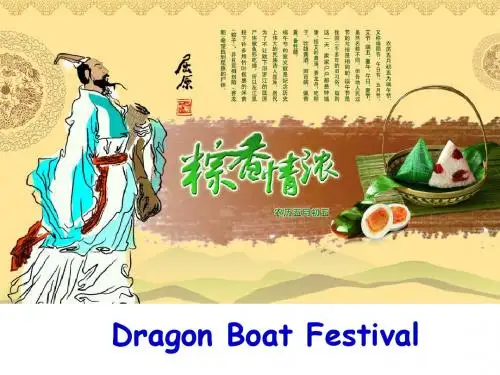
六年级英语下册(上海牛津本地版)Unit 3《Dragon Boat Festival》公开课课件
that year. ___________________________________________________
8 How do people celebrate the Dragon Boat Festival? People eat rice dumplings and have dragon boat races. ___________________________________________________
4 What happened to Qu Yuan when the old king died?
The new king did not listen to him. ___________________________________________________
1 2
C
PIGGY BANK
GOLD MINE
5 Why was Qu Yuan so sad? 2-2 Because the new king did not take his advice and the ___________________________________________________ country was in danger. 6 What did Qu Yuan do then? He jumped into a river and died. ___________________________________________________ 7 When did Qu Yuan die? He died on the fifth day of the fifth lunar month of ___________________________________________________
上海牛津版英语六年级下册6BUnit3U3同步讲义
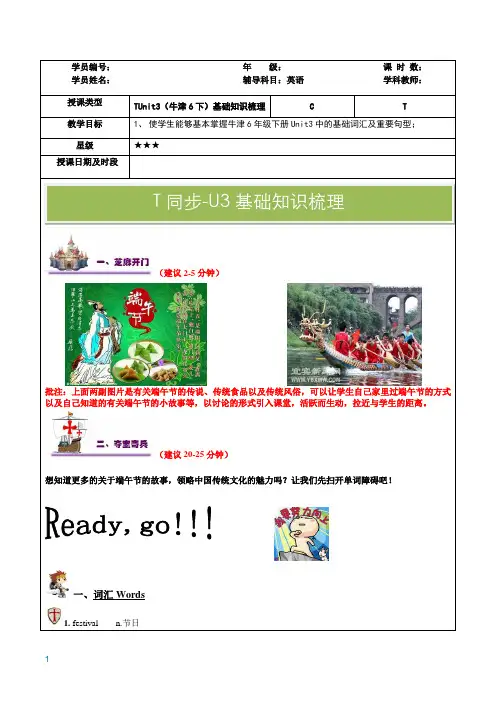
学员编号:年级:课时数:学员姓名:辅导科目:英语学科教师:授课类型TUnit3(牛津6下)基础知识梳理C T教学目标1、使学生能够基本掌握牛津6年级下册Unit3中的基础词汇及重要句型;星级★★★授课日期及时段T同步-U3基础知识梳理(建议2-5分钟)批注:上面两副图片是有关端午节的传说、传统食品以及传统风俗,可以让学生自己家里过端午节的方式以及自己知道的有关端午节的小故事等,以讨论的形式引入课堂,活跃而生动,拉近与学生的距离。
(建议20-25分钟)想知道更多的关于端午节的故事,领略中国传统文化的魅力吗?让我们先扫开单词障碍吧!一、词汇Words1. festival n.节日e. g. -The Spring Festival is a traditional Chinese festival.春节是中国的传统节日。
-It's the most important holiday of the year.它是一年中最重要的节日。
【记忆链接】Dragon Boat Festival端午节Mid-autumn Festival中秋节批注:这里可引入各种节日的说法。
西方:Valentine's Day(情人节)(February 14)Easter(复活节)April Fool's Day 愚人节NEW YEAR’S DAYS 新年Thanksgiving Day 感恩节Halloween(万圣日)Christmas Day 圣诞节东方:通过图片讨论中国传统节日2. something pron.某事;某物e. g. -Are you looking for me? 你在找我吗?-Yes, I have something to ask you.是的,我想问你点儿事。
【友情提示】在英语中,如果需要用形容词修饰something、somebody和someone这些词时,形容词只能放在这些词后面,如something interesting 或somebody boring。
(沪教牛津版)六年级英语下册《Module3 Unit3》教学课件
About you:
S1: How do you go to school?
S2: I go to school by _____/on foot. I go to school by _____/on foot, then … S1: How long does it take? S2: It takes me only/about/
… more than/almost
minutes. half an hour. an hour.
Look and read:
--Mum, how long does it take you to get to the supermarket? --It takes me about ten minutes to get there.
Mark: How long does it take you to get to your friend’s home?
Grandpa: It takes me more than 30 minutes to get there. He lives quite far away from here.
20 minutes
Total
an hour and 40 minutes
Total
an hour
Total
20 minutes
Look and learn:
a restaurant
offices
a hawker
Look and read:
then
walk to the underground station
take the underground
then walk to school
牛津沪教六年级下册module 1《unit 3 water》优秀教案(重点资料).doc
Contents
Methods
Purpose
Warming
up
Pre-task preparation
1.Sing songs
2.Daily talk:
Review the story.
new words
3. Read a poem.
How are you?
Which do you like better, blue or purple?
在学习单词时也讨论有水的地方,及水的特征,为小诗学习作准备。
While-task procedure
Post-task activity
Assignment
1.Do exercises on Photocopiable Page 17
Exercises
Read and write.
4. Ask the students questions to check for comprehension, such as: Where is water? To elicit: It’s in the waterfall. It’s everywhere around us.
The pump, the tap, the well.
Key Points: Water has no taste at all
The pump, the tap, the well.
Difficult Points: Water has no taste at all
Teaching Aids:tape、radio、word cards.
5 Distribute Photocopiable page 16 to the students. Give them time to unscamble the words. Ask: Where can we find water? And elicit the answers.
牛津版英语六年级下册unit 3
3.mice
nice
4.moon
noon
5.win
wing
6.bank
back
7.in
ink
8.seem
sing
听力材料: 1.Who am I? 2.Turn left at the second crossing.
You can see the cinema. 3.Help! There are mice in my kitchen! 4.One day, we can all go to the moon. 5.Who will win the race? 6.Is there a bank near your home? 7.There’s a bottle of ink on the desk. 8.Let’s sing a song.
S1: What changes would you like to see in our school?
S2: I’d like to … a. have a swimming pool b. have a lot of clubs
S3: I’d like to … c. have a lot of books and
中an-angห้องสมุดไป่ตู้ en-eng, in-ing的关系。
同学们,这一课学习的单词你们都掌握了吗?现 在大家来检验一下,点击下面的视频开始听写吧!
2. Students will have a picnic every month. 学生们将每个月去野餐。
这是一个一般将来时的句子。 句型结构:主语+will+动词原形+其他. 常见的时间状语有tomorrow(明天),next year(明年), next month(下个月),the day after tomorrow(后天), soon(不久),in+时间段(多久之后)等。
沪教牛津版六年级下册英语Unit3第3课时教学课件
第五页,共十七页。
What changes would you like to see in our school?
have a swimming pool
our school? I&。
Write down your wishes.
Name___________________________ My wishes: There will be ___________________________________ _ _________________________________ .
What changes would you like to see in our school?
I'd like to...
第十页,共十七页。
In pairs, ask and answer the question about your summer holiday.
How was your summer holiday? It was great/fun/not bad.
第七页,共十七页。
What changes would you like to see in
our school?
I'd like to...
第八页,共十七页。
What changes would you like to see in our school? I'd like to...
第九页,共十七页。
沪教牛津版六年级下册英语Unit3第3课时教学课件
科 目:英语 适用版本:沪教牛津版 适用范围:【教师教学】
小学英语沪教牛津版六年级下册Module 1 Unit 3 (第2课时)教学PPT
mountain 山;山脉
even 甚至
space 太空
Look and read.
Robots will help us find books in the library. They will also do other things in schools.
Look and read.
dinosaur 恐龙
Finish the text
In the future, schools will be__d_if_fe_r_e_n_t_. They will be_u_n_d_e_r_t_h_e_s_e_a__, _o_n_h_i_g_h_m__o_u_n_ta_i_n_s___ and even_i_n_s_p_a_c_e__.
We will use computers in all our lessons. They will help us see dinosaurs and other interesting things.
Look and read.
We will have lessons with students from other countries. We will do a lot of things online together!
Students will study online at home.
Let’s talk
In the past,our school was__o_l_d__. There was/were_m__a_n_y_o_l_d_d_e_s_k_s_a_n_d__ch_a_i_r_s_.
Let’s talk
Finish the text
We will have lessons with students from other countries
牛津上海版六年级下册U3教案
学科教师辅导教案讲义编号:组长审核:Lose 失去 lose memory 失忆 lose one’s way 迷路 lose one’s eyesight失去视力 lose one’s job 失业danger n.危险 be in danger 处于危险中 dangerous adj.危险的 ---反义词 safe Remember v. 记得 memory n.记忆力 remember to do sth 记得去做某事(未做)Remember doing sth 记得做过某事(已做) forget to do sth 忘记去做某事(未做)Forget doing sth 忘记做过某事(已做)Would rather do sth than do sth 宁愿做某事不愿做...Send sth to sb =send sb sth 寄给某人某物2.讲解课文P14-P17 would like to do sth =want to do sth 想要做....Thousand 千表示具体数量不加s two thousand 表示成千上万加s thousands of One’s job is to do sth 某人的工作是去做.... listen to sb 听某人的话The fifth day of the fifth lunar month of that year 农历五月初五Rice dumplings with meat 肉粽 rice dumplings without meat 不加肉的粽子Ones 一些 one 一个 a piece of 一片作文:Spring festival 传统节日:春节The Spring Festival is coming. I will help my mother clean the windows and wash the clothes. I will put on duilian on the door and chuanghua on the window.People usually go home to spend the festival with their family. They have a big family get together. The Chinese people have big meals and watch TV during the Spring Festival. They also visit their friends and relatives.The underlined part means “________”.A. AboutB. Less thanC. OverD.little( ) 7. Ben’s mother is not at home. He _________ look after his younger sister.A. has toB. have toC. need toD. must to ( ) 8. I don’t like coffee ____________ sugar. It’s too sweet.A. withB. withoutC. hasD. /( ) 9. --Where is your brother? -- He __________ to the library.A. has goneB. has beenC. goesD. went( ) 10. Bangkok is _________ of Shanghai.A. south-westB. to the west-southC. west-southD. in the south west ( ) 11. I spent____________ making this model plane.A. a half and an hourB. one and a half hoursC. one and a half hourD. an and half hours( ) 12. My father’s job is ___________ sick people better.A. makeB. makingC. to makeD. makes( ) 13. It’s too hot outside. I’d rather not _______ out!A. goB. goingC. to goD. goes( ) 14. There are many skirts in the shop. Do you like this red ________?A. oneB. onesC. one’sD. once( ) 15. --Would you like ______ orange juice? -- _______________.A. any … No, thanksB. some … Of courseC. some … Yes, pleaseD. an … No, thanks。