
牛津译林版七年级英语上册unit6grammar
Exercise
☆• 6.March 8th is _W_o_m__e_n_’s_(woman) Day. ☆• 7.Would you get me some __pa_p_e_r___
(paper), please? ☆• 8.I have a lot of _m__o_n_ey__ (money) in my
a piece of a glass of a plate of a packet of
bread
water
chicken
salt
two bags of rice
three cups of tea
four kilos five cartons of meat of milk
six bottles of juice
Exercise
( )3.There are some____and ____on the desk.
• A. radios, photos B. radioes, photos
• C. radioes, photos D. radios, photos ☆( )4.---Are there any _____ on the farm?
--- No, there isn’t.
A.photos
B. potatoes
C. news
D. glasses of milk
Exercise
• 词汇运用 • 1.You shold clean your _t_e_e_th__(tooth) every day. • 2.Mark twain liked to tell others funny
2.RICE 5. MEAT 7.tea 8. milk
10.WATER 12. JUICE 14.salt Uncountable noun home
2,5,7,8,10,12,14
Which word can be be “a” and which word can be with “an”?
Question: How can I remember it so well?
Which is followed by “s” and which is followed by “es”?
heroes(英雄) kilos radios zoos photo s potatoes pianos tomatoes
• C. knifes, shelves D. knives, shelfs
• ( )2.---What can I do for you?
•
--- I’d like _____.
• A. two kilos of pork B. a kilo of porks
• C. two piece of pork D. a pork
half halves
Read and draw. Listen to the teacher and draw a picture.
Mr Wang’s wife catches(抓住)two wolves with a knife on the shelf.
Then she cuts a piece of meat into halves to feed(喂) them.
• 5. There are 12 _m_o_n__th_s_(month) in a year.
• 精灵:我是以es结尾的名词复数,我们的特 征很明显,以s, sh, ch, x结尾的单数名词要 加上es才可以更强大。比如:dress--dresses, box---boxes, watch---watches, dish---dishes…等等。
1. boy 2. baby
boys babies
3. family
families
4. country
countries
5.guyΒιβλιοθήκη guys6.fly
flies
Complete the following sentences according to the words given.
• 1. Best _w_i_s_h_e_s_(wish) to you.
Can you find any changing rules of the
following words?
child man woman
children men
women
foot
feet
tooth fish sheep Chinese
teeth fish sheep
Chinese
Japanese
• 9.many Chinese 10.six knives
• 11.four radios orange juice
12.three bottles of
Exercise
• 选择题
• ( )1.There are many ___ on those ___.
• A. knives, shelfs B. knives, shelves
Mum: We can also buy a few _b_o_t_t_le_s_ of _j_u_ic_e__.
Exercise
• 翻译下列词组 • 1.两杯茶 ________2.一袋盐________ • 3. 八个家庭 ________4.很多土豆______ • 5.两公斤肉 _________6.两场比赛______ • 7.五盒牛奶 _________8.两袋米________ • 9.许多中国人________10.六把小刀_____ • 11.四台收音机_______12.三瓶桔子汁____
mango es
Which is followed by “s” and which is followed by “es”?
Heroes like to eat potatoes, tomatoes and mangoes.
knife
knivfees
shelf shelvf es
wife wives wolf wolves
juice
packets of sugar
a packet of salt
a bottle of water
number +noun+ of+ uncountable noun
量词
two cups of tea two cartons of milk
one carton of milk
four bottles of water
• I make ______________ here.
many friends
Give the noun words ending in “y” as many as possible.
-y
Could you form the plural form of these following words?
--- Yes, there are some.
• A. horse
B. duck
• C. chicken
D. sheep
Exercise
☆( )5.The hospital has thirty ________.
• A. women’s doctors B. women doctors
C. woman doctors D. women doctor ☆( )6.---Is there any ______ in it?
Keys
• 翻译下列词组
• 1.two cups of tea 2. a packet of salt
• 3.eight families
4.many potatoes
• 5.five kilos of meat 6.two matches
• 7.five cartons of milk 8.two bags of rice
pocket. ☆• 9.---What is your favourite fruit?
• ---_M_a_n_g_o_e_s_(Mango) ☆• 10.I go to school on _fo_o_t__(foot) today.
a egohugrancba8mcaUn5oSlkgebyeeurger
an
Complete the following sentences,
and what can you find?
• 1.我想买两本书。
• I’d like to buy _tw__o__b_o_o__k_s.
• 2.一些学生在操场上打篮球。
• S_o__m__e_s_t_u_d__e_n_t_sare playing on the playground.
• 3.那个人每顿吃三个汉堡包。
•
That each
person meal.
has
__t_h_r_e_e__h_a_m__b_u_r_g__e_rs___for
• 4.我在这儿交了许多朋友。
Millie: Do we need to buy some v_e_g_e_ta_b.les
Mum: Yes. Let’s buy some _ca_r_r_o_ts_____ and _p_o_t_at_o_e.s
Millie: I want to buy some _o_r_a_n_g_e_s ___. They are Grandpa’s favourite. And we have only one _a_p_pl_e__. We need to buy some too.
• 2. We’d like two g__la_s_s_e_s(glass) of milk, please.
牛津译林七年级英语上册unit6 Grammar

hamburger.
a
['hæmbɚgə]
cake [keɪk].
an
egg [eg] . orange [ˈɒrɪndʒ] .
More examples:
_a__ US ship _a_n_ hour
‘a’ or ‘an’
_a_n_ uncle/aunt
There is _a__ ‘u’ and _a_n_ ‘s’ in the word ‘use’.
bag packet apple
vegetables potatoes bottles
carrots oranges
chicken rice salt juice
My breakfast, lunch and dinner For breakfast:
For lunch:
For dinner:
Let’s go shopping!
教学课件
英语 七年级上册 译林版
Unit 6 Food and lifestyle
Grammar
Grammar Countable & Uncountable Nouns
food and drinks
Nouns
名词
Countable
Uncountable
Nouns
Nouns
Can you help the nouns in the box find their home?
Nouns ending in o
potato →potatoes, photo → photos, +s or +es tomato →tomatoes, …
Nouns ending in f or fe
my+style+Period+3+Grammar+导学案 牛津译林版英语七年级上册

译林版七年级上册Unit 6 My clothes, My style Period 3 Grammar 导学案一、学习目标1. 掌握一般现在时中主语为第三人称单数时动词的变化规则。
2. 能够正确运用一般现在时的肯定句、否定句和疑问句来描述日常生活中的习惯和状态。
3. 通过练习和实际运用,提高对一般现在时的理解和运用能力。
二、学习重难点1. 重点掌握一般现在时中第三人称单数动词的变化形式,如:加“s”“es”等。
学会运用一般现在时的各种句型进行表达。
2. 难点动词第三人称单数形式的不规则变化。
能够在实际情境中准确运用一般现在时进行交流。
三、学习方法1. 自主学习:通过预习课本内容,初步了解一般现在时的第三人称单数形式。
2. 合作学习:小组讨论、交流,共同解决学习中遇到的问题。
3. 练习巩固:通过做练习题,加深对知识点的理解和掌握。
四、学习过程(一)课前预习1. 预习课本P[X] - P[X] 关于一般现在时的语法内容,了解一般现在时的概念和基本用法。
2. 观察下列句子,找出其中的动词,并思考其在主语为第三人称单数时的变化形式。
He likes apples.She studies hard.The dog runs fast.(二)课堂学习1. 导入通过展示一些图片或视频,如一个人每天的日常生活(起床、刷牙、吃早餐等),引导学生用一般现在时来描述这些场景,从而引出本节课的语法重点——一般现在时中主语为第三人称单数时动词的变化。
2. 知识讲解(1)一般现在时的概念:表示经常发生的动作或存在的状态。
(2)一般现在时中主语为第三人称单数时动词的变化规则:- 大多数动词在词尾加“s”,如:like - likes,play - plays。
- 以“s”“x”“ch”“sh”“o”结尾的动词,在词尾加“es”,如:watch - watches,go - goes。
- 以辅音字母加“y”结尾的动词,把“y”变为“i”,再加“es”,如:study - studies,fly - flies。
牛津译林版七年级上册(新)英语课件:Unit6Grammar课件
Countable and uncountable nouns
群中初一英语组
Free talk:
1.What’s your favourite food? 2. Do you drink milk every day? 3. Do you have an apple ev have for breakfast/
lunch/ supper? 5. Do you run every day or every week? 6. How do you keep healthy?
Tomorrow is Millie’s birthday.She will go shopping with her mother this evening.
Test you ! “a” or “an”
I spend about _a_n__ hour reading books
every night.
There is _a_n__”s”and __a__”u” in the word
“use”.
She has _a_n_ umbrella and __a_ useful
o
+es →mangoes, a radio → radios
Nouns f or fe
ending
in
-f or +ves
fe
a shelf
→shelves,
a
knife
→knives
Special plural forms of some words:
1. man 2. woman 3. foot 4. tooth 5. child 6. fish 7. sheep 8. Chinese
Unit6Grammar学案牛津译林版英语七年级上册
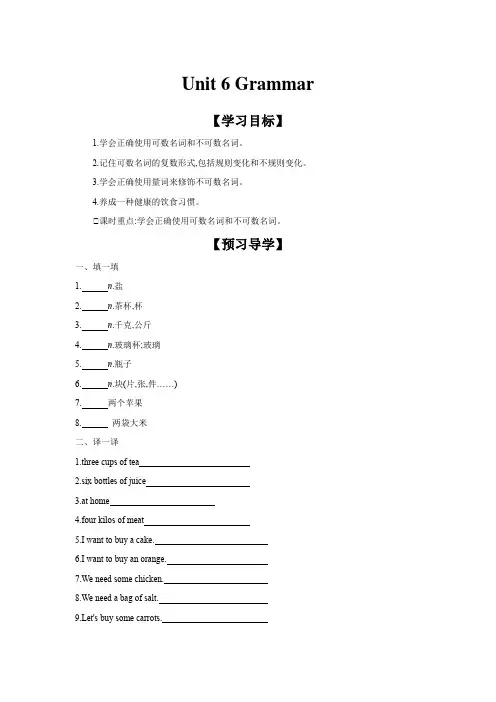
Unit 6 Grammar【学习目标】1.学会正确使用可数名词和不可数名词。
2.记住可数名词的复数形式,包括规则变化和不规则变化。
3.学会正确使用量词来修饰不可数名词。
4.养成一种健康的饮食习惯。
◉课时重点:学会正确使用可数名词和不可数名词。
【预习导学】一、填一填1. n.盐2. n.茶杯,杯3. n.千克,公斤4. n.玻璃杯;玻璃5. n.瓶子6. n.块(片,张,件……)7. 两个苹果8. 两袋大米二、译一译1.three cups of tea2.six bottles of juice3.at home4.four kilos of meat5.I want to buy a cake.6.I want to buy an orange.7.We need some chicken.8.We need a bag of salt.9.Let's buy some carrots.三、想一想1.什么时候在可数名词单数前用不定冠词a?______________________________________________________________ 2.什么时候在可数名词单数前用不定冠词an?______________________________________________________________ 3.不可数名词的量如何表示?______________________________________________________________【答案】一、1.salt2.cup3.kilo4.glass5.bottle6.piece7.two apples8.two bags of rice二、1. 三杯茶2.六瓶果汁3.在家4.四公斤肉5.我想买一个蛋糕。
6.我想买一个橘子。
7.我们需要一些鸡肉。
8.我们需要一袋盐。
9.我们买点胡萝卜吧。
三、1.a用在以辅音音素开头的单词前面(注意是辅音音素,不是辅音字母)。
2024-2025学年牛津译林版七年级英语上册 Unit 5-6词组
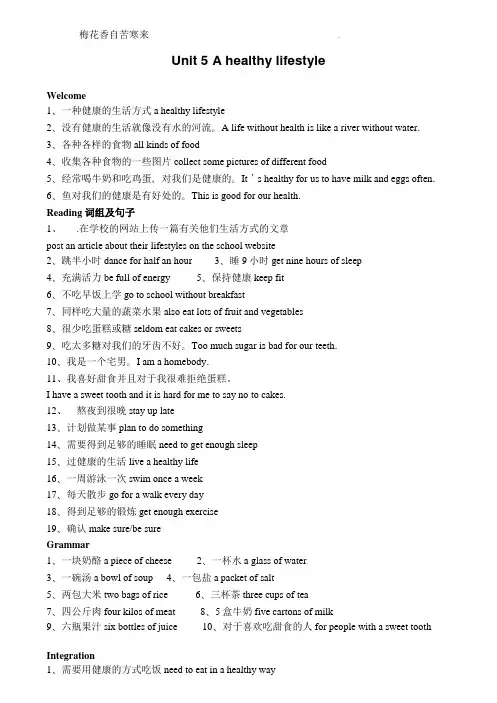
梅花香自苦寒来Unit 5 A healthy lifestyleWelcome1、一种健康的生活方式a healthy lifestyle2、没有健康的生活就像没有水的河流。
A life without health is like a river without water.3、各种各样的食物all kinds of food4、收集各种食物的一些图片collect some pictures of different food5、经常喝牛奶和吃鸡蛋,对我们是健康的。
It's healthy for us to have milk and eggs often.6、鱼对我们的健康是有好处的。
This is good for our health.Reading 词组及句子1、.在学校的网站上传一篇有关他们生活方式的文章post an article about their lifestyles on the school website2、跳半小时dance for half an hour3、睡9小时get nine hours of sleep4、充满活力be full of energy5、保持健康keep fit6、不吃早饭上学go to school without breakfast7、同样吃大量的蔬菜水果also eat lots of fruit and vegetables8、很少吃蛋糕或糖seldom eat cakes or sweets9、吃太多糖对我们的牙齿不好。
Too much sugar is bad for our teeth.10、我是一个宅男。
I am a homebody.11、我喜好甜食并且对于我很难拒绝蛋糕。
I have a sweet tooth and it is hard for me to say no to cakes.12、熬夜到很晚stay up late13、计划做某事plan to do something14、需要得到足够的睡眠need to get enough sleep15、过健康的生活live a healthy life16、一周游泳一次swim once a week17、每天散步go for a walk every day18、得到足够的锻炼get enough exercise19、确认make sure/be sureGrammar1、一块奶酪a piece of cheese2、一杯水a glass of water3、一碗汤a bowl of soup4、一包盐a packet of salt5、两包大米two bags of rice6、三杯茶three cups of tea7、四公斤肉four kilos of meat 8、5盒牛奶five cartons of milk9、六瓶果汁six bottles of juice 10、对于喜欢吃甜食的人for people with a sweet toothIntegration1、需要用健康的方式吃饭need to eat in a healthy way2、对你的饮食、锻炼或睡眠做出一些改变make some changes to your diet,exercise or sleep3、早餐吃一顿大餐have a big meal for breakfast4、做美味的粥cook delicious porridge5、给我们一整个上午的能量give us energy for the whole morning6、错过早餐。
2024年新译林版英语七年级上册全册教学课件 Unit 6 (3.Grammar)

典例 [石家庄外国语教育集团期中]
— Is this your pencil? —_D__ It’s Bob’s. A.Yes, this is. B.Yes, it is. C.No, this isn’t. D.No, it isn’t. [解析] 问句句意:这是你的铅笔吗?根据“It’s Bob’s”(它 是鲍勃的)可知,此处应用否定回答,先排除A、B两 项。当含有be动词的一般疑问句的主语是this或that时, 回答时要用it指代this或that。故选D。
Be动;其他?
否定:No, 主语(人称代词主格)+be动词+not.
(通常is、are和not要缩写,但am和not不能缩写)
助动词+主语+ 肯定:Yes, 主语(人称代词主格)+助动词. 动词原形+其 否定:No, 主语(人称代词主格)+助动词+not.
他?
(通常助动词和not要缩写)
class/grade 哪个班级/年级 what colour 什么颜色
time 几点 many 多少
much 多少(钱)
old 几岁
how
tall 多高
often 多久一次
long 多长/多久
far 多远
soon 多久以后
对所在班级/年级提问 对颜色提问 对时间点提问 对可数名词的数量提问 对不可数名词的量或事物的 价格提问 对年龄提问 对高度提问 对频率提问 对长度或时间段提问 对距离提问 对“in+时间段”提问
二、特殊疑问句
特殊疑问句是以疑问词开头,对句子中某些具体信息进 行提问的疑问句。因大多数疑问词均以wh-开头,故特殊 疑问句又被称为“wh-问句”。
牛津译林版英语7AUnit6Grammar教学设计
5.鼓励学生在日常生活中的英语表达中,尽量运用所学时态,提高英语实际运用能力。
五、作业布置
为了巩固学生对本章节一般现在时、现在进行时和一般将来时的掌握,以及提高他们的实际应用能力,特布置以下作业:
1.完成教材Unit 6 Grammar部分的练习题,包括填空、选择、改错等题型,要求学生在规定时间内独立完成。
4.通过头脑风暴活动,让学生列举更多关于日常习惯和正在进行的动作的例子,为新课的学习做好铺垫。
(二)讲授新知
1.教师结合教材内容,讲解一般现在时、现在进行时和一般将来时的概念和用法。
2.通过示例句子和情境,让学生理解并区分这三种时态的用法,如:
-一般现在时:描述日常习惯、客观事实,如:“I always get up at 6:00 in the morning.”
四、教学内容与过程
(一)导入新课
1.教师通过播放一段关于日常生活的视频,引导学生观察并描述视频中人物的动作和状态。
2.学生观看视频后,教师邀请他们分享观察到的内容,如:“The man is reading a book.”或“The girl is playing with her cat.”
3.教师根据学生的回答,板书一般现在时和现在进行时的句子,引导学生回顾这两种时态的用法。
(2)新授:结合教材内容,以任务型教学法引导学生学习一般现在时、现在进行时和一般将来时的用法。
(3)练习:设计形式多样的练习题,让学生在不同场景中运用所学语法知识,提高他们的实践能力。
(4)巩固:开展小组讨论、情景剧表演等活动,让学生在实际运用中巩固所学知识。
(5)拓展:鼓励学生课后收集与单元话题相关的素材,进行拓展学习,提高他们的自主学习能力。
初中英语七年级上册(牛津译林版)Unit6Grammar优秀教学案例
4.知识与技能、过程与方法、情感态度与价值观的综合培养:本案例在教学过程中注重培养学生的知识与技能,同时也关注他们的过程与方法,情感态度与价值观的培养,使得学生在全面发展的基础上,提高了英语语法的学习效果。
3.培养学生勇于表达、乐于交流的合作精神,增强他们的自信心。
4.通过英语学习,让学生认识到一般现在时态在实际生活中的重要性,提高他们对英语的实际运用能力。
三、教学策略
(一)情景创设
1.利用实物和图片:通过展示教室里的物品、人物图片等,让学生直观地感知一般现在时态的运用场景,激发学生的学习兴趣。
2.创设生活情境:设计一些与学生日常生活相关的问题,如描述自己的家庭成员、兴趣爱好等,让学生在真实语境中运用一般现在时态。
2.通过真实语境的创设,让学生在实践中感知一般现在时态的用法。
3.设计具有针对性的练习题,让学生在练习中巩固所学知识,提高语法运用能力。
4.组织小组合作学习,培养学生的团队协作精神和沟通能力。
(三)情感态度与价值观
1.激发学生对英语学习的兴趣,让他们在轻松愉快的氛围中掌握一般现在时态。
2.培养学生积极思考、主动探究的学习态度,提高他们的自主学习能力。
(四)反思与评价
1.让学生自主总结:在课堂的最后阶段,让学生自主总结一般现在时态的构成规则和用法,加深他们对知识的理解。
2.设计课后作业:布置一些与一般现在时态相关的课后作业,让学生在实际运用中巩固所学知识。
3.评价与反馈:对学生的学习过程和成果进行评价,及时给予反馈,鼓励他们持续进步。同时,关注学生的情感需求,关心他们的学习进步,为学生提供个性化的指导和支持。
牛津译林版七年级英语上册课件:7A U6 Grammar(3)
Mr Wang: What about fruit? There are Millie: (8)____________ are some pears, apples and bananas.
C4
Mr Wang: What about drinks?
There is Millie: (9)____________ a carton of milk, a carton of orange juice and a bottle of Coke. Is there Mr Wang: (10)____________ any bread?
a cake→cakes
a story →stories
a glass →glasses, a wish →wishes, a watch →watches, a box →boxes a potato →potatoes, a radio → radios,a mango →mangoes,
a shelf →shelves, a knife →knives
There is (not) There are (not) Is there Are there
a banana too much sugar many potatoes
Yes, /No,
on the table? in them? on the table?
there is/ isn't.
there are/ aren't.
pianos kilos
shelves
watches
stories
CLICK
hours
mangoes
B8
a piece of bread
新译林版英语七年级(初一)上册Unit 6知识点归纳总结
5. 早餐/中餐/晚餐吃... have... for breakfast/lunch/dinner
6.感到饥饿
feel hungry
•
7.在.... 和....之间 between... and....
8. 对...有害 be bad for...
9. too much +不可数名词;太多... too many +可数名词复数;太多
单数形式 复数形式 修饰语
egg, policeman, animal eggs, policemen, animals
不定冠词(a,an),数词 many,(a) few, several, a great number of
much, a little, a great deal of
Some, all, a lot of, lots of
4. 踢足球来保持健康 play football to keep fit 5.帮助某人做某事 help sb (to) do sth 帮某人某事
help sb with sth
•语法详解
可数名词和不可数名词
英语中的名词指的是一种抽象的或者具体的事物,它 有可数和不可数之分。所谓可数名词指的就是在数量上可 以计数,可以数出数量的事物; 可数名词在他之前可以 加上冠词a/an。而不可数名词前面是不可以直接家冠词的。 所谓不可数名词是指不能以数目来计算,不可以分成 个体的概念、状态、品质、感情或表示物质材料的东西。 不可数名词一般没有复数形式,只有单数形式,它的前面 不能用不定冠词a / an ,若要表示它的个体意义时,一般 需要将其量化。
E.g. There are eight E.g. I am sorry to give you rooms in the house. so much trouble. He left for Beijing a few Do you have much money days ago. left?