
仁爱版英语八年级[上册]教材同步详细讲解
仁爱英语八年级上册Unit 1 topic 1Section A语言点讲解1.I saw you play basketball almost every day during the Summer holidays.常见的感官动词有:see, watch, hear, smell, feel 等。
后可接①动词ing形式,表此动作正在发生。
②动词原形,不表此动作正在发生, 表此动作已完成或存在的事实。
①Do you smell something ? (burn) 答案:burning②I often see him basketball after class. ( play ) 答案:play2.There is going to be a basketball game between Class Three and our class thisSunday.There be 句型:表某地有某物. 而have 表示某人有…(1)There is/ are..表现在某地有某物,is/are取决于后面的名词是单数还是复数,单数用is复数用are,如①There is a pen and two rulers on the desk.②There are two rulers and a pen…(2) There was/were…表过去某地有某物。
was/were的用法也遵循就近原则。
(3)There will be 或There is/are going to be 表某地将有某事物。
不能说成There willhave…(题) a match in our school between Class Three and Class Four next week.3.Would you like to come and cheer us on? ----- Sure, I’d love to.(1)Would you like + 不定式?表建议或邀请。
常用I’d love to 来回答,不同意也常用“I’d love to, but…”来拒绝别人。
如:Would you like to play basketball with me ?--- I’d love to, but I have a lot of homework to do.(2)在肯定句中would like= want 如:I’d like to have a rest. = I want to havea rest.4.I hope our team will win.---- Me , too.(= So do I.)①hope + that从句,that 可省去。
I hope that I can see you soon.②hope to do sth. I hope to see you soon.注意: (1)wish(愿)与hope的用法一样,后既可以接从句也可以接不定式,但不能说hope sb. to do sth. (hope 后不接双宾语, 但wish 可以),如:I hope you to help me (错) I hope that you can help me.(对)(2)hope 后接的从句常用将来时态表可以实现的愿望,而wish 后接的宾语从句常用过去时态表难以实现的愿望,如:①I hope you will come. ②I wish I could fly to the moon.5. I prefer rowing.(1)prefer(过去式\过去分词需双写preferred) 后可直接接动词ing形式或动词不定式,表更喜欢…, 用法同like/ love:①I prefer swimming (更喜欢经常游泳) ②I prefer to swim.(更喜欢这一次去游泳)(2)prefer (doing) A to (doing) B 相当于:like… better than…I prefer swimming to skating. ==I like swimming better than skating.(3) 后接不定式时与rather than 或instead of连用,如:He preferred to die ratherthan (to) steal. / He preferred to die instead of stealing. 他宁死也不去偷窃。
6. -----Do you row much ?你经常划船吗?----- Yes , quite a bit / a lot. 是的,经常。
quite a bit/ a lot 经常/许多,大量. ①quite a bit of 后接不可数名词,如:quite a bit of money。
②quite a lot of 后既可接可数名词复数也可以接不可数名词,如:quite a lot of books/ information。
而③quite a few=many 表“相当多”后接可数名词复数,如:quitea few students④quite a little =much表许多,后接不可数名词,如; quite a little money⑤very few / little 很少很少。
7.Are you going to join the school rowing club?①join 加入(人群,组织)②take part in 参加(活动,比赛)注意:(1)join可与in连用,后接活动,即take part in=join in = be in后都接活动。
如:①He joined in the game ;②He joined in helping the old man. ③I’ll be in therelay race. (2) Join sb. in doing sth. 表加入某人的活动。
如:Will you join us in playing basketball ?Section B1.How tall is he, do you know?----- Yes. He is2.26 meters tall.与how构成的疑问词有:How tall(身高)多高; how high(山)多高;how heavy多重;how long 多长;How wide 多宽;how deep 多深;how old 多大…. 对应的回答常用“数词+量词+形容词”,如:1.70 meters tall; 2 kilometers high;3 kilos heavy;20 years old2.They both play for the Houston Rockets in the NBA.play for 为某个队效力;play against 与某个队比赛;play with 玩某物/与某人玩(比较:play basketball 打篮球;Look, the baby is playing with a basketball 玩弄一个篮球)3. what are you going to be when you grow up ?= what do you want to be …?你长大想干什么?5.David Beckham, a famous soccer star, arrived in Beijing with his teamyesterday.表到达的有:①arrive at + (小地名);arrive in +(大地名)②get to ③reach6.The fans are very excited.(1)excited 表“感到激动的、兴奋的”,常只作表语,主语常为人。
如:We are excited.类似的有:interested有趣的; tired感到疲劳的; bored感到厌烦的(2)exciting 表“令人激动兴奋的”既可作定语,也可作表语;作表语时,主语常为事物,如:①an interesting book; ②The book is interesting.类似的有:interesting令人有趣的; tiring令人感到疲劳的; boring令人感到厌烦的7.It’s too bad that they aren’t going to stay in Beijing for long.主语是斜体that从句部分,前用it 来代替它。
因此这是一个含主语从句的复合句。
It’s too bad that…= It’s a pity that…= It’s a shame that..很遗憾…..8.在英语中有一些表示位置移动的词,如:go,come,leave, arrive, fly 可用现在进行时态表将来。
如:They are flying to Wuhan tomorrow. (表将飞往武汉而不是正去武汉) They are leaving for Japan.= They will leave for Japan.9.Zhang Yining, one of the world’s best women table tennis players, won twogold medals for China.(1)one of 表…中的一个,后接可数名词的复数,如:one of my friends(2)名词作定语修饰名词时,一般用单数形式,如:two book shops, two shoe shops,但man,woman,sports修饰可数名词复数时,常用复数形式,如:two men teachers;sports meet(3)win a gold medal赢得一枚金牌; win a prize 赢得奖品; win the first place 赢得第一名10. What a shame != What a pity 多么遗憾!类似的有:What fun ! 多么有趣!11. break the record 打破纪录;keep the record 保持纪录12. Please write back soon.write back 回信Section C1.once a week, 一周一次twice a week一周两次, 三次或三次以上用“数字+times”如:three times a year, four times a day, five times a week,…..2.go + v-ing形式的短语表“去做某事”如:go hiking 去徒步旅行,go shopping去购物,go skating 去滑冰,go skiing 去滑雪;go fishing 去钓鱼。
(最新)仁爱英语八年级上册三单元教材详解
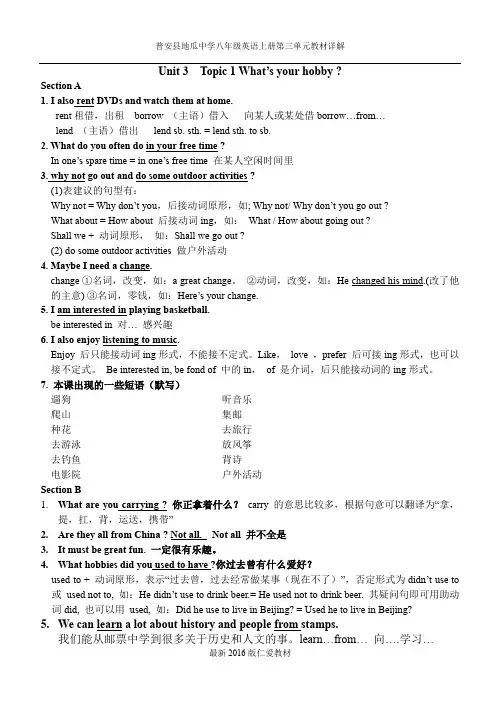
Unit 3Topic 1What’s your hobby ?Section A1.Ialso rent DVDs and watch them at home.rent租借,出租borrow (主语)借入向某人或某处借borrow…from…lend(主语)借出lend sb. sth. = lend sth. to sb.2. What do you often do in your freetime ?In one’s spare time = in one’s free time 在某人空闲时间里3.why not go out and do some outdoor activities ?(1)表建议的句型有:Why not = Why don’t you,后接动词原形,如; Why not/ Why don’t you go out ?What about = How about 后接动词ing,如:What / How about going out ?Shall we + 动词原形,如:Shall we go out ?(2) do some outdoor activities 做户外活动4. Maybe I need a change.change ①名词,改变,如:a great change。
②动词,改变,如:He changed his mind.(改了他的主意) ③名词,零钱,如:Here’s your change.5. I am interested in playing basketball.be interested in 对…感兴趣6. Ialso enjoy listening to music.Enjoy 后只能接动词ing形式,不能接不定式。
Like,love ,prefer 后可接ing形式,也可以接不定式。
Be interested in, be fond of 中的in,of 是介词,后只能接动词的ing形式。
Unit1 Topic3仁爱版英语八年级上册课文同步翻译知识梳理和话题写作范文
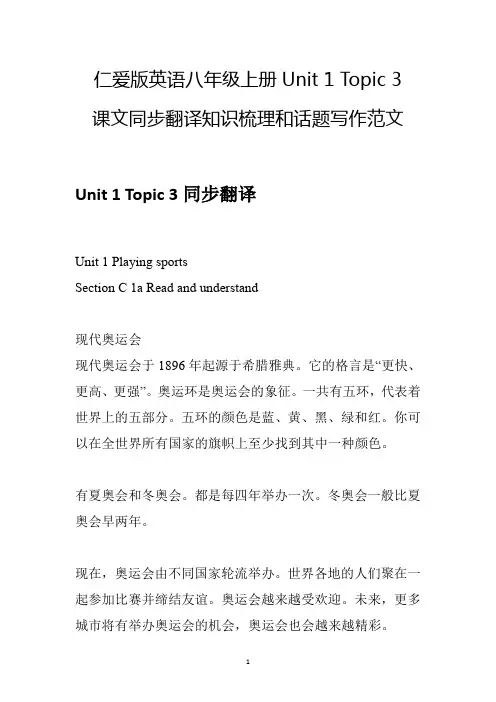
仁爱版英语八年级上册Unit 1 Topic 3 课文同步翻译知识梳理和话题写作范文Unit 1 Topic 3同步翻译Unit 1 Playing sportsSection C 1a Read and understand现代奥运会现代奥运会于1896年起源于希腊雅典。
它的格言是“更快、更高、更强”。
奥运环是奥运会的象征。
一共有五环,代表着世界上的五部分。
五环的颜色是蓝、黄、黑、绿和红。
你可以在全世界所有国家的旗帜上至少找到其中一种颜色。
有夏奥会和冬奥会。
都是每四年举办一次。
冬奥会一般比夏奥会早两年。
现在,奥运会由不同国家轮流举办。
世界各地的人们聚在一起参加比赛并缔结友谊。
奥运会越来越受欢迎。
未来,更多城市将有举办奥运会的机会,奥运会也会越来越精彩。
Unit 1 Topic 3知识梳理Topic 3 The school sports meet is coming.【重点短语】1.the school sports meet 学校运动会2.the boy’s 800-meter race男子800米赛跑3.relay race 接力赛4.It’s one’s first time to do sth.某人第一次做某事4.prepare for… 为……做准备5.sports clothes/shoes 运动衣/鞋6.go to the movies去看电影7.go for a picnic 去野餐8.at the school gate 在校门口9.at the theater 在剧院10.a/the symbol of………的象征11.stand for 代表,象征12.at least 至少13.every four years 每四年14.the Summer/Winter Olympic Games 夏季/冬季奥林匹克运动会15.in turn 轮流16.all over the world 全世界17.do badly in 在某方面做的差18.cross the finish line 穿过终点线19.be regarded as…被看做……【重点句型】1.--Which sport will you take part in?--The boy’s 800-meter race.--你将参加哪项运动?--男子800米赛跑。
仁爱版八年级英语上册知识讲义-语法讲解(情态动词used to)
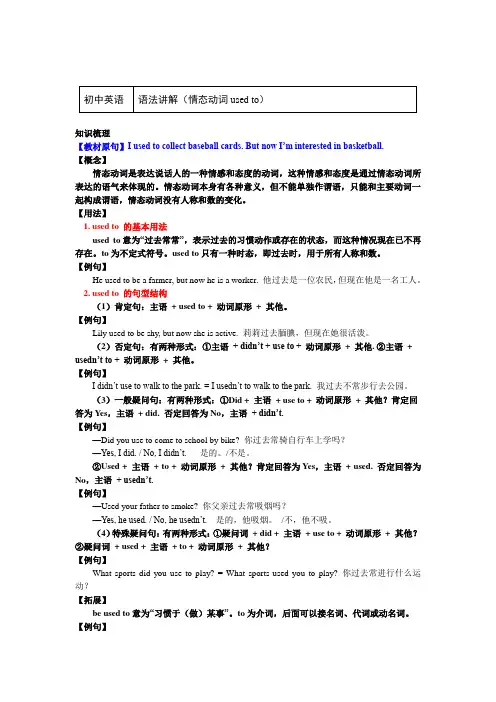
知识梳理【教材原句】I used to collect baseball cards. But now I’m interested in basketball.【概念】情态动词是表达说话人的一种情感和态度的动词,这种情感和态度是通过情态动词所表达的语气来体现的。
情态动词本身有各种意义,但不能单独作谓语,只能和主要动词一起构成谓语,情态动词没有人称和数的变化。
【用法】1. used to 的基本用法used to意为“过去常常”,表示过去的习惯动作或存在的状态,而这种情况现在已不再存在。
to为不定式符号。
used to只有一种时态,即过去时,用于所有人称和数。
【例句】He used to be a farmer, but now he is a worker. 他过去是一位农民,但现在他是一名工人。
2. used to 的句型结构(1)肯定句:主语+ used to + 动词原形+ 其他。
【例句】Lily used to be shy, but now she is active. 莉莉过去腼腆,但现在她很活泼。
(2)否定句:有两种形式:①主语+ didn’t + use to + 动词原形+ 其他. ②主语+ usedn’t to + 动词原形+ 其他。
【例句】I didn’t use to walk to the park. = I usedn’t to walk to the park. 我过去不常步行去公园。
(3)一般疑问句:有两种形式:①Did + 主语+ use to + 动词原形+ 其他?肯定回答为Yes,主语+ did. 否定回答为No,主语+ didn’t.【例句】—Did you use to come to school by bike? 你过去常骑自行车上学吗?—Yes, I did. / No, I didn’t. 是的。
/不是。
②Used + 主语+ to + 动词原形+ 其他?肯定回答为Yes,主语+ used. 否定回答为No,主语+ usedn’t.【例句】—Used your father to smoke? 你父亲过去常吸烟吗?—Yes, he used. / No, he usedn’t. 是的,他吸烟。
最新仁爱版英语八年级上册教材解说 精华版
1、注重结构的 呈现与功能的运 用
2 、以单元为单位, 每个单元包括section A section B和selfcheck三部分,注重专 项训练。
仁 爱 版
人 教材编写特点 教 版
3、本教材的内容设置 使英语课程的五个总 体目标之间也实现了 相互融合、相互渗透 、相互促进。
3 、设计了大量的 听力素材,注重语 言技能的培养。
认真研读课标 准确把握教材
仁爱版 八年级上册
“三说”课件
一、说课标
二、说教材
三、说建议
总体目标
影响学生学习和 发展的重要因素 得体运用语言 的保证
文化知识 跨文化交际 意识与能力
提高学习效率, 发展自主学习能 力的保证
动机兴趣/自信意志 合作精神/祖国意识 国际视野 情感态度
语音/词汇/ 语法/功能/ 话题 语言知识
Reminding and warning Giving advice
Topic2 I must ask him to give up smoking .
Unit 2 Keeping Hed brush your teeth twice a day . illnesses Making appointments will will Topic2 I‘ll kick you the ball again Making requests and responses
Topic3 理解的 Unit 3 Topic1 Unit 2 基础上 培养 听懂对 Unit 4 学生 Unit 1 Review of Unit 1 话,通 用英 过不同 语做 学习单元 Review of Unit 2 的听力 事情 复习单元 活动, 的能 Review of Unit 3 力 帮助学 Review of Unit 4 生完成 课文及语法注释 词汇表 编写对新材 料的理 体例解,提 帮助学生养成良好的学习习惯,掌握 高其听 科学的学习方法,从而提高学习效率, 及目的 说能力。 成为真正的自主学习者。
仁爱版英语八年级上册Unit1__Topic1重点词汇讲解
Unit1 Topic1重点词汇讲解1.see v. 看见see sb. do sth. 看见某人做某事,强调看到动作的全过程。
see sb. doing sth. 看见某人正在做某事,强调动作正在进展。
类似用法的动词还有feel, hear, watch等。
如:I often see him play soccer on Sunday afternoon. 我经常看见他在星期日下午踢足球。
2.hope v. 希望hope to do sth. 希望做某事。
如:Betty hopes to study Chinese in Peking University. 贝蒂希望在北京大学学中文。
hope+ that 从句,that可以省略。
如:I hope (that) you will come to my party. 我希望你来参加我的晚会。
3.prefer v. 更喜欢相当于like …better。
如:Which sport do you prefer? = Which sport do you like better?1)prefer + 名词/代词,如:I prefer English. 我更喜欢英语。
2)prefer doing sth/to do sth. 如:I prefer watching TV at home.【拓展】prefer…to…比起…更喜欢...。
注意此处的to 为介词,prefer和to后面接名词、代词或动名词。
如:I prefer apples to bananas.He prefer swimming to playing football.4.join v.参加,参加1) join + sb./团体,组织参加某人或某团体。
如:He joined the basketball team last year.他去年加人了篮球队.Would you like to join us for dinner?你要加人我们一起去用餐吗?2)join in + sth. /doing sth. 参与某事或做某事, 如:They always join in the soccer games between classes after school.他下课后总会参加班与班之间的足球赛。
八年级上册仁爱版英语u2t1知识点
八年级上册仁爱版英语u2t1知识点本文将围绕着八年级上册仁爱版英语U2T1知识点进行详细的讲解。
对于学习英语的同学们来说,熟悉这些知识点,掌握好这些内容,是非常有必要的。
一、词汇及短语1. Lucky:幸运的2. Unlucky:不幸的3. Passport:护照4. Lost:丢失5. Impossible:不可能的6. Maybe:也许7. Excuse me:请问8. Sorry:对不起二、语法1. 过去时态过去时态是指动作或状态发生在过去某个时间。
其构成方法是:规则动词加-ed。
例如:watch → watched;work → worked。
2. 过去进行时态过去进行时态表示在过去某个时间正在进行的动作。
其构成方法是:was/were + 现在分词(-ing)。
例如:I was watching TV。
3. 过去完成时态过去完成时态表示在过去某个时间之前完成的动作。
其构成方法是:had + 过去分词。
例如:I had finished my homework before he came.4. 情态动词情态动词是指能够表示说话人主观意愿、可能性、能力、必须性、推测等意义的动词。
常见的情态动词有:can、could、may、might、must、shall、should、will、would。
三、听力听力是英语学习中非常重要的一部分,通过听力可以帮助我们提高语感,同时也可以帮助我们更好地理解英语口语。
八年级上册仁爱版英语U2T1中,听力部分主要包括对话和短文两部分。
在听力训练中,需要注意以下几点:1. 注意听力材料的语速。
2. 注意听力材料中重点单词的发音。
3. 注意听力材料中的重点信息。
四、口语在英语学习中,口语是非常重要的一部分。
通过口语训练,可以帮助我们更好地掌握语音、语调、语速等方面的技巧,同时也可以提高我们的听力和表达能力。
在八年级上册仁爱版英语U2T1中,口语部分主要涉及以下几个方面:1. 日常交际用语:包括问候、介绍、提问、道歉等方面的表达。
精品推荐:仁爱版八年级上册英语教材同步详解
八年级上册Unit 1 topic 1Section A1.I saw you play basketball almost every day during the Summer holidays.常见的感官动词有:see, watch, hear, smell, feel 等。
后可接①动词ing形式,表此动作正在发生。
②动词原形,不表此动作正在发生, 表此动作已完成或存在的事实。
①Do you smell something ? (burn) 答案:burning②I often see him basketball after class. ( play ) 答案:play2.There is going to be a basketball game between Class Three and our class this Sunday.There be 句型:表某地有某物. 而have 表示某人有…(1)There is/ are..表现在某地有某物,is/are取决于后面的名词是单数还是复数,单数用is 复数用are,如①There is a pen and two rulers on the desk.②There are two rulers and a pen…(2) There was/were…表过去某地有某物。
was/were的用法也遵循就近原则。
(3)There will be 或There is/are going to be 表某地将有某事物。
不能说成There willhave…(题) a match in our school between Class Three and Class Four next week.3.Would you like to come and cheer us on? ----- Sure, I’d love to.(1)Would you like + 不定式?表建议或邀请。
上仁爱英语八年级上册教材分析
Unit1 Playing SportsTopic1 I’m going to play basketball.【重点单词】1. ①health y(形容词)=(同义词)fit ②(名词)health2. ①win(过去式)won②(名词)win ner3. ski(现在分词)skiing4. famous(比较级)more famous5. arrive(同义词)=reach=get6. leave(过去式))left7. popular(最高级)the most popular【重点短语】1.during the summer holidays在暑假期间2.between…and…在两者之间3.cheer sb. on为某人加油4.prefer do ing sth.更喜欢做某事5.quite a bit/a lot很多6.plan to do sth.计划做某事7.have a skating club举办滑雪俱乐部8.go skati ng/ski ing/bicycl ing/climb ing/hik ing去滑雪/滑冰/骑车/爬山/远足9.arrive in/at到达10.play against…与……对抗/较量11.for long很久12.leave for…动身去…13.the day after tomorrow后天14.China’s national team中国国家队15.play baseball打棒球16.at least至少17.What a shame!多羞愧!18.be good at善于做某事19.take part in参加20.all over the world全世界21.be good for对……有益22.a good way一种好方法23.keep fit/healthy保持健康24.relax oneself放松某人自己【重点句型】1.What’s your favorite sport = What sport do you like best你最喜爱的运动是什么2.Which sport do you prefer = Which sport do you like better你更喜欢什么运动I prefer skating. = I like skating better. 我更喜欢滑雪.3.Do you skate much = Do you often skate 你常滑雪吗4.She spends at least half an hour in the gym every day. 每天她至少花半小时在体育馆.5.She plays baseball pretty well and she is also good at jumping.她棒球打得相当好而且擅长于跳.6.What kind of sports do you like = Which sport do you like 你喜欢哪种运动7.Would you like to come and cheer us on你愿意来为我们加油吗8.What are you going to be when you grow up当你长大后做什么9.There is going to be a school sports meet next month.下月有一场运动会。
(简化版)仁爱版英语八年级上册教材同步详细讲解
(简化版)仁爱版英语八年级上册教材同步详细讲解1. 单元一:Meeting New Friends本单元主要介绍了如何与新朋友交流和建立友谊的技巧。
- 第一课:Greetings and Introduction这一课主要介绍了问候和自我介绍的基本用语,以及如何用合适的方式与陌生人交流。
- 第二课:Making Friends这一课主要教授了如何主动交友和与他人展开对话的方法。
- 第三课:Meeting People Online该课程旨在向学生介绍如何在网上结识新朋友并保持网络安全。
- 第四课:Inviting Friends to a Party本课程通过模拟邀请朋友参加派对的情景,教会学生如何邀请和回应邀请。
2. 单元二:The World Around Us本单元主要介绍了地理和环境相关的知识。
- 第一课:Weather这一课程向学生介绍了天气相关的词汇以及如何描述天气状况。
- 第二课:Natural Disasters该课程涵盖了地球自然灾害,如地震、火山喷发和飓风等,以及如何保护自己和提前预防。
- 第三课:Wildlife Conservation该课程旨在增强学生对野生动物保护的意识,并了解一些保护动物的方法。
- 第四课:Environmental Issues该课程探讨了当前环境问题,如污染和气候变化,并提倡学生参与环保活动。
3. 单元三:Science and Technology本单元主要介绍了科学和技术领域的知识。
- 第一课:Inventions and Discoveries这一课程介绍了一些重要的发明和发现,并引导学生思考科技对人类生活的影响。
该课程探讨了人与机器之间的交流方式,并介绍了一些常见的科技设备。
- 第三课:The Internet and Social Media该课程向学生介绍了互联网和社交媒体的基本概念,以及如何正确使用和保护个人信息。
- 第四课:Artificial Intelligence本课程以人工智能为主题,向学生介绍了机器研究和智能系统的基本原理。
初中英语仁爱版八年级上册知识点梳理(共计59页)
八年级(上册)Unit 1 Play Sports【考点解析】Topic 1 Are you going to play basketball?Section A1.We are going to have a basketball game against Class Three.against表示“对着:反对;靠着”2.cheer sb.on为……加油,鼓劲3.win和beat都可表示“赢”,但用法不同。
(1) win(won,won)一般后接比赛,奖品或奖项作宾语,也可作不及物动词,表示“赢”的结果。
(2) beat(beat,beaten)击败、战胜,一般接对手作宾语,还可译为“心脏跳动”或“击打”。
a game a teamwin+事物 a war beat+对手 a nationa prize an apponent(对手)4.prefer宁愿,更喜欢(1)prefer doing sth.to doing sth.跟做某事比较起来更喜欢做某事prefer sb./sth.to sb./sth.跟某人/某物比较起来更喜欢人/某物(2)prefer to do sth.(rather)than do sth.跟做某事比较起来更喜欢做某事(3)prefer to do sth.更喜欢做某事5.join/take part in(1)join参加某个政党,团体,组织等,成为其中的一员(2)join sb.(in doing sth.)和某人一起(做某事)(3)join in=take part,in参加某项活动Section B1.play for a team为某队效力be in/on the team在某队打球2.dream作名词,“梦,梦想”。
e.g.my dream job也可作动词dream of/about sth./doing sth.3.“one of the+形容词最高级+名词的复数”意思是“最……之一”。