
仁爱版英语七年级下册Unit1Topic1SectionC
3 Pair work
Make conversations similar to the example, using the words or phrases in the box.
Activity: meet friends watch TV listen to music read books cook go to the zoo play soccer
Yu Jing Read books
What does Fan Mingming usually do after school? He usually cleans the house, but he doesn’t play the guitar.
Fan Mingming Clean the house
Frequency: once a week twice a week three times a week very often every day seldom never
A:
Do you often read books in the library?
B: Yes, I do. / No, I don’t. A: B: How often do you come to the library? Very often.
放学后
after school
踢足球
play football/soccer
到达家里
get home
做作业
do one’s homework
上课
have a class/classes
Pair work
What does Yu Jing usually do after school? He usually reads books, but he doesn’t play basketball.
Wang Junfeng do his homewor来自 go to the park
A:__________________________________________ A: What does Wang Junfeng usually do after school? B: He usually does his homework, but he doesn’t B:__________________________________________ _____________ go to the park.
Ellen listen to music watch TV
A: What does Ellen usually do after school? A:__________________________________________ B: She usually listens to music, but she doesn’t watch TV. B:______________________________________________
I usually go to school on foot. = I usually ____ walk ____ to school. Maria sometimes goes to school by bike. rides ____ a ____ bike ____ to = Maria sometimes ____ school. Jane often goes to school by bus. = Jane often ____ takes ____ a ____ bus ____ to school. Kangkang’s father goes to Beijing by plane. = Kangkang’s father ____ flies ____ to Beijing. I seldom go home by subway. take ____ the subway = I seldom ____ _____ home.
does her homework
goes to bed
Retell Ann’s day according to the key words. Time Activity 6:20 a.m. gets up 7:00 a.m. has breakfast 7:30 a.m. goes to school 12:10 p.m. has lunch after school plays football 5:30 p.m. gets home after dinner does her homework 9:45 p.m. goes to bed
一会儿;一段时间 开始;着手 床
begin while bed
What are they doing?
They are having a Chinese class.
Read the passage carefully and complete the table.
(1)What does Jane usually do at twenty past six? She usually gets up at twenty past six. (2)How many classes does she have in the morning? She has four classes in the morning. (3)How does she go home? She takes the subway home. (4)What time does she go to bed? She goes to bed at about a quarter to ten.
Read the passage carefully and complete the table.
Time 6:20 a.m. 7:00 a.m. 7:30 a.m. 12:00 p.m. After school 5:30 p.m. After dinner 9:45 p.m. Activity gets up has breakfast goes to school has lunch plays soccer gets home
Pair work
Hai Qing play soccer play basketball
A:_________________________________________ What does Hai Qing usually do after school? B:______________________________________________ He usually plays soccer, but he doesn’t play basketball.
1. Learn the vowels. 2. Review adverbs and phrases of frequency. 3. Sum up the present simple tense. 4. Sum up the useful expressions in this topic.
写一篇关于自己日常活动的短 文。要求: (1)使用一般现在时。 (2)尽可能多地使用学过的频度 副词。
Wen Wei go swimming go fishing
A:__________________________________________ What does Wen Wei usually do after school? B: He usually goes swimming, but he doesn’t go fishing. B:____________________________________________
仁爱七年级unit1topic2sectionc教学反思

仁爱七年级unit1topic2sectionc教学反思本节课是九年级上册Unit 1 Topic2 Section C的一篇阅读课。
对于九年级的孩子来说,这篇文章较长,理解起来还是有些难度的。
在教学过程中,我依据课程标准,结合仁爱教材特点,对本堂课的内容进行了整合。
并遵循阅读教学的原则,针对初三学生的特点,精心设计了读前、读中、读后三个环节的教学活动。
旨在充分调动了学生的参与意识,让他们通过描述、理解、合作、探究的方式学习和运用语言,调动学生的积极性。
下面我就从三个教学环节逐一进行反思一.读前活动(Pre-reading activities)首先利用图片激活学生已有词汇,已有句型来描述自己看到的图片内容,解决阅读中出现的部分生词,为后面的阅读做铺垫。
通过图片,让学生预测本节课的学习的内容,激起学生学习的兴趣。
二.读中活动(While-reading activities)这部分主要是引导学生学会如何阅读并掌握阅读策略。
第一遍快速阅读(Skimming)read and match,引导学生说出是如何做的?tips:关注首尾句,获取文段的中心句。
第二遍读是scanning(read and answer) 让学生带着问题找含有关键词的句子。
引导学生反思阅读的过程,想一想是怎样找到答案的。
提示学生在阅读的过程中关注中心句,阅读对学生来说最大的兴趣在于文中的信息。
每个人阅读的过程都是获取信息的过程。
第三遍进行careful reading挖空填词。
这一遍阅读是细读,这是寻找细节信息的阅读方法。
通过找出文章细节,学生可以加深对文章的理解。
第四遍是自由读,注意语音语调,问学生是否理解了文章,学生的问题通过学生解决。
第五步是合上书,填写所缺内容。
三.读后活动(Post-reading activities)这是一个对前面所学内容的巧妙输出的过程。
在理解前面文本的基础上,给这篇文章给个题目,并陈述理由。
接着抛出两个发散性的问题,依据所补充的材料,帮助学生充分思考,进而探讨,分享。
仁爱英语七年级下册Unit5 Topic1 SectionC 随堂练习
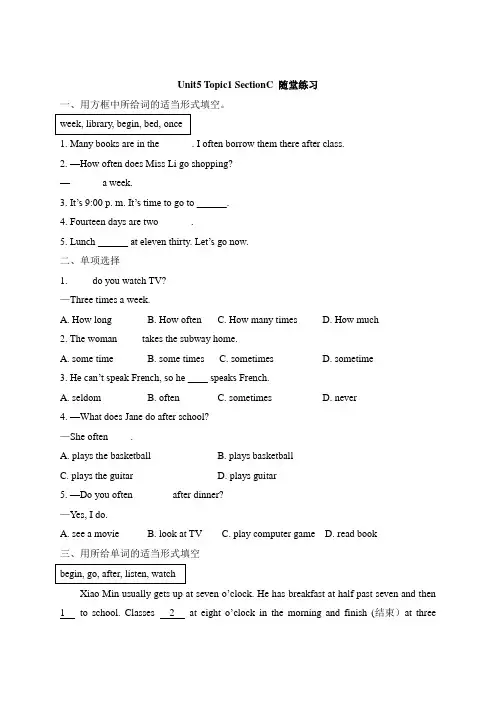
Unit5 Topic1 SectionC 随堂练习一、用方框中所给词的适当形式填空。
1. Many books are in the ______. I often borrow them there after class.2. —How often does Miss Li go shopping?—______ a week.3. It’s 9:00 p. m. It’s time to go to ______.4. Fourteen days are two ______.5. Lunch ______ at eleven thirty. Let’s go now.二、单项选择1. ____ do you watch TV?—Three times a week.A. How longB. How oftenC. How many timesD. How much2. The woman ____ takes the subway home.A. some timeB. some timesC. sometimesD. sometime3. He can’t speak French, so he ____ speaks French.A. seldomB. oftenC. sometimesD. never4. —What does Jane do after school?—She often ____.A. plays the basketballB. plays basketballC. plays the guitarD. plays guitar5. —Do you often _______ after dinner?—Yes, I do.A. see a movieB. look at TVC. play computer gameD. read book三、用所给单词的适当形式填空Xiao Min usually gets up at seven o’clock. He has breakfast at half past seven and then 1 to school. Classes 2 at eight o’clock in the morning and finish (结束)at threeo'clock in the afternoon. 3 school, Xiao Min usually plays games with his classmates. At about half past six, he has dinner with his family. Then he 4 TV for a short time. In the evening he reads books or 5 to music. He goes to bed at half past nine.1. ____2. ____3. ____4. ____5. ____四、根据汉语提示完成句子。
仁爱版英语七年级下册Unit 6 Topic 1 Section C自学课时练
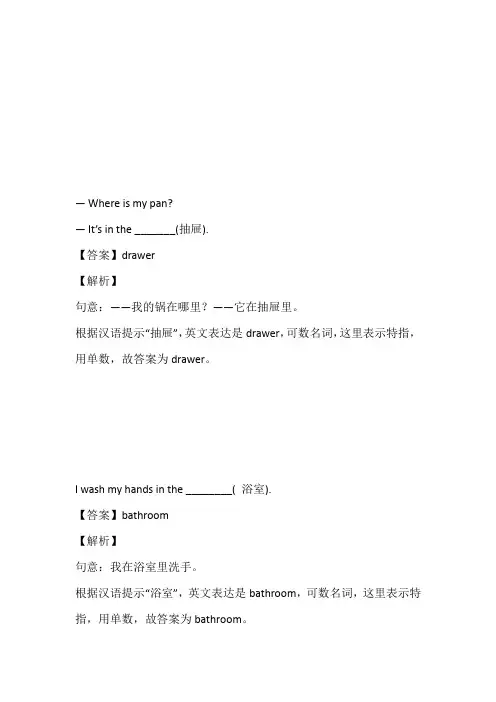
— Where is my pan?— It’s in the _______(抽屉).【答案】drawer【解析】句意:——我的锅在哪里?——它在抽屉里。
根据汉语提示“抽屉”,英文表达是drawer,可数名词,这里表示特指,用单数,故答案为drawer。
I wash my hands in the ________( 浴室).【答案】bathroom【解析】句意:我在浴室里洗手。
根据汉语提示“浴室”,英文表达是bathroom,可数名词,这里表示特指,用单数,故答案为bathroom。
There is a ________(键盘) near the computer.【答案】keyboard【解析】句意:电脑附近有一个键盘。
根据汉语提示“键盘”,英文表达是keyboard,可数名词,前面有不定冠词a修饰,用单数,故答案为keyboard。
There are some books on the ________(椅子).【答案】chair【解析】句意:有一些书在椅子上。
根据汉语提示“椅子”,英文表达是chair,on the chair在椅子上,故答案为chair。
—What’s in her garden?—There are many _________ _________(漂亮的花) in it.【答案】beautiful flowers【解析】句意:——她的花园里有什么? ——里面有很多漂亮的花。
根据汉语提示“漂亮的花”,“花”flower,可数名词,这里指“很多漂亮的花”,用复数flowers;“漂亮的”beautiful,形容词,在句中作定语修饰后面的复数名词flowers;故答案为(1). beautiful (2). flowers。
选词填空【1】Are there ________ (any/some) picture on the wall?【2】There is a bird ________(on/in) the tree.【3】There is a river ________(on/behind) the house.【4】The purse is _________(my/mine).【5】Let’s ________(have a look/have a look at) the map.【答案】【1】any【2】in【3】behind【4】mine【5】have a look at【解析】【1】句意:墙上有一些图画吗?分析题干可知,设空处需要填入不定代词;some一些,用于肯定句及其表示请求建议的疑问句中;any一些,用于疑问句及否定句。
最新七年级英语下册仁爱版教材教案
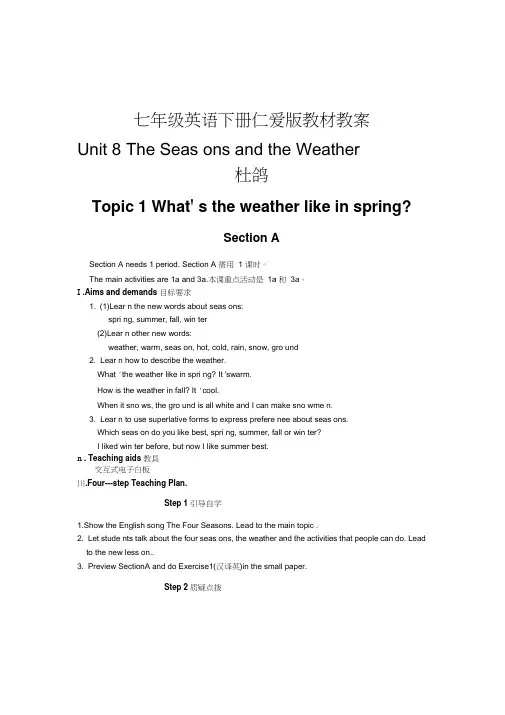
七年级英语下册仁爱版教材教案Unit 8 The Seas ons and the Weather杜鸽Topic 1 What' s the weather like in spring?Section ASection A needs 1 period. Section A 需用1 课时。
The main activities are 1a and 3a.本课重点活动是1a 和3a。
I .Aims and demands 目标要求1. (1)Lear n the new words about seas ons:spri ng, summer, fall, win ter(2)Lear n other new words:weather, warm, seas on, hot, cold, rain, snow, gro und2. Lear n how to describe the weather.What 'the weather like in spri ng? It 'swarm.How is the weather in fall? It 'cool.When it sno ws, the gro und is all white and I can make sno wme n.3. Lear n to use superlative forms to express prefere nee about seas ons.Which seas on do you like best, spri ng, summer, fall or win ter?I liked win ter before, but now I like summer best.n . Teaching aids 教具交互式电子白板川.Four---step Teaching Plan.Step 1引导自学1.Show the English song The Four Seasons. Lead to the main topic .2. Let stude nts talk about the four seas ons, the weather and the activities that people can do. Leadto the new less on..3. Preview SectionA and do Exercise1(汉译英)in the small paper.Step 2质疑点拨1.What 'the weather like …? =How is the weather …?2.lt S a good seas on for doing sth.It's a good time to do sth.3.Which seas on do you like best?What's your favorite seas on?Step 3课堂展示1. First let stude nts liste n to 1a and the n watch the video and repeat after it.■ ■in pairs a nd the n act it out.2. Practice3. Let stude nts describe the weather in the four seas ons and the activities done in each seas on4. Group work.Fi nd o ut importa nt phrases and senten ces in 1a. Let stude nts point outorally.and expla in them.5. Work alo ne.Read 1a aga in and match the seas ons with the weather and activities. Finish 1b.6. Ask and an swer:A:What's your favorite season?B: My favorite season is...A: Why do you like it ?B:Because it's a good time/season…/ Because we can...Lead to 3a7. Let stude nts liste n to 3a and an swer the questi ons.What 'sKan gka ng 'favorite seas on? Why?(让学生再听3a录音,跟读并表演3a。
仁爱版英语七年级上册Unit 1 Topic 1 Section C课件

Your father get home at 7 p.m.
Good evening,… _______ _______
You get up at 7 a.m.
Good morning,
…
_______ _______
3. How are you? 较熟悉的人之间见面时常用的问候语,但并不是想深入交谈 某人的健康状况,只是一种礼貌的问候方式。 常用答语为: Fine./I’m fine. / I’m (very)well. /I’m OK. 意为 “我很好”,并常 用 “Thank you.” 或“Thanks. ”表示感谢。 出于礼貌, 还可用 “How are you?”或 “And you?”问候对方。 这时可以用:I’m fine, too./ Fine, too./ Not (too) bad, thank you.等作答。
Look and copy.
S: Good morning, Mr. ... How are you? T: I’m fine. Thank you. And you? S: I’m fine, too. Goodbye, Mr. ... T: Bye. 1. goodbye/bye interj. 再见
How do you do? 5. my, a, teacher, dad, good, is (.)
My dad is a good teacher.
Ⅲ. 根据对话内容,在每个空白处填上一个适当的单词,使对 话的意思连贯、完整。
A: How are you, Jack? B: I’m fine, thanks. 1.__A__n_d__ you, Lily? A: I’m fine, 2.__t_o_o___. Is this your CD? B: 3.__Y_e_s___, it’s mine (我的). Look!A letter “J” is on it. A: Oh. Here you 4.___a_re___. B: 5._T__h_a_n_k_ you. A: You’re welcome.
仁爱版英语七年级下册Unit7Topic1SectionC教学设计
3.教师邀请学生进行角色扮演,用一般现在时描述图片中的环境问题和环保行为,让学生在实际语境中运用所学知识。
(三)学生小组讨论
1.学生分成小组,每组选择一个环境问题或环保行为,用一般现在时进行讨论,讨论过程中要求每个成员都参与发言。
2.在语法方面,学生对一般现在时的理解程度不同。部分学生可能在动词第三人称单数形式的变换上存在困难,需要在教学中进行针对性的讲解和练习。
3.口语表达方面,学生在描述环境问题和环保行为时,可能存在表达不清、句子结构单一等问题。教师应鼓励学生多开口,提高他们的口语表达能力。
4.阅读理解方面,学生对关于环保的文章阅读存在一定难度,可能无法准确抓住文章主旨和关键信息。教师应引导学生运用阅读技巧,提高阅读理解能力。
2.掌握一般现在时的用法,特别是动词第三人称单数形式的变换规则,如:He/She/It +动词原形/第三人称单数形式。
3.学会使用一般现在时描述环境问题和环保行为,提高口语表达能力。
4.能够阅读并理解关于环保的文章,抓住文章主旨,提取关键信息。
(二)过程与方法
在本章节的教学过程中,教师将采用以下方法引导学生学习:
2.邀请学生分享他们对这些图片的看法,以及他们在生活中所见到的环保行为,为学习新课做好情感上的准备。
3.教师提出本节课的学习目标,让学生明确将要学习的内容,包括环保词汇、一般现在时的用法等。
(二)讲授新知
1.教师呈现新课的词汇表,引导学生学习新单词,如pollute、environment、protect、waste、recycle等,并通过例句展示这些词汇的用法。
仁爱版七年级英语上册 Unit 1 Topic 1 Section C 课件
Video time
Consolidation
英语中总共_2_6_个字母,_5__个元音字母 分别是_____A_a__E__e_I_i__O_o__U__u_______。 分印刷体和__书__写__体__两种,所有字母 书写时统一往_右___略倾斜。 书写单词时各字母之间要紧凑,书写 句子时各单词要间隔一个字母距离为 宜。
【注意】 1.I’m = I am 2.Thanks. =Thank you. 3.How are you?可以用And you?代替。 A: How are you? B:I’m fine, thanks. And you? A:I’m OK.
New drills
What are they talking about他 们在说什么?
头上有“辫”上两格(b, d, h, k, l), 有“尾”下面两格拖(g, q, y), 无“辫”无“尾”中间格(a, c, e, m, n, o, r, s,
u, v, w, x, z),惟有f, j, p占三格, i, t中上一格半,对照课本仔细看, 养成书写好习惯,关键还要反复练。
单词及句子的书写
印刷体
THE ENGLISH ALPHABET
Aa Bb Cc Dd Ee Ff Gg
Hh Ii Jj Kk Ll Mm Nn
Oo Pp Qq Rr Ss Tt Uu
Vv Ww Xx Yy Zz
手写体
字母书写歌诀
字母书写有规律,右倾五度正合适。
大写一律上两格,上不顶线是原则。
小写字母怎么办?请你耐心往下看:
1. 书写单词时,字母与字母之间的间隔要 均匀、适当,不要凑的过紧,也不要离得太远。
2. 书写句子时,单词之间必须有适当的距 离,一般以空出一个小写字母a的宽度为 宜。
仁爱版八年级英语下册第七单元Topic1SectionC教案
Unit7 Topic1 SectionC精品教案Ⅰ. Material analysis本节课建议用1课时完成。
主要活动为Section C的1a和3。
本课通过介绍Craig Kielburger和他成立的组织Free the Children的事迹展开学习活动,继续学习that 引导的宾语从句,复习发出邀请的功能用语,学习邀请函的写作。
要求学生掌握黑体词汇和短语的用法,理解白体词汇的含义,进一步学习并运用宾语从句,学会如何写邀请函。
鼓励他们学习Craig Kielburger 关心他人,乐于助人的精神,并向Craig Kielburger学习从小立下远大志向,并为之努力奋斗。
Ⅱ. Teaching aimsKnowledge aims:1. 学生能进一步掌握宾语从句的用法。
2. 学生能正确掌握邀请函的写作。
Skill aims:1. 能听懂有关邀请他人参加美食节的对话。
1/ 222. 能就邀请他人参加美食节的话题进行交谈。
3. 能从所给语言材料中找出有关信息。
4. 能写出简单的邀请函。
Emotional aims:向Craig Kielburger学习,从小立下远大志向,并为之努力奋斗。
Ⅲ. The key points and difficult pointsKey points:1. 能向别人简单介绍Craig Kielburger的事迹。
2. 进一步掌握宾语从句的用法。
Difficult points:写出简单的邀请函。
Ⅳ. Learning strategies1. 阅读时学会运用学过的知识和文段的关键词及大意进行预测。
2/ 222. 写出邀请函一类的应用文之前首先要明确格式和写作的内容。
Ⅴ. Teaching aidsComputer multimedia projector.Ⅵ. Teaching procedures3/ 22Ⅶ. Blackboard design9/ 22Unit7 Topic1 SectionC精品教案Ⅰ. Material analysis本节课建议用1课时完成。
七年级英语Unit1 Topic1 Section D仁爱版 教案
Unit1 Topic1 Section D The main activities are 1, 2 and 5. 本课重点活动是1, 2和5。
Ⅰ. Teaching aims and demands 教学目标1. (1)Review greetings:①Hi! Hello!②Good morning! / Good afternoon!③How are you? / I’m fine, thank you./Fine, thanks.④How do you do? / How do you do?⑤Nice to meet / see you. / Nice to meet/see you, too.⑥Wele to China!(2)Review the introduction:①—I’m… Are you…?—Yes, I am.②This is…(3)Review farewells:①—See you later.—See you.②—Goodbye.—Bye.2. Review the letters Aa-Zz.Ⅱ. Teaching aids 教具录音机/投影仪/字母卡片Ⅲ. Five-finger Teaching Plan 五指教学方案Step 1 Review 第一步复习(时间:10分钟) 1. (复习课堂用语。
)T: Good morning, class!Ss: Good morning, Mr. …/Miss…2. (复习问候语,老师先和学生对话做示X,后让学生自己表演。
巩固问候语的英文表达法,做到学以致用。
)T: Let’s review the greetings.(1)T: Hi! S1.(老师作挥手打招呼状。
)S1: Hello! Mr. …/Miss…T: Nice to meet/see you.(教师作握手状。
)S1: Nice to meet/see you, too.(2)T: Good morning, S2.(老师作挥手打招呼状。
初一下册仁爱英语第一单元作文
初一下册仁爱英语第一单元作文English:In the first unit of the first volume of the Grade 7 Ren'ai English textbook, we learn about the theme of "My School Life". School life is an important part of our growing up years, as it is where we spend a significant amount of our time, make friends, learn new things, and develop our skills. In this unit, we talk about our daily routine at school, the subjects we study, the activities we participate in, and the teachers who guide us. We also learn vocabulary related to school life, such as classroom objects, school subjects, and school activities. Through this unit, we not only practice our English language skills but also reflect on the importance of education and the role of schools in our lives.中文翻译:在初一下册仁爱英语教材的第一单元中,我们学习了关于“我的学校生活”的主题。
学校生活是我们成长岁月中的一个重要部分,因为我们在这里花费大量时间,交朋友,学习新事物,发展技能。