
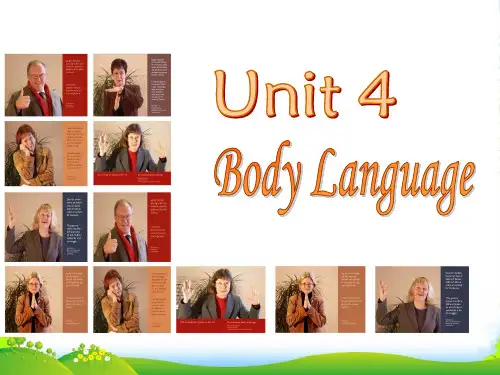
人教版高中英语必修四Unit 4 Body language
必修4 Unit 4 Body language词汇_________ adj.主要的__________ adj.地方的__________ adj.好奇的__________ vt.介绍__________ vt./vi接近__________vt. 接触__________ n.陌生人__________ adj.口头的__________ vt.表达__________ n. 活动__________ adj.可能的__________ adj.总体的__________vt.避免__________ vt.误解__________adj. 相似的__________ vt.代表__________ vt.惩罚__________ n./adj. 成人__________ n. 协议__________ adj. 面部的短语________________________ 采取行动________________________ 使……平静|安逸________________________准备好做……________________________接近________________________介绍________________________. 很可能________________________ 乐意干……________________________ 尊敬某人________________________ 派某人做…… ________________________ 正视某人________________________ 向某人点头________________________伸手________________________ 和某人握手________________________ 面部表情构词法:1.major→ __________n.大多数2.represent→ __________n.代理人adj.典型的3.curious→ __________n.好奇心4.introduce→ __________n.介绍5.touch→ __________adj.情绪激动的6.learn→ __________adj.有学问的7.strange→ __________n.陌生人8.speak→ __________n.发言、演说→ __________adj.口语的9.express→ _________n.表达表情10.action→ __________v.行动表演→ __________n.演员→ __________adj. 活跃的;积极的→ __________n.活动11.general→ __________adv.一般地;通常地12.avoid→ __________adj.可避免的→ __________n.避开13.misunderstand→ __________n.误会→ __________n.理解;明白14.similar→ __________n.相似性→ __________adv.类似地15.agreement→ _________v.同意→ __________n.不同意→ __________v.不同意16.punish __________n惩罚知识点讲解I.单词1. major【观察思考】adj.1) This is a major road.2) Water plays a major role in our life.n. Her major is History.vi. She majored in English at Shandong University.【巩固运用】1)这是一家大跨国公司。
____________________________________________________________________________ 2)Never mind―it’s not major.____________________________________________________________________________ 3)他在大学主修法语。
____________________________________________________________________________ 4)The majority ______ in favor of banning smoking.A. areB. isC. should beingD. A or B2. represent representation n. ___________ adj.典型的,有代表性的【观察思考】1)The competition attracted over 500 players representing 8 different countries.2)He represented himself as an expert.3)Let me try to represent my ideas to you in another way.4)The King is represented as a hero in the play.【巩固运用】1)用represent的正确形式填空。
The red lines on the map railway lines.2)她把自己描绘成世界上最好的母亲。
____________________________________________________________________________ 3)They represented their concerns to the authorities.(英译汉)____________________________________________________________________________ 3. approach【观察思考】v. 1) National Day is approaching.2) She approached the bank for a loan.3) As you approach the town, you will see the college on the left.n. 1) All the approaches to the airport were blocked by the police.2) The school has decided to adopt a different approach to discipline.【巩固运用】1)随着冬天的临近,天气变得更冷了。
____________________________________________________________________________ 2)学习外语的最好途径是什么?____________________________________________________________________________ 完成句子1)__________________(通往房子的路) the house was a narrow path.2)The time ______________ (越来越近了) when we will have to leave.4. touch touched adj. _______________ adj.令人同情的,感人的,动人的【观察思考】1)Don’t touch that plate―it’s hot.2)His story touched us all deeply.3)Are you still in touch with your friends from college?4)In his speech he was only able to touch on a few aspects of the problem.【拓展】________________ 与某人失去联系lose touch with sb _________________________________与某人取得联系keep in touch with sb __________________________________ 被……感动【巩固运用】1)我轻轻地碰了碰他的手臂。
I ______ _____ lightly _____ _____ ______.2)他的话确实触动了我的心弦。
____________________________________ my heart.3)自毕业之后我们一直保持联系。
(汉译英)____________________________________________________________________________ 5. likely【观察思考】1)Tickets are likely to be expensive.2)It’s likely that the thieves don’t know how much it is worth?3)Me? Join the army? Not likely!【辨析】likely/possible/probable用法上有区别么?【巩固运用】1)他今晚很可能给我打电话。
译1:_______________________________________________________________________ 译2:_______________________________________________________________________ 2)Look, dark clouds are gathering. It is ______ to rain soon.A. probableB. possibleC. likelyD. perhaps3)I think he is ______ to win, but I’m not sure.A. possibleB. likelyC. probableD. certain4)---I advise you to learn a second language. ---Me? ______! I’m too slow.A. Not likelyB. No problemC. As possibleD. SurelyII.短语1. take action【观察思考】1) The police had to take firm action to deal with the strike.2) Firefighters took action immediately to stop the blaze spreading.【拓展】in action ______________ ________________ 不能工作;停止运转;发生故障put / bring sth into action _____________ take measures / steps to do sth _____________ 【巩固运用】1) Immediate action should be ______ to prevent people from being affected by the bird flu.A. madeB. broughtC. takenD. paid2) I’ve get to see all the players ______ ______ (实地比赛).3) All the machines ______ ______ ______ ______ (停止工作) because of power failure.4) The government ______ ______ ______ ______ ______ (使这个计划生效).2. at ease【观察思考】1) The policemen tried every means possible to put the missing child at ease.2) He didn’t feel completely at ease in the strange surroundings.【拓展】with ease _________________ __________________ 感到/ 看上去心情放松put / set sb at one’s ease _______________ take one’s ease _________________【巩固运用】1) The girl answered all the questions ______ ______ ______ (非常轻松地).2) Don’t overwork yourself and ______ ______ ______ (休息一会儿).3) He sat back on the chair, listening to the MP4 and _____.A. looking at easeB. looked at easeC. being looked at easeD. to look at ease3. as well【观察思考】1) I’m going to London and my sister’s coming as well.2) Jack went to the park, John went there, too.3) Jack didn’t go to school, Tom didn’t, either.4) He finished his homework on time, Li Ming also finished it.【归纳总结】as well/too /either /also /as well as __________________________________________________ 【巩固运用】用as well, too, either, also, 和as well as 填空。
高中英语人教版必修四unit4body_language重点单词和短语ppt课件
通知;通告;布告
Ⅱ.重点短语必背
1.__d__ef_e_n_d__a_g_a_in_s_t *2.__o_n_t_h_e_c_o_n_t_r_a_r_y__ *3.__a_t _e_a_se_ *4.t_u_r_n__o_n_e_'s_b__a_ck__t_o_
5.__g_e_t__cl_o_s_e_t_o *6._b__e_l_ik_e_l_y_t_o_._..__ *7.__i_n_g_e_n_e_r_a_l *8.__lo_s_e_f_a_c_e_ 9.__w_a_t_c_h_/_lo_o_k__o_u_t_ 10. put up
n. 真实;
真理
14. truly adj.好奇的→ trnu.th好奇心
adv. 好奇地→
true
15. curiovuts. 保护;保卫→
cunr.iou防sl御y ;保卫
curiosity
defend
defence
1.语境串记(用所给词的适当形式填空) (1)It was curiousthat he should have given in to _______ and openceudritohseity
2.主题串记
请根据词性和汉语提示写出以-ment为后缀的高频单词
(1) statement n.
陈述;说明
(2) achievementn.
功绩;成就
(3) adjustment n.
调整;调节
(4) advertisement n.
广告
(5) agreement n.
同意;一致;协定;协议
(6) announcementn.
代表;象征 接近;靠近;走近 接近;方法;途径 主要的 成人;成年人 成人的;成熟的 可能的
人教版高中英语必修四unit4Bodylanguage教案
人教版高中英语必修四unit4Bodylanguage教案Teaching PlanModule4 Unit 4 Body languagePart1 .Analysis of the teaching materialSs have been learning how to communicate by speaking or writing, they are familiar with the words or voice, but sometimes body languages can express our feelings more directly. If we don’t notice them we may make misunderstanding. So it’s very important to learn the new lesson, lesson4 body language. Body language means the moving of eyes, head or hands while talking, even the distance between persons. In the new class, Ss are helped to learn the ways of body language and the expressions related to them. And by leaning the reading text, Ss are expected to learn the meanings of body language on different cultural background.1.Teaching aims1)K nowledge aims:To understand the meaning of body language.To memorize the new words, phrases and sentence patents.Ability aims:To be able to describe body language with the words learnt.Can recognize the differences under the same body language.2)E motion aims:To arouse the Ss’ interest in body language.To cultivate the Ss’ love for body language.2.Teaching difficult and important points1)The new words, phrases and sentences:2) The ability to describe and recognize body language.3.Teaching aidsa teaching planA multi-media systempptPart2. Teaching and learning methods1.Task-based method,2.Audio-visual(直观) methodPart3. Teaching stepsStep1: GreetingsGreet the whole class as usual.Step2: lead-in (Individual Work)1)Lead Ss know the topic of the lesson (body language)2)Lead Ss know the objectives of the lesson.Step3:Warm-up (individual Work and pair work)1)Show Ss some picturesT: What can you infer from the pictures in Ex1 on P25?2)Games (group work and pair work)Show Ss pictures of different body language, ask them to guess in English together.Invite some Ss act out body language in front of the classroom, others try to guess in English.Ask student go through the expressions in Ex2.Step4:Pre-reading (group work)Have Ss listen to the tape to get the general idea of the text.(the misunderstanding caused by body language)Step5: listening (group work)Have Ss listen to the tape twice and under the body language and the related feels.Check the answers with the CStep6 reading (individual work and group work)1)H ave Ss read the text and do Ex1 of the Comprehending. Check up with the C.2)H ave Ss discuss the questions of Ex2 of the Comprehending.Homework1, Go through the question1-3 of Pre-reading on P25.2, Listen and read the text on P26 two times.3, complete other Exes about new words.。
单元讲解必修四unit4 body language
单元讲解必修四unit4 bodylanguage课本单元讲解(含课文音频):必修四Unit4 Body language_doctor今天,要和大家分享的是人教版必修四Unit4常考单词、高频短语和写作句式,并附有课文音频学起来哦!Unit4 Body language常考单词、高频短语和写作句式Ⅰ. 常考单词必背1.statementn. 陈述;说明His statement is pletely untrue.他的话完全是在撒谎。
2.greetvi.&vt. 迎接;问候I greeted her with a smile.我笑着向她致意。
(1)greet sb with... 用……迎接……;用……向某人打招呼(2)greeting n. (常用复数形式) 问候;祝贺;贺词3.representvt. 代表;象征In the western countries,V often represents victory.在西方国家,V常象征着胜利。
He represented himself as a doctor.他自称是一个医生。
[快速闪记](1)represent sth to sb 向某人说明某事,向某人传达某事represent...as... 把……描绘成……represent oneself as/to be... 自称是……(2)representative n. 代表4.curiousadj. 好奇的The children were curious to know what was happening over there.孩子们很想知道那边发生了什么事。
[快速闪记](1)be curious about 对(某事物)感到好奇be curious to do... 很想做某事;渴望做某事(2)curiously adv. 好奇地5.approachvt..&vi.接近;靠近;走近 n. 接近;方法;途径As summer approached,the weather became hotter and hotter.随着夏天的临近,天气越来越热。
人教版高二英语必修四《Unit4 Body language》评课稿

人教版高二英语必修四《Unit4 Body language》评课稿一、前言本评课稿主要针对人教版高二英语必修四中的第四单元《Body language》进行细致评析。
通过对该单元教学内容和教学目标的剖析,以及对课程设计、教师角色、学生反馈等方面的评价,从而提供一些改进和优化的建议,以期能够更好地提高教学质量和学生学习效果。
二、教学内容1. 教学目标本单元的教学目标主要包括以下几个方面: - 了解和掌握主要的肢体语言、面部表情及其他非语言信息; - 学习和运用有关肢体语言的词汇和表达方法; - 培养学生通过观察和分析他人的肢体语言来获取信息的能力; - 培养学生准确理解他人肢体语言的能力,并能在实际交流中灵活运用。
2. 课程内容分析本单元的核心内容涵盖了以下几个方面: - 肢体语言的分类和定义; - 面部表情的含义及使用; - 眼神传递信息的重要性; - 其他非语言信息的理解和运用。
3. 课程设计分析本单元的课程设计注重以学生为中心,通过多种教学形式和活动设计,使学生能够主动参与和实践,以达到更好的教学效果: - 开篇:通过观看一个有趣的视频,引起学生对肢体语言的兴趣,激发学生思考; - 知识点讲解:教师通过PPT 和图示,详细讲解肢体语言、面部表情和其他非语言信息的概念和分类; - 交流与演练:学生以小组为单位进行小组讨论和角色扮演,运用所学的肢体语言及表情,进行交流和演练;- 学习资源拓展:提供相关阅读材料和视频资源,供学生自主学习和拓展。
三、教师角色分析1. 课前准备教师在教学前应充分准备,并具备深入了解和掌握本单元内容的能力,以便能够传递给学生有效的知识和技能。
2. 授课过程中在正式授课过程中,教师应发挥引导者和组织者的作用,注重学生的主体性和参与性,通过引发学生思考、提问、讨论等方式,激发学生的学习兴趣和积极性。
同时,教师还应在学生实践活动中进行指导和点评,及时帮助学生纠正错误。
3. 课后总结教师应对本节课的教学效果进行总结和评估,及时调整和改进教学策略,为后续的教学提供参考。
人教版高中英语必修四 Unit4 Body Language reading 课件
Para1 Body language is one of the most powerful means of communication, often even more powerful than spoken language. People around the world show all kinds of feelings, wishes and attitudes that they might never speak aloud. It is possible to "read" others around us, even if they do not intend for us to catch their unspoken communication. Of course, body language can be misread, but many gestures and actions are universal.
but many gestures and actions are universal. Para7 With so many cultural differences between people, it is great
to have some similarities in body language. We can often be wrong about each other, so it is an amazing thing that we understand each other as well as we do!
Para7 With so many cultural differences between people, it is great to have some similarities in body language. We can often be wrong about each other, so it is an amazing thing that we understand each other as well as we do!
人教课标英语必修四Unit4 Body language 课件 (共20张PPT)
Find out the two cultural mistakes in Para2 Read it by yourself.
The first mistake
Tony Garcia (Columbia )
Julia Smith (Britain)
He approached Julia, _to_u__ch__ed__ _h_e_r__ __sh__o_u_ld_e_r_and __k_i_ss_e_d_ her on the __c_h_e_e_k__.
sad
How are they feeling?
How is he feeling?
angry
What is body language?
Body language is one form of c_o_m__m__u_n_i_c_a_t_io_n_(交流) without using words, including eye contact , facial_e_x_p_r_e_s_s_i_o_n_s_, gestures, and _p_o__s_tu__re_s__ (姿势).
He __r_e_a_ch__ed_ his hand __o_u_t____ to the Japanese student.
He __b_o_w_e_d__ so his nose _t_o_u_c_h_e_d_George’s _m__o_v_in_g_ __h_a_n__d__.
Para3:
2 Finish the exercise on the work
book.
Many thanks!
Goodbye!
She _s_t_ep__p_ed__b_a_c_k___ appearing _s_u_r_p_r_is_e_d_ and put up her hands, as if _i_n_d_e_f_e_n_c_e_.
人教版高中英语必修4《Unit4Bodylanguage》教案
人教版高中英语必修4《Unit4Bodylanguage》教案人教版高中英语必修4《Unit 4 Body language》教案【一】教学准备教学目标1. 教学目标(1)知识目标:学生能掌握下列重点单词和短语的意义和用法:greet, represent, approach, expression, defend, misunderstand, adult, cheek, major, likely, in general。
能够表达一些Body language.(2)能力目标:学生能掌握基本的阅读理解方法:速读,寻读,归纳中心和查找细节。
(3)情感目标:学生了解不同国家和文化的身势语,激发学生学习这种语言的兴趣。
教学重难点教学重点和难点(1) 培养学生的阅读策略和技巧,让学生了解文章的细节知识和文章结构。
(2) 让学生合适地使用不同的身势语。
(3)课文中现在分词作定语和状语的长难句。
教学过程Step 1. Lead in(1)The teacher shows a question on screen:How can we communicate with others when we can’t speak ?Then ask a student to answer.设计说明:引出本单元的话题。
(2) The teacher shows some pictures on screen of some body language and ask some students to guess and discuss the meaning they stand for. 设计说明:引出本节课的题目。
Step 2. Fast reading1. Go through the passage quickly and find out the main idea of each paragraph.o Match the main idea of each para. with lines.(Para.1) A. Other examples of different greeting body language.(Para.2) B. Different people have different body language.(Para.3) C. Summary of body language.(Para.4) D. Meet the visitors at the airport.(Para.5) E. Examples of different greeting body language.2. Try to write down the main idea of the text.The text is mainly about different _____________ in different countries. In order to avoid difficulties in today’s world of cultural crossroads, we should ___________________________.设计说明:通过这个题目的练习,让学生掌握速读,先对文章段落大意有一个了解。
人教版必修4-Unit-4-Body-language教学设计及反思
人教版必修4 Unit 4 Body language教学设计及反思一、教学设计思想:1. 倡导并实施以学生为主体的课堂教学模式,教师发挥组织、引导和协助的作用。
2. 倡导并实施任务型教学,在课堂中让学生完成根据阅读材料所设置的任务,从中学习语言知识以提高语言应用能力。
在布置小组活动时,让不同学习类型的学生为一个学习小组,尽可能让所有学生都参与到任务活动中来。
3. 把握从兴趣出发的原则,采用表演、猜测和讨论等形式,使学生保持学习的热情。
4. 让学生在实践中掌握阅读技巧和方法,提高阅读能力。
教学中以学生体验为主,在语境中体会词义,培养学生爱思考的好习惯。
5. 英语学习不仅是对语言的学习,更是对文化的学习。
二、教材内容分析:本单元的中心话题是“身势语”,阅读部分讲述了一个机场迎接客人的故事。
来自几个不同国家的商人由于文化背景的差异,在初次见面时互相问候的方式迥然不同且发生了一些小误会,反映出身势语与文化背景的密切关系,以及身势语在人们日常交际中的重要作用。
三、教学目的:1. 知识与能力让学生通过阅读文章去了解不同的文化、不同的身势语。
同时,在阅读训练中渗透略读、查读等阅读技巧来培养学生预测内容、概括大意、查找特定信息、猜测生词、细节判断以及推理的能力。
2. 情感态度身势语是传递交际信息的非语言手段。
帮助学生了解由于文化差异所带来的身势语的变化,减少在跨文化交际中产生的误解。
四、教学重点和难点:1. 教学重点了解不同文化中的身势语的不同含义。
掌握略读、查读、猜生词及推理判断等阅读方法和技巧。
2. 教学难点对文章内容进行推理判断的能力及在实践中运用阅读技巧的能力。
五、教学方法:任务型教学问答讨论六、学法指导:教师在教学中渗透一些阅读方法,如略读和查读等。
七、教学步骤:Step 1 LeadinProvide some students with several pieces of paper on which some directions are written. For example:1. Show gestures for“Well done / OK / Be quiet / Stop”.2. Show expressions for being “happy / sad / frightened / angry / proud”.The students are asked to make a demonstration of those actions with body language.【设计说明】这项任务旨在通过学生的参与并以游戏的形式来展现和导入本单元的主题——Body language,不仅能提高学生对所学内容的兴趣,充分起到了热身的作用,而且能使学生通过对旧知识的回顾从而自然过渡到对新知识的学习上来。
高中英语人教版必修四单元教案:Unit4BodyLanguage
Unit 4 Body LanguagePart One: Teaching DesignTeaching goals1. Target Languagea. 重点词汇和短语重点词汇和短语misunderstand, similar, facial, expression, agreement, yawn, chest, gesture, adult, punishb. 重点句型或交际用语重点句型或交际用语Act out the following meanings, please.Please guess what I mean.Please show the actions, using body language.Now it is your turn to show the action / gesture.Please use either spoken words or body language to express your ideas.Please use both spoken words and body language to express your ideas.2. Ability goalsa. Enable the students to understand what a certain gesture of the body language means in a given situation.b. Enable the students to act out some meanings, requirements, requests or situations given in the target language.c. Enable the students to express with the target language the meanings given in body language.3. Learning ability goalsa. Help the students learn how to express themselves in body language when needed.b. Help the students understand others when body language is being used.Teaching important pointsa. Teach the students how to understand body language used in different countries or cultures as well as in different occasions.b. Teach the students how to use body language in the most appropriate occasions. Teaching difficult pointsa. Enable the students to realize the importance of body language in communication so that little or no misunderstanding may occur.b. Let the students know that there is both positive body language and negative body language.Teaching methodsa. Individual work, pair work and group work.b. Acting out by imitation, mime or with gestures and body movement.Teaching aidsA computer, a projector and some pictures.Teaching procedures & waysThe first period reading(COMMUNICATION: NO PROBLEM?)AimsTo help students develop their reading ability.To help students learn about body language.ProceduresI. Warming upWarming up by actingLook at the list of interpretation on the right side of the chart. Perform the action or the nonverbal behaviour on the left side.Examples Of Body LanguageWarming up by defining—What is body language?II. Pre-reading1. Looking and sayingLook at the man in the picture below. What does he say to you by his body language?Basically, how the ...... do I know? Or, I don’t know nothin! The shoulders are hunched and the hands are open signifying a big question mark.2. Talking and sharingBody language is the quiet, secret and most powerful language of all!According to experts, our non-verbal language communicates about 50% of what we really mean (voice tonality contributes 38%) while words themselves contribute a mere 7%.Our bodies send out messages constantly and often we don't recognize that we're communicating a lot more than we realize.Our understanding and use of non-verbal cues in facial expression are familiar to us nearly from birthIII. Reading1. Reading aloud to the recordingNow please listen and read aloud to the recording of the text COMMUNICATION: NO PROBLEM?. Pay attention to the pronunciation of each word and the pauses within each sentence. I will play the tape twice and you shall read aloud twice, too.2. Reading and underliningNext you are to read and underline all the useful expressions or collocations in the passage. Copy them to your notebook after class as homework.3. Reading to identify the topic sentence of each paragraphNext you are to skim the text to identify the topic sentence of each paragraph.4. Reading and transferring informationRead the text again to complete the table. Where is he/ she from? What does he/ she do when he/ she meet someone at the airport for the first time?Name Country Action MeaningMr GarciaJulia SmithAhmed AzizMadame Coulon5. Reading and understanding difficult sentencesAs you have read the text times, you can surely tell which sentences are difficult to understand. Now put your questions concerning the difficult points to me the teacher.6. Reading and translatingNow it’s time to translate the text into Chinese, sentence by sentence. Who will be the first to d o it?IV. Closing downClosing down by doing exercisesTo end the lesson you are to do the comprehending exercises No. 1 and 2 on page 26 and 27.Closing down by checkingC heck some of the following basic non-verbal cues and you'll recognize that you already speak and translate much of the language.“I’m surprised!” I’m shocked!” “I’m sad!”The second period Learning about Language(The ~ing form as the Attribute & Adverbial)I. Warming upWarming up by discovering useful words and expressionsTurn to page 27 and do exercises No. 1, 2 ,3 and 4 first. Check your answers against your classmates’.II. Learning about grammar1. Reading and thinkingTurn to page 25 and read with me the text of COMMUNICATION: NO PROBLEM? As you read along, pay attention to the uses of The ~ing form as the Attribute & Adverbial. (They are visitors coming from several countries. 作定语;Four people enter looking around in a curious way. 作状语;作状语; This is an exciting experience for you. 作定语; You stand watching and listening. 作状语;……)2. Doing exercises No. 1 and 2 on page 29Turn to page 29. Do exercises No. 1 and 2。
人教必修四Unit4-Body-language-词汇要点讲解
(3)面对困难时,他们从不放弃而是努力寻找出路。
F_a_c_e_d_w_i_th_d_i_ff_ic_u_l_ti_es___,_they never give up but try their best to find a way out.
司机看错了一个重要的信号。
• I'm afraid you completely misread the situation. 恐怕你完全看错了形势。
• 3 facial 脸部的,面部的 • facial expression 面部表情 • facial tissues 面巾纸 • facial painting 脸谱 • facial cream 美容霜
ease. 他递给她一杯咖啡,让她放松下来。
with ease=easily轻易地
At ease ! 稍息!
10.lose face 丢脸;失面子 lose face with sb在…面前丢脸
lose heart 泄气,灰心 ; lose one’s heart to…爱上…
(1)save one's face
• 5 function n.作用,功能,职能 v.起作用
• The function of the government is to serve the people.
• 政府的职能是为人民服务。 • The sofa can also function as a bed.
这沙发也可以当床。
• Some English nouns function as verbs.
她从椅子上跳起来迎接她父亲。 greet sb with (a smile)用…向…问候 greeting(s) n.