
人教新课标必修五 Unit 2 The United Kingdom-Reading[阅读课件]
Big Ben
England
Manchester Union English language
Queen Elizabeth the Second
伊丽莎白二世女王
Beckham 贝克汉姆
rose of England
the Union Jack
英国国旗
Big Ben 大本钟
Oxford University
While- reading
Information about the UK
Task 1. Skim the text, and tick out what are mentioned in the text.
sports history life styles invasions
Geography London The biggest country – England cultures
description n.描写;描述→describe vt.描述;形容;描绘 12.__________ 13.________ furnished adj.配备好装备的;带家具的→furnish vt.装
备;(用家具等)布置(房间、公寓);提供 possibility n.可能(性)→possible adj.可能的;合理的 14.___________ →impossible adch is the national flag of the UK? A. B.
C. The union jack
7. Which is the bank note of the UK ? A. U.S. Dollar $
B.
Euros €
C.
Pounds £
Brainstorming: When you mention England, what or who will you think of? Queen Victoria …… Cambridge University Princess Kate
Which country held the 30th Olympiad in 2012?
The UK
1. What does UK stand for? (the full name of the UK?) The United Kingdom of Great Britain and Northern Ireland. 大不列颠及北爱尔兰联合王国 2. Look at the map of UK. London is the capital of 3. _______ England and UK. A famous saying goes: If you are tired of London, you are tired of life. 假如你已厌倦伦敦, 你就已厌倦了生活。
Part 1-Geography
Scotland
the UK =
England + Wales + Scotland + Northern Ireland
Edinburgh
Wales
England
London
Dublin
Cardiff Republic of Ireland
Organization
unite vi.&vt.联合;团结→united adj.团结的;联合的 8._______ →union n.联合;联盟;结合;协会
convenience n.便利;方便→convenient adj.方便的 9.___________
rough adj.粗糙的;粗暴的→roughly adv.粗略地;粗糙地 10.______ attract vt.吸引;引起注意→attraction n.吸引;吸引力 11._______ →attractive adj.有吸引力的
are the Romans, Anglo-Saxons _______ Vikings and ____________, Normans.
Part 1-History
Great Britain England
the United Kingdom
Later, Great Britain + Northern Ireland 1603, England + Wales + Scotland the 13th century AD, England + Wales.
the greatest ________ historical treasure of all, has collections _________, London art _________, museums theatres, buildings parks and ________.
the four groups of invaders
arrangevt.筹备;安排;整理→arrangement n.布置; 15._______ 整理 16.delight ______ n.快乐;高兴;喜悦vt.使高兴;使欣喜 →delighted adj.高兴的;快乐的→delightful adj.令人高兴 的 collection 17.__________ n.收藏品;珍藏;收集→collect vt.收集 thrill vt.使激动;使胆战心惊→thrilling adj.令人激 18.______
动的
[高频短语]
consist of 1.________________ 由……组成
divide...into 2.________________ 把……分成
break away(from) 挣脱(束缚);脱离 3.________________
to one’s credit 4.________________ 为……带来荣誉;值得赞扬; 在……名下 leave out 5.________________ 省去;遗漏;不考虑 take the place of 代替 6.________________
after class
Part 1:___________
Part 2:___________
Part 3:___________
Detailed reading
The United Kingdom consist of the four parts.
Northern Ireland Belfast
Language
Religion Capital
English
Catholicism London
Answer the questions. Can you name the capital cities of the countries of the UK?
Can you name the capital cities of the countries of the UK?
Warming up
What do you know about the UK? Please do the quiz on page 9.
be made up of
1. How many countries does the UK consist of ? A. two B. three C. four √ 2. How long does it take to fly from Beijing to London Heathrow Airport? A. about six hours B. about ten hours √ C. about sixteen hours
the UK England ______, Wales Contains ________, Northern Ireland Scotland and _______________.
in the 13th Wales was linked to England. ______ Century in the century 17th England and Wales were joined to Scotland, and the name Great Britain changed to ___________.
Southern ________Ireland broke away the early and _________ Northern Ireland joined with England, Wales and 20th the UK came century Scotland. Thus _______ into being. the ______ largest of the four countries, England consists of the ______, ________ South Midlands and North _____ of England
牛津大学
Cambridge University 剑桥大学
London Tower Bridge 伦敦塔桥
London Tower Bridge
The River Thames
泰晤士河
More information about the UK
Area Population 244,100 sq km 60,600,000
direct flight
3. Who rules the country: the Prime Minister or the queen? A. The Queen B. The Prime Minister √ C. both 4. What are the provinces called in England? A. counties B. departments C. states √ 5. Which is the longest river in England? A. The River Avon B. The River Thames C. The River Severn
人教版英语必修5Unit2TheUnitedKingdomppt课件
Fill in the blanks with in /to:
1) I took delight _in_ books. 2) T_o_ his delight, he passed the driving
test. 3) She delights _in_ being surrounded by
12. feel / be proud of take pride in 以……为自豪 他以自己的成功自豪。
He takes a pride in his success. He prides himself on his success. He is proud of his success. 他以自己是一个科学家感到光荣。
remain silent at the conference.
√A. invited
B. inviting
C. being invited D. having invited
8. in memory of = in honor of 为了纪念 in celebration of 为了庆祝 The museum was built in memory of the great writer – Lu Xun. A grand party was held in celebration of their victory.
The Statue of Liberty
Royal Observatory in Greenwich
The Meridian Line Longitude 0º
Buckingham Palace
Windsor Castle
Karl Marx
Monument in Highgate Cemetery
(新)人教版高中英语必修五 Unit 2 united Kingdom(精品课件)

• 牛津大学 University of Oxford
牛津大学有历史、有世界声誉。尽管由于国家和资源的优势相对衰落,牛津和剑桥高居于世界大学 之冠的日子早已不再。但它仍在英国社会和高等教育系统中具有极其重要的地位,也仍然有着世界 性的影响。英国甚至全世界教育界,言必称牛津;英国和世界很多的青年学子们都以进牛津为理想.
ABOUT CAPITAL
• 伦敦(London)。英国第一大城市及第一大港, 欧洲最大的都会区之一兼世界三大金融中心之一。 人口751.24万,面积1,577.3平方公里。是世界十 大都市之一。伦敦的主要景点有:白金汉宫、唐 宁街10号、大英博物馆、威斯敏斯特宫、伦敦塔、 海德公园、格林尼治天文台、福尔摩斯博物馆。
大英博物馆
大本钟
海德公园
福尔摩斯博物馆
唐宁街
白金汉宫
语言 面积 人口
• • 语言 官方语言为英语(English)(非法定)。此外,还有威尔士语 (Welsh)、爱尔兰盖尔语(Irish Gaelic)、阿尔斯特苏格兰语(Ulster Scots)、苏格兰盖尔语(Scottish Gaelic)、康沃尔语(Cornish)为英 国各地区的官方语言。
ABOUT TEACH
• 英国实行5-16岁义务教育制度。1998/1999财政年度教育经费占国内 生产总值的4.9%。公立学校学生免交学费。私立学校师资条件与教 学设备都较好,但收费高,学生多为富家子弟。著名的高等学府有牛 津大学、剑桥大学、伦敦帝国理工学院、伦敦政治经济学院、爱丁堡 大学等。
•
英国教育一般分为五个阶段。第一阶段是3岁到5岁的幼儿园教育; 第二阶段是5-11岁的小学教育;第三阶段是11岁-16岁的中学教育。5 岁-16岁为法律规定的强制教育阶段。适龄儿童必须入学,由国家负 责必须的学费、书籍和必要的供应。16岁-18岁是中学高级班(或大 学预备班),为中学至大学的过渡期;第四阶5年;第五阶段为16岁 以后的继续教育。包括青年和成人的职业教育(正规大学不算在内), 方式有全日、半日和业余时间。学制的长短在各地、各部门、各专业 均不相同。
新人教版高中英语必修5《Unit 2 The United Kingdom》课件
Show the Ss some well-written passages or beautiful sentences for them to appreciate.
I have learned ______ well. A. Guy Fawkes Night B. Some stories that happened in the Tower of London C. Some interesting places to visit in London D. The history of the UK E. How to use the past participle as the object complement F. Some useful words and expressions
The Fourth Period
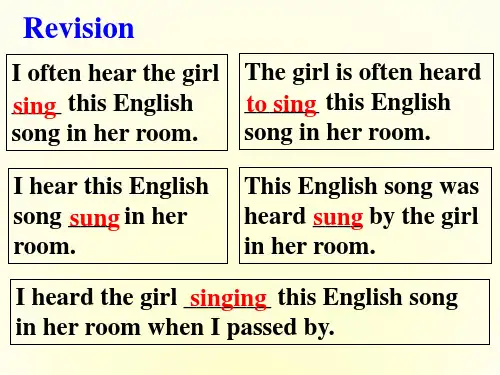
一、作宾语补足语的过去分词与宾语之间的关系 1. 及物动词(短语)的过去分词用作宾语补足语时, 宾语即是过去分词的逻辑宾语,宾语和过去分词 之间存在逻辑上的被动关系。 2. 少数不及物动词如 go, change, fall 等的过去分词 作宾语补足语时,仅表示动作完成。 3. 动词 seat, hide, dress 等的过去分词作宾语补足语 一般表示状语而不表示被动的意义。
In the 17th century, there were two kinds of Christian in Europe, Catholic and Protestant, and they were often at war with each other. Guy Fawkes was a Catholic, but the government of England usually supported Protestant. So Fawkes and his Catholic friends decided to blow up the Houses of Parliament and kill King James. But before they could do anything, their plan was discovered. Guy Fawkes was caught and killed. And King James made November 5th into a yearly celebration so that people will not forget this “disaster”.
高中英语必修5_Unit2_The_United_Kingdom课件2(人教新课标)

Because Wales was linked to England in the 13th century AD.
Now when people refer to England, Wales is included as well.
Task4:Detailed reading.
Divide the passage into three parts and write down the mPaartin1:i(dpeaaroafgeraacphhp1a)rt.
Three Parts The Midlands(in the middle)
The North(near to Scotland)
• Reading Skill2: Finding topic sentence.(找文 章的主题句)
• Frankly speaking ,we can’t finish reading the whole passage in one minute, so we must find the topic sentence of each paragraph. It can help us find out what each paragraph talks about.
高效学习模型-内外脑 模型
2
内脑- 思考内化
思维导图& 超级记忆法& 费曼学习法
1
外脑- 体系优化
知识体系& 笔记体系
内外脑高效学习模型
超级记忆法
超级记忆法-记忆 规律
记忆前
选择记忆的黄金时段
前摄抑制:可以理解为先进入大脑的信息抑制了后进 入大脑的信息
后摄抑制:可以理解为因为接受了新的内容,而把前 面看过的忘记了
人教版(新课程标准)必修五Unit2TheUnitedKingdom知识点课件(11)
核心词汇
【即学即练】
教材原句精听听写: They had no time to arrange their own wedding,so they had it organized by a company.
核心词汇
4. delight [dɪˈlaɪt]:a feeling of great pleasure n.快乐;高兴;喜悦
A. two
B. rn Ireland
Wales
Scotland England
PART 01
词汇 Vocabulary
核心词汇
1. attract [əˈtrækt] : to cause to approach or adhere vt. 吸引;引起注意;通常用于被动结构
take great delight in ...以...为乐 with delight 高兴,愉快
(2) to one's delight=to the delight of sb.
使某人高兴的是
It's a delight to do sth.做某事是令人愉快的
核心词汇
【归纳拓展】
(3) delighted adj. 高兴的,快乐的 be delighted at 为某事而高兴 be delighted to do sth./that
核心词汇
1) arrange for sb.to do sth. 安排某人做某事 arrange with sb. to do sth. 与人约定干某事 arrange that sb./sth.should do 安排
(2) make arrangements for 安排
核心词汇
【高考链接】 分析核心的句子功能 ①(高考湖南卷·阅读理解A) As I was arranging the details another poem came to mind. ②Large amounts of money have been arranged for the people in the flooded area since last week. ③The company XXX arrange for a taxi to meet you at the airport. ④The manager arranged that the meeting (should)be put off for a couple of days. ⑤The local newspaper made arrangements for an interview with the famous scientist. 。
人教新课标高中英语必修五Unit 2 The United KingdomUnit 2 The United Kingdom教案(1)
Unit 1 Great scientistsReadingTeaching goals教学目标1. Target language 目标语言a. 重点词汇和短语attend, control, severe, pub, immediately, handle, instructor, pump, contribute, conclude, steam engine, virus, put forward, make a conclusion, expose tob. 重点句式To prevent this from happening again, John Snow suggested that ... P32. Ability goals 能力目标Enable the students to talk about science and scientists.3. Learning ability goals学能目标Enable the students to learn about some famous scientists and their contributions and how to organize a scientific research.Teaching important & difficult points教学重难点Talk about science and scientists.Teaching methods 教学方法Task-based activities.Teaching aids 教具准备A computer and a projector.Teaching procedures & ways 教学过程与方式StepⅠ Lead-inAsk the students to think of some great inventions and inventors in history.T: Welcome back to school, everyone. I guess most of you have enjoyed your holiday. Maybe I should say everyone has enjoyed a scientific life. Why? Because you have enjoyed the results of the science and scientists. Now can you tell me the scientists who invented the lights, the gramophone and the computer?S1: Edison invented the lights and the gramophone.S2: The first computer was invented by a group of American scientists.StepⅠ Warming upFirst, ask some questions about great scientists. Second, ask all the students to try the quiz and find out who knows the most.T: You know our life is closely related to science and scientists. We benefit a lot from them. Can you name out as many scientists as possible?S1: Newton.S2: Watt.S3: Franklin.Sample answers:1. Archimedes, Ancient Greek (287-212 BC), a mathematician.2. Charles Darwin, Britain (1808-1882). The name of the book is Origin of Species.3. Thomas Newcomen, British (1663-1729), an inventor of steam engine.4. Gregor Mendel, Czech, a botanist and geneticist.5. Marie Curie, Polish and French, a chemist and physicist.6. Thomas Edison, American, an inventor.7. Leonardo da Vinci, Italian, an artist.8. Sir Humphry Davy, British, an inventor and chemist.9. Zhang Heng, ancient China, an inventor.10. Stepper Hawking, British, a physicist.Step Ⅰ Pre-readingGet the students to discuss the questions on page 1 with their partners. Then ask the students to report their work. Encourage the students to express their different opinions. T: Now, class, please look at the slide. Discuss these questions with your partners. Then I’ll ask some students to report their work.Show the following on the screen.What do you know about infectious diseases?What do you know about cholera?Do you know how to prove a new idea in scientific research?What order would you put the seven in? Just guess.Sample answer 1:S1: Let me try. Infectious diseases can be spread easily. They have an unknown cause and may do great harm to people.S2: People could be exposed to infectious diseases, so may animals, such as bird flu.S3: AIDS, SARS are infectious diseases.S4: Infectious diseases are difficult to cure.Sample answer 2:S1: I know sth. about it. First we should find the problem. Then, think of a solution.S2: We should collect as much information as possible.S3: Analyzing results is the most important stage.S4: Before we make a conclusion, it is necessary for us to repeat some stages or processes.Sample answer 3:S1: I think “Find a problem” should be the first stage.S2: “Make up a question” should follow the first stage.S3: “Think of a method”, “Collect results” and “Analyze results” are after that.S4: Of course, before “Make a conclusion”, we should “Repeat if necessary”.T: Well done! When we want to solve some problems, first we should find out the problem, do some research on it, prove your findings, and then make a conclusion. This is a scientific and objective way of researching. Now let’s see how doctor John Snow did his research.Step Ⅰ ReadingLet the students skim the whole passage and try to work out the meanings of the new words and structures using context.T: The effect of cholera in the nineteenth century London was devastating. Many people died without knowing the reason. It was doctor John Snow who saved the people. Please look at the screen. Let’s read the whole passage and find answers to the questions. Show the questions on the screen.1. What conditions allowed cholera develop?2. Why do you think people believed that cholera multiplied in the air without reason?3. What evidence did John Snow gather to convince people that idea 2 was right? Sample answers:S1: The dirty water made the cholera develop quickly.S2: Because people could not understand its cause and could not get it cured. So people imagined that some poisonous gas in the air caused the deaths.S3: He found that many of the deaths were near the water pump while some areas far away from the water pump had no deaths. So when people were asked not to use the water pump, the disease began to slow down. In this way, John Snow had shown that cholera was spread by germs and not in a cloud of gas.Step Ⅰ Text analyzingAsk the students to analyze the text in groups.T: Now class. Can you tell me what style of the passage belongs to?S1: I think it is a report.T: Please look at the chart on the screen. The chart shows that each paragraph of the text explains John Snow’s stages in his research. Please read the text and find out the general idea of each paragraph and match the stage with each paragraph. Discuss it in groups, and then report your answers.Paragraphs Stages General ideas1234567Sample answers:S1: My group’s opinion is this: stage one “Find a problem” is expressed in paragraph one. The general idea is like this: John Snow wanted to find the causes of cholera.S2: Our answer is like this: paragraph two expresses the second stage “Make up a question”. The general idea is like this: John Snow wanted to prove which theory was correct.S3: “Think of a method” is the third stage. And it is contained in paragraph three. The general idea is like this: John Snow collected data on those who were ill or died and where they got their water.S4: The fourth stage “Collect results” lies in paragraph four. Its general idea is like this: John Snow plotted information on a map to find out where people died or did not die.S5: Our group believe paragraph five contains the fifth stage of John Snow’s research. The general idea is like this: John Snow analysed the water to see if that was the cause of the illness. So this stage is to “Analyse the results”.S6: The sixth stage is “Repeat if necessary”. It is contained in the sixth paragraph. The general idea is like this: John Snow tried to find other evidences to confirm his conclusion. S7: The last paragraph is about the seventh stage “Make a conclusion”. Its general idea is like this: The polluted dirty source of drinking water was to blame for the cause of the London cholera.Ask some students to put their answers in the chart.Paragraph Stages General ideas1Find a problem The causes of cholera2Make up a question The correct or possible theory3Think of a method Collect data on where people were ill and died and where they got their water4Collect results Plot information on a map to find out where people died or did not die5Analyse the results Analyse the water to see if that is the cause of the illness6Repeat if necessary Find other evidences to confirm his conclusion7Make a conclusion The polluted dirty source of drinking water was to blame for the cause of the London choleraStepⅠ Homework1. Get more information about some infectious diseases and modern scientists.2. Finish the Exercises 1, 2, 3 on pages 3 and 4.教后反思:在高考阅读中,常常会出现对文中单词或词组词义的猜测,在平时的阅读教学中如何渗透对学生这一方面能力的培养,也是教师应该思考的一个问题。
高中英语人教新课标必修五-Unit2-The-United-Kingdom教案
Unit 2 The United KingdomⅢ. 教材分析与教材重组1. 教材分析本单元以The United Kingdom为中心话题。
通过学习,使学生了解英国的历史、地理、政治、文化、宗教、社会习俗及名胜古迹等有关知识。
1.1 Warming Up 通过一个小测试考查学生对英国的了解情况。
1.2 Pre-reading通过三个有关英国的小问题,让学生进一步加深对英国的了解。
1.3 Reading本单元的阅读材料——PUZZLES IN GEOGRAPHY(“地理之迷”),从地理、历史、政治、文化、体育等方面简要介绍了联合王国的形成和发展、风土人情和人文景观。
1.4 Comprehending通过回答问题、解析地图中的信息、划分课文段落写出大意以及归纳课文内容写出小结等练习,加强学生对课文深层次的理解,培养学生归纳、概括、总结能力。
1.5 Learning about Language分词汇和语法两部分。
词汇部分设置了“短文填空”和“句子填空”两个内容;语法部分由两个部分组成:一是让学生自己通过在课文中寻找含有相关语法项目(过去分词用作宾语补足语)的句子;二是对该语法项目进行操练。
形式有语法结构讲练、趣味性游戏等。
1.6 Using Language 通过增加阅读篇目“SIGHTSEEING IN LONDON”,让学生了解英国首都伦敦的名胜古迹;该部分还提供了听力材料(conversation between Zhang Pingyu and a tourist guide),设计了“说” 的话题(让学生表演游客和导游之间的对话),并设置了写作练习,要求学生用“恰当的形容词和动词”来描写他们熟悉或参观过的某一建筑或景观。
1.7 SUMMING UP 让学生用选择的形式来小结本单元所学的主要内容。
1.8 LEARNING TIP就“如何修改自己的作文”给学生提出了几点建议。
2. 教材重组2.1 将Warming Up, Pre-reading, Reading和Comprehending四部分整合为一节“阅读课”。
高中英语 Unit 2 The United Kingdom课 新人教版必修5
知识要点整合
核心词汇梳理
1.consist vi. 由……组成;由……构成 搭配 consist of 由……组成;由……构成 Their diet consisted largely of vegetables. 他们的日常饮食以蔬菜为主。 Most of the fieldwork consisted of making tape recordings. 现场工作多半为进行磁带录音。 拓展 consist in在于;存在于 The beauty of Venice consists largely in the style of its ancient buildings. 威尼斯的美很大程度上在于城中古建筑物的风格。
课前10分钟
概括大意 Many of the services needed both by industry and by each
of us are provided by the government or by local authorities. Without hospitals,roads,electricity,telephones,railways, this country could not function.All these require continuous spending on new equipment and new development if they are to serve us properly,requiring more money than is raised through
高中英语 第二单元 《the United Kingdom》课件 新人教版必修5
• A. which
B. what
C. who
D. that
• 答案 D
unwilling
• to do sth) not wanting to do sth and refusing to do it
• They are unwilling to invest any more money in the project.
• 27.(山东省东营市胜利一中2010届高三上学期 模块考试)
• As we all know, the UK is a large country ____ four parts.
• A. consisting of B. makes up
• C. consist of
D. is make up of
argument; controversy 冲突; 争执; 争论; 论 战:
• a long and bitter conflict between employers and workers 劳资双方旷日持久 的激烈争执.
• 29. (天津市五校2010届高三上学期期中联考)
• In dealing with public relations, we should make every effort to prevent the ________in personality.
• A.break away; free from B.break up; free of
• C. break off; opposed to D. break down; instead of
• 答案 A
• break away (from sb/sth)
• (a) escape suddenly (from captivity) 突然逃脱, 挣脱(束缚):
高中英语人教新课标必修五 Unit2 The United Kingdom教案
Unit 2 The United Kingdom Ⅰ. 单元教学目标Ⅲ. 教材分析与教材重组1. 教材分析本单元以The United Kingdom为中心话题。
通过学习,使学生了解英国的历史、地理、政治、文化、宗教、社会习俗及名胜古迹等有关知识。
1.1 Warming Up 通过一个小测试考查学生对英国的了解情况。
1.2 Pre-reading通过三个有关英国的小问题,让学生进一步加深对英国的了解。
1.3 Reading本单元的阅读材料——PUZZLES IN GEOGRAPHY(“地理之迷”),从地理、历史、政治、文化、体育等方面简要介绍了联合王国的形成和发展、风土人情和人文景观。
1.4 Comprehending通过回答问题、解析地图中的信息、划分课文段落写出大意以及归纳课文内容写出小结等练习,加强学生对课文深层次的理解,培养学生归纳、概括、总结能力。
1.5 Learning about Language分词汇和语法两部分。
词汇部分设置了“短文填空”和“句子填空”两个内容;语法部分由两个部分组成:一是让学生自己通过在课文中寻找含有相关语法项目(过去分词用作宾语补足语)的句子;二是对该语法项目进行操练。
形式有语法结构讲练、趣味性游戏等。
1.6 Using Language 通过增加阅读篇目“SIGHTSEEING IN LONDON”,让学生了解英国首都伦敦的名胜古迹;该部分还提供了听力材料(conversation between Zhang Pingyu and a tourist guide),设计了“说” 的话题(让学生表演游客和导游之间的对话),并设置了写作练习,要求学生用“恰当的形容词和动词”来描写他们熟悉或参观过的某一建筑或景观。
1.7 SUMMING UP 让学生用选择的形式来小结本单元所学的主要内容。
1.8 LEARNING TIP就“如何修改自己的作文”给学生提出了几点建议。