
【新教材】1.3discoveringusefulstructures教学设计-人教版高中英语必修第一册
【新教材】必修第一册Unit 1 Teenage life 教学设计(人教版)Period 3 Discovering useful structures本板块包括以下学习内容1.识别名词短语,形容词短语和副词短语2.了解名词短语,形容词短语和副词短语在句中的作用3.练习将利用以上三种形式丰富简单信息的句子内容。
1. Let students learn and recognize Noun Phrase, Adjective Phrase and Adverb Phrase.2. Let students master the function of Noun Phrase, Adjective Phrase and Adverb Phrase.3. Get students improve a draft by using Noun Phrase, Adjective Phrase and Adverb Phrase.Importance:1. Get students to recognize and realize the importance of Noun Phrase, Adjective Phrase and Adverb Phrase in polishing a draft.2. Get students to finish a draft improvement.Difficulty:Guide the students finish the task of improving a draft1.Ask the students to make preparations in vocabulary and phrases related to the theme of the period.2.Help the students to finish the Guided Learning PlanStep 1 Warming upActivity 1Ask Ss to look at the given pictures and choose a better answer to match the pictures.Step 2 Learn about Noun Phrase, Adjective Phrase and Adverb PhraseActivity 21.Guide the students to learn about the definitions and functions of Noun Phrase, Adjective Phraseand Adverb Phrase.Remind the students to understand the instructions and divide the phrases in different groups. 短语类型组成功能名词短语(限定词)+(形容词、形容词短语、描述性名词)+ 名词+(介词短语)在句中相当于名词,一般用作主语、宾语、表语或宾语补语形容词短语(副词)+ 形容词+(介词短语)在句中当作形容词用,可以修饰名词或代词,还可以用作表语或宾语补语副词短语(副词)+ 副词在句中当作副词用,可以修饰动词、形容词或副词a really big challenge a little confusing very carefullythe school advisor a very difficult language quite difficultmuch more carefully far too fast all the subjectsa senior high school student my advanced course strong enoughNoun phrase: a really big challenge; the school advisor; a very difficult language;all the subjects; a senior high school student; my advanced course Adjective phrase: a little confusing; quite difficult; strong enoughAdverb phrase: very carefully; far too fast; much more carefullyActivity 22.Find and mark the phrases in the sentences that fits the categories below. Then state theirfunctions.1)The first week was a little confusing.NP(主语) AdjP(表语)2)The building is so big that I'm completely lost.NP(主语) AdjP(表语) AdjP(表语)3)The kids over there are putting something on a round paper plate.NP(主语) NP(宾语)4)Linda thinks and speaks quite quickly and she can do well in the debate.AdvP (状语) NP(宾语)5)The new coach told me that I didn't play well enough.NP(主语) AdvP (状语)6)My first French class was very confusing, the teacher spoke so fast.NP(主语) AdjP(表语) AdvP (状语)Step 3 Answer the questionsActivity 3Get the students to answer the question using the phrases in brackets.1)How soon do you think you'll finish your homework? (Pretty soon)I will finish my homework pretty soon.2)What do you think of your new teachers?(Very nice and patient)My new English teacher is very nice and patient.3)How many clubs have you joined this year? (Two clubs)I have joined two clubs this year.4)How well does Rita play the violin? We need a new violinist in our music club. ( quite well)She can play the violin quite well.5)What did you adviser say about advanced literature course? (Too difficult, but very interesting)She said the advanced literature course was too difficult, but very interesting.Step 4 Improve a draftActivity 4Joyce has just written a draft. Help her improve it by using noun/ addictive /adverb phrases to add more information.Ask the students to work in groups and discuss which part of each sentence can be improved.Guide the students to finish the task and give help whenever necessary.Cheerleader Try-outsI've always wanted to be a cheerleader. Yesterday, I tried out for the team. It was hard. First, we had to dance. The teacher showed us how to move, and then we tried. Second, we practicedsinging a song about the school basketball team. Finally, some girls had to lift their partners. The other girls jumped and cheered. I think I did well, but the other girls were better. I'm not sure if Iwill make the team or not.A possible Answer:I've always wanted to be a high school cheerleader yesterday I tried out for my school'scheerleading team. It was really h ard first.We had to dance as energetically as we could . The teacher patiently showed us how to move beautifully and then we tried our best. Second, wecarefully practiced singing a pop song about the school basketball team. As last, some tall andstrong girls had to lift their shorter and thinner partners. The other girls jumped and cheered happily. I think I did very well, but the other girls were even better. I'm not sure if I will finally make the team or not.Step 5 Make a draftAsk the student to write a short introduction of themselves.Exchange their self-introductions and make improvements where necessary.1、通过本节内容学习,学生能否了掌握名词短语,形容词短语和副词短语的构成与基本用法。
Unit 5 Discovering Useful Structures示范教案【英语人教必修第三册

Unit 5 The Value of MoneyDiscovering Useful Structures教学设计教材分析该板块的语法学习内容包括两项,一是复习情态动词,二是学习过去将来时。
活动主题是探索如何“表达情态”,以及表述从过去时间看将来要发生的事情”(E xpress modality and talk about future events in the past)。
情态动词反映了说话人对所述内容的态度。
本单元引导学生在剧本对白中体会情态动词的语用效果,归纳其表意功能,巩固情态动词的用法。
本单元剧本中还包含过去将来时态的一些范例。
该时态最典型的句子结构是would be/do和was/were going to be/do,此时的would和作为情态动词的would意义不同。
教学目标在本课学习结束时,学生能够:1. 梳理常用情态动词的表意功能。
2.能够根据具体语境恰当地使用情态动词。
3. 掌握过去将来时两种常用结构的用法。
教学重难点【教学重点】1.复习和梳理常见情态动词的表意功能,引导学生根据真实语境恰当地使用情态动词。
2. 掌握过去将来时两种常用结构的用法。
【教学难点】结合语境,准确地掌握常见情态动词的功能和意义。
教学过程Step 1 Warming-upCompare the sentences and think about the function of modal verbs.A. The exam may be difficult.B. You should be studying harder.C. I can’t study all night during the semester.a. The exam is difficult.b. You are studying harder.c. I study all night during the semester.Step 2 UnderstandingModal verbs have many functions, including the following (A-F). Find modal verbs in previous sections and discuss their functions.A necessityB possibilityC obligationD requestE adviceF intentionWe can discuss it now.You must do it at once.Would you please pass me the salt?You needn’t have stayed.You ought to help him.I would rather do it myself.设计意图:通过分析句子,分析情态动词的表意功能。
新教材1.3-discovering-useful-structures--人教版高中英语必修第一册
【新教材】1.3-d i s c o v e r i n g-u s e f u l-s t r u c t u r e s--人教版高中英语必修第一册(总3页)--本页仅作为文档封面,使用时请直接删除即可----内页可以根据需求调整合适字体及大小--Unit 1 Teenage LifePeriod 3 Discovering useful structures导学案1.了解名词短语,形容词短语和副词短语的构成和作用2.练习确定带有以上三种形式句子的主语,宾语,表语,定语或状语等成分3.练习将利用以上三种形式丰富简单信息的句子内容。
重点:1. 练习在句中寻找名词短语,形容词短语和副词短语2. 练习将利用以上三种形式丰富简单信息的句子内容。
难点:1.结合所学内容,能够完成完善一篇学生习作的任务。
一、初步了解名词短语,形容词短语和副词短语’1. 构成和作用名词短语(NP):(限定词)+(形容词、形容词短语、描述性名词)+ 名词+(介词短语)在句中相当于名词,一般用作主语、宾语、表语或宾语补语形容词短语(AdjP):(副词)+ 形容词+(介词短语)在句中当作形容词用,可以修饰名词或代词,还可以用作表语或宾语补语副词短语(AdvP):(副词)+ 副词在句中当作副词用,可以修饰动词、形容词或副词注意:名词短语,形容词短语和副词短语的核心词分别是名词,形容词和副词。
二、识别名词短语,形容词短语和副词短语将下列短语按照类型进行归类:a really big challenge a little confusing very carefullythe school advisor a very difficult language quite difficultmuch more carefully far too fast all the subjectsa senior high school student my advanced course strong enough 名词短语:a really big challenge; the school advisor; a very difficult language; all the subjects; a senior high school student; myadvanced course形容词短语:a little confusing; quite difficult; strong enough副词短语: very carefully; far too fast; much more carefully三、了解多个形容词作定语多个形容词修饰名词时,其排序规律是:(限定词+程度副词+) 描绘性形容词+表示大小(长短、高低)、形状、年龄(新旧)的形容词+表颜色的形容词+表国籍或产地的形容词+表物质材料的形容词+表类别或用途的形容词+名词。
新教材高中Unit13DiscoveringUsefulStructures教案新人教版必修第一册
新教材高中英语:Unit 1 Teenage LifePeriod 3 Discovering Useful Structures教材分析:This teaching period mainly deals with the grammar: Phrases.This period carries considerable significance to the cultivation of students’ writing competence and lays a solid foundation for the basic appreciation of language beauty. The teacher is expected to enable students to master this period thoroughly and consolidate the knowledge by doing some exercise of good quality.教学目标与核心素养:1. Get students to have a good understanding of the basic usages of phrases, including adjective phrases, adverb phrases and noun phrases.2. Enable students to use the basic phrases structures flexibly.3. Develop students’ speakin g and cooperating abilities.4. Strengthen students’ great interest in grammar learning.教学重难点:1. How to enable students to have a good understanding of the basic usages of phrases, including adjective phrases, adverb phrases and noun phrases.2. How to enable students to use the basic usages of phrases flexibly.教学过程:Step1:语法自主探究读下列例句并感知画线部分的共性。
高中英语必修件DiscoveringUsefulStructures
遇到生词时,可以根据上下文和已知词汇 进行推断,猜测其大致意思。
替换词汇
注意词汇的感情色彩和语体风格
在写作和口语表达中,尝试使用不同的词 汇表达相同的意思,以增加表达的丰富性 和准确性。
了解词汇的感情色彩和语体风格,以便在合 适的场合使用合适的词汇。
03
语法知识点解析
句子成分及基本句型分类
01
02
高中英语必修件 DiscoveringUsefulS tructures
汇报人:XX 20XX-01-27
目录
• 课程介绍与背景 • 词汇学习与拓展 • 语法知识点解析 • 阅读理解技巧提升 • 写作技能培养与提高 • 听力训练策略分享 • 口语表达能力培养
01
课程介绍与背景
Discovering Useful Structures概述
文化背景知识介绍
让学生了解不同国家的文化背景和社交礼仪,培养他们的跨文化 意识。
跨文化交际技巧培训
教授学生如何与不同文化背景的人进行有效沟通,包括尊重文化差 异、避免文化冲突等技巧。
国际交流活动参与
鼓励学生参加国际交流活动,如模拟联合国、国际文化节等,提升 他们的跨文化交际能力和全球视野。
THANKS
Discovering Useful Structures 是高中英语必修件,旨在帮助学 生掌握英语基本句型和语法结构
。
该课程通过引导学生观察、发现 、总结语言规律,培养其自主学
习和综合运用语言的能力。
Discovering Useful Structures 注重实践与应用,鼓励学生将所
学知识运用到实际语境中。
03
学生应多阅读英文原著 和报刊杂志,扩大词汇 量和提高阅读理解能力 。
【新教材】1.3 discovering useful structures 课件-人教版高中英语必修第一册
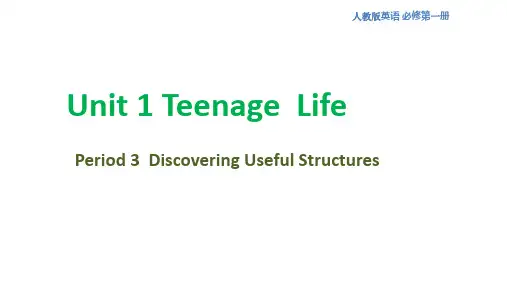
the pictures.
a kid
a lovely kid in a yellow rain coat
a boy
an unhappy boy with a sad look
a father
a young father with his son in the forest
Describe the following pictures
人教版英语 必修第一册
Unit 1 Teenage Life
Period 3 Discovering Useful Structures
Activity 1
Step 1Warming up Look at the given pictures and choose a better answer to match
quite difficult
much more carefully
far too fast
all the subjects
a senior high school student
my advanced course
strong enough
名词短语( Noun Phrase):_______________________ 形容词短语( Adjective phrase ):________________ 副词短语(Adverb phrase):_____________________
Discovering+Useful+Structures 教学设计 高中英语人教版(2019)必修
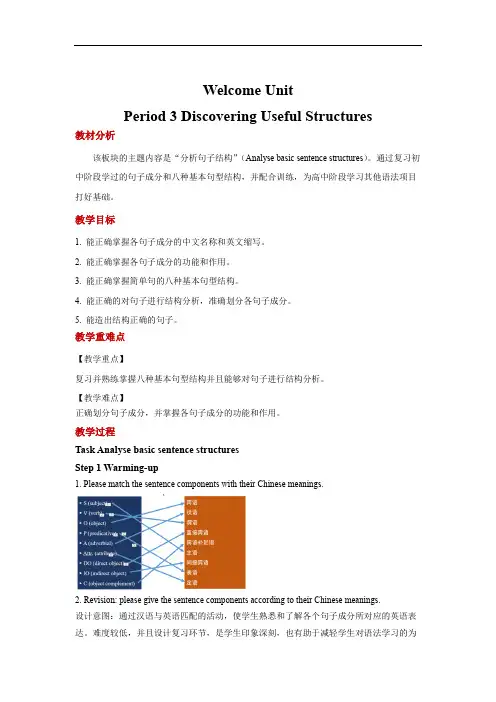
Welcome UnitPeriod 3 Discovering Useful Structures教材分析该板块的主题内容是“分析句子结构”(Analyse basic sentence structures)。
通过复习初中阶段学过的句子成分和八种基本句型结构,并配合训练,为高中阶段学习其他语法项目打好基础。
教学目标1. 能正确掌握各句子成分的中文名称和英文缩写。
2. 能正确掌握各句子成分的功能和作用。
3. 能正确掌握简单句的八种基本句型结构。
4. 能正确的对句子进行结构分析,准确划分各句子成分。
5. 能造出结构正确的句子。
教学重难点【教学重点】复习并熟练掌握八种基本句型结构并且能够对句子进行结构分析。
【教学难点】正确划分句子成分,并掌握各句子成分的功能和作用。
教学过程Task Analyse basic sentence structuresStep 1 Warming-up1. Please match the sentence components with their Chinese meanings.2. Revision: please give the sentence components according to their Chinese meanings.设计意图:通过汉语与英语匹配的活动,使学生熟悉和了解各个句子成分所对应的英语表达。
难度较低,并且设计复习环节,是学生印象深刻,也有助于减轻学生对语法学习的为难情绪。
Step 2 Identifying definition1.句子成分定义:组成句子的各个部分叫做句子成分。
必须部分:主语、谓语必要部分:宾语、表语和补足语辅助部分:定语、状语2. Summary3. Work on Acitivity1. Study the sentence structures.There are _____ types of basic sentence structures.设计意图:明确句子成分和句子类型的相关定义。
【教案】Unit+5Discovering+useful+structures教学设计人教必修第一册
主题单元分课时教学设计课题指向核心素养的高中英语主题教学(第4课时)课时类型Discovering usefulstructures学时40分钟教学素材PPT, 视频资料指导思想和理论依据1.主题为语言学习提供主题范围或主题语境。
学生对主题意义的探究应是学生学习语言的重要内容,直接影响学生语篇理解的程度、思维发展水平或语言学习的成效。
语言技能是语言运用能力的重要组成部分。
学生应通过大量的专项和综合性语言实践活动,发展语言技能,提升认知策略技能——在语境中学习词汇和语法。
2. 英语课程标准提出了指向学科核心素养的英语学习活动观,即学习活动的设计应以促进学生学科核心素养发展为目标,围绕主题语境,基于语篇,设计学习理解、应用实践、迁移创新等层层递进的语言、思维、文化相融合的活动。
使学生基于已有知识,依托不同类型的语篇,在分析问题和解决问题的过程中,促进自身语言知识学习、语言技能发展、文化涵养理解、多元思维发展、价值取向判断和学习策略运用。
内容分析/语篇研读/文本分析依托大单元主题的主题背景来引导学生自主探究语言结构和语法的学习。
该课是本单元的第四课时,其主题意义为“描述你喜欢的事物”。
在语言大观念构建方面,该课初步感知认识限制性定语从句,正确使用that、which、 who、whose、whom等连接词,能使用限制性定语从句描述自己喜欢的事物,在提高英语语言能力的同时发展逻辑思维能力。
What本课语篇是一篇记叙文,讲述了少年Jack在学习德语的经历。
文章先以“我”面对德语学习的畏难情绪开头,诉说了“我”在德语学习时对单词和语法的难以掌控感。
在这之后,“我”向妈妈诉苦,表示自己想要放弃德语的学习。
而妈妈为了鼓励“我”继续学习,劝导和启发我德语学习还有诸多益处,即便将来不在德语国家生活,也能增益智慧、锻炼大脑。
此后的一天,“我”在学习德语时,发现德语对他而言比从前简单了很多,并且,得益于他对德语的掌握,现在他也能从新的视角看世界了。
新教材人教版高中英语必修三 U3 Discovering Useful Structures课件
He has a knowledge of first aid but his friend doesn’t (have a knowledge of first aid).
第十二页,共三十五页。
三、复合句中的省略
1. 状语从句的省略。 ①Wood gives off much smoke whilwe hbuilren(iintgi.s) burning. Whe②neWverh(eint eisv)epropsosisbslieb,le, they would stop him and ask him the three questions.
第二十页,共三十五页。
①He likes to swim more than (to) skate.
②He believes it important to study rather than to make
friends.
(比较)
⑶并列的不定式可以省略后面的不定式符号to。但若两个不 定式之间表示对比关系时,则不能省略to。
⑷当不定式在某些动词后作宾语时,常可省略。常见的 动词有agree, afford, expect, forget, hope, know, manage, pretend, remember, refuse, want, wish, would like等。
第二十二页,共三十五页。
①All he could do was nothing but wait and see. ②We had no alternative but to wait.
新教材人教版高中英语必修三 U3 Discovering Useful Structures课件
Unit3 Discovering Useful Structures教学设计-高中英语新教材必修第
Unit3 Discovering Useful Structures教学设计-高中英语新教材必修第三册大单元整体教学设计+拼图式阅读(视频+课件+教案)教学目标:1. 掌握有关非限定性定语从句、虚拟语气、情态动词和被动语态等语法结构的应用;2. 培养学生独立学习和思考的能力;3. 提高学生英语口头表达和思维表达能力。
教学难点:1. 非限定性定语从句和虚拟语气的正确使用;2. 如何正确运用情态动词和被动语态;3. 如何培养学生的学习和思考能力,提高英语口头表达和思维表达能力。
教学重点:1.掌握非限定性定语从句的构成和用法;2.掌握虚拟语气的应用;3.掌握情态动词和被动语态的用法。
教学准备:1. PowerPoint课件;2. 练习题和示例题;3. 纸和笔。
教学过程:Step 1 导入(5分钟)通过展示一些生动的图片、表情包和视频向学生介绍本堂课的话题和主要内容,以激发学生的学习兴趣和主动性。
Step 2 了解学生已有的语法知识(10分钟)通过问答和小组讨论的方式,了解学生对非限定性定语从句、虚拟语气、情态动词和被动语态等语法结构的理解和应用情况。
Step 3 非限定性定语从句的学习(20分钟)a. 介绍非限定性定语从句的定义、构成和用法;b. 解释定语从句与非限定性定语从句的区别;c. 配合PPT展示相关例句,让学生逐步理解和掌握非限定性定语从句的应用;d. 给出练习题,让学生进行运用和巩固。
Step 4 虚拟语气的学习(20分钟)a. 介绍虚拟语气的定义、构成和用法;b. 解释虚拟语气在现在和过去的运用;c. 配合PPT常用虚拟语气展示相关例句。
让学生逐步理解和掌握虚拟语气的应用;d. 给出练习题,让学生进行巩固。
Step 5 情态动词和被动语态的学习(20分钟)a. 介绍情态动词的定义、构成和用法;b. 解释被动语态的构成和用法;c. 配合PPT展示相关例句。
让学生逐步理解和掌握情态动词和被动语态的应用;d. 给出练习题,让学生进行运用和巩固。
Unit3DiscoveringUsefulStructures讲义高中英语人教版
附加疑问句又称为反意疑问句,是附加在陈述句后的简短问句,对陈述句所叙述的事实或观点提出疑问。
一、附加疑问句的结构、组成及功能1.结构:陈述部分+附加疑问部分(助动词/be动词/情态动词+陈述部分主语的相应代词)2.规律:陈述部分是肯定形式,附加疑问部分用否定形式;陈述部分是否定形式,附加疑问部分用肯定形式。
助动词和人称前后一致。
【前肯后否,前否后肯】3.功能:对说话人说的句子的反问,有加强语气、请求进一步的确定的意味二、否定附加疑问句的回答不管【前肯后否,前否后肯】,直接【根据实际情况回答】【前肯后否,照实回答前面】或将句子转化成一般疑问句再去回答—lt's a beautiful day, isn't it?今天天气很好,不是吗?【Is it a beautiful day】—Yes, it is. 是的,它是。
—That sounds interesting, doesn't it?听起来很有趣,不是吗?【Does it sound interesting?】—Sure, it does.当然,确实如此。
—He wants to go, doesn’t he?——他想去,不是吗?【Does he want to go?】—No, he doesn’t.——不,他不想去。
【前肯后否,照实回答后面】—You aren’t a student, are you?你不是学生,是吗?【Are you a student?】—Yes, I am.不,我是。
/No,I’m not.是的,我不是。
—It's not a real sport, is it?【Is it a real sport?】—Yes, it is.不,它是。
/No, it is.是的,它不是。
2.当陈述部分为否定式,附加疑问部分为肯定式时,要根据事实来回答,事实是肯定的用Yes;Yes译为“不”事实是否定的用No;No译为“是的”。