
八年级下册英语M1Unit 3
There are two books and a pen on the desk.
Put the words and phrases in the correct order.
1. I /for her birthday/ bought/ a new book/ my
mother/. I bought my mother a new book for her birthday. 2. her / stamp collection /me /she showed/. She showed me her stamp collection. 3. on TV / watch sport/ I/ often/.
1. 你能把那支铅笔递给我吗? pass me Can you ______ ______ that pencil? 2. 我叔叔给了我一个很漂亮的生日礼物。 My uncle _________ a very nice birthday gave present _____ ______. to me 3. 这位男孩把茶端给了他的爸爸。 This boy ________ _____ ______ his father. brought tea to
as a result as well as because come out look after spend…(in) such as tidy up
3. Jane is good at singing _________ dancing. as well as 4. At our school you can try lots of new activities, ________ creative writing and such as playing the piano.
六种基本句型
英语以动词为中心组成六大句型。 1. 主语+ 系动词+ 表语(+状语)
常见的系动词有be 的不同形式、 look、 feel 、 taste、 sound、 smell、 get、 keep等, 其 后常接形容词作表语。 These books are great. Tom is very happy today.
6. there be + 主语+ 状语 主语由名词充当, be动词的单复数由与其临 近的名词的单复数形式决定。 There are many story books in his schoolbag. There is a very nice cup on the table.
There is a pen and two books on the desk.
breakfast for me.
He wrote a book in senior high school.
4. 主语+ 谓语(及物动词)+ 间接宾语(人)+直接宾 语(物)(+状语) / 主语 + 及物动词 + 直接宾语 + 介词to /for + 间接宾语 谓语是及物动词,后可接名词或代词。常见的能 接双宾语的动词有give, show, pass, teach, send, buy, make, draw, do, get, cook等。 也就是说这类动词后面可以出现两个动作的承 受者,后跟两个宾语。一般来说,指人的通常 是间接宾语,表示动作是对谁做的或为谁做的; 指物的通常是直接宾语,是动作所涉及的物。
7. I /sing /her/ heard/.
I heard her sing. 8. The museum /fans/ in / lots of / there are. There are lots of fans in the museum.
9. the piano/I’m/ playing/. I’m playing the piano.
Complete these sentences. 1. Pass me the salt, please. Please pass the salt to me 2. I gave him a big present.
I gave a big present to him . 3. My mother makes me a birthday cake every birthday. Every birthday my mother makes a birthday cake for me .
I often watch sport on TV.
4. I’m / writer/a/. I’m a writer. 5. a lot / read / I /. I read a lot. 6. my father/ me/ to be a musician/ wanted/. My father wanted me to be a musician.
具有方向性动作的双宾语动词,其后面的间 接宾语后置时,通常加介词to。to sb.侧重于 “给某人”,表示某人接受或收到了某物。 此类动词常见的有:bring, give, leave, lend, pass, return, send, show, take, throw, hand, teach等。 Pass the English dictionary to me.
4. 刚才他替父亲写了一封信。 He _________ a letter _________ his father wrote for just now. 5. 我妈妈为我做了一条鱼。 My mother _________ a fish ______ _____. cooked for me 6. 这个女孩用英语给我们唱了首歌。 The girl ______ _______ a song in English. sang us The girl sang _____ _____ ______ ______in a song for us English.
3. 主语+ 谓语(及物动词)+宾语(+状语) 谓语是及物动词, 后可直接接名词或代词。 I bought a very good book yesterday. My father loves pictures of cars. Every morning, my mother prepares
2. 主语+ 谓语(不及物动词)(+状语)
谓语是不及物动词, 后不能直接接名词或代
词。 (In 2003,) The first book came out in 2003. We didn’t go to the cinema yesterday. Last week, I went to Guilin for my holiday.
(1) “主语 + 及物动词 + 间接宾语 + 直接宾
语”。在表达时,常常是间接宾语在前,
直接宾语在后。如:
This term Mr Wang teaches us Chinese.
He gave me a bike.
(2) “主语 + 及物动词 + 直接宾语 + 介词to /for + 间接宾语”。在具体表达时,可以将 直接宾语提前。如果直接宾语在前,间接宾 语在后,这时,要根据具体的意思在间接宾
Analyse the following sentences.
1. He looks happy. 2. The rain stopped just now.
3. He bought a book last Sunday.
4. His father bought him a computer. 5. I made him clean the room. 6. There is a book on the desk.
5. 主语+ 谓语(及物动词)+ 宾语+ 宾语补足语 (+状语) 宾语补足语是补充说明宾语的情况。作宾语 补足语的词通常是名词、动词、形容词、副 词、动词不定式或动名词等。 We can help you develop new skills. I don’t want you to work too hard. The news made everyone happy.
“主语 + 动词 + 直接宾语 + 介词to / for + 间
接宾语”的句型可根据句子的意思与“主语
+ 及物动词 + 间接宾语 + 直接宾语”进行互
换。如: Please give me that book. = Please give that book to me. My mother cooked me a nice meal. = My mother cooked a nice meal for me.
Mary showed me her new skirt. (me是间接
宾语,her new skirt是直接宾语) His hobby has brought him enjoyment. My father bought me a very good bike on my birthday. Last week, my aunt sent me a box of chocolate.
Complete the sentences with the words and expressions in the box.
as a result as well as because come out look after spend…(in) such as tidy up 1. I’d like to learn another language, because _________ I want to travel around the world one day. 2. The Harry Potter stories were very popular and _________ more teenagers as a result begin to enjoy reading than ever before.
Put the words and phrases in the correct order.
1. I /for her birthday/ bought/ a new book/ my
mother/. I bought my mother a new book for her birthday. 2. her / stamp collection /me /she showed/. She showed me her stamp collection. 3. on TV / watch sport/ I/ often/.
1. 你能把那支铅笔递给我吗? pass me Can you ______ ______ that pencil? 2. 我叔叔给了我一个很漂亮的生日礼物。 My uncle _________ a very nice birthday gave present _____ ______. to me 3. 这位男孩把茶端给了他的爸爸。 This boy ________ _____ ______ his father. brought tea to
as a result as well as because come out look after spend…(in) such as tidy up
3. Jane is good at singing _________ dancing. as well as 4. At our school you can try lots of new activities, ________ creative writing and such as playing the piano.
六种基本句型
英语以动词为中心组成六大句型。 1. 主语+ 系动词+ 表语(+状语)
常见的系动词有be 的不同形式、 look、 feel 、 taste、 sound、 smell、 get、 keep等, 其 后常接形容词作表语。 These books are great. Tom is very happy today.
6. there be + 主语+ 状语 主语由名词充当, be动词的单复数由与其临 近的名词的单复数形式决定。 There are many story books in his schoolbag. There is a very nice cup on the table.
There is a pen and two books on the desk.
breakfast for me.
He wrote a book in senior high school.
4. 主语+ 谓语(及物动词)+ 间接宾语(人)+直接宾 语(物)(+状语) / 主语 + 及物动词 + 直接宾语 + 介词to /for + 间接宾语 谓语是及物动词,后可接名词或代词。常见的能 接双宾语的动词有give, show, pass, teach, send, buy, make, draw, do, get, cook等。 也就是说这类动词后面可以出现两个动作的承 受者,后跟两个宾语。一般来说,指人的通常 是间接宾语,表示动作是对谁做的或为谁做的; 指物的通常是直接宾语,是动作所涉及的物。
7. I /sing /her/ heard/.
I heard her sing. 8. The museum /fans/ in / lots of / there are. There are lots of fans in the museum.
9. the piano/I’m/ playing/. I’m playing the piano.
Complete these sentences. 1. Pass me the salt, please. Please pass the salt to me 2. I gave him a big present.
I gave a big present to him . 3. My mother makes me a birthday cake every birthday. Every birthday my mother makes a birthday cake for me .
I often watch sport on TV.
4. I’m / writer/a/. I’m a writer. 5. a lot / read / I /. I read a lot. 6. my father/ me/ to be a musician/ wanted/. My father wanted me to be a musician.
具有方向性动作的双宾语动词,其后面的间 接宾语后置时,通常加介词to。to sb.侧重于 “给某人”,表示某人接受或收到了某物。 此类动词常见的有:bring, give, leave, lend, pass, return, send, show, take, throw, hand, teach等。 Pass the English dictionary to me.
4. 刚才他替父亲写了一封信。 He _________ a letter _________ his father wrote for just now. 5. 我妈妈为我做了一条鱼。 My mother _________ a fish ______ _____. cooked for me 6. 这个女孩用英语给我们唱了首歌。 The girl ______ _______ a song in English. sang us The girl sang _____ _____ ______ ______in a song for us English.
3. 主语+ 谓语(及物动词)+宾语(+状语) 谓语是及物动词, 后可直接接名词或代词。 I bought a very good book yesterday. My father loves pictures of cars. Every morning, my mother prepares
2. 主语+ 谓语(不及物动词)(+状语)
谓语是不及物动词, 后不能直接接名词或代
词。 (In 2003,) The first book came out in 2003. We didn’t go to the cinema yesterday. Last week, I went to Guilin for my holiday.
(1) “主语 + 及物动词 + 间接宾语 + 直接宾
语”。在表达时,常常是间接宾语在前,
直接宾语在后。如:
This term Mr Wang teaches us Chinese.
He gave me a bike.
(2) “主语 + 及物动词 + 直接宾语 + 介词to /for + 间接宾语”。在具体表达时,可以将 直接宾语提前。如果直接宾语在前,间接宾 语在后,这时,要根据具体的意思在间接宾
Analyse the following sentences.
1. He looks happy. 2. The rain stopped just now.
3. He bought a book last Sunday.
4. His father bought him a computer. 5. I made him clean the room. 6. There is a book on the desk.
5. 主语+ 谓语(及物动词)+ 宾语+ 宾语补足语 (+状语) 宾语补足语是补充说明宾语的情况。作宾语 补足语的词通常是名词、动词、形容词、副 词、动词不定式或动名词等。 We can help you develop new skills. I don’t want you to work too hard. The news made everyone happy.
“主语 + 动词 + 直接宾语 + 介词to / for + 间
接宾语”的句型可根据句子的意思与“主语
+ 及物动词 + 间接宾语 + 直接宾语”进行互
换。如: Please give me that book. = Please give that book to me. My mother cooked me a nice meal. = My mother cooked a nice meal for me.
Mary showed me her new skirt. (me是间接
宾语,her new skirt是直接宾语) His hobby has brought him enjoyment. My father bought me a very good bike on my birthday. Last week, my aunt sent me a box of chocolate.
Complete the sentences with the words and expressions in the box.
as a result as well as because come out look after spend…(in) such as tidy up 1. I’d like to learn another language, because _________ I want to travel around the world one day. 2. The Harry Potter stories were very popular and _________ more teenagers as a result begin to enjoy reading than ever before.
合集下载
冀教版八年级下册英语课件Unit1Lesson3TheSunIsRising
先练后背
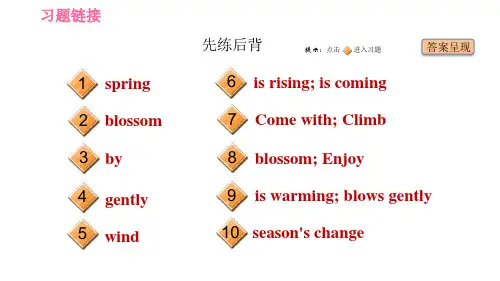
二、根据汉语意思完成句子, 并背记英语句子 6. 太阳在升起, 春天姗姗而来。 The sun ___is__ ___r_is_i_n_g___ ; spring ___is__ __co_m__i_n_g_.
先练后背
7. 跟我来, 爬山坡。 __C__o_m__e_ __w__it_h___ me. __C__li_m__b_ the hillside.
题组专训
4. —Shall I ____A____ some tea or water? —Either will do. I'm really thirsty. A. get B. take C. carry D. bring
题组专训
5. Follow that _te_a_c_h_e_r_'s_ (teacher) advice and soon you will solve the problem. 【中考•扬州】
—____A____, Jack!
【中考•泸州】
A. Have fun
B. No problem
C. Best wishes
D. Take care
题组专训
13. All the students are having great fun _p__la_y_i_n_g_(玩) with water in the river.
三、根据汉语意思完成句子 11. 夏令营让孩子们开心、交新朋友、体验新事物。 【中考•乐山】 Summer camp is a place for kids to ___h_a_v_e__ ___f_u_n___, make new friends and experience new things.
外研版八年级英语下册Module 1 Unit 3

请根据各题后括号内的要求改写下列句子。
1. The fish smells good.(改为否定句) The fish __d_o_es_n_'t__sm__e_ll_good.
2. The song sounds nice. (对划线部分提问) _H_o_w__d_o_e_sn_ the song _so_u_n_d__?
Grammar
Sense verbs; adjectives
Look at these sentences.
那闻起来好香啊!
它T尝起h来a味t道s太m浓了e。lls delicious!
它闻起来不新鲜。
它I摸t起t来a很s软t很e舒s服。too strong.
It doesn’t smell fresh.
+ adj.
常见的系动词除了 smell, taste, feel, look, sound以 外,还有seem (似乎), keep (保持), turn (变), become (成为), get (变)。
结构:连系动词 + 形容词 / 名词(表语) (常由形容词/名词来充当表语)
例:It seems that you're wrong. 似乎你错了。 She wants to know how to keep young. 她想知道如何保持年轻。
Lead in
How do they feel about these things?
The flowers ___s_m__e_l_l_ __s_w_e__e_t_. The willows _l_o_o_k_____ ___g_re_e__n__. Lily _____f_e_e_ls__ ______t_ir_e_d_. The light music _s_o_u__n_d_s__ ___c_o_m__fo__rt_a_b_l_e___. The candy ___t_a_s_t_e_s_ _____s_w_e__e_t.
2018-2019外研版初中英语八年级下册Module1Unit3教案
此外,我注意到在小组讨论中,学生们的思考角度多样,能够从不同的文化视角出发进行交流。但在引导讨论时,我发现自己可以更加灵活地运用开放式问题,引导学生深入思考,促进他们批判性思维的发展。
在总结回顾环节,我感到欣慰的是学生们能够较好地掌握本节课的核心知识点。不过,我也意识到在课程结尾时,应该留出更多的时间让学生提问,这样可以及时解答他们的疑惑,确保他们对知识点的透彻理解。
(三)实践活动(用时10分钟)
1.分组讨论:学生们将分成若干小组,每组讨论一个与旅行相关的实际问题,如制定旅行计划。
2.实验操作:为了加深理解,我们将进行一个简单的角色扮演活动,模拟制定旅行计划的过程。
3.成果展示:每个小组将向全班展示他们的讨论成果和制定的旅行计划。
(四)学生小组讨论(用时10分钟)
1.理论介绍:首先,我们要了解旅行的基本概念。旅行是人们为了休闲、商务或其他目的而进行的短暂迁移。它是了解不同文化、拓宽视野的重要方式。
2.案例分析:接下来,我们来看一个具体的案例。这个案例展示了旅行在实际中的应用,以及它如何帮助我们解决问题。
3.重点难点解析:在讲授过程中,我会特别强调一般过去时态和旅行计划的制定这两个重点。对于难点部分,我会通过举例和比较来帮助大家理解。
四、教学流程
(一)导入新课(用时5分钟)
同学们,今天我们将要学习的是《Travelling》这一章节。在开始之前,我想先问大家一个问题:“你们在日常生活中是否有过旅行的经历?”这个问题与我们将要学习的内容密切相关。通过这个问题,我希望能够引起大家的兴趣和好奇心,让我们一同探索旅行的乐趣和意义。
(二)表达旅行计划,包括时间、地点、活动等元素的讨论。
举例:在讨论旅行计划时,学生需能够使用“Next Monday, we plan to go sightseeing in the countryside to enjoy the beautiful landscape and experience the traditional culture.”
在总结回顾环节,我感到欣慰的是学生们能够较好地掌握本节课的核心知识点。不过,我也意识到在课程结尾时,应该留出更多的时间让学生提问,这样可以及时解答他们的疑惑,确保他们对知识点的透彻理解。
(三)实践活动(用时10分钟)
1.分组讨论:学生们将分成若干小组,每组讨论一个与旅行相关的实际问题,如制定旅行计划。
2.实验操作:为了加深理解,我们将进行一个简单的角色扮演活动,模拟制定旅行计划的过程。
3.成果展示:每个小组将向全班展示他们的讨论成果和制定的旅行计划。
(四)学生小组讨论(用时10分钟)
1.理论介绍:首先,我们要了解旅行的基本概念。旅行是人们为了休闲、商务或其他目的而进行的短暂迁移。它是了解不同文化、拓宽视野的重要方式。
2.案例分析:接下来,我们来看一个具体的案例。这个案例展示了旅行在实际中的应用,以及它如何帮助我们解决问题。
3.重点难点解析:在讲授过程中,我会特别强调一般过去时态和旅行计划的制定这两个重点。对于难点部分,我会通过举例和比较来帮助大家理解。
四、教学流程
(一)导入新课(用时5分钟)
同学们,今天我们将要学习的是《Travelling》这一章节。在开始之前,我想先问大家一个问题:“你们在日常生活中是否有过旅行的经历?”这个问题与我们将要学习的内容密切相关。通过这个问题,我希望能够引起大家的兴趣和好奇心,让我们一同探索旅行的乐趣和意义。
(二)表达旅行计划,包括时间、地点、活动等元素的讨论。
举例:在讨论旅行计划时,学生需能够使用“Next Monday, we plan to go sightseeing in the countryside to enjoy the beautiful landscape and experience the traditional culture.”
外研社八年级英语下册m1u3

C. delicious anything
7. Our teacher makes us
D. something delicious
in class.
A. discuss B. discussing C. discusses D. to discuss
Ⅱ. 完成句子 1.很抱歉,有点不整洁,我将收拾一下桌子和椅子.
a) Growing vegetables.
c) Collecting stamps.
b) Climbing.
5. Which hobby helps other people?
a) Growing vegetables.
b) Collecting stamps. c) Playing chess.
2. The Harry Potter stories were very popular and
as a result more teenagers began to enjoy reading than _________ ever before
as well as 3. Jane is good at singing _________ dancing.
Sorry, it’s a bit untidy, I’ll tidy up the table and chairs. 2. 在高中,大卫写了一个有关青少年的故事, 于2003 年作为一本书出版。 In senior high school, David wrote a story about teenage life, and it come out as a book in 2003. 3. 本学期末,在人民大会堂将有一个音乐会。
4. It’s my A. a
八年级下册英语unit3全单元
Reading Skills Tips
总结词
掌握阅读技巧
详细描述
为了提高阅读理解能力,需要掌握一些阅读技巧,如预测下文内容、推断作者意图、识别隐含意义等。此外,还 可以通过略读、扫读、细读等不同方式来提高阅读效率。
04
Writing training
Analysis of Writing Tasks
• The unit will also explore diverse cultural topics, encouraging students to think critically about issues of race, gender, class, and other social identities. Through the exploration of these topics, students will gain a better understanding of the world around them and develop their cultural awareness and sensitivity.
Understanding the gist
Encourage students to grasp the main idea of the listening material. They should be able to identify the topic, the opinions and the relationships between different ideas.
Student Writing Practice and Commentary
01
Practice Task 1
Students will be given a prompt to write a paragraph on their
新外研版八年级下英语M3-U1

Edison invented the electric light bulb. 爱迪生发明了电灯泡。 Columbus discovered America but he did not explore the new continent. 哥伦布发现了美洲,可是他没有去探 索这个新大陆。 I’m looking for my pen but I can’t find it. 我正在找我的钢笔,但找不到。
Words and expressions
just model spaceship project no problem adv. 刚才;刚刚 n. 模型 n. 航天器;宇宙飞船 n. 计划;工程;项目 没问题(用于表 示乐于做某人要 求做的事) adj. 最近的,最新的
latest
Words and expressions
4. The journey has taken several months. 行程历时几个月。 take后面加时间常表示“花费(多长时 间)”,常用句型为: It takes sb. some time to do sth. 意为“某人花时间做某事”,常与句型 “sb. spend some time doing sth”互换。 如: It took us an hour to send this email. = We spent an hour sending this email. 我们花了一个小时发这个电子邮件。
2. What are you up to? 你在干什么呢? be up to用于表示 “忙于……,正在 做……”。例如: Practise 这么多书放在地上,他在干什么呀? What is he up to with all those books on the floor?
外研版八年级下册Module1 Unit 3 课件ppt
There is music in the room. It sounds a bit noisy, but I enjoy the songs. I am actually a quiet person, but today at the party, we dance, eat, laugh and have a lot of fun together. I feel quite comfortable with the girls. And I am happy to make friends with them. It's a great day!
facial features (面部特征):
skin:
age:
Let’s learn more words about appearance.
facial features eyes – big, small, bright (明亮的)… (面部特征):
nose – flat (扁平), straight (直挺) …
Your mum: A: What does your mum look like? B: She’s tall and beautiful. A: What is your mum like? B: She’s friendly.
Let’s learn more words about appearance.
Alex: Oh, yes. My mum made a cake for me. Here, have some. It really 2. tastes delicious!
Jane: Thanks. It 3. looks/is very pretty too. Mm,
八下unit3 SectionA 1a-1c -八年级下册英语同步精美课件(人教版)
before his grandma arrives, too.
听力原文
礼貌、委婉 地提出要求
肯定回答
1c Make conversations about the chores in 1a.
A: Could you please sweep the floor?
B: Yes, sure. Can you do the dishes?
Homework
Recite 1a and memorize the new words.
根据汉语提示完成下列句子。 1. His sister has to _d_o_t_h_e_d_is_h_e_s__ (洗餐具) after dinner. 2. Could you please _fo_l_d_t_h_ቤተ መጻሕፍቲ ባይዱ_c_lo_t_h_es__ (叠衣服), Jenny? 3. Ben likes to _d_o__th_e_c_l_ea_n_i_n_g___ (打扫卫生). 4. Linda, help your mother _t_a_k_e_o_u_t_t_h_e_r_u_b_b_is_h__ (倒垃圾). 5. My brother hates to __d_o__ch_o_r_e_s_(做家务).
—Could you please fold the(your) clothes?
—Yes, sure. /All right. /No problem. /Certainly.
—Could you please sweep the floor?
—Yes, sure. /All right. /No problem. /Certainly.
1b
Listen. Who will do these chores? Check (√) Peter’s mother or Peter.
听力原文
礼貌、委婉 地提出要求
肯定回答
1c Make conversations about the chores in 1a.
A: Could you please sweep the floor?
B: Yes, sure. Can you do the dishes?
Homework
Recite 1a and memorize the new words.
根据汉语提示完成下列句子。 1. His sister has to _d_o_t_h_e_d_is_h_e_s__ (洗餐具) after dinner. 2. Could you please _fo_l_d_t_h_ቤተ መጻሕፍቲ ባይዱ_c_lo_t_h_es__ (叠衣服), Jenny? 3. Ben likes to _d_o__th_e_c_l_ea_n_i_n_g___ (打扫卫生). 4. Linda, help your mother _t_a_k_e_o_u_t_t_h_e_r_u_b_b_is_h__ (倒垃圾). 5. My brother hates to __d_o__ch_o_r_e_s_(做家务).
—Could you please fold the(your) clothes?
—Yes, sure. /All right. /No problem. /Certainly.
—Could you please sweep the floor?
—Yes, sure. /All right. /No problem. /Certainly.
1b
Listen. Who will do these chores? Check (√) Peter’s mother or Peter.
初中英语北师大版八年级下册《unit 1 lesson3》课件
Strategy
Do the reading
Reading
Jobs in the past, at present and in the future.
Discussion Read the text and choose the best answers.
1. Who is the writer talking to in the text? a. college teachers b. junior high school students c. company managers
require 要求 include包括 decision-making做决策的
problem-solving 解决问题的 express表达 at the same time同时
listener听众 plan计划 decision决定 deal经营 deal with处理
situation情形 rather相反 rather than而不是
Example I’d like to be a tour guide in the future because I love travelling and meeting people.
Work in pairs
Do you think the job you want to do will be the same or different in the future?
Discussion
Which future job skills are you good at and which do you need to work on?
Work in pairs
What skills will be important for future jobs? Why? How should we face the changes?
外研版八年级英语下册M1 Unit 3课件
7. Shall we _s_p_e_n_d__ some time _i_n__ playing table Tennis on Sunday.
8. I buy the magazines when they __c_o_m_e__o_u_t _ each month.
Look at the picture. What activities does it show?
2. her / stamp collection /me / she showed /. She showed me her stamp collection.
3. on TV / watch sport / I / often /. I often watch sport on TV.
4. I’m / writer / a / . I’m a writer.
(Are they similar?) They sent him letters.
My father bought me a very good bike on my birthday.
His hobby has brought him enjoyment. He gave me a piece of advice.
some of my father’s childhood (2)__h_o_b_b_i_e_s___.
He once told me that he wrote to people all over the world, and they sent him letters,
too.(3)___a_s_a__r_e_s_u_lt_____, he had a book of interesting (4)_s_t_a_m__p_s__________.
8. I buy the magazines when they __c_o_m_e__o_u_t _ each month.
Look at the picture. What activities does it show?
2. her / stamp collection /me / she showed /. She showed me her stamp collection.
3. on TV / watch sport / I / often /. I often watch sport on TV.
4. I’m / writer / a / . I’m a writer.
(Are they similar?) They sent him letters.
My father bought me a very good bike on my birthday.
His hobby has brought him enjoyment. He gave me a piece of advice.
some of my father’s childhood (2)__h_o_b_b_i_e_s___.
He once told me that he wrote to people all over the world, and they sent him letters,
too.(3)___a_s_a__r_e_s_u_lt_____, he had a book of interesting (4)_s_t_a_m__p_s__________.