
小学英语外研版(三起)四年级下册Module4__Unit2__will_it_be_hot_in_Haikou
Read
It will be hot in Haikou tomorrow. On Friday I will fly my kite.
Will it rain in Beijing? Yes, it will.
Homework:
1 Read the passage. 2 听天气预报并用英文写至少3个城 市的天气预报。如:It will be ___ in ____.
Choose.
1 Will it
(sunny\be sunny) next (will be\will) cold tomorrow.
week? 2 It
3 Will it (rain\snowy) on Sunday. 4 Will it be hot tomorrow? No, it (will\won’t). 5 I will (fly\flying) my kite.
Yes, it will.
Yinchuan
It will be cold in Yinchuan.
No, it won’t.
Will it snow in Hangzhou?
Hangzhou
It will rain in hangzhou.
Will it rain in Shenyang?
Shenyang
4. Saturday, I’ll go to the park. A. On B. At
5. It will snow, tomorrow I will make a snow man. A. So B. Because 6. It will on Sunday. A. sunny B. rain
Match.
1.
A.---Will it be cold tomorrow?
---No. It will be hot.
2.
B. It will snow tomorrow.
C. –Will it rain?
3.
--Yes, it will.
4.
D. It wilHale Waihona Puke be cold tomorrow.
Beijing
Yes, it will.
It will be windy in Beijing.
Cities
Signs of weather
Beijing
Hangzhou Guangzhou Haikou Yinchuan Shenyang
map
It will …tomorrow.
Will it… tomorrow ? Yes, it will./ No, it won’t.
It will be cloudy in London.
rain
下雨
snow
下雪
sunny
windy
cold
hot
晴朗的 刮风的 寒冷的 炎热的
Will it be hot in Haikou? Yes, it will.
It will be hot in Haikou.
Haikou
Will it be cold in Yinchuan?
1. It will On Sunday. A. hot B. be hot 2.-Will it snow on Monday? – Yes, . A. it Will B. it can
Choose .
3. --What’s the weather like? . A. It’s rainy. B. I will go swimming.
连词成句。 Will, in, snow, tomorrow, it ,Yinchuan?
Will it snow in Yinchuan tomorrow?
will , It , Friday, sunny, be, On.
It will be sunny on Friday.
Read
cloudy windy cold weather rain hot sunny snow
小学英语外研版(三起)四年级下册
sunny
snow
rainning
Windy
hot
cold
Module 4
Unit 2 Will it be hot in Haikou ?
Bishan School Lily
weather forecast天气预报
It will be sunny in Beijing.
No, it won’t
It will snow in shenyang.
Will it be cloudy in Guangzhou? No, it won’t.
Guangzhou
It will be sunny in Guangzhou.
Will it be windy in Beijing?
M4U2 Will it be hot in Haikou?教学设计
1.Listen to a music and sing with it.Then answer the question.
What does this song sing about?学生回答weather并跟读老师。
2.导入Part 1内容,引出单词cloudy。
Today we are going to learn more about the weather,let us listen to Part 1 and read it.引入cloudy,学生听并跟读。
五.Homework
Need to do:
1.Listen and read the content on page 23 nicely. (Pay attention to the pronunciation and intonation.)
2.Introduce the weather tomorrow to ish.
2. 全体学生能够运用Will it (be)in? Yes, it will. / No, it won't.It will (be)in.
二. 技能目标
1. 全体学生能听懂Will it (be)in? Yes, it will. / No, it won't.It will (be)in.
2.全体学生能用以上句型简单地谈论天气。
2.Look、match and say.
做课本Part 3 练习。
3.Team work
Let us report the weather tomorrow with your partner.
4.Listen and chant
5.Improve
外研版四年级英语下册《Will you take your kite》PPT优质课件

Module 4 Unit 1 Will you take your kite?
第一课时
第二课时
第一课时
Look and answer.
Can a bird fly?
Lookcat fly?
Listen, point and say.
picnic: 野餐
have a picnic: 去野餐
We will have a picnic this weekend.
great: 太好了,好极了 That’s a great picture.
- We will have a party this Sunday. - Great!
take: 带,拿 take away: 拿走 Take the umbrella to school.
On Saturday we’re going to have a picnic!
Great!
Will you take your kite tomorrow?
No, I won’t.
Oh. Will you take your ball
tomorrow?
No, I won’t.
Listen, point and find “Will you…?.
Will he come here tomorrow? No, he won’t.
Because tomorrow is Friday. Why not take your kite tomorrow ?
询问对方为什么不做某事的原因: - Why not+ 动词原形+ 其他? - Because+ 原因。
Oh! We’re going to have a picnic
英语外研新标准(三起)四年级下册-Module 4 Unit 1 Will you take you
英语外研新标准(三起)四年级下册-Module 4 Unit 1 Will youtake your kite说课稿一、背景Module 4 Unit 1 是英语外研新标准(三起)四年级下册的一个模块。
本单元主要是介绍如何用英语表达风筝飞行的话题。
二、教学目标1.了解如何用英语表达天气现象。
2.学会用英语表达风筝飞行相关的词汇。
3.学会用英语表达和询问风筝飞行的话题。
三、教学内容与步骤1. 词汇学习教师在黑板上写出与风筝相关的词汇:kite, fly, string, wind, sun, cloud等。
让学生逐个读音,并跟读,牢记每个单词的音标和意义。
2. 听说训练让学生听一段描述天气的对话:A: Will you fly your kite today? B: I hope so. But I hope the wind will blow later. A: Yes. We need a windy day. B: Look at the clouds in the sky. It may rain soon.然后在黑板上画一个天空,让学生模拟对话,利用已学到的词汇描述天气和风筝飞行:A: Will you take your kite today? B: I hope so. But I hope the wind will blow later. A: Yes. We need a windy day. B: Look at the clouds in the sky. It may rain soon.让学生在对话中运用所学的词汇,进行语言训练。
教师要逐个点评学生对话的语言表达是否准确。
3. 读写练习教师发放练习册,让学生完成练习册上的相关练习。
这些练习涵盖了关于天气和风筝飞行的问答练习、图片配对练习、根据描述填空的练习等。
4. 语音练习在黑板上画出单词fly的发音,让学生模仿教师的发音,注意每个音的发声。
四年级下册英语教案-Module4Unit2Iwasverynervous外研版
四年级下册英语教案Module4 Unit 2 I was very nervous (外研版)教学目标1. 学生能够理解并正确使用过去进行时态描述过去正在进行的动作。
2. 学生能够运用目标句型 "I was very nervous" 来表达过去某个时刻的情感状态。
3. 学生能够听懂并准确复述课文中的对话内容。
4. 学生能够通过本课的学习,增强自己的语言表达能力,提高与他人交流的自信心。
教学内容1. 词汇:nervous, excited, happy, sad, angry 等。
2. 句型:I was very nervous. What was he/she doing?He/She was3. 语法:过去进行时态的运用。
4. 对话:课文中的相关对话内容。
教学重点与难点1. 教学重点:学生能够熟练运用过去进行时态描述过去正在进行的动作。
2. 教学难点:学生能够正确运用 "I was very nervous" 来表达过去某个时刻的情感状态,并能在实际情景中进行运用。
教具与学具准备1. 教师准备:多媒体教学设备,PPT课件,录音机,磁带,单词卡片,图片等。
2. 学生准备:英语课本,笔记本,文具等。
教学过程1. 导入:通过图片或故事引导学生回顾已学的情感词汇,激发学生的学习兴趣。
2. 新课内容展示:通过PPT课件或录音,展示本课的对话内容,引导学生跟读并模仿。
3. 语法讲解:通过例句和练习,讲解过去进行时态的构成和用法。
4. 练习:设计相关的练习题,让学生在实际操作中掌握过去进行时态的运用。
5. 小组活动:分组进行角色扮演,模拟课文中的对话情景,提高学生的语言表达能力。
板书设计1. Module4 Unit 2 I was very nervous2. 词汇:nervous, excited, happy, sad, angry 等。
3. 句型:I was very nervous. What was he/she doing?He/She was4. 语法:过去进行时态的构成和用法。
外研版四年级下册英语Module4 Unit 2 Will it be hot in Haikou?
4. Meimeiisgoingto_____g_o__(go/goes) swimming.
点拨:begoingto后接动词原形。 5.—WillitsnowinYinchuan? —No, it________(will/won't).
Harbin
( )5.—WillitraininHaikou?
—NTo, itwillbecloudy.
Haikou
五、连词成句。(注意区分大小写) 1. is, tomorrow, because, Saturday(.) _______________________________________
inGuangzhou
七、阅读短文, 完成下列任务。
ItwillbesunnyonMonday.
Iwillplayfootball.
ItwillbewindyonTuesday. Iwillflyakiteinthepark.
ItwillbecloudyonWednesday.
Iwillrowaboat.
A. hot B. and C. have
三、选词填空。 1. Itwill________ (rainy/rain) inHangzhou.
rain
2. Willit__点__拨__:__w(iilsl/后be接) c动old词in原Ha形rb。in? be
3. Itwillbe________(cloud/cloudy) inBeijing. 点拨:will后接动词原形。
er Hangzh Guangzh Haik City
ou ou ou Weath
Module4Unit2-Will-it-be-hao-in-Haikou
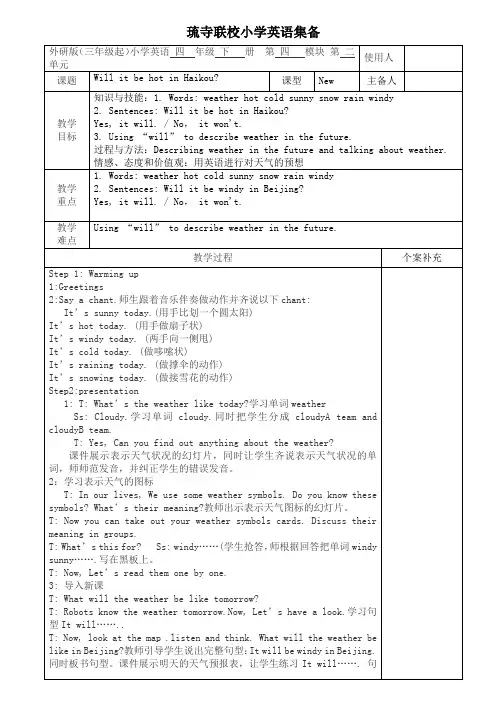
课件展示表示天气状况的幻灯片,同时让学生齐说表示天气状况的单词,师师范发音,并纠正学生的错误发音。
2:学习表示天气的图标
T: In our lives, We use some weather symbols. Do you know these symbols? What’s their meaning?教师出示表示天气图标的幻灯片。
It’s cold today. (做哆嗦状)
It’s raining today. (做撑伞的动作)
It’s snowing today. (做接雪花的动作)
Step2:presentation
1: T: What’s the weather like today?学习单词weather
Ss: Cloudy.学习单词cloudy.同时把学生分成cloudyA team and cloudyB team.
T: Now you can take out your weather symbols cards. Discuss their meaning in groups.
T: What’s this for? Ss: windy……(学生抢答,师根据回答把单词windy sunny…….写在黑板上。
T: Now, Let’s read them one by one.
Step4: Consolidation
我是小小天气播报员
Hello, I’m__________.I will report the weather.
It will__________in________.
先小组讨论,然后小组上台展示,对于播报较好的小组向上走一个台阶。
外研版小学英语(三起)四年级下册Module4Unit1教材内容全解
外研版小学英语四年级下册Module4Unit1教材内容全解Module4Unit1教材内容全解Module4Unit1 Will you take your kite?你将要带着你的风筝吗?1.Listen ,pointand say.听一听,指一指,并说一说。
【情景详解】英语描述:Two cats and two birds are standing in thetree.A bird says it will fly and it flies.A cat says itwill fly but it falls down.The other cat says itwon’t fly.汉语描述:两只猫和两只鸟正站在树上。
一只鸟说它将要飞并且它飞了(下去)。
一只猫说它将要飞,但是它掉了下去。
另一只猫说它不要飞。
【课文全译】I will fly. 我将要飞。
I will fly too. 我也将要飞。
Will you fly? 你将要飞吗?No,I won’t. 不,我不要。
【课文注解】fly(动词)飞,第三人称单数形式flies,过去式flew,短语:fly a kite放风筝,fly away飞走,例句:Can birds fly?鸟会飞吗?另外,fly还可以当名词用,意为“苍蝇”。
2.Listen,point and find“Will you…?”.听一听,指一指,并找到“Will you…?”【情景详解】英语描述:The Smarts are going to have a picnic onSaturday.Sam hopes that Amy can take the kite andthe ball tomorrow.But Amy can’t.Becausetomorrow is Friday.Sam is a little careless.汉语描述:斯玛特一家打算在星期六去野餐。
小学英语外研版(三起)四年级下册Module4+Unit1Robots+will+do+everything教学设计
小学英语外研版(三起)四年级下册Module 4 Unit 1 Robots will do everything教学设计一、教材分析本单元是以Robots为题的对话,要求学生在第三模块的基础上会用Will they do the housework? Will they do the homework? 以及回答Yes, they will. No, they won’t.来谈论将来可能发生的事。
第三模块已经学习了Will you take … to …? Yes, I will. No, I won’t.本模块学习起来相对简单一些,但学生必须通过大量的操练才能熟练的掌握。
二.教学目标:知识目标:1.基本能够听懂,会说,会读词汇:robot, one day, everything, housework, learn, our.2. 学会用“ Will they…? Yes, they will./ No, they won’t.”以及“ I can walk / talk.”的语言结构。
能力目标:能够听懂会说本模块句型,能灵活运用功能句谈论将来的行为,培养学生的想象能力。
情感目标:在积极参与教学活动及小组合作中激发学生兴趣,体会到学习的快乐。
教学重、难点:灵活运用Will they…? 以及回答Yes, they will. No, they won’t.来谈论将来发生的事情。
三、学情分析本模块内容设计适合四年级学生,他们经过一年的学习初步具备一定的听说读的技能,有一定的模仿能力,在老师的引导下,能运用所学基本句型进行语言操练,在课堂教学中能积极参与,互动交流。
并且一般将来时态will在第三模块已经学习接触过,学习起来难度会降低一些。
本课主要运用will 对将来要做的事情进行提问,对于大多数学生来说比较容易掌握。
但是,要灵活自如地运用重点句型进行语言交流,还需要大量的操练。
四.教学方法:五步教学法,小组合作学习五、教学策略1、注意策略通过比赛、竞争、观看视频等各种灵活多样的方法,利用学生注意的选择性和转移性,把学生的注意力牢牢地吸引在课堂上,增强学生注意的稳定性。
外研版小学四年级英语下册 《It will be very hot in Sanya》2
天气
Beijing
sunny
ItissunnyinBeijing.北京晴朗。
ItwillbesunnyinBeijing. 北京将会晴朗。
cloudy
多云的
London
ItwillbecloudyinLondon. 伦敦将会多云。
theweathertomorrow 明天的天气
Let’splayagame. 火眼金睛
Hangzhou
Yinchuan
Haikou
Shanghai
Shenyang
Maoming
cloudy windy sunny cold hot
in
London. Beijing. Guangzhou. Yinchuan. Haikou.
Itwillbewindy.
Whatwilltheweatherbelike?
Whatwilltheweatherbelike?
Itwillbecloudy.
Itwillrain.
Whatwilltheweatherbelike?
Itwillsnow.
Whatwilltheweatherbelike?
A
Will
it
Yes,itwill.
No,itwon’t.
B
Haveaniceday~~
Sunny, sunny, itwillbesunny. Hot, hot, itwillbehot. Cold, cold, itwillbecold. Windy, windy, itwillbewindy. Cloudy,cloudy, itwillbecloudy. Rain, rain, itwillrain. Snow, snow, itwillsnow.
英语外研新标准(三起)四年级下册- Module 4 Unit 1 Will you take yo
英语外研新标准(三起)四年级下册- Module 4 Unit 1 Willyou take your kite教案教学目标1.了解问询他人是否有做某事的用语:“Will you take…?”2.听、说、读、写句型:“Will you take your kite?”3.学生能够在实际生活中运用所学知识询问他人是否准备带上某物。
教学重点1.学会用“Will you take…?”来询问他人是否准备带上某物。
2.阅读、写作技能的培养。
教学难点1.学生能否熟练运用所学知识询问他人。
2.较为复杂的阅读技能的培养。
教学准备1.多媒体课件。
2.板书工具。
教学过程导入(5分钟)1.教师与学生互相问好,营造良好的课堂氛围。
2.教师为学生介绍本节课的主要内容。
热身(10分钟)1.教师向学生展示一个名为“Flying Kite”的视频短片,并问学生是否喜欢放风筝。
2.向学生讲述自己童年时放风筝的有趣经历,并要求学生与教师分享自己的风筝故事和经历。
正文(25分钟)1. 学习会话1.向学生展示“Will you take your kite?”这个句子的用法和意义,并要求学生用此句子询问自己的同桌是否准备带风筝。
2.让学生进行互动交流,帮助他们更好地掌握询问方式。
2. 阅读理解1.教师出示一张名为“Famous Kites”的图片,并引导学生进行阅读。
2.教师向学生提出一些问题,帮助学生更深入、更全面地理解文章。
3. 巩固练习1.让学生以小组为单位进行练习,询问对方是否准备带上指定的物品。
2.鼓励学生进行课堂展示,并向同班同学询问是否准备带上指定的物品。
小结(5分钟)1.教师总结本节课上学习的重点内容。
2.向学生提出一些问题,帮助他们回顾本节课的重要信息。
课堂作业(5分钟)让学生在家将“Will you take your kite?”这个句子运用到实际生活中,询问他人是否准备带风筝或其他物品。
总结在本节课中,学生通过学习“Will you take…?”这一句型,掌握了询问他人是否准备带上某物的方法。