
英语中限制性定语从句与非限制性定语从句的区别
定语从句分为限制性定语从句和非限制性定语从句,它们都是以关系代词开头。
一、限制性定语从句对于句子意义的完整是必须的,它提供它所修饰名词或名词短语的必要信息,去掉的话,会影响到整个句子的意思,甚至有的句子没有任何的意思,例如:
The girl who looks like Jennifer Lopez is T om's girlfriend.
看起来像詹妮弗·洛佩兹的那个女孩是汤姆的女朋友。
解析:此句若去掉限制性定语从句,意思就发生了改变:那个女孩是汤姆的女朋友。
I couldn’t find the book that you recommended.
我找不到你推荐的那本书。
解析:此句若去掉限制性定语从句,意思就发生了改变:我找不到那本书。
The writer whose article you read last week has met with an accident. 你上星期读的那位作家的文章遇到了一个意外。
解析:此句若去掉限制性定语从句,意思就发生了改变:那位作家遇到了一个意外。
Children who eat lots of vegetables are more likely to be healthy.
吃很多蔬菜的孩子更有可能健康。
解析:此句若去掉限制性定语从句,意思就发生了改变:孩子更有可能健康。
删除后此句没有任何意义。
My sister has eaten the cake that I baked yesterday.
我姐姐吃了我昨天烤的蛋糕。
解析:此句若去掉限制性定语从句,意思就发生了改变:我姐姐吃了那个蛋糕。
The car that we want is out of our price range.
我们要的那辆车超出了我们的价格范围。
解析:此句若去掉限制性定语从句,意思就发生了改变:那辆车超出了我们的价格范围。
在大部分限制性定语从句中,关系代词可以省略,而且句子的意思和语法没有变化,特别是在定语从句中充当宾语的关系代词that,例如:
My sister has eaten the cake that I baked yesterday. = My sister has eaten the cake I baked yesterday.
The car that we want is out of our price range. = The car we want is out of our price range.
二、非限制性定语从句与限制性定语从句相反,它在句子中添加额外的且不是必要的信息,去掉它,不会影响整个句子的意思,而且通常用逗号把它与句子的其他成分隔开,例如:
He lives in Galle, which is the capital city of the Southern province.
他住在加勒,这是南部省份的省会城市。
解析:此句若删除非限制性定语从句,就变成He lives in Galle,没影响整个句子的意思。
Charles Dickens, who wrote “Oliver Twist”, is a great author.
查尔斯·狄更斯是一位伟大的作家,他写了《雾都孤儿》。
解析:此句若删除非限制性定语从句,就变成Charles Dickens is a great author,没影响整个句子的意思。
Kaylee, who is an accomplished dancer, is a mother of two children.
凯莉是一位出色的舞蹈家,是两个孩子的母亲。
解析:此句若删除非限制性定语从句,就变成Kaylee is a mother of two children,没影响整个句子的意思。
The hypothesis, which he tested throughout the research, was rejected.他在整个研究过程中验证了这一假设,但被否决了。
解析:此句若删除非限制性定语从句,就变成The hypothesis was rejected,没影响整个句子的意思。
跟限制性定语从句不一样,在非限制性定语从句中,关系代词不能省略,例如:
误:The hypothesis, he tested throughout the research, was rejected.。
限制性定语从句和非限制性定语从句
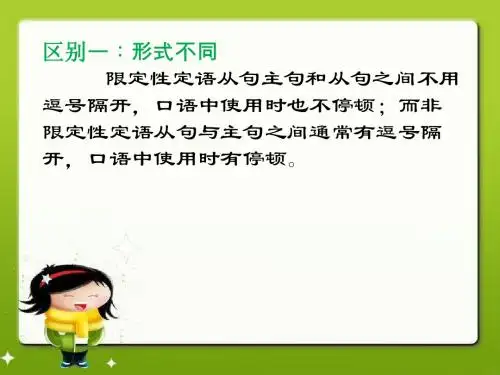
区别五: 区别五:先行词不同
限定性定语从句的先行词只能是名词或代词,而非限定性定语从句的先行词 则可以是名词或代词,也可以是短语或句子;另外,当先行词为专有名词或其他 具有独一无二性的普通名词时,通常要用非限制性定语从句,而不用限制性定语 从句。如: Peter drove too fast, which was dangerous. 彼得开车很快,这是很危险的。(which 指drive too fast) He changed his mind, which made me very angry. 他改变了主意,这使我很生气。 (which指整个主句) Mr. Smith, who is our boss, will leave for Japan next week. 我们的老板史密斯先生下 周要去日本。(先行词为专有名词,要用非限制性定语从句修饰) Her father, who has a lot of money, wishes her to study abroad. 她父亲很有钱,希望 她出国学习。(先行词为表独一无二意义的普通名词,要用非限制性定语从句修 饰)
II. 根据汉语,完成英语句子。 根据汉语,完成英语句子。 1. 屋子里都是孩子,其中十个是那个老人自己的孙子。 The house was full of children,____________________________________________________ ____ . 2. 我们学校有许多实验室,其中最大的是去年建造的。 Our school has many laboratories,________________________________________________ . 3. 我去年买的那幢房子带着一个漂亮的花园。 My house,________________________________________________ , has got a lovely garden. 4. 我们沿着村里的大街向前走去,村民们正在那里赶集。 We walked down the village street,________________________________________________ . 5. 一个中年女子杀害了自己的丈夫,这令我十分恐惧。 A middle-aged woman killed her husband,________________________________________ .
限制性与非限制性定语从句区别

为⼤家整理的限制性与⾮限制性定语从句区别,供⼤家学习参考!⼀、在句中作⽤不同限制性定语从句对被修饰的先⾏词有限定制约作⽤,使该词的含义更具体,更明确。
限制性定语从句不能被省略,否则句意就不完整。
⾮限制性定语从句与先⾏词关系不⼗分密切,只是对其作⼀些附加说明,不起限定制约作⽤。
如果将⾮限制性定语从句省去,主句的意义仍然完整。
⼆、外在表现形式不同限制性定语从句因与先⾏词关系密切,所以不可以⽤逗号将其与主句隔开;⽽⾮限制性定语从句与先⾏词关系不⼗分密切,所以可⽤逗号将其与主句隔开。
例 1. Do you remember the girl who taught us English?你还记得教我们英语的那个⼥孩吗?例 2. Clock is a kind of instrument which can tell people time.钟是⼀种能够告诉⼈们时间的仪器。
例 3. This is the place where he used to live.这就是他过去居住的地⽅。
例 4. Mr. Zhang, who came to see me yesterday, is an old friend of mine.张先⽣昨天来看我,他是我的⼀位朋友。
例 5. We walked down the village street, where they were having market day.我们沿着村⾥的⼤街向前⾛去,村民们正在那⾥赶集。
析:在前三个例句中,定语从句与先⾏词关系密切,为限制性定语从句,不可⽤逗号将其与主句隔开。
在后两个例句中,定语从句与先⾏词关系不密切,为⾮限制性定语从句,可⽤逗号将其与主句隔开。
三、先⾏词内容有所不同⼤多数限制性和⾮限制性定语从句的先⾏词往往为某⼀个词或短语,⽽特殊情况下⾮限制性定语从句的先⾏词也可为整个主句,此时⾮限制性定语从句常由 which 引导。
例 1. A middle-aged woman killed her husband, which frightened me very much.⼀个中年⼥⼦杀害了⾃⼰的丈夫,这令我⼗分恐惧。
限制性定语从句与非限制性定语从句的区别
限制性定语从句与非限制性定语从句的区别限制性定语从句与非限制性定语从句的区别根据定语从句与先行词的关系,定语从句可分为限制性定语从句及非限制性定语从句。
限制性定语从句紧跟先行词,主句与从句不用逗号分开,从句不可省去;非限制性定语从句主句与从句之间有逗号分开,起补充说明作用,如省去,意思仍完整。
在以上几个单元我们已经了限制性定语从句,现在把两种从句作对比学习。
一、限制性定语从句1.关系代词that既可代表事物也可代表人,which只代表事物,它们在从句中作主语或宾语。
在从句中作宾语时常可省略。
I was the only person in our office that was invited to the palace ball.The present that(which)I received last week was from my sister.This is a book which is about space rocket technology.2.关系代词who和whom引导的从句用来修饰人,分别作从句中的主语和宾语,whom作宾语时,要注意它可以作动词的宾语也可以作介词的宾语。
如:This is the man who helped me.The doctor whom you are looking for is in the room.3. whose是关系代词,修饰名词,作定语,相当于who和whom 的所有格,既可以修饰人又可以修饰物。
如:Do you know the student whose name is Wang Fei?We lived in a room whose window opens to the west.4. where是关系副词,用来引导表示地点的定语从句,where在从句中作状语。
如:At last we arrived at a small village where we’ll work for a week.5. when是关系副词,引导定语从句表示时间,在从句中作状语。
限制性定语从句与非限制性定语从句区别知识点总结
限制性定语从句与非限制性定语从句区别知识点总结定语从句是英语语法中的一个重要概念,用于修饰名词或代词,并提供更多的信息。
在定语从句中,最常见的类型是限制性定语从句和非限制性定语从句。
本文将详细讨论这两种定语从句的区别及其在句子中的用法。
一、限制性定语从句1. 定义:限制性定语从句指的是对名词或代词进行修饰、限定,如果去掉这个定语从句,句子的意思就会发生改变。
它提供的信息对于理解主句来说是必需的。
2. 格式:限制性定语从句通常使用关系代词或关系副词引导,常见的关系代词有:that, which, who, whom, whose;关系副词有:when, where, why。
3. 示例:a) I have a friend who is studying abroad.(我有一个正在国外学习的朋友。
)b) The book that you lent me is very interesting.(你借给我的那本书非常有趣。
)c) She lives in the city where there are many tall buildings.(她住在有很多高楼的城市。
)4. 特点:限制性定语从句的特点如下:a) 不用逗号与主句分开。
b) 定语从句中的关系代词或关系副词在从句中不能被省略。
c) 定语从句修饰的是前面的名词,它是该名词的一个必需部分。
二、非限制性定语从句1. 定义:非限制性定语从句指的是对名词或代词进行修饰、补充说明,与主句的内容是附加关系,如果去掉这个定语从句,句子的意思仍然完整。
2. 格式:非限制性定语从句通常使用逗号隔开,引导词同样使用关系代词或关系副词。
3. 示例:a) John, who is my best friend, is coming to visit me tomorrow.(约翰,我的最好朋友,明天要来看我。
)b) The Great Wall, which is a world-famous tourist attraction, attracts millions of visitors every year.(长城,一座举世闻名的旅游胜地,每年吸引着数百万的游客。
高中英语限制性定语从句和非限制性定语从句有四大区别及练习华师大版

限制性定语从句和非限制性定语从句有四大区别;一、在句中作用不同限制性定语从句对被修饰的先行词有限定制约作用;使该词的含义更具体;更明确..限制性定语从句不能被省略;否则句意就不完整..非限制性定语从句与先行词关系不十分密切;只是对其作一些附加说明;不起限定制约作用..如果将非限制性定语从句省去;主句的意义仍然完整..二、外在表现形式不同限制性定语从句因与先行词关系密切;所以不可以用逗号将其与主句隔开;而非限制性定语从句与先行词关系不十分密切;所以可用逗号将其与主句隔开..例1. This is the place where he used to live.例 2. Mr. Zhang;who came to see me yesterday;is an old friend of mine.在例 1中;定语从句与先行词关系密切;为限制性定语从句;不可用逗号将其与主句隔开..在例2中;定语从句与先行词关系不密切;为非限制性定语从句;可用逗号将其与主句隔开..三、先行词内容有所不同大多数限制性和非限制性定语从句的先行词往往为某一个词或短语;而特殊情况下非限制性定语从句的先行词也可为整个主句;此时非限制性定语从句常由 which 引导..例:1. A middle-aged woman killed her husband;which frightened me very much.由语境可知;令“我”恐惧的内容应为“中年女子杀害了自己的丈夫”这整个一件事;因此先行词为整个主句;此时应由 which 引导定语从句..例:2. A five-year-old boy canspeak two foreign languages; which surprises all the people present.由语境可知;令所有在场的人感到惊讶的内容是“一个五岁男孩会讲两门外语”这整个一件事;因此先行词为整个主句;此时应由 which 引导非限制性定语从句..四、关系词的使用情况有所不同一 that 不可用于引导非限制性定语从句所有关系代词和关系副词均可引导限制性定语从句;大多数关系代词和关系副词可引导非限制性定语从句;但 that 不可..例如:他没通过这次考试;令我很失望..误:He didn't pass the exam;that disappointed me.正:He didn't pass the exam;which disappointed me.值得注意的是;不少同学误认为只有 which 才能引导非限制性定语从句;这个观点是不正确的..使用非限制性定语从句时;如果先行词指人;则用 who ; whom或 whose 引导非限制性定语从句;先行词指物可用 which 引导非限制性定语从句;先行词表时间或地点且在从句中作时间状语或地点状语时;可用when;where 引导非限制性定语从句..例1. We'll graduate in July;when we will be free.例2. Last Sunday they reached Nanjing;where a conference was to be held.二关系代词替代情况不同关系代词 whom 在限制性定语从句中作宾语时可用 who 代替 whom ;但 whom 在非限制性定语从句中作宾语时不可用 who 来代替..例: 1. This is the girl whom I met in the street.先行词 the girl 在限制性定语从句中作宾语;可用 who 代替whom .例: 2. A young man had a new girl friend;whom he wanted to impress.先行词 a new girl friend 在非限制性定语从句中作宾语;不可用 who 代替 whom .在限制性定语从句中;先行词指人时可用 that 代替 who/ whom ;但在非限制性定语从句中先行词指人时;不可用 that 代替who/whom .例:她有一个姐姐;她是教师..误: She has a sister;that is a teacher.正:She has a sister;who is teacher.三关系代词省略情况不同关系代词在限制性定语从句中作宾语时可以省去;非限制性定语从句的所有关系词均不可省..例 1. This is the bookwhich/thathe lost yesterday.先行词 the book 在限制性定语从句中作宾语;关系代词 which 或 that 可以省略..例 2. The book; which he lost yesterday; has been found.先行词 the book 在非限制性定语从句中作宾语;关系代词which 不可省..四as引导定语从句时的用法① as引导限制性定语从句通常用于the same … as; such … as 结构中..e.g. I want the same shirt as my friend’s.Such machines as are used in our workshop are made in China. 我们车间使用的这种机器是中国制造的..② as引导非限制性定语从句既可放在主句之前;也可放在主句之后;用来修饰整个句子..通常用下列句型:as is known to all; as is said; as is reported; as is announced; as we all know; as I expect 等..e.g. As I expected; he got the first place again in this mid-term examination.3as 引导非限制性定语从句时与which的区别① 当主句和从句语义一致时;用as;反之;用which来引导非限制性定语从句..e.g. He made a long speech; as we expected.He made a long speech; which was unexpected.② 当非限制定语从句为否定时;常用which引导..e.g. Tom drinks a lot every day; which his wife doesn’t likeat all.2. 定语从句有时不直接紧靠先行词;中间由一个定语、状语或谓语隔开..这种定语从句叫做分隔性定语从句e.g. There is an expression in his eyes that I can’t understand.4. 引导定语从句的关系副词有时可以用“介词+ which”来代替..e.g. October 1; 1949 was the day on which = when the People’s Republic of China was founded.5. 当定语从句中谓语动词是带介词或副词的固定短语动词时;短语动词的各个固定部分不要拆开..e.g. The sick man whom she is looking after is her father.6. 介词在关系代词前;只能用which和whom;且不能省略;介词在句尾;关系代词可以省略..定语从句练习、一、把下列每对句子合并成含有定语从句的主从复合句:1. The fan is on the desk. You want it.2. The man is in the next room. He brought our textbooks here yesterday.3. The magazine is mine. He has taken it away.4. The students will not pass the exam. They don’t study hard.5. The woman is our geography teacher. You saw her in the park.6. The letter is from my sister. I received it yesterday.7. The play was wonderful. We saw it last night.8. The train was late. It was going to Nanning.9. The boy is my brother. He was here a minute ago.10. The tree is quite tall. He is climbing it.11. Here is the girl. Her brother works in this shop.12. That’s the chi ld. We were looking at his drawing just now.13. This is the boy. His sister is a famous singer.14. I want to talk to the boys. Their homework haven’t been handed in.15. Is that the woman Her daughter is in my class.16. He used to live in a big house. In front of it grew many banana trees.17. They passed a factory. At the back of the factory there were rice fields.18. The soldier ran to the building. On the top of it flewa flag.19. In the evening they arrived at a hill. At the foot of the hill there was a temple.20. She came into a big room. In the middle of it stood a large table.二、根据句子意思;用介词+关系代词whom或which 完成下列句子.1. The person ________ ________ I spoke just now is themanager that I told you about.2. The pencil ________ ________ he was writing broke.3. Wu Dong; ________ ________ I went to the concert; enjoyed it very much.4. The two things ________ ________ Marx was not sure were the grammar and some of the idioms of English.5. Her bag; ________ ________ she put all her books; has not been found.6. The stories about the Long March; ________ ________ thisis one example; are well written.三、选择填空:1. The man ____ visited our school yesterday is from London.A. whoB. whichC. whomD. when2. The woman ____ is talking to my mother is a friend of hers.A. whoseB. whoC. whomD. which3. Because of my poor memory; all ____ you told me has been forgotten.A. thatB. whichC. whatD. as4. Do you remember those days ____ we spent along the seashore very happilyA. whenB. whereC. whichD. who5. Tom t took away the camera because it was just the samecamera ____ he lost last week.A. whichB. thatC. whomD. as6. Those ____ want to go please sign their names here.A. whomB. whichC. whoD. when7. Where is the man ____ I met this morningA. whenB. whereC. whichD. who8. Who is the woman ____ is sweeping the floor over thereA. whoB. /C. thatD. when9. The man ____ you talked just now is a worker.A. whoB. whomC. to whomD. to who10. The man ____ you are going to make friends is my father’s neighbour.A. with whomB. whenC. to whomD. which11. The doctor ____ is leaving for Africa next month.A. the nurse is talking to himB. whom the nurse is talkingC. the nurse is talking toD. who the nurse is talking12. The man ____ around our school is from America.A. which you showedB. you showed himC. you showedD. where you showed13. He talked about a hero ____ no one had ever heard.A. of whomB. from whomC. about thatD. who14. In fact the Swede did not understand the three questions____ were asked in French.A. whereB. whoC. in whichD. which15. Have you read the book ____ I lent to youA. thatB. whomC. whenD. whose16. Finally; the thief handed over everything ____ he had stolen to the police.A. thatB. whichC. whateverD. all17. The foreign guests; ____ were government officials; werewarmly welcomed at the airport.A. most of themB. most of thatC. most of whomD. most of those18. This is the very letter ____came last night.A. whoB. whichC. thatD. as19. I know only a little about this matter; you may ask ____ knows better than I.A. whoeverB. whomeverC. anyoneD. the one20. This is the school ____ we visited three days ago.A. whereB. /C. whenD. what21. This is the factory ____ we worked a year ago.A. whereB. thatC. whichD. on which22. Nearby were two canoes ____ they had come to the island.A. whichB. in whichC. thatD. /23. Jack is pleased with ____ you have given him and all ____ you have told him.A. that; whatB. what; thatC. which; whatD. that; which24. Do you work near the building ____ colour is yellowA. thatB. whichC. itsD. whose25. In the dark street; there wasn’t a single person ____ she could turn for help.A. whomB. whoC. to whomD. form whom26. Is this school ____ we visited three years agoA. the oneB. whichC. thatD. where27. Is this the school ____ we visited three years agoA. the oneB. whereC. in whichD. /28; How many students are there in your class ____ homes are in the countryA. whoseB. whoC. whomD. which29. Alice received an invitation from her boss; ____ cameas a surprise.A. itB. whichC. thatD. he30. The train was crowded and I had to get into a carriage____ already seven other people.A. when there wereB. which there wereC. that there wereD. where there were31. I live in the house ____ windows face south.A. whichB. whoseC. whereD. that32. ---- What game is popular with them---- The ____ most is tennis.A. game they like itB. game they likeC. best game they likeD. best game they like it33. They stayed with me three weeks; ____ they drank all the wine I had.A. whichB. which timeC. during whichD. during which time34. The room ____ Mr White lives is not very large.A. thatB. whichC. whereD. when35. Don’t forget the day ____ you were received into theYouth League.A. whenB. thatC. at whichD. where36. I’ve finished writing the novel; ____ is to be published next month.A. thatB. whatC. whichD. when37. He returned home safe and sound after a fierce battle; ____ was unexpected.A. whichB. asC. thatD. it38. ____ is known to all; English is not very difficult to learn.A. WhatB. AsC. ThatD. Which39. The old man had three sons; all of ____ died during World War Ⅱ.A. whoseB. thatC. whomD. who40. I have bought two pens; ____ write well.A. none of whichB. neither of whichC. both of whichD. all of which41. Do you know the reason ____ she has changed her mindA. whyB. whichC. for thatD. of which42. He failed in the exam; ____ proves that he wasn’t working hard enough.A. whichB. whatC. itD. that43. During the week ____ he tried to collect materials for his article.A. followingB. followedC. to followD. that followed44. ____ was expected; he succeeded in the exam.A. ItB. WhichC. AsD. That45. He studied hard and later became a well-known writer; ____ his father expected.A. that was whatB. what was thatC. and which wasD. which was what46. We should read such books ____ will make us better and wiser.A. whenB. asC. whoseD. what47. You must show my wife the same respect ____ you show me.A. whenB. asC. whoseD. what48. He is absent; ____ is often the case.A. whatB. whichC. whoD. as49. It is the first time ____ I have come to your city.A. thatB. whichC. whatD. when50. Who ____ has the same idea as it will do it in this way.A. whoB. thatC. whomD. which51. I shall never forget those years ____ I lived in thecountry with the farmers; ____ has a great effect on my life.A. that; whichB. when; whichC. which; thatD. when; who52. This is the only book ____ I can find.A. thatB. whichC. itD. with which53. I don’t like ____ you speak to her.A. the wayB. the way in thatC. the way whichD. the way of which54. That is one of those books that ____ worth reading.A. isB. areC. hasD. have55. This is the only one of the students whose handwriting ____ the best.A. isB. areC. hasD. have定语从句参考答案一、1. The fan that you want is on the desk.2. The man who brought our textbooks here yesterday is in next room.3. The magazine which he has taken away is mine.4. The students who don’t study hard will not pass the exam.5. The woman you saw in the park is our geography teacher.6. The letter I received yesterday is from my sister.7. The play that we saw last night was wonderful.8. The train which was going to Nanning was late.9. The boy who was here a minute ago is my brother.10. The tree he is climbing is quite tall.11. Here is the girl whose brother works in this shop.12. That’s the child whose drawing we were looking at just now.13. This is the boy whose sister is a favous singer.14. I want to talk to the boy whose homework hasn’t beenhanded in.15. Is that the woman whose daughter is in my class16. He used to live in a big house; in front of which grew many banana trees.17. They passed a factory; at the back of which there were rice fields.18. The soldier ran to the building; on the top of which flewa flag.19. In the evening they arrived at a hill; at the foot of which there was a temple.20. She came into a big room; in the middle of which stooda large table.二、1. to whom; 2. wiht which; 3. with whom;4. about which;5. in which;6. of which三、1~5 ABACD 6~10 CDCCA 11~15 CCADA 16~20 ACCAB21~25 ABBDC 26~30 ADABD 31~35 BBDCA 36~40 CABCC 41~45 AADCD 46~50 BBDAB 51. BAABA。
限制性与非限制性定语从句区别
限制性与非限制性定语从句区别一、在句中作用不同限制性定语从句对被修饰的先行词有限定制约作用,使该词的含义更具体,更明确。
限制性定语从句不能被省略,否则句意就不完整。
非限制性定语从句与先行词关系不十分密切,只是对其作一些附加说明,不起限定制约作用。
如果将非限制性定语从句省去,主句的意义仍然完整。
二、外在表现形式不同限制性定语从句因与先行词关系密切,所以不可以用逗号将其与主句隔开;而非限制性定语从句与先行词关系不十分密切,所以可用逗号将其与主句隔开。
例1. Do you remember the girl who taught us English?你还记得教我们英语的那个女孩吗?例2. Clock is a kind of instrument which can tell people time.钟是一种能够告诉人们时间的仪器。
例3. This is the place where he used to live.这就是他过去居住的地方。
例4. Mr. Zhang, who came to see me yesterday, is an old friend of mine.张先生昨天来看我,他是我的一位朋友。
例5. We walked down the village street, where they were havingmarket day.我们沿着村里的大街向前走去,村民们正在那里赶集。
析:在前三个例句中,定语从句与先行词关系密切,为限制性定语从句,不可用逗号将其与主句隔开。
在后两个例句中,定语从句与先行词关系不密切,为非限制性定语从句,可用逗号将其与主句隔开。
三、先行词内容有所不同大多数限制性和非限制性定语从句的先行词往往为某一个词或短语,而特殊情况下非限制性定语从句的先行词也可为整个主句,此时非限制性定语从句常由which 引导。
例1. A middle-aged woman killed her husband, which frightened me very much.一个中年女子杀害了自己的丈夫,这令我十分恐惧。
限制性定语从句和非限制性定语从句的区别
Practice A
• 1. 2. 请区分出下列句子哪些是限制性定语从句, 那些是非限制性定语从句: The teacher told me that Tom was the only person that I could depend on. His mother, who loves him very much, is strict with him. China is a country which has a long history. China, which was founded in 1949, is becoming more and more powerful.
A、who
B、who want
C、what wants
D、want
7、His walking stick, ____ he can’t
walk, was lost yesterday. A、that
D
B、with which
C、which D、without which
8、They have decided to finish their
C、which
D、where
B
C. that D. the one which
5、This is the factory_______we visited
last year.
A
A、that
B、 in which
C、what
D、the one
解析:the factory是定语从 句的先行词, 用作宾语; 从句we visited last year中 visit是个及物动词,后接 宾语,因此选A.
形式上
意义上
译法上
限制性定语从句与非限制性定语从句区别知识点总结
限制性定语从句与非限制性定语从句区别知识点总结定语从句是英语语法中重要的一部分,通过引导一个修饰性从句来进一步描述或限定一个名词。
在定语从句中,常见的有限制性定语从句和非限制性定语从句两种形式。
本文将总结并对比这两者的区别。
一、定义限制性定语从句(Restrictive Relative Clauses),也称为限定性定语从句,是对被修饰名词进行限定、界定的从句。
它给出一个特定范围,从中选出被修饰的名词,删除该从句将导致句意不完整或不明确。
非限制性定语从句(Non-restrictive Relative Clauses),也称为非限定性定语从句,是对被修饰名词提供额外的附加信息,但不对名词进行限定。
即使删除该从句,句意仍然连贯完整。
二、标点使用1. 限制性定语从句通常不使用逗号进行标点分隔。
如:The bookthat I borrowed last week is very interesting.(我上周借的那本书非常有趣。
)2. 非限制性定语从句使用逗号或者破折号进行标点分隔。
如:My sister, who lives in London, is a doctor.(我妹妹住在伦敦,是一名医生。
)三、修饰范围1. 限制性定语从句修饰的范围是限定、特定的。
它给出特定条件,仅对名词进行限定。
如:The book that I borrowed last week is very interesting.(我上周借的那本书非常有趣。
)2. 非限制性定语从句提供额外的信息,对整个句子进行补充说明。
如:My sister, who lives in London, is a doctor.(我妹妹住在伦敦,是一名医生。
)四、形式1. 限制性定语从句不需要逗号,从句中的关系代词(that, who, whom, whose, which等)在从句中充当主语或宾语。
如:The book that I borrowed last week is very interesting.(我上周借的那本书非常有趣。
定语从句例句:限制性与非限制性定语从句区别
中考/备考辅导定语从句例句:限制性与非限制性定语从句区别一、在句中作用不同限制性定语从句对被修饰的先行词有限定制约作用,使该词的含义更具体,更明确。
限制性定语从句不能被省略,否则句意就不完整。
非限制性定语从句与先行词关系不十分密切,只是对其作一些附加说明,不起限定制约作用。
如果将非限制性定语从句省去,主句的意义仍然完整。
二、外在表现形式不同限制性定语从句因与先行词关系密切,所以不可以用逗号将其与主句隔开;而非限制性定语从句与先行词关系不十分密切,所以可用逗号将其与主句隔开。
例1. Do you remember the girl who taught us English?你还记得教我们英语的那个女孩吗?例2. Clock is a kind of instrument which can tell people time.钟是一种能够告诉人们时间的仪器。
例3. This is the place where he used to live.这就是他过去居住的地方。
例4. Mr. Zhang, who came to see me yesterday, is an old friend of mine.张先生昨天来看我,他是我的一位朋友。
例5. We walked down the village street, where they were having market day.我们沿着村里的大街向前走去,村民们正在那里赶集。
析:在前三个例句中,定语从句与先行词关系密切,为限制性定语从句,不可用逗号将其与主句隔开。
在后两个例句中,定语从句与先行词关系不密切,为非限制性定语从句,可用逗号将其与主句隔开。
三、先行词内容有所不同大多数限制性和非限制性定语从句的先行词往往为某一个词或短语,而特殊情况下非限制性定语从句的先行词也可为整个主句,此时非限制性定语从句常由which 引导。
例1. A middle-aged woman killed her husband, which frightened me very much. 一个中年女子杀害了自己的丈夫,这令我十分恐惧。
限制性定语从句与非限制性定语从句的区别
限制性定语从句与非限制性定语从句的区别1. 结构不同限制性定语从句常紧接在先行词后,主、从句间没有逗号分开;而非限制性定语从句与先行词之间常用逗号分开,并且as所引导的非限制性定语从句还可放在主句之前。
如:His friend who works in Guangdong telephoned him last night. 他在广东工作的朋友昨天来了电话。
(限制性)His father, who works in Guangdong, telephoned last night. 他父亲在广东工作,昨天给他来了电话。
(非限制性)As you know, I don’t like drinking or smoking. 你知道,我不喜欢喝酒、抽烟。
(非限制性)2. 功能不同限制性定语从句对先行词进行修饰、限制,如果去掉定语从句,整个句子的意思就不完整、不准确;非限制性定语对先行词进行补充、说明,即使去掉定语从句,对句子的意思没有影响。
如:He asked me a question which was about my study at school. 他问了一个有关我在学校学习的问题。
如果去掉后面的定语从句,句子的意思显然不清楚。
This is my motorbike, which was sent to me by my uncle. 这是我的摩托车,它是我叔叔送的。
显然去掉后面的定语从句对句子的意思没有影响。
3. 先行词不同限制性定语从句的先行词一般是名词或代词;非限制性定语从句的先行词可以是名词、代词、短语、甚至是整个句子。
如:I know nothing that happened last night. 昨天晚上所发生的事情,我一点也不知道。
(修饰前面的nothing)He has made great progress, which made us happy. 他进步了,这使我们大家都很高兴。