
【最新整理】牛津译林版7B英语七年级下册Unit2Neighboursreading公开课课件
牛津译林英语七年级英语下册Unit 2 Neighbours 知识点归纳.doc

7B Unit2 知识点解析一、知识要点1.Where are you going?你打算去哪里?be going此处为“现在进行时表将来”。
现在进行时表将来主要用于表示按计划或安排将要发生的动作,常有“意图”“安排”或“打算”的含义。
这种现在进行时比较生动,给人一种期待感。
go, come, leave等表示位移的动词,都可以用于现在进行时表将来。
例如:He is going. 他要走了。
I’m coming. 我要来了。
Tom is leaving. 汤姆要走了。
2. I’m going to visit our new neighbours.我打算拜访我们的新邻居。
be going to意为“计划,打算”,后接动词原形,用于表将来。
例如:I’m going to wash the car if I have time. 若有时间我想洗洗车。
Where are we going to stay tonight? 我们今晚住哪里?3. I’m afraid they won’t welcome visitors like you.恐怕他们不会欢迎像你一样的拜访者。
(1)welcome作及物动词,意为“欢迎’’,可与介‘词to连用;也可作形容词,意为“受欢迎的"。
如:Welcome you to our school! 欢迎到我们学校来!You’re welcome.不用谢。
(2)句中like是介词,意为“像,相似’’,其反义词是unlike;作动词时,意为“喜欢’’,后可接动名词或不定式作宾语。
如:What is Jim like? 吉姆这个人怎么样?They like playing football on Sunday.他们喜欢在星期天踢足球。
(3)won’t是will与not的缩略形式。
“will+动词原形"也是一般将来时的构成之一。
如:We will take a bus to work.我们将乘公共汽车上班。
牛津译林英语七年级英语下册unit2neighbours知识点归纳 (2).docx

一、知要点1. Where are you going?你打算去哪里?be going 此“ 在行表将来”。
在行表将来主要用于表示按划或安排将要生的作,常有“意”“安排”或“打算”的含。
种在行比生,人一种期待感。
go, come, leave 等表示位移的,都可以用于在行表将来。
例如: He is going.他要走了。
I ’m coming. 我要来了。
Tom is leaving.姆要走了。
2. I’m going to vi sit our new neighbours.我打算拜我的新居。
be going to意“ 划,打算”,后接原形,用于表将来。
例如: I ’m going to wash the car if I have time.若有我想洗洗。
Where are we going to stay tonight?我今晚住哪里?3. I ’m afraid they won’t welcome visitors like you.恐怕他不会迎像你一的拜者。
(1)welcome作及物,意“ 迎’’,可与介‘to用;也可作形容,意“受迎的 " 。
如:Welcome you to our school!迎到我学校来!You’re welcome .不用。
(2)句中like是介,意“像,相似’’,其反是unlike;作,意“喜’’,后可接名或不定式作。
如:What is Jim like?吉姆个人怎么?They like playing football on Sunday.他喜在星期天踢足球。
(3)won ’t是 will与not的略形式。
“ will+原形"也是一般将来的构成之一。
如:We will take a bus to work.我将乘公共汽上班。
4. Most of them have 14 floors.most of 意“⋯⋯中的大多数”,后面接可数名复数作主,用复数形式;也可接不可数名,此用数形式。
Unit2Neighbours知识讲义牛津译林版英语七年级下册

牛津版译林英语7B知识点总结Unit2 Neighbours1.Where are you going?【知识点一】:be doing(1)现在进行时表将来(2) go、e、leave、move表示移动的词,都可以用“现在进行时表将来”(3)进行时开始表示:近期一直在做某事2. I'm afraid they won't wele visitors like you. 恐怕他们不会欢迎像你这样的客人。
(P18)【知识点一】afraid adj. 害怕的(1) I'm afraid (that) + 宾语从句, 恐怕Eg. I’m afraid (that) you are wrong.(2) be afraid of doing sth 害怕做某事= be afraid to do sth(3) I'm afraid not. 恐怕不是这样的。
Eg.—Can you get there before 6 o’clock? —I’m afraid not.(4) I'm afraid so. 恐怕是这样的。
Eg.—Is it going to rain tomorrow? —I’m afraid so.【随堂练习】1. —Will your father e to see your piano show tomorrow?— . He is having an important meeting in Beijing now.A. They'd like toB. You're rightC. I'm afraid soD. I'm afraid not2. —Would you like to help me with my lessons?—Sorry. .I have no time now .A. I'm sure.B. I'm afraid.C. I'd like.D. I hope.【知识点二】visitor (n.)拜访者①visit v. 参观;拜访n. 参观visit sp. = be on a visit to sp.②构词法:动词+or→表示人的职业或身份act→ actor invent→ inventor collect→ collector【随堂练习】1. Do you know the (visit) telephone numbers? I want to call them.【知识点三】like(1) v. 喜欢like doing sth./ like to do sth. 反义词:dislike = hate(2) prep. 像反义词:unlikebe like/look like①问性格,品质What be sb. like?Eg.—What is he like? —He is kind and helpful.②问外貌:What does sb. look like? = How does sb. look?Eg.—What does he look like? = How does he look?—He looks tall and strong.区别:What does sb like (doing)? 问爱好(3)不能单独作谓语: be like 像…look like 看起来像… sound like听起来像【随堂练习】1.The boy, his father, playing football.A. like;likesB. likes;likeC. liked;likeD. like; will like2.— __________ your hometown like? —It’s a good place ___________.A. How is; to liveB. How does; to liveC. What is; livingD. What is; to live3. What is your father like?A. He likes history best.B. He likes eating meat.B. He is kind and friendly. D. He is forty years old.补: 问职业①What be sb? ②What be sb’s job? ③What do/does sb do?3. How many buildings are there in your neighbours? 在你居民区有多少幢楼?【知识点一】how often, how many times, how soon, how long 与how far的区别【随堂练习】1. — ______ do you help your parents do housework? — Every evening.A. How oftenB. How longC. How soonD. How far2. — ______ music do you listen to every day? —One hour.A. How manyB. How longC. How soonD. How much3. — ______ hours of music do you listen to every day? —One.A. How manyB. How longC. How soonD. How much4. — ______ will you e back? —In two days.A. How oftenB. How longC. How soonD. What time4. Most of them have 14 floors. 它们大多数有14层。
牛津译林版英语七年级下册Unit 2 Neighbours书面表达(含答案)

七下Unit 2 Neighbours书面表达A假设你所生活的小区将在这周末举行一个互帮互助的活动,为社区居民提供一些便民服务。
请你根据所学内容并适当发挥想象,帮助社区中心写一篇80词的英语书面通知。
通知的开头和结尾已给出,但不计入要求词数。
NoticeWe are going to have an activity called “Helping each other” at the community centre this Saturday afternoon._____________________________________________________________________________ _______________________________________________________________________________ _______________________________________________________________________________ _______________________________________________________________________________ _______________________________________________________________________________ _______________________________________________________________________________ _____________________________________________________________________________ Everyone is welcome!Community CentreJanuary 21, 2021One possible version:B根据以下提示,以My neighbour为题写一篇70词左右的短文。
最新译林牛津初一英语下册7B单元教案Unit 2 Neighbours
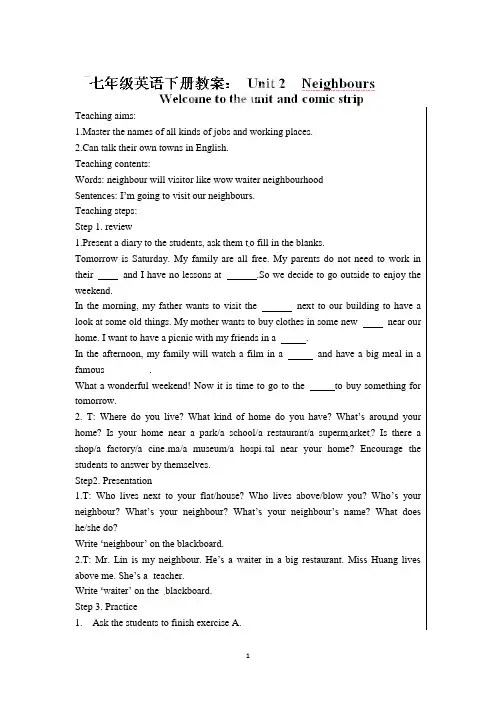
Teaching aims:1.Master the names of all kinds of jobs and working places.2.Can talk their own towns in English.Teaching contents:Words: neighbour will visitor like wow waiter neighbourhoodSentences: I‟m going to visit our neighbours.Teaching steps:Step 1. review1.Present a diary to the students, ask them t o fill in the blanks.Tomorrow is Saturday. My family are all free. My parents do not need to work in their and I have no lessons at .So we decide to go outside to enjoy the weekend.In the morning, my father wants to visit the next to our building to have a look at some old things. My mother wants to buy clothes in some new near our home. I want to have a picnic with my friends in a .In the afternoon, my family will watch a film in a and have a big meal in a famous .What a wonderful weekend! Now it is time to go to the to buy something for tomorrow.2. T: Where do you live? What kind of home do you have? What‟s arou nd your home? Is your home near a park/a school/a restaurant/a superm arket? Is there a shop/a factory/a cine ma/a museum/a hospi tal near your home? Encourage the students to answer by themselves.Step2. Presentation1.T: Who lives next to your flat/house? Who lives above/blow you? Who‟s your neighbour? What‟s your neighbour? What‟s your neighbour‟s name? What does he/she do?Write …neighbour‟ on the blackboard.2.T: Mr. Lin is my neighbour. He‟s a waiter in a big restaurant. Miss Huang lives above me. She‟s a teacher.Write …waiter‟ o n the blackboard.Step 3. Practice1. Ask the students to finish exercise A.T: We have a lot of neighbours. They have different jobs. Look at the pictures. Where do they work? Please match them with the places.2.Make a dia logue with a student.Step 4. Presentation1. Make sure the understand the idea of the dialogue B.T: Amy is asking Simon questions. What are these questions about? Please listen to the tape and tell me.2. Encourage the students to the tape and answer.T: The questions are about Simo n‟s home and different places around his flat. Present …neighbourhood‟ and write it.Step5.Practise1. Play the tape ,ask the stud ents to answer more questions. eg:(1) Where‟s Simon‟s flat?(2) How many buildings are there in neighbourhood?(3) How many floors do the buildings have?(4) What does Simon have around his neighbourhood?(5) What does Simon think of his neighbourhood?2. Divide the students into two groups to read.3. Ask some students to make a dialogue using part B as a model.4. Ask some students to act.Step 6. Presentation1. T: Do you often talk with our neighbours? Do you often play with your neighbours? Do you like visitin g them? Do they often visit your home? Do you think they‟re good visitors? What do you think your neighbours?W rite …visitor‟ on the blackboard.2. ask the students to listen to the tape and find the answer:Where‟s Hobo going?3. ask the students to answer more questions according to the tape.Step7.PractiseAsk the students to read the dialogue and act.Step8. Homework1.Remerber all the new words and sentences.2.Ricite the dialogue and part B.3.Finish the exercise.Teaching aims:1. Understand the knowledge about the centre of a town.2. Can introduce in English.Teaching contents:Words: helpful, community, skill, problem, something, engineer, check, broken, someone, fix, anyone, college, luckySentences: They help us with all kinds of problems.There‟s something wrong with my computer.I‟m going to ask a computer engineer to check it.Some college students are ready to help.Teaching steps:Step1. ReviewT: Where do you l ive? How many buildings are there in your neighbourhood? How many floors do they have? When you‟re ill, where do you go? ......encourage thestudents to answer with their own words.Step 2. Presentation1.T: I‟m very lucky to have many good neighbours. They have different skills and can do many different things. They‟re also very helpful. When they‟re free, th ey often go to the community centre to help others.Write …luck y s kills helpful community centre‟ on the blackboard.2. Present the poster of the flat and new knowledge.Step 3.PractiseSample conversationS1: Excuse me, there‟s something wrong with my computer. Can you help me?S2: Yes, I‟m an engineer. I‟m good at checking c omputers. I can help you.S1: Thank you very much.S3: Excuse me, I have to go outside. Who can help me look after my daughter.S4: I‟m a volunteer. Can I help you take care of your child?S3: It‟s very kind of you. Thank you.Step 4. PresentationIntroduce the passage to the students, then ask them to answer the questions.T: To make our neighbourhood a better place to live, we should help each other as possible as we can. Simon is talking about his neighbours with Amy. Please rea d their conversation and answer the questions: What happens when Simon has problems? Give the students two minutes to read the dialog ue then answer.Play the tape, then a sk them to complete the table.Problem HelpComputer doesn‟t work Bicycle is brokenHomework is difficultOld people need helpAsk the students to read the dialogue then do the exercise of part B2.T: Amy is writing something about Simon‟s neighbours. Write a T if the sentences is true or an F if it is false.Step5.ActionAsk the students to act the dialogue.T: Shall we do a role-play activity? Wo rk in a group of four. Suppose one of you is Simon and the others are volunteers at Simon‟s community centre. Tell us your skills and introduce what you can do to help your neighbours.Sample conversationT: Hello, I‟m Simon. I live in a big community. There are some volunteers in it.They have different skills and they‟re very helpful.Look, this is…, thisS1: Hi, I‟m…I‟m an engineer. I can…I‟m good at…I can help you with…S2: Hi, I‟m…S3: Hi, I‟m…T: I‟m very lucky to have a community centre like that.Divide the students into groups to make dialogues.Ask the students to act.Step6.HomeworkRead the passage. Finish the exercise.【Teaching reflection】Teaching aims:1.To grasp the expression about the text.2.To train the Ss comprehension abilityTeaching points:task-based approachTeaching difficulties:To retell the passage with Ss‟s own words.Teaching steps:Step1 RevisionRevise good neighours by asking students some questions.Step2. PresentationDiscuss: ask Ss to discuss some details in groups. Then write down the important phrases and sentences.Step 3.ListeningBooks open.Listen to the tape and ask Ss to repeat one sentence by one sentence.Step 3. Reading1. Ask some students to report their homework about good neighours .Look at these pictures in part B1.They‟re from the community centre. Let Ss complete the sentences.2. Listen to the tape and answer the questions about the text.(1)What does Simon‟s community centre have?(2)What do volunteers do at the community centre?(3)When do they meet?(4)What are they going to do this weekend?(5)There‟s something wrong with Simon‟s computer. How will he ge t help?(6)Annie‟s bicycle is broken. How will she get help?(7)A boy has some problems with his homework. How will he get help?(8)What do volunteers do to help the old people?(9)What does Amy think of Simon to have such a neighourhood?Step4.PractiseRead Amy and Simon‟s conversation together.Read again, boys play the roles of Simon, girls play the role of Amy.Please complete the part3.Practise this conversation with your partner.Step5.Act it out(choose 1)Do a role-play. Suppose one of you is Simon. The other is Amy. Try to act out the conversation.Who wants to play the role of Simon to introduce the community centre in your nighbourhood? Who wants to play the role of Amy? Please tell us if you want to have a community centre like that. You can choose one role each and discuss this with your partner.Step nguage pointsanyone pron. used instead of someone in negative sentences and in questions.broken adj. has been damaged or injured, no longer whole or woking correctly.check vt. to examine sth to see if it is correct, safe or satisfactory .You should check your homework before handing it in .college n. a university where students can study for a degree after they have left high school. eg.Lily is going to visit some famous colleges in Beijing during this summer holiday. community n. a group of people living in particular local area. In my community, we have a lot of activities at weekends.Engineer n. a person whose job is to design and build engines, machines, roads, bridges, etc.eg.My cousin wants to be an engineer when he grows up.fix vt. to repair or correct sth.eg. The car won‟t start---can you fix it?HomeworkRetell the text.2.《课课练》P14【Teaching reflection】Teaching aims:1.Simple future tense with will and shallTeaching points:Teaching steps:Step1 Revision1.Ask some questi ons about the Simon‟s community centre.Where does Simon live?What do you t hin k of the community centre in his neighourhoodDo you think Simon lucky to live in s uch a nighourhood? Why?2.Here are some people who live in Simon‟s nighourhood. They have some problems. How can they get help from the community centre?1) Mr. Green‟s computer doesn‟t work well.2) Lily bicycle is broken.3) Little Tom has problems with his homework.4) Grandma Chen is sick these days.Help Ss answer these questions from the text.Step2 Presentation-What will you do if you have problems with your h omework?-I will/shall________.2. What do we use will or shall to talk about?(We use will or shall to talk about things that will happen and plans that we‟re making now. This is an example of the simple future tense).If someone has problem with his or her homework, he or she will ask the teacher for help. He or she won‟t copy the other‟s answers. What‟ll you do? Will you ask your teacher for help? Will your parents help you?(Help Ss answer them like “Yes, I will/shall. No, I will/s hall not. Yes, they will. No, they will not).Read partA carefully and find out the rulers.(What do we use for “I” or “we”? What do we use for “you” “he” “she” “it” and “they”Step3PractiseDo the practice of Part A(Simon‟s computer is broken. He‟s asking Mr. Lin for help. Please c omplete their conversation w ith the simple future tense.Read the dialogue about Mr Lin and Simon‟s.Step4 Presentation(Do you think comm unity centers are helpful? I think they are. The community centre in my nighourhood is going to have a “helping hands‟ meeting the day after tomorrow. I‟m going to teach children English songs. My daughter is going to dance for the old people. My parents are going to cook some delicious food.What do we use be going to to talk about?(We use be going to to talk about something we decide to do and things that will probably happen).3. 1)Are you going to join the “helping hand” meeting in your neighourhood?2)Is your father going to do sth for the old people?3)What‟s he going to do ?4) What‟s your mother going to do?5)What are your neighours going to d o ?4.Look at the part B and find out the rulers.Step4 PracticeComplete part B(Simon is telling Amy about his plan for a day out with his uncle‟s family. Please help him complete his plan).Answer these questions with your partner.What are you going to do for old people this Sunday?What‟s your father/mother going to do for your neighours tomorrow?What are you going to do for poor children the day after tomorrow?What‟s your father/mother going to do for your comm unity next week?Step5 Homework《课课练》P17.Prepare :Integrated skills.【Teaching reflection】Teaching aims:1. master more words about job and the places.2.Get some iformation to co mplete the text.3.Talk about their dreams in the future.Teaching contents:一,Words:manager office worker policemanElder future artistSick二,Phrases:by train/bus/ship/bike三,Sentences:What are you going to be in the future?I‟m going to be a computer engineer.Teaching tools:HiteboardSteps:Step I RevisionT:Now let’s play a game. Here are some riddles fo r you. Can you tell me the name of the job?The work in a school to help children learn.(teacher)When you are ill, you go to see them. (doctor)They make delicious food for people in restaura nts. (cook)They have special skills, such as making ships, planes and other machines.Step II:PresentationTo show some pictures about jobs.T:Different people have different jobs. Look at this woman. What does she do? What’s her job? She works in a c ompany. She doesn’t work in a factory. She’s an office worker. Write:job, company and an office worker, T:his woman works for a company too. Bu t she‟s not an office worker. She‟s a manager. Other people in the company should listen to her. This man is a postman. Everyday he puts newspapers or letters into people‟s postboxes. He works in a post office. What about this man? Is he a postman? No, he’s a policeman. He catches people who do bad things and takes them to the police station.Write on the Bb:office, manager, postman, post office, policeman, police station.Step III Practise.To finishPartA1T:Millie wants to learn more about different jobs. Here are some pic tures. Would you please write the correct names under them?Play the tape and finish Part A2T: Wendy is Millie’s pen friend. She’s talking about the jobs of their family members. Let’s listen to the tape and complete the table in Part A2.Ask some students to check the answers.T :What does Wendy’s dad/ mum/ elder brother/ elder sister do? Where does he/she do?Step IV PresentationPlay the tape again and answer some questions.T:Let’s listen to the tape once more and answer my questions about Wendy.⑴Where’s her father’s police station?⑵Where’s her mother’s restaurant?⑶Is her mother very busy?⑷How does her elder brother go to work?⑸How does her elder sister go to work?Step V Practice1. According to Part A and Part B finish the A3.Teacher ask Ss to read “Wendy‟s family” then read after the te acher,Encourage Ss read bravely .2. Let Ss say about their own family like the passage. with some phrases.Step VI ConclusionDo Exercises (课课练)HomeworkRecite Part BPrepare: Speak up【Teaching reflection】Teaching aims:To master more words about job and the places.To know something about linking sounds together.Teaching contents:Words:future/ police station/ job/ post/ artist/ sound/ stickSentences:①What are you going to be in the future?②I’m going to be a computer engineer.Teaching tools:HiteboardRevision: Answer the questionsHow many people are there in W endy‟s home?What‟s Wendy‟s father?Where does Wendy‟s mother work?How does her sister go to work?二、Presentation1, Show some pictures to introduce some jobs. And let students discuss, lead to the topic.Teacher says: look at these jobs. Are they interesting? Whic h is your favourite? Students answer with their own information.Teacher says: oh, I see, ……is going to be……in the future.Write down on the blackboard: “Future and this sentence”In the same way, show an artist with colourful chalk.2, PracticeTeacher says, Millie is talking with her classmates about their future jobs. Listen to the conversation and do “true or false” exercise s.1)Daniel likes comput erMillie is going to be a computer engineer.Sandy is going to be a teacher.Amy is going to be a doctorSimon is going to b e a basketball star.2)listen to the tape again, then read after the teacherPlease open your books and repeat after the tape. Sentence by sentence, if need read more.3)Act it outGive students enough time to prepare for the same dialogue.三ConclusionSome phrases and sentences四.PresentationLook at some phrases : an apple ,stand up ,in an hour teacher read these phrases, let Ss pay attention to th e pronunc iation what‟s the difference among them.1 We usually link a consonant with a vowe l sound.2.When the first word ends –r or –re and the next word begins with a vowel sound, we join them together with a /r/ sound between them3.When there re two vowel sounds, we join them as if there were a /j/ or /w/sound between them.4.When two consonant of two words meet, we sometimes do not need to pronounce the first consonant sound .二.PracticeListen to the tape about them. Please work in pairs .read th em to your partner.In a minute fall in the riverTell us story take care of it work at it in an office三.Homework。
牛津译林初中英语七下Unit 2 Neighbours教案3 .doc

7B Unit 2 NeighbourTeaching points:task-based approachTeaching difficulties:To retell the passage with Ss’s own words.Teaching steps:Step1 RevisionRevise good neighours by asking students some questions.Step2. PresentationDiscuss: ask Ss to discuss some details in groups. Then write down the impo rtant phrases and sentences.Step 3.Listeni ngBooks open.Listen to the tape and ask Ss to repeat one sentence by one sentence.Step 3. Reading1. Ask some students to report their homework about good neighours .Look at these pictures in part B1.They’re from the community centre. Let Ss complete the sentences.2. Listen to the tape and answer the questions about the text.(1)What does Simon’s community centre have?(2)What do volunteers do at the community centre?(3)When do they meet?(4)What are they goi ng to do this weekend?(5)There’s something wrong with Simon’s computer. How will he get help?(6)Annie’s bicycle is broken. How will she get help?(7)A boy has some problems with his homework. How will he get help?(8)What do volunteers do to help the old people?(9)What does Amy think of Simon to have such a neighourhood?Step4.Practise1.Read Amy and Simon’s conversation together.2.Read again, boys play the roles of Simon, girls play the role of Amy.3.Please complete the pa rt3.4.Practise this conversatio n with your partner.Step5.Act it out(choose 1)1.Do a role-play. Suppose one of you is Simon. The other is Amy. Try to act outthe conversation.2.Who wants to play the role of Simon to introduce the community centre in yournighbourhood? Who wants to play the role of Amy? Please tell us if you want to have a community centre like that. You can choose one role each and discussthis with your partner.Step nguage points1.anyone pron. used instead of someone in negative sent ences and in questions.2.broken adj. has been damaged or injured, no longer whole or wokingcorrectly.3.check vt. to examine sth to see if it is correct, safe or satisfactory .Youshould check your homework before handing it in .4.college n. a university where students can study for a degree after theyhave left high school.eg.Lil y is going to visit some famous colleges in Beijing during this summer holiday.munity n. a group of people living in particular local area. In mycommunity, we have a lot of activities at weekends.6.Engineer n. a person whose job is to design and build engines, machines,roads, bridges, etc.eg.My cousin wants to be an engineer when he grows up.7.fix vt. to repair or correct sth.eg. The car won’t start---can you fix it?。
译林牛津版七年级英语下册7B Unit2 Neighbours 知识点梳理 (2)
Unit 2 Neighbors知识点一:Neighbour(英式英语)邻居;邻国=neighbor(美式英语)Neighborhood(n.)邻居;小区The neighbors in our neighbourhood are friendly .知识点二:一般现在进行时态表示将来时态瞬间性动词或趋向性动词(come;go;leave;move;arrive;get;start 等)The bus is coming. 车快来了。
I’m leaving for Russia. 我将动身前往俄罗斯。
Where are you going? 你打算去哪?----I’m going to France. 我打算去法国。
知识点三:visit. Sb.=call on Sb.拜访某人Visit Sp.=call at Sp.参观某地Many visitors visit the palace.知识点四:afraidI’m afraid they won’t welcome visitors like you.介词I’m afraid. 我害怕。
/ 很抱歉。
be afraid to do sth. 害怕去做某事be afraid of doing sth.害怕.....知识点五:How many +名词复数+.....?How much+不可数名词?How much....?(对价格提问)There are five trees in the garden.----How many trees are there in the garden?There are five trees in the garden.---What’s in the garden?There is some milk in the bottle.---How much milk is there in the bottle?知识点六:most ;all; some;many; (作代词)All of them 他们中的所有人Some of them 他们中一些人Most of them have 14 floors. 他们中的大部分(代词)Most (adv.)最这是世界上最漂亮的画。
牛津译林版七年级下册 Unit2 Neighbours 知识点总结
牛津译林版七年级下册unit2 Neighbours 1.I’m afraid they won’t welcome visitors like you.恐怕他们不会欢迎你这样的客人。
句中的like为介词,意为“像,类似,像......一样”Eg: Don’t look at me like that. 别像那样看着我。
2.I live in a flat in City Garden in Ninth Street.我住在第九大道城市花园的一个公寓里。
live in 居住在......Eg: We live in the same alley.我们住在同一条小巷里。
3.How many buildings are there in your neighbourhood?你的邻近有多少建筑物?how many (+可数名词)多少= how much (+不可数名词)Eg: How many parents do that?有多少父母能做到这样吗?How much is this worth?这值多少钱?4.There are about 20 buildings.有大约20栋建筑物。
there be 句型表示“有(某处存在某物)”have 也可表示“有(某人拥有某物)”Eg: There are some apples on the table.有一些苹果在桌上。
We have all kinds of books.我们有各种各样的书。
there be 句型的就近原则:be 动词的使用取决于be动词后最近的词为单数还是复数。
Eg: There is a book on the desk.有一本书在书桌上。
There are three books on the desk.有三本书在书桌上。
若be动词后的词为不可数名词,则be动词用单数。
Eg: There is some milk in the fridge.有一些牛奶在冰箱里。
牛津译林版七年级下册UnitNeighboursGrammar
一般将来时的基本结构: will /shall(第一人称)+动词原形 be (am, is, are)going to+动词原形
A Simple future tense with
will and shall
We use will or shall when we talk about 1. things that are sure to happen in the future: e.g. It will rain this afternoon.
2. plans that we are making now: e.g. I will take an umbrella with me.
We usually use will. We only use shall with I or we, and this usage is becoming old-fashioned.
Will/shall
I/we
go?
Will
you/they/he/she/it
We answer questions using the simple future tense like this:
I/we
will/shall.
Yes,
you/they/he/she/it
will.
I/we
will not/shall not.
— Two hours later. 10. — How long _d_o_e_s_ it _ta_k__e (take) you
to get there by the train? — Two hours and a half.
B Simple future tense with
最新译林牛津初一英语下册7B单元Unit2Neighbours教学设计
最新译林牛津初一英语下册7B单元Unit2Neighbours教学设计《英语》(七年级下册)Unit 2 NeighboursReading (I)I. Teaching aims and learning objectivesBy the end of the lesson, students should be able to:1. know something about the community centre;2. introduce the activities of the community centre in English;3. learn to help each other in your neighbourhood.II. Teaching contents1. New words and phrases: helpful, volunteer, community, skill, problem, something, engineer,check, broken, someone, fix, anyone, college, lucky, help sb with sth,do some shopping2. New structures: They help us with all kinds of problems.There’s something wrong with my computer.I’m going to ask a computer engineer to check it.Some college students are ready to help.III. Focus of the lesson and predicted area of difficulty1. Get the general and specific information from the conversation.2. Sum up how to introduce one’s neighbours.3. Introduce students’ own neighbours.IV. Teaching proceduresStep 1 Lead-inT: Look at the picture. It’s about the community. May I ask you some questions about your neighbours?Do you have good neighbours?What are your neighbours?What do your neighbours usually do to help each other?【设计意图:通过学生比较熟悉和感兴趣的话题导入新课,为接下来的教学做好铺垫。