
最新外研版小学英语三年级下册M3U2公开课教学设计
r,r,r /r //r //r /(做动作)i,i,i/ ai/ / ai// ai/
d,d,d拼读/raid/分组读,两组PK读。
bike /baik/touch and say,让每一个学生都参与其中。
rideabike(骑自行车)引出句子我喜欢骑自行车。I like riding a bike.
T:Next one ,look at me ,I will act it out.(游泳) OK,now follow me , swim音标教学.
2操练
通过观察,带领学生得出本节课的句型I like/I don’t like +Ving形式。
Module3 Unit2 I don't like riding my bike .
(
课堂教学设计
课题
M3U2I don’t like riding my bike.第课时
主备人
执教人
执教时间
年月日
教学
目标
1.复习上节课学过的运动football,basketball,table tennis,morning exercises以及如何表达自己对某项运动的喜欢与否即I like…,I don’t like…的使用。
2.能听、说、认、读单词swimming,skipping,riding bikes;
3.掌握表达喜欢做某事的句型I like Ving sth./ I don’t like Ving sth.
重点
难点
重点:
1.单词swimming,skipping,riding bikes的认读;
2.I like Ving sth./ I don’t like Ving sth.句型的操练。
New lessons:
1.lead in:
2. New words:
( 5 ) Summary
( 6) practice
Ts : Hello !boys and girls.
Ts : How are you today ?
Ts: I'm fine, too.
<</SPAN>Walking,walking,walking>
针对本节课的教学重点,给出学生部分相关习题,提问学生,在做题过程中再次带领学生复习本节课所学。达到边练习边复习。
Ss: Hello ! Maisie!
Ss: Fine, thank you. And you?
students do and say
S:It’sa basketball.
S:morning exercises.
2.做课时训练Module3 .
难点:
3.I like Ving sth./ I don’t like Ving sth.句型的操练。
教法
预设
讲授法、演示法、练习巩固法、讲演结合法
教学设计
教学内容
教师活动学生活动时 Nhomakorabea分配Step1:Greetings
Step2:Warm-up
Step3:Review
Step4:Presentation
S: I don’t like fooball.
S:骑自行车
通过以上这种方式,把本节课的新单词全部引入并操练,然后通过手心手背,小老师游戏进行整体操练
在Show环节让学生试着去运用
1min
3min
3min
5min
16min
7min
10min
作业设计
1.抄写单词ride, swim,skip, I like swimming.I don’t like skipping. I like ridding my bike 5+1,并熟读。
复习环节通过课件展示,老师领读的方式,带领全班学生一起把上节课学习的单词和句型进行复习。
T:Today we will continue to learn something about sports.Now look at this picture,what does she doing?(她在做什么?)
(该环节是在欢快的音乐节奏中蹦蹦跳跳,营造一个欢快轻松的学习环境)
T:Now look,What’s this?(拿着一个篮球)
T:What am I doing ?(我做早操)
T: If I do like this(把足球仍在一边)What should I say?
T:Now who wants to try?
Module 2(教学设计)外研版(三起)英语三年级下册
Module 2(教学设计)外研版(三起)英语三年级下册1. 教学目标本单元教学的目的是让学生掌握家庭成员、身体部位以及简单的情感表达,培养学生的听、说、读、写四种语言能力,提高学生的英语语言运用能力。
2. 教学内容本单元的教学内容包括以下几个方面:•家庭成员:father, mother, sister, brother, grandma, grandpa;•身体部位:head, nose, mouth, ear, eye, hand, foot;•情感表达:happy, sad, angry, tired。
3. 教学重点•掌握家庭成员、身体部位以及简单的情感表达;•能够听、说、读、写相关的单词和句子;•培养学生的英语语言运用能力。
4. 教学难点•理解并正确使用情感表达的单词和句子;•掌握家庭成员和身体部位的表达方式及应用。
5. 教学方式本单元的教学方式包括以下几种:•演示课:通过教师的示范,引导学生掌握家庭成员和身体部位的相关单词和表达方式;•听说训练:通过听录音、模仿和口头表达等方式,让学生掌握相关语言知识;•互动讨论:通过讨论、对话等活动,提高学生的英语交流能力。
6. 教学步骤第一课时1.介绍家庭成员并教授相关单词;2.展示家庭成员的图片,引导学生概括并表述自己的家庭成员;3.制作家庭成员卡片,让学生进行家庭成员的讨论和交流。
第二课时1.介绍身体部位并教授相关单词;2.展示身体部位的图片,引导学生学习、掌握相关单词;3.通过听录音、模仿等方式,让学生更好地理解和掌握身体部位的表达方式。
第三课时1.让学生进行身体部位的搭配练习;2.通过游戏和竞赛等方式,让学生加深对身体部位的了解。
第四课时1.介绍情感表达并教授相关单词;2.让学生进行情感表达的模仿和表达,提高学生口语表达能力;3.通过阅读、背诵等方式,提高学生对情感表达的理解和运用能力。
第五课时1.通过集体合作、小组活动等方式,让学生运用所学知识进行口语交流练习,培养学生团队合作和互动能力。
M3U2教学设计
Module 3 Unit 2 I don’t like riding bikes.荣成第三十六中学区石岛中心完小冷文凤Ⅰ. Teaching aims and demands:1.语言知识目标能听、说、认、读单词swimming,skipping,riding bikes;能读出、读懂课文的句子。
2.语言技能目标能用I like…和I don’t like…来表达自己喜欢和不喜欢的体育运动。
3.情感态度目标:通过有趣的课堂活动,激发学生的兴趣,鼓励学生大胆开口说英语,并通过小组活动,培养学生的合作能力。
Ⅱ. Teaching contents:1.教学重点:单词swimming,skipping,riding bikes的认读;并能熟读课文的句子。
2.教学难点:能根据个人的爱好,运用I like…和I don’t like…来表达自己喜好。
Ⅲ. Teaching aids:课件、单词卡片、头饰Ⅳ. Learning steps:一、Warm up.1. Free talk: What’s your favourite…? I like…2. Sing a song.3. Greeting.【目的:通过歌曲、师生间的亲切问候,建立轻松、和谐、民主的课堂气氛,使学生很自然地进入课堂。
】二、Lead-in.T:(出示课件)Welcome to Sports Club1. Look and guess. “What is it?”2. Do and sayT: I like basketball. I like table tennis. What about you? let’s play sports and say.Basketball, basketball, I like basketball;Table tennis, table tennis, I like table tennis;Football, football, I don’t like football.【目的:通过创设参观俱乐部的情景,复习上节课所学的basketball, football, table tennis,morning exercise。
外研三起三年级下册Module 3 Unit 2 教案

外研三起三年级下册Module 3 Unit 2 教案一、课程概述本次课程主要以学习如何表达物品的位置和方位为主要内容,利用一些简单的地图和地图上的标志物,帮助学生们提高对于英文描述的理解力,并提升日常生活中的交流能力。
二、教学目标•了解物品描述位置和方位的英文表达方式;•掌握用以上所学知识问路或描述路线的方法;•能够在日常生活中用英文交流指引和指导;•提升学生学习外语的兴趣,增强学习英语的信心。
三、教学重点•学会用英语描述物品的位置和方位;•练习用英语描述路线或寻求帮助。
四、教学难点•学生需要练习记忆和口语快速反应;•学生需要逐渐熟练在日常生活中使用英语进行交流。
五、教学流程时间安排授课内容10分钟导入新课,引入主题20分钟学习物品位置和方位的英文表达方式25分钟练习在日常生活中用英语描述路线或寻求帮助5分钟总结本节课程,布置作业导入新课,引入主题1.教师问学生是否知道房间内物品的中英文表达方式,如“桌子”、“椅子”等;2.提出如下问题:“我们在房间里玩时,你会如何描述玩具的位置和方位?”3.引导学生对于物体位置和方位进行讨论。
学习物品位置和方位的英文表达方式1.教师向学生展示一张简单地图,让学生看看地图上有哪些地方,讲解地图上的标志物;2.教师讲解基本的物体位置和方位表达方式:上、下、左、右、前、后等;3.教师将词汇呈现给学生,让学生将其背诵并理解其含义。
练习在日常生活中用英语描述路线或寻求帮助1.教师模拟问路情境,让学生说出应该如何回答;2.教师将学生分成小组进行练习,从生活实际出发让学生描述到某个地方的路线,并让另一位同学对着小组所画的地图模仿学生描述的路线。
总结本节课程,布置作业1.教师向学生提问本节课程的重点和难点;2.布置作业-请学生稍后认真完成,将脑海里的日常生活场景描述成英文,写成30个句子,以表达在日常生活中与他人的沟通交流。
六、教学用具•一张简单地图;•听力录音。
七、教学评价自我评价本节课我采用了有趣的方法,引入贯穿全堂课程的情境,并且允许学生大声地口语交流,提高了他们在日常生活中的英文表达技巧,同时运用多种教学工具使得课程更加生动有趣。
外研版英语三年级下册精品 教案 M3 U2
Module 3Unit 2I don’t like riding my bike.【教学目标】(一) Aims on the knowledge:1、Master the words about sports:swimming, skipping, riding bikes.2、Learn sports vocabulary:football、basketball、table tennis ,morning exercises.3、The consolidation of the patterns:I like…. I don’t like….(二) Aims on the abilities:To be able to use the sentence patterns to express their love: I like…. I don’t like….(三) Aims on the emotion:1、Improve students' interest in English learning, develop good study habits.2、Inspire students to actively participate in classroom, boldly open use of learning exchanges.评论(0)3学情分析The English teaching of Primary school is base on the children's psychological and physiological characteristics, creating a condition actively. Try to achieve the improvement of their language ability through experience, participation, practice and creation. Therefor, I tap the teaching materials fully, combining students' actual, arranging the teaching elaborately to make the link of teaching closely. Especially we’ll not learn the article until we finish the hard training of the key words, sentence. In this way the transition is natural, in accord with the students' cognitive rule. In theorganization of classroom teaching I incarnate tenet fully,“Take teacher as the leading factor and take the students as main body.” In addition to let students learn the necessary language materials, I try to building up a real language environment as far as possible, to guide the students to participate actively in learning. With the help of games ,match and multimedia computer I try to activate the communicative situation, to attract the attention of students. To take timely and incentive mechanism ,try to develop and mobilize fully the students’varieties of potential in activities, so as to carry out the educational aim of learning new knowledge, training skills.评论(0)4【教学重难点】1、To correctly read words: swimming, skipping, riding bikes.2、Proficiency in the use of sentence patterns: I like…. I don’t like….5教学过程5.1 第一学时教学活动评论(0)活动1【导入】Step 1:Warm-up1、GreetingsT:Good morning,boys and girls.S: Good morning,Miss Zhang.2、Revision(CAI) I like football.I don’t like football.I like basketball. I don’t like basketball.I like morning exercises. I don’t like morning exercises.Design intent: The advantages of using multimedia illustrated lesson knowledge, with sound, visual image, attract the attention of students, review questions, and new knowledge and learning of the bedding.评论(0)活动2【讲授】Step 2:Presentation1、Show a picture of swimming. Learn the new words: swimming. Then the sentence:I like swimming. I don’t like swimming.Design intent: After learning of this text on the basis of learning this course, the sentence. From the shallower to the deeper, step by step, students are easy to accept, and timely reward good performance of students, improve the enthusiasm of the students.Then use the same method to learn the words: skipping, riding bikes. The sentences: I like/ don’t like skipping/riding bikes.2、Various methods are available to practice the lessons of new knowledge.(1) The rising and falling to read words.(2) See the shape, guess the word.Design intent: Through this course students' language, on the learning content to have a rational knowledge, and through a variety of ways to practice, consciously cultivate the students' language competence and communicative competence.3、Listen to the tape. Read after it.4、Pair works. Two students a group. Perform the text. Then ask some groups act it out on the platform.Design intent: Give students create a full performance space, meet the students learn the language accomplishment, cultivate students' team spirit and dare to show my energy.评论(0)Step 3:Practise(1)(CAI)A book on second components of sports. At the same time to produce a large smile and frown. Guide the students to say the sentence:I like…. I don’t like…. Design intent: Here the image interesting cry and smile greatly attract the attention of students, thereby into the class sentence exercise. At the same time, exploit the moral education textbooks factors, infiltrate the ideological education to students, told the students to do anything to persevere(2)The teacher refers to the picture, students say the sentences.Design intent: This link to the children to create a real language use situation, activityguide design from controlling to semi controlled, the layers of depth, and completed by the language knowledge to language skills transfer, make English teaching activity, activity teaching communication.(3) The teacher demonstrated and expression, let the students say the sentences. Then let the students do the action on stage, the remaining students practice the sentences. Design intent: Give the children created a real language situation, guide the students to learn out of textbooks, in a real sense to use new knowledge, further consolidate the understanding to education content and application. And the effective implementation of the teachers and students, interactive, active classroom, the purpose to learn in order to practise. Take the form of cooperative learning, cultivate the students' consciousness of team cooperation.(4)A game. Students in groups, in schoolmate ear edge transitive sentence. Design intent: Through the game to achieve solid objective practice, so that students in the entertainment in the imperceptibly to master the knowledge, edutainment.评论Step 4:A chantDesign intent: Lively rhythm, rhythmic rap, Get Word language, meaningful drill the lesson and difficult knowledge, reduce the single training to students' fatigue. Will students into a relaxed and harmonious atmosphere for English learning.评论(0)Step 4:Share partLearn alphabet DEF reading and writing.。
最新外研版小学英语三年级下册Module 3 Unit 2公开课教学设计
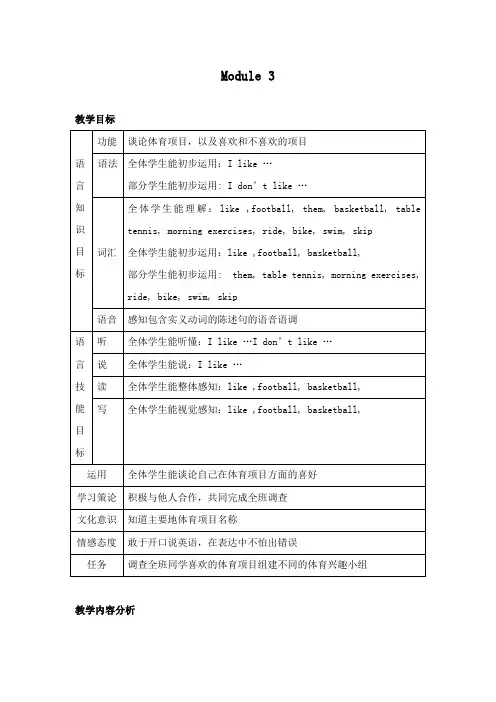
Module 3 教学目标教学内容分析本模块的教学内容是谈论体育项目,以及喜欢和不喜欢的事物。
第一单元的课文情景是熊猫Panpan在参加体育活动,Panpan以为自己喜欢的是球,尝试了以后发现自己并不喜欢。
他又尝试了篮球和乒乓球,发现自己都不喜欢。
最后Panpan 做起了早操,发现自己真正喜欢的体育运动是做早操。
第二单元的课文情景是一个男孩和一个女孩在讲述自己喜欢和不喜欢的体育项目。
我们可以在课后调查一下学生喜欢和不喜欢的体育项目分别是什么。
本模块学习的重点是“I like …I don’t like …”结构。
这是学生第一次学习实义动词的一般现在时结构,教师不能要求学生第一次学习这种结构就完全掌握,而应该有一个过程性的设计。
本学期从第三模块到第六模块的学习重点都是实义动词的一般现在时结构,第七模块和第八模块是这一结构的巩固运用。
也就是说,实义动词的一般现在时结构是本学期六个模块的学习重点,而不是第三模块的学习重点。
因此,要合理设计每一模块的学习要求。
体育项目也是本模块的新内容,但体育项目不是本模块的重点。
教师可以运用颜色和动物等学生已经掌握的名词进行训练,例如: I like red. I don’t like blue.Unit 2 I don’t like riding my bike.教学过程:一、热身导入1、师生之间相互问好。
2、教师带领学生一起说上一单元学过的英语韵句。
3、开展模仿体育运动动作、猜测运动项目名称的游戏。
游戏结束时,教师展示游戏的动作,请学生猜是什么体育项目。
学生可能还不会表达,教师告诉学生:“我们现在就来学习这个体育项目的英文名称。
”4、播放SB Unit 2 活动1的动画,请学生看图并理解内容;再次播放动画,请学生完整地看一遍。
最后播放动画,请学生跟读。
注意提醒学生语音语调。
二、任务呈现教师告诉学生:“今天我们要调查全班同学在体育运动方面的喜好,然后要以此为依据组建体育兴趣小组。
外研三下英语M3U2 I don’t like riding my bike教学设计

Assignment
1.Make a mini bookI like sports.
2.Read it to your parents.
5-1 Think and answer
5-2 Read and answer
5-3 Read the mini book after the tape
巩固掌握单词的意思
问题驱动,回顾核心句型。
巩固所学课文,跟读课文原句。
以图片环游的方式带领学生阅读自制小图画书,进一步巩固核心语言。
Ⅲ.
Post-task activities
课时
语言知识与技能
语用任务
第
三
课
时
1.正确朗读、书写字母Ee, Ff, Gg.
2.学生能听、说、认读核心词汇morning exercise,football, basketball,table tennis,skip,swim, ride,并运用核心句型I like...和I don’t like...进行正确的应答及描述。
1.Chant
1-1 Look and chant
用熟悉的节奏认读核心词汇。
Ⅱ.
While-task procedures
1.Look and say
2.Match the words with the pictures
3.Talk:
I like... I don’t like...
4. Guess what teacher likes and dislikes.
M3U2I don’t like riding my bike.(Period3)
I like sports
Module2(教学设计)外研版(三起)英语三年级下册
-小(small)
-快(fast)
-慢(slow)
6.请用英文完成以下日常交流用语:
- What's your favorite animal?
- I like cats.
7.请用英文回答以下问题:
- What's your favorite animal?
- I like birds.
5.板书设计应与课堂活动和教学内容紧密相连,确保学生能够通过板书快速回顾和巩固所学知识。例如,在课堂活动中,教师可以引导学生通过观察板书,回忆和运用所学的动物名称和特征。
6.板书设计应鼓励学生积极参与课堂讨论和思考,例如,教师可以邀请学生上台展示他们的板书设计,并解释他们对动物名称、特征和日常交流用语的理解和应用。
教学实施过程
教师活动:
发布预习任务:通过在线平台或班级微信群,发布预习资料(如PPT、视频、文档等),明确预习目标和要求。
设计预习问题:围绕动物的名称、特征以及与动物相关的日常交流用语,设计一系列具有启发性和探究性的问题,引导学生自主思考。
监控预习进度:利用平台功能或学生反馈,监控学生的预习进度,确保预习效果。
信息技术手段:利用在线平台、微信群等,实现预习资源的共享和监控。
作用与目的:
帮助学生提前了解动物的名称、特征以及与动物相关的日常交流用语,为课堂学习做好准备。
培养学生的自主学习能力和独立思考能力。
2.课中强动物图片,引出本节课的主题,激发学生的学习兴趣。
讲解知识点:详细讲解动物的名称、特征以及与动物相关的日常交流用语,结合实例帮助学生理解。
教学难点与重点
本节课的核心内容是关于动物的词汇和句型,包括动物的名称、特征以及与动物相关的日常交流用语。学生需要掌握以下重点内容:
三年级下册英语教案-Module 3第三课时Unit 2 1~3 外研版(三起)
三年级下册英语教案-Module 3第三课时Unit 2 1~3 外研版(三起)一、教学目标•语言目标:学生能够听懂并理解课文内容,学会询问并回答日常活动的时间。
•情感目标:培养学生自主学习的习惯,增强学生的自信心和合作精神。
•学习策略:通过听、说和模仿等方式,激发学生的学习兴趣,提高他们的语言技能。
二、教学重点•学会用英语表述日常活动的时间。
•学会询问并回答日常活动的时间。
三、教学难点•学生能够用英语询问并回答日常活动的时间。
四、教学过程1. 导入新知识首先,教师可以跟学生们聊一聊自己的日常活动,如吃早饭、上学、午餐时间等,引出今天的主题,即学习如何询问和回答日常活动的时间。
2. 学习课文本课的主要内容是学习课文《Daily Routines》,学生可以听录音,跟读并模仿发音。
教师可以安排一些练习,帮助学生掌握一些关键的单词和句型,例如:•at half past seven:在七点半•at quarter to nine:在九点差一刻•What time do you…?: 你什么时候…•I usually…:我通常…3. 角色扮演练习教师可以安排角色扮演练习,让学生自己扮演老师或学生的角色,进行问答练习。
例如,老师可以问学生:“What time do you usually get up in the morning?”,学生可以回答:“I usually get up at seven o’clock.”4. 小组合作练习教师可以把学生分成小组,在小组内进行合作练习。
每个小组可以编写一个对话,讨论他们的日常活动,然后在全班分享。
5. 课堂作业作为课堂作业,教师可以留下一些问题,供学生进行思考和回答。
例如:•What time do you usually have breakfast?•What time do you usually go to bed?•What time do you usually do your homework?五、教学评价教学评价主要通过观察学生在教学过程中的表现进行,例如:•学生是否能够准确地理解课文内容?•学生是否能够用英语表达日常活动的时间?•学生是否能够与同学进行共同学习和合作?六、小结本课主要通过模拟对话、角色扮演、小组合作等方式,帮助学生掌握了日常活动时间的表述方法,并在练习中提高了他们的听、说能力和合作精神。
三年级-外研版(三起点)-英语-下册-[教学设计]-Module-3-Unit-2-(2)
Module 3Unit 2 I don’t like riding my bike.一、教学目标1. 知识目标:能够在语境中准确理解swimming, skipping, riding my bike的含义,并正确朗读。
2. 能力目标:能够准确运用句型I like ... 和I don’t like ... 表达自己喜欢和不喜欢的运动。
3. 情感目标:能够运用本模块所学句型表达生活中自己喜欢或不喜欢的食物、动物、颜色、运动等。
二、教学重点掌握有关运动的词汇:swimming, skipping, riding my bike。
三、教学难点能够准确运用句型I like ... 和I don’t like ... 表达自己喜欢和不喜欢的运动。
四、教学准备多媒体课件、单词卡片。
五、教学过程Step I Warm-up1. Greetings.T: Good morning, boys and girls.Ss: Good morning, Miss Wang.T: How are you today?Ss: I’m fine, thank you. And you?T: I’m great. Thanks a lot. Are you happy today?Ss: Yes.2. Sing a song.3. Revision.【设计意图】歌曲调动气氛,复习上节课的知识为今天新知识顺利进行奠定基础。
Step II Presentation1. 教师出示运动图片,师生进行问答。
T: What sport?Ss: Football/basketball/table tennis/morning exercises.T: What sport do you like or don’t like?Ss: I like …I don’t like …2. New teaching.(1) 教师出示一幅游泳的图片。
外研版(三起)三年级英语下册优质教案Module2
外研版(三起)三年级英语下册优质教案Module2Module2教学设计教学目标语言知识目标功能识别并描述动物语法全体学生能初步运用:This\That…is tall\short\big\small.部分学生能初步运用:What are they?They’re…词汇全体学生能理解:they,they’re=they are,monkey,baby,all,zoo,tiger,lion,elephant,man,tall,short,big,small,fat,thin全体学生能初步运用:they,they’re=they are,tall,short,big,small,部分学生能初步运用:monkey,baby,all,zoo,tiger,lion,elephant,man, fat,thin语音感知英语拟声词语言技能目标听全体学生能听懂:This\That…is tall\short\big\small.What are they?They’re…说全体学生能说:This\That…is tall\short\big\small.读全体学生能整体认知:they,they’re=they are,tall,short,big,small,写全体学生能视觉感知:they,they’re=they are,tall,short,big,small,运用全体学生能描述动物的形态特征学习策论在词语与相应事物之间建立联系文化意识通过比较英语和汉语中模拟动物叫声的拟声词,初步了解中外文化的异同情感态度通过模仿动物叫声体会英语学习的乐趣任务创建小组“动物乐园”教学内容分析本模块的教学内容是识别并描述动物。
第一单元的课文情景是学生在教师的带领下参观动物园,学生可能不认识某些动物(更大的可能是不知道这些动物用英语怎么说),就去询问教师,教师一一作答。
最后Sam.和Amy看到一只憨态可掬的熊猫,大家惊呼:“这只熊猫好胖!”。