
初中英语人教版八年级下册Unit3 SectionA(3a-3c)
Teaching plan for Unit 3 Could you please clean your room?Section A (3a-3c)汕头市金禧中学林艳春2017-3-15单元教材分析本单元主题将焦点聚集在家庭生活上,谈论家务琐事及家庭互助。
家庭生活及家务劳动是社会家庭和学生生活中的重要方面,对学生生活习惯的养成、社会行为习惯及家庭责任感的建立起着重要的作用。
从话题角度上看,这单元在本学期乃及整个初中阶段的教学中具有特殊的地位和重要性。
3a-3c通过阅读强化对单元主题内容及语言项目的学习及理解,发展学生的阅读技能,在练习活动的设计上紧密联系上一单元的阅读策略,进一步巩固、强化学生对词性的辨识及运用。
语言知识与技能目标:1.语言目标:谈论做家务的词汇,及如何有礼貌的提出要求。
2.技能目标:能听懂和谈论做家务的话题;能写出重点单词和重点句型。
3.情感目标:培养学生爱劳动,分享家务的能力。
过程与方法:Task-based approach情感态度与价值观:培养学生爱劳动,分享家务的能力,并培养学生良好的生活习惯、社会行为习惯及家庭责任感。
教学重点1. Can listen ,say, read and write the new words and expressions : throw , neither, shirt .2. Can listen ,say, read and write the phrases: welcome sb.,come home from school/work, throw down, sit down, come over, take sb. for a walk, all the time ,as soon as ,all day/evening ,do housework ,shout back, walk away, share the housework, a comfortable home, clean and tidy, in surprise, watch one show.3. Can understand the meaning of the sentences: 1.For one week, she did not do any housework and neither did I. 2.My mom came over as soon as I sat down in front of the TV. 3. I’m just as tired as you are!教学难点:Make polite requestsAsk for permission教具:CAI教学步骤:Step 1Warming up1.Watch a video and answer the questions:1. Did Peter help his mother with the housework ?2.What chores did he do ?Task1 Make a surveyDo you do these chores at home? Discuss them with your partner.1.do the dishes2. take out the rubbish3. fold your clothes4. sweep the floor5. make your bed6. clean the living roomTask2 Talk about the housework.A: What kind of chores did you do last weekend?B: I did the washes.Step 2 ReviewA: Could you please make sentences with these phrases in the past tense?B: Sure. I did some chores.1. take out the trash2. do chores3.do the dishes4. sweep the floor5.make dinner6. make the bed7.fold the clothes8. clean the living room Step 3Prestation1. Let’s learn the new words.2. 3a Pre- reading (读前预测)Look at the picture of the story, discuss the questions and try to find the answers : 1.Was the house clean and tidy , or was it a mess?( It was a mess. )2. What would you do if your house is a mess like this?(I would clean my room ,sweep the floor and keep it clean and tidy.)阅读指导1. 先认真阅读每个题目的意思,弄清要求我们寻找什么信息。
2. 带着问题,再来读短文。
在短文中认真寻找我们所需的信息,在有相关内容的地方,应多读几次,认真理解,以找到想要找的信息。
3. 最后,再通读一遍,检查一下所找的答案是否正确。
Task3Fast reading3a. Read the story and answer the q uestions.1. Why was Nancy’s mom angry with her?(Because she didn’t do any housewor k.)2. Did they solve the problem? How?(Yes, they did. They need to share the housework.)Task4 Careful readingRead the story and answer the questions.1. When did this happen?(Last month.)2. What was the first thing Nancy did when she got home?(She watched TV first.)3. What did her mother want her to do ?(Her mother wanted her to take the dog for a walk.)4. What did Nancy want to do ?(She wanted to watch TV.)5. What does Nancy’s mother do during the day ?And what does she have to do in t he evening ?(She works all day and has to do housework in the evening .)6. What was the result when neither Nancy nor her mother did any housework for a week ?(The house got so messy that Nancy could not find a clean dish or a clean shirt.)7. What did Nancy finally understand ?(She finally understood they need to share the housework to have a clean and comfortable home.)Step 4Read aloud the storyTask5 Intensive Reading (精读)3b. Read the sentences below. Underline the sentences from the reading that mean the same thing.1.Neither of us did any housework for a week.For one week, she did not do any housework and neither did I.2.My mom came over as soon as I sat down in front of the TV.The minute I sat down in front of the TV, my mom came over.3.You’re tired, but I’m tired, too.I’m just as tired as you are!Step 5 Language points1. You watch TV all the time and ...all the time(在该段时间内)一直;向来,一向;时时刻刻;每时每刻e.g. I do this all the time. 我一直是这么做的。
This happens all the time. 这种情况是时时发生的。
2. I’m just as ti red as you are!as ... as 意为“和……一样” ,表示同级的比较。
使用时要注意第一个as为副词,第二个as为连词。
其基本结构为:as + adj./ adv. + as。
e.g. This film is as interesting as that one. 这部电影和那部电影一样有趣。
Your pen writes as smoothly as mine. 你的钢笔书写起来和我的一样流畅。
as … as 的否定形式为“not as/so + adj./adv. + as”。
e.g. He didn’t act as well as you.他表现得不如你好。
3. For one week, she did not do any housework, and neither did I.neither 用作副词,作“也不”解释,放在句首,表示前面否定的内容也适用于另一个人或物,句子须采用部分倒装。
此时也可用nor替换neither 使用。
例如:— I don’t like this dress. 我不喜欢这件连衣裙。
— Neither / Nor do I. 我也不喜欢。
英语人教版八年级下册Unit 3 SectionA(3a-3c)

TEACHING PLANUnit3 Could you please clean your room?Section A (3a-3b)ⅠTeaching Objectives:1. Language objective:all the time, as soon as, neither.Could you please take the dog for a walk?She finally understood that we need to share the housework to have a cleanand comfortable home.The minute I sat down in front of the TV, my mom came over.2.Ability objective: Understand the story and communicate with parents in the rightway.3.Emotion objective: Lead the students to understand it’s their duty to do thehousework. Sharing the housework makes a happy family.ⅡThe Key Point:Understand the story and experience how the target languagewas used in the conversation between Nancy and her mom.Learn how to solve problems in the right and wise way.ⅢThe Difficult Point:shout back, the minute...Have a good understanding of Nancy’s and her mother’s ways to solve the problem. ⅣTeaching Methods: Task-based approach, Communicative approach, Situational approach, Presentation.ⅤTeaching Procedures:Step 1. Pre-reading:Teacher’s Activity:1.Greet students, then play a short video about a dog which can help withhousework.2. Then ask Ss: what chores I should do.3. Play a guessing game: who did these chores yesterday.Students’ Activity:1. Watch the video.2.Guess the chores actively and learn the new words in a relaxing atmosphere. Purpose:Shorten the distance between the teacher and the students; Review the phrases about chores; Lead out the key words in a smart way.Step 2. While-reading: task 1:Teacher’s Activity:Lead the Ss to read the story and answer the question:What did Nancy finally understand ?Students’ Activity:Read the story carefully and skim the question.Purpose:Let students grasp the main idea and the ending of the story.Step 3. While-reading: task 2:Teacher’s Activity:1. Ask the students to read the story carefully and complete the mind-map.2. Check the answer.3. Retell the story from the beginning.Students’ Activity:1. Read the story.2.Do the mind-map under the guidance of the teacher.3. Retell the story from the beginning under the guidance of the teacher. Purpose:Help the students to find the answer to the six questions. And help the students understand the importance of the six questions when they read a story.Step 4. While-reading: task 3Teacher’s Activity:State the requirements and help the students to complete the exercises. Students’ Activity:Read the story again and complete the exercises.Purpose:Help students better understand the story.Step5 While-reading: task 4:Teacher’s Activity:Guide the students to experience the emotions of Nancy and Nancy’s mother in the conversation.Students’ Activity:Experience the emotions of Nancy and Nancy’s mother in the conversation and act it out.Purpose:Improve students awareness of duty to share the housework.Step 6.While-reading: task 5:Teacher’s Activity:1.Summary the important words and phrases;2.Review the story.Students’ Activity:1.Review the important words and phrases;2.Review the story.Purpose:Further understand the story.Step 7. post-reading:Teacher’s Activity:1.Free talk the questions all together.2.Make a plan to share the housework. Students’ Activity:1.Think about the questions carefully and talk about them freely.2.Make a plan to share housework in a group of four.Purpose:Let the students further understand the main idea: Sharing the housework makes a happy family.Step 8.Homework:Write down the report .ⅥBlackboard design:。
Unit3SectionA3a-3c课件人教版八年级英语下册

What are the elements of a story?
Character: A person ,
animal, or object who plays an important role
A story
Conflict (冲突): A
challenge or problem that drives the action
of the story.
Plot (情节): The
evethe passage carefully and complete the chart.
“Could you please take the dog for a walk?” she asked. take the dog for a walk 遛狗
“Could I watch one show first?” I asked.
“No!” she replied angrily. “You watch TV all the time and never help out around all the time 总是,一直 help out 帮忙
Who
Nancy and her mother
Where
Nancy’s home
When
Last month
Conflict (冲突)
Nancy’s mother asked her to take the dog for a walk, but Nancy refused and
argued with her mother.
Unit 3 Section A (3a -3c)教案人教版英语八年级下册
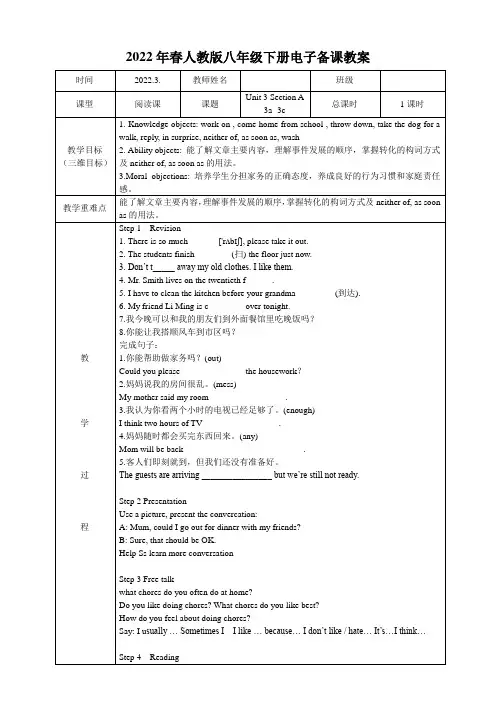
Step 2 Presentation
Use a picture, present the convercation:
A: Mum, could I go out for dinner with my friends?
Read the story and choose the best answer.
( )1. Who wanted a walk?
A.Nancy’s room B. The dog C. Nancy’s dad D. Nancy
( )2. Nancy came home from ________.
B: Sure, that should be OK.
Help Ss learn more conversation
Step 3Free talk
what chores do you often do at home?
Do you like doing chores? What chores do you like best?
D.Because she got back home late.
( )5. How did they solve the problem?
A.Nancy’s mother said sorry to Nancy.
B.Nancy said sorry to her mother and now she understood she should share the housework.
3.我认为你看两个小时的电视已经足够了。(enough)
新人教版八年级英语下册Unit 3 Section A 3a-3c 课件(共23张PPT)
既不......也不...... ___n__e_i_t_h__e_r_._.._n__o_r_______ 我们两都不______n__e_i_t_h__e_r__o_f__u__s___
neither + be /助动词/情态动词+主语 表示 “某人也不....”
4. all the time 汉意___一___直________→(同义词)________a__l_w__a_ys
• (7)take turns 轮流,替换
• (8)It takes sb. sometimes to do sth. 做某事花费某人多长时间
When you read,pay attention to: What: The story tells us the conflict / arguement (争吵) between Nancy and her mother about doing chores. How: cause & effect(原因&结果) conflict & solution
home.
3b Read the sentences.Underlinethe sentences from the reading the the same thing. 1 Neither of us did any housework for a week.
=For one week,she didn’t do any housework and neither did I.
2.Why do you say so?
(三)While-reading I. Read the story again and answer the questions. 1. When did this story happen? ____I_t_h_a_p__p_e_n__e_d__la_s_t__m__o_n_t_h__. _____________ 2. What was the first thing Nancy did when she got home
英语人教版八年级下册Unit-3-SectionA(3a-3c)

when
Last month
where At home
who
Nancy and her mom
Nancy's
what
story
how
why
ending of the story
Nancy understands that _t_h_e__y_n__e_e_d__t_o_s__h_a_r_e__th__e_ir_
Last month, when Nancy came home from school she t_h_r_ew__d_o_w__n_her bag and went to the living room. Her mom came over _a_s_s_o_o_n_a_s_she sat down in front of the TV. Her mother wanted her to__ta_k_e_t_h_e_d_o_g__f_or _a_w_a_l_k_ first, but she wanted to watch one show first.
LaMsot tmheornstha:idNnanoctyhignogt haonmdewfirasltk, ethdenawmaotyh!er came back.
Nancy: Hi,Mom!
Mother: Hi, Nancy! How is it going?
Nancy: It's OK. How about you?
first.
While-reading
Task 2: Let's read the story carefully and complete the mindmap.
when how
(完整版)英语人教版八年级下册Unit3SectionA3a-3c
Unit 3 could you please clean your room?Period 2一、教学内容Section A 3a-3c二、教学目标1.词汇:stay out late, work on the computer, get a ride,use the car, go to a meeting, hate to do /doing sth2.句型:---Could I please go to the movies?---Yes, you can.---Could I please use the computer?--- No, you can’t. You must do the dishes at first.三.重点和难点1.重点。
1)学习和复习一些常用的动词短语。
2)委婉地提出请求、征求许可做某事。
---Could I please use your computer?---Sorry, you can’t..---Could I please watch TV?---Yes, you can. But you have to clean your room first..3)学习如何请求他人的帮助。
2.难点。
1)表达看法:I like doing dishes because it’s relaxing, but I hate to do…because it’s boring.2)区别make与do的用法四. 教学过程。
1.Warming upGame “Chain drill”.运用上节课的target language “Could you please do…?”依次问答,其中的动词短语不能重复,复习动词短语。
2.Listening. 3aRead the instructions. Learn the key vocabulary.stay out late, use the car, get a ride, go to a meeting, clean your room,1) Peter ask his father if he can do four things. Check “yes” or “no”2) Listen again, Why does Peter’s father say “no”Draw lines to the reasons in the chart.3. Present target language由听的活动3a 引入target language:A: Could I please get a ride? B: Yes, you can.A: Could I please get a ride? B: Sorry, you can’t, I have to go to a meeting.4. Pair work 2cAccording the sample conversation, ask and answer in pairs. Then ask and answer inpairs in class.5. 3a Fill in the blanks with “make” and ”do”. Get the students to read the dialogue in pairs, then act out it.6. 3b Chores that you like or dislike,1) 呈现like doing/to do, hate doing2) Make a list of chores that you like and dislike.3) Pairwork.谈论喜欢和不喜欢的家务,并表达自己的看法。
人教版英语八年级下册Unit3SectionA3a~3c教学设计
1.学生在完成作业时,要注重质量,力求达到最佳效果。
2.家长要关注孩子的学习过程,鼓励孩子积极参与,培养良好的学习习惯。
3.教师在批改作业时,要全面了解学生的学习情况,给予及时反馈,提高教学效果。
(3)定期进行听说读写综合测试,了解学生的英语水平,为教学提供依据。
四、教学内容与过程
(一)导入新课
1.教学活动设计:
(1)教师通过展示一幅世界地图,引导学生谈论自己知道的著名旅游景点和他们的旅行经历。
(2)邀请几名学生分享他们的旅行故事,让学生在轻松愉快的氛围中回忆过去的美好时光。
(3)教师引导学生关注旅行中遇到的有趣事情和难忘的经历,为新课的学习做好情感上的铺垫。
4.学生对于一般过去时态的掌握程度不一,部分学生容易在句子中出现时态混淆的现象,需要教师在教学中进行针对性指导。
5.学生的阅读理解能力参差不齐,部分学生对文章细节信息的捕捉和处理能力较弱,需要在教学中加强阅读策略的培养和训练。
6.学生在情感态度方面,对于旅行、文化交流等话题表现出较高的兴趣,有利于激发学生的学习动机和参与度。
(3)听说训练:设计角色扮演活动,让学生模拟课文中的情景,进行对话练习,提高学生的口语表达能力。
(4)阅读理解:引导学生通过略读、寻读等策略,捕捉文章细节信息,提高阅读理解能力。
2.教学方法:
(1)采用任务型教学法,引导学生通过小组合作、讨论等形式,主动参与课堂活动,提高学生的自主学习能力。
(2)利用多媒体教学资源,创设生动、真实的语言环境,激发学生的学习兴趣。
2.教学目的:
通过总结归纳,帮助学生巩固所学知识,培养学生的学习策略,提升学生的情感态度。
五、作业布置
针对本节课的教学内容,特布置以下作业,旨在巩固所学知识,提高学生的语言运用能力,培养学生的学习策略和情感态度:
Unit3SectionA3a-3c课件人教版英语八年级下册
a walk. Nancy watched TV all the time never help out around the house. 2.What was the result when neither Nancy nor her mother did any
3b Read the sentences below. Underline the sentences from the reading that mean the same thing.
1. Neither of us did any housework for a week.
For one week, she did not do any houesework and neither did I.
“Well, I work all day at school , too ! I’mY_o_ju_u_ast_re _ti_ar_sed_at_in_rde_d_I’_ma_s_tiyroeud a, rtoe!o”. I shouted back.
Careful reading:
She __Nd_ied_in_t_’ht_e_rd_ooafnuyshdoiudseawnoyrk _h_no_eFu_ito_shr_ee_wor_noedriwkdeIfe.okr a week.
Let's read.
3C Decide whether the underlined words in the sentences are verbs or nouns. Then write another sentence using the underlined word in another part of speech.
英语人教版八年级下册Unit 3 Section A (3a – 3c)
旦马乡初级中学教学方案授课题目Unit 3Section A (3a – 3c)授课班级八年级授课时间2017年 3 月 15 日授课教师毛桂芳第(2)课时教学目标及教学过程教学目标知识与能力目标1.Learn to make a police request and ask for permission.2.Structure:“could‖ for police requests,“could‖ for permission.方法与情感目标1. Educate students to love their parents.2. Sharing the housework can make the house clean and comfortable.教学重点Be able to understand the passage and learn to make a police request and ask forpermission教学难点Help students learn how to make police request with the target language.学法指导教具运用教学流程师生活动补充与反思step 1 ReviewA: Could you please make sentences with these phrases in the pasttense?B: Sure. I did some chores.take out the trash do chores do the dishessweep the floor make dinner make the bedfold the clothes clean the living room help out withat least finish doing sth. back from shoppingsee this mess mother cleane.g. 1. A: Could you please......?B: Yes, sure./ All right./No problem./CertainlySorry, I can't. I have to do ...Sorry, I can't. I am doing ...2. A: What kind of chores did you do last weekend?B: I did the washes.Step 2 Reading3a Read the passage and answer the following questions.1. Did Nancy do any housework that day?2. Why was Nancy’s mom angry with Nancy?3. Did they solve the problem? How?3b. Read the story again and read the sentences below. Underline thesentences from the reading that mean the same thing.1. Neither of us did any housework for a week.2. My mom came over as soon as I sat down in front of the TV.3. You’re tired, but I’m tired, too.3c. Decide whether the underlined words in the sentences are verbs or nouns. Then write another sentence using the underlined word in the other form.1.Could you take the dog for a walk? (noun)2. Could I watch one show first?3. I can’t work all day.4. You watch TV all the time.5. ―What happened?‖ she asked in surprise.Step 3 Language points1. You watch TV all the time and ...all the time(在该段时间内)一直;向来,一向;时时刻刻;每时每刻e.g. I do this all the time. 我一直是这么做的。
英语人教版八年级下册Unit3.SectionA 3a-3c
人教版新目标英语八年级下册颍州区颍西办事处河水学校Xu XuexueUnit3Could you please clean your room?Section A 3a-3cⅠTeaching Objectivesa.Knowledge objectives:1. Students are able to learn the new words, phrases and sentence patterns.2. Students can understand the main grammar structure and general idea in this passage.b. Ability objectives1. Students are able to improve their reading skills such as skimming and scanning.2. Students can talk about their own problems or worries in a real situation.c. Emotional objectives1. Students can cultivate their confidence and interest in learning English.2. Students will understand their parents better and help their parents share the housework.ⅡTeaching Key and Important pointsa.Teaching key points:1.Students can master some new words, phrases and thetarget language of the text.2.Students can improve their reading skills such as skimmingand scanning.b.Teaching difficult points:1.Students can master some basic reading strategies,predicting for the context of the text, skimming the text for the main idea, scanning the text for the specific information.2.Students use the target language to talk about their ownproblems with their parents.ⅢTeaching MethodsTask-based Teaching method, Communicative Approach,Situational ApproachⅣTeaching AidsMulti-media, ppt, pictures, some beautiful cards.ⅤTeaching ProceduresStep 1 Warm-up and Lead-in(1). Greet students as usual to attract their attentioninto the class.(2). Have a view with students. Lead them to reviewthe sentence patterns they have learnt last class.T: What’s the meaning of this sentence? There are two kinds of answers to this question, do you still remember them?Step 2 Pre-reading(1)Show some pictures about different people who aredoing different chores. Ask students to speak out thename of the activities. Then ask Students a question:Do you often help your mom do chores at home?(2)A ccording to the topic they have talked about, askstudents to predict what the passage talks about. Step 3 While-reading(1)SkimmingT: Boys and girls, do you want to know more aboutNancy’s story? Now please read the passage quickly toget the main idea of the passage. Then answer thefollowing questions:Why was Nancy’s mom angry with her?Did they solve the problem? How?(2)ScanningAsk students to read the passage again to decidewhether these statements are true or false and givereasons.1) I took the dog out for a walk last month.2) Finally, I couldn’t find a clean dish because bo th mymother and I did not do the housework.3) Finally, I shared the housework.(3) Careful reading.Ask students to read the passage carefully and underline the difficult points and important points. Then the teacher set a situation to guide students to guess the meaning of key points while explaining some key phrases and sentences.Step 4 Post-reading(1) Invite a student to retell the passage.(2) Group discussion. Ask students to discuss the following questions for 3-4 minutes:Do you often help your parents do the chores?What will you do if you have problems with your parents? Then the teacher invites some volunteers to present their answers.Step 5 Summary and Homework(1)S ummary: One student acts as an assistant teacherto guide all the students to summarize the key pointsof this class. Then the teacher makes a summary.(2)H omework:1).Everyone has some problems or worries withparents. So please write and send me an e-mail about them.2). Please design a poster to call on students to help parents do some chores.。